anguage is a complex and distinctly human ability that resides in the neuroanatomical and neurophysiological architecture of the human brain
...
Decades of remarkable technological advances have allowed researchers
to study the brain as it performs complex linguistic activities; such
studies have increased scientists’ understanding of and appreciation
for humans’ capacity for language. For
instance, functional
magnetic resonance imaging (fMRI) is a procedure that uses intense
magnetic fields to study how the brain functions during various
activities, as well as during sleep and rest states. The results of
hundreds of studies of the hu-
man brain using fMRI have
substantially improved what we know about the human brain, to include
where and how language is comprehended.
...
Our knowledge about the neural architecture of the brain—including
the neuroanatomy and the neurophysiology of the capacity for
language—has grown exponentially during the last few decades. We can
credit then-President, George H. W. Bush who proclaimed in 1990, the
next 10 years would be the “Decade ofbthe Brain” (Office of the
Federal Register, 1990). The advances in knowledge about
the
brain achieved during the Decade of the Brain and the beginning of the
21st century have provided researchers and students of language
development with unprecedented understanding of how the brain
processes and produces language, and why, in some cases, language does
not develop as expected.
...
Neuroscience
Neuroscience is a branch of science that focuses on the anatomy and
physiology of the nervous system, or the neuroanatomy and
neurophysiology, respec-
tively
The human nervous system includes the central nervous system (CNS, comprising the brain and the spinal cord) and the peripheral nervous system (PNS, comprising the cranial and spinal nerves, which carry information inward to and outward from the brain and spinal cord)
...
Neuroscientists study the anatomical structures of the nervous system (neuroanatomy), and examine how these structures work together as a complex unit and as separate, distinct biological units (neurophysiology)
..
anatomists
Neuroscience is a focused branch of the more general disciplines of anatomy and physiology, which involve the study of body structures and the functions of these structures. More specifically, anatomists study the physical characteristics of body structures and examine how they relate to other structures to form anatomical systems
Physiologists
Physiologists study how body structures function, both individually
and in concert with other structures to form physiological systems.
Neuroscientists
Neuroscientists study the structures
and functions of the
nervous system; their work has benefited tremendously from the rapid
and remarkable advances in imaging technologies that allow researchers
to study nervous system functions and structures at the level of the neuron.
magnetic resonance imaging
Technologies such as magnetic resonance imaging (MRI), positron emission to- mography (PET), computerized tomography (CT) scanning, and magnetoencepha- lography (MEG) provide detailed images of the anatomy and/or physiology of the nervous system
Although commonplace today, researchers only began using MRI
to
examine the brain’s functioning in the early 1990s (Belliveau et al.,
1990). Now, there are entire conferences and organizations devoted to
sharing research findings that involve neuroimaging of the brain
(e.g., the Organization for Human Brain Mapping). See Research
Paradigms: fMRI Studies for information on a brain-imaging
technique that allows researchers to examine brain activity when
an individual is engaged in a specific processing task.
..
neurolinguists,
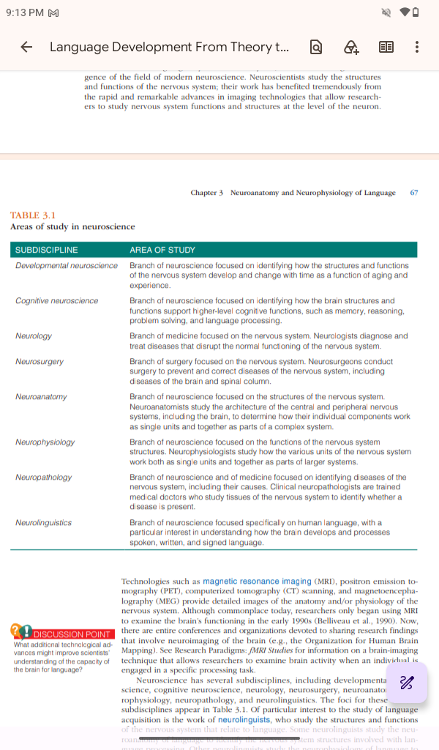
Neuroscience has several subdisciplines, including developmental
neuro- science, cognitive neuroscience, neurology, neurosurgery,
neuroanatomy, neurophysiology, neuropathology, and neurolinguistics.
The foci for these various subdisciplines appear in Table 3.1. Of
particular interest to the study of language acquisition is the work
of neurolinguists, who study the structures and functions of the
nervous system that relate to language. Some neurolinguists study the
neu-
roanatomy of language to identify the nervous system
structures involved with language processing. Other neurolinguists
study the neurophysiology of language to identify the specific ways in
which the nervous system functions, such as how the human brain
processes language. Still, other neurolinguists study the
neuropathol-
ogy of language to identify the ways in which
diseases and injuries affect the functioning of the human nervous
system; for example, some study how various brain structures
reorganize and assume new language functions after injury.
Functional magnetic resonance imaging (
Functional magnetic resonance imaging (fMRI) is a
type of brain
imaging that allows researchers and cli-
nicians to identify the
brain structures involved in spe-
cific mental functions. fMRI is
a noninvasive procedure
that maps neural activities (i.e.,
functions) to specific
neural regions (i.e., structures)
according to changes
in blood oxygen levels that correspond to
changes in
neural activity (Brown, Cheng, Haacke, Thompson,
&
Venkatesan, 2014). fMRI uses MRI technology, which
provides structural scans of the brain (e.g.,
measure-
ments of anatomical regions of the brain). However,
fMRI differs from MRI in that it maps brain functioning
by
examining brain activity when individuals are en-
gaged in a
specific processing task (e.g., listening to
yes–no questions)
or in a resting state. fMRI has signif-
icant benefits over other
types of brain-imaging tech-
nologies, such as PET scans, because
it requires no
injections of radioactive materials, images can
be col-
lected relatively quickly (often with a single pass), and
the resultant images are of extremely high resolution.
An
example of an image obtained by using fMRI is
presented in the
figure accompanying this box.
One example of the potential for fMRI to improve
understanding
of language functions in the brain is de-
scribed in a study by a
team of scientists in the Nether-
lands (Groen et al., 2010). In
Chapter 2, we noted that
children with autism spectrum disorder
(ASD) exhibit
difficulties with social aspects of communication.
One
such difficulty involves the ability to integrate
informa-
tion that is important for communicating socially. For
instance, when communicating with others, we must
integrate our knowledge about the speaker with our
knowledge of what words to use to communicate
ef-
fectively. This is called linguistic-context integration
(we must match our language to the context in which
we are
communicating). When speaking to a 3-year-
old, we might choose
to use the word “frog” rather than
“amphibian” because we
understand a young child is
more likely to be familiar with the
former than the latter.
Persons with ASD have difficulty
integrating these and other types of information, which leads to
difficulties with social communication.
..
Few studies have sought to determine whether
there is a neural
basis for this difficulty. That is, whether
differences exist in
the brain functions of persons with
ASD compared to those
without ASD that cause dif-
ficulties with social communication.
Groen and col-
leagues sought to determine whether this was the
case by using fMRI to study the brain functions of 30
adolescents with ASD and 31 adolescents who were
typically
developing (TD). The participants listened ei-
ther to sentences
that involved integrating congruent
information (the integrated
information made sense)
or incongruent information (the
integrated informa-
tion didn’t make sense). For instance, the
participants
heard the sentence “If only I looked like Britney
Spears
in her latest video” as spoken by both a male and a
female (Groen et al., 2010, p. 1939). When spoken by
a
female, the linguistic-context integration is congru-
ent; when
spoken by a male, it is not. The research-
ers identified several
regions of interest (ROIs) near
Broca’s area to examine brain
functions while partic-
ipants heard these congruent and
incongruent sen-
tences. They found adolescents with ASD showed
less
activation in the ROIs when hearing linguistic-context
incongruent sentences than the TD participants.
Ado-
lescents with ASD do not seem to process incongruent
information in the way their typical peers do, suggest-
ing
that social-communication difficulties of persons
with ADS may
have a neural basis.
..
human brain processes language. Still, other neurolinguists study the neuropathology of language to identify the ways in which diseases and injuries affect the functioning of the human nervous system; for example, some study how various brain structures reorganize and assume new language functions after injury.
..
Linguistics and psycholinguistics are additional disciplines that have yielded considerable advances in understanding language
..
Linguistics
Linguistics is a broad field concerned specifically with language as a developmental and ecological phenomenon
psycholinguistics
psycholinguistics is a more focused field dealing with the cognitive processes involved in developing, processing, and producing human language
Psycholinguistics
Psycholinguistics is the study of the psychology of language, an integration of the fields of psychology and linguistics. It also involves studying the language and com- municative capacities of other species, such as nonhuman primate
Terminology
Students of language development require knowledge
of the specific terminology, or nomenclature, to describe anatomy and
physiology, as well as the neuroanatomy and neurophysiology of
language. Much of this terminology has its roots in ancient Latin and Greek.
...
Nervous System Axes
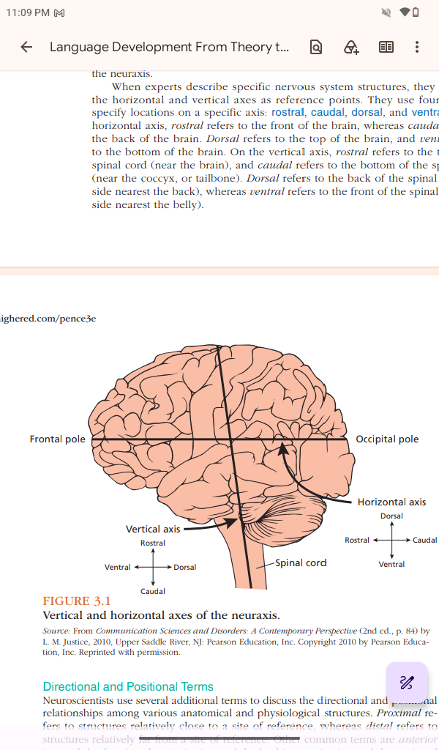
The human nervous system is organized along
two axes: the horizontal axis and the vertical axis. Together, these
axes compose the T-shaped neuraxis.
..
The horizontal
The horizontal
axis runs from the anterior (frontal) pole of the brain to the posterior (occipital) pole
vertical axis
The vertical axis extends from the superior portion of the brain downward along the entire spinal cord. Figure 3.1 depicts the horizontal and vertical axes of the neuraxis.
...
When experts describe specific nervous system structures, they often use the horizontal and vertical axes as reference points. They use four terms to specify locations on a specific axis: rostral, caudal, dorsal, and ventral.
rostral
On the
horizontal axis, rostral refers to the front of the brain,
caudal
whereas caudal refers to
the back of the brain
Dorsal
refers to the top of the brain,
ventral
refers
to the bottom of the brain
vertical axis,
On the vertical axis, rostral refers to the top of the
spinal
cord (near the brain),
caudal refers
and caudal refers to the bottom of the spinal cord
(near the
coccyx, or tailbone).
caudal
caudal refers to the bottom of the spinal cord
(near the
coccyx, or tailbone).
Dorsal
Dorsal refers to the back of the spinal cord (the side nearest the back), whereas
ventral
whereas ventral refers to the front of the spinal cord (the
side nearest the belly).
Directional and Positional Terms
Directional and Positional Terms
Neuroscientists use several
additional terms to discuss the directional and positional
relationships among various anatomical and physiological structures.
Proximal
Proximal refers to structures relatively close to a site of reference
distal
distal refers to
structures relatively far from a site of reference.
anterior
Other common terms are anterior
(toward the front) an
posterior
posterior (toward the back
superior
superior (toward the top)
inferior
(toward the bottom
external
external (toward the outside)
internal
internal (toward
the inside
efferent
and efferent (away from the brain)
Efferent pathways (also called descending pathways) move away from the brain, carrying motor impulses from the central nervous system to more distal body structure
afferent
afferent (toward the brain).
Afferent pathways (also called ascending pathways) move toward
the brain, carrying sensory information from the distal body
structures to the brain
and efferent (away from the brain) and afferent (toward the brain). The last two terms often describe the pathways of information as it moves to and from the brain
..
Neuroscience Basics
The human nervous system, like that of many
other species, is a complex anatomical and physiological structure
that includes the brain, the spinal cord, and sets of nerves that
carry information to and from the brain and spinal cord. The human
nervous system mediates nearly all aspects of human behavior, with few exceptions
..