Instructions for Side by Side Printing
- Print the notecards
- Fold each page in half along the solid vertical line
- Cut out the notecards by cutting along each horizontal dotted line
- Optional: Glue, tape or staple the ends of each notecard together
3063 chapter 3
front 1 anguage is a complex and distinctly human ability that resides in the neuroanatomical and neurophysiological architecture of the human brain | back 1 ... |
front 2 Decades of remarkable technological advances have allowed researchers
to study the brain as it performs complex linguistic activities; such
studies have increased scientists’ understanding of and appreciation
for humans’ capacity for language. For | back 2 ... |
front 3 Our knowledge about the neural architecture of the brain—including
the neuroanatomy and the neurophysiology of the capacity for
language—has grown exponentially during the last few decades. We can
credit then-President, George H. W. Bush who proclaimed in 1990, the
next 10 years would be the “Decade ofbthe Brain” (Office of the
Federal Register, 1990). The advances in knowledge about | back 3 ... |
front 4 Neuroscience | back 4 Neuroscience is a branch of science that focuses on the anatomy and
physiology of the nervous system, or the neuroanatomy and
neurophysiology, respec- |
front 5 The human nervous system includes the central nervous system (CNS, comprising the brain and the spinal cord) and the peripheral nervous system (PNS, comprising the cranial and spinal nerves, which carry information inward to and outward from the brain and spinal cord) | back 5 ... |
front 6 Neuroscientists study the anatomical structures of the nervous system (neuroanatomy), and examine how these structures work together as a complex unit and as separate, distinct biological units (neurophysiology) | back 6 .. |
front 7 anatomists | back 7 Neuroscience is a focused branch of the more general disciplines of anatomy and physiology, which involve the study of body structures and the functions of these structures. More specifically, anatomists study the physical characteristics of body structures and examine how they relate to other structures to form anatomical systems |
front 8 Physiologists | back 8 Physiologists study how body structures function, both individually
|
front 9 Neuroscientists | back 9 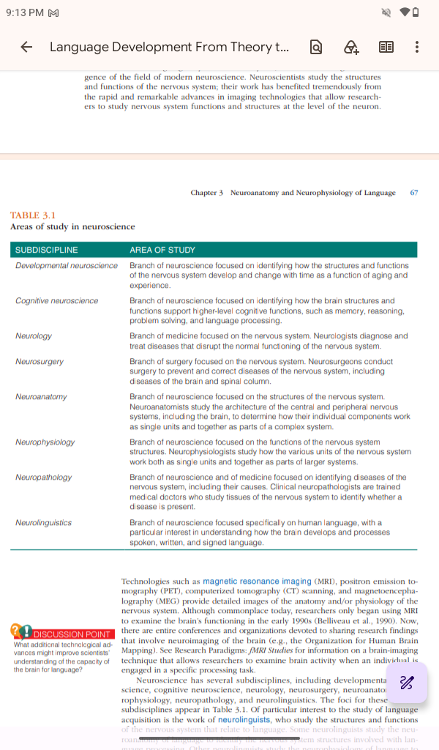 Neuroscientists study the structures |
front 10 magnetic resonance imaging | back 10 Technologies such as magnetic resonance imaging (MRI), positron emission to- mography (PET), computerized tomography (CT) scanning, and magnetoencepha- lography (MEG) provide detailed images of the anatomy and/or physiology of the nervous system |
front 11 Although commonplace today, researchers only began using MRI | back 11 .. |
front 12 neurolinguists, | back 12 Neuroscience has several subdisciplines, including developmental
neuro- science, cognitive neuroscience, neurology, neurosurgery,
neuroanatomy, neurophysiology, neuropathology, and neurolinguistics.
The foci for these various subdisciplines appear in Table 3.1. Of
particular interest to the study of language acquisition is the work
of neurolinguists, who study the structures and functions of the
nervous system that relate to language. Some neurolinguists study the
neu- |
front 13 Functional magnetic resonance imaging ( | back 13 Functional magnetic resonance imaging (fMRI) is a |
front 14 One example of the potential for fMRI to improve | back 14 .. |
front 15 Few studies have sought to determine whether | back 15 .. |
front 16 human brain processes language. Still, other neurolinguists study the neuropathology of language to identify the ways in which diseases and injuries affect the functioning of the human nervous system; for example, some study how various brain structures reorganize and assume new language functions after injury. | back 16 .. |
front 17 Linguistics and psycholinguistics are additional disciplines that have yielded considerable advances in understanding language | back 17 .. |
front 18 Linguistics | back 18 Linguistics is a broad field concerned specifically with language as a developmental and ecological phenomenon |
front 19 psycholinguistics | back 19 psycholinguistics is a more focused field dealing with the cognitive processes involved in developing, processing, and producing human language |
front 20 Psycholinguistics | back 20 Psycholinguistics is the study of the psychology of language, an integration of the fields of psychology and linguistics. It also involves studying the language and com- municative capacities of other species, such as nonhuman primate |
front 21 Terminology | back 21 ... |
front 22 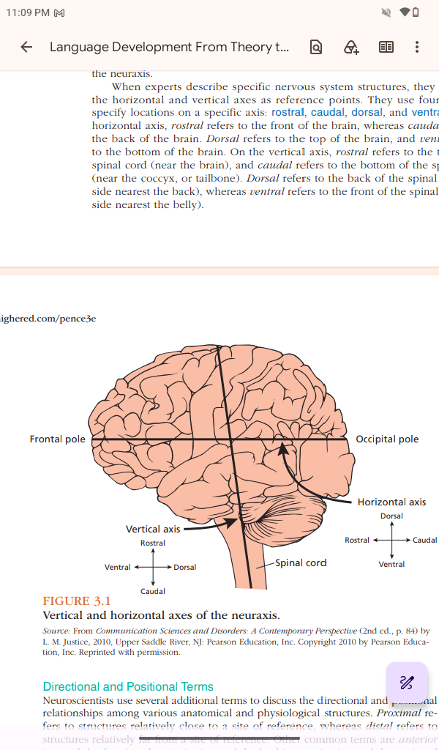 Nervous System Axes | back 22 .. |
front 23 The horizontal | back 23 The horizontal axis runs from the anterior (frontal) pole of the brain to the posterior (occipital) pole |
front 24 vertical axis | back 24 The vertical axis extends from the superior portion of the brain downward along the entire spinal cord. Figure 3.1 depicts the horizontal and vertical axes of the neuraxis. |
front 25 ... | back 25 When experts describe specific nervous system structures, they often use the horizontal and vertical axes as reference points. They use four terms to specify locations on a specific axis: rostral, caudal, dorsal, and ventral. |
front 26 rostral | back 26 On the |
front 27 caudal | back 27 whereas caudal refers to |
front 28 Dorsal | back 28 refers to the top of the brain, |
front 29 ventral | back 29 refers |
front 30 vertical axis, | back 30 On the vertical axis, rostral refers to the top of the |
front 31 caudal refers | back 31 and caudal refers to the bottom of the spinal cord |
front 32 caudal | back 32 caudal refers to the bottom of the spinal cord |
front 33 Dorsal | back 33 Dorsal refers to the back of the spinal cord (the side nearest the back), whereas |
front 34 ventral | back 34 whereas ventral refers to the front of the spinal cord (the
|
front 35 Directional and Positional Terms | back 35 Directional and Positional Terms |
front 36 Proximal | back 36 Proximal refers to structures relatively close to a site of reference |
front 37 distal | back 37 distal refers to |
front 38 anterior | back 38 Other common terms are anterior |
front 39 posterior | back 39 posterior (toward the back |
front 40 superior | back 40 superior (toward the top) |
front 41 inferior | back 41 (toward the bottom |
front 42 external | back 42 external (toward the outside) |
front 43 internal | back 43 internal (toward |
front 44 efferent | back 44 and efferent (away from the brain) Efferent pathways (also called descending pathways) move away from the brain, carrying motor impulses from the central nervous system to more distal body structure |
front 45 afferent | back 45 afferent (toward the brain). Afferent pathways (also called ascending pathways) move toward
|
front 46 and efferent (away from the brain) and afferent (toward the brain). The last two terms often describe the pathways of information as it moves to and from the brain | back 46 .. |
front 47 Neuroscience Basics | back 47 .. |