The immunoglobulin heavy-chain gene segments are found on which chromosome?
Chromosome 14
Each B-cell receptor is built from which chains?
Heavy and light chains
A developing B cell has two copies of chromosome 14. How many heavy-chain loci are ultimately used?
One
A B-cell heavy-chain locus successfully makes a
functional heavy chain. What is this called?
A. Class switching
B. Productive rearrangement
C. Affinity
maturation
D. Somatic hypermutation
B. Productive rearrangement
One chromosome 14 successfully rearranges first.
What happens to the other chromosome 14 locus?
A. It class
switches
B. It makes Igβ
C. It is silenced
D. It
binds antigen
C. It is silenced
A mature B cell has completed receptor development.
How many BCR specificities does it produce?
A.
Two
B. One
C. Dozens
D. Hundreds
B. One
The antigen recognized by a B cell’s receptors is called its what?
_____ antigen
Cognate antigen
A BCR binds one small portion of a
bacterial protein. What is that region
called?
A. Isotype
B. Haplotype
C. Cognate
antigen
D. Epitope
D. Epitope
Which two accessory proteins transmit BCR signals inward?
Igα and Igβ
Igα and Igβ are important because they help transmit
signals to the what?
A. Lysosome
B. Thymus
C.
Nucleus
D. Complement system
C. Nucleus
A soluble antigen binds only one
BCR weakly. What event is usually needed for
strong activation?
A. BCR crosslinking
B. C9 insertion
C. Fas binding
D. MHC loss
A. BCR crosslinking
BCR crosslinking helps activation by
clustering which molecules?
A. C3a and
C5a
B. CD4 and CD8
C. Heavy and light chains
D. Igα
and Igβ
D. Igα and Igβ
Crosslinking can serve as a _____ so B cells are not activated all the time.
safeguard
Besides BCRs, B cells also carry receptors for which
immune system component?
A. Interferon
B. Complement
C. Perforin
D. Hemoglobin
B. Complement
A bacterial antigen is coated with complement fragments. Which B-cell
receptor can bind those fragments?
A. Complement receptor
B. T-cell receptor
C. Fas receptor
D. Fc receptor
A. Complement receptor
A B cell binds both an epitope and a complement fragment. What is the complement receptor called?
Co-receptor
A B cell has never encountered its cognate antigen. What is it
called?
A. Experienced B cell
B. Plasma B cell
C.
Naive B cell
D. Memory B cell
C. Naive B cell
Which term also describes a naive B cell?
A. Effector
B.
Virgin
C. Experienced
D. Activated
B. Virgin
A B cell has already encountered its cognate antigen. What is it
called?
A. Virgin B cell
B. Immature B cell
C. Naive
B cell
D. Experienced B cell
D. Experienced B cell
Most naive B cells require how many signals for activation?
A.
Two
B. One
C. Three
D. Four
A. Two
For naive B cells, in T-cell-dependent activation, what is signal 1?
____ ____
BCR crosslinking
For naive B cells, in T-cell-dependent activation, which cell supplies signal 2?
____ ____ ____
Helper T cell
The second signal for naive B-cell activation is also called
what?
A. Co-stimulatory signal
B. Opsonizing signal
C. Apoptotic signal
D. Neutralizing signal
A. Co-stimulatory signal
A naive B cell needs helper T-cell assistance for activation. What is
this called?
A. Alternative activation
B. Lectin
activation
C. T-cell-dependent activation
D. Complement activation
C. T-cell-dependent activation
During T-cell-dependent activation, helper T cells
use which surface molecule?
A. CD40
B.
CD40L
C. Igα
D. Igβ
B. CD40L
CD40L on helper T cells interacts
with which B-cell molecule?
A. Igβ
B.
ICAM
C. Fas
D. CD40
D. CD40
The CD40L-CD40 interaction provides which signal?
A. Signal
1
B. Co-stimulatory signal
C. Complement signal
D.
Danger signal only
B. Co-stimulatory signal
A polysaccharide antigen has many identical
repeated epitopes. What can it strongly cause?
A.
CD40 silencing
B. MHC I loss
C. BCR crosslinking
D.
Igβ destruction
C. BCR crosslinking
Repeated epitopes activate B cells
without helper T cells. What is this called?
A. T-cell-independent activation
B. T-cell-dependent
activation
C. Productive rearrangement
D. Somatic hypermutation
A. T-cell-independent activation
Even in T-cell-independent activation, what additional signal is
still required?
A. CD40L signal
B. Thymic signal
C.
Antibody signal
D. Danger signal
D. Danger signal
Which self molecule has repeated epitopes but
should not normally activate B cells?
A.
TNF
B. DNA
C. LPS
D. C3b
B. DNA
During heavy-chain selection, both
chromosome 14 copies initially do what?
A.
Rearrange gene segments
B. Secrete antibodies
C. Bind
helper T cells
D. Express CD40L
A. Rearrange gene segments
The “winner” chromosome 14 is selected because it makes what first?
____ ____ ____
Functional heavy chain
A mature B cell secretes antibodies matching its surface BCR. How
many antibody types does it make?
A. Two unrelated types
B. One specific type
C. Many random types
D. Four chain types
B. One specific type
BCR crosslinking is essential because one BCR alone usually gives
what?
A. Excessive apoptosis
B. Strong complement
activation
C. Immediate antibody secretion
D. Weak
activation signaling
D. Weak activation signaling
A B cell binds complement-coated antigen through its co-receptor.
What happens to signaling?
A. It is amplified
B. It is
blocked
C. It becomes unrelated
D. It causes silence
A. It is amplified
Why is the complement receptor considered a
co-receptor?
A. It makes antibodies
B.
It replaces BCRs
C. It strengthens signaling
D. It
silences CD40
C. It strengthens signaling
Which combination gives a stronger B-cell signal?
A. Complement
binding alone
B. BCR plus complement receptor
C. CD40
alone
D. Igβ alone
B. BCR plus complement receptor
Which antigen type is most likely to activate B cells without helper
T-cell co-stimulation?
A. Single epitope protein
B. Small
soluble peptide
C. Host DNA alone
D. Repetitive polysaccharide
D. Repetitive polysaccharide
T-cell-independent activation still needs a
danger signal to prevent what?
A. Class
switching
B. Random self-attack
C. Heavy-chain
failure
D. Complement production
B. Random self-attack
Why does DNA not normally trigger strong B-cell activation despite repeated epitopes?
____ signal is absent
Danger signal is absent
Helper T cells recognize antigen mainly through which
molecule?
A. Class I MHC
B. B-cell receptor
C.
Complement receptor
D. Class II MHC
D. Class II MHC
T-cell-independent activation helps adaptive immunity respond to _____ and _____
carbs and fats
A parasite produces a molecule that activates many unrelated B cells. What is this molecule called?
_____
Mitogen
A mitogen activates B cells by binding molecules other than
what?
A. BCRs
B. CD40
C. Complement
D. IgM
A. BCRs
A parasite causes many nonspecific B cells to
activate at once. What is this called?
A.
Class switching
B. Affinity maturation
C. Complement
fixation
D. Polyclonal activation
D. Polyclonal activation
In polyclonal activation, BCRs become crosslinked by what mechanism?
Crosslinking by _____
Crosslinking by proxy
Some parasites use polyclonal activation mainly to do what?
_____ _____ response
Distract immune response
After activation and proliferation, B cells enter maturation with
roughly how many possible steps?
A. One
B. Two
C.
Three
D. Four
C. Three
Which maturation step lets B cells change antibody class?
A.
Somatic hypermutation
B. Class switching
C. Polyclonal
activation
D. Complement fixation
B. Class switching
Which maturation step can increase BCR affinity?
A. Class switching
B. ADCC
C. Complement
fixation
D. Somatic hypermutation
D. Somatic hypermutation
Somatic hypermutation changes BCRs
to improve binding to what?
A. Cognate
antigen
B. Class II MHC
C. C1 inhibitor
D. Fc receptor
A. Cognate antigen
During the “career decision,” a B cell may become which antibody
factory?
A. Memory B cell
B. Virgin B cell
C. Plasma
B cell
D. Naive B cell
C. Plasma B cell
During maturation, a B cell may also become which long-lived
cell?
A. Mitogen cell
B. Memory B cell
C. C1
complex
D. Helper T cell
B. Memory B cell
The three maturation events must occur in what order?
A. Class
switch first
B. Hypermutation first
C. No required
order
D. Plasma decision first
C. No required order
Which statement about B-cell maturation steps is correct?
A.
Not all must occur
B. All always occur
C. They need
TLR4
D. IgM blocks them
A. Not all must occur
When a virgin B cell is first activated, it mainly produces which antibody?
IgM
First-activated virgin B cells can also produce tiny amounts of which antibody?
IgD
The immune function of IgD is best described as what?
Unclear
Class switching changes antibody production from IgM to which
possible class?
A. IgM only
B. IgD only
C. IgG, IgE,
or IgA
D. C1, C3, or C5
C. IgG, IgE, or IgA
In class switching, which antibody region remains unchanged?
A.
Fc region
B. Fab region
C. C1 region
D. Heavy
constant only
B. Fab region
In class switching, which antibody region changes?
A. Fab
region
B. Epitope region
C. Antigen-binding region
D. Constant Fc region
D. Constant Fc region
After class switching, antigen specificity does
what?
A. Stays the same
B. Becomes random
C.
Recognizes MHC
D. Recognizes complement
A. Stays the same
After class switching, antibody function changes
because the antibody gets what?
A. New Fab region
B. New
Fc region
C. New epitope
D. New antigen
B. New Fc region
Which antibody is especially good at activating complement?
IgM
Activating complement by antibody is also called what?
A.
Neutralizing complement
B. Opsonizing complement
C. Fixing
complement
D. Silencing complement
C. Fixing complement
In blood, about 30 complement proteins form which complex?
C1
C1 complexes are normally bound by what?
A. Inhibitors
B.
Antibodies
C. Fc receptors
D. Mitogens
A. Inhibitors
What happens when two C1 complexes come close together?
A. They
bind DNA
B. They become IgM
C. They cross placenta
D. Inhibitors fall off
D. Inhibitors fall off
C1 inhibitor release allows which process to begin?
____ ____
Complement cascade
IgM must first bind what before efficiently activating C1?
_____
Antigen
Antigen-bound IgM can bind multiple C1 complexes using what region?
____ region
Fc regions
Antigen-bound IgM brings C1 complexes together, triggering
what?
A. Somatic hypermutation
B. Complement cascade
C. Class II display
D. IgD production
B. Complement cascade
IgG can fix complement, but which antibody does it more efficiently?
IgM
Why is IgM especially efficient at fixing complement?
A. It
crosses placenta
B. It has five Fc regions
C. It binds NK
cells
D. It lacks Fab regions
B. It has five Fc regions
Among IgG subclasses, which fixes the most complement?
A.
IgG1
B. IgG2
C. IgG4
D. IgG3
D. IgG3
Which IgG subclass is best at opsonizing invaders?
A.
IgG1
B. IgG2
C. IgG3
D. IgG4
A. IgG1
Besides complement fixation, IgG3 can help perform
which process?
A. Somatic hypermutation
B. T-independent
activation
C. Mitogen activation
D. Antibody-dependent
cellular cytotoxicity
D. Antibody-dependent cellular cytotoxicity
IgG3 ____ the target cell, and the NK cell binds the IgG3 Fc region through ____. This links the NK cell to the target and activates killing.
coats
CD16
Which antibody class can transfer from mother to fetus?
IgG
Maternal IgG reaches the fetus from the mother’s what?
_____
Blood
Maternal IgG protects the infant until what happens?
A. Infant
makes its own
B. IgM crosses placenta
C. C1 becomes
active
D. IgD matures
A. Infant makes its own
IgG supplied from the mother protects infants for roughly how
long?
A. Hours after birth
B. One day after birth
C.
Several months after birth
D. Until adolescence
C. Several months after birth
Another term for IgG antibodies is what?
A. Gamma
globulins
B. Alpha globulins
C. Beta globulins
D. C1 globulins
A. Gamma globulins
After hepatitis A exposure, some patients receive
what injection?
A. IgM vaccine
B. Complement
inhibitor
C. Mitogen blocker
D. Gamma globulin
D. Gamma globulin
Gamma globulin injections contain antibodies from how many
people?
A. Many donors
B. One donor
C. Fetal donors
only
D. Parasite-infected donors
A. Many donors
Why can pooled gamma globulin help after hepatitis A exposure?
A. It supplies mitogens
B. It kills B cells
C. Some donors
have anti-HAV antibodies
D. It blocks class II MHC
C. Some donors have anti-HAV antibodies
The goal of gamma globulin after exposure is to help do what?
A. Neutralize the virus
B. Trigger polyclonal activation
C. Fix all complement
D. Block NK cells
A. Neutralize the virus
Gamma globulin protection is meant to last until what occurs?
A. C1 disappears
B. IgD function clarifies
C. Own immune
response develops
D. Mitogens leave blood
C. Own immune response develops
Polyclonal activation is dangerous because it activates B cells
how?
A. Antigen-specific
B. Nonspecifically
C. Via
its memory cells
D. Via its IgG cells
B. Nonspecifically
A patient receives pooled IgG after HAV exposure. What type of
immunity is this?
A. Active adaptive
B. Innate
cellular
C. Passive antibody-mediated
D. T-cell dependent
C. Passive antibody-mediated
Which feature remains constant after class switching?
A.
Antigen bound
B. Fc-mediated function
C. Antibody
class
D. Complement ability
A. Antigen bound
Which feature changes after class switching?
A. Cognate
antigen
B. Epitope recognized
C. Fab specificity
D.
Effector function
D. Effector function
Which antibody is most abundant overall in the body?
IgA
Which antibody is most abundant in blood?
IgG
A patient has recurrent infections at mucosal surfaces. Which antibody class is most important there?
IgA
The “clip” structure of IgA helps transport
IgA across which barrier?
A. Placental barrier
B. Intestinal wall
C. Blood-brain barrier
D. Splenic sinusoid
B. Intestinal wall
The IgA “clip” structure helps
resist which threat?
A. Digestive acids and
enzymes
B. Complement-mediated lysis
C. Mast-cell
degranulation
D. T-cell apoptosis
A. Digestive acids and enzymes
A breastfeeding infant receives antibody protection coating the gut mucosa. Which antibody is provided?
IgA
Why is IgA poor at fixing complement?
A. IgA lacks Fab
regions
B. C1 cannot bind IgA Fc
C. IgA destroys
complement proteins
D. IgA blocks all cytokines
B. C1 cannot bind IgA Fc
Anaphylactic shock is caused by _____ of _____ cells.
degranulation
mast
Mast-cell degranulation releases which major
active chemical?
A. Histamine
B.
Perforin
C. C3b
D. IFN-gamma
A. Histamine
IgE is produced in response to what?
A. Self
DNA
B. Allergens
C. C1 complexes
D. MHC I loss
B. Allergens
Which cells carry IgE receptors involved in
allergy?
A. Neutrophils
B. Plasma
cells
C. Mast cells
D. Erythrocytes
C. Mast cells
IgE-bound mast cells dump granules
into tissues. What is this process called?
A.
Degranulation
B. Opsonization
C. Neutralization
D.
Affinity maturation
A. Degranulation
Antibody class switching is controlled mainly by _____ encountered by activated _____ cells.
cytokines
B
Examples of cytokines encoutered and class switching:
IL-4, IL-5 → ____ subclasses
IFN-γ → opsonizing ____ subclasses
TGF-β → ____
IgE
IgG
IgA
IL-4 and IL-5 are abundant in ____ reactions and ____ infections.
allergic
parasitic
Very high mutation rates occur in selected
B-cell gene regions. What is this called?
A. Somatic
hypermutation
B. Class switching
C. Polyclonal
activation
D. Complement fixation
A. Somatic hypermutation
Somatic hypermutation especially affects regions
containing which segments?
A. C only
B. V, D, J
C. Fc and C2
D. C1 and V
B. V, D, J
Somatic hypermutation occurs after which event?
A. Mast-cell
priming
B. VDJ selection
C. IgA secretion
D.
Complement fixation
B. VDJ selection
Somatic hypermutation occurs after which rearrangement is
selected?
A. Productive rearrangement
B. Polyclonal
rearrangement
C. Fc rearrangement
D. Complement rearrangement
A. Productive rearrangement
Somatic hypermutation can affect BCR affinity in which way?
A.
Increase only
B. Decrease only
C. Increase, decrease, or
unchanged
D. Always unchanged
C. Increase, decrease, or unchanged
B cells with higher-affinity BCRs compete better for what?
A.
T-cell help
B. C1 inhibitor
C. Mast-cell granules
D.
Intestinal transport
A. T-cell help
During affinity selection, T-cell help is best
described as what?
A. Unlimited
B. Irrelevant
C.
Limited
D. Toxic
C. Limited
The end result of somatic hypermutation is BCRs that bind antigen
how?
A. Weakly
B. Tightly
C. Randomly
D. Nonspecifically
B. Tightly
Fine-tuning BCRs toward higher average affinity is called what?
A. Class switching
B. Polyclonal activation
C. Complement
fixation
D. Affinity maturation
D. Affinity maturation
T-cell-independent B-cell activation usually lacks which processes?
____ ____ and ____ ____
Class switching and Somatic Hypermutation
B cells activated independently of T cells do not produce which cells?
____ B cells
Memory B cells
In T-cell-independent activation, activated B cells become what?
____ B cells
Plasma B cells
Maternal milk IgA mainly protects against
pathogens entering through what route?
A. Respiratory inhalation
B. Placental circulation
C. Skin
abrasions
D. Ingestion
D. Ingestion
The alternative complement pathway is _____
The classical complement pathway is _____
nonspecific
specific
The longest lived antibody class is ____
IgG
Which antibody is the least abundant in the body?
IgE
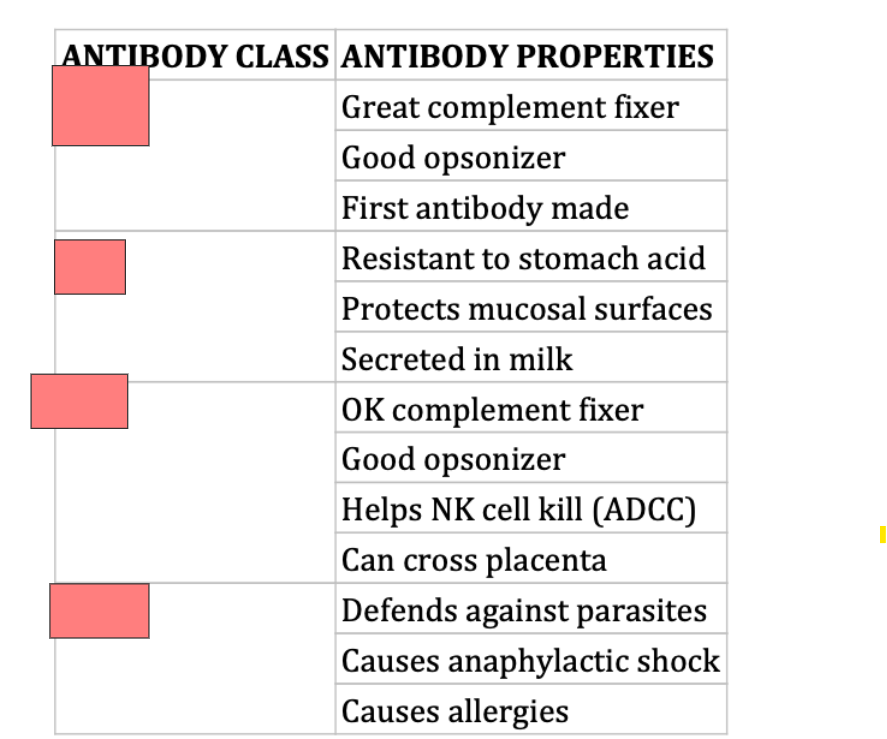
IgM
IgA
IgG
IgE
A pathogen is coated with complement fragments. Which B-cell mechanism helps recognize this opsonized invader?
A. B-cell coreceptors
B. T-cell receptor rearrangement
C. NK-cell CD16 binding
D. Mast cell degranulation
A. B-cell coreceptors
Direct binding of antigen to which receptor can signal a B cell?
A. CD8
B. BCR
C. MHC I
D. FcεRI
B. BCR
T-cell independent B-cell activation first starts with which event?
A. Class switching before antigen binding
B. Cytokine release by Th2 cells
C. Plasma cell apoptosis
D. Crosslinking of BCRs
D. Crosslinking of BCRs
A bacterial polysaccharide antigen binds and crosslinks multiple BCRs on a B cell. What type of activation can this initiate?
A. T-cell independent B-cell activation
B. CD8 T-cell activation
C. NK-cell licensing
D. IgE-mediated mast cell activation
A. T-cell independent B-cell activation
After BCR crosslinking, T-cell independent B-cell activation also requires what?
A. MHC I downregulation
B. A naive helper T cell
C. An active bacterial invader or danger signal
D. Eosinophil activation
C. An active bacterial invader or danger signal
T-cell independent B-cell activation is best described as which type of process?
A. Antigen nonspecific
B. Antigen specific
C. MHC I restricted
D. NK-cell dependent
B. Antigen specific
Most B cells activated without T-cell help are found in which organ
A. Thymus
B. Bone marrow
C. Lymph node cortex
D. Spleen
D. Spleen
A splenectomized patient is especially vulnerable to encapsulated bacteria. Which organism is a classic example?
A. *Streptococcus pneumoniae*
B. *Candida albicans*
C. *Histoplasma capsulatum*
D. *Trichophyton rubrum*
A. *Streptococcus pneumoniae*