Communication is an exchange between a sender and a receiver? True or False
True
Speech
The oral production of the sounds, sound patterns, and intonations of a language.
Language
A code that consists of a set of symbols and the knowledge about how to use those symbols to convey thoughts and feelings.
Pragmatics
Set up rules for language use (social use & understanding)
Morphology
Rules governing internal word order; the study of forms of words
Phonology
Rules governing the combination of individual speech sounds
Syntax
Rules governing sentence structure (grammar)
Semantics
Refers to meaning
If I were teaching a 6 year old the rules of how to take turns in a conversation, I would be working on what dimension of language?
Semantics
Pragmatics
Syntax
Phonology
Pragmatics
To practice as a speech language pathologist independently, in all capacities without the need for a supervisor and have your CCCs from ASHA, you must have a master's degree. True or False?
True
Which of the following settings were discussed in lecture as options for work settings? (choose all that apply)
School
Corporations
Home Health Agencies
Hospitals
COMMUNICATION
What is communication?
– An exchange of meaning between a sender
and a receiver.
– The primary means through which people exchange
thoughts &
ideas, express feelings, pass on traditions,
conduct business,
teach, and learn, etc.
– “ the
transmission of thoughts and feelings from the mind of a
speaker
to the mind of a listener” (Borden, Harris & Raphael,
1994).
– Can be intentional or unintentional.
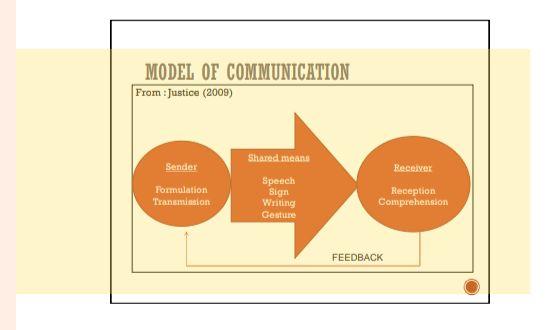
MODEL OF COMMUNICATION
model of communication from justice in 2009. communication entails a receiver and sender. the sender is the one that formulates the message and that requires language. and then also after formulating the message, the sender then transmits that message, and the receiver on the other end has to be able to receive the message. and in order to receive that message, it has to be in a modality that the receiver is able to receive it. for instance if both the sender and receiver are able to use spoken language, then speech could be the modality, but if the sender's sends spoken language message and the receiver is not equipped to receive that or prefers sign language. then there would be a breakdown in communication. so from that angle then there has to be a shared means or a shared modality or a shared mode of communication and there could be varied number of modalities including spoken language or speech, signed language, writing, gesturing. another important piece of this model of communication is the feedback. so oftentimes the receiver can provide the feedback or the sender can sende whether the message is being communicated in an effective manner and can readjust or resend the message based on the feedback
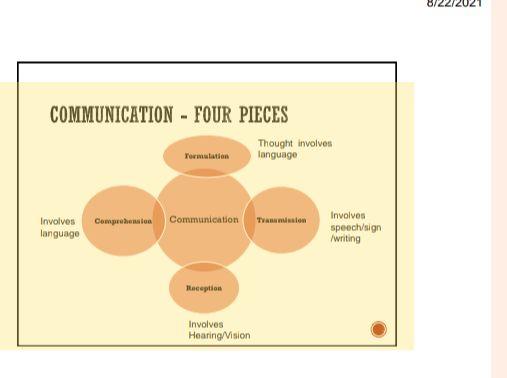
Communication four pieces
important aspects of communication which is formulation. formulation requires thought which requires language. so knowledge if language is important in order to firmulate a massage and then in order to transmit, the person needs to have some means to transmit that whether its speech, sign, writing or gesturing and each of that, those aspects have a place. we sometimes might just need to write, sometimes we may need to gesture.
transmission entails different modes of communication depending on the situation. and then the reception requires our sensitive system to be functioning well. it could either be hearing, it could be vision and if theres a breakdown in the system, then that could hamper communication.
lastly comprehension requires language. the person who received the information not only needs to receive it through the sensory system well, but they also need to have the language in order to comprehend the message
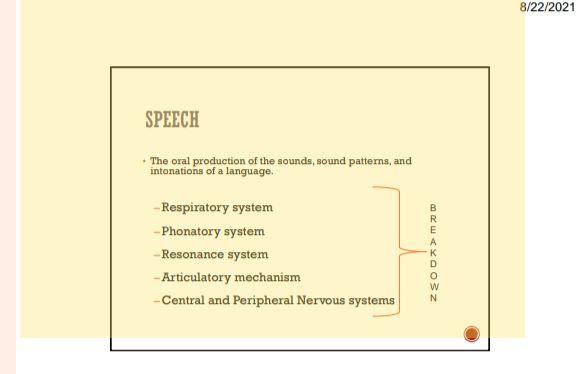
Speech
speech is the oral production of sounds, sound patterns and intonation of a language. speech can be looked in terms of different aspects so at the outset, you can look at it in terms of a segmental vs super segmental aspects of speech. so segmental aspects of speech refernce to vowels and consonants cuz if you think about a speech, its noting bad, were speaking vowels and consonats. caz if you think about a speech. its nothing bad, were speaking vowels and consonants just combination of those. however, it also is over laid with what we call the super segmental aspects of speech which could be the different presiding aspects of speech intonation, stress, rhythm all of that. so speech can be construed as segmental and supersegmental aspects of speech. but in order to produce speech, it rrequires coordination among various subsystems. and those are respiratory system which is the source that provides the air which is required to produce voice by the laryngeal system. once the voices is produced then it has to resonate in the oral, nasal and in differential which is the throat area in these cavities. it needs to resonate and then we require the articulators, the lips, the tongue, the mandible, the soft palate, heard palate. all of these are structures that help in making those sounds along with the air, along with the voice,along with the resonance. and then you move your articulator is in order to produce speech. sonif there is a breakdown in any of these subsystems. there will be a speech impairment
Building blocks of normal speech
Breath stream
Voice
Articulation / Resonance
Fluency
So therefore the building blocks of normal speech are breath stream, voice articulation, resonance. Most importantly whatever you communicate, it also needs to be a fluent. Massage that could be a breakdown if your message is not fluent.
Speech
Food for thought / Research
How do we go from a “thought” to
“actual speech”?
Language
• A code that consists of a set of symbols and the knowledge
about how to combine those symbols into words, sentences and
texts in order to convey ideas, thoughts, feelings, etc.
•
Allows for a finite set of symbols to convey and infinite number
of messages.
– Linguistic system
– Central Nervous system
language is nothing but a code that consists of a set of symbols and knowledge about how to combine these symbols into words, sentences and texts in order to convey our thoughts, feelings and ideas. think about language as creating infinite number of messages with the help of a finite set of symbols
Five dimensions or aspects of language
Semantics: Refers to meaning.
Syntax: Rules governing sentence
structure.
Morphology: Rules governing internal word
order
Phonology: Rules governing the combination of individual
speech sounds
Pragmatics : Set of rules for language use
Semantics:
Refers to meaning
Syntax:
Rules governing sentence structure
Morphology:
Rules governing internal word order
Phonology:
Rules governing the combination of individual
speech sounds
Pragmatics :
Set of rules for language use
Language domains
The below three domains are used to describe the five
dimensions of language
1. FORM: How sounds and words are
arranged to convey the
meaning.
2. CONTENT: Meaning of
language
3. USE: How language is used for personal and social needs
FORM:
How sounds and words are arranged to convey the
meaning
CONTENT:
Meaning of language
USE:
How language is used for personal and social needs
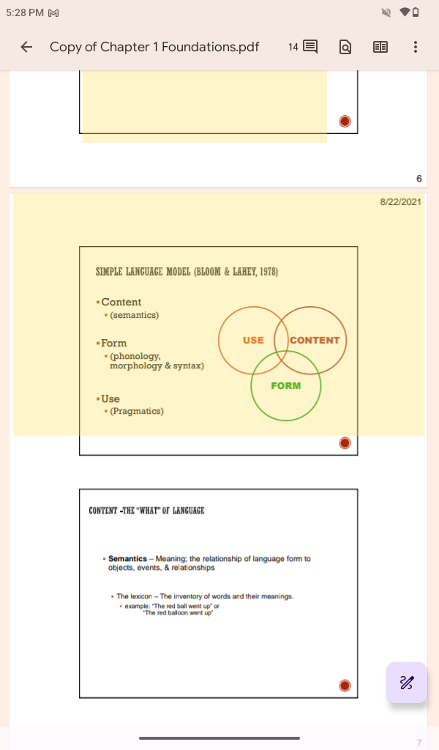
Content
(semantics)
Form
(phonology,
morphology & syntax)
Use
(Pragmatics)
content refers to the what of language. and so what falls under that is semantics, lexicon meaning. the form refers to the how of the language. phonology, morphology and syntax form. lastly, the user refers the why of language and pragmatics fits into use aspect
Content the "what" of the language
Semantics – Meaning; the relationship of language form to
objects, events, & relationships
The lexicon – The inventory of words and their meanings.
example: “The red ball went up” or
“The red balloon went up”
Semantics
Meaning; the relationship of language form to
objects, events,
& relationships
The lexicon
The inventory of words and their meanings.
example: “The red
ball went up” or
“The red balloon went up”
Form the "how" of a language
Syntax - rules governing sentence structure
word order
relationships between word classes
relationships between
phrases and clauses
Sentence types (e.g., imperative,
declarative, interro
Form the "how" of a language
Syntax provides structure and organization to language.
Without syntax, we would just have grouping of words that had
ambiguous meanings.
At dog the a store buy Peter
Peter bought a dog at the store.
Syntax allows for consistent
interpretation. Consider these 2 active
sentences.
1) The
dog chased the wolf.
2) The wolf chased the dog.
The dog
was chased by the wo
Morphology
rules governing internal word order
Morpheme
smallest unit of meaning
Free
A unit that has meaning in and of itself, i.e., a word
(e.g.,
cat, kid, check, transport, wrap, is, the.)
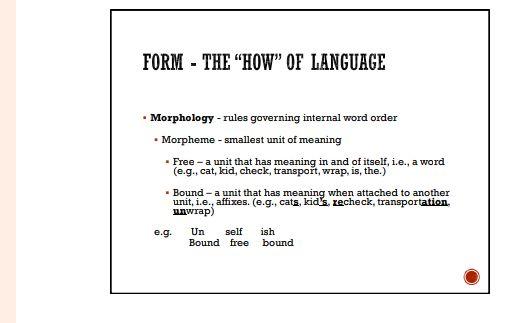
Bound
A unit that has meaning when attached to another
unit, i.e.,
affixes. (e.g., cats, kid’s, recheck, transportation,
unwrap)
e.g. Un self ish
Bound free bound
Phonology
rules governing the combination of individual
speech sounds
Phonemes
smallest unit of speech that can lead to differences in
meaning
/pat/ versus /bat/
USE the "Why" of language
Pragmatics
set of rules for language use
Organize language
Organize language
turn-taking
starting, maintaining,
& ending both a conversation and a topic with the
conversation
making relevant comments
Repair communication breakdowns
Role
Establish & maintain a role
Code switching
Govern speech acts
Requests, Comments, Questions, etc.
Requests, Comments, Questions, etc.
Composts of language
Language Function
Language Meaning (Content)
Language
Form
All three domains are important.
People with
communication disorders can have problems in
form, meaning, or
function, and very importantly, the
connections between these
areas.
As SLPs and Deaf educators, we need under
Our profession
The professions of communication sciences and disorders and
Audiology are clinical/applied in nature.
It is critical
to understand that being an SLP or an Audiologist
or teacher of
the Deaf requires foundational scientific
knowledge.
scope of our profession, which we will limit in this particular course to speech language pathology, audiology and education for the deaf, we will be discussing not only the clinical aspects but will also be discussing some scientific aspects. because its critical for us to understand that being a educatir of deaf or slp or audiologist requires some foundational scientific knowledge.
Significant foundation of communication disorders
Speech Science
Anatomy & Physiology
Acoustics
Phonetics
Hearing Science
Anatomy &
Physiology
Acoustics
Language Science
Linguistics
Psycholinguistics
Anatomy & Physiology
so we will be in this course as well as some other courses. we will se some of these recurring thems that pertain to scientific foundations of communication disorders. and it could be in the form of speech science where youre discussing anatomy and physiology, acoustics or fanatics. or it could be in the area of hearing scuence again where we will. discuss definitely discuss anatomy, physiology and acoustics, or it could be language science. and you will you be learning about linguistics, psycholinguistics and again anatomy and physiology pertaining to language. beyond these foundations of scientific foundations of communication disorders.
Speech Science
Anatomy & Physiology
Acoustics
Phonetics
Hearing Science
Anatomy & Physiology
Acoustics
Language Science
Linguistics
Psycholinguistics
Anatomy & Physiology
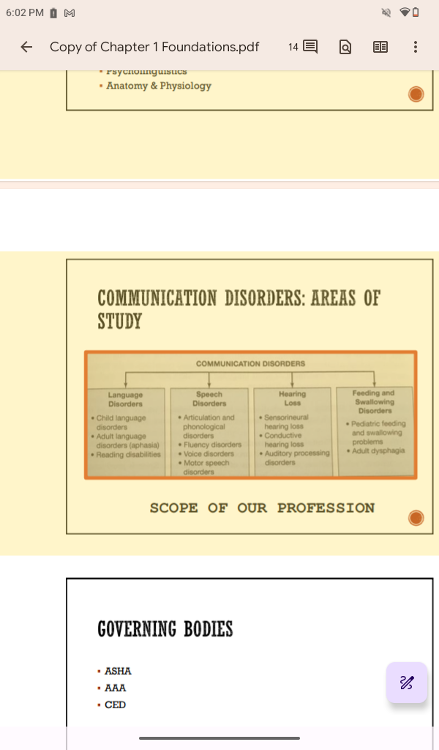
Communication disorder areas of study
you will be introduced to in this particular course. the varous communication disorders. and each of the modules, modules two, three, four and five will refer to these areas of communication disorders, which are language disorders, speech disorders, hearing disorders as well as feeding and swallowing disoders. we will discuss all of these disorders as it pertains to the pediatrics as well as aduits and judeo tricks.
Language disorders
Child language disorders
Adult language disorders
(aphasia)
Reading disabilities
Speech disorders
Articulation and phonological disorders
Fluency disorders
Voice disorders
Motor speech disoders
Hearing loss
Sensorineural hearing loss
Conductive hearing loss
Auditory
processing disorders
Feeding and swallowing disorders
Pediatric feeding and swallowing problems
Adult dysphagia
Governing bodies
ASHA
AAA
CED
SLP/AUD professionals
American Speech Language Hearing Association
• Market Trends:
https://www.asha.org/Careers/Market-
Trends/#market
•
211,000 - ASHA members
• 181,628 are certified speech-language
pathologists (SLP)
• 13,610 are certified audiologists (AuD)
• 785 SLP/A (Dual certification)
• A small % are employed
in the academia
according to the American speech language and hearing association, here are over 200,000 plus professionals ot of which there are 181, 628 are certified speech language pathologist and about roughly over 13,000 certified audiologists. and then there are about 785 duly certified professionals who are both cardiologist and speech language pathologist. and then if you go further into people that are academic, that is even a small number. although there are 211,000 asha members who are serving people with communication disorders, there is a shortage in our field and were so
Setting
• Public and Private Schools
• Hospitals
• Rehabilitation
Facilities
• Home health agencies
• Community and University
Clinics
• Private practices
• State agencies
•
Universities
• Corporations
• TELEPRACTICE
Inter-profssional practice
Special educators
Teachers of the Deaf
Occupational
therapists
Neurologists
Physical therapists
Otorhinolaryngologists (ENT)
Pediatricians
Psychologists
Oncologist
Radiologist
…… and others