Types of graphs and date
categorical, ranked, discrete numerical (countable), continuous numerical (range).
Box plot shows minimum, the quartiles, median and maximum.
Frequency polygon is a regular line graph. Cumulative frequency curve.
Histogram is bar chart for continuous data.
How to calculate a specific percentile
Percentile wanted x total frequency / 100
averages are referred to measures of central tendency.
Standard deviation and outliers, also coded data
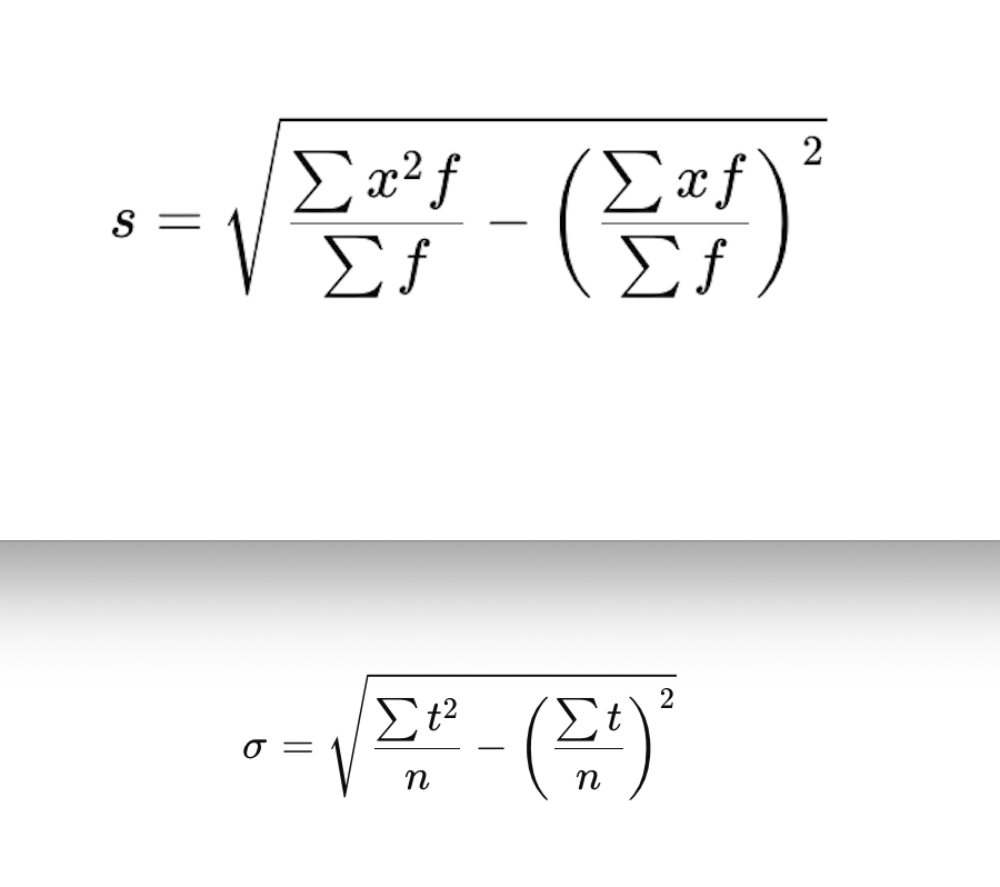
Standard deviation = √variance.
variance - Var(X) = E(X2) - [E(X)]2
Find the mean after squaring x first - the regular mean squared after solved regularly
outliers
- IQR = Q₃ − Q₁
- Lower outlier if value is below Q₁ − 1.5(IQR)
- Upper outlier if value is above Q₃ + 1.5(IQR)
coded data
example, a question might say: The mean of a set of data is 20 and the standard deviation is 4. The data is coded using y=3x+2. Find the mean and standard deviation of the coded data.
- the mean is changed by both the constant and multiplied. However the standard deviation is not effected by the constant only multiplied by coefficient.
working with histograms
Frequency density = frequency / class width
Mean = frequency x midpoint / frequency
Probability equations
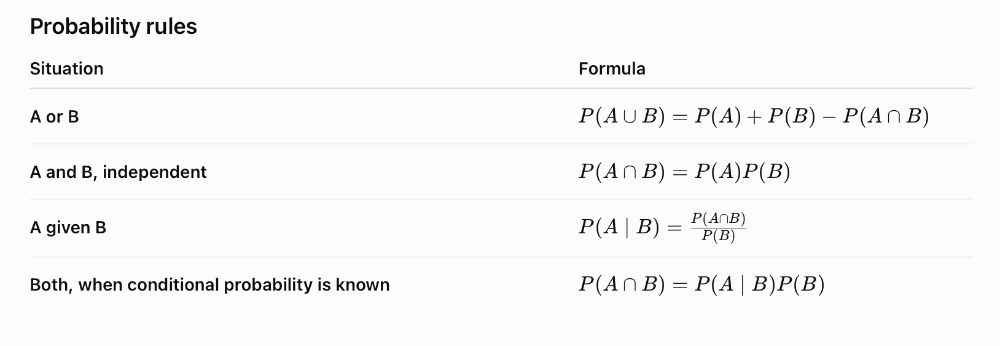
When adding and finding probability of one or the other - P(A∪B)=P(A) + P(B) − P(A∩B) (subtracting the overlap)
When multiplying for independent events -P(A∩B)= P(A)P(B)
For Conditional Probability When the question says "given that..." so another event has already happened : P(A∣B) = P(A∩B) / P(B)
if you know a conditional probability and need the probability that both events occur. - P(A∩B) = P(A∣B) × P(B)
Independant, mutually exclusive and complimentary events
independent if they do not affect each other.
mutually exclusive if it is impossible for both of them to happen.
The event 'not A' is the complement of the event A.
meaning of discrete random variable. and calculation
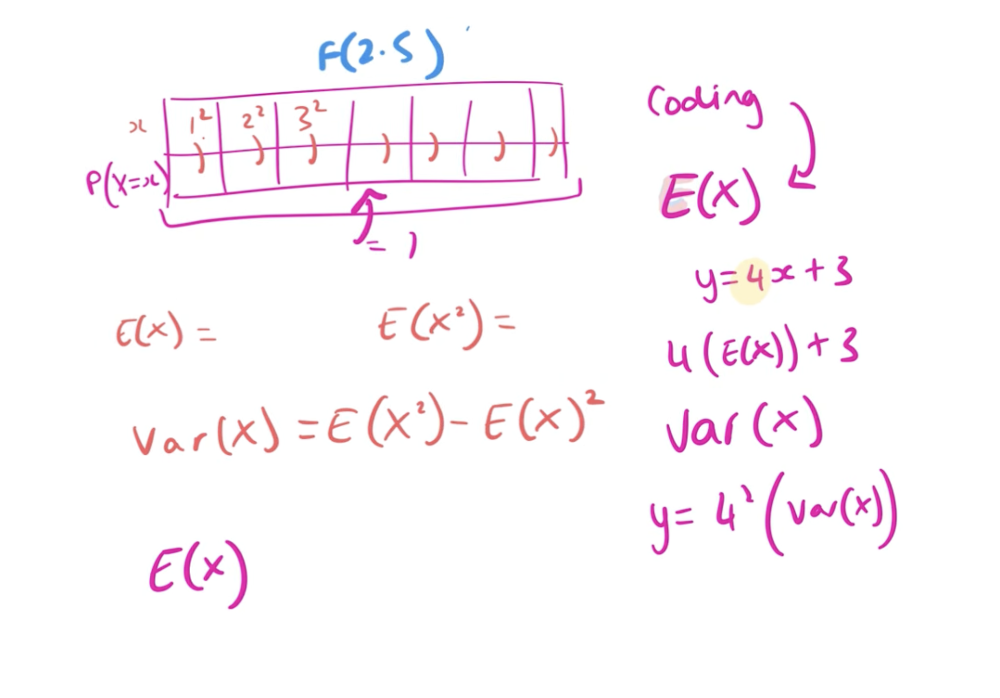
Variable is a quantity (x) that can take on any set of variables. It is random if each value has an associated probability that can add to 1. its discrete if it has countable separate values.
To calculate P(X=r) = gives the function to figure out the probabilities of the variables. for example P(X=r) = kx
E(x) is same as mean
Permutations and combinations rules
Number of arrangements is done by n!. When repetitions are allowed nr where n is the number of choices and r is the length of arrangement.
Permutations are when the order matters n! / (n-r)!
Combinations when just want specific ones picked n! / (n-r)! x r! when choosing r from n
For permutations with repeating items n! / n1 x n2 ...
when want multiple of the same thing together treat it as 1
when none of the same block together = use regular formula to get arrangements of other items missing out the together blocks x number of spaces! / number of things together! x (number of spaces - number together)!
Binomial distribution
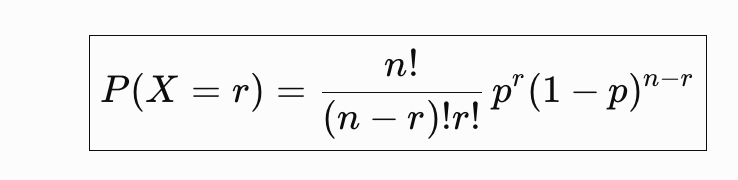
For fixed number of trials, independent probability, 2 outcomes.
If roll dice 10 times, want to get 6. 10 is number of trials, you either get the 6 or not (two outcomes) and 1/6 is fixed probability.
Formula = p is probability, n is number of trials, r is random variable when P(X = r)
variance - n x p x (1-p)
standard deviation = √variance
If P(X < 3) then need to have n as 1,2 and 3 and add them.
Geometric distribution
where don't know how how many trials as continue until success made.
Probability is p = P(X = r) =p(1-p)r-1
If X is in form > 5 that means success happens after 5 so shortcut formula is (1-p)5 X > or equal 5 includes five as possibly being correct so still (1-p)4. If < direction then do equation for > then take away from 1.
Expected formula and geometric distribution mean = 1/p
geometric variance = 1-p / p2
Nominal distribution
X - N(mean, standard deviation2 ) σ is symbol for sd, σ 2 is variance. mean symbol is μ
X = μ + zσ
z = X - μ / σ
z is how many sd's to get probability for z < n from the table the row contains digit and first decimal, column second decimal.
for approximation - calculate mean - (total number(n) x p) and standard deviation √np(1-p). Take 0.5 from X value interested in and use X - μ / σ to get z. then get probability from z.