Gastric ulcers present with pain that is _____ by meals (eating stimulates _____ secretion in the stomach).
Duodenal ulcers characteristically present with pain that _____ with meals (eating stimulates _____ secretion in the duodenum).
exacerbated, acid
improves, bicarb
What hereditary disease is characterized by an inherited mutation in one copy of the APC gene?
_____ _____ _____ - inherited APC mutation (chromosome _____)
Familial Adenomatous Polyposis
5
Familial Adenomatous Polyposis:
Thousands of _____ develop in _____ - high risk for _____
transformation
polyps, colon, malignant
What is the most common cause of Vitamin B12 deficiency?
_____ _____ gastritis
Chronic autoimmune gastritis
Chronic autoimmune gastritis leads to destruction of parietal cells which secrete _____ _____ (_____ anemia)
intrinsic factor, pernicious
Achalasia represents damage to the _____ cells of the _____ plexus.
ganglion
myenteric
Which type of hypersensitivity is responsible for chronic autoimmune
gastritis?
A. Type I (IgE-mediated)
B. Type II
(antibody-mediated)
C. Type III (immune complex-mediated)
D. Type IV (T-cell mediated)
D. Type IV (T-cell mediated)
Intrinsic factor deficiency in chronic autoimmune gastritis is best
explained by:
A. Direct antibody-mediated destruction of
intrinsic factor
B. Loss of parietal cells due to
T-cell–mediated damage
C. Increased degradation of intrinsic
factor in the intestine
D. Decreased secretion from chief cells
B. Loss of parietal cells due to T-cell–mediated damage
Why are anti-intrinsic factor antibodies detected in chronic
autoimmune gastritis?
A. They initiate the disease process
B. They are produced secondary to parietal cell destruction
C.
They directly activate T cells
D. They prevent vitamin B12
absorption by binding ileal receptors
B. They are produced secondary to parietal cell destruction
In chronic autoimmune gastritis, what is the role of anti-parietal
cell antibodies?
A. Directly destroy parietal cells
B.
Activate complement to lyse gastric mucosa
C. Are a consequence
of parietal cell damage
D. Prevent T-cell activation
C. Are a consequence of parietal cell damage
inner layers of the tract protrude through the muscular layer, meckel or zenker?
zenker
A 70-year-old man presents with dysphagia, regurgitation of
undigested food, and chronic cough. Imaging reveals a
posterior pharyngeal outpouching. Which muscle is
primarily responsible for forming a sphincter and contributing to the
pathophysiology?
A. Thyropharyngeus
B.
Stylopharyngeus
C. Cricopharyngeus
D. Palatopharyngeus
C. Cricopharyngeus
this is Zenker's diverticulum
In achalasia, LES tone is typically:
A. Decreased
B.
Normal
C. Increased
D. Absent
C. Increased
A patient with Zenker diverticulum undergoes surgical treatment.
Which of the following interventions directly addresses the underlying
cause of this condition?
A. Esophageal dilation of the lower
esophageal sphincter
B. Resection of the diverticulum
alone
C. Cricopharyngeal myotomy
D. Fundoplication
C. Cricopharyngeal myotomy
Zenker: Herniation of ____ through a muscular defect due to increased ____ pressure
mucosa
intraluminal
An elderly patient presents with dysphagia,
regurgitation of undigested food, halitosis, and
recurrent aspiration pneumonia. What
is the most appropriate diagnostic test to confirm this
condition?
A. Barium contrast esophagogram
B. CT scan of
the neck
C. Upper endoscopy (EGD)
D. Esophageal manometry
A. Barium contrast esophagogram
Zenker diverticulum is suspected.
Primary achalasia causes inability to relax the LES because
of:
A. Muscular rupture
B. Inflammatory fibrosis
only
C. Ganglion cell degeneration
D. Vagal hyperstimulation
C. Ganglion cell degeneration
In Chagas disease, secondary achalasia is caused by destruction of
the:
A. Submucosal plexus only
B. Serosal
mesothelium
C. Myenteric plexus
D. Muscularis mucosae
C. Myenteric plexus
What demographic is most commonly affected by Zenker diverticulum?
_____ _____
elderly males
Between Mallory-Weiss syndrome and esophageal varices, which presents with painful hematemesis and which presents with painless hematemesis?
Painful hematemesis: mallory-weiss syndrome
Painless hematemesis: esophageal varices
Secondary achalasia in Chagas disease leads to failure of peristalsis
and:
A. Esophageal dilatation
B. Gastric volvulus
C.
Pyloric closure
D. Colonic ischemia
A. Esophageal dilatation
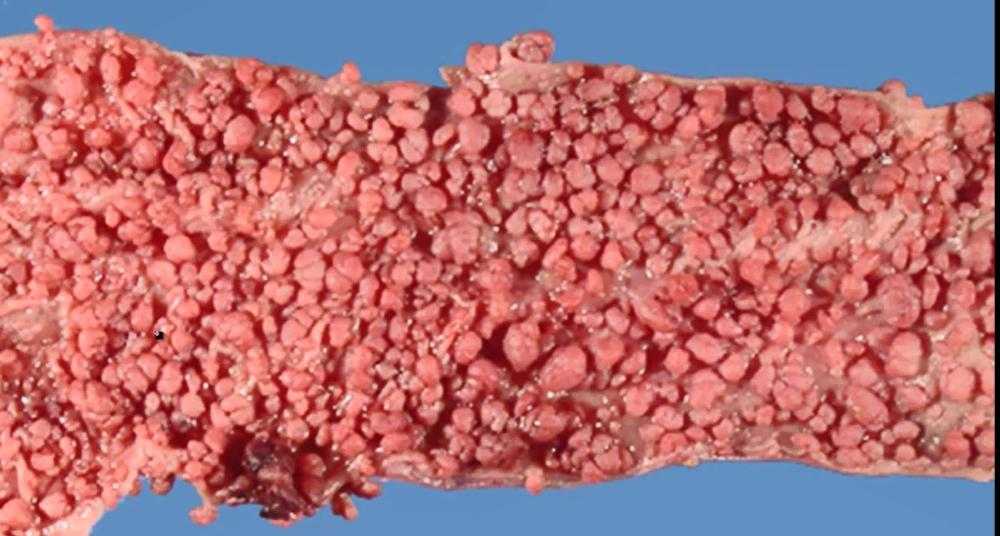
what is this?
FAP
A patient has achalasia, alacrima, and ACTH-resistant adrenal
insufficiency. This syndrome is:
A. Allgrove syndrome
B. MEN
2A
C. Cowden syndrome
D. Peutz-Jeghers syndrome
A. Allgrove syndrome
The most feared complication of Boerhaave syndrome is:
A.
Barrett metaplasia
B. Severe mediastinitis
C.
Tracheoesophageal fistula
D. Portal hypertension
Boerhaave syndrome
What type hernias are found in about half of patients with Mallory-Weiss syndrome and are considered a strong predisposing factor?
hiatal hernias
What test/imaging study is used to diagnose a Mallory-Weiss tear? _____
Endoscopy
Proximal esophageal atresia with the distal esophagus arising from the trachea.
TE fistula
What is the likely diagnosis in a patient with alcohol use disorder who presents with epigastric pain and hematemesis following multiple episodes of vomiting (normal X-ray)?
Mallory-Weiss tear
What are dilated submucosal veins in the lower 1/3rd of the esophagus
esophageal varices
esophageal varices rise secondary to _____ hypertension
portal
_____ is characterized by disordered esophageal motility due to inability to relax the _____ esophageal sphincter
Achalasia
lower
Dysphagia for both solids and liquids
Putrid breath
High LES pressure on esophageal manometry
Bird-beak sign on barium swallow study
achalasia
A 45-year-old man presents after repeated episodes of forceful
vomiting with hematemesis. He is hemodynamically stable, and the
bleeding stops spontaneously. Which of the following best describes
the underlying lesion?
A. Transmural rupture of the distal
esophagus
B. Linear mucosal tear at the gastroesophageal
junction
C. Variceal rupture due to portal hypertension
D.
Full-thickness gastric perforation
B. Linear mucosal tear at the gastroesophageal junction
mallory-weiss
A patient presents with chest pain and subcutaneous emphysema after
severe vomiting. Imaging reveals pneumomediastinum. Which of the
following best describes the underlying lesion?
A. Transmural
rupture of the distal esophagus
B. Linear mucosal tear at the
gastroesophageal junction
C. Variceal rupture due to portal
hypertension
D. Full-thickness gastric perforation
A. Transmural rupture of the distal esophagus
Boerhaave syndrome
A patient presents with hematemesis following excessive alcohol
intake and vomiting. The bleeding is bright red and resolves without
intervention. Which diagnosis is most likely?
A. Boerhaave
syndrome
B. Esophageal varices
C. Mallory-Weiss tear
D. Peptic ulcer disease
C. Mallory-Weiss tear
delete
delete
What is management of tracheoesophageal fistula?
surgery
Baby is born with respiratory distress and excess drooling
_____ _____
TE fistula
GERD: Reflux of acid from the stomach due to ____ ____ in the ____ esophageal sphincter
reduced tone
lower
A newborn presents with excessive drooling, choking during
feeds, and inability to pass a nasogastric tube into the
stomach. Imaging reveals air in the stomach and intestines.
Which of the following is the most likely anatomical
abnormality?
A. Isolated esophageal atresia without
fistula
B. H-type tracheoesophageal fistula without
atresia
C. Proximal esophageal atresia with distal
tracheoesophageal fistula
D. Distal esophageal atresia with
proximal tracheoesophageal fistula
C. Proximal esophageal atresia with distal tracheoesophageal fistula
A 58-year-old man with a long history of GERD presents with worsening
reflux symptoms and intermittent dysphagia. A hiatal hernia is
suspected. What is the most appropriate initial diagnostic test?
A. Esophageal manometry
B. Upper endoscopy (EGD)
C. Barium
swallow study
D. CT scan of the chest
C. Barium swallow study
A patient with chronic GERD is found to have a hiatal hernia on
imaging. After initial evaluation, which test is most appropriate to
assess for complications such as Barrett esophagus?
A.
Esophageal manometry
B. Barium swallow
C. Upper endoscopy
(EGD)
D. Abdominal ultrasound
C. Upper endoscopy (EGD)
Gastroesophageal reflux disease (GERD) may damage the ____ of teeth
enamel
Gastroesophageal reflux disease (GERD) may present with chronic cough and adult-onset _____
asthma
Gastroesophageal reflux disease (GERD) often presents with _____, which can mimic cardiac chest pain
heartburn
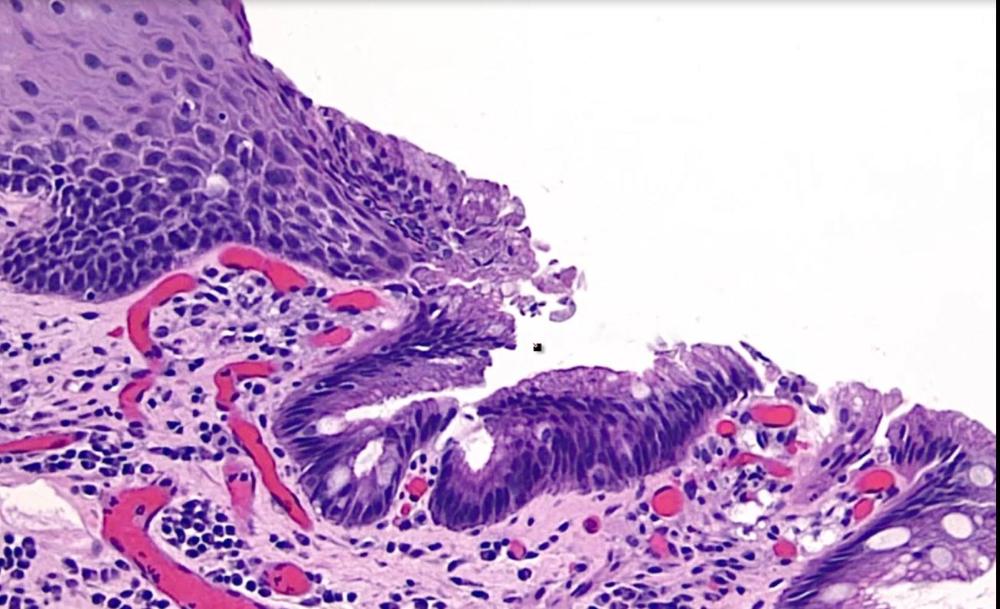
what is this?
barrett's esophagus
A huge risk factor for esophageal adenocarcinoma involves ____ ____
barrett's esophagus
_____ of the esophagus is a malignant proliferation of glands
adenocarcinoma
acidic damage to stomach mucosa: ____ gastristis
acute gastristis
Dysphagia, Iron Deficiency Anemia, and Esophageal webs are the triad characteristic of which syndrome?
Plummer-Vinson Syndrome (Plumbers DIE)
Neonate with extra-abdominal intestines; to the
right of the umbilicus and not
contained in a membrane?
A. Omphalocele
B.
Gastroschisis
C. Umbilical hernia
D. Diaphragmatic hernia
B. Gastroschisis
A newborn has a midline defect with organs in a sac. What embryologic
failure occurred?
A. Failure of lateral fold fusion
B.
Failure of intestinal return to cavity
C. Failure of mesoderm
differentiation
D. Failure of cloacal partitioning
A. Failure of lateral fold fusion
omphalocele
often presents with a palpable olive -like mass in the epigastric region of the abdomen
pyloric stenosis
is a congenital hypertrophy of the pyloric smooth muscle
pyloric stenosis
Which antibiotic used in infants is associated with hypertrophic pyloric stenosis?
Erythromycin
A 3-week-old infant presents with progressive, forceful
vomiting after feeds. The vomitus is
nonbilious, and the parents report increased hunger
after episodes. On exam, visible peristaltic waves
are noted across the abdomen. Which of the following additional
findings is most likely on physical examination?
A. Diffuse
abdominal tenderness with guarding
B. Palpable olive-like mass
in epigastrium
C. Absent bowel sounds in all quadrants
D.
Hepatosplenomegaly with abdominal distension
B. Palpable olive-like mass in epigastrium
this is pyloric stenosis
A patient is diagnosed with gastric cancer
characterized by diffuse infiltration of the stomach
wall and desmoplastic reaction causing linitis
plastica. Which of the following risk factor profiles is most
consistent with this condition?
A. Chronic Helicobacter pylori
infection with intestinal metaplasia
B. High intake of
nitrosamines from smoked foods
C. Blood type A with chronic
atrophic gastritis
D. No association with Helicobacter pylori infection
D. No association with Helicobacter pylori infection
diffuse gastritis
acidic damage to stomach mucosa
acute gastristis
chronic inflammation of stomach mucosa that leads to intestinal metaplasia
chronic gastristis
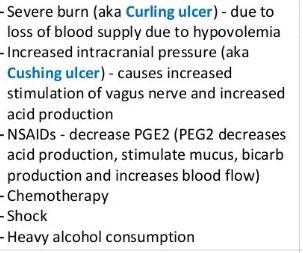
chronic or acute gastritis etiologies?
acute gastritis
A 58-year-old woman has fatigue and
glossitis. Labs show macrocytic
anemia and elevated gastrin. Endoscopy shows
fundic mucosal atrophy. Which mechanism best
explains her condition?
A. T-cell destruction of parietal
cells
B. Urease-mediated injury of antrum
C. NSAID-induced
prostaglandin depletion
D. Zollinger-Ellison acid hypersecretion
A. T-cell destruction of parietal cells
this is chronic autoimmune gastritis
A 49-year-old man has chronic epigastric pain. Gastric biopsy shows
intestinal metaplasia in the
antrum. Urea breath test is
positive. What cancer risk is most increased?
A. Diffuse-type
gastric adenocarcinoma
B. Intestinal-type gastric
adenocarcinoma
C. Esophageal squamous cell carcinoma
D.
Gastrointestinal stromal tumor
B. Intestinal-type gastric adenocarcinoma
this is chronic h pylori gastritis
A patient with chronic gastritis is found to have achlorhydria, high
gastrin, and anti–intrinsic factor antibodies. Which additional
finding is most likely?
A. Antral-predominant active
inflammation
B. Megaloblastic anemia from B12 deficiency
C. Positive stool antigen only
D. Duodenal ulcer from excess acid
B. Megaloblastic anemia from B12 deficiency
A 45-year-old man has recurrent dyspepsia and a positive stool
antigen test. Gastric biopsy shows chronic inflammation involving the
antrum. Which treatment is most appropriate?
A. Vitamin B12 and
iron
B. High-dose steroids and biopsy
C. PPI plus
clarithromycin and amoxicillin
D. H2 blocker monotherapy alone
C. PPI plus clarithromycin and amoxicillin
this is chronic h pylori gastritis
A patient has chronic gastritis with biopsy showing intestinal
metaplasia. Which additional finding would most strongly favor
autoimmune gastritis over chronic H pylori gastritis?
A.
Positive urea breath test
B. Antral-predominant mucosal
inflammation
C. Epigastric pain with ulceration
D.
Anti-parietal cell antibodies
D. Anti-parietal cell antibodies
MALT lymphoma risk, what type of gastritis?
chronic h pylori gastritis
A 32-year-old man has recurrent epigastric pain that
improves shortly after meals. Endoscopy shows an
ulcer in the proximal duodenum. Which cause is most
likely?
A. Helicobacter pylori infection
B. Chronic
NSAID-associated injury
C. Gastric reflux into esophagus
D. Left gastric artery ischemia
A. Helicobacter pylori infection
duodenal ulcer
A 61-year-old woman has epigastric pain that becomes worse
with meals. Endoscopy shows an ulcer along the
lesser curvature of the stomach. Which factor most
likely caused this ulcer?
A. Hypertrophy of Brunner glands
B. Excess bicarbonate production
C. Long-term NSAID use
D.
Elevated gastrin only
C. Long-term NSAID use
gastric ulcer- remember that this one becomes worse with meals
What ulcer? diagnostic endoscopic biopsy shows ulcer with hypertrophy of Brunner glands!
duodenal ulcer
A patient with a posterior duodenal ulcer suddenly
develops hematemesis and signs of
shock. Which structure was most likely eroded?
A.
Splenic artery posteriorly
B. Left gastric artery
C.
Gastroduodenal artery
D. Inferior pancreaticoduodenal vein
C. Gastroduodenal artery
A patient is diagnosed with a gastric ulcer. Which feature most
strongly distinguishes it from a typical duodenal ulcer?
A.
Usually improves after meals
B. Never requires biopsy
C.
Higher malignant potential
D. Commonly caused by Zollinger-Ellison
C. Higher malignant potential
duodenal ulcer is more present in anterior or posterior?
anterior
which ulcer is more likely to cause pancreatitis?
duodenal
A 64-year-old man presents with weight loss and early
satiety. Endoscopy reveals a large, irregular gastric
ulcer with heaped-up margins along the
lesser curvature of the antrum. Which type of
gastric carcinoma is most likely?
A. Diffuse-type carcinoma with
signet ring cells
B. Intestinal-type carcinoma forming glandular
structures
C. Gastrointestinal stromal tumor with spindle
cells
D. Primary gastric lymphoma from B cells
B. Intestinal-type carcinoma forming glandular structures
A patient is diagnosed with gastric adenocarcinoma located along the
lesser curvature of the antrum. Which of the following risk factors is
most strongly associated with this subtype?
A. Chronic
autoimmune gastritis with achlorhydria
B. Intestinal metaplasia
and nitrosamine exposure
C. CDH1 mutation causing E-cadherin
loss
D. Epstein-Barr virus gastric infection
B. Intestinal metaplasia and nitrosamine exposure
A 55-year-old patient presents with early satiety and weight loss.
Endoscopy shows a diffusely thickened, rigid stomach
wall without a discrete mass. Biopsy reveals
malignant cells with mucin pushing the nucleus to the periphery. What
is the most likely diagnosis?
A. Intestinal-type gastric
adenocarcinoma forming glands
B. Diffuse-type gastric carcinoma
with signet ring cells
C. Gastrointestinal stromal tumor with
spindle cells
D. Primary gastric lymphoma from mucosal lymphoid tissue
B. Diffuse-type gastric carcinoma with signet ring cells
this is diffuse type of gastric carcinoma
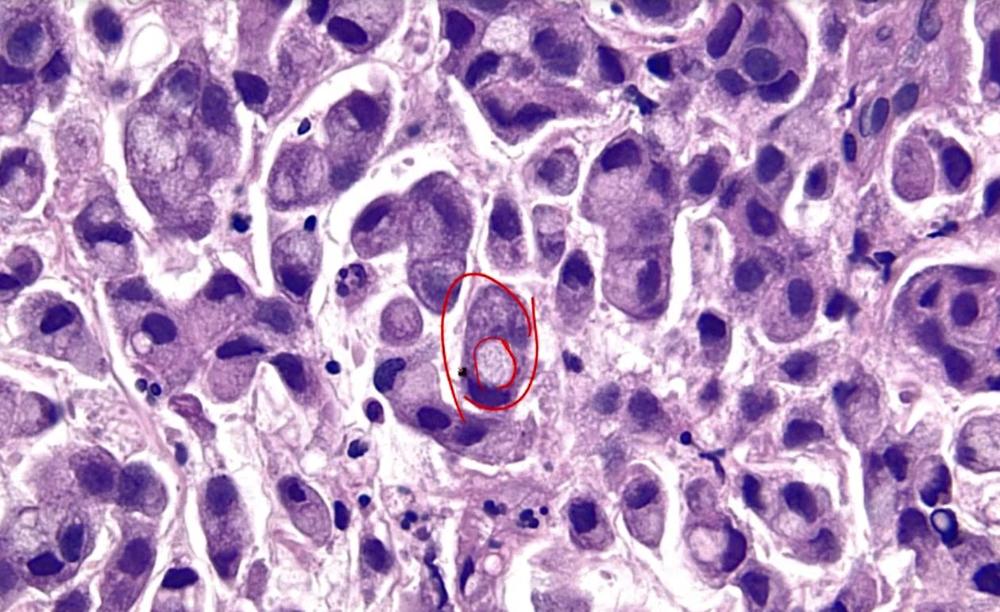
what is this?
signet ring cell
A patient is diagnosed with gastric cancer
characterized by diffuse infiltration of the stomach
wall and desmoplastic reaction causing linitis
plastica. Which of the following risk factor profiles is most
consistent with this condition?
A. Chronic Helicobacter pylori
infection with intestinal metaplasia
B. High intake of
nitrosamines from smoked foods
C. Blood type A with chronic
atrophic gastritis
D. No association with Helicobacter pylori infection
D. No association with Helicobacter pylori infection
_____ carcinoma presents late with weight loss, abdominal pain, anemia, _____ satiety
gastric
early
gastric carcinoma can spread to lymph nodes, such as the _____ supraclavicular node (_____ node)
left supraclavicular node (Virchow node)
Which type of gastric carcinoma is associated with a Sister Mary Joseph nodule? Kruckenburg?
Intestinal or Diffuse
Intestinal
Diffuse

duodenal atresia
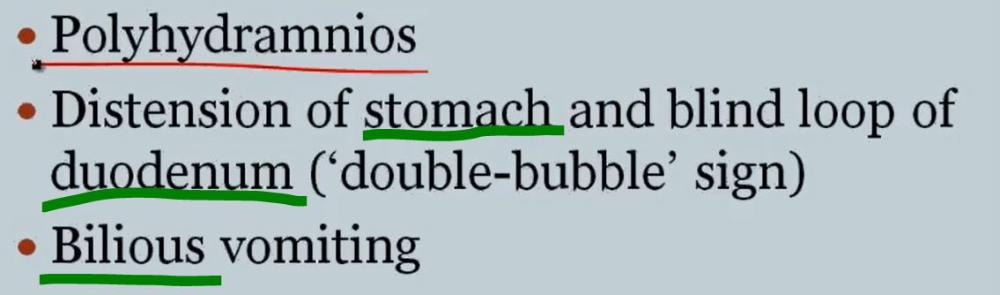
duodenal atresia
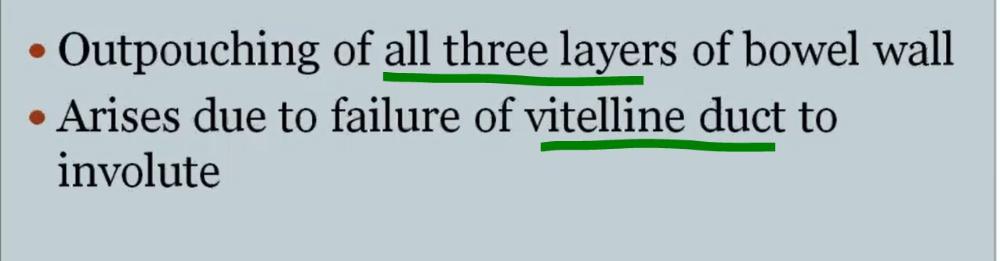
meckel diverticulum
Meckel diverticulum most commonly occurs in the:
A.
Duodenum
B. Jejunum
C. Sigmoid colon
D. Ileum
D. Ileum
The most common site of acquired diverticula (Pseudodiverticula) is
the:
A. Transverse colon
B. Cecum
C. Ileum
D.
Sigmoid colon
D. Sigmoid colon
Congenital hypertrophic pyloric stenosis is more common in:
A.
Males
B. Females
C. Turner patients only
D. Premature
infants only
A. Males
Which syndrome increases risk of hypertrophic pyloric
stenosis?
A. Marfan syndrome
B. Turner syndrome
C. Down
syndrome
D. Noonan syndrome
A. Marfan syndrome
Which trisomy is linked to hypertrophic pyloric stenosis?
A.
Trisomy 13
B. Trisomy 21
C. Trisomy 18
D. Trisomy 16
C. Trisomy 18
Which antibiotic exposure in the first 2 weeks increases pyloric
stenosis risk?
A. Gentamicin
B. Azithromycin
C.
Amoxicillin
D. Metronidazole
B. Azithromycin
Another antibiotic linked to pyloric stenosis risk is:
A.
Erythromycin
B. Vancomycin
C. Ceftriaxone
D. Doxycycline
A. Erythromycin
intussusception: _____ of the bowel
telescoping
A 2-year-old child develops episodic abdominal pain and vomiting. Imaging suggests that one bowel segment has invaginated into the immediately distal segment after a wave of peristalsis. Which diagnosis is most likely?
A. Volvulus
B. Intussusception
C. Adhesion
D.
Incarcerated hernia
B. Intussusception
A 70-year-old patient presents with acute abdominal distention, obstipation, severe pain, and signs of bowel ischemia. Imaging suggests twisting of bowel around its mesenteric attachment. Which diagnosis is most likely?
A. Intussusception
B. Volvulus
C. Adhesion
D. Hernia
B. Volvulus
The pathophysiology of volvulus most directly causes:
A. Secretory and osmotic loss
B. Mucosal and lymphatic
failure
C. Luminal and vascular compromise
D. Serosal and
neural inflammation
C. Luminal and vascular compromise
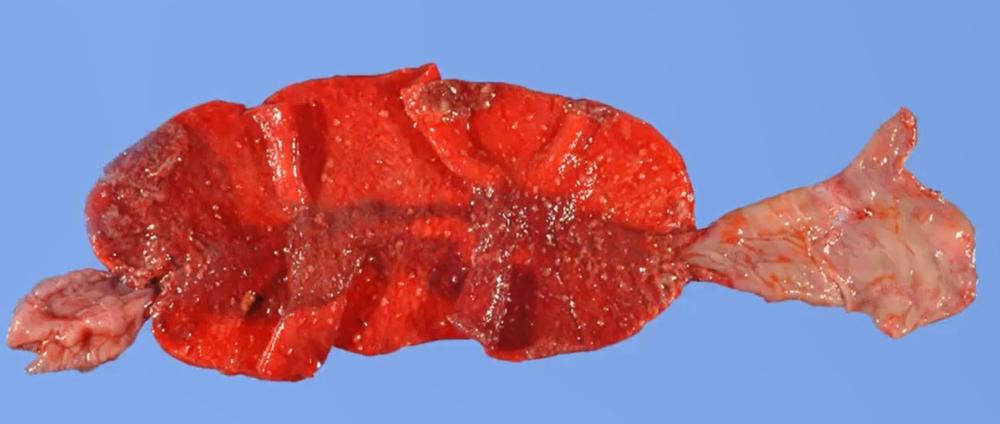
volvulus
Once the bowel segment becomes trapped in intussusception, ongoing peristalsis typically causes it to:
A. Retract spontaneously
B. Pull mesentery along
C.
Perforate immediately
D. Untwist at the base
B. Pull mesentery along
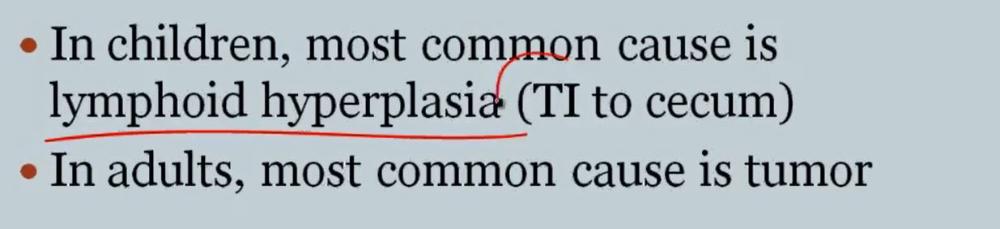
intussusception
A pathology specimen shows necrosis limited to the mucosa and not extending beyond the muscularis mucosae. This is best classified as:
A. Mural infarction
B. Transmural infarction
C. Mucosal
infarction
D. Serosal infarction
C. Mucosal infarction
Infarction involving the mucosa and submucosa is best termed:
A. Mural infarction
B. Mucosal infarction
C. Transmural
infarction
D. Mesenteric strangulation
A. Mural infarction
Necrosis involving all layers of the intestinal wall, from the mucosa to the serosa.
A. Mucosal infarction
B. Mural infarction
C. Transmural
infarction
D. Focal serosal necrosis
C. Transmural infarction
If untreated, intussusception may progress to:
A. Fistula and pseudomembranes
B. Dysentery, malabsorption,
infarction
C. Obstruction, vessel compression, infarction
D.
Ascites, jaundice, varices
C. Obstruction, vessel compression, infarction
Lactose intolerance is caused by decreased function of the _____ enzyme found in brush border enterocytes
lactase
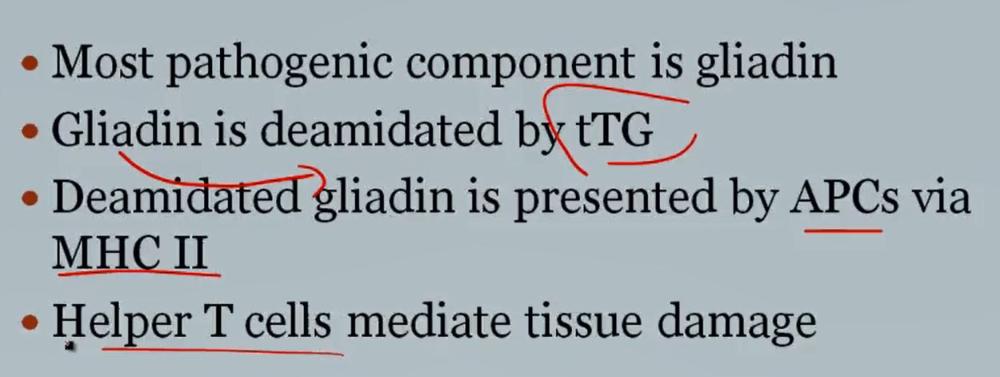
celiac disease
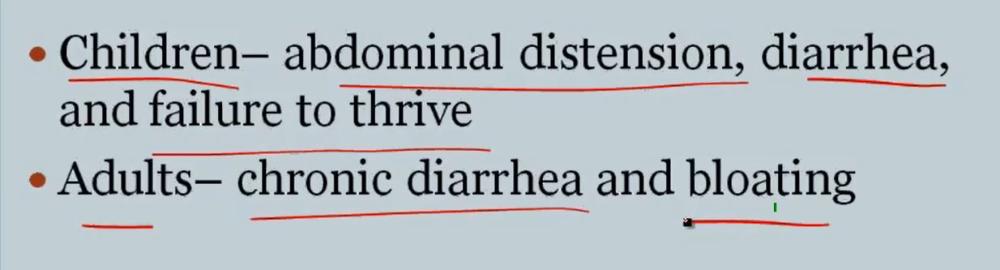
celiac disease
A 28-year-old man presents with chronic diarrhea, weight
loss, and fatigue. He also reports an intensely
pruritic, blistering rash on his elbows and knees.
Skin biopsy shows granular IgA deposition at the
tips of dermal papillae. Which of the following is
the most likely associated condition?
A. Psoriasis with
autoimmune keratinocyte proliferation
B. Dermatitis
herpetiformis associated with celiac disease
C. Pemphigus
vulgaris with anti-desmoglein antibodies
D. Bullous pemphigoid
with subepidermal blistering
B. Dermatitis herpetiformis associated with celiac disease
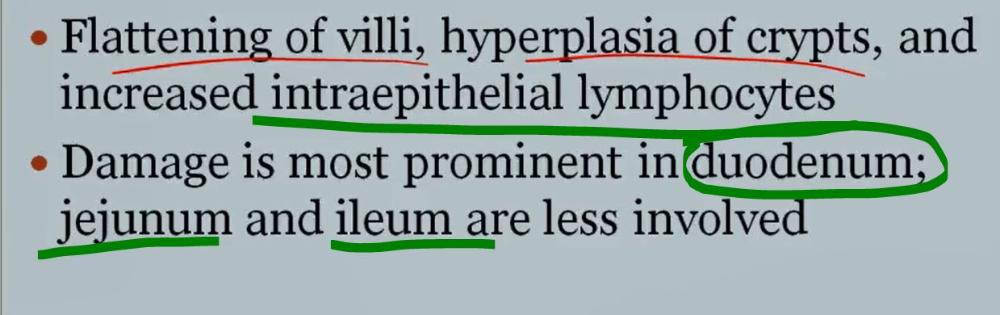
celiac disease
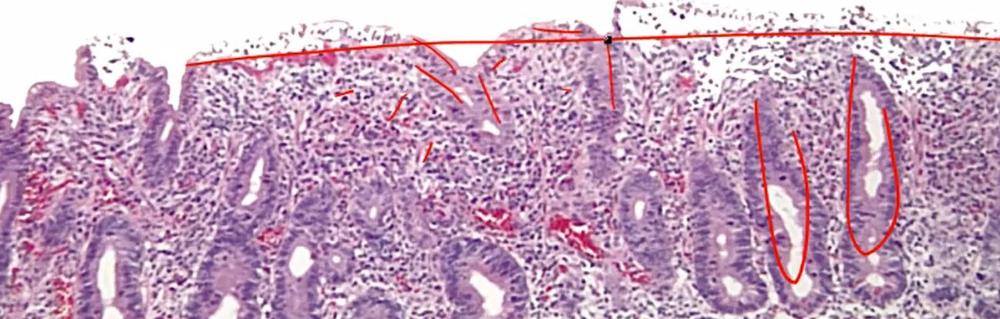
celiac disease
A 24-year-old woman develops chronic diarrhea, bloating, and weight loss after eating wheat-containing foods. Small-bowel biopsy suggests immune-mediated enteropathy. Which diagnosis is most likely?
A. Environmental enteropathy
B. Celiac disease
C.
Autoimmune enteropathy
D. Crohn disease
B. Celiac disease
In celiac disease, gliadin peptides presented by HLA-DQ2/DQ8 primarily activate which immune cell?
A. CD8+ T cells
B. Plasma cells
C. CD4+ T cells
D. Neutrophils
C. CD4+ T cells
Celiac disease most commonly involves which regions of the GI tract?
A. Duodenum and jejunum
B. Ileum and cecum
C. Stomach and
duodenum
D. Colon and rectum
A. Duodenum and jejunum
The malabsorption in celiac disease is most directly caused by:
A. Pancreatic enzyme deficiency
B. Ileal bile salt
loss
C. Lymphatic obstruction
D. Loss of brush border
D. Loss of brush border
The most sensitive serologic test for celiac disease is measurement of IgA antibodies against:
A. Endomysium
B. Tissue transglutaminase
C. Gliadin
peptidase
D. Deamidated gluten
B. Tissue transglutaminase
The most common malignancy associated with celiac disease is:
A. Colonic adenocarcinoma
B. Gastric lymphoma
C.
Enteropathy-associated T-cell lymphoma
D. Pancreatic adenocarcinoma
C. Enteropathy-associated T-cell lymphoma
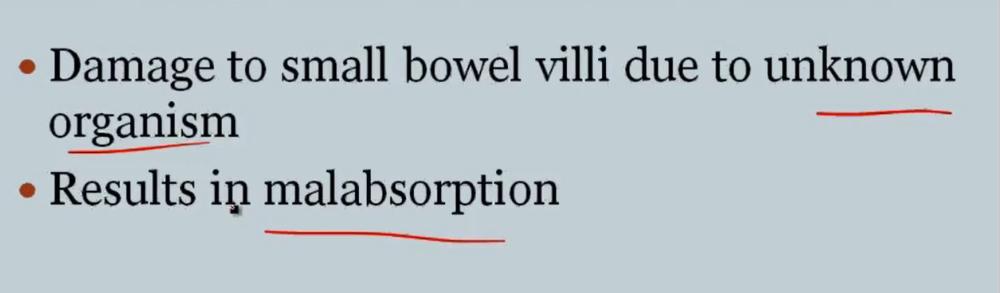
tropical sprue
A 35-year-old man returns from the Caribbean with chronic
diarrhea, weight loss, and fatigue following an episode of
infectious gastroenteritis. Biopsy shows mucosal
damage predominantly in the jejunum and ileum. Which
of the following is the most likely diagnosis?
A. Celiac disease
with villous atrophy
B. Tropical sprue responding to
antibiotics
C. Crohn disease with transmural inflammation
D. Lactose intolerance with enzyme deficiency
B. Tropical sprue responding to antibiotics
A 52-year-old man presents with chronic diarrhea, weight
loss, and bulky, foul-smelling stools. He also reports
migratory joint pain. Small-bowel biopsy shows foamy
macrophages in the lamina propria that stain positive with
periodic acid–Schiff. Which of the following best
explains his steatorrhea?
A. Macrophages compress lacteals and
impair chylomicron transport
B. Autoimmune villous injury
reduces brush-border enzyme activity
C. Pancreatic enzyme
deficiency prevents intraluminal fat digestion
D. Terminal ileal
inflammation blocks bile acid reabsorption
A. Macrophages compress lacteals and impair chylomicron transport
whipple disease
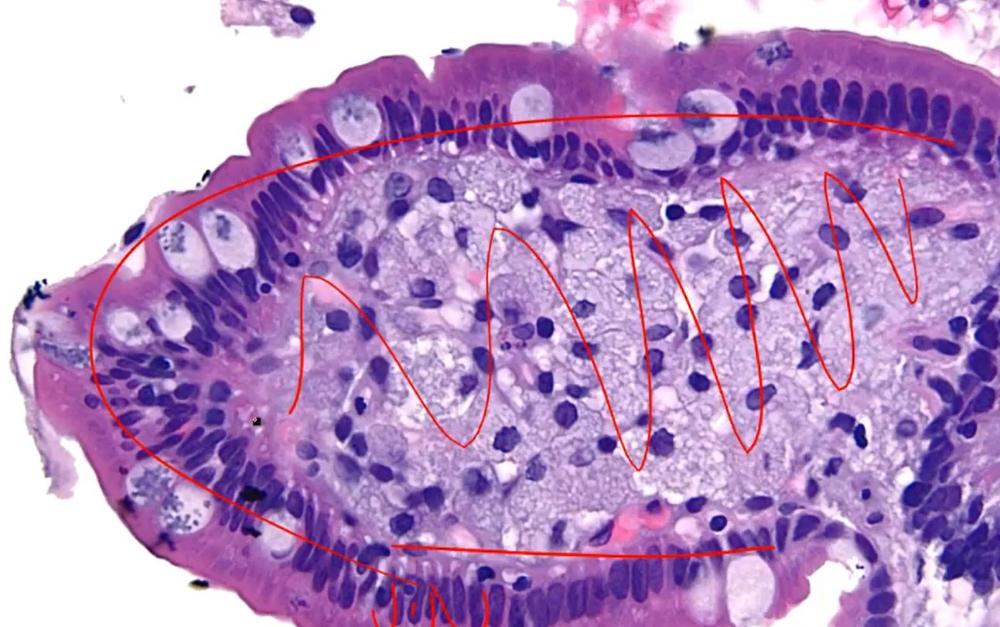
foamy macrophages
A patient with chronic malabsorption is found to
have PAS-positive foamy macrophages in the lamina
propria of the small intestine. Which infectious organism is most
likely responsible for this finding?
A. Tropheryma whipplei
within macrophage lysosomes
B. Giardia lamblia attached to
duodenal mucosa
C. Mycobacterium avium in intestinal
macrophages
D. Entamoeba histolytica invading the colonic wall
A. Tropheryma whipplei within macrophage lysosomes
A 6-month-old infant presents with failure to thrive, chronic
diarrhea, and steatorrhea. Laboratory studies show extremely low
levels of LDL and VLDL. Which of the following is the most likely
underlying defect?
A. Impaired synthesis of apolipoprotein B-48
and B-100
B. Defective pancreatic enzyme secretion into
duodenum
C. Inability to reabsorb bile acids in terminal
ileum
D. Autoimmune destruction of small intestinal villi
A. Impaired synthesis of apolipoprotein B-48 and B-100
apolipoproteinemia
A child is diagnosed with a genetic disorder causing fat
malabsorption due to defective chylomicron
formation. Which of the following mechanisms best explains
this finding?
A. Lack of apolipoprotein B prevents chylomicron
assembly
B. Decreased bile salt synthesis impairs fat
emulsification
C. Increased intestinal motility reduces fat
absorption time
D. Brush border enzyme deficiency limits lipid digestion
A. Lack of apolipoprotein B prevents chylomicron assembly
apolipoproteinemia
A patient with abetalipoproteinemia is found to have absent
circulating LDL and VLDL particles. Which of the following best
explains this laboratory finding?
A. Failure of apolipoprotein
B-100 production in liver
B. Increased clearance of lipoproteins
by macrophages
C. Reduced dietary fat intake causing low lipid
levels
D. Impaired conversion of HDL to LDL in circulation
A. Failure of apolipoprotein B-100 production in liver
A peripheral smear in a patient with abetalipoproteinemia would most likely show:
A. Schistocytes
B. Acanthocytes
C. Spherocytes
D.
Target cells
B. Acanthocytes
Abetalipoproteinemia is best described as an inherited inability to:
A. Absorb gluten peptides
B. Hydrolyze brush-border
sugars
C. Produce pancreatic lipase
D. Secrete
triglyceride-rich lipoproteins
D. Secrete triglyceride-rich lipoproteins
A 56-year-old patient is found to have a submucosal,
polyp-like lesion in the small intestine during evaluation
for vague abdominal discomfort. Biopsy reveals a low-grade malignant
tumor composed of neuroendocrine cells. Which of the
following is the most likely diagnosis?
A. Gastrointestinal
stromal tumor from interstitial cells
B. Carcinoid tumor from
neuroendocrine cell proliferation
C. Adenocarcinoma forming
irregular glandular structures
D. Primary intestinal lymphoma
from B lymphocytes
B. Carcinoid tumor from neuroendocrine cell proliferation
A patient with a small bowel tumor develops flushing,
diarrhea, and wheezing. Laboratory testing shows elevated
urinary 5-HIAA levels. Why are these symptoms
typically absent in early disease?
A. Serotonin is degraded by
hepatic monoamine oxidase
B. Tumor does not produce vasoactive
substances initially
C. Kidneys rapidly excrete serotonin before
circulation
D. Intestinal enzymes inactivate serotonin before absorption
A. Serotonin is degraded by hepatic monoamine oxidase
carcinoid tumor
A patient with a neuroendocrine tumor of the gut is asymptomatic
until liver metastases develop. Which of the following best explains
the onset of carcinoid syndrome at that stage?
A. Increased
tumor size leads to intestinal obstruction
B. Metastases bypass
hepatic metabolism of serotonin
C. Liver failure increases
production of serotonin
D. Immune response triggers systemic
cytokine release
B. Metastases bypass hepatic metabolism of serotonin
carcinoid syndrome
A 60-year-old patient with a known small bowel neuroendocrine
tumor develops flushing, diarrhea, and
wheezing. Imaging reveals liver metastases.
What is the most likely explanation for the onset of these
symptoms?
A. Increased local tumor growth causing bowel
obstruction
B. Serotonin release bypasses hepatic metabolism via
metastases
C. Decreased monoamine oxidase activity in intestinal
mucosa
D. Enhanced renal reabsorption of serotonin metabolites
B. Serotonin release bypasses hepatic metabolism via metastases
carcinoid syndrome
Gastric carcinoid tumors may be associated with autoimmune
chronic:
A. superficial gastritis
B. erosive
gastritis
C. atrophic gastritis
D. viral gastritis
D. viral gastritis
A syndrome associated with gastric neuroendocrine tumors is:
A.
Peutz-Jeghers syndrome
B. Zollinger-Ellison syndrome
C.
Carney triad
D. Cowden syndrome
B. Zollinger-Ellison syndrome
Neuroendocrine tumors within the stomach and duodenum ______ metastasize and are generally cured by resection.
rarely
Neuroendocrine tumors that arise in the ____ and ____ are often multiple and tend to be aggressive.
jejunum, ileum
Rectal neuroendocrine tumors tend to produce:
A.
catecholamines
B. bile salts
C. polypeptide hormones
D.
mucin only
C. polypeptide hormones
Symptomatic rectal neuroendocrine tumors may present with:
A.
abdominal pain and weight loss
B. jaundice and ascites
C.
dysphagia and regurgitation
D. hemoptysis and cough
A. abdominal pain and weight loss
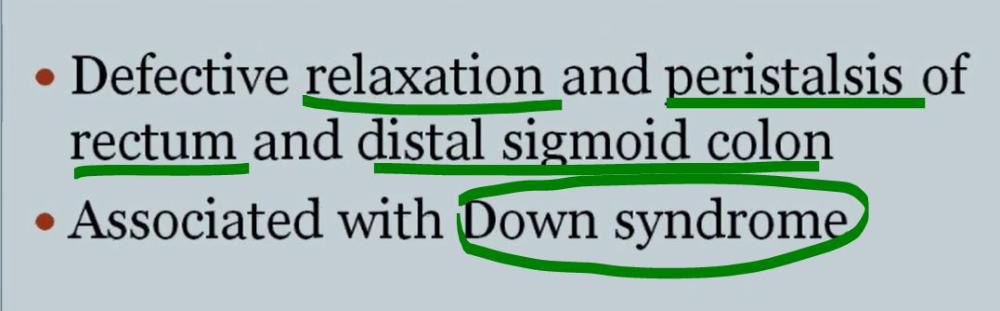
Hirschsprung disease
In Hirschsprung disease, which segment is always involved?
A.
cecum
B. sigmoid colon
C. ileum
D. rectum
D. rectum
Hirschsprung disease is also called:
A. Congenital pyloric
stenosis
B. Functional ileus syndrome
C. Congenital
aganglionic megacolon
D. Distal colonic atresia
C. Congenital aganglionic megacolon
Hirschsprung disease results from abnormal migration or loss
of:
A. Smooth muscle cells
B. Neural crest-derived ganglion
cells
C. Enterochromaffin cells
D. Mesothelial cells
B. Neural crest-derived ganglion cells
Definitive diagnosis of Hirschsprung disease requires absence
of:
A. Goblet cells
B. Paneth cells
C. Ganglion
cells
D. Chief cells
C. Ganglion cells
Ganglion cells in Hirschsprung evaluation may be identified using
stains for:
A. Creatine kinase
B.
Acetylcholinesterase
C. Myeloperoxidase
D. Acid phosphatase
B. Acetylcholinesterase
A large Zenker diverticulum commonly causes:
A. Regurgitation
and halitosis
B. Hematemesis and melena
C. Jaundice and
pruritus
D. Tenesmus and fever
A. Regurgitation and halitosis
Nutcracker esophagus reflects loss of coordination between
the:
A. Mucosa and serosa
B. Circular and longitudinal
muscle
C. Vagus and phrenic nerves
D. Upper and lower sphincters
B. Circular and longitudinal muscle
Nutcracker esophagus is characterized by:
A. Absent lower
sphincter tone
B. Distal perforation
C. High-amplitude
distal contractions
D. Proximal web formation
C. High-amplitude distal contractions
A newborn fails to pass meconium within the first 48
hours and develops abdominal distension. Rectal
biopsy shows absence of ganglion cells in the distal
colon. Which of the following is the most appropriate
definitive treatment?
A. Resection of aganglionic bowel
segment
B. High-fiber diet with stool softeners
C.
Long-term laxative therapy for motility
D. Endoscopic dilation
of narrowed segment
A. Resection of aganglionic bowel segment
Hirschsprung
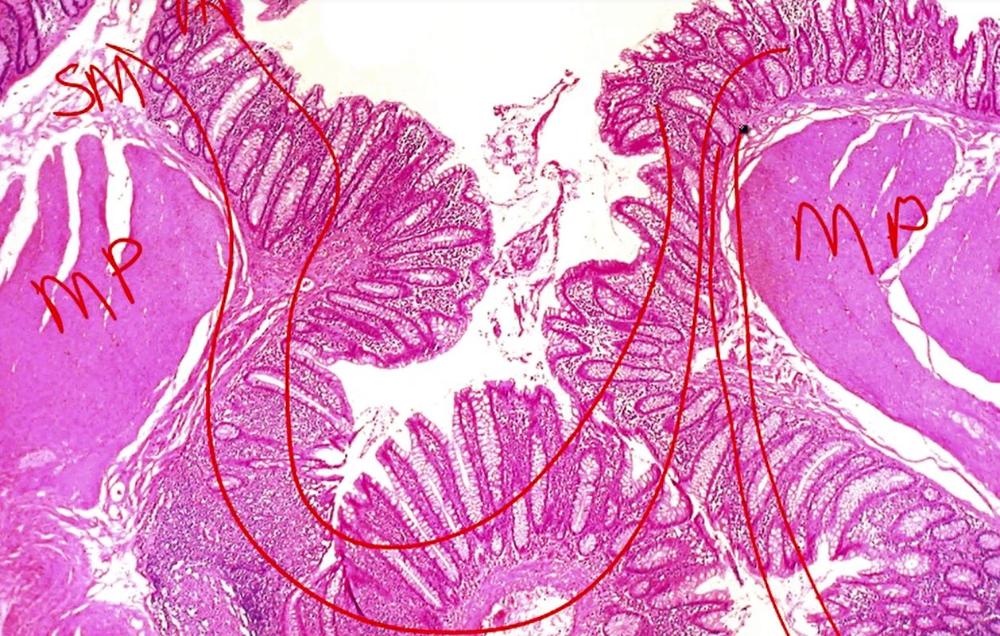
colonic diverticula
outpounchings of mucosa and submucosa through muscularis propria: ______ diverticula
colonic
A 68-year-old man with chronic constipation presents
with left lower quadrant pain and fever. CT scan shows
inflamed outpouchings in the sigmoid
colon. What is the underlying structural abnormality?
A. Herniation of mucosa through muscularis propria
B.
Full-thickness outpouching involving all bowel layers
C.
Transmural inflammation with granuloma formation
D. Hypertrophy
of circular muscle without herniation
A. Herniation of mucosa through muscularis propria
An elderly patient presents with painless
hematochezia. Colonoscopy reveals multiple
diverticula in the sigmoid colon. Which anatomic feature
explains where these lesions most commonly form?
A. Areas of
maximal peristaltic contraction
B. Sites where vasa recta
penetrate bowel wall
C. Regions of highest lymphoid tissue
density
D. Junction between small and large intestine
B. Sites where vasa recta penetrate bowel wall
A patient develops a fistula connecting the
colon to the bladder. What is the
most likely preceding condition?
A. Chronic low-fiber diet
without inflammation
B. Acute appendicitis in right lower
quadrant
C. Diverticulitis with localized inflammation
D.
Ischemic colitis with mucosal necrosis
C. Diverticulitis with localized inflammation
Which of the following best distinguishes colonic diverticulosis from
a true diverticulum such as Meckel diverticulum?
A. Location in
distal small intestine
B. Presence of ectopic gastric
mucosa
C. Involvement of all bowel wall layers
D. Only
mucosa and submucosa herniate
D. Only mucosa and submucosa herniate
A 72-year-old patient has long-standing constipation and is diagnosed
with colonic diverticulosis. Which factor most
contributed to the development of this condition?
A. High-fiber
diet increasing stool bulk
B. Increased intraluminal pressure
from straining
C. Rapid intestinal transit time
D.
Decreased colonic segmentation activity
B. Increased intraluminal pressure from straining
An older adult presents with intermittent lower GI bleeding. Colonoscopy shows malformed mucosal and submucosal vessels in the cecum. Which diagnosis best fits?
A. Volvulus
B. Angiodysplasia
C. Dysentery
D. Intussusception
Angiodysplasia
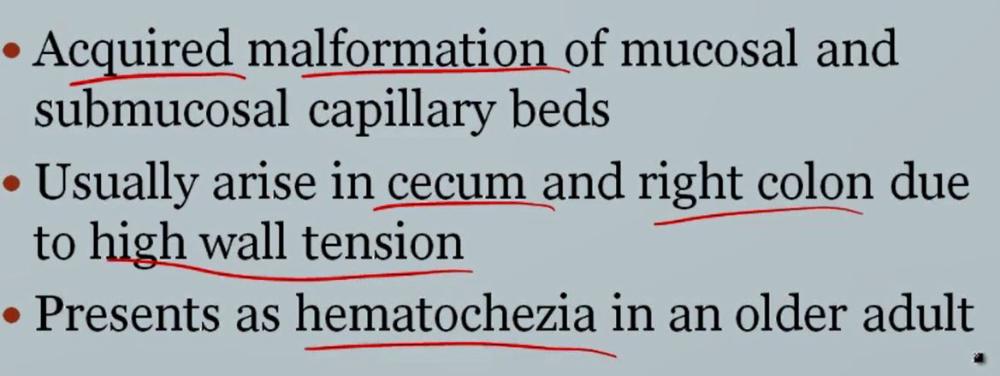
Angiodysplasia
A 34-year-old woman presents with recurrent nosebleeds and
episodes of gastrointestinal bleeding. Physical exam reveals
multiple small red lesions on the lips and oral
mucosa. Which of the following is the most likely underlying
condition?
A. Autosomal dominant disorder causing fragile blood
vessels
B. Autoimmune vasculitis with immune complex
deposition
C. Platelet dysfunction due to von Willebrand
deficiency
D. Vitamin C deficiency impairing collagen synthesis
A. Autosomal dominant disorder causing fragile blood vessels
hereditary hemorrhagic telangiectasia
A patient with hereditary hemorrhagic telangiectasia
develops chronic iron deficiency anemia. Which of the
following best explains the source of bleeding?
A. Ulceration
from gastric acid hypersecretion
B. Rupture of thin-walled
mucosal blood vessels
C. Immune-mediated destruction of vascular
endothelium
D. Thrombocytopenia causing impaired clot formation
B. Rupture of thin-walled mucosal blood vessels
A 40-year-old man has a history of recurrent
epistaxis and visible telangiectasias on his
tongue. Which inheritance pattern is most consistent with this
condition?
A. Autosomal recessive with enzyme deficiency
B. X-linked recessive affecting clotting factors
C. Autosomal
dominant with vascular malformations
D. Mitochondrial
inheritance affecting energy metabolism
C. Autosomal dominant with vascular malformations
A 72-year-old man with a history of atherosclerosis
presents with sudden left lower quadrant abdominal
pain followed by bloody diarrhea. Which area
of the colon is most likely affected?
A. Cecum supplied by
ileocolic artery
B. Transverse colon near hepatic flexure
C. Splenic flexure watershed region
D. Rectum supplied by
inferior rectal artery
C. Splenic flexure watershed region
ischemic colitis
A patient with severe atherosclerosis develops
postprandial abdominal pain and weight loss. Which
mechanism best explains progression to ischemic colitis?
A.
Reduced blood flow through superior mesenteric artery
B.
Autoimmune inflammation of colonic mucosa
C. Increased
intraluminal pressure from constipation
D. Venous thrombosis of
inferior mesenteric vein
A. Reduced blood flow through superior mesenteric artery
ischemic colitis
A hospitalized patient develops acute abdominal pain and later passes
bloody stools. Imaging suggests colonic ischemia. Which sequence best
explains this presentation?
A. Chronic inflammation leads to
mucosal ulceration
B. Ischemia progresses to infarction causing
bleeding
C. Infection causes toxin-mediated epithelial
damage
D. Obstruction leads to proximal bowel dilation
B. Ischemia progresses to infarction causing bleeding
ischemic colitis
A 35-year-old woman presents with recurrent
abdominal pain, bloating, and alternating diarrhea and
constipation. She notes that her pain improves after
bowel movements. Which of the following is the most likely
diagnosis?
A. Irritable bowel syndrome with functional bowel
disorder
B. Crohn disease with transmural inflammation
C.
Ulcerative colitis with continuous mucosal ulceration
D. Celiac
disease with gluten-induced villous atrophy
A. Irritable bowel syndrome with functional bowel disorder
A patient reports chronic abdominal discomfort associated
with changes in bowel habits. Extensive workup including
colonoscopy is normal. Which feature most strongly supports
irritable bowel syndrome?
A. Pain improves
after defecation
B. Presence of bloody diarrhea
C.
Unintentional weight loss
D. Nocturnal awakening with symptoms
A. Pain improves after defecation
A 60-year-old patient undergoes routine colonoscopy, which reveals
multiple small polyps in the rectosigmoid
colon. Biopsy shows serrated architecture with
hyperplasia of glands but no dysplasia. What is the most
likely diagnosis?
A. Hyperplastic polyp
B. Adenomatous
polyp
C. Hamartomatous polyp
D. Inflammatory polyp
A. Hyperplastic polyp
A patient is found to have a colonic polyp with serrated
histologic appearance and polyclonal glandular
hyperplasia. Which of the following best describes its
malignant potential?
A. High risk of progression to
adenocarcinoma
B. Moderate risk depending on size
C. No
risk of malignant transformation
D. Risk only if associated with inflammation
C. No risk of malignant transformation
Which of the following features most strongly supports a diagnosis of
hyperplastic polyp rather than an
adenomatous polyp?
A. Presence of dysplastic
epithelial cells
B. Serrated glands without cytologic
atypia
C. Villous architecture with high mitotic activity
D. Large size with irregular borders
B. Serrated glands without cytologic atypia
A 58-year-old patient undergoes colonoscopy and is found to have a
polyp. Biopsy reveals monoclonal proliferation of
dysplastic glandular epithelium. Which of the
following is the most likely diagnosis?
A. Hyperplastic polyp
with polyclonal gland growth
B. Adenomatous polyp with
neoplastic gland proliferation
C. Hamartomatous polyp with
disorganized tissue elements
D. Inflammatory polyp with
regenerative mucosal changes
B. Adenomatous polyp with neoplastic gland prolifera
A patient is diagnosed with a colonic polyp that is benign but has
potential to progress to malignancy. Which pathway best describes this
progression?
A. Chronic inflammation to dysplasia sequence
B. Adenoma to carcinoma sequence
C. Metaplasia to hyperplasia
sequence
D. Hamartoma to sarcoma sequence
B. Adenoma to carcinoma sequence
Which dietary pattern most promotes progression of diverticular disease?
A. High-protein diet
B. High-fat diet
C. Lactose-free
diet
D. Low-fiber diet
D. Low-fiber diet
Which statement about diverticular disease is most accurate?
A. Usually presents with obstruction
B. Most patients are
asymptomatic
C. Has high malignant potential
D. Usually
involves true diverticula
B. Most patients are asymptomatic
The pathogenesis of diverticular disease is most closely related to:
A. Elevated intraluminal pressure
B. Transmural granulomatous
inflammation
C. Mucosal ischemic necrosis
D. Defective
enteric innervation
A. Elevated intraluminal pressure
Colorectal adenocarcinoma develops in ____% of untreated FAP patients
100
Which finding is required for diagnosis of classic familial adenomatous polyposis?
A. At least 10 polyps
B. Rectal cancer before age 30
C.
Biallelic APC mutation only
D. At least 100 polyps
D. At least 100 polyps
Familial adenomatous polyposis is best described as which syndrome?
A. APC-associated adenomatous polyposis
B. Mismatch repair
deficiency syndrome
C. Hamartomatous polyposis syndrome
D.
Biallelic MYH serrated syndrome
A. APC-associated adenomatous polyposis
The standard preventive treatment for classic familial adenomatous polyposis is:
A. Annual polypectomy
B. Endoscopic ablation
C.
Prophylactic colectomy
D. Small-bowel resection
C. Prophylactic colectomy
After colectomy for FAP, which medication class can reduce polyps in the residual rectum?
A. NSAIDs
B. Antimetabolites
C. Corticosteroids
D.
Bile acid binders
A. NSAIDs
A 3-year-old child presents with painless rectal
bleeding. Parents report a small mass that
occasionally protrudes from the rectum during defecation.
Which of the following is the most likely diagnosis?
A. Juvenile
polyp with benign hamartomatous growth
B. Juvenile polyp with
dysplastic epithelial cells
C. Hyperplastic polyp with serrated
glandular pattern
D. Hyperplastic polyp due to chronic colitis
A. Juvenile polyp with benign hamartomatous growth
A 16-year-old girl presents with multiple dark pigmented
spots on her lips and oral mucosa. She has a history of
recurrent abdominal pain, and imaging reveals
multiple polyps throughout the gastrointestinal
tract. Which of the following is the most likely diagnosis?
A.
Peutz-Jeghers syndrome
B. Familial adenomatous polyposis
C. Lynch syndrome
D. Juvenile polyposis
A. Peutz-Jeghers syndrome with hamartomatous polyps
A 4-year-old child presents with intermittent painless rectal bleeding. Colonoscopy reveals a solitary rectal polyp composed of disorganized but mature tissue elements. Which diagnosis is most likely?
A. Hyperplastic polyp
B. Tubular adenoma
C. Juvenile
polyp
D. Inflammatory pseudopolyp
C. Juvenile polyp
Juvenile polyps are best classified as:
A. Hamartomatous polyps
B. Neoplastic adenomas
C.
Inflammatory lesions
D. Vascular malformations
A. Hamartomatous polyps
Which presentation is most typical of a juvenile polyp?
A. Watery secretory diarrhea
B. Small bowel
obstruction
C. Mucocutaneous pigmentation
D. Rectal bleeding
D. Rectal bleeding
A child has multiple hamartomatous colorectal polyps and a family history of similar lesions. Which syndrome should raise concern for future colonic adenocarcinoma?
A. Lynch syndrome
B. FAP
C. Juvenile polyposis
syndrome
D. Cowden syndrome
C. Juvenile polyposis syndrome
Juvenile polyposis syndrome is often associated with mutation in:
A. SMAD4
B. APC
C. KRAS
D. MLH1
A. SMAD4
The major long-term malignancy risk in juvenile polyposis syndrome is:
A. Gastric lymphoma
B. Pancreatic carcinoma
C. Small
bowel carcinoid
D. Colonic adenocarcinoma
D. Colonic adenocarcinoma
In Peutz-Jeghers syndrome, hamartomatous polyps most often involve the:
A. Small intestine
B. Rectum
C. Esophagus
D. Appendix
A. Small intestine
Which gene is characteristically mutated in Peutz-Jeghers syndrome?
A. SMAD4
B. TP53
C. STK11
D. BRAF
C. STK11
A 10-year-old boy presents with acute abdominal pain
that began periumbilically and migrated to the right lower
quadrant. Imaging confirms appendicitis.
Which of the following is the most likely underlying cause in this
patient?
A. Lymphoid hyperplasia causing luminal
obstruction
B. Fecalith obstruction of appendiceal lumen
C. Autoimmune inflammation of intestinal mucosa
D. Ischemic
injury from vascular insufficiency
A. Lymphoid hyperplasia causing luminal obstruction
A 35-year-old man presents with right lower quadrant
abdominal pain, fever, and leukocytosis. Which of the
following mechanisms most likely initiated this condition?
A.
Obstruction by fecalith leading to bacterial overgrowth
B. Viral
infection causing diffuse mucosal inflammation
C. Decreased
blood flow causing ischemic necrosis
D. Autoimmune destruction
of appendiceal tissue
A. Obstruction by fecalith leading to bacterial overgrowth
appendicitis
A 29-year-old patient has chronic abdominal pain and diarrhea. Endoscopy shows inflamed bowel separated by normal intervening mucosa. Which diagnosis is most likely?
A. Ulcerative colitis
B. Ischemic colitis
C. Crohn
disease
D. Microscopic colitis
C. Crohn disease
Which feature best distinguishes Crohn disease from ulcerative colitis?
A. Transmural inflammation
B. Rectal involvement
C. Toxic
megacolon risk
D. Mucosal ulceration only
A. Transmural inflammation
A patient with inflammatory bowel disease develops enteroenteric fistulas and bowel wall fibrosis. Which diagnosis best fits?
A. Ulcerative colitis
B. Infectious colitis
C.
Pseudomembranous colitis
D. Crohn disease
D. Crohn disease
Which distribution is most typical of ulcerative colitis?
A. Any GI segment
B. Colon and rectum
C. Small bowel
only
D. Stomach and duodenum
B. Colon and rectum
Histology from an inflamed bowel segment shows noncaseating granulomas and transmural inflammation. Which disorder is most likely?
A. Crohn disease
B. Ulcerative colitis
C. Ischemic
colitis
D. Diverticulitis
A. Crohn disease
A patient with longstanding inflammatory bowel disease develops severe colonic dilation and systemic toxicity. Which disease is classically associated with this complication?
A. Crohn disease
B. Celiac disease
C.
Angiodysplasia
D. Ulcerative colitis
D. Ulcerative colitis
Which gross feature is classically associated with Crohn disease?
A. Continuous rectosigmoid disease
B. Diffuse
pseudopolyposis
C. Creeping fat
D. Superficial mucosal erosion
C. Creeping fat
Ulcerative colitis is typically confined to which bowel layers?
A. Muscularis and serosa
B. Mucosa and superficial
submucosa
C. Full bowel wall thickness
D. Subserosa and mesentery
B. Mucosa and superficial submucosa
A patient with Crohn disease develops recurrent obstructive symptoms from fibrosing bowel narrowing. Which treatment is often required?
A. Surgical resection
B. Total colectomy
C. Air enema
reduction
D. Anticoagulation
A. Surgical resection
A patient with severe ulcerative colitis undergoes total colectomy. What is the expected effect on the intestinal disease?
A. Disease shifts to ileum
B. Fistulas continue
C. Skip
lesions persist
D. Intestinal disease is cured
D. Intestinal disease is cured
A 29-year-old man with chronic inflammatory bowel disease presents
with fatigue and pruritus. Laboratory testing reveals a
cholestatic pattern, and imaging shows
multifocal stricturing of the bile ducts. Which of
the following associated conditions is most likely present?
A.
Primary sclerosing cholangitis with p-ANCA positivity
B.
Autoimmune hepatitis with anti-smooth muscle antibodies
C.
Primary biliary cholangitis with antimitochondrial antibodies
D.
Alcoholic liver disease with AST greater than ALT
A. Primary sclerosing cholangitis with p-ANCA positivity
this is UC

what is this associated with?
crohn's
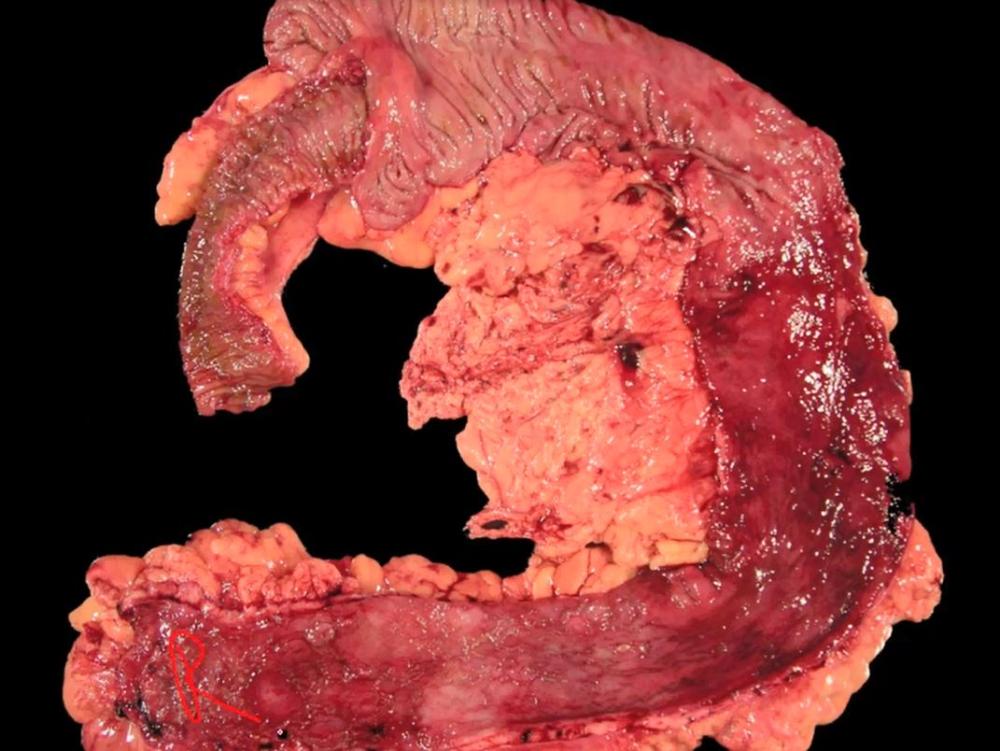
UC or Crohns?
UC
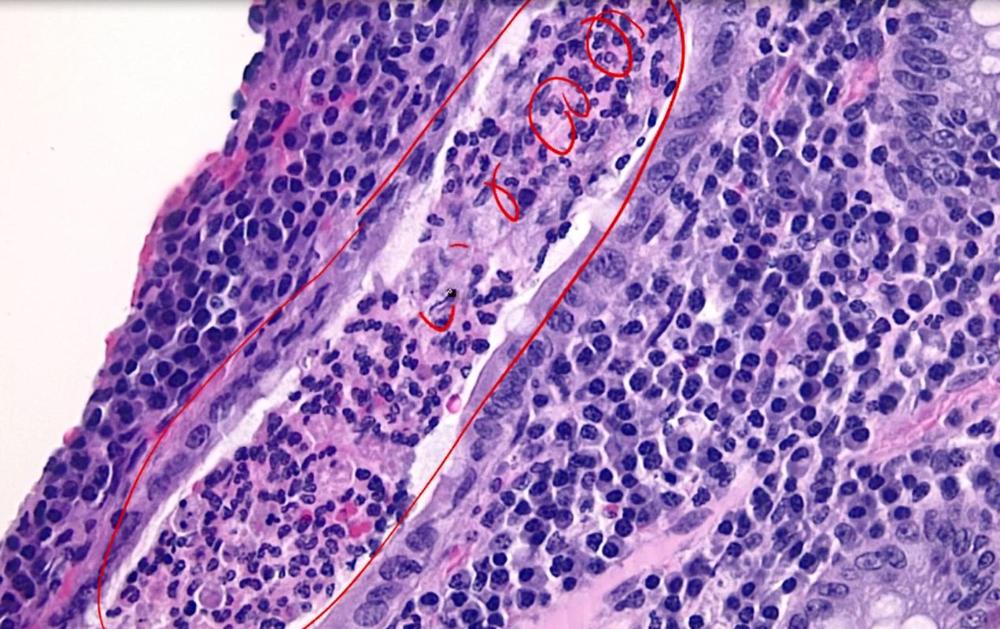
UC or Crohns?
UC
crypt abcess, neutrophils
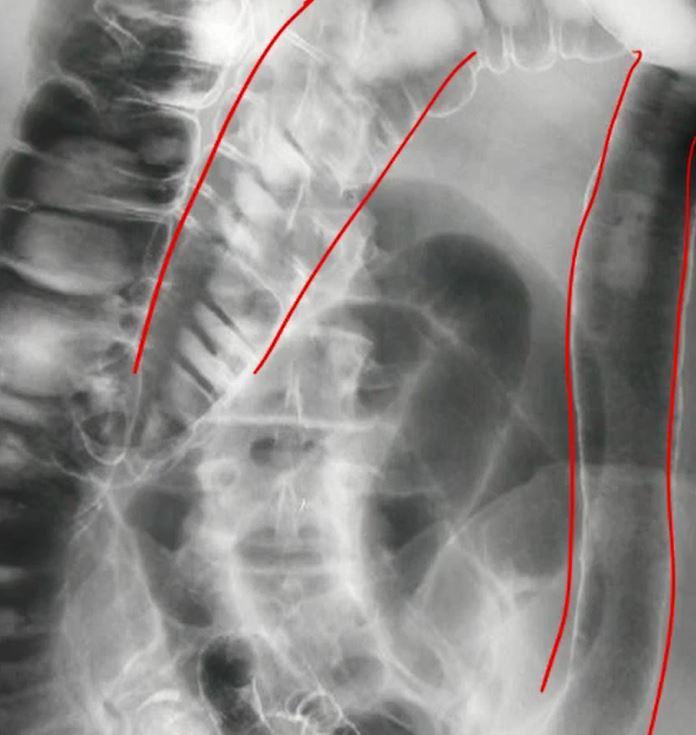
what is happening here?
lead pipe sign- loss of haustra, UC
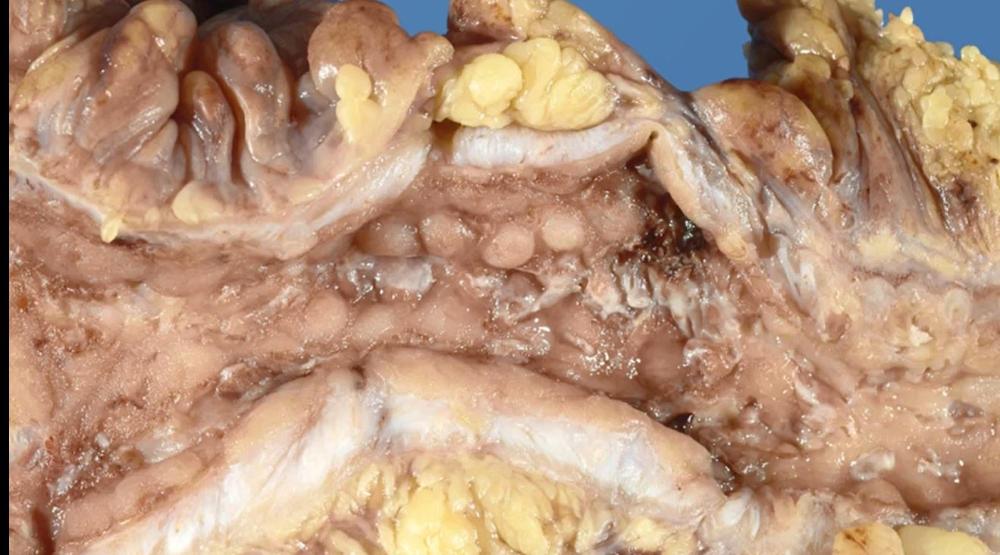
UC or Crohns?
Crohns
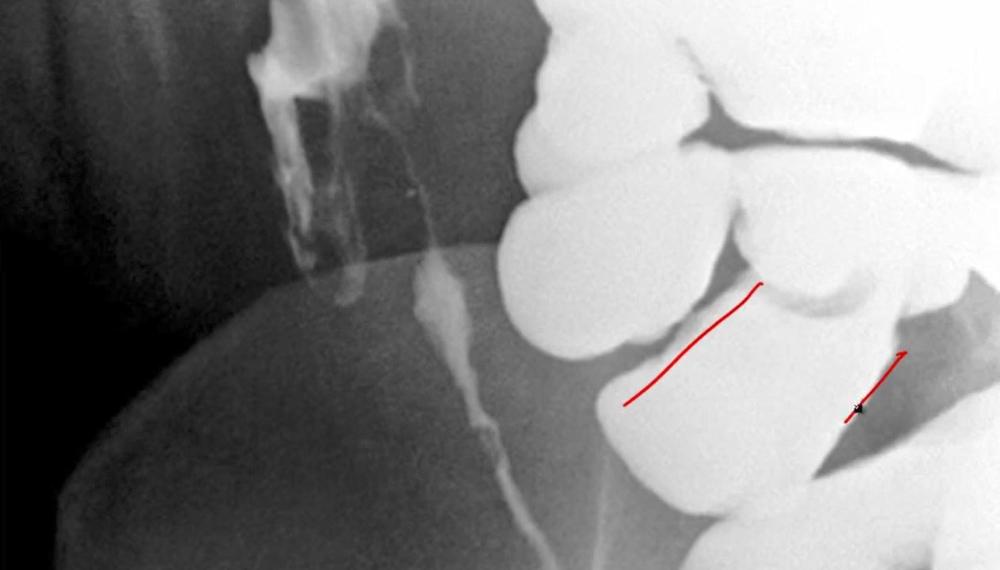
UC or Crohns?
Crohns
string sign
A neonate with polyhydramnios has excessive salivation, choking with feeds, and failure to pass an NG tube. Esophageal atresia most commonly occurs near which anatomic level?
A. Upper esophageal sphincter
B. Tracheal bifurcation
C.
Diaphragmatic hiatus
D. Gastroesophageal junction
B. Tracheal bifurcation
Prenatal imaging shows abdominal viscera in the thorax. After delivery, the infant develops severe respiratory distress. Which paired finding is most characteristic of congenital diaphragmatic hernia?
A. Right-sided defect; pulmonary hypoplasia
B. Left-sided
defect; renal agenesis
C. Right-sided defect; bowel
atresia
D. Left-sided defect; pulmonary hypoplasia
D. Left-sided defect; pulmonary hypoplasia
A newborn has a midline abdominal wall defect covered by a membranous sac. Which genetic association is classically linked to this lesion?
A. Down syndrome
B. Turner syndrome
C. Marfan
syndrome
D. Noonan syndrome
A. Down syndrome
Endoscopy identifies an “inlet patch” of ectopic gastric mucosa in the esophagus. Where is this finding most commonly located?
A. Distal third
B. Gastric cardia
C. Upper third
D. Terminal ileum
C. Upper third
A child presents with painless lower GI bleeding from a congenital true diverticulum containing ectopic tissue. This lesion most commonly arises in the:
A. Ileum
B. Jejunum
C. Duodenum
D. Colon
A. Ileum
The clinical presentation describes a Meckel's diverticulum
Meckel diverticulum results from failure of involution of a structure that normally connects the:
A. Foregut to allantois
B. Hindgut to cloaca
C.
Developing gut to yolk sac
D. Stomach to liver bud
C. Developing gut to yolk sac
A neonate with abdominal distention and empty rectum is suspected of having Hirschsprung disease. Which gene is most classically implicated by loss-of-function mutation?
A. APC
B. CFTR
C. FBN1
D. RET
D. RET
What is the earliest classic postnatal clue to Hirschsprung disease?
A. Bilious emesis
B. Failure to pass meconium
C.
Projectile vomiting
D. Hematochezia
B. Failure to pass meconium
A patient with intermittent chest pain and dysphagia has a barium swallow showing a corkscrew esophagus. Which manometric feature best fits this disorder?
A. Normal amplitude contractions
B. Increased LES
relaxation
C. Absent peristaltic activity
D. Gray-white pseudomembranes
A. Normal amplitude contractions
A patient has recurrent chest pain with hypertensive but coordinated peristaltic waves on manometry. Which description would argue against nutcracker esophagus?
A. Low-amplitude coordinated waves
B. High-amplitude
coordinated waves
C. High-amplitude uncoordinated waves
D.
Absent LES relaxation
C. High-amplitude uncoordinated waves
In Plummer-Vinson syndrome, esophageal webs classically occur with glossitis, cheilosis, and:
A. Hemolytic anemia
B. Iron deficiency anemia
C.
Pernicious anemia
D. Aplastic anemia
B. Iron deficiency anemia
A patient with dysphagia to solids and liquids has incomplete lower esophageal sphincter relaxation. Which additional pair completes the classic achalasia triad?
A. Increased tone with aperistalsis
B. Low tone with
spasm
C. Normal tone with eosinophilia
D. Weak tone with webs
A. Increased tone with aperistalsis
After repeated retching, a patient develops hematemesis. Endoscopy shows longitudinal mucosal lacerations near the gastroesophageal junction. These lesions are called:
A. Boerhaave rupture
B. Mallory-Weiss tears
C. Barrett
metaplasia
D. Plummer-Vinson webs
B. Mallory-Weiss tears
Which precipitating event most classically causes Mallory-Weiss tears?
A. Portal venous congestion
B. Atopic mucosal
inflammation
C. Chronic caustic ingestion
D. Repetitive
forceful vomiting
D. Repetitive forceful vomiting
Candidiasis of the esophagus is characterized by:
A. Linear mucosal furrows
B. Salmon-colored mucosa
C.
Gray-white pseudomembranes
D. Circumferential ulcers
C. Gray-white pseudomembranes
Which mechanism is a major driver of GERD pathogenesis?
A. Transient LES relaxation
B. Esophageal muscular
hypertrophy
C. Congenital distal web
D. Chronic fungal colonization
A. Transient LES relaxation
Biopsy of distal esophageal mucosa in chronic reflux disease most classically shows:
A. Goblet cell metaplasia
B. Basal zone hyperplasia
C.
Full-thickness dysplasia
D. Granulomatous inflammation
B. Basal zone hyperplasia
A patient with chronic heartburn and acid regurgitation has uncomplicated GERD. Which drug class is standard therapy?
A. Sucralfate
B. Budesonide
C. Octreotide
D.
Proton pump inhibitors
D. Proton pump inhibitors
A young adult with asthma and multiple food allergies has recurrent solid-food dysphagia. Which underlying process best fits eosinophilic esophagitis?
A. Atopic disease
B. Alcohol misuse
C. Chagas
disease
D. Portal hypertension
A. Atopic disease
A cirrhotic patient presents with massive hematemesis from dilated submucosal veins in the distal esophagus. The most likely underlying cause is:
A. Diffuse esophageal spasm
B. Incomplete LES relaxation
C. Portal hypertension
D. Iron deficiency anemia
C. Portal hypertension
Barrett esophagus represents which metaplastic transition?
A. Columnar to squamous
B. Squamous to cuboidal
C.
Glandular to squamous
D. Squamous to columnar
D. Squamous to columnar
Which cell type is required for the diagnosis of Barrett esophagus?
A. Paneth cells
B. Goblet cells
C. Chief cells
D.
Parietal cells
B. Goblet cells
Which epidemiologic pattern for esophageal cancer is correct?
A. West squamous, world adenocarcinoma
B. West adenocarcinoma,
world adenocarcinoma
C. West adenocarcinoma, world
squamous
D. West squamous, world squamous
C. West adenocarcinoma, world squamous
Which condition is a major risk factor for esophageal adenocarcinoma?
A. Barrett esophagus
B. Alcohol dependence
C. Nutcracker
esophagus
D. Candida esophagitis
A. Barrett esophagus
Esophageal adenocarcinoma most often arises in which location?
A. Proximal third
B. Distal third
C. Midesophagus
D. Upper esophageal sphincter
B. Distal third
Which exposure pattern is most strongly associated with esophageal squamous cell carcinoma?
A. Chronic iron deficiency
B. Childhood atopy
C. Barrett
metaplasia
D. Alcohol and tobacco
D. Alcohol and tobacco
Which esophageal malignancy is more likely to spread to lymph nodes and carry a poorer prognosis?
A. Esophageal squamous carcinoma
B. Distal Barrett
adenocarcinoma
C. Mallory-Weiss syndrome
D. Candidal esophagitis
A. Esophageal squamous carcinoma
Acute gastritis is defined histologically by the presence of:
A. Neutrophils
B. Eosinophils
C. Plasma cells
D. Fibroblasts
A. Neutrophils
chronic use of what can cause gastritis by inhibiting production of vasodilation products?
NSAIDs
A critically ill patient with extensive full-thickness burns develops hematemesis several days after admission. Which ulcer type is most classically associated with this setting?
A. Cushing ulcer
B. Stress-free ulcer
C. Curling
ulcer
D. Marginal ulcer
C. Curling ulcer
Ulcers occurring in the context of intracranial disease is termed:
A. Curling ulcer
B. Cushing ulcer
C. Meckel ulcer
D. Dieulafoy ulcer
B. Cushing ulcer
Chronic gastritis worldwide is most commonly caused by:
A. Autoimmune injury
B. Crohn disease
C. NSAID
exposure
D. Helicobacter pylori
D. Helicobacter pylori
H. pylori occurs mostly in which part of the stomach?
A. Body
B. Fundus
C. Incisura
D. Antrum
D. Antrum
A urease breath test is positive in a patient with dyspepsia. H. pylori uses urease primarily to generate which compound that promotes survival?
A. Nitric oxide
B. Hydrogen peroxide
C. Ammonia
D.
Sulfur dioxide
C. Ammonia
Expression of CagA by H. pylori has what effect on gastric cancer risk?
A. Eliminates malignant potential
B. Decreases dysplasia
risk
C. Has no prognostic role
D. Increases cancer risk
D. Increases cancer risk
A patient with chronic H. pylori gastritis develops dense lymphoid aggregates in the stomach. This infection is a risk factor for formation of:
A. GIST
B. Carcinoid tumor
C. MALT lymphoma
D. Leiomyoma
C. MALT lymphoma
Which feature best distinguishes autoimmune gastritis from H. pylori gastritis?
A. Antral predominance
B. Hypergastrinemia with antral
sparing
C. Urease-mediated ammonia production
D. Curling
ulcers after burns
B. Hypergastrinemia with antral sparing
Autoimmune gastritis is primarily associated with immune-mediated loss of which gastric cell type?
A. Mucous neck cells
B. Chief cells
C. G cells
D.
Parietal cells
D. Parietal cells
A patient with autoimmune atrophic gastritis develops fatigue, glossitis, and macrocytosis. Which associated manifestation is most expected?
A. Iron deficiency anemia
B. Hemolytic anemia
C.
Megaloblastic anemia
D. Microcytic anemia
C. Megaloblastic anemia
Histology from autoimmune atrophic gastritis most characteristically shows injury involving which anatomic regions?
A. Cardia and pylorus
B. Body and fundus
C. Antrum and
cardia
D. Pylorus and duodenum
B. Body and fundus
A patient with peripheral eosinophilia and recurrent gastric symptoms has biopsy-proven eosinophilic gastritis. Which mechanism is most likely responsible?
A. Allergic reaction
B. Portal hypertension
C. H. pylori
colonization
D. Intracranial hypertension
A. Allergic reaction
In Western populations, the most common cause of granulomatous gastritis is:
A. Sarcoidosis
B. Tuberculosis
C. Crohn disease
D.
Whipple disease
C. Crohn disease
Which trio most completely accounts for the great majority of peptic ulcers involving the stomach or duodenum?
A. Alcohol, steroids, CMV
B. H. pylori, NSAIDs, smoking
C. Autoimmunity, Crohn, stress
D. Zollinger-Ellison, burns, trauma
B. H. pylori, NSAIDs, smoking
Peptic ulcer disease most commonly affects which gastric location?
A. Greater curvature body
B. Cardia near GE junction
C.
Fundus along posterior wall
D. Antrum lesser curvature
D. Antrum lesser curvature
H. pylori infection that predominantly involves the fundus and body is most associated with which physiologic pattern?
A. Increased acid without atrophy
B. Decreased acid with
atrophy
C. Normal acid with ulcers
D. Increased gastrin
without injury
B. Decreased acid with atrophy
Which condition carries the greater association with gastric adenocarcinoma?
A. Autoimmune atrophic gastritis
B. H. pylori antral
gastritis
C. Eosinophilic gastritis
D. Granulomatous Crohn gastritis
A. Autoimmune atrophic gastritis
A patient with giant rugal folds, edema, and protein-losing gastropathy is found to have overexpression of which cytokine?
A. Transforming growth factor beta
B. Tumor necrosis factor
alpha
C. Transforming growth factor alpha
D. Epidermal
growth factor
C. Transforming growth factor alpha
Menetrier disease
Menetrier disease is most classically characterized by which pair of findings?
A. Parietal hyperplasia and hypercalcemia
B. Goblet metaplasia
and dysphagia
C. Chief cell loss and ulceration
D.
Foveolar hyperplasia and hypoproteinemia
D. Foveolar hyperplasia and hypoproteinemia
A patient has severe recurrent peptic ulcers and markedly increased gastrin levels from a pancreatic neuroendocrine tumor. Which gastric cell type is expected to be especially enlarged?
A. Parietal cells
B. Chief cells
C. Mucous neck
cells
D. Enterochromaffin cells
A. Parietal cells
Zollinger-Ellison gastrinomas are classically associated with which inherited syndrome?
A. MEN2A
B. MEN2B
C. MEN1
D. VHL syndrome
C. MEN1
Fundic gland polyps and intestinal-type gastric adenocarcinoma are both associated with mutations in which gene?
A. RB1
B. APC
C. KRAS
D. SMAD4
B. APC
Which set best lists classic metastatic sites of gastric adenocarcinoma?
A. Cervical spine, liver, spleen, lung
B. Brain, pancreas,
kidney, femur
C. Virchow, umbilical, ovaries, axilla
D.
Adrenal, pleura, jejunum, bladder
C. Virchow, umbilical, ovaries, axilla
A family with hereditary diffuse gastric cancer is found to carry a germline mutation in which gene?
A. MLH1
B. STK11
C. KIT
D. CDH1
D. CDH1
Which viral infection is implicated in lymphoproliferation and GI lymphoma formation?
A. Epstein-Barr virus
B. Cytomegalovirus
C. Human
papillomavirus
D. Hepatitis B virus
A. Epstein-Barr virus
A patient with episodic flushing develops wheezing, secretory diarrhea, and tricuspid dysfunction. Which syndrome best fits this presentation?
A. VIPoma syndrome
B. Zollinger-Ellison syndrome
C.
Carcinoid syndrome
D. Menetrier disease
C. Carcinoid syndrome
Neuroendocrine tumors from which embryologic region tend to be the most aggressive?
A. Foregut
B. Midgut
C. Hindgut
D. Cloacal remnant
B. Midgut
A submucosal GI spindle-cell tumor is found to arise from the gut’s pacemaker cells. What is its cell of origin?
A. Smooth muscle cells
B. Enteric ganglion cells
C.
Schwann cells
D. Interstitial cells of Cajal
D. Interstitial cells of Cajal
About 75% of gastrointestinal stromal tumors harbor gain-of-function mutations in which gene?
A. KIT
B. RET
C. APC
D. CDH1
A. KIT
Worldwide, the most frequent cause of intestinal obstruction is:
A. Hernias
B. Volvulus
C. Intussusception
D. Adhesions
A. Hernias
An elderly patient develops sudden abdominal pain, distention, and bowel ischemia after a segment of colon twists around its mesenteric attachment. This process is termed:
A. Intussusception
B. Volvulus
C. Ileus
D. Stricture
B. Volvulus
A 14-month-old child develops intermittent colicky pain, vomiting, and drawing up of the legs. Which is the most common cause of intestinal obstruction in children younger than 2 years?
A. Hirschsprung disease
B. Inguinal hernia
C.
Intussusception
D. Midgut volvulus
C. Intussusception
A patient with profound hypotension develops ischemic colitis at a bowel region supplied by the terminal branches of both the SMA and IMA. Which site is this severe watershed zone?
A. Cecum
B. Splenic flexure
C. Rectosigmoid
junction
D. Terminal ileum
B. Splenic flexure
A premature, low-birth-weight neonate develops abdominal distention, bloody stools, and pneumatosis intestinalis. Which GI emergency best fits?
A. Meconium ileus
B. Jejunal atresia
C. Hirschsprung
enterocolitis
D. Necrotizing enterocolitis
D. Necrotizing enterocolitis
Which HLA profile is most strongly associated with celiac disease?
A. HLA-B27 and DR4
B. HLA-DQ2 and DQ8
C. HLA-A3 and
B8
D. HLA-DR3 and DR5
B. HLA-DQ2 and DQ8
Autoimmune enteropathy is classically associated with mutations in which gene?
A. APC
B. FOXP3
C. RET
D. MYO5B
B. FOXP3
An infant with intractable secretory diarrhea is diagnosed with microvillus inclusion disease. Which gene is most likely mutated?
A. MTP
B. CFTR
C. MYO5B
D. FOXP3
C. MYO5B
Abetalipoproteinemia is caused by mutation in which protein?
A. MTP
B. ApoA-I
C. NPC1L1
D. LDL receptor
A. MTP
A patient with profuse “rice-water” diarrhea is infected by a comma-shaped gram-negative organism. Which pathogen best fits?
A. Shigella dysenteriae
B. Salmonella typhi
C.
Campylobacter jejuni
D. Vibrio cholerae
D. Vibrio cholerae
Which cholera toxin component is responsible for the downstream activation leading to CFTR-mediated ion and water efflux?
A. B subunit
B. M protein
C. A subunit
D. S1 nuclease
C. A subunit
Based on the material provided, the most common bacterial cause of traveler’s diarrhea and food poisoning is:
A. Salmonella enteritidis
B. Campylobacter jejuni
C.
Vibrio cholerae
D. Shigella sonnei
B. Campylobacter jejuni
A patient develops inflammatory diarrhea after undercooked poultry and later presents with asymmetric arthritis. Which HLA type is associated with this postinfectious complication?
A. HLA-B27
B. HLA-DQ2
C. HLA-DR4
D. HLA-DQ8
A. HLA-B27
A patient develops ascending weakness several weeks after diarrheal illness due to Campylobacter jejuni. Which neurologic complication is classically associated?
A. Multiple sclerosis
B. Myasthenia gravis
C.
Guillain-Barré syndrome
D. Subacute combined degeneration
C. Guillain-Barré syndrome
Campylobacter jejuni is best described as which of the following?
A. Bacillus, gram-positive
B. Comma-shaped,
gram-negative
C. Cocci, gram-negative
D. Spiral, acid-fast
B. Comma-shaped, gram-negative
Which statement about Shigella is correct?
A. Gram-positive coccus
B. Acid-fast bacillus
C.
Gram-negative organism
D. Encapsulated diplococcus
C. Gram-negative organism
Shigella organisms are classically taken up by which intestinal cells?
A. Goblet cells
B. M cells
C. Paneth cells
D.
Enteroendocrine cells
B. M cells
A foodborne diarrheal illness is caused by a gram-negative bacillus. Which organism best matches this morphology and classification?
A. Vibrio cholerae
B. Campylobacter jejuni
C. Shigella
flexneri
C. Salmonella enteritidis
C. Salmonella enteritidis
Nontyphoidal salmonellosis is most classically caused by:
A. Salmonella typhi
B. Campylobacter jejuni
C.
Salmonella enteritidis
D. Shigella sonnei
C. Salmonella enteritidis
Which organism is the classic cause of typhoid fever?
A. Salmonella typhi
B. Salmonella enteritidis
C. Vibrio
cholerae
D. Shigella dysenteriae
A. Salmonella typhi
Typhoid fever disseminates primarily through:
A. Bile and pancreatic ducts
B. Blood and lymphatics
C.
Portal venous shunts
D. Intestinal crypt abscesses
B. Blood and lymphatics
A patient with typhoid fever develops abdominal distention and GI bleeding from inflamed lymphoid tissue in the ileum. Which structure is classically enlarged?
A. Brunner glands
B. Crypts of Lieberkühn
C. Peyer
patches
D. Paneth cells
C. Peyer patches
Which statement about typhoid fever is most accurate?
A. It remains confined to colon
B. It causes only watery
diarrhea
C. It resolves without complications
D. It can
cause extraintestinal disease
D. It can cause extraintestinal disease
A child with iron overload develops enterocolitis from a pathogen that invades M cells and is enhanced by iron availability. Which organism best fits?
A. Yersinia enterocolitica
B. Vibrio cholerae
C.
Campylobacter jejuni
D. Enterotoxigenic E. coli
A. Yersinia enterocolitica
Which extraintestinal manifestation is classically associated with Yersinia infection?
A. Hemolytic anemia
B. Erythema nodosum
C. Right-sided
valvulopathy
D. Migratory thrombophlebitis
B. Erythema nodosum
A patient with Yersinia enterocolitica develops symptoms outside the intestine. Which additional finding is characteristic?
A. Hemoptysis
B. Uveitis
C. Glossitis
D. Pharyngitis
D. Pharyngitis
Another patient with Yersinia infection presents with joint pain several days after enterocolitis. Which extraintestinal manifestation best fits?
A. Raynaud phenomenon
B. Facial nerve palsy
C.
Arthralgia
D. Polycythemia
C. Arthralgia
Which morphology best describes Escherichia coli?
A. Gram-negative bacillus
B. Gram-positive coccus
C.
Acid-fast bacillus
D. Encapsulated diplococcus
A. Gram-negative bacillus
A child develops hemorrhagic colitis after eating undercooked beef. Antibiotics are avoided because toxin release may precipitate which complication?
A. Reactive arthritis
B. Toxic megacolon
C.
Hemolytic-uremic syndrome
D. Guillain-Barré syndrome
C. Hemolytic-uremic syndrome
A hospitalized patient develops fever, abdominal cramping, and pseudomembranes after broad-spectrum antibiotic use. Which pathogen is most likely responsible?
A. Clostridium difficile
B. Salmonella typhi
C.
Norovirus
D. Giardia lamblia
A. Clostridium difficile
Which treatment pair is listed as effective first-line therapy for C. difficile infection?
A. Ciprofloxacin and rifaximin
B. Metronidazole and
vancomycin
C. Ceftriaxone and azithromycin
D. Trimethoprim
and sulfamethoxazole
B. Metronidazole and vancomycin
In Whipple disease, malabsorptive diarrhea most directly reflects:
A. Crypt cell apoptosis
B. Villous autoantibodies
C.
Paneth cell destruction
D. Impaired lymph drainage
D. Impaired lymph drainage
Which triad is classic for Whipple disease?
A. Diarrhea, weight loss, arthralgia
B. Fever, rash, renal
failure
C. Dysphagia, anemia, glossitis
D. Cough,
hematuria, edema
A. Diarrhea, weight loss, arthralgia
About half of viral gastroenteritis cases are attributed to:
A. Rotavirus
B. Adenovirus
C. Norovirus
D. Astrovirus
C. Norovirus
Which statement about rotavirus is correct?
A. It is double-stranded RNA
B. It is nonenveloped DNA
C. It lacks a capsid
D. It is acid-fast
A. It is double-stranded RNA
Which IBD subtype affects both the ileum and colon?
Crohns
Which IBD subtype presents with a diffuse and continuous distribution?
UC
Which IBD subtype presents with difficulties absorbing fats and vitamins?
Crohn's
Which IBS subtype predominates in the colon only?
UC
Which IBD subtype is described as transmural?
Crohn's
Which IBD subtype is limited to only the mucosa and submucosa?
UC
Which IBD subtype is characterized by skip lesions?
Crohn's
Which IBD disorder is limited to the colon and rectum?
UC
Which IBD subtype leads to an increased risk of toxic megacolon, increasing risk of perforation?
UC
Which type of polyp is most often regarded as genetically determined?
A. Adenomatous
B. Hyperplastic
C. Inflammatory
D. Hamartomatous
D. Hamartomatous
In older adults, decreased epithelial shedding can produce mucosal elevations in the gut known as:
A. Fissures
B. Ulcers
C. Polyps
D. Fistulas
C. Polyps
A patient develops colitis after surgical diversion performed during treatment of Hirschsprung disease. Which diagnosis best fits?
A. Diversion colitis
B. Crohn disease
C. Ulcerative
colitis
D. IBS
A. Diversion colitis
Which gene is implicated in increased risk of Crohn disease, despite accounting for less than half of total disease risk?
A. APC
B. STK11
C. RET
D. NOD2
D. NOD2
A patient with early-onset right-sided colon cancer has few polyps but a strong family history of similar malignancies. Which syndrome best fits?
A. Gardner syndrome
B. Lynch syndrome
C. Peutz-Jeghers
syndrome
D. Juvenile polyposis
B. Lynch syndrome
Lynch syndrome most classically involves mutations in which gene pair?
A. APC and KRAS
B. KIT and RET
C. STK11 and SMAD4
D. MSH2 and MLH1
D. MSH2 and MLH1
The defective pathway in Lynch syndrome normally mediates:
A. Base excision repair
B. Homologous recombination
C.
Mismatch repair
D. Nucleotide excision repair
C. Mismatch repair
Most colorectal adenocarcinomas involve mutation of which gene?
A. APC
B. FOXP3
C. CDH1
D. MYO5B
A. APC
A colorectal carcinoma arises in the setting of DNA mismatch repair deficiency. Which molecular phenomenon is most characteristic?
A. Chromothripsis
B. Microsatellite instability
C.
Trinucleotide expansion
D. Loss of imprinting
B. Microsatellite instability
Which two features are most important for prognosis in colorectal cancer?
A. Tumor grade and mucin
B. KRAS status and age
C. Size
and ulceration
D. Depth and nodal spread
D. Depth and nodal spread
A patient with anal canal cancer is found to have a viral-associated squamous cell carcinoma. Which pathogen is most strongly linked?
A. EBV
B. CMV
C. HPV
D. HBV
C. HPV
Which statement about the appendix is correct?
A. It is a true diverticulum
B. It is a false
diverticulum
C. It lacks muscularis propria
D. It lacks
serosal covering
A. It is a true diverticulum
The most common appendiceal tumor is:
A. Mucinous adenocarcinoma
B. GIST
C. Lymphoma
D.
Neuroendocrine tumor
D. Neuroendocrine tumor
Tumors arising from the peritoneal lining are called:
A. Adenomas
B. Leiomyomas
C. Mesotheliomas
D. Hamartomas
C. Mesotheliomas
Which pair correctly describes Shigella?
A. Encapsulated and motile
B. Encapsulated and nonmotile
C. Unencapsulated and nonmotile
D. Unencapsulated and motile
C. Unencapsulated and nonmotile