A truck moves 80 m east, then moves 240 m west, and finally moves east again a distance of 40 m. If east is chosen as the positive direction, what is the truck's resultant displacement?
-210m
A car travels 60 m east, then 150 m west, then 30 m east.
(East
is positive.)
–60 m
A person walks 120 m west, then 200 m east, then 50 m west.
(East is positive)
+30m
A cyclist rides 90 m east, then 40 m west, then 25 m west.
(East is positive)
+25m
A delivery van drives 300 m west, then 180 m east, then 70 m
east.
(East is positive)
-50m
An object moves 74 m east in 29 s and then returns to its starting point, taking an additional 36 s. If west is chosen as the positive direction, what is the average speed of the object?
2.28m/s
A runner goes 60 m east in 20 s, then runs back to the starting point in 25s. (West is positive.)
2.67m/s
A car travels 90 m west in 30 s, then returns to the starting point
in 45 s.
(West is positive)
2.40m/s
A cyclist rides 120 m east in 40 s, then rides back to the start in
50 s.
(West is positive)
2.67m/s
A person walks 50 m west in 18 s, then walks back to the starting
point in 22 s.
(West is positive)
2.50m/s
An object moves 28 m east in 31 s and then returns to its starting point, taking an additional 48 s. If west is chosen as the positive direction, what is the average velocity of the object?
0m/s
A runner goes 40 m west in 20 s, then returns to the starting point
in 30 s.
(West is positive)
0 m/s
A car drives 100 m east in 50 s, then returns to its starting point
in 60 s.
(West is positive)
Final answer: 0 m/s
A cyclist rides 75 m west in 25 s, then rides back to the start in 35
s.
(West is positive)
Final answer: 0 m/s
A person walks 30 m east in 12 s, then walks back to the starting
point in 18 s.
(West is positive)
Final answer: 0 m/s
A sports car dealer claims that his car will accelerate at a constant rate from zero to 99 km/hr in 7 s. If so, what is the acceleration in m/s²?
3.39 m/s2
A car accelerates from 0 to 72 km/h in 6
s.
Find the acceleration in m/s².
Final answer: 3.33 m/s²
Practice Question 2
A motorcycle accelerates from 0 to 108 km/h in
9 s.
Find the acceleration.
Final answer: 3.33 m/s²
A sports car accelerates from 0 to 90 km/h in
5 s.
Find the acceleration.
Final answer: 5.00 m/s²
A car goes from 0 to 120 km/h in 8
s.
Find the acceleration.
Final answer: 4.17 m/s²
A solid metal ball is released at rest from the top of a high building, such that it falls straight down to the ground. If the time it takes to hit the ground is 6.8 seconds, what was the height (in meters) from which the ball was dropped? (Take g = 9.8 m/s² and assume air resistance is negligible)?.
227m
A stone is dropped from rest and hits the ground in 5.0
s.
Find the height.
Final answer: 122.5 m
A ball falls for 3.2 s before hitting the
ground.
Find the height.
Final answer: 50.2 m
An object is dropped and takes 7.5 s to reach the
ground.
Find the height.
Final answer: 275.6 m
A rock falls for 4.0 s before hitting the
ground.
Find the height.
Final answer: 78.4 m
A car starts from rest and has a constant acceleration of 1.6 m/s². What is the magnitude of its displacement at the end of 14 seconds after it started? Write your answer in terms of meters.?
157m
A car starts from rest and accelerates at 2.0 m/s²
for 10 s.
Find the displacement.
Final answer: 100 m
An object starts from rest and accelerates at 1.2
m/s² for 12 s.
Find the displacement.
Final answer: 86.4 m
A vehicle accelerates from rest at 3.0 m/s² for
8 s.
Find the displacement.
Final answer: 96 m
A car starts from rest and accelerates at 0.9 m/s²
for 20 s.
Find the displacement.
Final answer: 180 m
A cheetah can run at approximately 94 km/hr and a gazelle at 71 km/hr. If both animals are running at full speed, with the gazelle 87 m ahead, how long before the cheetah catches its prey? Write your answer in terms of seconds.?
13.6s
A leopard runs at 90 km/h and a deer runs at
60 km/h.
The deer is 75 m
ahead.
How long before the leopard catches it?
Final answer: 9.0 s
A wolf runs at 72 km/h and a rabbit runs at
54 km/h.
The rabbit is 36 m
ahead.
How long before the wolf catches it?
Final answer: 7.2 s
A dog runs at 80 km/h and a cat runs at 56
km/h.
The cat is 48 m ahead.
How
long before the dog catches it?
Final answer: 7.2 s
A lion runs at 100 km/h and a zebra runs at
80 km/h.
The zebra is 55 m
ahead.
How long before the lion catches it?
Final answer: 9.9 s
A railroad train travels forward along a straight track at 45 m/s for 1500 m and then travels at 34 m/s for the next 1500 m. What is the average velocity?
38.7 m/s
A car travels 30 m/s for 1000 m, then 20 m/s
for another 1000 m.
Find the average velocity.
Final answer: 24.0 m/s
A truck moves 40 m/s for 2000 m, then 25 m/s
for 2000 m.
Find the average velocity.
Final answer: 30.8 m/s
A train travels 50 m/s for 1200 m, then 30
m/s for 1200 m.
Find the average velocity.
Final answer: 37.5 m/s
A car travels 35 m/s for 800 m, then 15 m/s
for 800 m.
Find the average velocity.
Final answer: 21.0 m/s
You are driving on the highway at a speed of 45 miles per hour. You suddenly see something on the road and apply the brakes. If you stop in a time = 12 seconds, how far would you have travelled after the brakes were applied? Assume that the car had a constant value of acceleration during the braking period. Write your answer in meters.?
120.7 m
A car travels at 60 mph and stops in 10
s.
Find the stopping distance in meters.
Final answer: 134.1 m
A vehicle is moving at 50 mph and stops in 8
s.
Find the stopping distance.
Final answer: 89.4 m
A car is traveling at 70 mph and stops in 14
s.
Find the stopping distance.
Final answer: 219.0 m
A car moves at 40 mph and stops in 9
s.
Find the stopping distance.
Final answer: 80.5 m
How far (in meters) would a car travel if it starts from rest and accelerates at 3.3 m/s² for 8 s?
106m
A car starts from rest and accelerates at 2.5 m/s²
for 6 s.
Find the displacement.
Final answer: 45 m
An object starts from rest and accelerates at 4.0
m/s² for 5 s.
Find the displacement.
Final answer: 50 m
A vehicle accelerates from rest at 1.8 m/s² for
10 s.
Find the displacement.
Final answer: 90 m
A car starts from rest and accelerates at 2.2 m/s²
for 12 s.
Find the displacement.
Final answer: 158.4 m
A car crosses a green traffic signal going at 6 m/s. How far from the signal would it by after 9 s, if it continuously accelerated at 4 m/s²?
216m
A car moves at 5 m/s and accelerates at 3
m/s² for 8 s.
Find the displacement.
Final answer: 136 m
A vehicle is traveling at 10 m/s and accelerates at
2 m/s² for 6 s.
Find the displacement.
Final answer: 96 m
A car moves at 4 m/s and accelerates at 5
m/s² for 7 s.
Find the displacement.
Final answer: 150.5 m
A motorcycle travels at 8 m/s and accelerates at
3 m/s² for 10 s.
Find the displacement.
Final answer: 230 m
A car starts from rest and accelerates at 3 m/s² for 7 s, after which it continues at constant speed for 16 s. How far would it have traveled from its starting point by that time?
410m
A car starts from rest and accelerates at 2 m/s² for 6
s, then travels at constant speed for 10
s.
Find the total displacement.
156 m
A vehicle accelerates from rest at 4 m/s² for 5 s,
then moves at constant speed for 12 s.
Find the
total displacement.
340 m
A car starts from rest and accelerates at 1.5 m/s² for 8
s, then continues at constant speed for 15
s.
Find the total displacement.
234 m
A motorcycle accelerates from rest at 3.5 m/s² for 4
s, then moves at constant speed for 18
s.
Find the total displacement.
322 m
You throw a baseball in the downwards direction with a speed of 2 m/s from the top of a building that is 43 meters high. How much time would it take to hit the ground (in seconds)? (take g = 9.8 m/s² and assume air resistance is negligible.)
2.77s
A ball is thrown downward at 3 m/s from a 50
m building.
Find the time to hit the ground.
2.89 s
A stone is thrown downward at 5 m/s from a height of
60 m.
Find the time to reach the ground.
3.06 s
A ball is thrown downward at 4 m/s from a 35
m building.
Find the time to hit the ground.
2.37 s
A rock is thrown downward at 6 m/s from a height of
80 m.
Find the time to hit the ground.
3.47 s
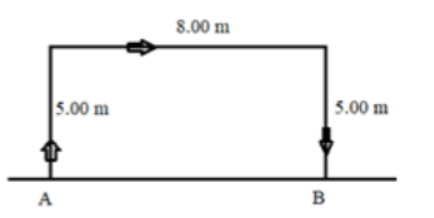
A particle goes from point A to point B along
the path shown by
the arrows. What is the
particle’s distance travelled, and
the
magnitude of the displacement?
a. Distance = 8.00 m, Displacement = 10.0 m
b. Distance = 18.0
m, Displacement = 18.0 m
c. Distance = 10.0 m, Displacement =
10.0 m
d. Distance = 18.00 m, Displacement = 8.00 m
ook next An athelete runs halfway around a 50.0 m
diameter
circular track in 40.0 s (shown by the heavy line). What
is
the magnitude of his average velocity? (circumference
of
the circle is 314 m).
a) 1.96 m/s
b) 1.25 m/s
c) 0.833
m/s
d) 3.93 m/s
An athlete runs halfway around a circular track with a 60 m
diameter in 30 s.
Find the magnitude
of the average velocity.
Final answer: 2.0 m/s
2.0 m/s
A runner moves halfway around a 40 m diameter track
in 20 s.
Find the magnitude of the average velocity
2.0 m/s
An athlete runs halfway around a 100 m diameter
circular track in 50 s.
Find the magnitude of
the average velocity.
2.0 m/s
A runner goes halfway around a 80 m diameter
circular track in 32 s.
Find the magnitude of
the average velocity.
2.0 m/s
A ball is thrown straight up. At which point in time will its acceleration be zero?
a. Immediately after throwing b. At no time during its motion
b. At no time during its motion
c. At the
highest point in its path
d. Just before reaching the highest point
The velocity of a train in the given coordinate system is – 40 m/s. In the same coordinate system the acceleration is – 2 m/s2. What will be the nature of the speed?
a. It will be increasing (getting faster)
b. It will be decreasing (getting slower)
c. It will remain
constant d. It will increase, then decrease.
A particle moving along a straight line has an acceleration of +2.00
m/s2. Which
statement most accurately describes its motion?
a. It is going at a constant velocity.
b. It is going at a
constant speed.
c. It is getting faster.
d. It is getting
slower.
e. It may be getting faster, or it may be
getting slower.
A ball reaches its highest point in 2.5 s.
How
long after it was thrown will it return to the ground?
Final answer: 5.0 s
A stone reaches its highest point in 4.0 s.
Find the total time in the air.
Final answer: 8.0 s
A projectile reaches its highest point in 1.8
s.
Find the total flight time.
Final answer: 3.6 s
A ball reaches its peak in 5.5 s.
Find the
total time before it returns to the ground.
Final answer: 11.0 s
An airplane has to take off from a runway that has a total length of 2.00 km. The plane starts from one end of the runway from a state of rest, and it must attain a speed of 200 km/hour to take off. What must be the acceleration of the plane, and how much time does it take to traverse the runway? Give your answers in SI units, i.e., m/s² and seconds.
a= 0.772m/s²
t= 72.0s
A plane needs a speed of 180 km/h to take off.
It starts from rest and has 1500 m of runway.
Find the acceleration and the time.
Final answers:
Acceleration: 0.83
m/s²
Time: 60.2 s
A jet must reach 250 km/h on a runway of
2500 m.
It starts from rest.
Find the
acceleration and time.
Acceleration: 0.97 m/s²
Time: 71.7 s
An airplane must reach 160 km/h on a runway of
1200 m.
It starts from rest.
Find the
acceleration and time.
Acceleration: 0.82 m/s²
Time: 54.3 s
A plane needs 220 km/h to take off and has
1800 m of runway.
It starts from rest.
Find the acceleration and time.
Acceleration: 1.04 m/s²
Time: 58.9 s
If your cell phone slips off the table and falls to the ground, how much time would it take to hit the ground? The table is 120.0 cm high. (Ignore air resistance.)
0.495s
A phone falls from a table 90.0 cm high.
Find
the time to hit the ground.
0.43 s
A book falls from a 1.50 m high shelf.
Find
the time to reach the floor.
0.55 s
A cup falls from a table 75.0 cm high.
Find
the time to hit the ground.
0.39 s
A phone drops from a desk 2.00 m high.
Find
the time to hit the ground.
0.64 s
A ball is thrown in the horizontal direction from the top of a building that is 30.0 m high, with a velocity = 6.00 m/s at 0°. How far from the base of the building will the ball hit the ground?
14.8m
A ball is thrown horizontally at 8.0 m/s from a
20.0 m high building.
How far from the base
does it land?
16.2 m
A rock is thrown horizontally at 5.0 m/s from a
45.0 m high cliff.
Find the horizontal distance.
15.2 m
A ball leaves a table 1.25 m high with a horizontal
speed of 3.0 m/s.
Find how far from the table
it lands.
1.52 m
A stone is thrown horizontally at 10.0 m/s from a
40.0 m building.
Find the horizontal distance.
28.6 m
In one-dimensional motion, the average speed of an object that moves from one place to another and then back to its original place has which of the following properties?
It is positive.
The distance of the Earth from the sun is 93,000,000 miles. If there are 3.15 x 10⁷ s in one year, find the speed of the Earth in its orbit about the sun.
18.6 miles/s
Displacement is which of the following types of quantities?
scalar vector magnitude dimensional
vector
Which of the following is not a vector
quantity? acceleration temperature velocity displacement
temperature
Velocity when it is going up
positive
Velocity when it is going down
negative
Acceleration when it is going up
-9.8m/s2
Acceleration when it is going down
-9.8m/s2
Acceleration at the highest point
-9.8m/s2
Velocity at the highest point
zero
1. What is the final velocity of a bicycle starting at 2.0 m/s accelerating at 1.5 m/s2 for 3.0 seconds?
vf = 6.5 m/s
2. What is the initial velocity of a ball thrown down off a building that hit the ground at 32 m/s after 2.0 seconds?
vi = 12 m/s down
3. What was the average velocity of a plane that takes 3600 seconds to travel 417600 meters?
v = 116 m/s