A system of rules usually enforced through a set of institutions (law enforcement); rules developed by society
law
-More likely than not (scientific evidence requires 50.1% agreement to be admissible)
-involves disputes between people or organizations, the goal is to compensate the victim
civil law
Beyond reasonable doubt, punish the offender
criminal law
allows for interpretation
Interpretive law
black and white
factual law
apply their expertise/opinions in a particular field that is relevant in the court of law
expert witness
testifies to what they saw; not there to offer their opinion
Factual/material witness
-Hold their colleagues accountable
- apply their expertise/opinions in the court of law
- presents the facts related to their area of expertise
Roles of an expert
-education: where you went to school, level of education
- experience: years of experience
- appearance: attire, how you present yourself to the jury
-fee (what you charge): charging more makes you seem more valuable
Factors that impact value of an expert/perception of jury
experts who tailor their opinions to fit the hiring attorney's case theory
hired gun
want to be close to 50/50; they try to decipher if you're biased
case distribution
Body language, background, hours spent on case, terminology, confidence, understand case report/make sure there are no mistakes
Preparation
counsel that brought you in
Direct examination
opposing counsel asks you questions
Indirect/cross examination
legal rule that determines if scientific evidence or expert testimony is admissible in court; 1923; general acceptance
Frye
A systemic framework for a trial judge to assess the relilability and relevance of expert witness testimony before it is presented to a jury; 1993
Daubert
What are the criteria of Daubert?
1. testibility (can it be tested)
2. publication/peer review
3. known error rate (accuracy and precision)
4. Known standards (standard methods on how to do things)
5. generally accepted in relevant scientific community
prescription medication used to treat nausea and vomiting during pregnancy
Bendictin
judge is the "gatekeeper" of evidence; trial about benedictin drug causing birth defects
Daubert vs. merrell Dow Pharmaceuticals (1993)
if a lower court makes a decision, the higher court has to follow/honor it; appellate courts must defer to trial judges on evidentiary rulings unless there is an abuse of discretion
General Electric vs Joiner (1997)
A federal trial judge's "gatekeeping" obligation applies not only to "scientific" testimony but to all expert testimony
Kumho tire vs. Carmicheal (1999)
A witness who is qualified as an expert by knowledge, skill, experience, training, or education may testify in the form of an opinion or otherwise
Federal rules of Evidence (FRE) 702
to speak the truth, refers to the process of questioning potential jurors by the judge and attorneys to determine if they are suitable to serve on a jury in a particular case, essentially aiming to identify any biases or conflicts that might prevent them from being impartial
voir dire
Daubert vs. Frye
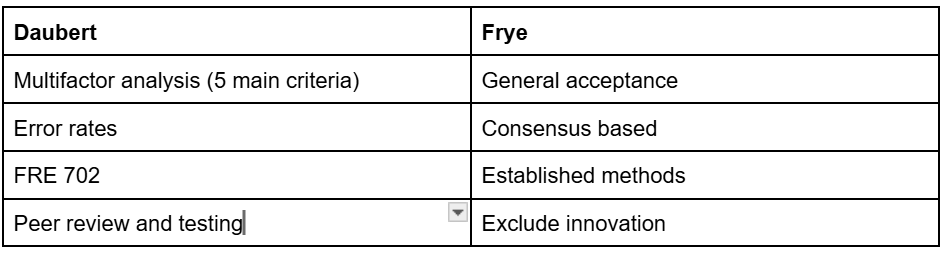
you need to give any evidence you have over to the defense
Brady evidence
data, method, or expert that provides insight to a case
relevance
data varies but includes the correct answer
reliability
offers guidance/opinions; advises and assists attorney's or judges on specific matter (cheaper)
consulting expert
offers opinions on the stand
testimonial expert
testifies what they saw; do NOT offer opinon
fact witness
interpretation of the law depends on where you're from; location drives interpretation of the law
legal resolution
Starts with a general principle and applies it to reach a specific conclusion; "top-down"; uses a general principle or premise as grounds to draw specific conclusions
deductive reasoning
moves from specific observations to a general conclusion; "bottom-up"; uses specific and limited observations to draw general conclusions that can be applied more widely
inductive reasoning
Consistency of results, low variability
precision
How close a measurement is to the true or accepted value (known value)
accuracy
drawing conclusions from an individual sample
- are the results being drawn truly representative of the observtions being described?
pseudoreplication
law is verbatim within the application; constitution should be interpreted based on the original meaning of its text at the time it was written; law is black and white
Originalist
interpretation from something to relate to current society
living document
concept evolves into a new concept, dependent ,on what was initally known
paradigm
independent way of thinking (didn't evolve from another concept)
revolution
a relationship between the 2 variable being examined
correlation
one event is the result of the occurrence of the other event
causation
Theory of falsification; scientific theories cannot be proven true, only falsified; philosopher; helped to develop the Daubert standard
Karl Popper
creates an inference; suggests a conclusion but does not directly prove it
circumstantial
Identifying something as belonging to a specific person, usually through unique characteristics like fingerprints or DNA, which directly link someone to a crime scene
individualization
conducts original empirical research, then experiments to verify the validity of the theory; designs and creates instrumentation and applied techniques; is published in own field with peers; and advances his field of knowledge
scientist
devoted to one kind of work or study; an expert in a specific area
specialist
what is the likelihood of getting the answer correct; frequency of errors; likelihood of incorrect results in scientific testing
error rate
limited and concentrated training, applies known techniques
technician/examiner
interpretation of material and information of an experiment
Practitioner