Instructions for Side by Side Printing
- Print the notecards
- Fold each page in half along the solid vertical line
- Cut out the notecards by cutting along each horizontal dotted line
- Optional: Glue, tape or staple the ends of each notecard together
Law exam 1
front 1 A system of rules usually enforced through a set of institutions (law enforcement); rules developed by society | back 1 law |
front 2 -More likely than not (scientific evidence requires 50.1% agreement to be admissible) -involves disputes between people or organizations, the goal is to compensate the victim | back 2 civil law |
front 3 Beyond reasonable doubt, punish the offender | back 3 criminal law |
front 4 allows for interpretation | back 4 Interpretive law |
front 5 black and white | back 5 factual law |
front 6 apply their expertise/opinions in a particular field that is relevant in the court of law | back 6 expert witness |
front 7 testifies to what they saw; not there to offer their opinion | back 7 Factual/material witness |
front 8 -Hold their colleagues accountable - apply their expertise/opinions in the court of law - presents the facts related to their area of expertise | back 8 Roles of an expert |
front 9 -education: where you went to school, level of education - experience: years of experience - appearance: attire, how you present yourself to the jury -fee (what you charge): charging more makes you seem more valuable | back 9 Factors that impact value of an expert/perception of jury |
front 10 experts who tailor their opinions to fit the hiring attorney's case theory | back 10 hired gun |
front 11 want to be close to 50/50; they try to decipher if you're biased | back 11 case distribution |
front 12 Body language, background, hours spent on case, terminology, confidence, understand case report/make sure there are no mistakes | back 12 Preparation |
front 13 counsel that brought you in | back 13 Direct examination |
front 14 opposing counsel asks you questions | back 14 Indirect/cross examination |
front 15 legal rule that determines if scientific evidence or expert testimony is admissible in court; 1923; general acceptance | back 15 Frye |
front 16 A systemic framework for a trial judge to assess the relilability and relevance of expert witness testimony before it is presented to a jury; 1993 | back 16 Daubert |
front 17 What are the criteria of Daubert? | back 17 1. testibility (can it be tested) 2. publication/peer review 3. known error rate (accuracy and precision) 4. Known standards (standard methods on how to do things) 5. generally accepted in relevant scientific community |
front 18 prescription medication used to treat nausea and vomiting during pregnancy | back 18 Bendictin |
front 19 judge is the "gatekeeper" of evidence; trial about benedictin drug causing birth defects | back 19 Daubert vs. merrell Dow Pharmaceuticals (1993) |
front 20 if a lower court makes a decision, the higher court has to follow/honor it; appellate courts must defer to trial judges on evidentiary rulings unless there is an abuse of discretion | back 20 General Electric vs Joiner (1997) |
front 21 A federal trial judge's "gatekeeping" obligation applies not only to "scientific" testimony but to all expert testimony | back 21 Kumho tire vs. Carmicheal (1999) |
front 22 A witness who is qualified as an expert by knowledge, skill, experience, training, or education may testify in the form of an opinion or otherwise | back 22 Federal rules of Evidence (FRE) 702 |
front 23 to speak the truth, refers to the process of questioning potential jurors by the judge and attorneys to determine if they are suitable to serve on a jury in a particular case, essentially aiming to identify any biases or conflicts that might prevent them from being impartial | back 23 voir dire |
front 24 Daubert vs. Frye | back 24 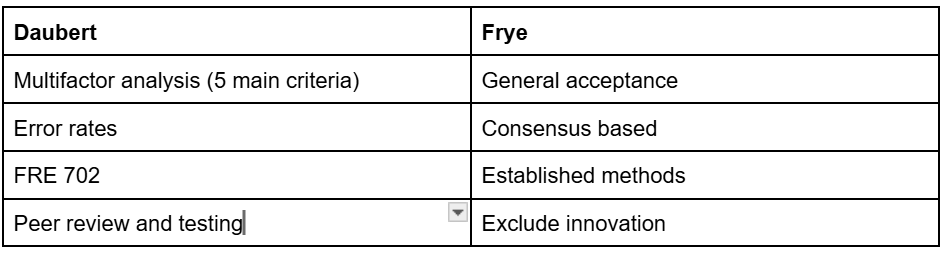 |
front 25 you need to give any evidence you have over to the defense | back 25 Brady evidence |
front 26 data, method, or expert that provides insight to a case | back 26 relevance |
front 27 data varies but includes the correct answer | back 27 reliability |
front 28 offers guidance/opinions; advises and assists attorney's or judges on specific matter (cheaper) | back 28 consulting expert |
front 29 offers opinions on the stand | back 29 testimonial expert |
front 30 testifies what they saw; do NOT offer opinon | back 30 fact witness |
front 31 interpretation of the law depends on where you're from; location drives interpretation of the law | back 31 legal resolution |
front 32 Starts with a general principle and applies it to reach a specific conclusion; "top-down"; uses a general principle or premise as grounds to draw specific conclusions | back 32 deductive reasoning |
front 33 moves from specific observations to a general conclusion; "bottom-up"; uses specific and limited observations to draw general conclusions that can be applied more widely | back 33 inductive reasoning |
front 34 Consistency of results, low variability | back 34 precision |
front 35 How close a measurement is to the true or accepted value (known value) | back 35 accuracy |
front 36 drawing conclusions from an individual sample - are the results being drawn truly representative of the observtions being described? | back 36 pseudoreplication |
front 37 law is verbatim within the application; constitution should be interpreted based on the original meaning of its text at the time it was written; law is black and white | back 37 Originalist |
front 38 interpretation from something to relate to current society | back 38 living document |
front 39 concept evolves into a new concept, dependent ,on what was initally known | back 39 paradigm |
front 40 independent way of thinking (didn't evolve from another concept) | back 40 revolution |
front 41 a relationship between the 2 variable being examined | back 41 correlation |
front 42 one event is the result of the occurrence of the other event | back 42 causation |
front 43 Theory of falsification; scientific theories cannot be proven true, only falsified; philosopher; helped to develop the Daubert standard | back 43 Karl Popper |
front 44 creates an inference; suggests a conclusion but does not directly prove it | back 44 circumstantial |
front 45 Identifying something as belonging to a specific person, usually through unique characteristics like fingerprints or DNA, which directly link someone to a crime scene | back 45 individualization |
front 46 conducts original empirical research, then experiments to verify the validity of the theory; designs and creates instrumentation and applied techniques; is published in own field with peers; and advances his field of knowledge | back 46 scientist |
front 47 devoted to one kind of work or study; an expert in a specific area | back 47 specialist |
front 48 what is the likelihood of getting the answer correct; frequency of errors; likelihood of incorrect results in scientific testing | back 48 error rate |
front 49 limited and concentrated training, applies known techniques | back 49 technician/examiner |
front 50 interpretation of material and information of an experiment | back 50 Practitioner |