graph
Points (called vertices or nodes) which are connected by lines (edges or arcs)
weighted graph/network
if a graph has a number associated with each edge (usually called its weight) then it is a weighted graph or a network
vertex set
list of all the nodes on a graph
e.g. A,B,C,D,E
edge set
list of all the edges in a graph (AB, AC, etc...)
subgraph
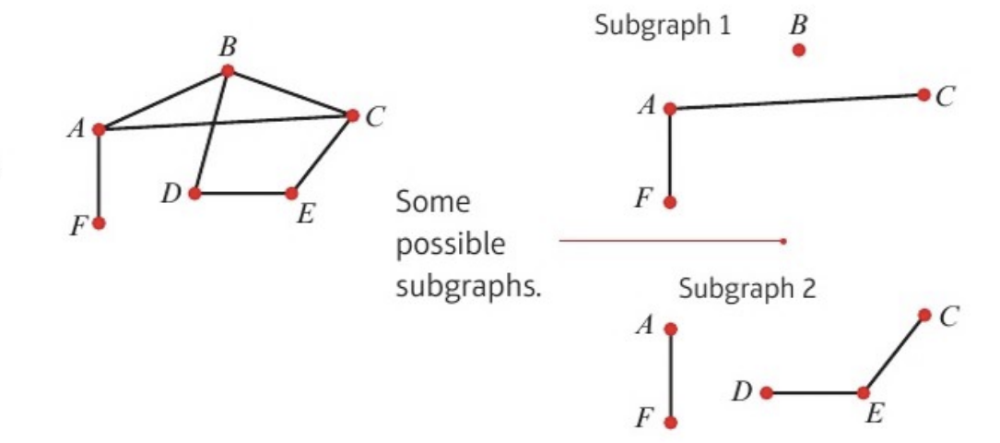
A subgraph of (e.g.) graph G is a graph where each of whose vertices belongs to G - it is simply a part of the original graph
(graph on left is graph G, graphs on right are subgraphs of graph G)
degree/valency/order of a vertex
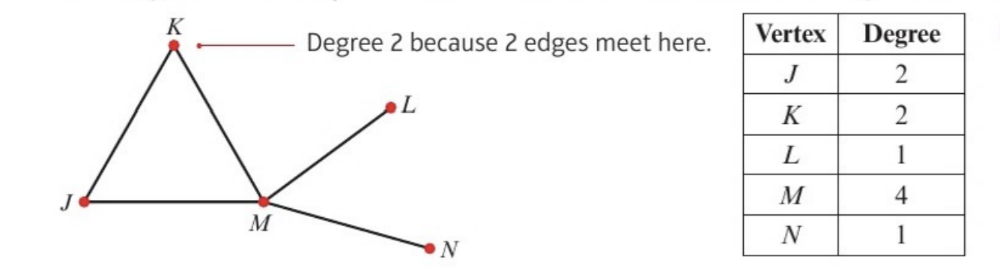
number of edges incident to that vertex
if a vertex has even degree we say it is even and if it has odd degree we say it is an odd vertex
walk
a route through a graph along edges from one vertex to the next
path
a walk in which no vertex is visited more than once
trail
a walk in which no edge is visited more than once
cycle
a walk in which the end vertex is the same as the start vertex and no other vertex is visited more than once
Hamiltonian cycle
a cycle* which includes every vertex
*cycle=a walk in which the end vertex is the same as the start vertex and no other vertex is visited more than once
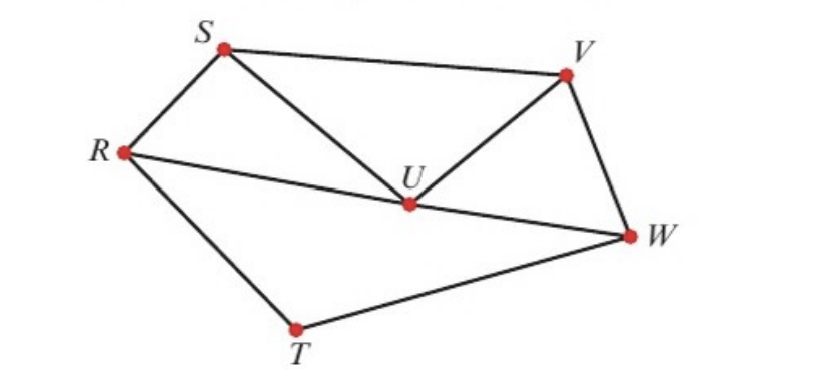
in terms of the diagram, give examples of:
1. a walk
2. a path
3. a trail
4. a cycle
5. an hamiltonian cycle
walk: e.g. RSUWVU, SUV, etc
path: RSUVW, RUVW, etc
trail: RUSVUW
cycle: RSUR
hamiltonian cycle: RSUVWTR
connected vs unconnected graphs
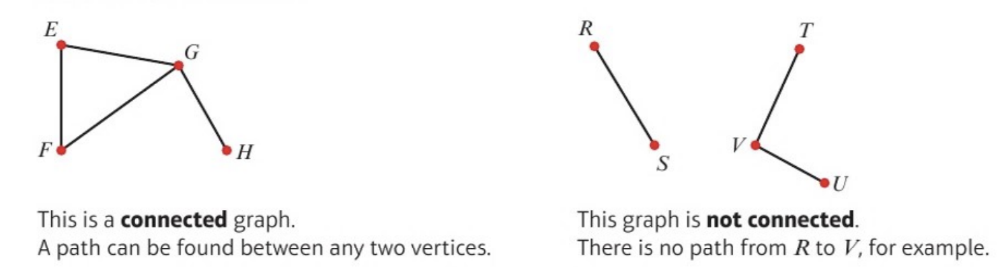
Two vertices are connected if there is a path between them. a graph is connected if all its vertices are connected
loop

an edge that starts and finishes at the same vertex
simple graph
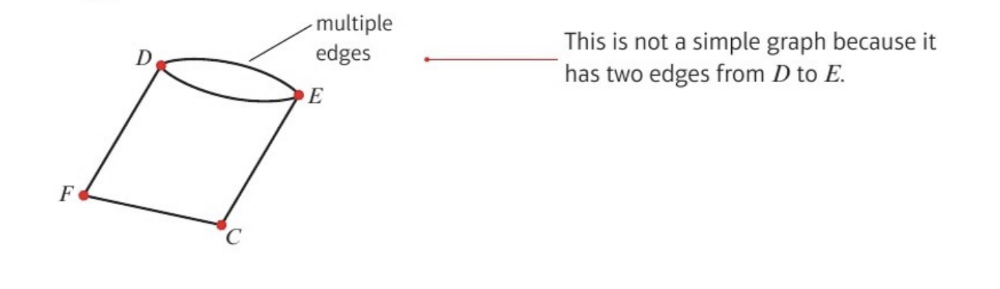
graph in which there are no loops and there is at most one edge connecting any pair of vertices
digraph
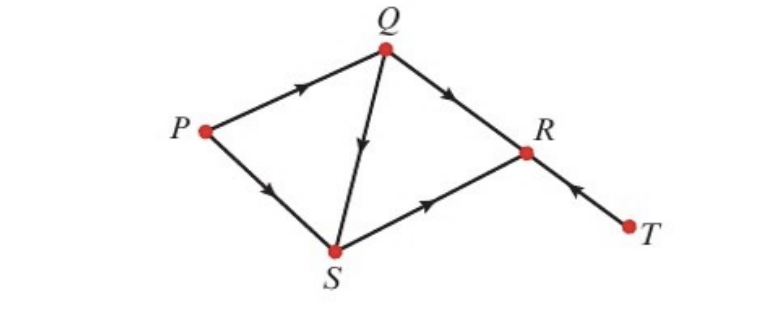
if the edges of a graph have a direction associated with them they are known as directed edges and the graph is known as a directed graph (digraph)
Euler's handshaking lemma
In any undirected graph, the sum of the degrees of the vertices is equal to 2x the number of edges.
Therefore, the number of odd vertices must always be even (including possibly zero). This result is known as Euler's handshaking lemma.