Parts of a wave (wavelength, frequency, crest, trough, amplitude and wave speed)
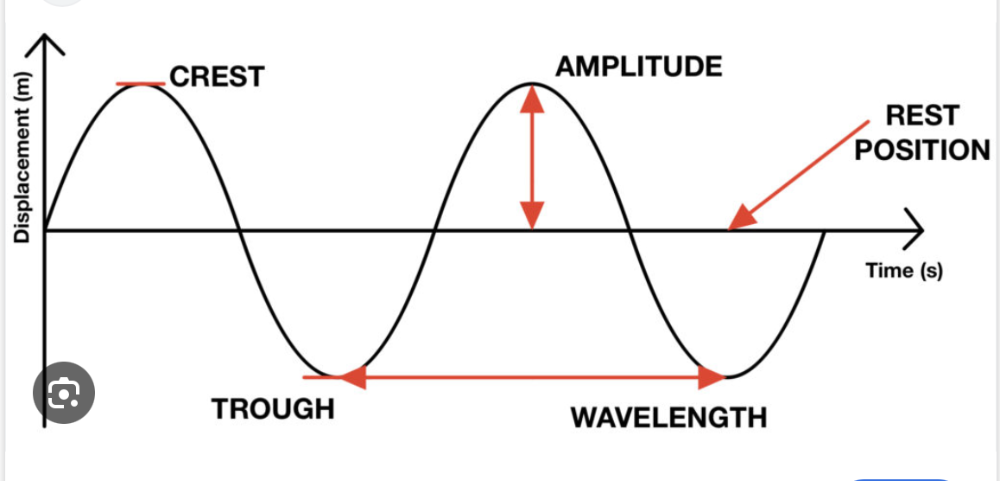
Wavelength (λ) (distance between two identical points on successive waves), frequency (waves passing a point per second), crest/peak (highest point), trough (lowest point), amplitude (maximum displacement from the rest position), and wave speed (rate of energy transfer).
What is a wavefront
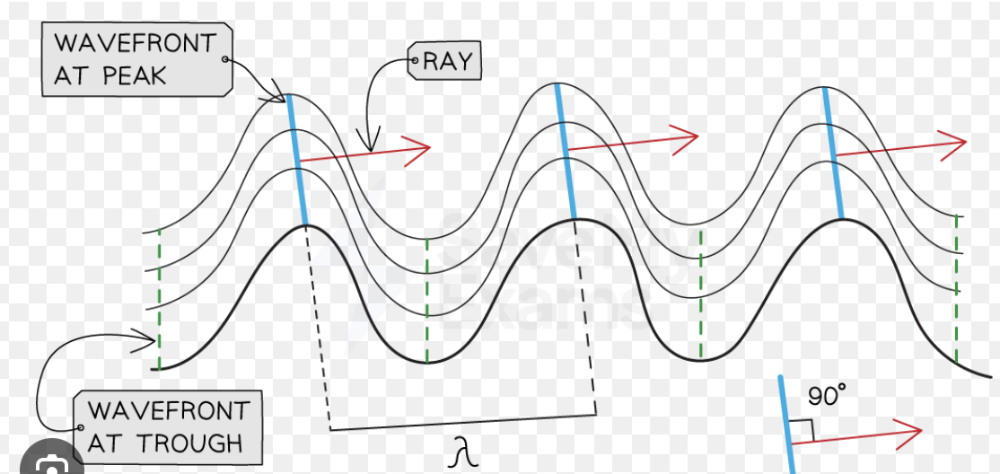
Wavefront (an imaginary line of constant phase) of a wave.
How waves function and physical examples
Waves transfer energy without transferring matter.
- Oscillating Water:Water particles on the surface move up and down, as well as in a small circular motion, but they do not travel with the wave's forward motion.
- A leaf or a small object floating on the water would only bob up and down, demonstrating that the water itself is not transported by the wave.
Slinky or rope moving also example.
Recall and use the equation for wave speed
wave speed (v) = frequency (f) x wavelength (λ)
transverse vs longitudinal waves
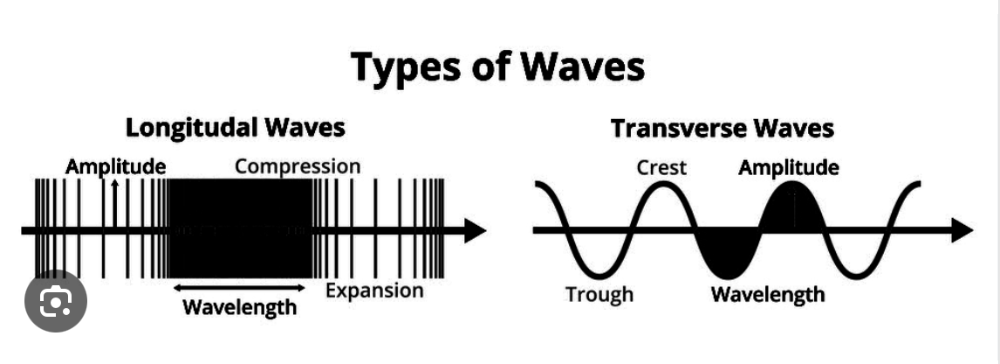
Transverse Waves
- Definition:The particles of the medium vibrate at right angles (perpendicular) to the direction in which the wave is traveling.
Examples: electromagnetic radiation, water waves and seismic S-waves (secondary)
Longitudinal Waves
- Definition:The particles of the medium vibrate parallel to the direction of the wave's movement.
Examples: sound waves and seismic P-waves (primary)
Describe the use of a ripple tank to show:
(a) reflection at a plane surface
(b) refraction due to a change in speed caused by
a change in depth
(c) diffraction due to a gap
(d) diffraction due to an edge
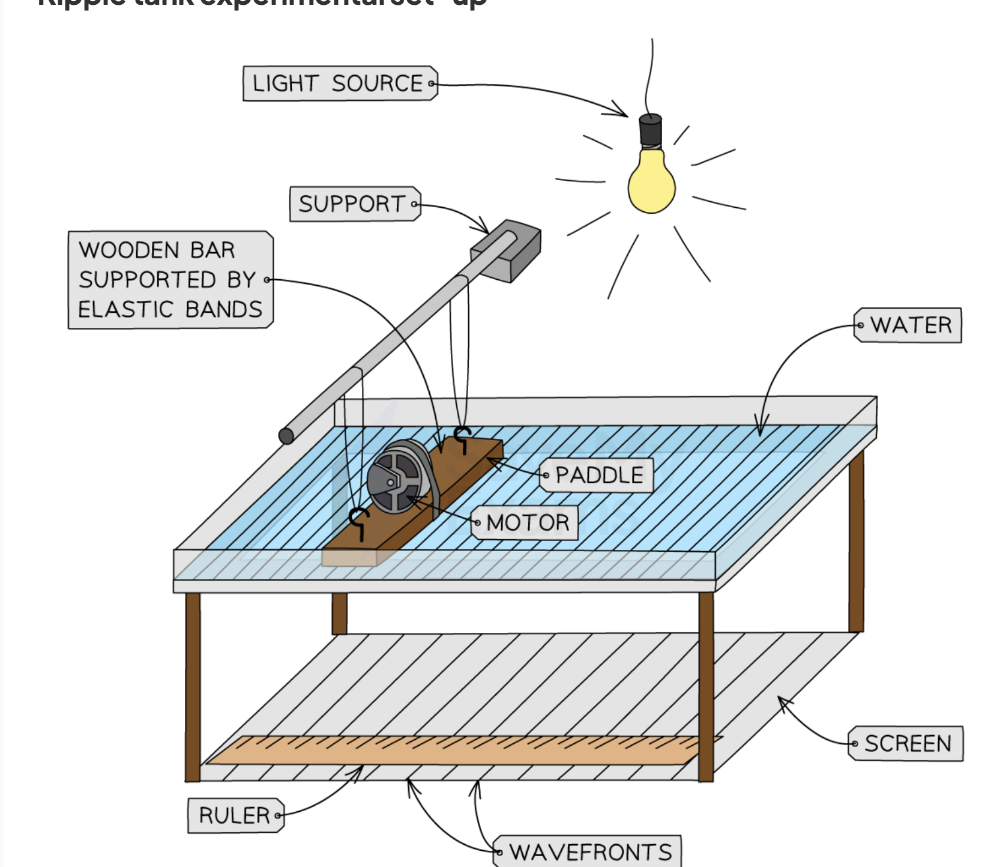
Reflection: Wavefronts are reflected off a metal bar (plane surface) placed in the water of the ripple tank. When the bar is placed at an angle they reflect according to the Law of reflection.
Refraction can be shown by placing a glass block in the tank.The glass block should sit below the surface of the water and cover only some of the tank floor
- The depth of water becomes shallower where the glass block is placed. Since speed depends on depth, the ripples slow down when travelling over the block and the wave length becomes smaller.
Diffraction can be shown in a ripple tank by placing small barriers with a gap or an edge in the tank.
- Maximum diffraction (spreading out) occurs when the wavelength is approximately equal to the gap or edge size.
- If the wavelength is much larger than the gap, there is significant diffraction.
- Conversely, if the wavelength is much smaller than the gap, very little diffraction occurs
the law of reflection
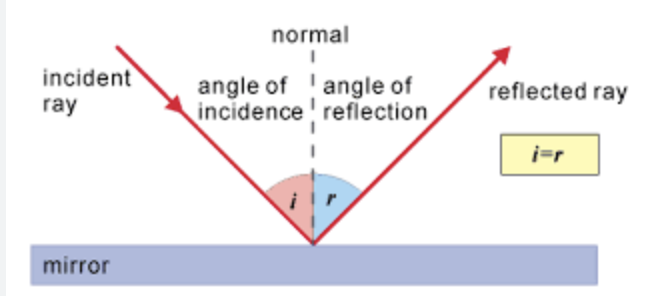
Where the angle of incidence (angle between the incoming wave and the normal) equals the angle of reflection (angle between the reflected wave and the normal).
Optical image characteristics
- Virtual Image:The image is virtual, meaning it cannot be projected onto a screen because the light rays do not physically converge at the image location. These reflected rays appear to diverge from a point behind the mirror, which is perceived as the image location.
- Same Size:The image formed is of the same size as the object.
- Same Distance from Mirror:The perpendicular distance of the image behind the mirror is equal to the perpendicular distance of the object in front of the mirror.
- Upright Orientation:The image maintains the same upright orientation as the object.
- Laterally Inverted:The image is laterally inverted, meaning the left and right sides of the object are reversed in the image.
Describe an experiment to show refraction of light
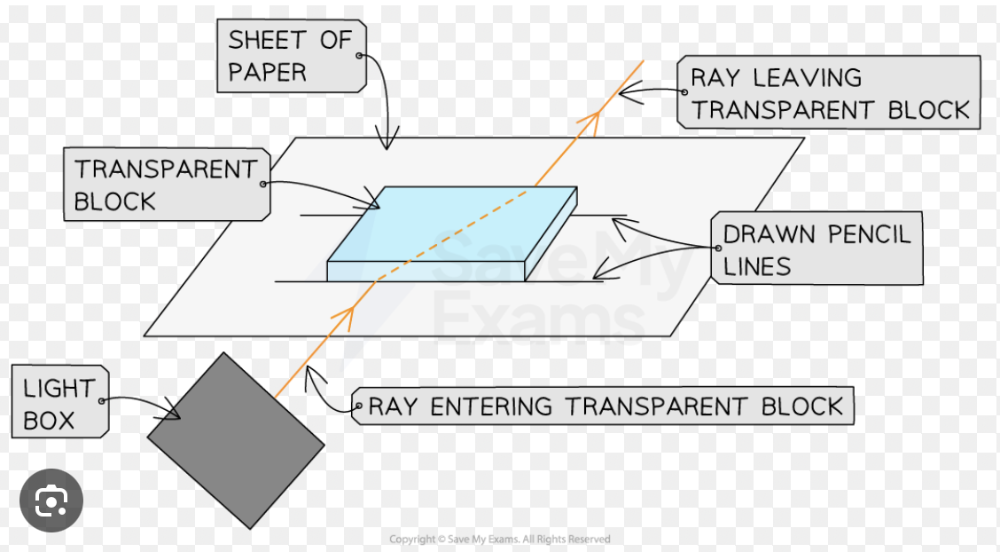
To show refraction with different-shaped transparent blocks (rectangular, prism, semi-circular), trace the block's outline on paper, shine a light ray through it, mark points on the incident, refracted, and emergent rays, then remove the block to draw the path, add a normal, and measure the angles of incidence and refraction. Repeat for different angles and block shapes, then compare.
When light enters a different medium how it changes.
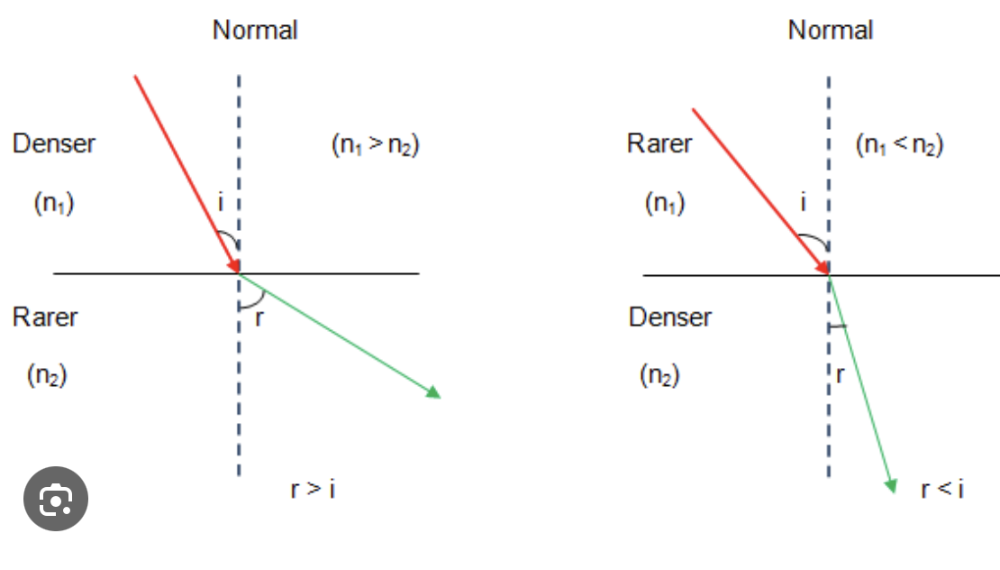
It bends towards the normal when entering a denser medium (like air to glass) and away from the normal when entering a less dense medium (like glass to air).
State the meaning of critical angle
The specific angle of incidence at which light, traveling from a denser to a less dense medium, undergoes total internal reflection.
this happens when the resulting angle of refraction is 90°. It depends on the material
Define refractive index
and both equations
the ratio of the speeds of a wave in two different regions
n = 1 / sin c and n = sin i / sin r
reflection and total internal reflection
telecommunications
and everyday examples
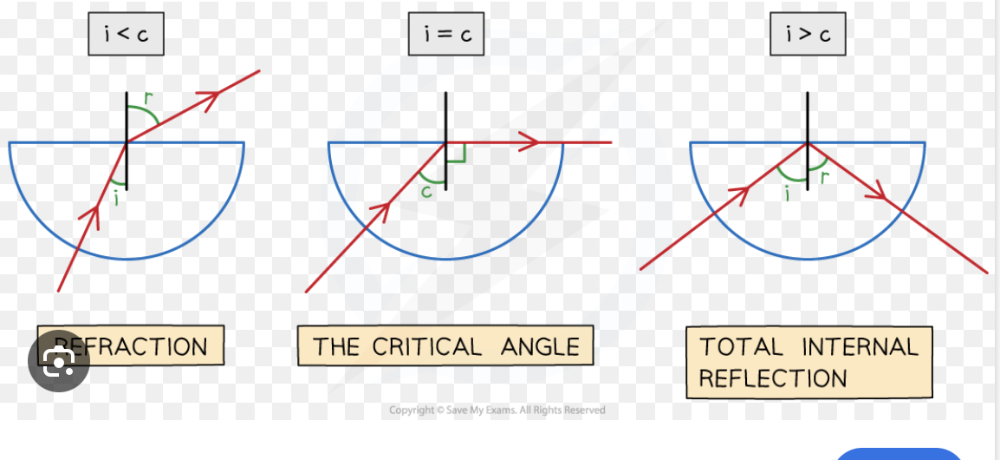
Total internal reflection (TIR) is the complete reflection of light when it travels from a denser to a less dense medium at an angle greater than the critical angle, causing it to be reflected back into the denser medium instead of passing through the boundary. Optical fibers use TIR to guide light along a core by repeatedly reflecting it off the cladding, which has a lower refractive index. In everyday telecommunications, optical fibers enable high-speed internet by transmitting data as pulses of light.
- Sparkling diamonds:When light enters a diamond, it reflects multiple times internally because the diamond's shape and the specific critical angle cause light to be completely reflected back and forth. This makes the diamond appear to sparkle intensely.
- Mirages:In a desert or on a hot road, the air near the surface is hotter and less dense than the cooler, denser air above it. Light from the sky or a distant object travels from the denser to the less dense air, undergoing total internal reflection and creating the illusion of a watery surface.
- Underwater view:When you are underwater in a swimming pool, you can see the bottom as a perfect mirror when looking at a shallow angle. The water-to-air surface acts as a reflecting surface because the light from below is reflected back, not refracted.
Define and use the terms focal length, principal axis and principal focus (focal point)
- The principal axis is defined as: A line which passes through the centre of a lens
- The principal focus, or focal point, is defined as: The point at which rays of light travelling parallel to the principal axis intersect the principal axis and converge or the point at which diverging rays appear to proceed
- Focal length is defined as: The distance between the centre of the lens and the principal focus
Describe thin converging lenses
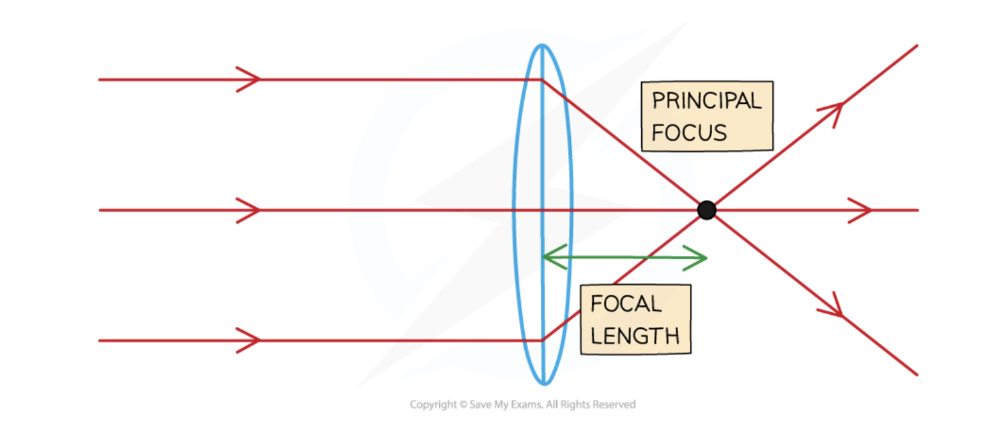
- In a converging lens, parallel rays of light are brought to a
focus
- This point is called the principal focus
- This lens is sometimes referred to as a convex lens
- The distance from the lens to the principal focus is
called the focal length
- This depends on how curved the lens is
- The more curved the lens, the shorter the focal length
Describe thin diverging lenses
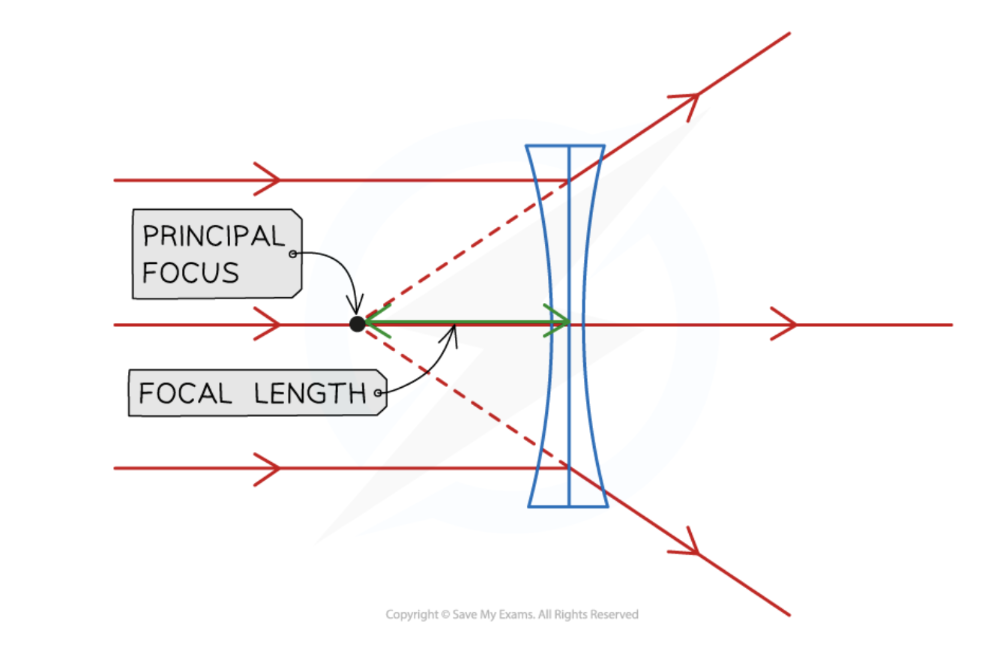
- In a diverging lens, parallel rays of light are made to diverge
(spread out) from a point
- This lens is sometimes referred to as a concave lens
- The principal focus is now the point from which the rays appear to diverge from
When a virtual image is formed
when diverging rays come from behind the lens and don't form a visible projection on a screen
characteristics of an image terms
enlarged/samesize/diminished,
upright/inverted and real/virtual
Virtual light rays are drawn dashed.
Draw and use ray diagrams for the formation of a real image by a converging lens
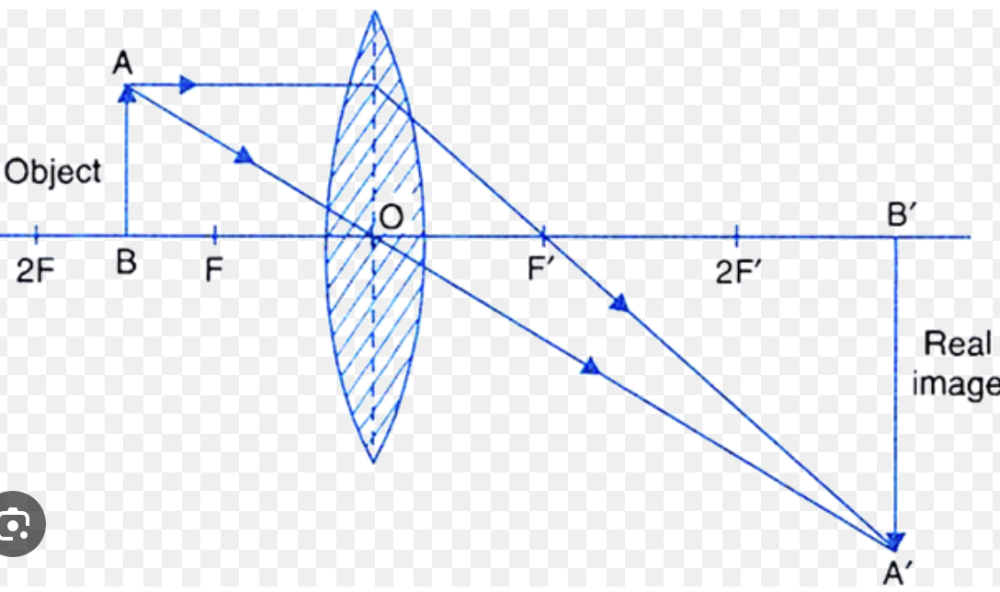
- Draw a ray from the object to the lens that is parallel to the principal axis. Once through the lens, the ray should pass through the principal focus.
- Draw a ray which passes from the object through the centre of the lens.
If an object is placed further from the lens than the focal length f then a real image will be formed
the image is:
- inverted
- real
visible light of a single frequency is described as...
monochromatic
Draw and use ray diagrams for the formation of a virtual image by a converging lens
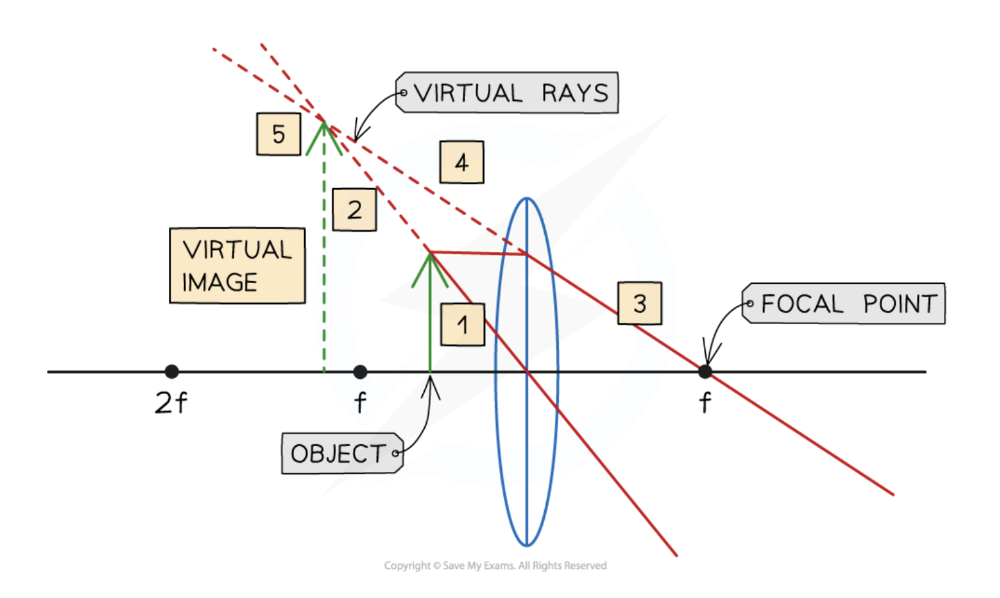
If the object is placed closer to the lens than the focal length f then a virtual image will be formed.
- Start by drawing a ray going from the top of the object through the centre of the lens. This ray will continue to travel in a straight line
- Draw a dashed line continuing this ray upwards
- Next draw a ray going from the top of the object, travelling parallel to the axis to the lens. When this ray emerges from the lens it will travel directly through the principal focus f
- Also, draw a dashed line continuing this ray upwards
- The image is the line drawn from the axis to the point where the two dashed lines meet
- In this case, the image is:
- Virtual: the light rays appear to meet when produced backwards
- Magnified: the image is larger than the object
- Upright: the image is formed on the same side of the principal axis
Describe the use of a lens as a magnifying glass
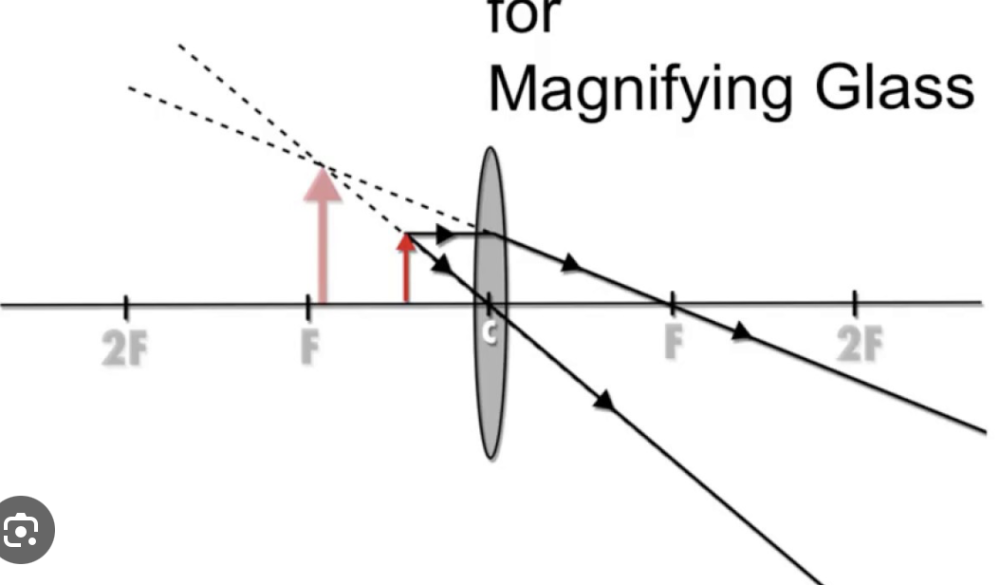
A single lens acts as a magnifying glass when it's a convex (converging) lens and the object is placed within the lens's focal length. T
he lens refracts (bends) the light rays from the object, creating a virtual, upright, and enlarged image on the same side of the lens as the object. The eye then perceives this enlarged image.
Because the object is within the focal length, these refracted rays do not converge to form a real image. Instead, they appear to originate from a point farther away.
Describe the use of converging and diverging lenses to correct long-sightedness and short- sightedness
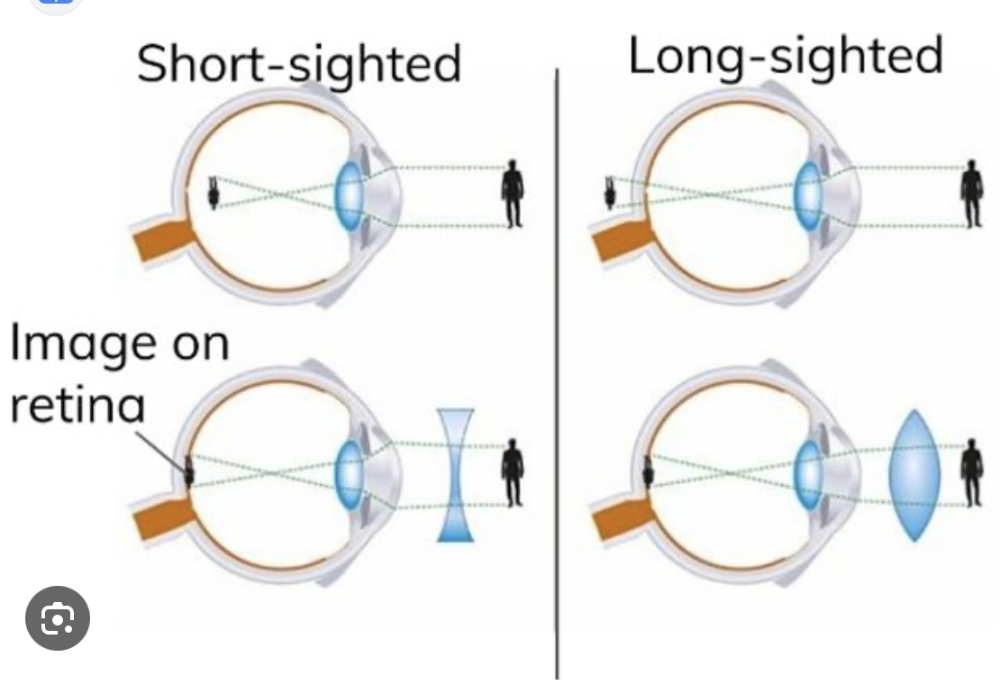
Diverging (concave) lenses correct short-sightedness (myopia) by spreading out light rays before they enter the eye, shifting the focal point back onto the retina as light would naturally land in front of it.
Converging (convex) lenses correct long-sightedness (hyperopia) by bending light rays inward more strongly, bringing the focal point forward onto the retina as light would naturally be behind retina.
speed of electromagnetic waves in a vacuum
3.0 × 10⁸m / s and is approximately the same in air
all electromagnetic waves travel at the same high speed in a vacuum
Know the main regions of the electromagnetic spectrum in order of frequency and in order of wavelength
The electromagnetic spectrum, from lowest to highest frequency (and thus shortest to longest wavelength), includes: Radio waves, microwaves, infrared radiation, visible light, ultraviolet radiation, X-rays, and gamma rays.
Describe typical uses of the different regions of the electromagnetic spectrum, why mobile phones, bluetooth and optical fibres use what they use, and the harmful effects on people for the following:
(a) microwaves
(b) infrared
(c) ultraviolet
(d) X-rays and gamma rays
(a) radio waves : radio and television transmissions, astronomy, radio frequency identification (RFID)
(b) microwaves; satellite television, mobile phones (cell phones), microwave ovens.
Communication with artificial satellites is mainly by microwaves (some satellite phones use low orbit artificial satellites and some satellite phones and direct broadcast satellite television use geostationary satellites).
(c) infrared; electric grills, short range communications such as remote controllers for televisions, intruder alarms, thermal imaging, optical fibres
(d) visible light; vision, photography, illumination
(e) ultraviolet; security marking, detecting fake bank notes, sterilising water
(f) X-rays; medical scanning, security scanners
(g) gamma rays; sterilising food and medical equipment, detection of cancer and its treatment
Effects :
(a) microwaves; internal heating of body cells
(b) infrared; skin burns
(c) ultraviolet; damage to surface cells and eyes, leading to skin cancer and eye conditions
(d) X-rays and gamma rays; mutation or damage to cells in the body
Important systems of communications rely on electromagnetic radiation including:
(a) mobile phones (cell phones) and wireless internet use microwaves because microwaves can penetrate some walls and only require a short aerial for transmission and reception
(b) Bluetooth uses low energy radio waves or microwaves because they can pass through walls but the signal is weakened on doing so
(c) optical fibres (visible light or infrared) are used for cable television and high-speed broadband because glass is transparent to visible light and some infrared; visible light and short wavelength infrared can carry high rates of data
Know the difference between a digital and analogue signal and benefits.
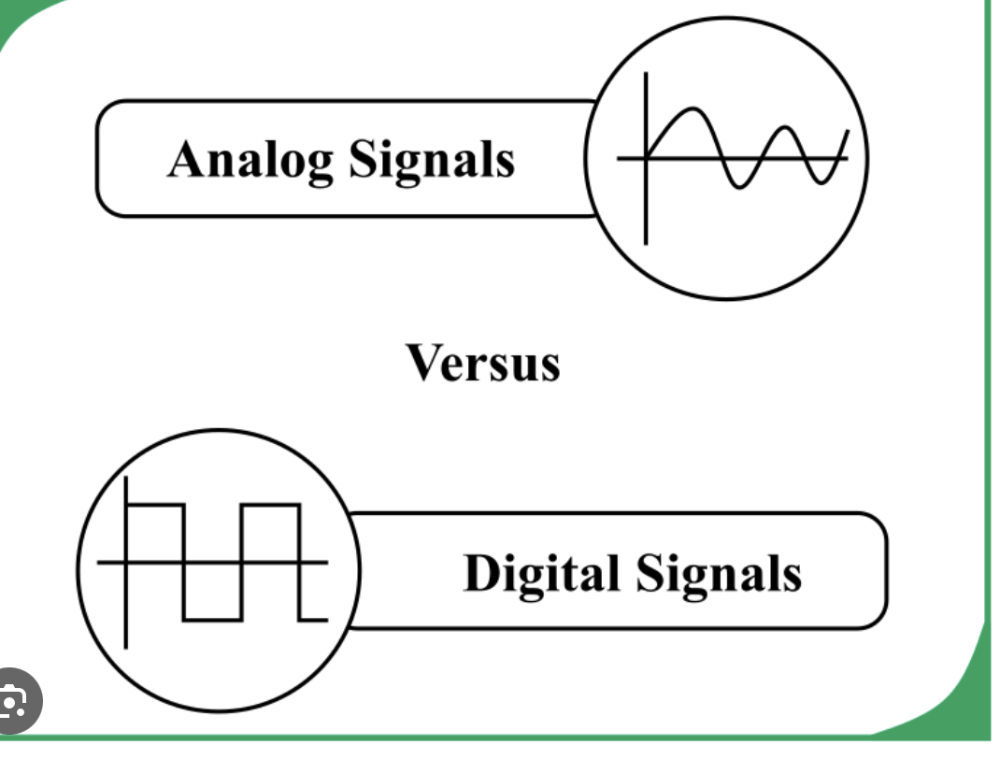
- Analog Transmission:A sound is converted into a continuous electrical signal whose amplitude and frequency mimic the original sound. This signal is transmitted, but any added noise is also amplified and transmitted along with the original sound.
- Digital Transmission: Sound is first encoded into a sequence of binary data (0s and 1s). This digital stream is then transmitted and can be regenerated by amplifiers and regenerators, which remove noise and restore the signal to its original form, providing clearer sound.
- Increased Transmission Rate:The discrete, standardized nature of digital signals allows for more efficient encoding and processing, leading to faster data transmission rates.
- Increased Range via Regeneration:As digital signals travel, they encounter noise, which can corrupt the data. However, at intervals, digital receivers can regenerate the signal, converting the imperfect signal back into its original, perfect 0s and 1s, thereby cleaning out the noise and allowing the signal to travel much further without degradation.
State the approximate range of frequencies audible to humans
20 Hz to 20 000 Hz
Know the speed of sound in air
330–350 m / s
Describe sound waves
longitudinal, need a medium to travel through, produced by vibrations.
in general, sound travels faster in solids than in liquids and faster in liquids than in gases
Describe compression and rarefaction
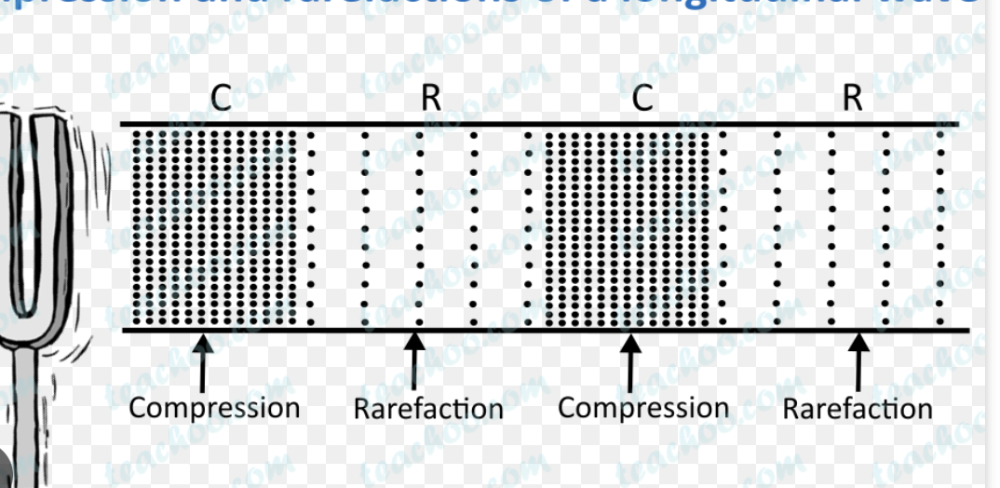
Compression is a region in a longitudinal wave where particles in the medium are closest together, resulting in high pressure and density.
Rarefaction is where particles are spread farthest apart, leading to low pressure and density.
These alternating regions of high and low pressure propagate through the medium, creating the wave's motion and transferring energy.
ultrasound definition
Sound with a frequency higher than 20 kHz
Define an echo
The reflection of sound waves
Describe a method for determining the speed of sound in air
A sound is generated at a known distance from an observer who starts a stopwatch upon seeing the sound-making action and stops it when the sound is heard.
The distance (d) is measured between the source and observer, and the time (t) taken for the sound to travel this distance is recorded.
The speed of sound (v) is then calculated using the formula v = d / t.
To minimize errors, the experiment should be repeated several times for averaging, and a large distance should be used.
Describe how changes in amplitude and frequency affect the loudness and pitch of sound waves
Changes in amplitude affect the loudness of a sound: a larger amplitude creates a louder sound, while a smaller amplitude results in a quieter sound.
Changes in frequency affect the pitch of a sound: a higher frequency produces a higher pitch and a lower frequency results in a lower pitch.
Describe the uses of ultrasound
-
Non-Destructive Testing (NDT):High-frequency sound
waves are used to find internal defects like cracks, voids, or
inclusions in materials without damaging them.
- How it works: A transducer emits sound waves into the material. Reflections from surfaces and internal flaws are detected by the transducer.
- Applications: Checking the thickness of materials, detecting wear and corrosion in pipes, and identifying structural flaws in components.
-
Medical Scanning (Ultrasonography):Used to create
images of soft tissues and internal organs.
- How it works: Sound waves are transmitted into the body, and the echoes from different tissues and organs are used to create a visual image.
- Applications: Monitoring the growth of a fetus during pregnancy, imaging the heart, blood vessels, breasts, and abdominal organs, and diagnosing soft tissue abnormalities like infections or cysts.
-
Sonar (Sound Navigation and Ranging):Uses sound
pulses to locate objects and measure distances underwater.
- How it works: A sound pulse is emitted, and the time it takes for the echo to return from an object or the seabed is measured.
- Applications: Determining the depth of water, locating submarines, and mapping the ocean floor.
describe a longitudinal wave
vibrations (of the wave / particles) are parallel to the direction of propagation
satellite types
Some satellite phones use low Earth orbit (LEO) satellites because their lower altitude allows for faster communication and higher-quality signals with a shorter time delay, though multiple satellites are needed for continuous coverage. Geostationary satellites, orbiting high above the equator, are used for services like direct broadcast TV and some satellite phones that require a wide coverage area and a fixed position in the sky.
to calculate change in speed or speed in different medium
speed in object = speed of light(3 x 10⁸ m/s) / refractive index