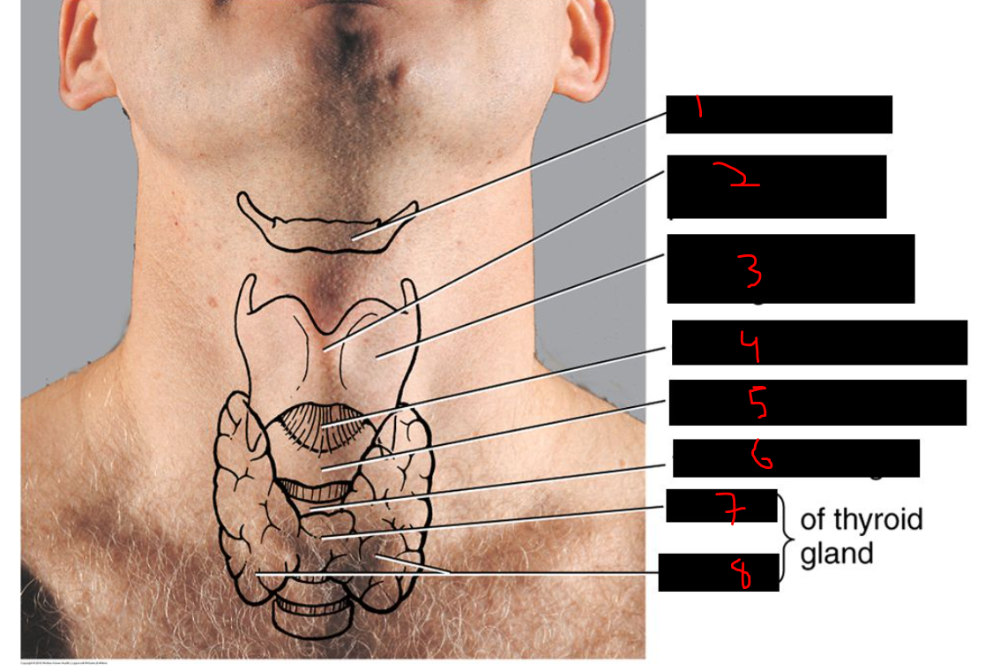
What is 1?
hyoid bone (C3)
What is 2?
laryngeal prominence
What is 3?
lamina of thyroid cartilage
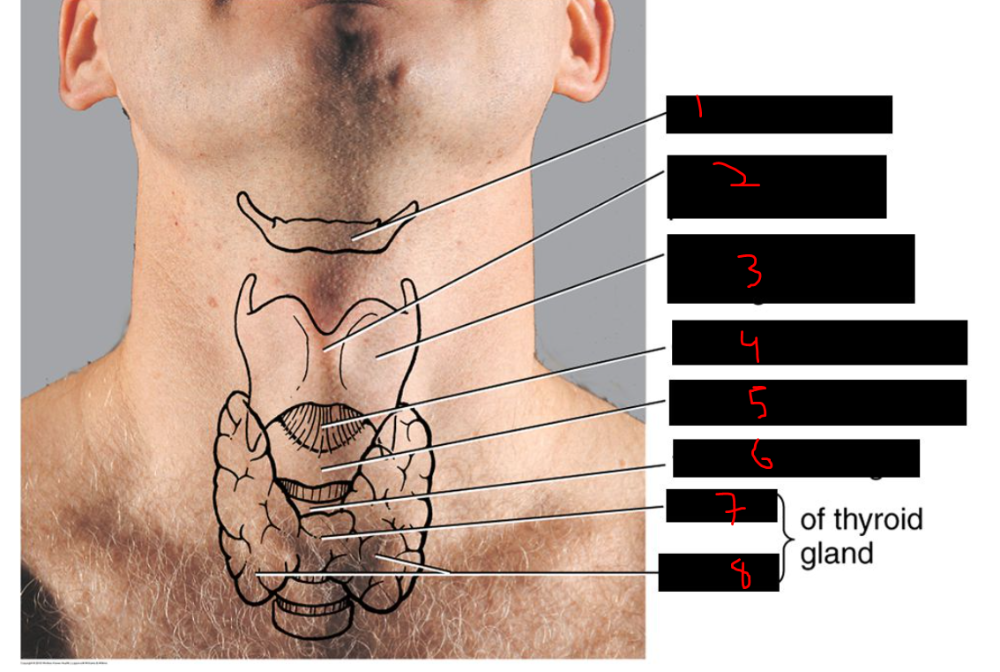
What is 4?
cricothyroid ligament
What is 5?
cricoid cartilage (C6)
What is 6?
1st tracheal ring
What is 7?
Isthmus
What is 8?
Lobes
at what vertebral level is the hyoid bone?
______
C3
what is the "adam's apple" anatomically known as ______ ______
larygneal prominence
at what vertebral level is the cricoid cartilage?
______
C6
at what vertebral level does the common carotid bifurcate?
______
C4
3 parts of the pharynx?
______
______
______
nasopharynx
oropharynx
laryngopharynx
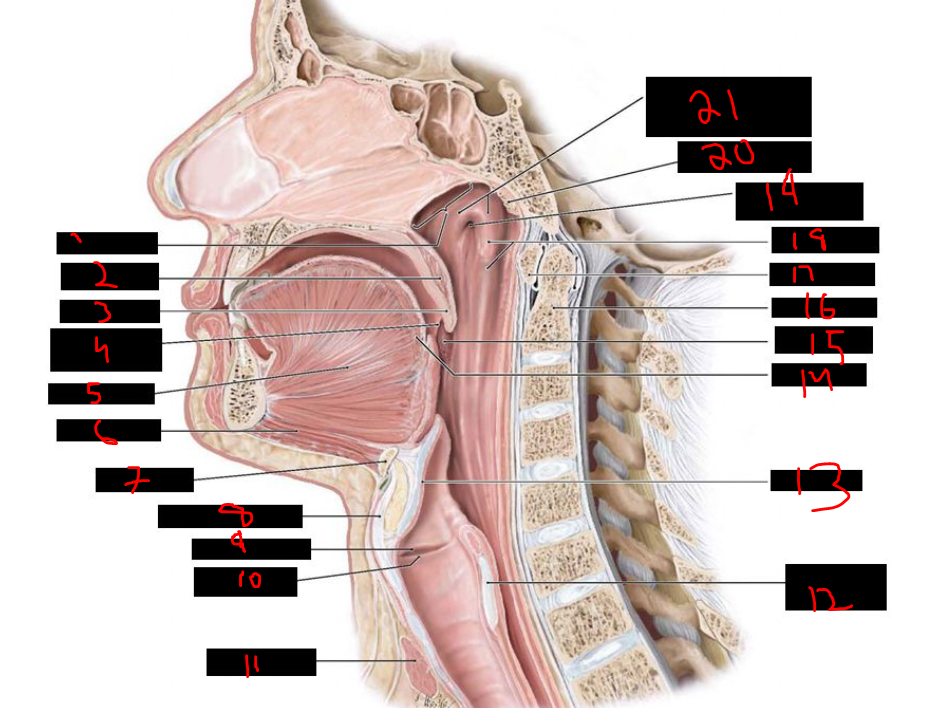
What is 1?
right choana
What is 2?
soft palate
What is 3?
uvula
What is 4?
palatoglossal arch
What is 5?
body of tongue
What is 6?
geniohyoid
What is 7?
hyoid bone
What is 8?
thyrohyoid ligament
What is 9?
vestibular fold
What is 10?
vocal fold
What is 11?
thyroid gland
What is 12?
cricoid cartilage
What is 13?
epiglottis
What is 14?
lingual tonsil
What is 15?
palatine tonsil
What is 16?
dens of axis
What is 17?
atlas
What is 18?
"lateral band"
What is 19?
pharyngeal orfice of eustachian tube
What is 20?
pharyngeal tonsil
What is 21?
torus tubarius
what structure attaches the pharynx to the oral cavity?
_____ _____
pterygomandibular raphe
The lateral attachments of the pharynx include the __________ raphe, the __________ ligament, the __________ horn and __________ horn of the hyoid bone, the __________ line of the thyroid cartilage, the fascial thickening of the __________ muscle, and the __________ cartilage.
pterygomandibular, stylohyoid, lesser, greater, oblique, cricothyroid, cricoid
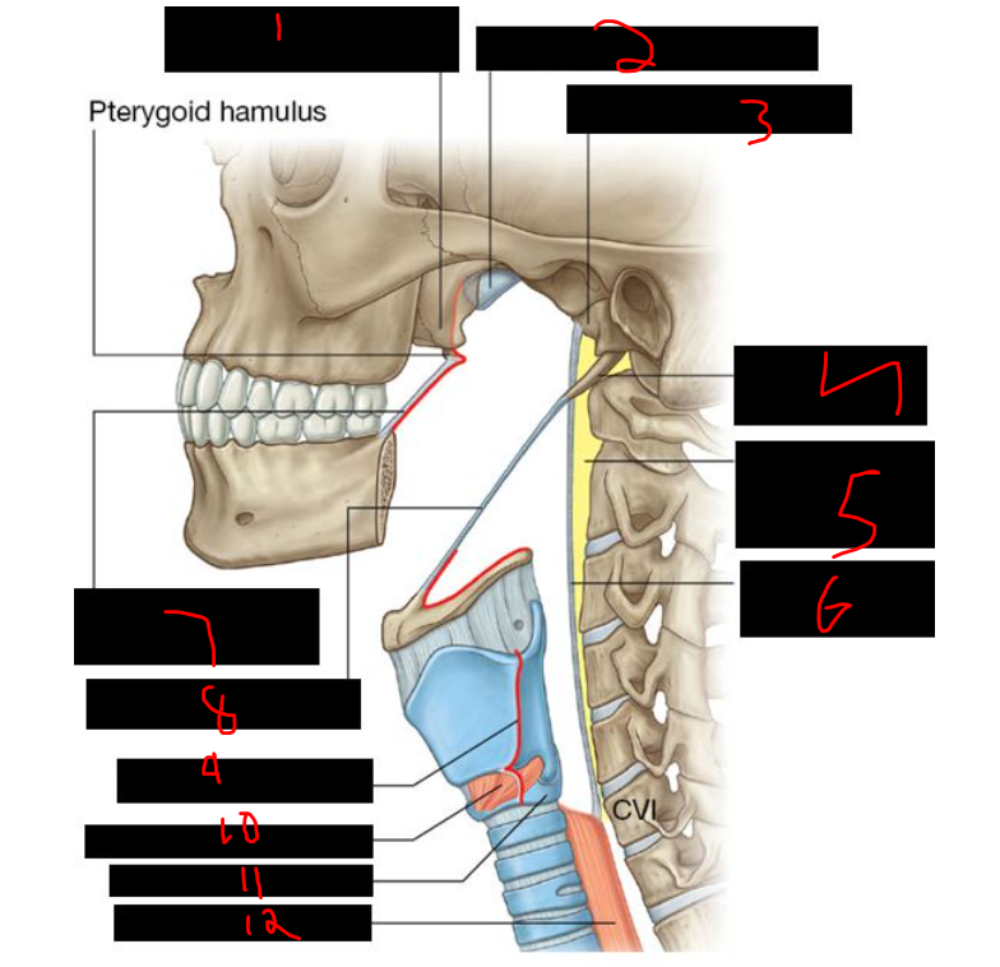
What is 1?
medial plate of pterygoid process
What is 2?
pharyngotympanic tube
What is 3?
pharyngeal tubercle
What is 4?
styloid process
What is 5?
retro-pharyngeal space
What is 6?
pharyngeal raphe
What is 7?
pterygopalatine raphe
What is 8?
stylohyoid ligament
What is 9?
oblique line
What is 10?
cricothyroid muscle
What is 11?
cricoid cartilage
What is 12?
esopahgus
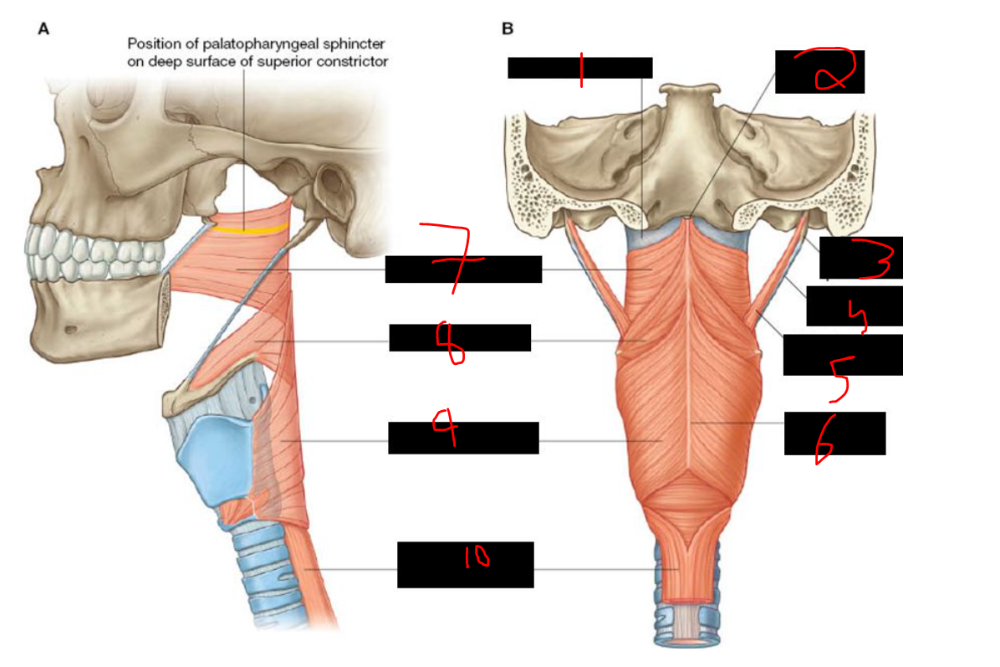
What is 1?
pharyngeal fascia
What is 2?
pharyngeal tubercle
What is 3?
styloid process
What is 4?
stylohyoid ligament
What is 5?
stylopharyngeus muscle
What is 6?
pharyngeal raphe
What is 7?
superior constrictor
What is 8?
middle constrictor
What is 9?
inferior constrictor
What is 10?
esophagus
The superior constrictor attaches anteriorly to the __________ and __________ __________, sharing the __________ __________ with the buccinator, and posteriorly to the muscle of the opposite side via the __________ __________. It is innervated by cranial nerve __________ and acts as the __________ __________, also known as Passavant's ridge, to help seal off the __________ during swallowing.
mandible, pterygoid hamulus, pterygomandibular raphe, pharyngeal raphe, X, palatopharyngeal sphincter, nasopharynx
The middle constrictor attaches anteriorly to the __________ ligament and the __________ and __________ horns of the hyoid bone, and posteriorly to the __________ __________. It is innervated by cranial nerve __________.
stylohyoid, greater, lesser, pharyngeal raphe, X
The inferior constrictor attaches to the __________ line of the thyroid cartilage, the fascia of the __________ muscle, and the __________ cartilage. It is innervated by cranial nerve __________.
oblique, cricothyroid, cricoid, X
The three longitudinal muscles of the pharynx are the __________ (innervated by X), the __________ (also innervated by X), and the __________ (innervated by IX). All three muscles function to __________ the pharynx during __________ and __________.
salpingopharyngeus, palatopharyngeus, stylopharyngeus, elevate, swallowing, speech
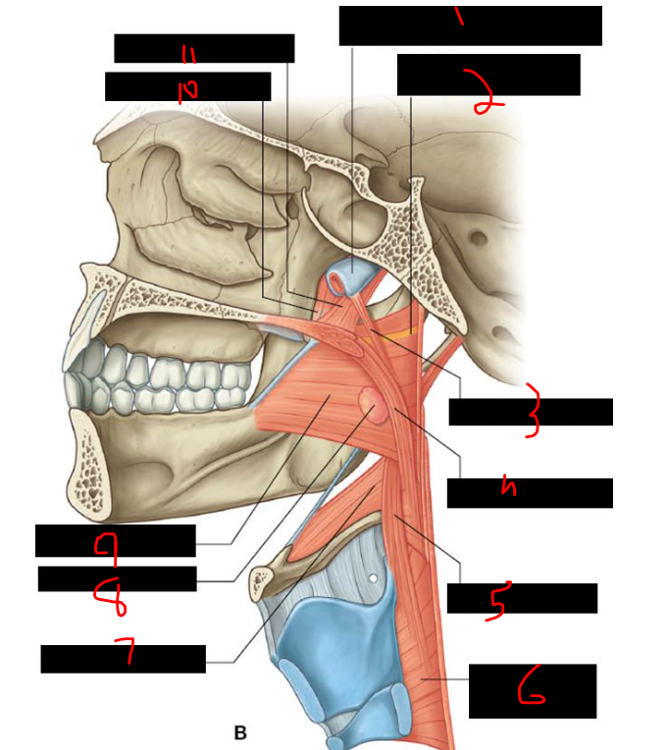
What is 1?
cartilaginous part of pharyngotympanic tube
What is 2?
palatopharyngeal sphincter
What is 3?
salpingopharyngeus
What is 4?
palatopharyngeus
What is 5?
stylopharyngeus
What is 6?
inferior constrictor
What is 7?
middle constrictor
What is 8?
palatine tonsil
What is 9?
superior constrictor
What is 10?
tensor veli palatini
What is 11?
levator veli palatini
The salpingopharyngeus originates from the __________ part of the pharyngotympanic tube and blends with the __________ muscle. It is innervated by cranial nerve __________ and acts to __________ the pharynx during __________ and __________.
cartilaginous, palatopharyngeus, X, elevate, swallowing, speech
The palatopharyngeus originates from the __________ palate and the __________ aponeurosis, and inserts on the posterior border of the __________ cartilage as well as the side of the __________ and __________. It is innervated by cranial nerve __________ and functions to __________ the pharynx during __________ and __________.
hard, palatine, thyroid, pharynx, esophagus, X, elevate, swallowing, speech
The stylopharyngeus arises from the __________ process, passes between the __________ and __________ constrictors, and inserts into the __________ and __________ borders of the thyroid cartilage. It is innervated by cranial nerve __________ and acts to __________ the pharynx during __________ and __________.
styloid, superior, middle, posterior, superior, IX, elevate, swallowing, speech
what muscle passes between the superior & middle constrictors?
__________ (__________)
stylopharyngeus (IX)
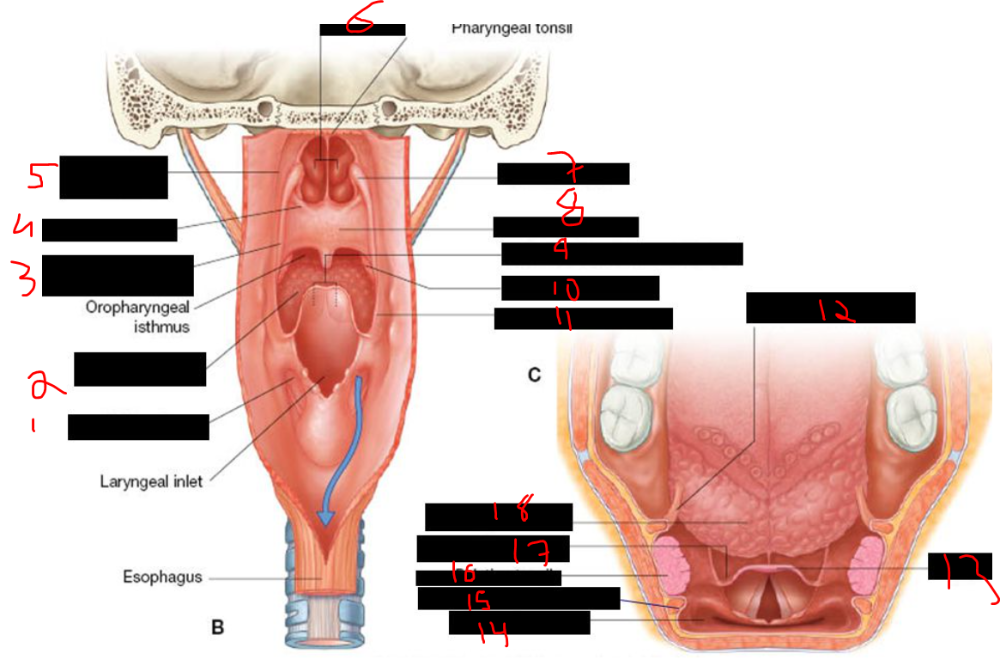
What is 1?
laryngeal inlet
What is 2?
piriform fossa
What is 3?
salpingopharyngeal fold
What is 4?
torus levatorius
What is 5?
pharyngeal recesses
What is 6?
choanae
What is 7?
torus tubarius
What is 8?
soft palate
What is 9?
valleculae (anterior to epiglottis)
What is 10?
palatine tonsil
What is 11?
palatopharyngeal arch
What is 12?
palatoglossal arch
What is 13?
epiglottis
What is 14?
piriform fossa
What is 15?
palatopharyngeal arch
What is 16?
palatine tonsil
What is 17?
vallecula
What is 18?
lingual tonsil
The most common site for foreign bodies such as fish bones to become lodged in the throat is the __________ __________ or __________. If the object enters the __________, it can trigger a spasm of the __________ muscles, which may dangerously close the __________.
piriform recess, fossa, larynx, laryngeal, airway
During a tonsillectomy, care must be taken not to damage the __________ __________ vein, the __________ artery (a branch of the __________ artery), and the __________ nerve (cranial nerve __________), which lies in the __________ bed.
external palatine, tonsillar, facial, glossopharyngeal, IX, tonsillar
The pharynx receives blood supply from the __________ pharyngeal artery (a branch of the __________ carotid), the __________ palatine and __________ arteries (branches of the __________ artery), branches of the __________ and __________ arteries, and the __________ thyroid artery, a branch of the __________ trunk.
ascending, external, ascending, tonsillar, facial, maxillary, lingual, inferior, thyrocervical
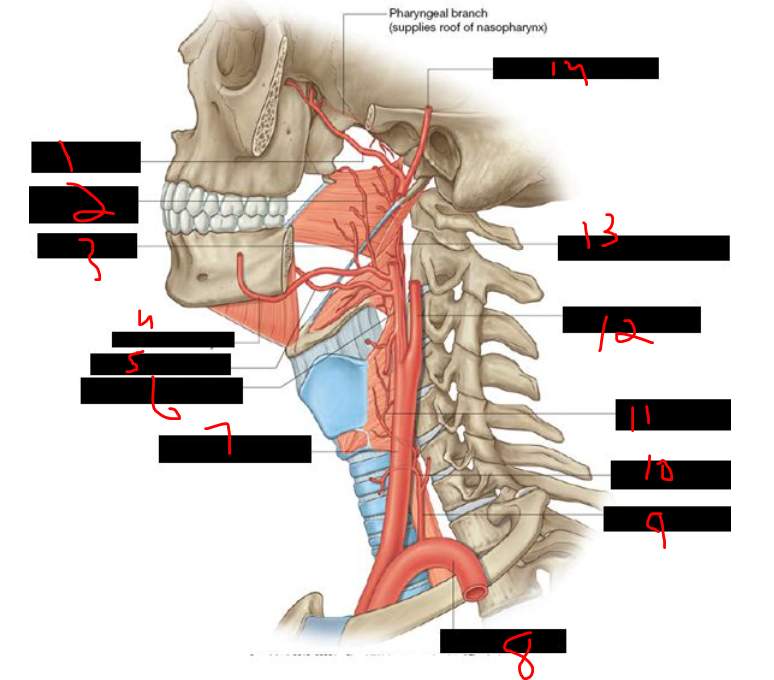
What is 1?
maxillary artery
What is 2?
ascending palatine artery
What is 3?
tonsillar branch
What is 4?
facial artery
What is 5?
lingual artery
What is 6?
external carotid artery
What is 7?
common carotid artery
What is 8?
subclavian artery
What is 9?
thyrocervical trunk
What is 10?
inferior thyroid artery
What is 11?
pharyngeal branches
What is 12?
internal carotid artery
What is 13?
ascending pharyngeal artery
What is 14?
superficial temporal artery
Blood from the pharynx drains into the __________ __________ and then into the __________ and __________ __________ veins.
pterygoid plexus, facial, internal jugular
where does lymph drain from the palatine tonsils?
__________ __________
jugulodigastric node
where does lymph from the pharynx drain?
__________ nodes
__________ nodes
__________ nodes
retropharyngeal nodes
paratracheal nodes
infrahyoid nodes
A patient may have enlarged cervical lymph nodes due to a __________ __________ or __________.
sore throat, tonsillitis
All pharyngeal muscles are innervated motor-wise by cranial nerve __________, except for the __________ muscle, which is innervated by cranial nerve __________.
X, stylopharyngeus, IX
Sensory innervation of the pharynx is region-specific: the __________ is supplied by the pharyngeal branch of __________, the __________ is supplied by cranial nerve __________, and the __________ is supplied by cranial nerve __________.
nasopharynx, V2, oropharynx, IX, laryngopharynx, X
the thyroid gland is enclosed by what fascial layer?
__________ __________
pretracheal fascia
what is the only muscle innervated by the external branch of superior laryngeal (X)?
__________
cricothyroid
The thyroid gland receives blood from the __________ __________ artery, which is the first branch of the __________ __________ artery, and the __________ __________ artery, which arises from the __________ __________.
superior thyroid, external carotid, inferior thyroid, thyrocervical trunk
Removal of parathyroid glandular tissue during a thyroidectomy can result in __________, a condition caused by low serum levels of __________, leading to increased neuromuscular __________.
tetany, calcium, excitability
During a thyroidectomy, it is critical not to damage the __________ (also called __________) __________ nerves, as this can lead to __________ __________. Additionally, care must be taken to preserve the __________ __________.
recurrent, inferior, laryngeal, laryngeal paralysis, parathyroid glands
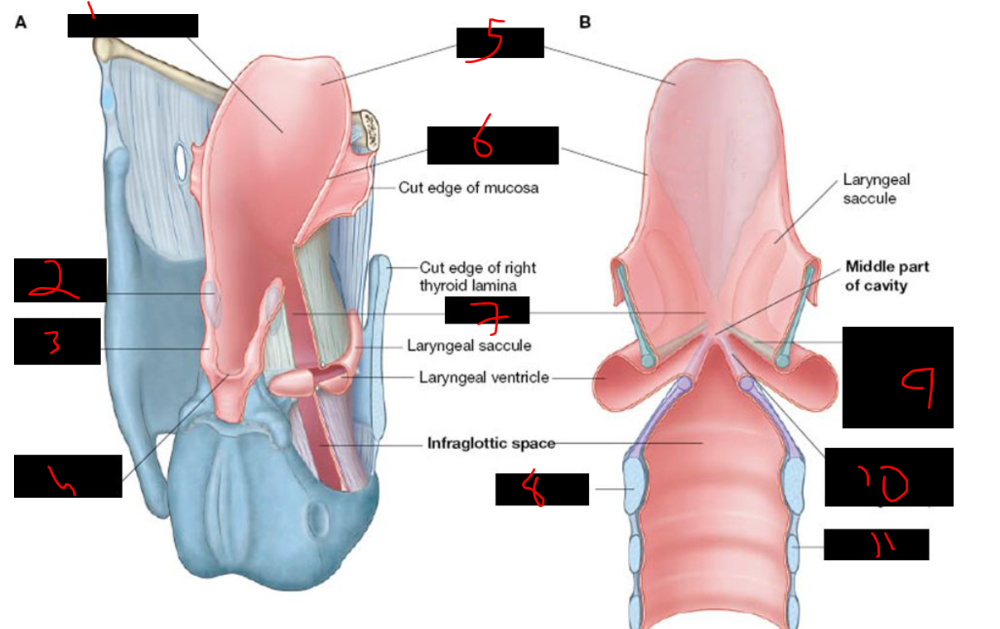
What is 1?
laryngeal inlet
What is 2?
cuneiform tubercle
What is 3?
corniculate tubercle
What is 4?
interartenoid notch
What is 5?
epiglottis
What is 6?
aryepiglottic fold
What is 7?
vestibule
What is 8?
cricoid arch
What is 9?
vestibular fold
What is 10?
vocal fold
What is 11?
trachea
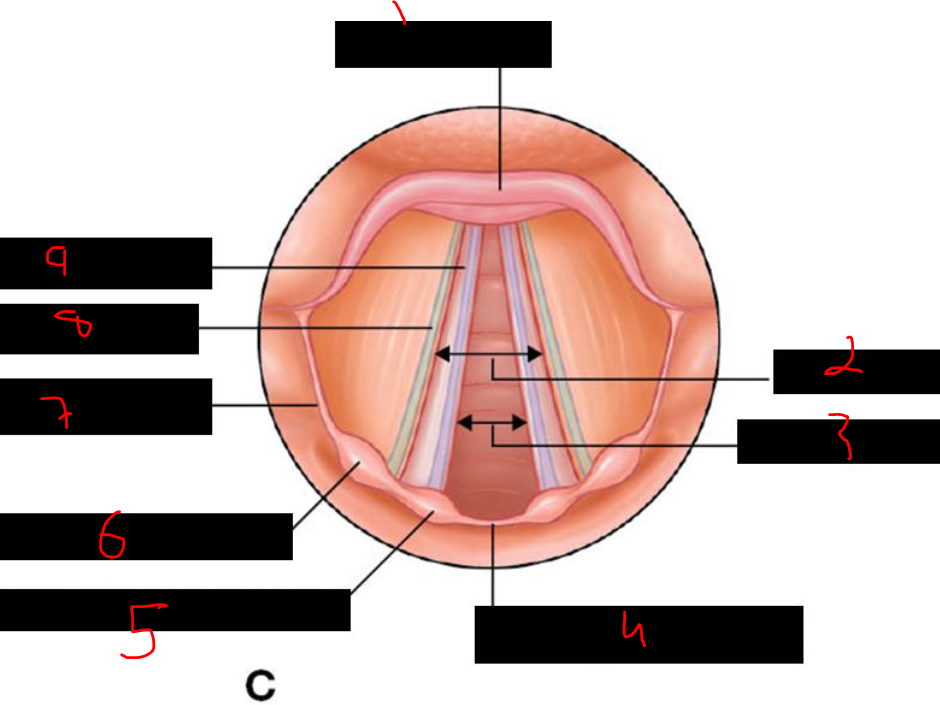
What is 1?
epiglottis
What is 2?
rima vestibuli
What is 3?
rima glottidis
What is 4?
interarytenoid fold
What is 5?
corniculate tubercle
What is 6?
cuneiform tubercle
What is 7?
aryepiglottic fold
What is 8?
vestibular fold
What is 9?
vocal fold
The three unpaired cartilages of the larynx are the __________, __________, and __________.
cricoid, thyroid, epiglottis
The paired cartilages of the larynx include the __________, __________, and __________ cartilages.
arytenoid, corniculate, cuneiform
Fibroelastic membranes connect the larynx to the __________ bone above and the __________ below.
hyoid, trachea
what is the most inferior laryngeal cartialge?
__________ __________
cricoid cartilage
what structures articulate w/ the bilateral articular facets of the cricoid cartilage?
__________ __________ of thyroid cartilage
__________ __________
-inferior horn of thyroid cartilage
-arytenoid cartilages
what structure(s) attach the the depressions on the posterior surface of the cricoid cartilage?
__________ __________ -__________ __________
posterior crico-arytenoid muscles
The thyroid angle of the thyroid cartilage measures approximately __________ to __________ degrees, typically ranging between males and females.
90, 120
The epiglottic cartilage is a __________-shaped __________ cartilage attached to the __________ aspect of the __________ cartilage. It helps direct the __________ __________ laterally toward the __________ __________ during swallowing.
leaf, elastic, posterior, thyroid, bolus, piriform fossae
during swallowing, where does the epiglottic cartilage direct the bolus?
__________ toward __________ __________
laterally toward piriform fossae
The anterior (lingual) surface of the epiglottic cartilage is lined by __________ __________ __________ epithelium, while the posterior (laryngeal) surface is lined by __________ epithelium, which is __________ __________ __________ __________ with __________ cells.
stratified squamous nonkeratinized, respiratory, pseudostratified columnar ciliated, goblet
Mobilization of the __________ cartilages is essential for vocalization, as they "swivel" on the __________ cartilage.
arytenoid, cricoid
The __________ cartilages are located at the __________ (apices) of the __________ cartilages, while the __________ cartilages are embedded in the __________ membrane that attaches the arytenoid cartilages to the __________.
corniculate, apices, arytenoid, cuneiform, fibroelastic, epiglottis
The thyrohyoid membrane attaches the __________ cartilage to the __________ bone.
thyroid, hyoid
The hyo-epiglottic ligament attaches the __________ of the epiglottis to the __________ bone in the midline.
midline, hyoid
The cricotracheal ligament connects the lower border of the __________ cartilage to the __________ __________ of the trachea.
cricoid, first ring
The sensory innervation of the larynx above the vocal folds is provided by the __________ branch of the __________ __________ nerve (cranial nerve __________), which penetrates the __________ membrane.
internal, superior laryngeal, X, thyrohyoid
what structure attaches the thyroid cartilage to the hyoid bone?
__________ __________
thyrohyoid membrane
The cricothyroid ligament, also known as the __________ or __________ membrane, attaches the __________ of the cricoid cartilage to the __________ ligament and is thickened in the midline to form the __________ __________ ligament.
cricovocal, cricothyroid, arch, vocal, median cricothyroid
The __________ membrane has a thickened lower margin called the __________ ligament.
quadrangular, vestibular
The __________ margin of the cricothyroid ligament is the __________ ligament, and the __________ margin of the quadrangular membrane is the __________ ligament.
upper, vocal, lower, vestibular
The __________ ligament is formed by the upper margin of the __________ ligament, while the __________ ligament is formed by the lower margin of the __________ membrane.
vocal, cricothyroid, vestibular, quadrangular
To perform a cricothyrotomy in an emergency, locate the __________ __________ membrane between the __________ cartilage and the __________ cartilage, just inferior to the __________ __________. Make a __________ cm __________ incision, then use a curved __________ to push through the membrane and place the __________ tubing.
cricothyroid, thyroid, cricoid, laryngeal prominence, 3, longitudinal, hemostat, endotracheal
A tracheotomy is performed in a hospital by locating the __________ to __________ tracheal rings, cutting the __________ of the thyroid gland, retracting the __________ muscles, and placing a __________ tube.
2nd, 4th, isthmus, infrahyoid, tracheostomy
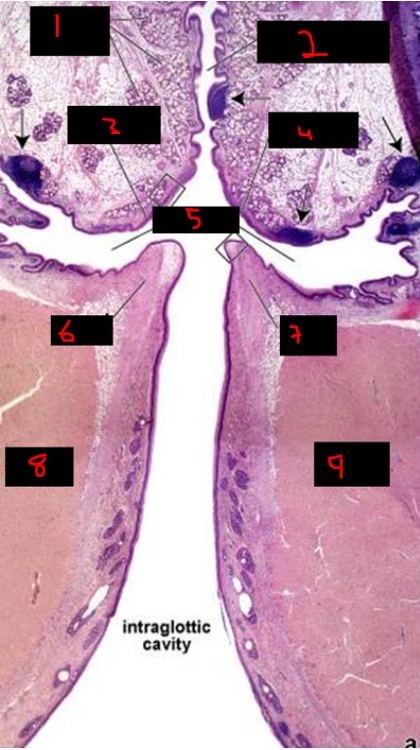
What is 1?
mucous glands
What is 2?
vestibule of the larynx
What is 3?
ventricular fold
What is 4?
ventricular fold
What is 5?
ventricles
What is 6?
vocal fold
What is 7?
vocal fold
What is 8?
vocalis muscle
What is 9?
vocalis muscle
All muscles of the larynx are innervated by cranial nerve __________. The __________ muscle is uniquely innervated by the __________ branch of the __________ __________ nerve, while all other laryngeal muscles are innervated by the __________ laryngeal nerve, which is the continuation of the __________ laryngeal nerve.
X, cricothyroid, external, superior laryngeal, inferior, recurrent
The cricothyroid muscle has two parts: the __________ part and the __________ part.
oblique, straight
The cricothyroid muscle is the only laryngeal muscle innervated by the __________ branch of the __________ __________ nerve.
external, superior laryngeal
The cricothyroid muscle acts by pulling the __________ cartilage __________ and __________, which elongates the __________ __________ and produces __________-pitch phonation.
thyroid, down, forward, vocal ligament, higher
The posterior cricoarytenoid muscle originates from the __________ on the __________ of the cricoid cartilage and inserts on the __________ process of the __________ cartilage. It is innervated by the __________ laryngeal nerve (branch of cranial nerve __________) and acts to __________ the vocal folds by externally __________ the arytenoid cartilage.
depression, lamina, muscular, arytenoid, recurrent, X, abduct, rotating
The lateral cricoarytenoid muscle originates from the __________ surface of the __________ arch and inserts on the __________ aspect of the __________ process of the arytenoid cartilage. It is innervated by the __________ laryngeal nerve (branch of cranial nerve __________) and acts to __________ the vocal folds by internally __________ the arytenoid cartilages.
superior, cricoid, anterior, muscular, recurrent, X, adduct, rotating
The transverse arytenoid muscle attaches to the __________ border of the __________ surface of the __________ cartilages. It is innervated by the __________ laryngeal nerve (cranial nerve __________) and acts to pull the cartilages toward one another, thereby __________ the cartilages and __________ folds.
lateral, posterior, arytenoid, recurrent, X, adducts, vocal
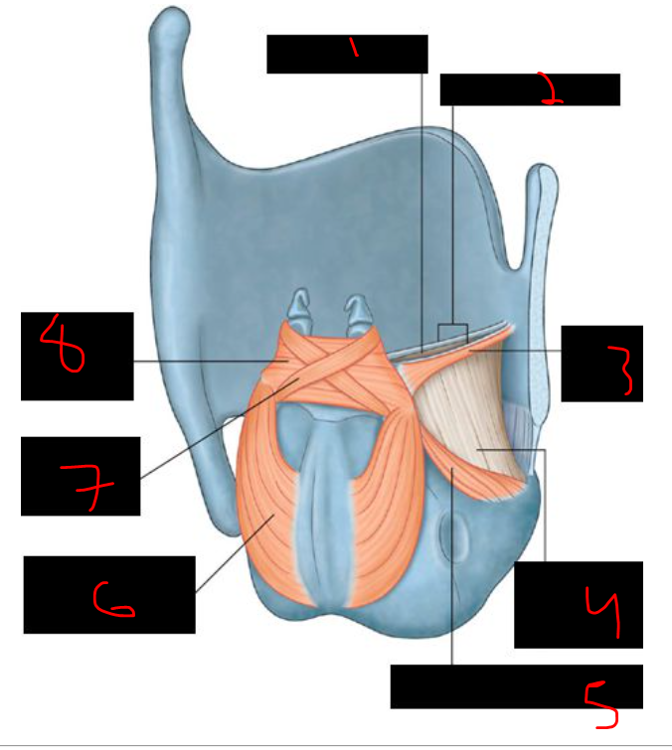
What is 1?
rima glottidis
What is 2?
vocal ligaments
What is 3?
vocalis muscle
What is 4?
lateral cricothyroid ligament
What is 5?
lateral crico-arytenoid
What is 6?
posterior crico-arytenoid
What is 7?
oblique arytenoid
What is 8?
transverse arytenoid
The oblique arytenoid muscle is innervated by the __________ laryngeal nerve and acts as a __________ of the laryngeal __________, helping to __________ it closed.
recurrent, sphincter, inlet, close
The vocalis muscle attaches from the __________ process of the __________ cartilages to the __________ of the __________ cartilage and runs along the __________ ligament. It is innervated by the __________ laryngeal nerve (cranial nerve __________) and acts to __________ tension on the vocal __________.
vocal, arytenoid, angle, thyroid, vocal, recurrent, X, adjust, cords
The thyroarytenoid muscle is innervated by the __________ laryngeal nerve and acts to __________ the vocal ligament, which __________ the pitch of the voice.
recurrent, relax, lowers
The superior laryngeal artery branches off the __________ __________ artery, which is the first branch of the __________ __________ artery.
superior thyroid, external carotid
The superior laryngeal artery enters the larynx alongside the __________ __________ nerve and continues with the __________ __________ nerve to supply the __________ muscle.
inferior thyroid, thyrocervical, subclavian
The inferior laryngeal artery accompanies the __________ __________ nerve.
recurrent laryngeal
The external laryngeal nerve travels with the __________ __________ artery as it continues after entering the __________.
superior laryngeal, larynx
The internal laryngeal nerve travels with the __________ __________ artery to enter the __________.
superior laryngeal, larynx
The recurrent laryngeal nerve travels with the __________ __________ artery.
inferior laryngeal
Damage to the __________ __________ nerve during a thyroidectomy can cause __________, leading to a __________ voice.
recurrent laryngeal, hoarseness, hoarse
Damage to the superior laryngeal nerve paralyzes the __________ muscle (innervated by the __________ branch) and causes loss of sensation from the larynx __________ the vocal folds (innervated by the __________ branch).
cricothyroid, external, above, internal
Common symptoms of superior laryngeal nerve damage include __________ voice __________ and a __________ pitch range. These effects are more subtle than injury to the __________ laryngeal nerve.
easy, fatigue, decreased, recurrent
Lymphatic drainage of the larynx above the vocal folds follows the __________ __________ artery to the __________ cervical lymph nodes located at the bifurcation of the __________ __________ artery.
superior laryngeal, deep, common carotid
Lymphatic drainage of the larynx below the vocal folds follows the __________ __________ artery.
inferior laryngeal
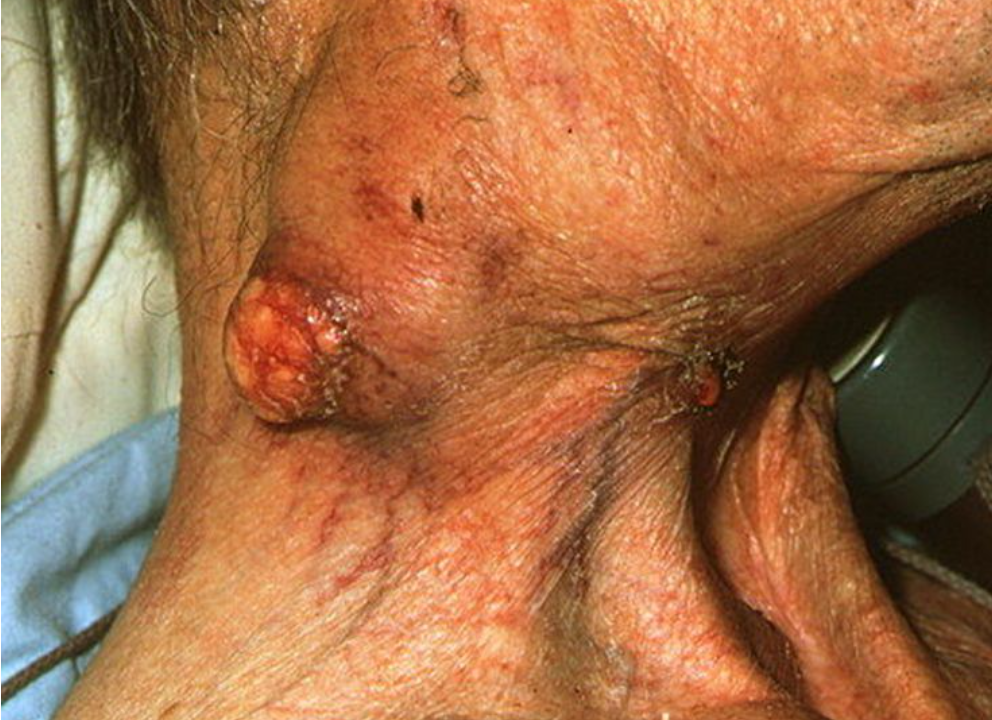
where was the cancer located in this patient? how can you tell?
above the vocal folds, higher up on neck
Lymphatic drainage from the larynx __________ the vocal folds drains to the __________ cervical lymph nodes near the bifurcation of the __________ __________ artery, located higher up on the neck.
above, deep, common carotid
The right recurrent laryngeal nerve wraps around the __________ artery
subclavian
the left recurrent laryngeal nerve wraps around the __________ of the __________ and the __________ __________.
arch, aorta, ligamentum arteriosum