Chapter 1: The Human Organism - Multiple Choice
1. Anatomy is
A. the study of function.
B. a
branch of physiology.
C. the study of structure.
D. the
study of living organisms.
E. the study of homeostasis.
C
2. Which subdivision of anatomy involves the study of organs that
function together?
A. regional
B. developmental
C. systemic
D. histology
E. surface anatomy
C
3. Which of the following activities would represent a physiological
study?
A. observing the structure of the interior of the
heart
B. studying a model of the kidney
C. examining the
surface of a bone
D. viewing muscle tissue through a microscope
E. determining normal blood sugar levels for 20-year-old students
E
4. Visual inspection of the appearance of the liver and gallbladder
during surgery is associated with which of the following?
A. histology
B. physiology
C. gross anatomy
D. radiology
E. cytology
C
5. Microscopic examination of a frozen tissue specimen is an
application of which of the following disciplines?
A.
histology
B. physiology
C. gross anatomy
D.
radiology
E. regional anatomy
A
6. Studies at the biochemical and molecular levels would be most
appropriate for learning about the
A. locations of body
parts.
B. gross anatomy of bones.
C. physiological
functions of organs.
D. ecological niches of humans.
E.
systemic anatomy.
C
7. Knowledge of the structure of body parts helps us to understand
their function. Which of the following is an accurate example of that
principle?
A. The basic structural unit of the body is
the cell.
B. The internal environment of the body is maintained
in a relatively stable condition.
C. Moveable joints allow us
to bend our fingers to perform many different actions.
D. Each
tissue type is composed of cells that have a similar structure and
function.
E. Negative feedback is not homeostatic.
C
8. An investigator who conducts an experiment to determine how changes in pH affect the function of enzymes on digestion is most likely to be a(n)
A. neurologist.
B. anatomist.
C. engineer.
D.
physiologist.
E. histologist.
D
9. The study of the structural features and functions of the cell is
A. cytology.
B. histology.
C. molecular biology.
D. microbiology.
E. surface anatomy.
A
10. The study of tissues is
A. cytology.
B.
histology.
C. molecular biology.
D. microbiology.
E. surface anatomy.
B
11. The study of the body's organization by areas is
A.
systemic anatomy.
B. regional anatomy.
C. molecular
biology.
D. microbiology.
E. surface anatomy.
B
12. The study of the external form of the body and its relationship to deeper structures is
A. systemic anatomy.
B. regional anatomy.
C.
molecular biology.
D. microbiology.
E. surface anatomy.
E
13. Which of the following systems carries necessary compounds like
oxygen and nutrients throughout the body?
A. nervous
B. cardiovascular
C. urinary
D. lymphatic
E. respiratory
B
14. Consider the following structural levels: chemical, organ,
tissue, cell, and organ system. Which level encompasses the other
four?
A. tissue
B. organ system
C. organ
D. chemical
E. cell
B
15. A tissue is a
A. structure contained within a cell.
B. lower level of organization than a cell.
C. group of
organs that performs specific functions.
D. group of cells with
similar structure and function.
E. structure that contains a
group of organs.
D
16. Organize the following structural levels of the human body from
simplest to most complex.
(1) cell
(2) tissue
(3)
chemical
(4) organ system
(5) organ
A. 1, 2, 3,
4, 5
B. 2, 3, 1, 4, 5
C. 3, 1, 2, 5, 4
D. 4, 2, 3,
1, 5
E. 3, 1, 2, 4, 5
C
17. Which organ system is the location of blood cell
production?
A. cardiovascular
B. skeletal
C.
digestive
D. nervous
E. endocrine
B
18. Which body system would be affected by degeneration of cartilage
in joints?
A. muscular
B. nervous
C.
cardiovascular
D. skeletal
E. lymphatic
D
19. The gallbladder, liver, and stomach are all part of the
A. endocrine system.
B. cardiovascular system.
C.
skeletal system.
D. respiratory system.
E. digestive system.
E
20. The integumentary system
A. regulates body
temperature.
B. breaks down food into small particles for
absorption.
C. controls intellectual functions.
D.
produces body movements.
E. coordinates and integrates body function.
A
21. Which of the following is NOT the correct name of an organ system?
A. integumentary
B. lymphatic
C. cardiovascular
D. muscular
E. hormonal
E
22. A cell is
A. a small structure within a molecule.
B. a structure composed of several tissue types.
C. the
basic structural unit of plants and animals.
D. a group of
organs with a common set of functions.
E. a group of atoms with
similar structure and function.
C
23. An organ is
A. a small structure within a cell.
B. a structure composed of several tissue types.
C. the
basic structural unit of all living organisms.
D. a group of
molecules with a common set of functions.
E. a group of cells
with similar structure and function.
B
24. An organ system is
A. a small structure within a
cell.
B. a structure composed of several tissue types.
C.
the basic structural unit of all living organisms.
D. a group
of organs with a common set of functions.
E. a group of cells
with similar structure and function.
D
25. An organelle is
A. a small structure within a cell.
B. a structure composed of several tissue types.
C. the
basic structural unit of all living organisms.
D. a group of
organs with a common set of functions.
E. a group of cells with
similar structure and function.
A
26. What system removes nitrogenous waste products from the blood and
regulates blood pH, ion balance, and water balance?
A.
respiratory
B. lymphatic
C. cardiovascular
D. immune
E. urinary
E
27. An organism's ability to use energy in order to swim is an
example of
A. metabolism.
B. responsiveness.
C. organization.
D. maturation.
E. development.
A
28. The changes an organism undergoes through time is called
A. organization.
B. metabolism.
C. reproduction.
D. growth.
E. development.
E
29. Nerve cells generate electrical signals in response to changes in
the environment. This is an example of
A. respiration.
B. digestion.
C. movement.
D. filtration.
E. responsiveness.
E
30. An increase in the number of cells is
A.
reproduction.
B. growth.
C. differentiation.
D.
metabolism.
E. organization.
B
31. The change in the shape of tissues or organs is called
A. reproduction.
B. growth.
C. differentiation.
D. metabolism.
E. morphogenesis.
E
32. Homeostasis is defined as
A. the production of
energy by cells.
B. the combination of growth, self-repair, and
energy release.
C. an amplification of deviation from the normal
range.
D. the maintenance of a relatively constant environment
within the body.
E. a condition in the body that does not
involve fluctuation.
D
33. Which of the following is consistent with homeostasis?
A. As body temperature rises, sweating occurs to cool the body.
B. When a person drinks large quantities of water, urine output
decreases to raise blood volume.
C. Elevated blood glucose
levels cause insulin secretion to decline.
D. Decreases in blood
pressure cause a corresponding decrease in heart rate.
E. As
blood pressure falls, blood flow to the heart decreases.
A
34. A blood clot stimulating even more blood clotting is an example
of
A. negative feedback.
B. positive feedback.
C. neutral feedback.
D. metabolism.
E. There is no
feedback involved.
B
35. Which of the following is most similar to the negative feedback
mechanism in human physiology?
A. A car runs out of gas
and stops.
B. A teacher marks all the wrong answers on students'
exam papers.
C. A toilet tank refills itself after a flush.
D. An automatic door opens as soon as somebody approaches it.
E. A clock ticks on a shelf.
C
36. A researcher discovered a new hormone that raises blood calcium
levels. According to the principles of negative feedback, this hormone
would be secreted when
A. blood calcium levels increase.
B. blood calcium levels decrease.
C. blood calcium levels
are stable.
D. blood calcium levels are elevated.
E. None
of these choices are correct.
B
37. In a negative feedback mechanism, the response of the effector
A. reverses the original stimulus.
B. enhances the
original stimulus.
C. has no effect on the original stimulus.
D. is usually damaging to the body.
E. creates a cycle
that leads away from homeostasis.
A
38. Which of the following is most consistent with homeostasis?
A. As blood pressure falls, blood flow to cardiac (heart) muscle
decreases.
B. As the mean blood pressure gradually increases in
aging people, the blood vessel walls become thinner.
C. Men
working in a hot environment drink large quantities of water, and
their urine volume increases.
D. As body temperature decreases,
blood vessels in the periphery dilate.
E. Elevated blood glucose
levels cause insulin secretion (insulin causes cells to take up
glucose) to increase.
E
39. A researcher discovered a sensory receptor that detects
decreasing oxygen concentrations in the blood. According to the
principles of negative feedback, it is likely that stimulation of this
sensory receptor will produce which of the following types of
responses?
A. a decrease in heart rate
B. an
increase in the respiratory rate
C. an increase in physical
activity
D. unconsciousness
E. both a decrease in heart
rate and an increase in the respiratory rate
B
40. Which of the following is NOT a component of a negative feedback
mechanism?
A. effector
B. stabilizer
C.
control center
D. receptor
B
41. Positive-feedback mechanisms are always damaging to the body.
A. TRUE
B. FALSE
B
42. In the anatomical position, the
A. arms are crossed
over the chest.
B. palms of the hands face posteriorly.
C. body is erect with the head turned to the right.
D.
thumbs point to the midline of the body.
E. palms of the hands
face anteriorly.
E
43. Which of the following sets of directional terms are most
appropriately referred to as opposites?
A. distal and
proximal
B. medial and inferior
C. superior and ventral
D. anterior and deep
E. lateral and superior
A
44. The term "dorsal" means
A. further from
the point of attachment to the body.
B. to lie with the anterior
surface down.
C. toward the back of the body.
D. away from
the midline.
E. toward the front of the body.
C
45. The anatomical term that means "away from the midline of the
body" is
A. medial.
B. proximal.
C.
distal.
D. lateral.
E. superficial.
D
46. The thumb is ___ to the fifth digit (little finger).
A. distal
B. lateral
C. medial
D. proximal
E. superficial
B
47. Which of the following describes the position of the nose?
A. inferior to the chin
B. superior to the forehead
C. posterior to the ears
D. lateral to the eyes
E.
superior to the mouth
E
48. The shoulder is _____ to the elbow.
A. lateral
B. dorsal
C. distal
D. ventral
E. proximal
E
49. A term that means "toward the attached end of a limb"
is
A. medial.
B. lateral.
C. superficial.
D. distal.
E. proximal.
E
50. Which of the following is most inferior in location?
A. pelvic cavity
B. mediastinum
C. diaphragm
D. pleural cavity
E. pericardial cavity
A
51. While Stacy is in the process of passing over the bar during a
pole vault, her hips are considered to be
A. anterior to
her shoulders.
B. posterior to her shoulders.
C. inferior
to her shoulders.
D. superior to her shoulders.
E.
cephalic to her shoulders.
C
52. Cephalic means
A. toward the middle or midline of
the body.
B. away from the surface.
C. closer to the
head.
D. closer than another structure to the point of
attachment to the trunk.
E. toward the back of the body.
C
53. Posterior means
A. toward the middle or midline of
the body.
B. away from the surface.
C. closer to the
head.
D. closer than another structure to the point of
attachment to the trunk.
E. toward the back of the body.
E
54. Medial means
A. toward the middle or midline of the
body.
B. away from the surface.
C. closer to the head.
D. closer than another structure to the point of attachment to
the trunk.
E. toward the back of the body.
A
55. Proximal means
A. toward the middle or midline of
the body.
B. away from the surface.
C. closer to the
head.
D. closer than another structure to the point of
attachment to the trunk.
E. toward the back of the body.
D
56. Deep means
A. toward the middle or midline of the
body.
B. away from the surface.
C. closer to the head.
D. closer than another structure to the point of attachment to
the trunk.
E. toward the back of the body.
B
57. In the expression "Let your fingers do the walking,"
which of the following anatomical terms could be substituted for
"fingers?"
A. tarsals
B. manuals
C. digits
D. carpals
E. metatarsals
C
58. The anatomical arm refers to the part of the upper limb from the
A. shoulder to the wrist.
B. elbow to the wrist.
C. shoulder to the elbow.
D. elbow to the fingers.
E. shoulder to the fingers.
C
59. The lumbar region is the
A. area in front of the
elbow.
B. chest area.
C. lower back.
D. bottom of
foot.
E. forearm.
C
60. The antecubital region is the
A. area in front of
the elbow.
B. chest area.
C. lower back.
D. bottom
of foot.
E. forearm.
A
61. The antebrachial region is the
A. area in front of
the elbow.
B. chest area.
C. lower back.
D. bottom
of foot.
E. forearm.
E
62. The pectoral region is the
A. area in front of the
elbow.
B. chest area.
C. lower back.
D. bottom of
foot.
E. forearm.
B
63. The plantar surface is the
A. area in front of the
elbow.
B. chest area.
C. lower back.
D. bottom of
foot.
E. forearm.
D
64. The brachial region is commonly known as the
A.
groin.
B. buttock.
C. breastbone.
D. upper arm.
E. naval.
D
65. The inguinal region is commonly known as the
A.
groin.
B. buttock.
C. breastbone.
D. upper arm.
E. naval.
A
66. The gluteal region is commonly known as the
A.
groin.
B. buttock.
C. breastbone.
D. upper arm.
E. naval.
B
67. The sternal region is commonly known as the
A.
groin.
B. buttock.
C. breastbone.
D. upper arm.
E. naval.
C
68. The umbilical region is commonly known as the
A.
groin.
B. buttock.
C. breastbone.
D. upper arm.
E. naval.
E
69. The cervical region is the
A. calf.
B.
armpit.
C. hollow behind the knee.
D. neck.
E. thigh.
D
70. The popliteal region is the
A. calf.
B.
armpit.
C. hollow behind the knee.
D. neck.
E. thigh.
C
71. The sural region is the
A. calf.
B. armpit.
C. hollow behind the knee.
D. neck.
E. thigh.
A
72. The femoral region is the
A. calf.
B. armpit.
C. hollow behind the knee.
D. neck.
E. thigh.
E
73. The axillary region is the
A. calf.
B. armpit.
C. hollow behind the knee.
D. neck.
E. thigh.
B
74. What plane divides the body into equal right and left halves?
A. coronal
B. transverse
C. median
D.
sagittal
E. frontal
C
75. Which of the following abdominal regions would contain the
appendix?
A. hypogastric
B. right iliac
C.
right lumbar
D. umbilical
E. left iliac
B
76. Which of the following is NOT found in the epigastric region?
A. liver
B. stomach
C. urinary bladder
D. duodenum
E. large intestine
C
77. A vertical plane that separates the body into right and left
portions is called a _____ plane.
A. sagittal
B.
transverse
C. frontal
D. horizontal
E. coronal
A
78. "Cutting off your nose" would be a section in the _____
plane.
A. coronal
B. nasal
C. median
D. transverse
E. sagittal
A
79. Amputation of a foot at the ankle would involve a cut in the
_____ plane.
A. coronal
B. median
C.
transverse
D. frontal
E. lateral
C
80. The thoracic cavity is separated from the abdominal cavity by the
A. sternum.
B. diaphragm.
C. mediastinum.
D. mesentery.
E. pericardial cavity.
B
81. A bullet enters the left lung and collapses it. Which cavity has
been entered?
A. mediastinal
B. pericardial
C. pleural
D. vertebral
E. cranial
C
82. The cavity of the body immediately inferior to the diaphragm is
the _____ cavity.
A. pleural
B. thoracic
C.
inguinal
D. pelvic
E. abdominal
E
83. The suffix "-itis" means inflammation. Which of the
following terms means inflammation of the membrane lining the body
cavity that contains the liver?
A. pericarditis
B.
peritonitis
C. pleurisy
D. colitis
E. hepatitis
B
84. Which of the following organs is retroperitoneal in location?
A. stomach
B. liver
C. heart
D.
kidney
E. ovary
D
85. The wall of the abdominopelvic cavity is lined by a serous
membrane called the
A. visceral pleural
membrane.
B. parietal peritoneum.
C. visceral mediastinal
membrane.
D. visceral peritoneum.
E. epicardium.
B
86. The visceral pleura is
A. a double-layered serous
membrane that anchors some of the abdominal organs to the body
wall.
B. the serous membrane that covers the lungs.
C. the
serous membrane that lines the abdominal and pelvic cavities.
D.
space located between the visceral and parietal pleura.
E. the
membrane that lines the pericardial sac.
B
87. The parietal peritoneum is
A. a double-layered
serous membrane that anchors some of the abdominal organs to the body
wall.
B. the serous membrane that covers the lungs.
C. the
serous membrane that lines the abdominal and pelvic cavities.
D.
space located between the visceral and parietal pleura.
E. the
membrane that lines the pericardial sac.
C
88. The mesentery is
A. a double-layered serous
membrane that anchors some of the abdominal organs to the body
wall.
B. the serous membrane that covers the lungs.
C. the
serous membrane that lines the abdominal and pelvic cavities.
D.
space located between the visceral and parietal pleura.
E. the
membrane that lines the pericardial sac.
A
89. The pleural cavity is the
A. a double-layered
serous membrane that anchors some of the abdominal organs to the body
wall.
B. the serous membrane that covers the lungs.
C. the
serous membrane that lines the abdominal and pelvic cavities.
D.
space located between the visceral and parietal pleura.
E. the
membrane that lines the pericardial sac.
D
90. The parietal pericardium is
A. a double-layered
serous membrane that anchors some of the abdominal organs to the body
wall.
B. the serous membrane that covers the lungs.
C. the
serous membrane that lines the abdominal and pelvic cavities.
D.
space located between the visceral and parietal pleura.
E. the
membrane that lines the pericardial sac.
E
91. A major limitation of radiographs is that they
A. can only visualize bone.
B. give only a flat,
two-dimensional image of the body.
C. are old technology that do
not give good results.
D. have very few applications.
B
92. An anatomic image created from sound waves is a
A.
radiograph.
B. CT scan.
C. MRI.
D. sonogram.
D
93. A CT scan allows for a three-dimensional image to be generated.
A. TRUE
B. FALSE
A
94. What technique creates a three-dimensional dynamic image of blood
vessels?
A. digital subtraction angiography
B.
magnetic resonance imaging
C. dynamic spatial
reconstruction
D. positron emission tomography
A
95. Magnetic resonance imaging is based on the movement of
A. electrons in a magnetic field.
B. carbons in a magnetic
field.
C. protons in a magnetic field.
D. cells in a
magnetic field.
C
96. The delivery of a radioactive compound to the body to study the
metabolism of tissues is called
A. MRI.
B.
PET.
C. DSA.
D. DSR.
B
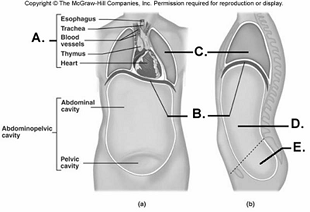
97. Here is a figure showing major trunk cavities and other
structures. What does "A" represent?
A.
diaphragm
B. mediastinum
C. pelvic cavity
D. thoracic
cavity
E. abdominal cavity
B
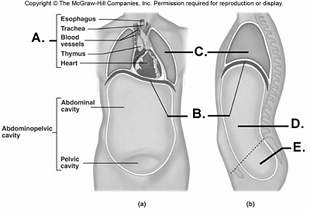
98. Here is a figure showing major trunk cavities and other
structures. What does "B" represent?
A.
diaphragm
B. mediastinum
C. pelvic cavity
D.
thoracic cavity
E. abdominal cavity
A
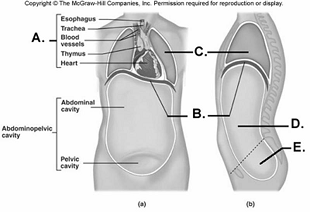
99. Here is a figure showing major trunk cavities and other
structures. What does "C" represent?
A.
diaphragm
B. mediastinum
C. pelvic cavity
D. thoracic
cavity
E. abdominal cavity
D
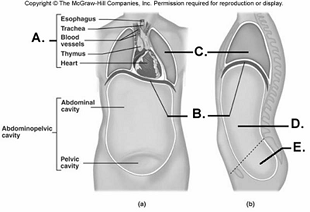
100. Here is a figure showing major trunk cavities and other
structures. What does "D" represent?
A.
diaphragm
B. mediastinum
C. pelvic cavity
D. thoracic
cavity
E. abdominal cavity
E
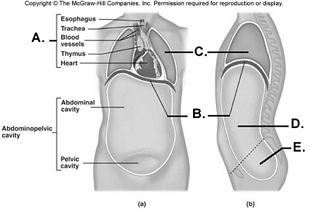
101. Here is a figure showing major trunk cavities and other structures. What does "E" represent?
A. diaphragm
B. mediastinum
C. pelvic cavity
D.
thoracic cavity
E. abdominal cavity
C
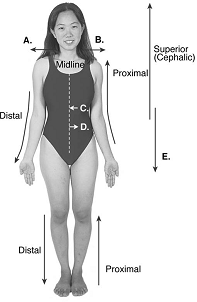
102. Directional terms are important in the study of anatomy. What
does "A" represent?
A. median
B.
right
C. left
D. inferior
E. lateral
B
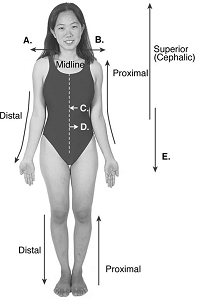
103. Directional terms are important in the study of anatomy. What
does "B" represent?
A. median
B.
right
C. left
D. inferior
E. lateral
C
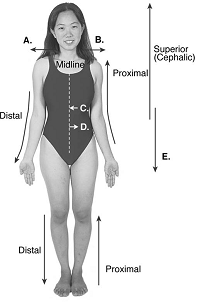
104. Directional terms are important in the study of anatomy. What does "C" represent?
A. median
B. right
C. left
D. inferior
E. lateral
A
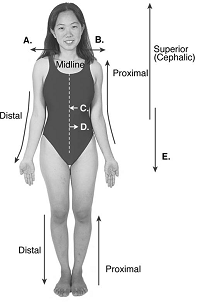
105. Directional terms are important in the study of anatomy. What does "D" represent?
A. median
B. right
C. left
D. inferior
E. lateral
E
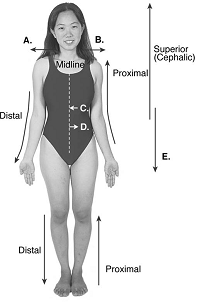
106. Directional terms are important in the study of anatomy. What
does "E" represent?
A. median
B.
right
C. left
D. inferior
E. lateral
D
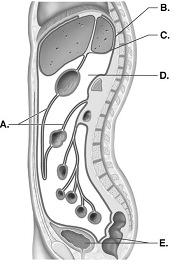
107. This is a sagittal section through the abdominopelvic cavity.
What structure does "A" represent?
A. visceral
peritoneum (covers organs)
B. mesentery
C. parietal
peritoneum (lines cavity)
D. retroperitoneal organs
E.
peritoneal cavity
B
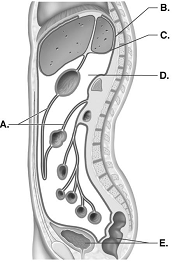
108. This is a sagittal section through the abdominopelvic cavity.
What serous membrane does "B" represent?
A.
visceral peritoneum (covers organs)
B. mesentery
C.
parietal peritoneum (lines cavity)
D. retroperitoneal
organs
E. peritoneal cavity
C
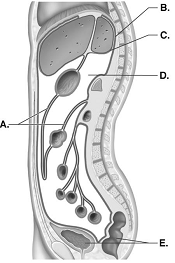
109. This is a sagittal section through the abdominopelvic cavity.
What serous membrane does "C" represent?
A.visceral peritoneum (covers organs)
B. mesentery
C.
parietal peritoneum (lines cavity)
D. retroperitoneal
organs
E. peritoneal cavity
A
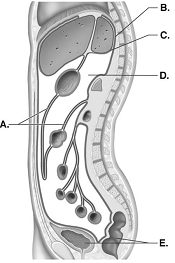
110. This is a sagittal section through the abdominopelvic cavity.
What cavity does "D" represent?
A.visceral
peritoneum (covers organs)
B. mesentery
C. parietal
peritoneum (lines cavity)
D. retroperitoneal organs
E.
peritoneal cavity
E
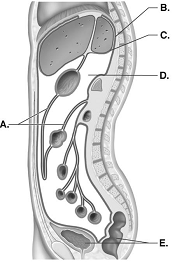
111. This is a sagittal section through the abdominopelvic cavity. What structures does "E" represent?
A. visceral peritoneum (covers organs)
B. mesentery
C. parietal peritoneum (lines cavity)
D. retroperitoneal
organs
E. peritoneal cavity
D
Anatomy deals with the
A) structure of the human
body.
B) functions of body parts.
C) psychology of
humans.
D) chemical compounds within the body.
A
Physiology deals with the
A) structure of the human
body.
B) functions of the human body.
C) human body and
its relation with the environment.
D) biochemistry of the
bacterial population infecting the human body.
B
Which of the following statements about anatomy and physiology is
true?
A) Anatomy and physiology are ancient fields of
study.
B) Anatomy and physiology both are required to understand
the body system.
C) Research still expands the concepts of
physiology.
D) All of the above statements are true.
D
Most of the terms used in anatomy and physiology originated from
which of the following languages?
A) Greek and French
B)
French and English
C) Greek and Latin
D) Latin and Spanish
C
Information about human cells can be obtained by studying
A)
bacteria.
B) rat cells.
C) monkey cells.
D) all of
the above.
D
The first human anatomical illustrations, published by ___________,
allowed for the correction of centuries of mistakes in
textbooks.
A) Claudius Galen
B) Andreas Vesalius
C)
Theodor Schwann
D) William Harvey
B
Biochemical and molecular explanations provide a better understanding
of
A) body parts.
B) anatomical details of bones.
C)
physiology of organs.
D) ecological niches.
C
Knowledge of the structure of body parts helps in understanding their
function. Which of the following is an accurate example of that
principle?
A) The heart is responsible for high blood
pressure.
B) The knees can be a cause of trouble when climbing
stairs.
C) Foldings in the brain do not reflect the complexity
of the brain.
D) The hand is adapted for grasping.
D
The location and description of bones in the skeletal system will be
covered under
A) physiology.
B) anatomy.
C)
ground.
D) dust.
B
Which of the following statements about physiology is true?
A)
Physiology is a stagnant subject.
B) Some human body functions
are still not clearly understood.
C) Physiology could never be
related with anatomy.
D) Physiology has no relationship with chemistry.
B
Magnetic resonance imaging makes use of
A) X-rays.
B)
radio waves.
C) radioisotopes.
D) high-frequency sound waves.
B
The study of the microscopic structure of the tissues and organs is
called
A) cytology.
B) astrology.
C) gross
anatomy.
D) histology.
D
Magnetic resonance imaging might be used to
A) distinguish
between normal and cancerous tissue.
B) assess damage sustained
by the heart.
C) obtain a sectional view of the brain.
D)
all of the above are uses of magnetic resonance imaging.
D
The smallest structures that are considered to be alive are
A)
organelles.
B) cells.
C) tissues.
D) body systems.
B
Cells contain structures called _________, which can perform specific
activities like energy production, and digestion.
A) atoms
B) molecules
C) organelles
D) macromolecules
C
To understand the structure and function of an organism we also need
to understand the structure and properties of
A) atoms and
molecules.
B) the atmosphere.
C) tectonic plates.
D)
Computed Tomography (CT).
A
To understand the structure of complex body systems we start from the
structure of the atom and progress to the structure of the organ
systems. This concept is called
A) levels of
deterioration.
B) structural diversity.
C) the hierarchy of
species.
D) levels of organization.
D
Which of the following lists is in the order of increasing levels of
complexity?
A) organelles - tissues - cells - organ systems -
organs
B) cells - macromolecules - tissues - body - organs
C) organelles - cells - tissues - organs - organ systems
D)
tissues - cells - organs - organelles - organ systems
C
Tissues are formed by a group of ________ that perform similar
functions.
A) cells
B) tissues
C) organs
D) atoms
A
The heart is an example of a(n)
A) cell.
B) organ.
C)
organelle.
D) organ segment.
B
To maintain life all living organisms depend on
A)
oxygen.
B) food.
C) blood.
D) hydrogen.
B
As one of the characteristic of Life, development includes
A)
fertilization and reproduction.
B) differentiation and
morphogenesis.
C) fertilization and differentiation.
D)
morphogenesis and metabolism.
C
Which of the following activities is not necessary to maintain
life?
A) intellectual capability
B) production of
energy
C) intake of food compounds
D) growth
A
To avoid extinction of a species, living organisms need to
A)
think.
B) read.
C) reproduce.
D) overgrow.
C
Which of the following carries necessary compounds like nutrients and
hormones throughout the body?
A) water
B) public city
transport
C) blood
D) lymph
C
What organ system is responsible for the production of blood
cells?
A) circulatory
B) skeletal
C) digestive
D) nervous
B
The ability of an organism to sense changes that take place within
its body is an example of
A) responsiveness.
B)
movement.
C) breathing.
D) metabolism.
A
Homeostasis is defined as the
A) ability of human beings to
maintain a low body weight throughout life.
B) maintenance of
constant room temperature.
C) capability of the body to maintain
a relatively constant internal environment.
D) digestion of food
compounds as soon as they are eaten.
C
Which of the following is NOT an example of a homeostatic
mechanism?
A) Shivering when the body temperature falls below
normal levels
B) Using blankets to cover up when the body feels
cold
C) Secreting insulin to decrease blood sugar concentration
after a meal or whenever the blood sugar level is high
D)
Increasing heart rate and contraction force when blood pressure is low
B
A blood clot stimulating formation of more blood clotting is an
example of
A) negative feedback.
B) negative and positive
feedback.
C) positive feedback.
D) spoon feeding.
C
The function of ADH (anti-diuretic hormone) is to conserve water by
decreasing urine output. According to the negative feedback mechanism,
ADH will be secreted when the
A) body is running low in
water.
B) body has an excess amount of water.
C) pituitary
gland is extremely dry.
D) kidneys are not functioning properly.
A
A ______ section separates the body into right and left
portions.
A) frontal
B) transverse
C) dorsal
D) sagittal
D
Amputation of a foot at the ankle would involve a cut in the
___________ plane.
A) coronal
B) midsagittal
C)
transverse
D) frontal
C
Which of the following sets of directional terms are most
appropriately referred to as opposite?
A) distal and
proximal
B) medial and inferior
C) superior and
ventral
D) anterior and deep
A
The three major anatomical planes are
A) parasagittal,
midsagittal, and frontal.
B) sagittal, frontal, and
transverse.
C) transverse, cross, and sagittal.
D) cross,
frontal, and coronal.
C
Which of the following does NOT belong to the axial part of the
body?
A) neck
B) left upper quadrant
C) thoracic
region
D) brachial region
D
The anterior medial thoracic region is called the _____
region.
A) coxial
B) cubital
C) pectoral
D) sternal
D
The groin is also known as the ______ region.
A) crural
B)
inguinal
C) perineum
D) popliteal
B
The spleen is in the _______ of the abdomen.
A) left upper
quadrant
B) right upper quadrant
C) right lateral
abdominal region
D) epigastric region
A
A view of the heart showing the interior of all four chambers would
be a ______ section.
A) transverse
B) coronal
C)
cross
D) parasagittal
B
A ______ plane passes through the breast, hip, and knee on only one
side of the body.
A) coronal
B) transverse
C)
midsagittal
D) parasagittal
D
The antecubital (cubital fossa) region of the body most resembles
what other body region?
A) sacral
B) lumbar
C)
popliteal
D) tarsal
C
The cranial cavity is _______ to the thoracic cavity.
A)
inferior
B) anterior
C) peripheral
D) superior
D
Most of the esophagus is in the
A) dorsal body cavity.
B)
thoracic cavity.
C) epigastric cavity.
D) umbilical region.
B
The axial portion of the body includes
A) the dorsal
cavity.
B) the ventral cavity.
C) the dorsal cavity and
the ventral cavity.
D) neither the dorsal cavity nor the ventral cavity.
C
The upper midportion of the abdomen is called the ______
region.
A) hypochondriac
B) iliac
C)
hypogastric
D) epigastric
D
When the body is placed in the anatomical position, which of the
following is NOT true?
A) The face is forward.
B) The arms
are at the sides.
C) The palms are facing backward.
D) The
body is erect.
C
A parietal membrane _______, whereas a visceral membrane
_______.
A) covers organs; lines cavities
B) lines
cavities; covers organs
C) is thick; is thin
D) secretes
mucus; secretes a serous fluid
B
Which of the following organs is located in the abdominopelvic
cavity?
A) heart.
B) trachea.
C) thymus gland.
D) None of the above.
D
The thoracic cavity lies where in relationship to the abdominopelvic
cavity?
A) dorsal (posterior)
B) ventral (anterior)
C) superior
D) inferior
C
The membrane on the surface of a lung is called the
A) visceral
pleura.
B) parietal pleura.
C) visceral pericardium.
D) parietal pericardium.
A
The dorsal cavity includes which of the following smaller
cavities?
A) spinal and cranial
B) abdominal and
pelvic
C) abdominopelvic and thoracic
D) pelvic and mediastinum
A
The ankle is _______ to the knee.
A) deep
B)
peripheral
C) superior
D) distal
D
The acromial region is the
A) neck.
B) armpit.
C)
point of the shoulder.
D) hip.
C
The _______ contains a portion of the inguinal region.
A) left
lower quadrant
B) left upper quadrant
C) hypochondriac
region
D) epigastric region
A
The urinary bladder is in the ________ region.
A)
inguinal
B) epigastric
C) umbilical
D) hypogastric
D
Examples of serous membranes include
A) pleura,
B)
pericardium.
C) peritoneum.
D) all of the above.
D
All of the following are retroperitoneal EXCEPT the
A)
esophagus.
B) pancreas.
C) kidneys.
D) adrenal glands.
A
The anus is in the ____ region.
A) perineal
B)
gluteal
C) pubic
D) inguinal
A
The carpus is distal to the
A) manus.
B) tarsus.
C)
digits.
D) acromion.
D
The concept of anatomical position stipulates all of the following
EXCEPT the
A) forearms are supine.
B) feet are slightly
apart.
C) arms are held down to the sides.
D) mouth is closed.
D
The breast is in the ______ region.
A) sternal
B)
acromial
C) pectoral
D) cervical
C
All of the following are found in the thoracic cavity EXCEPT
the
A) lungs.
B) pleurae.
C) meninges.
D) heart.
C
Which of the following is NOT the name of an organ system?
A)
hormonal
B) lymphatic
C) circulatory
D) muscular
A
_____________ investigates the body's structure, whereas __________
investigates the processes or functions of living things.
A)
Physiology, cytology
B) Physiology, anatomy
C) Anatomy,
histology
D) Histology, cytology
E) Anatomy, physiology
E
Ultrasound, X-rays, CT, and MRI are all examples of
A) anatomic
imaging.
B) surface anatomy.
C) regional anatomy.
D)
gross anatomy.
E) cytology.
A
A group of cells with similar structure and function, together with
the extracellular substances located between them, form a(n)
A)
organism.
B) organelle.
C) tissue.
D) organ.
E)
organ system.
C
The basic living unit of all plants and animals is the
A)
cell.
B) chemical.
C) organ.
D) organelle.
E) tissue.
A
Which organ system removes substances from the blood, combats
disease, maintains tissue fluid balance, and absorbs fat from the
digestive tract?
A) endocrine
B) integumentary
C)
lymphatic
D) respiratory
E) urinary
C
Which organ system consists of skin, hair, nails, and sweat
glands?
A) endocrine
B) integumentary
C)
lymphatic
D) respiratory
E) urinary
B
Which organ system consists of hormone-secreting glands, such as the
pituitary and thyroid glands?
A) endocrine
B)
integumentary
C) lymphatic
D) respiratory
E) urinary
A
Which of these characteristics of life helps maintain homeostasis
when environmental conditions change?
A) growth and
development
B) metabolism
C) organization
D)
reproduction
E) responsiveness
E
Development is a process that begins with fertilization and ends
with
A) birth.
B) adolescence.
C) adulthood.
D) old age.
E) death.
E
Given these terms related to negative(--)feedback: 1. control center
2. effector 3. receptor 4. response 5. stimulus Arrange them in the
correct order as they operate to maintain homeostasis.
A)
1,2,3,4,5
B) 2,3,5,1,4
C) 3,2,1,5,4
D)
4,5,3,2,1
E) 5,3,1,2,4
E
A body temperature of 98.6 degrees F (37 degrees C) is the __________
for body temperature.
A) constant
B) lower limit
C)
normal range
D) set point
E) upper limit
D
Which of these processes illustrates positive-feedback?
A)
increase in respiratory rate during exercise
B) increase in
heart rate when blood pressure decreases
C) shivering when body
temperature decreases
D) increase in uterine contractions when
uterine stretching increases during childbirth
E) all of these
D
Failure of negative-feedback mechanisms to maintain homeostasis
A) may produce disease.
B) occurs when blood pressure increases
during exercise.
C) can be corrected by stimulating
positive-feedback mechanisms.
D) cannot be corrected by medical
therapy.
E) all of these
A
According to the concept of negative feedback, a slight increase in
blood pressure causes
A) an increase in heart rate.
B) a
decrease in heart rate.
C) no change in heart rate.
B
To maintain homeostasis, the normal range of values for a
variable
A) is always below the set point.
B) may change in
different situations.
C) may not deviate from the set
point.
D) occurs because of positive-feedback.
B
A term that means "away from the midline" is:
A)
distal
B) lateral
C) medial
D) proximal
E) superior
B
Which of these descriptions does NOT apply correctly to a person in
the anatomic position?
A) standing erect
B) head facing
forward
C) feet facing forward
D) arms hanging to the
sides
E) palms facing toward the thighs
E
The scapula (shoulder blade) is __________ to the lung.
A)
dorsal
B) posterior
C) superficial
D) all of these
D
The elbow is __________ to the wrist.
A) distal
B)
inferior
C) lateral
D) medial
E) proximal
E
The nose is __________ and __________ to the ears.
A) anterior,
proximal
B) superior, lateral
C) inferior, posterior
D) anterior, medial
E) superficial, medial
D
Which of the paired terms below are opposites?
A) anterior and
cephalic
B) posterior and cephalic
C) posterior and
caudal
D) superior and cephalic
E) anterior and dorsal
E
Pancreatitis describes
A) inflammation of the pancreas.
B) removal of the pancreas.
C) cancer of the pancreas.
D)
secretions from the pancreas.
E) death of the pancreas.
A
A person lying flat on his back is said to be in the __________
position.
A) anatomic
B) prone
C) supine
C
Given these directional terms: 1. caudal 2. cephalic 3. distal 4.
inferior 5. proximal Which of these directional terms correctly
describes the relationship of the ankle to the knee?
A)
1,3
B) 1,3,4
C) 2,3,4
D) 3,4
E) 4,5
D
Which of these anatomical terms refers to the ankle?
A)
crural
B) femoral
C) carpal
D) pedal
E) tarsal
E
Which of these anatomical terms refers to the shoulder?
A)
acromial
B) brachial
C) cervical
D) clavicular
E) digital
A
The only plane that can divide the body into equal halves is
the
A) frontal (coronal) plane.
B) oblique plane.
C)
midsagittal plane.
D) transverse plane.
E) Serengeti plane.
C
A(n) __________ plane divides the body into superior and inferior
portions.
A) frontal (coronal)
B) oblique
C)
sagittal
D) transverse
D
A cut across the long axis of an organ made at other than a right
angle is called a(n)
A) cross section.
B) transverse
section.
C) oblique section.
D) longitudinal section.
C
In which quadrant of the abdomen would stomach pain most likely be
felt?
A) lower left
B) lower right
C) upper
left
D) upper right
C
Which of these structures is NOT found in the mediastinum?
A)
diaphragm
B) esophagus
C) heart
D) thymus
gland
E) trachea
A
Which of these statements concerning body regions is correct?
A) The pelvis is located between the thorax and abdomen.
B) The
leg extends from the knee to the ankle.
C) The arm extends from
the shoulder to the wrist.
D) The trunk can be divided into the
thorax and pelvis.
E) The thorax is often subdivided
superficially into four quadrants.
B
The cavity surrounded by the rib cage and bounded inferiorly by the
diaphragm is the
A) mediastinum.
B) pericardial
cavity.
C) thorax.
D) abdomen.
E) pelvic cavity.
C
The lungs are separated by the
A) mediastinum.
B)
mesenteries.
C) diaphragm.
D) peritoneal membranes.
E) pelvic cavity.
A
Serous membranes
A) line body cavities that open to the
outside.
B) produce a lubricating film of fluid.
C) are
found only on the walls of the thoracic cavity.
D) separate the
abdominal cavity from the pelvic cavity.
E) completely cover
retroperitoneal organs.
B
The serous membrane on the surface of the lungs is called
A)
parietal pericardium.
B) visceral pericardium.
C) parietal
pleura.
D) visceral pleura.
E) parietal peritoneum.
D
Which of these organs is NOT retroperitoneal?
A) adrenal
glands
B) kidneys
C) urinary bladder
D) spleen
E) pancreas
D
Given these serous membranes: 1. parietal pericardium 2. visceral
pericardium 3. parietal peritoneum 4. visceral peritoneum 5. parietal
pleura 6. visceral pleura
A man had a knife wound that penetrated
the abdomen, passed through the stomach, and hit the diaphragm, but
did not pass all the way through. Arrange the serous membranes in the
correct order as the knife passed through them.
A)
1,2,4,3,5
B) 2,3,4,4,3,2
C) 3,4,4,3
D)
4,3,3,4,5
E) 5,6,6,4
C
You are doing a handstand. Your head is __________ to your
neck.
A) superior
B) inferior
C) superficial
D) medial
E) proximal
A
Physiology
A) deals with the processes or functions of living
things.
B) is the scientific discipline that investigates the
body's structures.
C) is concerned with organisms and does not
deal with different levels of organization, such as cells and
systems.
D) recognizes the static (as opposed to the dynamic)
nature of living things.
E) can be used to study the human body
without considering anatomy.
A
The endocrine system
A) regulates other organ systems.
B)
removes waste products from the blood; maintains water balance.
C) regulates temperature; prevents water loss; provides
protection.
D) removes foreign substances from the blood;
combats disease; maintains tissue fluid balance.
E) produces
movement; maintains posture; produces body heat.
A
The integumentary system
A) regulates other organ systems
B) removes waste products from the blood; maintains water
balance
C) regulates temperature; prevents water loss; provides
protection
D) removes foreign substances from the blood; combats
disease; maintains tissue fluid balance
E) produces movement;
maintains posture; produces body heat
C
The lymphatic system
A) regulates other organ systems
B)
removes waste products from the blood; maintains water balance
C) regulates temperature; prevents water loss; provides
protection
D) removes foreign substances from the blood; combats
disease; maintains tissue fluid balance
E) produces movement;
maintains posture; produces body heat
D
The muscular system
A) regulates other organ systems
B)
removes waste products from the blood; maintains water balance
C) regulates temperature; prevents water loss; provides
protection
D) removes foreign substances from the blood; combats
disease; maintains tissue fluid balance
E) produces movement;
maintains posture; produces body heat
E
The nervous system
A) regulates other organ systems
B)
removes waste products from the blood; maintains water balance
C) regulates temperature; prevents water loss; provides
protection
D) removes foreign substances from the blood; combats
disease; maintains tissue fluid balance
E) produces movement;
maintains posture; produces body heat
A
The urinary system
A) regulates other organ systems
B)
removes waste products from the blood; maintains water balance
C) regulates temperature; prevents water loss; provides
protection
D) removes foreign substances from the blood; combats
disease; maintains tissue fluid balance
E) produces movement;
maintains posture; produces body heat
B
The characteristic of life that is defined as "all the chemical
reactions taking place in an organism" is
A)
development.
B) growth.
C) metabolism.
D)
organization.
E) responsiveness.
C
Negative-feedback mechanisms
A) make deviations from the set
point smaller.
B) maintain homeostasis.
C) are associated
with an increased sense of hunger the longer a person goes without
eating.
D) all of the above.
D
The following events are part of a negative-feedback
mechanism.
1. Blood pressure increases.
2. Control center
compares actual blood pressure to the blood pressure set
point.
3.The heart beats faster.
4. Receptors detect a
decrease in blood pressure.
Choose the arrangement that lists the events in the order they
occur.
A) 1,2,3,4
B) 1,3,2,4
C) 3,1,4,2
D)
4,2,3,1
E) 4,3,2,1
D
Which of these statements concerning positive feedback is
correct?
A) Positive-feedback responses maintain
homeostasis.
B) Positive-feedback responses occur continuously
in healthy individuals.
C) Birth is an example of a normally
occurring positive-feedback mechanism.
D) When the cardiac
muscle receives an inadequate supply of blood, positive-feedback
mechanisms increase blood flow to the heart.
E) Medical therapy
seeks to overcome illness by aiding positive-feedback mechanisms.
C
The clavicle (collarbone) is _____________ to the nipple of the
breast.
A) anterior
B) distal
C) superficial
D) superior
E) ventral
D
A term that means nearer the attached end of a limb is
A)
distal.
B) lateral.
C) medial.
D) proximal.
E) superficial.
D
Which of these directional terms are paired most appropriately as
opposites?
A) superficial and deep
B) medial and
proximal
C) distal and lateral
D) superior and
posterior
E) anterior and inferior
A
The part of the upper limb between the elbow and the wrist is called
the
A) arm.
B) forearm.
C) hand.
D) inferior
arm.
E) lower arm.
B
A patient with appendicitis usually has pain in the _____________
quadrant of the abdomen.
A) left-lower
B)
right-lower
C) left-upper
D) right-upper
B
A plane that divides the body into anterior and posterior parts is
a
A) frontal (coronal) plane.
B) sagittal plane.
C)
transverse plane.
A
The pelvic cavity contains the
A) kidneys.
B)
liver.
C) spleen.
D) stomach.
E) urinary bladder.
E
The lungs are
A) part of the mediastinum.
B) surrounded
by the pericardial cavity.
C) found within the thoracic
cavity.
D) separated from each other by the diaphragm.
E)
surrounded by mucous membranes.
C
Given these characteristics:
1. reduce friction between
organs
2. line fluid-filled cavities
3. line trunk cavities
that open to the exterior of the body
Which of the characteristics describe serous membranes?
A)
1,2
B) 1,3
C) 2,3
D) 1,2,3
A
Given these organ and cavity combinations:
1. heart and
pericardial cavity
2. lungs and pleural cavity
3. stomach
and peritoneal cavity
4. kidney and peritoneal cavity
Which of the organs is correctly paired with a space that surrounds
that organ?
A) 1,2
B) 1,2,3
C) 1,2,4
D)
2,3,4
E) 1,2,3,4
B
Which of these membrane combinations are found on the surface of the
diaphragm?
A) parietal pleura-parietal peritoneum
B)
parietal pleura-visceral peritoneum
C) visceral pleura-parietal
peritoneum
D) visceral pleura-visceral peritoneum
A
Mesenteries
A) are found in the pleural, pericardial, and
abdominopelvic cavities.
B) consist of two layers of peritoneum
fused together.
C) anchor organs such as the kidneys and urinary
bladder to the body wall.
D) are found primarily in body
cavities that open to the outside.
E) all of the above.
B
Which of the following organs is not retroperitoneal?
A)
adrenal glands
B) urinary bladder
C) kidneys
D)
pancreas
E) stomach
E