Path 18
Hepatitis ___: This is typically an acute, short-term infection spread through contaminated food or water that does not lead to chronic liver disease.
A
Hepatitis ___: It is transmitted through infected blood, sexual contact, or from mother to child during birth and can transition from an acute illness into a lifelong chronic infection (but rarely)
B
Hepatitis ___: Primarily spread through blood-to-blood contact (often via shared needles), this type is notorious for being a "silent" infection that becomes chronic in the majority of cases.
C
Hepatitis ___: This unique "satellite" virus can only infect people who already have Hepatitis B, as it requires the B virus to replicate.
D
Hepatitis ___: Similar to Type A, it is usually spread via the fecal-oral route through tainted water and is generally acute, though it poses a significant risk to pregnant women.
E
A patient is developing jaundice from rising
bilirubin levels. Which finding is most likely to appear
first on physical exam?
A. Diffuse yellowing of trunk skin
B. Yellow discoloration of sclera
C. Orange discoloration of
palms
D. Pale conjunctiva without icterus
B. Yellow discoloration of sclera
A patient has chronic hemolysis with
increased bilirubin production that exceeds
the liver’s conjugating capacity. Which condition best
explains this mechanism?
A. Extravascular hemolysis causing
jaundice
B. Rotor syndrome causing black liver
C.
Obstructive jaundice from gallstones
D. Viral hepatitis with
duct inflammation
A. Extravascular hemolysis causing jaundice
A patient with anemia develops jaundice and is noted to have a higher
risk of pigmented bilirubin gallstones. Which
underlying process best fits this presentation?
A. Extrahepatic
bile duct obstruction
B. Increased bilirubin production from
hemolysis
C. Impaired canalicular bilirubin transport
D.
Hepatocyte inflammation from hepatitis
B. Increased bilirubin production from hemolysis
this is Extravascular hemolysis causing jaundice
A jaundiced patient has dark urine, but the bilirubin responsible for
the jaundice itself is not present in the urine because it is not
water soluble. What most likely explains the dark
urine?
A. Bilirubinuria from obstructive
disease
B. Increased urinary urobilinogen excretion
C.
Hematuria from renal pigment injury
D. Excess ketones from
fasting state
B. Increased urinary urobilinogen excretion
A newborn develops jaundice shortly after birth because the
liver temporarily has low activity of UGT needed
for bilirubin conjugation. What is the most likely
diagnosis?
A. Gilbert syndrome
B. Crigler-Najjar
syndrome
C. Physiologic jaundice of the newborn
D.
Dubin-Johnson syndrome
C. Physiologic jaundice of the newborn
A neonate with severe jaundice is at risk for bilirubin deposition in
the basal ganglia, causing permanent
neurologic injury. Which complication is this?
A.
Kernicterus
B. Hepatic encephalopathy
C. Wilson
degeneration
D. Subdural hematoma
A. Kernicterus
Physiologic jaundice of the newborn
A newborn with jaundice is treated with light exposure that converts
UCB into a more water-soluble form. Which treatment was used?
A.
Exchange transfusion
B. Phototherapy
C. Ursodiol
therapy
D. Iron chelation
B. Phototherapy
Physiologic jaundice of the newborn
A healthy young adult has intermittent jaundice only during periods
of physiologic stress, such as severe
infection. The disorder is otherwise not clinically
significant. Which diagnosis is most likely?
A. Crigler-Najjar
syndrome
B. Gilbert syndrome
C. Biliary tract
obstruction
D. Viral hepatitis
B. Gilbert syndrome
A patient has an inherited disorder caused by mildly
decreased UGT activity and is otherwise
asymptomatic except during stress. What is the inheritance
pattern of this condition?
A. X-linked dominant
B.
Autosomal dominant
C. Mitochondrial
D. Autosomal recessive
D. Autosomal recessive
this is Gilbert syndrome
An infant has a complete absence of UGT1A1 activity
and rapidly develops severe neurologic injury from bilirubin
deposition. Which syndrome is most likely?
A. Rotor
syndrome
B. Crigler-Najjar syndrome
C. Gilbert
syndrome
D. Physiologic newborn jaundice
B. Crigler-Najjar syndrome
A child has profound jaundice due to complete failure of
bilirubin conjugation and develops
kernicterus. What is the usual prognosis without effective
intervention?
A. Usually self-limited
B. Usually
benign
C. Usually fatal
D. Usually relapsing-remitting
C. Usually fatal
A patient has an inherited defect in the canalicular
transport protein (MRP2) that normally moves
bilirubin into bile. Which diagnosis is most
likely?
A. Dubin-Johnson syndrome
B. Gilbert
syndrome
C. Viral hepatitis
D. Extravascular hemolysis
A. Dubin-Johnson syndrome
A patient with chronic jaundice is found incidentally to have a
darkly pigmented liver, but is otherwise largely
asymptomatic. Which syndrome best fits this picture?
A. Rotor
syndrome
B. Dubin-Johnson syndrome
C. Crigler-Najjar
syndrome
D. Physiologic neonatal jaundice
A. Dubin-Johnson syndrome
A patient has a disorder very similar to Dubin-Johnson syndrome but
lacks liver discoloration. Which diagnosis is this comparison
describing?
A. Gilbert syndrome
B. Rotor syndrome
C.
Viral hepatitis
D. Biliary atresia
B. Rotor syndrome
A patient presents with jaundice, intense itching, pale
stools, and dark urine. Which mechanism best explains this
presentation?
A. Hemolysis overwhelming conjugation
B.
Impaired bilirubin uptake into spleen
C. Obstruction of bile
flow to intestine
D. Decreased albumin production alone
C. Obstruction of bile flow to intestine
Biliary tract obstruction
A patient with jaundice is also found to have
xanthomas and pruritus due to
retained bile acids. Which disease process most
strongly fits this constellation?
A. Viral hepatitis
B.
Biliary tract obstruction
C. Gilbert syndrome
D.
Crigler-Najjar syndrome
B. Biliary tract obstruction
A patient with obstructive jaundice develops greasy
stools and deficiency of fat-soluble
vitamins. What is the most direct explanation?
A.
Failure of bile delivery impairs fat absorption
B. Renal loss of
vitamins causes deficiency
C. Pancreatic insulin deficiency
limits uptake
D. Splenic sequestration reduces lipid transport
A. Failure of bile delivery impairs fat absorption
Biliary tract obstruction
A patient with jaundice is found to have a biliary obstruction. Which
underlying cause is specifically associated with this disorder?
A. Severe UGT deficiency
B. Defective canalicular
transporter
C. Clonorchis sinensis infestation
D. Basal
ganglia bilirubin deposition
C. Clonorchis sinensis infestation
Biliary tract obstruction
A patient develops jaundice in the setting of pancreatic
carcinoma compressing the biliary tree.
Which broader category does this belong to?
A. Obstructive
jaundice
B. Hemolytic jaundice
C. Neonatal jaundice
D. Hereditary conjugation defect
A. Obstructive jaundice
A patient with liver inflammation develops jaundice because
both hepatocytes and small bile ductules
are disrupted. Which diagnosis best fits this
mechanism?
A. Dubin-Johnson syndrome
B. Viral
hepatitis
C. Gilbert syndrome
D. Extravascular hemolysis
B. Viral hepatitis
A patient with jaundice has dark urine, but the
mechanism is increased urinary bilirubin rather than
increased urinary urobilinogen. Which diagnosis
best fits that distinction?
A. Extravascular hemolysis
B.
Physiologic newborn jaundice
C. Viral hepatitis
D. Gilbert syndrome
C. Viral hepatitis
what two are only increased in Conjucated Bilirubin?
dubin-johnson
biliary tract obstruction
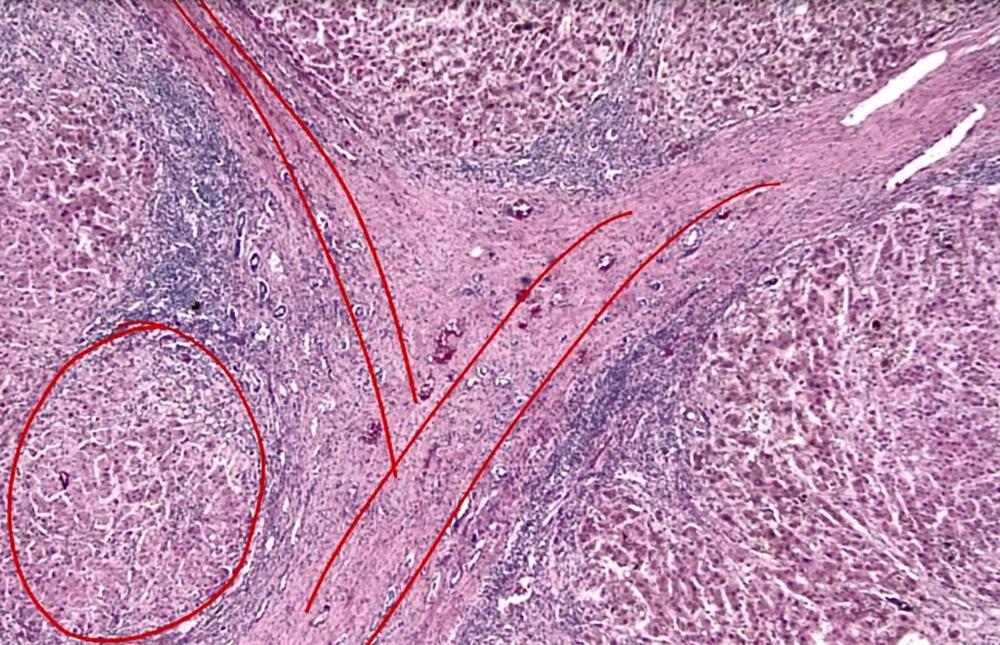
what is this?
cirrhosis
A male patient with chronic liver disease develops gynecomastia,
spider angiomata, and palmar erythema. What is the most likely cause
of these findings?
A. Increased androgen production from adrenal
glands
B. Decreased hepatic metabolism of circulating
estrogen
C. Excess bile acid deposition in the skin
B. Decreased hepatic metabolism of circulating estrogen
A patient with liver failure develops jaundice. Which mechanism best
explains this presentation?
A. Increased conjugation of
bilirubin in hepatocytes
B. Enhanced renal excretion of
bilirubin
C. Decreased metabolism of unconjugated bilirubin
C. Decreased metabolism of unconjugated bilirubin
A patient with cirrhosis presents with confusion and
a flapping tremor of the hands. Which underlying
mechanism best explains these neurologic findings?
A.
Accumulation of ammonia due to impaired detoxification
B.
Increased bilirubin deposition in peripheral nerves
C. Decreased
glucose uptake by neurons
A. Accumulation of ammonia due to impaired detoxification
rmbr that the liver does protein synthesis and clotting factor synthesis, so messed up liver would lead to
less protein/albumin
bleeding
is pt or ptt used to monitor cirrhosis liver destruction
pt
similar to warfarin
alcohol-related liver disease: damage to hepatic ______ due to consumption of alc
parenchyma
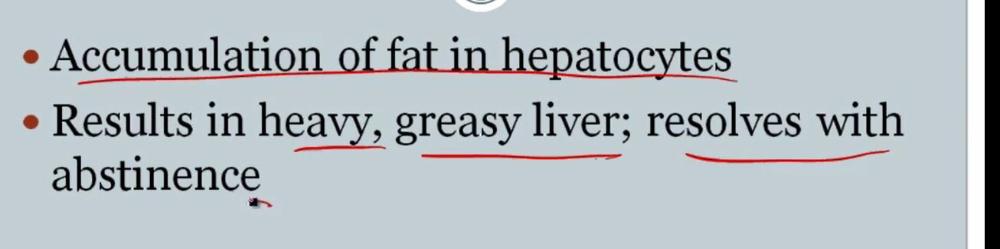
______ ______
fatty liver
A patient presents with acute liver injury after a weekend of heavy
binge drinking. The hepatocyte damage is primarily mediated by
accumulation of which toxic metabolite?
A. Acetaldehyde
B.
Acetone
C. Lactate
D. Pyruvate
A. Acetaldehyde
A patient with alcoholic hepatitis develops liver injury due to a
toxic intermediate formed during ethanol metabolism. Which step in
ethanol metabolism produces this harmful compound?
A. Conversion
of ethanol to acetaldehyde
B. Conversion of acetaldehyde to
acetate
C. Conversion of acetate to acetyl-CoA
D.
Conversion of NADH to NAD⁺
A. Conversion of ethanol to acetaldehyde
A patient with a history of heavy alcohol use presents with
right upper quadrant pain and
hepatomegaly. Laboratory studies show
elevated transaminases with AST significantly higher than
ALT. What is the most likely explanation for this enzyme
pattern?
A. Preferential mitochondrial injury increasing AST
release
B. Increased cytosolic enzyme release favoring ALT
C. Selective inhibition of AST synthesis in hepatocytes
D.
Enhanced renal clearance of ALT from circulation
A. Preferential mitochondrial injury increasing AST release
A patient with obesity and no history of alcohol use
is found to have elevated liver enzymes on routine testing. Further
evaluation excludes viral, toxic, and other known causes of
liver injury. Which diagnosis best fits a disorder that can
range from simple fatty change to hepatitis and eventually
cirrhosis?
A. Alcoholic hepatitis
B. Nonalcoholic fatty
liver disease
C. Dubin-Johnson syndrome
D. Acute viral hepatitis
B. Nonalcoholic fatty liver disease
An obese patient with chronically elevated transaminases undergoes
evaluation for liver disease. He denies alcohol use, and
workup for other known hepatic insults is negative. Which
laboratory pattern would most support the suspected diagnosis?
A. AST greater than ALT
B. AST equal to ALT
C. ALT greater
than AST
D. Isolated alkaline phosphatase elevation
C. ALT greater than AST
A 52-year-old man presents with fatigue, joint pain, and mild
hepatomegaly. Labs show elevated liver enzymes. Over time, he
develops diabetes and restrictive cardiomyopathy.
Liver biopsy shows iron deposition within
hepatocytes. Which mechanism best explains the cellular
injury leading to this patient’s organ dysfunction?
A. Direct
inhibition of mitochondrial DNA replication by iron
B. Free
radical formation causing lipid membrane damage
C.
Immune-mediated cytotoxic T-cell destruction of hepatocytes
D.
Impaired bilirubin conjugation leading to cholestasis
B. Free radical formation causing lipid membrane damage
hemochromatosis
primary or secondary hemochromatosis?
damage to the HFE gene, most commonly C282Y
primary
primary or secondary hemochromatosis?
complications of transfusions
hemochromatosis
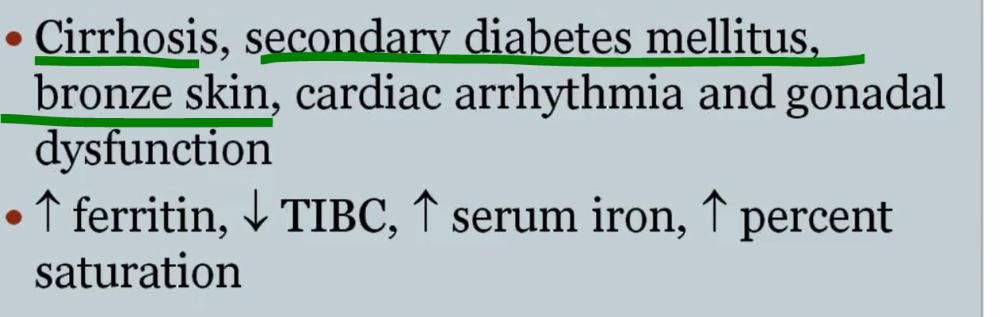
hemochromatosis
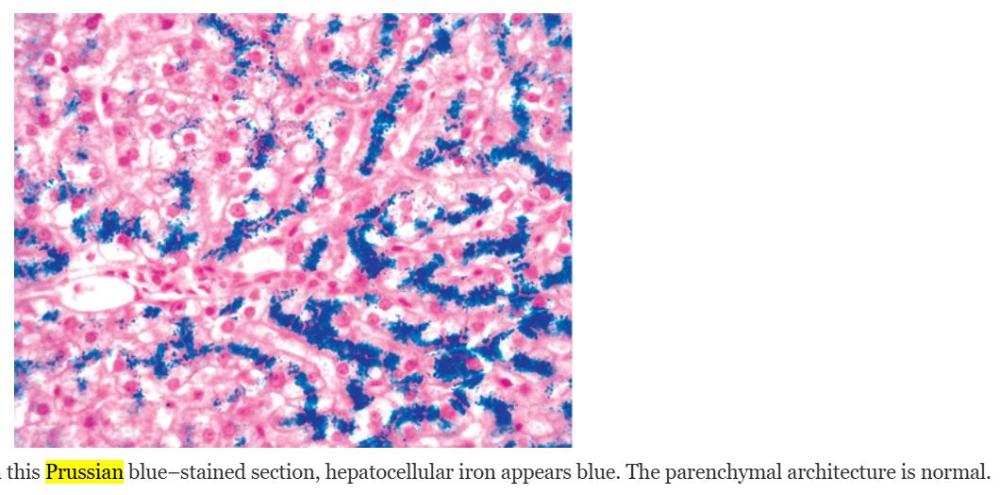
hemochromatosis
A patient is diagnosed with an inherited disorder affecting
copper handling in hepatocytes. The mutation
disrupts an ATP-dependent transport process. Which
immediate consequence most directly results from this defect?
A.
Failure to transport copper into bile
B. Increased renal
excretion of copper
C. Enhanced incorporation of copper into
ceruloplasmin
D. Increased intestinal absorption of copper
A. Failure to transport copper into bile
A patient with an autosomal recessive defect in the
ATP7B gene has impaired copper
metabolism. Which combination of abnormalities best reflects
the primary defect in hepatocyte function?
A. Increased copper
secretion into bile and plasma
B. Decreased copper incorporation
into ceruloplasmin
C. Increased binding of copper to
albumin
D. Enhanced copper storage in lysosomes only
B. Decreased copper incorporation into ceruloplasmin
A patient with a copper metabolism disorder develops
progressive liver dysfunction and later presents
with confusion and movement abnormalities. Which
additional finding would most strongly support the same underlying
disease process?
A. Kayser-Fleischer rings in the cornea
B. Elevated alkaline phosphatase only
C. Isolated increase in
LDL cholesterol
D. Decreased pancreatic enzyme secretion
A. Kayser-Fleischer rings in the cornea
Best initial treatment for Wilson disease:
A. Oral zinc
alone
B. IV iron chelation
C. Copper chelators
(penicillamine, trientine)
D. Eliminate dietary fructose
C. Copper chelators (penicillamine, trientine)
Typical diagnostic profile in Wilson disease:
A.
↑Ceruloplasmin, ↓urine copper
B. ↓Ceruloplasmin, ↑urine
copper
C. Normal ceruloplasmin, normal urine Cu
D.
↓Ceruloplasmin, ↓liver copper
B. ↓Ceruloplasmin, ↑urine copper
Hereditary hemochromatosis is mainly a disorder of:
A.
Excessive iron storage
B. Excessive copper storage
C.
Defective zinc export
D. Defective manganese uptake
B. Excessive copper storage
The commonest HH mutation:
A. Frameshift in HFE promoter
B. Missense in ATP7B gene
C. Deletion of SLC39A4 exon
D.
Tyr→Cys missense in HFE
A. Frameshift in HFE promoter
HFE normally binds the transferrin receptor to help induce:
A.
Ceruloplasmin
B. Ferritin
C. Hepcidin
D. Albumin
C. Hepcidin
In HH, decreased hepcidin leads to:
A. Increased free
iron
B. Decreased intestinal iron
C. Severe
hypoferritinemia
D. Increased iron in urine
A. Increased free iron
HH is usually inherited as:
A. X-linked recessive
B.
Autosomal dominant
C. Mitochondrial
D. Autosomal recessive
D. Autosomal recessive
A middle-aged patient presents with fatigue and
pruritus. Liver biopsy shows lymphocytic and
granulomatous destruction of small intrahepatic bile ducts
(florid duct lesion). Which mechanism best explains
the underlying pathogenesis of this condition?
A. T
cell–mediated autoimmune destruction of bile ducts
B. Direct
toxic injury to hepatocytes from bile acids
C. Obstruction of
extrahepatic bile ducts by stones
D. Increased bilirubin
production from hemolysis
A. T cell–mediated autoimmune destruction of bile ducts
Primary biliary cholangitis
A patient with chronic cholestatic liver disease
undergoes biopsy showing bile duct destruction and hepatocytes with
feathery degeneration. What is the most direct
cause of this hepatocyte change?
A. Accumulation of bile
components within hepatocytes
B. Excess iron deposition causing
oxidative damage
C. Viral-mediated cytotoxic injury to
hepatocytes
D. Increased glycogen storage within liver cells
A. Accumulation of bile components within hepatocytes
A patient with inflammatory bowel disease develops progressive
cholestasis. Which additional finding would most strongly support a
diagnosis of primary sclerosing cholangitis?
A. Association with
HLA alleles and autoantibodies
B. Isolated hepatocyte necrosis
without duct involvement
C. Increased iron deposition within
hepatocytes
D. Accumulation of copper due to transport defect
A. Association with HLA alleles and autoantibodies
A patient with chronic cholestatic liver disease is found to have
alternating strictures and dilation of
large bile ducts on imaging. Biopsy shows inflammation with
periductal fibrosis. Which mechanism best explains
the underlying disease process?
A. T cell–mediated immune injury
to bile ducts
B. Obstruction of ducts by gallstones
C.
Direct hepatocyte toxicity from bile acids
D. Increased
bilirubin production from hemolysis
A. T cell–mediated immune injury to bile ducts
This describes Primary sclerosing cholangitis.
fulminant liver failure and encephalopathy in children with viral illness who take aspirin.
related to mitochondrial damage of hepatocytes
Reye syndrome
A 24-year-old woman using oral contraceptives is found to have a well-circumscribed benign liver mass. Which diagnosis is most likely?
A. Hepatocellular adenoma
B. Hepatoblastoma
C.
Cholangiocarcinoma
D. Hemangioma
A. Hepatocellular adenoma
Hepatocellular adenoma is most strongly associated with oral contraceptives and:
A. Estrogen withdrawal
B. Anabolic steroids
C. Viral
hepatitis
D. Pregnancy alone
B. Anabolic steroids
The most common liver tumor of early childhood is:
A. Hepatocellular adenoma
B. Hepatoblastoma
C.
Angiosarcoma
D. Focal nodular hyperplasia
B. Hepatoblastoma
Widespread parenchymal injury causing zonal loss of contiguous hepatocytes is called:
A. Interface hepatitis
B. Confluent necrosis
C. Spotty
necrosis
D. Ballooning degeneration
B. Confluent necrosis
The principal liver cell responsible for scar deposition is the:
A. Kupffer cell
B. Hepatocyte
C. Hepatic stellate
cell
D. Cholangiocyte
C. Hepatic stellate cell
The most severe form of liver disease is:
A. Steatosis
B. Hepatitis
C. Cholestasis
D. Liver failure
D. Liver failure
Acute liver failure usually follows:
A. Slow portal fibrosis
B. Chronic biliary obstruction
C. Mild steatosis
D. Sudden massive destruction
D. Sudden massive destruction
Chronic liver failure more often follows:
A. Insidious progressive injury
B. Fulminant drug
overdose
C. Isolated portal thrombosis
D. Acute bacterial sepsis
A. Insidious progressive injury
Acute liver failure is defined by acute liver illness with encephalopathy and:
A. Hyperbilirubinemia
B. Coagulopathy
C. Portal
thrombosis
D. Neutropenia
B. Coagulopathy
Acute liver failure must occur within what time from the initial injury?
A. 12 weeks
B. 52 weeks
C. 26 weeks
D. 6 weeks
C. 26 weeks
Acute liver failure is usually associated with:
A. Massive hepatic necrosis
B. Portal lymphocytosis
C.
Bile duct hyperplasia
D. Fatty sparing
A. Massive hepatic necrosis
Chronic liver failure is most often associated with advanced fibrosis and:
A. Steatohepatitis
B. Cholangitis
C. Cirrhosis
D. Hemochromatosis
C. Cirrhosis
Cirrhosis features diffuse remodeling into parenchymal nodules surrounded by:
A. Fat vacuoles
B. Fibrous bands
C. Sinusoidal
thrombi
D. Bile lakes
B. Fibrous bands
Cirrhosis often includes a variable degree of:
A. Bacterial translocation
B. Arterial vasospasm
C.
Lymphatic obstruction
D. Portosystemic shunting
D. Portosystemic shunting
Grossly, cirrhosis converts the smooth liver capsule into a:
A. Pale glassy sheet
B. Soft friable mass
C. Bumpy
scarred surface
D. Uniform fatty surface
C. Bumpy scarred surface
The depressed scars and bulging nodules of cirrhosis reflect:
A. Necrotizing vasculitis
B. Regeneration and fibrosis
C. Iron deposition only
D. Acute cholestasis
B. Regeneration and fibrosis
Portal hypertension results partly from increased resistance to portal flow at the level of the:
A. Central veins
B. Portal venules
C. Hepatic
arteries
D. Sinusoids
D. Sinusoids
Portal hypertension also involves increased portal flow due to:
A. Portal thrombosis
B. Hyperdynamic circulation
C.
Hepatic infarction
D. Splenic rupture
B. Hyperdynamic circulation
Which is a major consequence of portal hypertension?
A. Ascites
B. Acute pancreatitis
C.
Cholelithiasis
D. Hepatic adenoma
A. Ascites
Another major consequence of portal hypertension is formation of:
A. Regenerative nodules
B. Portosystemic shunts
C.
Mallory bodies
D. Ground-glass cells
B. Portosystemic shunts
Portal hypertension commonly also causes congestive:
A. Hepatomegaly
B. Nephromegaly
C. Splenomegaly
D. Cardiomegaly
C. Splenomegaly
Which listed consequence of portal hypertension is commonly discussed under liver failure?
A. Ascites
B. Encephalopathy
C. Splenomegaly
D.
Variceal bleeding
B. Encephalopathy
Hepatitis B can result in acute hepatitis followed by:
A. Carrier conversion only
B. Recovery and clearance
C.
Immediate cirrhosis
D. Cholangiocarcinoma
B. Recovery and clearance
A severe possible consequence of hepatitis B is:
A. Massive liver necrosis
B. Amyloid deposition
C. Iron
overload
D. Fat embolism
A. Massive liver necrosis
Hepatitis B may also produce chronic hepatitis with or without progression to:
A. Steatosis
B. Fibrosis only
C. Cirrhosis
D. Abscess
C. Cirrhosis
Which hepatitis B outcome may be clinically silent?
A. Healthy carrier state
B. Acute fatty liver
C.
Fulminant cholangitis
D. Budd-Chiari syndrome
A. Healthy carrier state
Hepatitis C rarely causes:
A. Chronic hepatitis
B. Symptomatic acute hepatitis
C.
Cirrhosis later
D. Persistent infection
B. Symptomatic acute hepatitis
Hepatitis C is the most common cause of:
A. Acute liver failure
B. Chronic viral hepatitis
C.
Neonatal cholestasis
D. Hepatic adenoma
B. Chronic viral hepatitis
Chronic hepatitis requires continuing or relapsing hepatic disease for more than:
A. 3 months
B. 12 months
C. 6 months
D. 1 month
C. 6 months
Chronic hepatitis may also be defined morphologically by the presence of:
A. Steatosis
B. Fibrosis
C. Necrosis only
D. Bile plugs
B. Fibrosis
The defining histologic feature of chronic viral hepatitis is portal inflammation with:
A. Granulomas
B. Eosinophils
C. Neutrophils
D. Fibrosis
D. Fibrosis
The portal inflammatory infiltrate in chronic viral hepatitis is typically:
A. Lymphocytic or lymphoplasmacytic
B. Neutrophilic or
eosinophilic
C. Histiocytic or giant-cell
D. Fibrinous or suppurative
A. Lymphocytic or lymphoplasmacytic
In chronic hepatitis B, hepatocytes may show a ground-glass appearance due to accumulation of:
A. HCV core protein
B. HBsAg in ER
C. Iron in
lysosomes
D. Copper in cytosol
B. HBsAg in ER
Infectious agents that can involve the liver and biliary tree include bacteria, fungi, helminths, and:
A. Prions
B. Mycobacteria only
C.
Protozoa/parasites
D. Rickettsiae only
C. Protozoa/parasites
Autoimmune hepatitis is a chronic progressive hepatitis associated with genetic predisposition, autoantibodies, and response to:
A. Antibiotics
B. Anticoagulation
C.
Immunosuppression
D. Antivirals
C. Immunosuppression
Which finding supports the diagnosis of autoimmune hepatitis?
A. Low serum IgG
B. Elevated serum IgG
C. Undetectable
antibodies
D. Portal vein thrombosis
B. Elevated serum IgG
Diagnosis of autoimmune hepatitis requires exclusion of other etiologies such as:
A. Viral hepatitis and drugs
B. Diabetes and obesity
C.
Gallstones and pancreatitis
D. Trauma and ischemia
A. Viral hepatitis and drugs
A supportive study in autoimmune hepatitis is:
A. Renal biopsy
B. Bone marrow aspirate
C. Liver
biopsy
D. ERCP
C. Liver biopsy
In the United States, a major cause of acute liver failure is:
A. Drug- or toxin-induced injury
B. Wilson disease only
C. Autoimmune cholangitis
D. Hepatoblastoma
A. Drug- or toxin-induced injury
The classic dose-dependent predictable hepatotoxin is:
A. Isoniazid
B. Methotrexate
C. Acetaminophen
D. Halothane
C. Acetaminophen
In the United States, the most common cause of acute liver failure requiring transplantation is:
A. Hepatitis B
B. Acetaminophen toxicity
C. Alcoholic
hepatitis
D. Budd-Chiari syndrome
B. Acetaminophen toxicity
Excessive alcohol intake causes steatosis and dysfunction of mitochondria, microtubules, cellular membranes, and:
A. Cholangiolar transport
B. Oxidative stress pathways
C. Portal venous return
D. Urea excretion
B. Oxidative stress pathways
Alcohol-related liver injury ultimately leads to varying degrees of inflammation and:
A. Portal granulomas
B. Bile duct loss
C. Hepatocyte
death
D. Splenic infarction
C. Hepatocyte death
Which finding is characteristic of hemochromatosis?
A. Hypopigmented skin
B. Pancreatic islet destruction
C. Decreased cardiac output only
D. Isolated nephropathy
B. Pancreatic islet destruction
A patient with iron overload has arrhythmias, diabetes, bronzed skin, and arthropathy. Which diagnosis is most likely?
A. Wilson disease
B. α1AT deficiency
C.
Hemochromatosis
D. Preeclampsia
C. Hemochromatosis
α1-antitrypsin deficiency is characterized in hepatocytes by:
A. Ground-glass cytoplasm
B. Fat vacuoles
C. Mallory
bodies
D. Cytoplasmic globular inclusions
D. Cytoplasmic globular inclusions
Obstruction of the major hepatic veins causing liver enlargement, pain, and ascites is called:
A. Budd-Chiari syndrome
B. Gilbert syndrome
C. Rotor
syndrome
D. Fitz-Hugh-Curtis syndrome
A. Budd-Chiari syndrome
In preeclampsia, periportal sinusoids contain:
A. Copper granules
B. Fibrin deposits
C. Bile
thrombi
D. Amyloid deposits
B. Fibrin deposits
In preeclampsia, hemorrhage into the space of Disse leads to periportal hepatocellular:
A. Apoptosis
B. Ballooning
C. Coagulative
necrosis
D. Steatosis
C. Coagulative necrosis
Acute fatty liver of pregnancy can range from mild aminotransferase elevation to:
A. Portal fibrosis only
B. Hepatic failure and coma
C.
Chronic hepatitis only
D. Budd-Chiari syndrome
B. Hepatic failure and coma