Instructions for Side by Side Printing
- Print the notecards
- Fold each page in half along the solid vertical line
- Cut out the notecards by cutting along each horizontal dotted line
- Optional: Glue, tape or staple the ends of each notecard together
A&p chapter 5 quiz
front 1 Most of our discussion in Module 5 has been about the _______ part of the ANS. The sensory part of the autonomic nervous system (ANS) is spread widely within our bodies without holding distinctive anatomical characteristics while the __________ part of the ANS has two distinctive divisions. Correct answer: motor sensory enteric afferent | back 1 Motor |
front 2 _______________ is a state of equilibrium, or balance, in which biological conditions (such as body temperature) are maintained at optimal levels. rest and digest sympathetic parasympathetic homeostasis | back 2 homeostasis |
front 3 During a fight-or- flight response, which of the following DO NOT occur? breathing rate decreases glucose is released Answer, pupils dilate stomach activity is stimulated sweating | back 3 breathing rate decreases stomach activity is stimulated |
front 4 In the parasympathetic nervous system, which fibers are longer? preganglionic postganglionic | back 4 preganglionic |
front 5 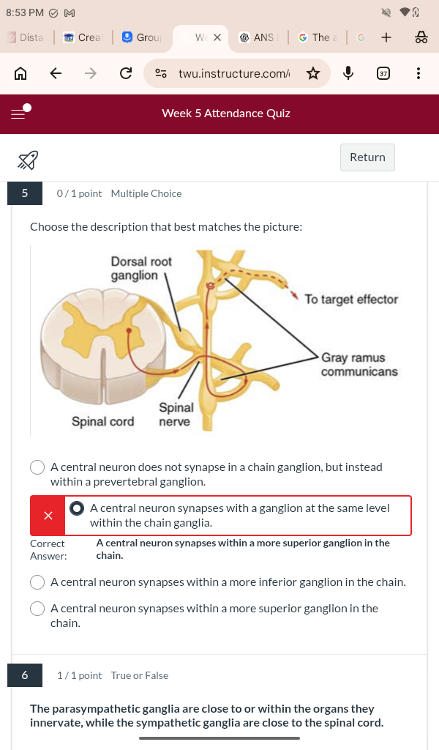 Choose the description that best matches the picture: A central neuron does not synapse in a chain ganglion, but instead within a prevertebral ganglion. A central neuron synapses with a ganglion at the same level within the chain ganglia. A central neuron synapses within a more superior ganglion in the chain. A central neuron synapses within a more inferior ganglion in the chain. A central neuron synapses within a more superior ganglion in the chain. | back 5 A central neuron synapses within a more superior ganglion in the chain |
front 6 The parasympathetic ganglia are close to or within the organs they innervate, while the sympathetic ganglia are close to the spinal cord | back 6 True |
front 7 The autonomic nervous system (ANS) can be defined as part of the CNS a system responsible for “rest and digest” responses another name for the peripheral nervous system generally considered to be within our voluntary control | back 7 a system responsible for “rest and digest” responses |
front 8 Which division of the autonomic nervous system (ANS) is involved in preparing the body for stress-related activities? the parasympathetic division the sympathetic division the enteric division the autonomic division | back 8 the sympathetic division |
front 9 The __________ part of the autonomic nervous system (ANS) has two distinctive divisions, while the __________ part of the ANS is is spread widely within our bodies without holding distinctive anatomical characteristics. parasympathetic, sympathetic sympathetic, parasympathetic motor, sensory sensory, motor | back 9 motor, sensory |
front 10 During a fight or flight response, all of the following occur except more oxygen needs to be inhaled and delivered to skeletal muscle the digestive system activates the respiratory system is activated sweating keeps the contracting muscles from overheating | back 10 the digestive system activates |
front 11 Once a threat (real or perceived) has been resolved, what system takes over and returns bodily functions to a relaxed state? sympathetic enteric peripheral parasympathetic | back 11 parasympathetic |
front 12 The three collateral ganglia that receive inputs from splanchnic nerves as well as central sympathetic neurons and are associated with controlling organs in the abdominal cavity are the (choose all that apply) celiac ganglion collateral ganglia left chain ganglia superior mesenteric ganglion inferior mesenteric ganglion | back 12 celiac ganglion superior mesenteric ganglion inferior mesenteric ganglion |
front 13 An axon from the central neuron that projects to a sympathetic ganglion and represents output from the CNS to the ganglion is referred to as a sympathetic fiber preganglionic fiber postganglionic fiber collateral fiber | back 13 preganglionic fiber |
front 14 The axon from a ganglionic neuron that projects to the target effector is called a sympathetic fiber preganglionic fiber postganglionic fiber collateral fiber | back 14 postganglionic fiber |
front 15 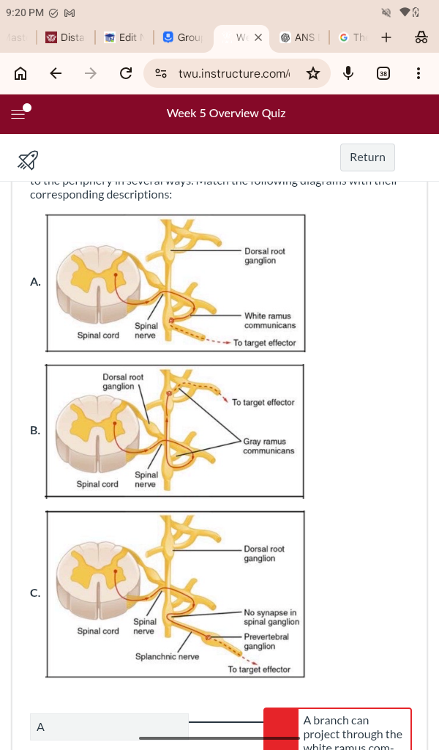 The axon from a central sympathetic neuron in the spinal cord can project to the periphery in several ways. Match the following diagrams with their corresponding descriptions: A B C | back 15 A. The fiber can project out to the ganglion at the same level and synapse on a ganglionic neuron B. A branch can project to more a superior or inferior ganglion in the chain C. A branch can project through the white ramus communicans, but not terminate on a ganglionic neuron in the chain. Instead, it projects through one of the splanchnic nerves to a collateral ganglion or the adrenal medulla |
front 16 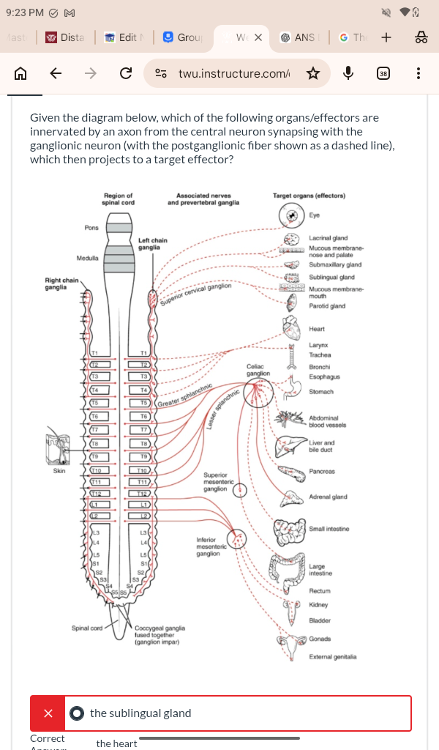 Given the diagram below, which of the following organs/effectors are innervated by an axon from the central neuron synapsing with the ganglionic neuron (with the postganglionic fiber shown as a dashed line), which then projects to a target effector? the sublingual gland the heart the stomach the kidney | back 16 The heart |
front 17 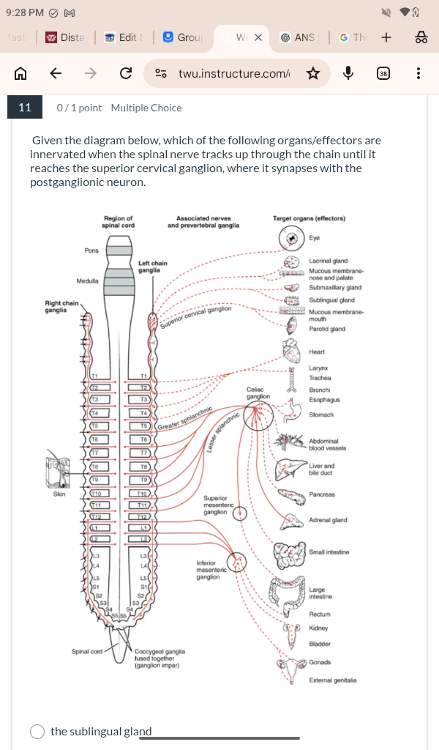 Given the diagram below, which of the following organs/effectors are innervated when the spinal nerve tracks up through the chain until it reaches the superior cervical ganglion, where it synapses with the postganglionic neuron. the sublingual gland the heart the stomach the kidney | back 17 Sublingual gland |
front 18 Given the diagram below, which of the following organs/effectors are innervated when additional branches from the ventral nerve root continue through the chain and on to one of the collateral ganglia? the sublingual gland the stomach the heart the larynx | back 18 The stomach |
front 19 Sympathetic ganglia are close to the spinal cord while parasympathetic ganglia are close to celiac ganglion the skin the spinal cord their effectors | back 19 their effectors |
front 20 Because the preganglionic neurons are located in nuclei of the brain stem and the lateral horn of the sacral spinal cord, the _________________ system can also be referred to as the craniosacral system (or outflow). sympathetic parasympathetic autonomic peripheral | back 20 parasympathetic |
front 21 The adrenal gland (in Latin, ad- = “on top of”; renal = “kidney”) secretes adrenaline. Adrenaline and ____________ are two names for the same molecule. adrenalide endogenous acetylcholine epinephrine | back 21 epinephrine |
front 22 Synapses of the autonomic system are classified as either cholinergic, meaning that acetylcholine (ACh) is released, or adrenergic, meaning that ______________ is released. adrenaline endogenous norepinephrine epinephrine | back 22 norepinephrine |
front 23 Neurotransmitters are released at synapses, whereas _____________ is (are) released into the bloodstream. hormones adrenaline norepinephrine epinephrine | back 23 hormones |
front 24 The autonomic nervous system (ANS) is distributed throughout the CNS and PNS to various extents and influences our sensory and motor functions. True False | back 24 True |
front 25 A medication blocks norepinephrine release from sympathetic neurons. Which effect would MOST likely occur? Increased heart rate Reduced fight-or-flight responses Increased sweating due to stress D. Larger pupils | back 25 Reduced fight-or-flight responses |
front 26 During a routine neurological examination, a patient has normal voluntary movement but poor regulation of heart rate and blood pressure. Which system is MOST likely affected? Somatic nervous system Autonomic nervous system Primary motor cortex Cerebellum | back 26 Autonomic nervous system |