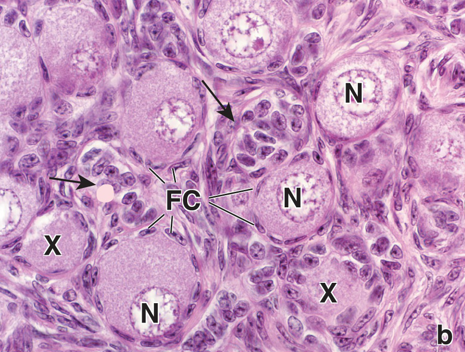
What follicle is this?
Primordial Follicles
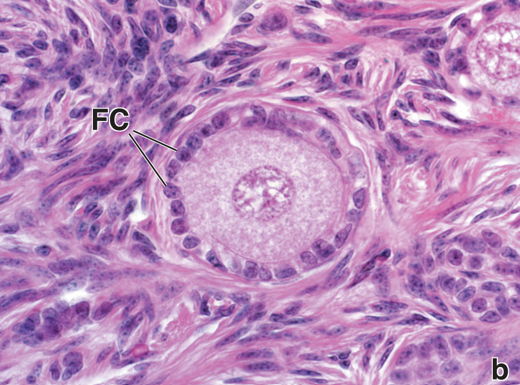
What follicle is this?
Early Primary Follicles
What are the two major functions of the ovary?
A. Oogenesis and steroid hormone production
B. Fertilization and implantation
C. Menstruation and lactation
D. Ovulation and placentation
A. Oogenesis and steroid hormone production
Which ovarian hormones promote growth of the internal and external female reproductive organs?
A. Progestogens
B. Estrogens
C. Androgens
D. Gonadotropins
B. Estrogens
What is a major function of ovarian progestogens?
A. Trigger follicular atresia
B. Promote external genital growth
C. Prepare endometrium for implantation
D. Initiate oocyte meiosis
C. Prepare endometrium for implantation
What type of epithelium covers the surface of the ovary?
A. Stratified squamous
B. Simple columnar
C. Transitional
D. Simple cuboidal
D. Simple cuboidal
The ovarian germinal epithelium is also classified as a type of:
A. Endothelium
B. Mesothelium
C. Neuroepithelium
D. Urothelium
B. Mesothelium
Which region forms the outer portion of the ovary?
A. Medulla
B. Hilum
C. Cortex
D. Mesovarium
C. Cortex
Which ovarian region contains developing follicles?
A. Medulla
B. Germinal epithelium
C. Tunica media
D. Cortex
D. Cortex
Which region forms the inner portion of the ovary?
A. Medulla
B. Cortex
C. Germinal epithelium
D. Follicular layer
A. Medulla
Which structures are characteristic of the ovarian medulla?
A. Primordial follicles
B. Loose CT, vessels, lymphatics, nerves
C. Zona pellucida and granulosa cells
D. Dense cartilage and glands
B. Loose CT, vessels, lymphatics, nerves
At birth, primary oocytes are arrested in which meiotic division?
A. Meiosis II
B. Mitotic metaphase
C. Meiosis I
D. Meiosis III
C. Meiosis I
What happens to groups of ovarian follicles beginning at puberty?
A. All immediately ovulate
B. All undergo atresia
C. Remain permanently dormant
D. Undergo cyclic growth and maturation
D. Undergo cyclic growth and maturation
Which follicular stage appears first during ovarian development?
A. Primary follicle
B. Primordial follicle
C. Secondary follicle
D. Graafian follicle
B. Primordial follicle
Primordial follicles first appear during approximately which fetal month?
A. First month
B. Second month
C. Third month
D. Sixth month
C. Third month
Early growth of primordial follicles is initially:
A. Dependent on LH
B. Dependent on FSH
C. Dependent on hCG
D. Independent of gonadotropins
D. Independent of gonadotropins
A primordial follicle contains an oocyte surrounded by what type of cells?
A. Single layer of squamous cells
B. Multiple cuboidal layers
C. Columnar cells
D. Theca lutein cells
A. Single layer of squamous cells
Which two stages are included under the category of growing follicles?
A. Primordial and Graafian
B. Primary and secondary
C. Secondary and luteal
D. Primary and Graafian
B. Primary and secondary
What is the final mature stage of ovarian follicle development?
A. Primordial follicle
B. Primary follicle
C. Graafian follicle
D. Corpus albicans
C. Graafian follicle
An early primary follicle develops during which portion of the ovarian cycle?
A. Luteal phase
B. Menstrual phase
C. Ovulatory phase
D. Follicular phase
D. Follicular phase
Which hormone is the principal influence on early primary follicle development according to these notes?
A. FSH
B. LH
C. Progesterone
D. Prolactin
A. FSH
An early primary follicle is initially surrounded by which type of follicular cells?
A. Squamous cells
B. Single layer of cuboidal cells
C. Columnar cells
D. Stratified squamous cells
B. Single layer of cuboidal cells
Which structure first appears during the primary follicle stage?
A. Corpus luteum
B. Follicular antrum
C. Zona pellucida
D. Corpus albicans
C. Zona pellucida
Which statement correctly describes the zona pellucida?
A. Secreted by granulosa cells
B. Made mainly of collagen
C. Found only after ovulation
D. Secreted by oocyte and glycoprotein-rich
D. Secreted by oocyte and glycoprotein-rich
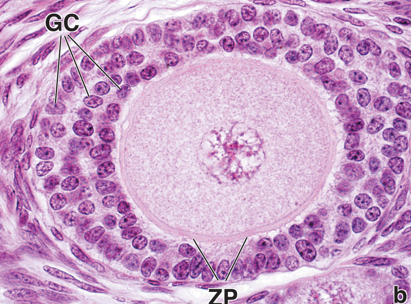
What follicle is this?
Late Primary Follicle
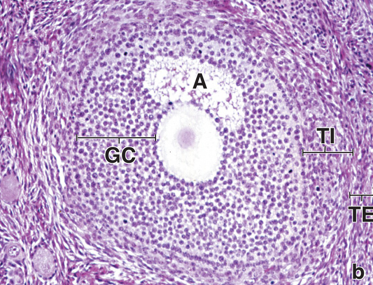
What follicle is this?
Secondary follicle
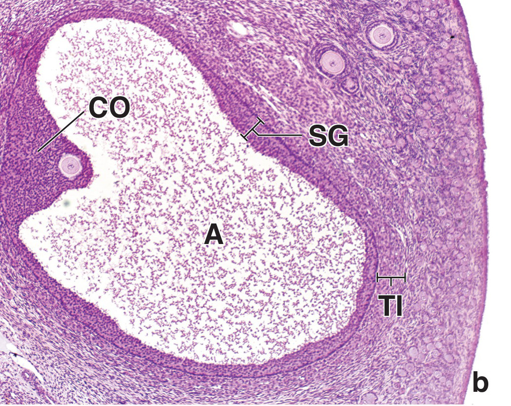
What follicle is this?
mature (graafian) follicle
In a late primary follicle, proliferating follicular cells are collectively called the:
A. Stratum granulosum
B. Theca externa
C. Cumulus oophorus
D. Corona radiata
A. Stratum granulosum
What are the cells of the stratum granulosum called?
A. Theca cells
B. Granulosa cells
C. Stromal cells
D. Luteal cells
B. Granulosa cells
Which enzyme in granulosa cells converts androgens into estrogens?
A. 5α-reductase
B. 21-hydroxylase
C. P450 aromatase
D. Cholesterol desmolase
C. P450 aromatase
Which hormone increases P450 aromatase gene expression in granulosa cells?
A. LH
B. Prolactin
C. Estrogen
D. FSH
D. FSH
As a primary follicle matures, surrounding ovarian stromal cells differentiate into the:
A. Theca interna and externa
B. Corona radiata and cumulus
C. Granulosa and zona pellucida
D. Corpus luteum and albicans
A. Theca interna and externa
Which thecal layer lies closest to the developing follicle?
A. Theca externa
B. Theca interna
C. Stratum granulosum
D. Tunica albuginea
B. Theca interna
What is the main function of theca interna cells?
A. Produce follicular fluid
B. Form the zona pellucida
C. Secrete steroid hormones
D. Form collagen
C. Secrete steroid hormones
Which receptors are expressed by theca interna cells according to these notes?
A. FSH and insulin receptors
B. Estrogen and progesterone receptors
C. GnRH and prolactin receptors
D. LH and LDL receptors
D. LH and LDL receptors
Theca interna cells use cholesterol primarily to synthesize:
A. Androgens
B. Estrogens
C. Progestins
D. Gonadotropins
A. Androgens
Which hormone stimulates theca interna cells to secrete androgens?
A. FSH
B. LH
C. ACTH
D. hCG
B. LH
Theca interna cells are functionally similar to which testicular cells?
A. Sertoli cells
B. Spermatogonia
C. Leydig cells
D. Peritubular cells
C. Leydig cells
What is the theca externa composed mainly of?
A. Granulosa cells
B. Steroid-secreting cells
C. Adipose tissue
D. Smooth muscle and collagen
D. Smooth muscle and collagen
Which pituitary hormone is a key factor in follicular maturation?
A. FSH
B. TSH
C. ACTH
D. Prolactin
A. FSH
Which growth factor listed in these notes contributes to follicular maturation?
A. VEGF
B. EGF
C. TGF-β
D. PDGF
B. EGF
Which insulin-like growth factor contributes to follicular maturation according to these notes?
A. IGF-II
B. IGF-III
C. IGF-I
D. IGF-IV
C. IGF-I
Which ion is listed as an important factor in follicular maturation?
A. Na+
B. K+
C. Cl−
D. Ca2+
D. Ca2+
What is the follicular fluid in a secondary follicle called?
A. Perivitelline fluid
B. Liquor folliculi
C. Amniotic fluid
D. Stromal fluid
B. Liquor folliculi
Liquor folliculi is especially rich in which substance?
A. Collagen
B. Cholesterol
C. Hyaluronic acid
D. Glycogen
C. Hyaluronic acid
As fluid-filled spaces between granulosa cells merge, they form the:
A. Zona pellucida
B. Corona radiata
C. Cumulus oophorus
D. Antrum
D. Antrum
What is the shape of the developing antrum described in these notes?
A. Crescent-shaped
B. Spherical
C. Triangular
D. Tubular
A. Crescent-shaped
What happens to a mature Graafian follicle as it enlarges?
A. Moves into medulla
B. Becomes surrounded by cartilage
C. Bulges at ovarian surface
D. Loses its granulosa cells
C. Bulges at ovarian surface
The mound of granulosa cells supporting the oocyte in a mature follicle is called the:
A. Theca interna
B. Corona radiata
C. Stratum granulosum
D. Cumulus oophorus
D. Cumulus oophorus
What are the granulosa cells directly surrounding the oocyte called?
A. Corona radiata
B. Cumulus oophorus
C. Theca interna
D. Theca externa
A. Corona radiata
In the mature follicle, which cells produce androgens under LH stimulation?
A. Granulosa cells
B. Theca interna cells
C. Theca externa cells
D. Corona radiata cells
B. Theca interna cells
In the mature follicle, granulosa cells convert theca-derived androgens into:
A. Progesterone
B. Testosterone
C. Estrogen
D. Cholesterol
C. Estrogen
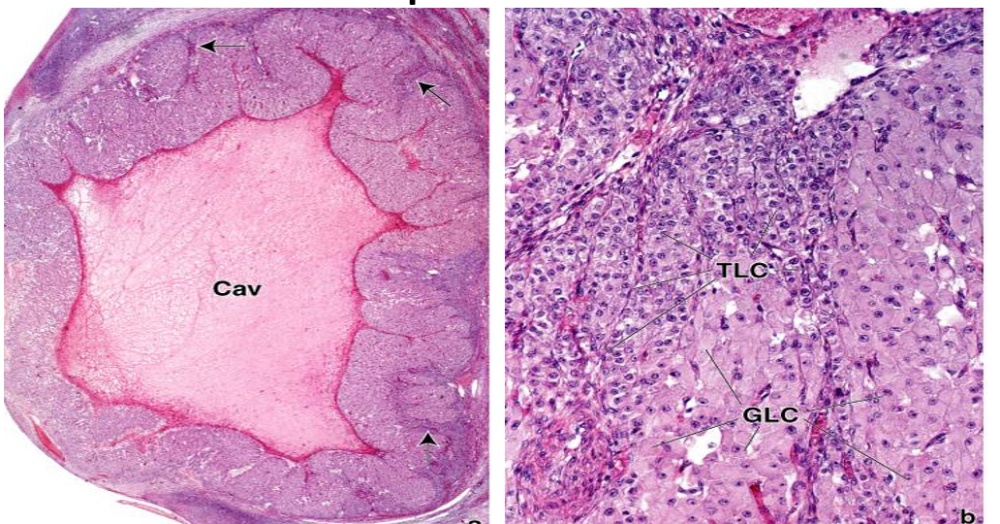
What is this?
Corpus Luteum
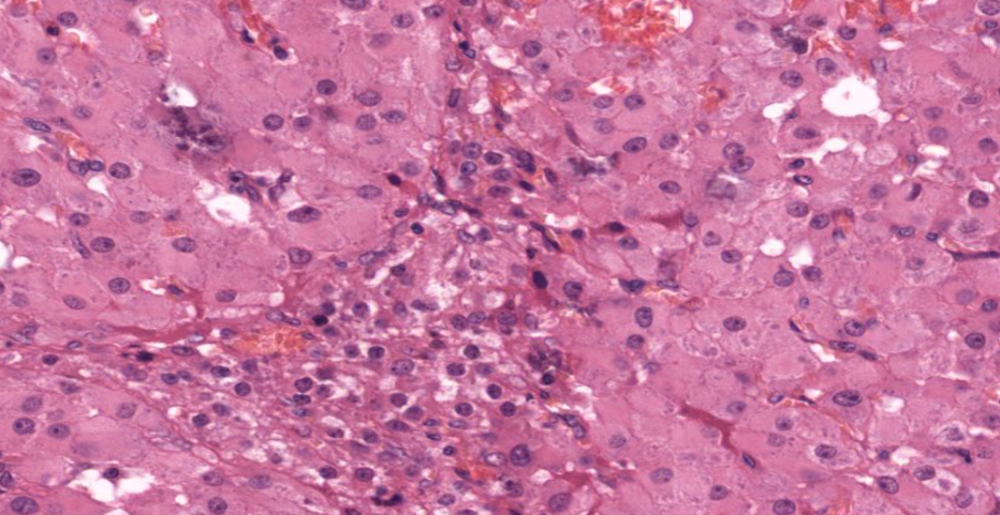
What is this?
Corpus Luteum
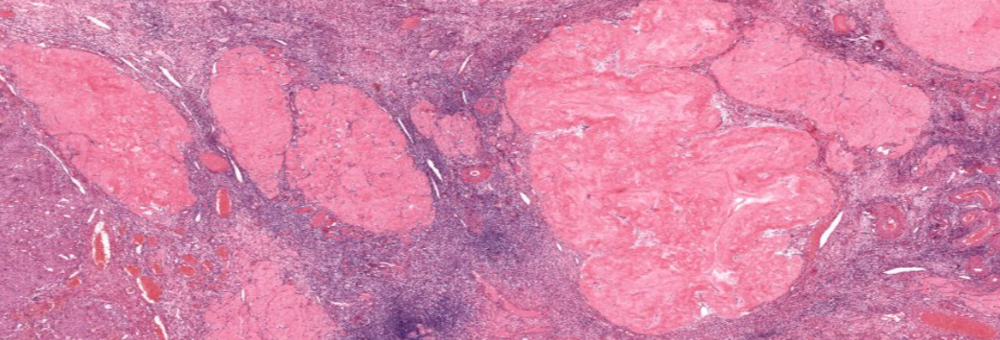
What is this?
Corpora Albicans
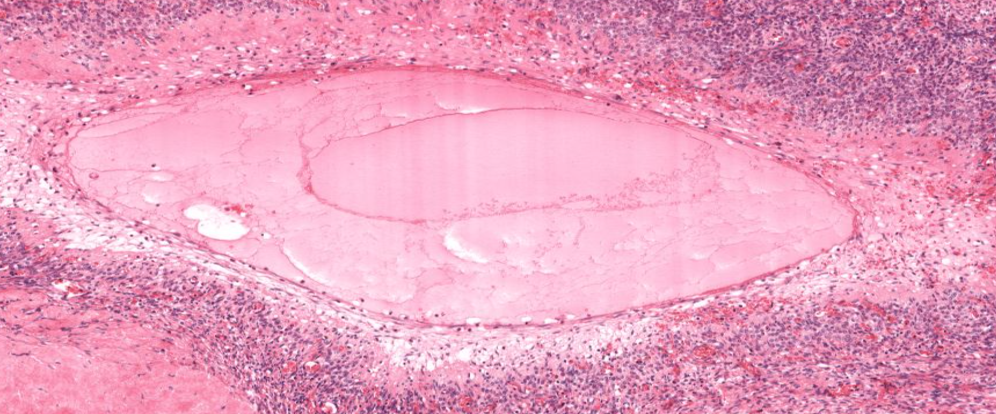
this is a _____ follicle
arteric follicle
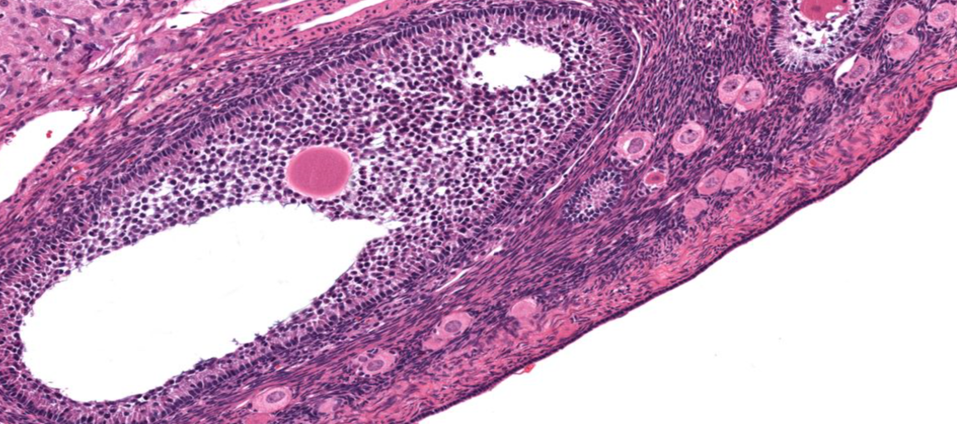
A large _____ follicle with remnant of zona pellucida.
arteric
If fertilization and implantation do not occur, how long does the corpus luteum remain active?
A. About 10 days
B. About 24 hours
C. About 3 weeks
D. About 6 weeks
A. About 10 days
What placental hormone is required to maintain the corpus luteum during pregnancy?
A. Prolactin
B. hCG
C. FSH
D. Oxytocin
B. hCG
Without hCG support, secretion of which hormones from the corpus luteum declines?
A. FSH and LH
B. hCG and prolactin
C. Progesterone and estrogen
D. Testosterone and DHT
C. Progesterone and estrogen
What structure forms when the corpus luteum degenerates?
A. Corpus hemorrhagicum
B. Graafian follicle
C. Zona pellucida
D. Corpus albicans
D. Corpus albicans
How is the corpus albicans best described?
A. White scar-like structure
B. Fluid-filled follicle
C. Steroid-secreting gland
D. Mature oocyte
A. White scar-like structure
Where does fertilization normally occur?
A. Isthmus
B. Ampulla
C. Uterine cavity
D. Cervix
B. Ampulla
Before reaching the oocyte, sperm must first penetrate which surrounding cell layer?
A. Zona pellucida
B. Theca interna
C. Corona radiata
D. Stratum granulosum
C. Corona radiata
According to these notes, the final steps of sperm capacitation occur while the sperm penetrates the:
A. Zona pellucida
B. Oolemma
C. Uterine wall
D. Corona radiata
D. Corona radiata
According to these notes, capacitation causes release of what from the sperm head?
A. Glycosides
B. Progesterone
C. Collagen
D. Cholesterol
A. Glycosides
What does release of sperm-head glycosides during capacitation allow the sperm to do?
A. Complete meiosis II
B. Bind the zona pellucida
C. Form the male pronucleus
D. Implant in endometrium
B. Bind the zona pellucida
What is triggered when a sperm binds to the zona pellucida?
A. Cortical reaction
B. Meiotic arrest
C. Acrosomal reaction
D. Luteinization
C. Acrosomal reaction
What is the major purpose of the acrosomal reaction?
A. Trigger implantation
B. Prevent capacitation
C. Maintain corpus luteum
D. Help sperm digest through zona pellucida
D. Help sperm digest through zona pellucida
Although multiple sperm may penetrate the zona pellucida, what prevents more than one from completing fertilization?
A. Follicular atresia
B. Polyspermy-blocking mechanisms
C. Corpus luteum regression
D. Cumulus degeneration
B. Polyspermy-blocking mechanisms
If fertilization occurs, the corpus luteum enlarges to form the:
A. Corpus albicans
B. Corpus hemorrhagicum
C. Corpus luteum of pregnancy
D. Graafian follicle
C. Corpus luteum of pregnancy
Which cells secrete hCG during early pregnancy according to these notes?
A. Granulosa cells
B. Theca cells
C. Pituitary cells
D. Chorionic trophoblasts
D. Chorionic trophoblasts
What is the main effect of hCG on the corpus luteum?
A. Maintains it
B. Causes atresia
C. Stops progesterone release
D. Converts it to albicans
A. Maintains it
Which pituitary hormones help maintain the corpus luteum during pregnancy according to these notes?
A. FSH and ACTH
B. LH and prolactin
C. TSH and GH
D. ADH and oxytocin
B. LH and prolactin
Which pancreatic hormone is listed as helping maintain the corpus luteum?
A. Glucagon
B. Somatostatin
C. Insulin
D. Pancreatic polypeptide
C. Insulin
In addition to endocrine hormones, what type of ovarian signals help maintain the corpus luteum?
A. Autocrine antibodies
B. Neural transmitters
C. Exocrine enzymes
D. Paracrine factors
D. Paracrine factors
At about what point in gestation does the feto-placental unit take over corpus luteum function according to these notes?
A. 6 weeks
B. 12 weeks
C. 20 weeks
D. 28 weeks
A. 6 weeks
The feto-placental unit involves an important interaction between the placenta and which fetal organ?
A. Fetal liver
B. Fetal adrenal gland
C. Fetal kidney
D. Fetal pancreas
B. Fetal adrenal gland
According to these notes, the fetal adrenal gland synthesizes which estrogen?
A. Estradiol
B. Estrone
C. Estriol
D. Estetrol
C. Estriol
According to these notes, fetal estriol synthesis uses which placental precursor?
A. Progesterone
B. Cholesterol
C. Testosterone
D. Pregnenolone
D. Pregnenolone
Maternal serum estriol levels can be used as an indicator of:
A. Fetal viability
B. Maternal ovulation
C. Placental location
D. Cervical dilation
A. Fetal viability
What can happen to an ovarian follicle at any stage of development?
A. It must ovulate
B. It may undergo apoptosis
C. It becomes a corpus luteum
D. It becomes a placenta
B. It may undergo apoptosis
After an oocyte degenerates, which structure may remain behind according to these notes?
A. Corpus luteum
B. Theca externa
C. Corona radiata
D. Zona pellucida
D. Zona pellucida
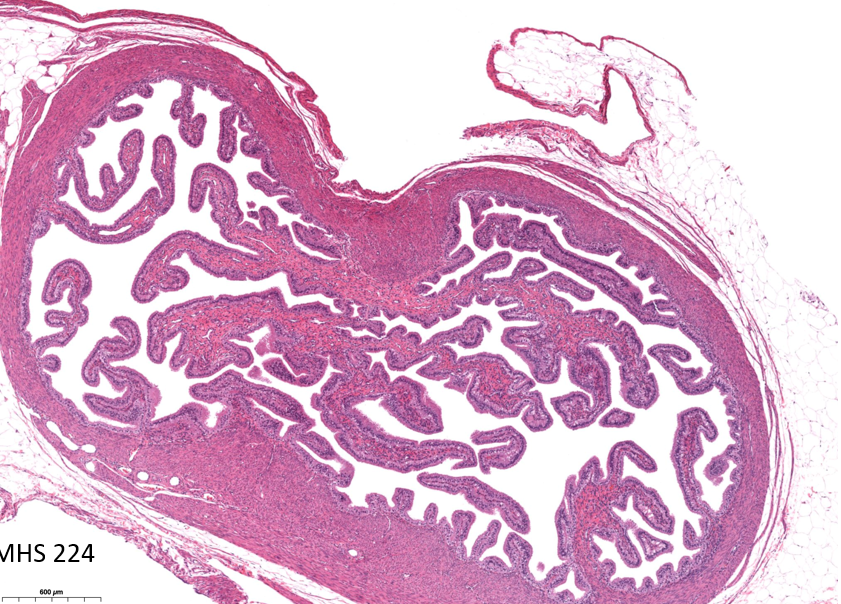
what is this?
Oviduct
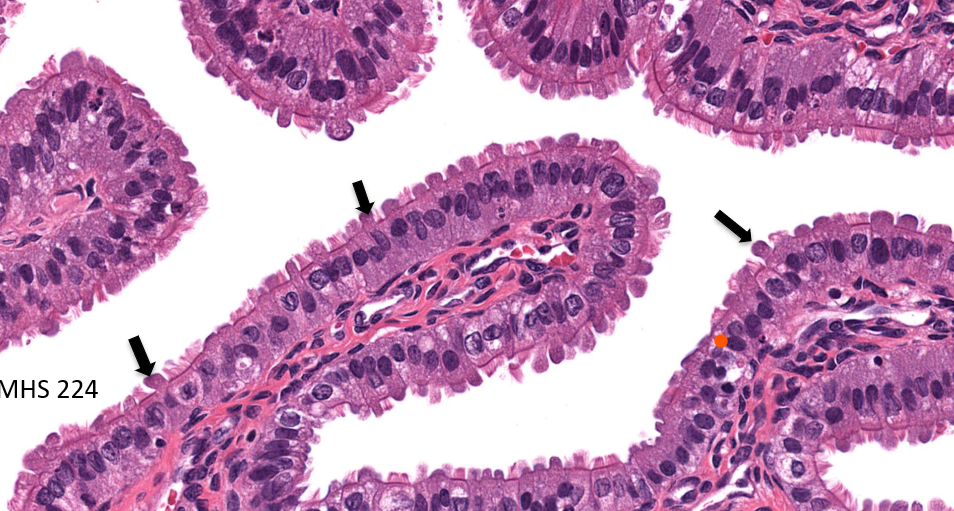
this is an _____. the arrows point to ____ cells
Oviduct
peg
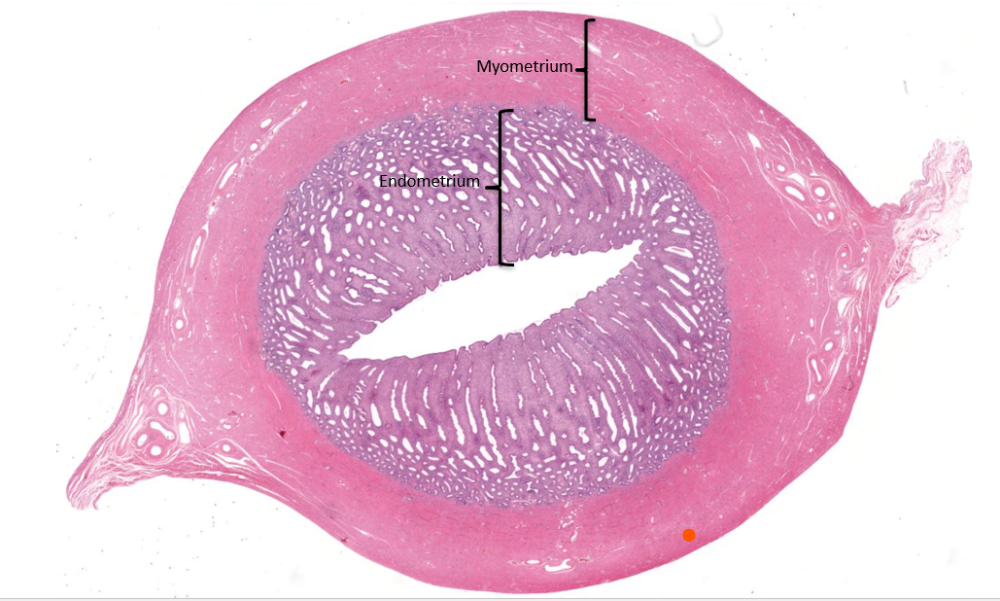
this is a ______
uterus
What forms the outermost layer of the oviduct?
A. Serosa
B. Muscularis
C. Mucosa
D. Endometrium
A. Serosa
What tissue covers the serosa of the oviduct?
A. Simple columnar epithelium
B. Mesothelium
C. Stratified squamous epithelium
D. Transitional epithelium
B. Mesothelium
What lies immediately beneath the mesothelium of the oviduct serosa?
A. Smooth muscle
B. Endometrium
C. Connective tissue
D. Cartilage
C. Connective tissue
How is the muscularis of the oviduct arranged?
A. Inner longitudinal, outer circular
B. Two equal circular layers
C. Skeletal muscle
D. Inner circular, outer longitudinal
D. Inner circular, outer longitudinal
Which muscular layer of the oviduct is thicker?
A. Inner circular layer
B. Outer longitudinal layer
C. Both are equal
D. Neither is muscular
A. Inner circular layer
The mucosa of the oviduct is arranged into:
A. Circular ridges
B. Thin longitudinal folds
C. Flat sheets
D. Transverse septa
B. Thin longitudinal folds
What type of epithelium lines the oviduct mucosa?
A. Stratified squamous
B. Simple cuboidal
C. Simple columnar
D. Transitional
C. Simple columnar
Which two cell types line the oviduct?
A. Goblet and basal cells
B. Chief and parietal cells
C. Squamous and cuboidal cells
D. Ciliated and peg cells
D. Ciliated and peg cells
In which direction do cilia of the oviduct beat?
A. Toward the uterus
B. Toward the ovary
C. Toward the peritoneum
D. Toward the cervix
A. Toward the uterus
What is the main function of nonciliated peg cells in the oviduct?
A. Move the oocyte
B. Provide nutritive secretions
C. Produce mucus
D. Form smooth muscle
B. Provide nutritive secretions
Which uterine region is the dome-shaped portion superior to the entry of the oviducts?
A. Cervix
B. Body
C. Fundus
D. Internal os
C. Fundus
Which part of the uterus is described as the lower, barrel-shaped region?
A. Fundus
B. Body
C. Endometrium
D. Cervix
D. Cervix
The internal os opens into the:
A. Uterine cavity
B. Vagina
C. Oviduct
D. Peritoneal cavity
A. Uterine cavity
The external os opens into the:
A. Uterine cavity
B. Vagina
C. Oviduct
D. Peritoneum
B. Vagina
What is the outermost layer of the uterine wall?
A. Endometrium
B. Myometrium
C. Perimetrium
D. Stratum basale
C. Perimetrium
The perimetrium is best described as the uterine:
A. Mucosa
B. Muscular layer
C. Basal endometrium
D. Serosa or visceral peritoneum
D. Serosa or visceral peritoneum
Which uterine layer is composed mainly of thick smooth muscle?
A. Myometrium
B. Endometrium
C. Perimetrium
D. Stratum functionale
A. Myometrium
Which uterine layer is the mucosa that responds to estrogen and progesterone?
A. Perimetrium
B. Endometrium
C. Myometrium
D. Serosa
B. Endometrium
Which hormone causes the proliferative phase of the endometrium?
A. Progesterone
B. FSH
C. Estrogen
D. LH
C. Estrogen
Which hormone causes the secretory phase of the endometrium?
A. Estrogen
B. FSH
C. LH
D. Progesterone
D. Progesterone
Which two layers make up the endometrium?
A. Stratum functionale and basale
B. Perimetrium and myometrium
C. Mucosa and serosa
D. Basale and muscularis
A. Stratum functionale and basale
Which endometrial layer is the thicker portion that responds cyclically to ovarian hormones?
A. Stratum basale
B. Stratum functionale
C. Myometrium
D. Perimetrium
B. Stratum functionale
Which endometrial layer is shed during menstruation?
A. Stratum basale
B. Myometrium
C. Stratum functionale
D. Perimetrium
C. Stratum functionale
Which endometrial layer remains after menstruation?
A. Stratum functionale
B. Myometrium
C. Perimetrium
D. Stratum basale
D. Stratum basale
What is the main function of the stratum basale after menstruation?
A. Regenerate the stratum functionale
B. Secrete progesterone
C. Produce uterine contractions
D. Form the perimetrium
A. Regenerate the stratum functionale
What type of epithelium lines the stratum functionale?
A. Stratified squamous
B. Simple columnar
C. Simple cuboidal
D. Transitional
B. Simple columnar
Invaginations of the endometrial surface epithelium form the:
A. Cervical crypts
B. Oviduct folds
C. Uterine glands
D. Placental villi
C. Uterine glands
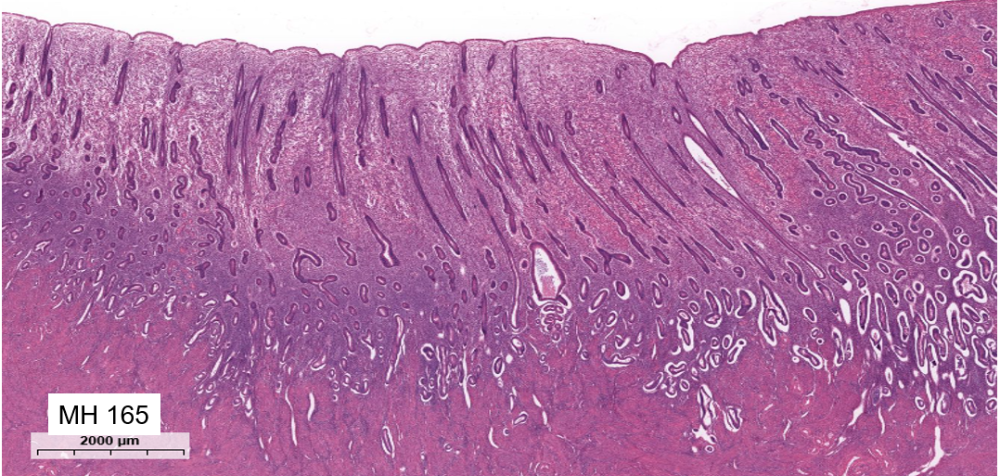
What phase of the menstrual cycle is this?
Proliferative Phase
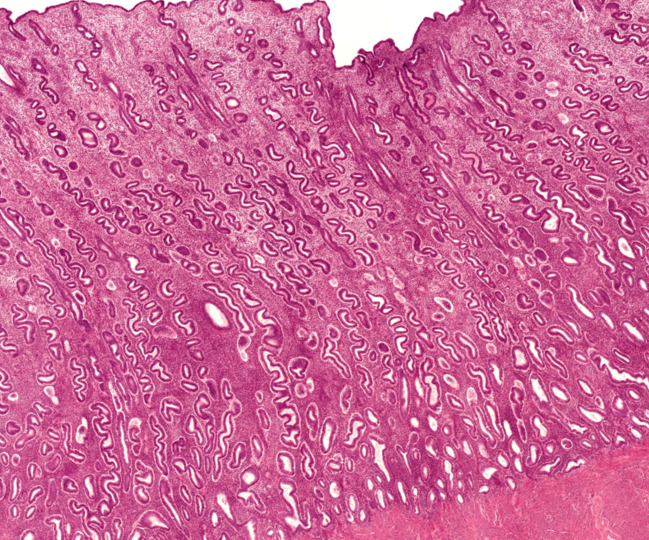
this is the _____ Secretory Phase
early
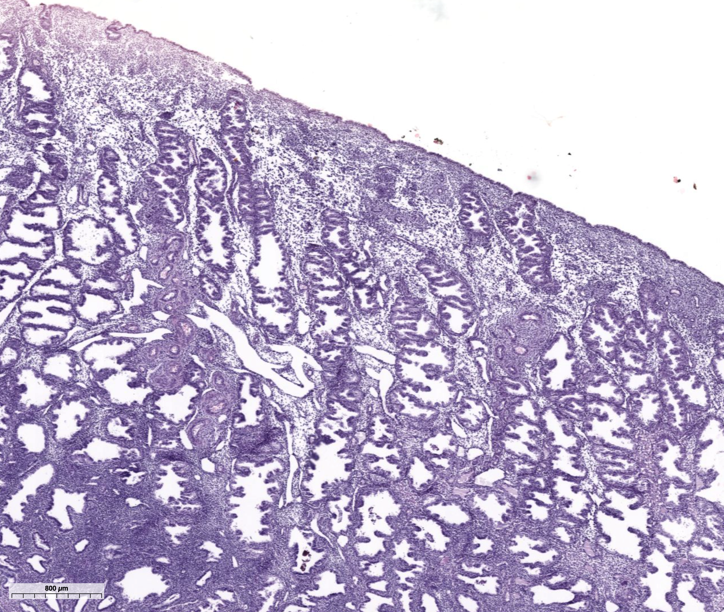
this is the _____ Secretory Phase
late
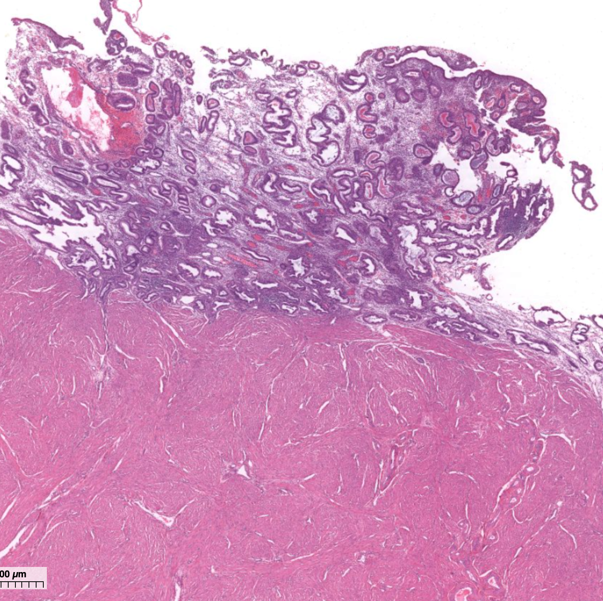
this is the _____ phase
Menstrual Phase
Which arteries pass through the stratum basale of the endometrium?
A. Straight arteries
B. Spiral arteries
C. Arcuate arteries
D. Ovarian arteries
A. Straight arteries
Within the stratum functionale, endometrial arteries become:
A. Straight
B. Spiral
C. Radial
D. Elastic
B. Spiral
What do the spiral arteries primarily supply within the stratum functionale?
A. Myometrium
B. Stratum basale
C. Capillary beds
D. Perimetrium
C. Capillary beds
Thin-walled dilated portions of endometrial capillaries are called:
A. Sinusoids
B. Venules
C. Canals
D. Lacunae
D. Lacunae
Which menstrual phase occurs at the same time as the ovarian follicular phase?
A. Secretory phase
B. Proliferative phase
C. Menstrual phase
D. Luteal phase
B. Proliferative phase
Which hormone primarily stimulates proliferation of the stratum functionale?
A. Progesterone
B. LH
C. Estrogen
D. FSH
C. Estrogen
The proliferative phase primarily causes which endometrial change?
A. Vascular rupture
B. Ischemia
C. Glandular secretion
D. Growth of stratum functionale
D. Growth of stratum functionale
Which menstrual phase corresponds to the luteal phase of the ovarian cycle?
A. Secretory phase
B. Proliferative phase
C. Menstrual phase
D. Follicular phase
A. Secretory phase
The menstrual phase begins as which ovarian structure degenerates?
A. Graafian follicle
B. Primary follicle
C. Corpus luteum
D. Corpus hemorrhagicum
C. Corpus luteum
Degeneration of the corpus luteum causes levels of estrogen and progesterone to:
A. Increase sharply
B. Remain constant
C. Alternate rapidly
D. Decline
D. Decline
What is an early vascular event in the menstrual phase?
A. Spiral artery contraction
B. Straight artery dilation
C. Venous thrombosis
D. Capillary proliferation
A. Spiral artery contraction
Contraction of the spiral arteries causes which change in the stratum functionale?
A. Hyperemia
B. Ischemia
C. Hypertrophy
D. Fibrosis
B. Ischemia
What follows the initial contraction of spiral arteries during menstruation?
A. Immediate regeneration
B. Hormone surge
C. Prolonged vascular contraction
D. Placental implantation
C. Prolonged vascular contraction
After prolonged vascular contraction, what happens to endometrial vessels?
A. They become permanent
B. They form new branches
C. They move into basale
D. They rupture
D. They rupture
Which sequence best describes the vascular events leading to menstruation?
A. Dilation → growth → rupture
B. Rupture → contraction → ischemia
C. Spiral artery contraction → ischemia → rupture
D. Ischemia → ovulation → rupture
C. Spiral artery contraction → ischemia → rupture
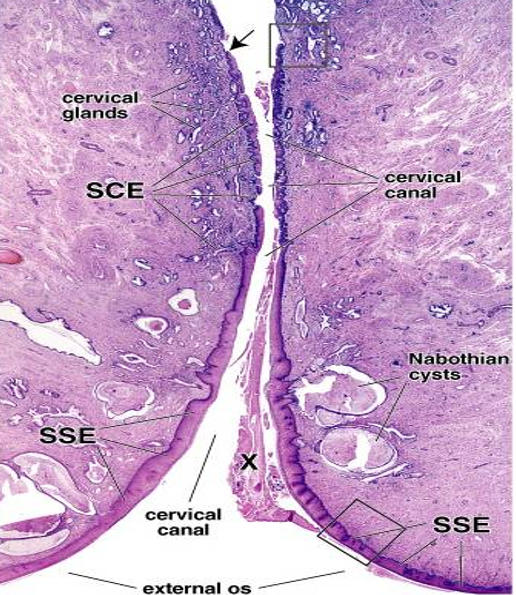
what organ?
cervix
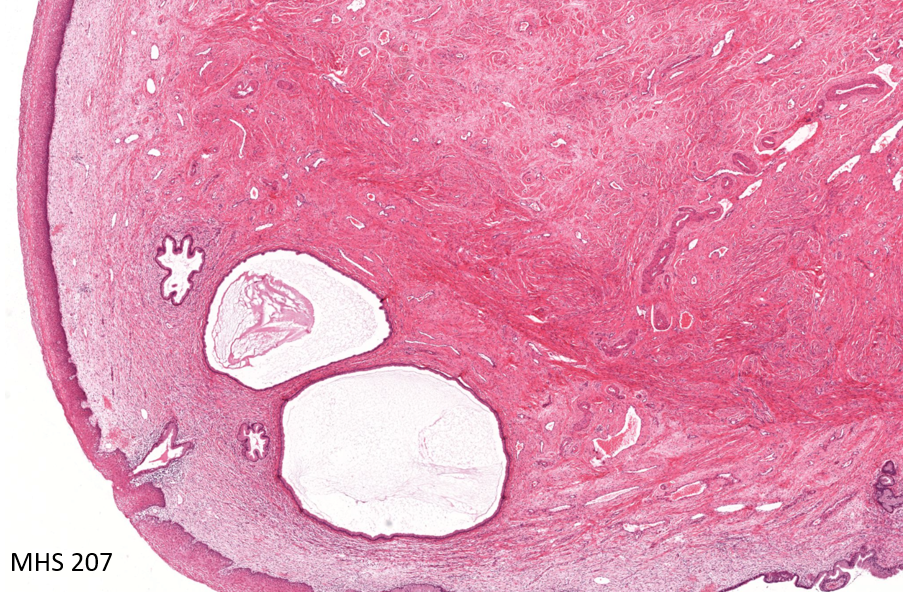
what organ?
cervix
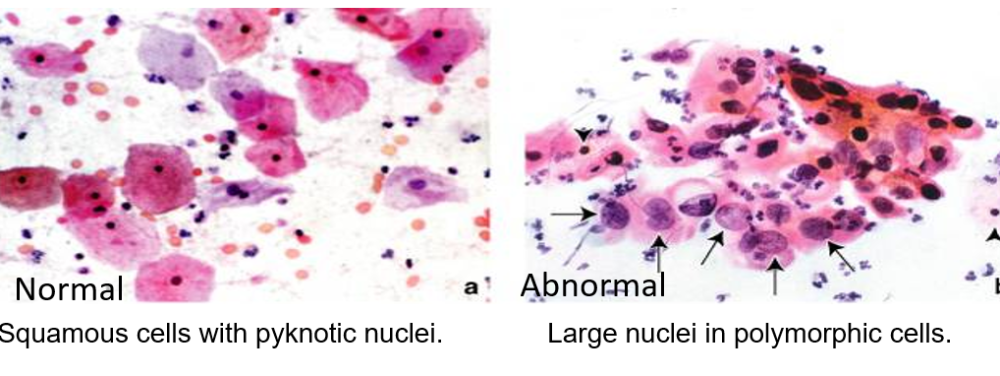
pap smear
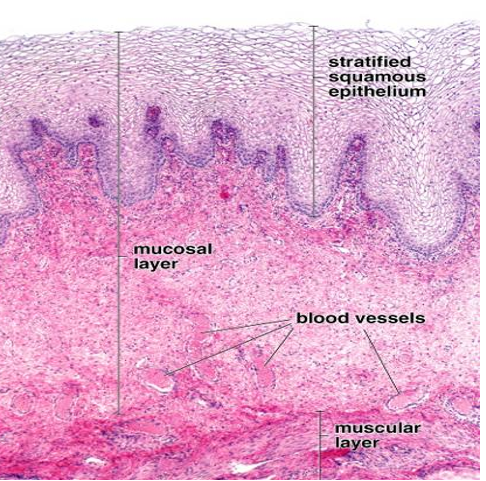
what organ?
vagina
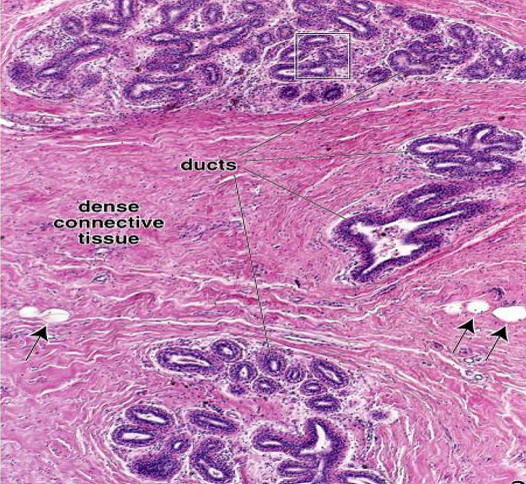
these are what glands
inactive mammary glands
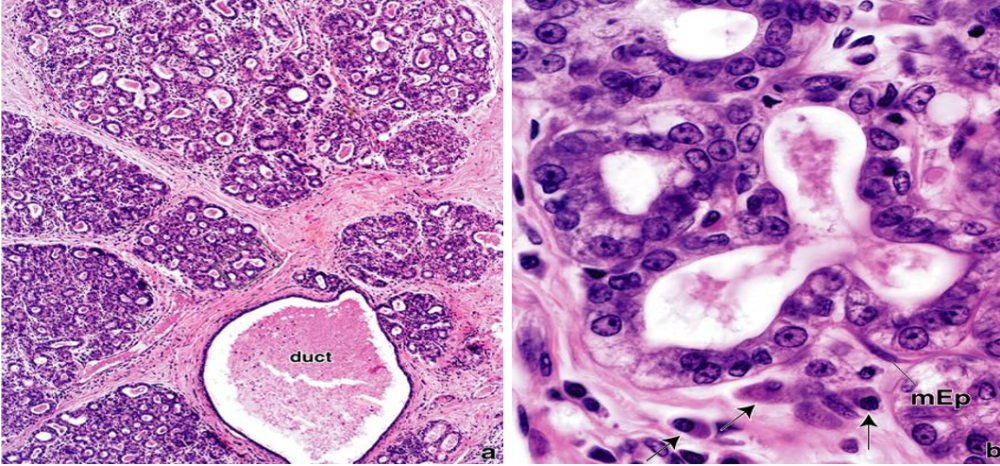
these are what glands
Active Mammary Glands
How does the cervical mucosa differ from the uterine endometrium?
A. It lacks spiral arteries and does not slough
B. It lacks glands completely
C. It contains only squamous epithelium
D. It undergoes no hormonal changes
A. It lacks spiral arteries and does not slough
Which statement best describes hormonal changes in the cervical mucosa?
A. It is completely hormone independent
B. It undergoes some hormone-dependent changes
C. It cycles exactly like endometrium
D. It undergoes menstrual shedding
B. It undergoes some hormone-dependent changes
Which vascular feature is absent from the cervical mucosa?
A. Capillaries
B. Venules
C. Spiral arteries
D. Arterioles
C. Spiral arteries
What do cervical glands primarily produce?
A. Estrogen
B. Progesterone
C. Glycogen
D. Mucus
D. Mucus
Obstruction or dilation of cervical glands can produce which cysts?
A. Nabothian cysts
B. Bartholin cysts
C. Gartner cysts
D. Follicular cysts
A. Nabothian cysts
The muscularis of the fibromuscular vaginal tube is composed primarily of:
A. Skeletal muscle
B. Smooth muscle
C. Cardiac muscle
D. Elastic tissue
B. Smooth muscle
How is the smooth muscle of the vaginal wall arranged?
A. Inner longitudinal; outer circular
B. Circular only
C. Inner circular; outer longitudinal
D. Longitudinal only
C. Inner circular; outer longitudinal
What type of epithelium lines the vagina according to these notes?
A. Simple columnar
B. Transitional
C. Keratinized squamous
D. Stratified squamous nonkeratinized
D. Stratified squamous nonkeratinized
Which statement about vaginal glands is correct?
A. Vaginal glands are absent
B. Numerous mucous glands are present
C. Only serous glands are present
D. Sebaceous glands dominate
A. Vaginal glands are absent
What is one major source of lubrication for the vagina?
A. Ovarian secretions
B. Cervical secretions
C. Endometrial glands
D. Uterine arteries
B. Cervical secretions
Which glands also contribute to lubrication of the vaginal opening?
A. Nabothian glands
B. Mammary glands
C. Bartholin glands
D. Endometrial glands
C. Bartholin glands
Where are the Bartholin glands located according to these notes?
A. Deep perineal pouch
B. Cervical stroma
C. Uterine wall
D. Superficial perineal pouch
D. Superficial perineal pouch
Under estrogen stimulation, vaginal epithelial cells accumulate which substance?
A. Glycogen
B. Collagen
C. Cholesterol
D. Hemosiderin
A. Glycogen
Mammary glands undergo cyclic changes primarily in response to:
A. Thyroid hormones
B. Ovarian hormones
C. Adrenal catecholamines
D. Pancreatic hormones
B. Ovarian hormones
What hormonal change occurs after birth that helps permit lactation?
A. Estrogen and progesterone fall
B. Estrogen sharply increases
C. Progesterone sharply increases
D. LH sharply increases
A. Estrogen and progesterone fall
How does prolactin contribute to lactational amenorrhea according to these notes?
A. Increases LH secretion
B. Increases estrogen secretion
C. Inhibits LH secretion
D. Stimulates hCG
C. Inhibits LH secretion