The two nasal cavities are separated from one another by which structure?
A. Bony and cartilaginous septum
B. Hard palate
C. Nasopharyngeal wall
D. Cribriform plate
A. Bony and cartilaginous septum
Each nasal cavity is divided into which three major regions?
A. Superior, middle, inferior
B. Vestibule, respiratory, olfactory
C. Nasal, oral, pharyngeal
D. Cutaneous, mucosal, serosal
B. Vestibule, respiratory, olfactory
Which region of the nasal cavity communicates directly with the external environment through the nostrils?
A. Respiratory segment
B. Olfactory segment
C. Vestibule
D. Nasopharynx
C. Vestibule
The external nares are another name for the:
A. Choanae
B. Turbinates
C. Meatuses
D. Nostrils
D. Nostrils
What type of epithelium lines the nasal vestibule?
A. Stratified squamous epithelium
B. Simple columnar epithelium
C. Transitional epithelium
D. Pseudostratified epithelium
A. Stratified squamous epithelium
What is the major protective function of hairs within the nasal vestibule?
A. Detect odors
B. Prevent large particles from entering
C. Produce mucus
D. Warm inspired air
B. Prevent large particles from entering
At the end of the nasal vestibule, stratified squamous epithelium transitions into which epithelial type?
A. Simple squamous
B. Transitional
C. Respiratory epithelium
D. Olfactory epithelium
C. Respiratory epithelium
Which epithelial description best characterizes the respiratory segment of the nasal cavity?
A. Simple columnar without cilia
B. Stratified squamous keratinized
C. Transitional with goblet cells
D. Pseudostratified ciliated columnar with goblet cells
D. Pseudostratified ciliated columnar with goblet cells
The lamina propria underlying the respiratory epithelium is attached directly to the periosteum of the:
A. Underlying bone
B. Nasal cartilage
C. Hard palate
D. Cribriform plate
A. Underlying bone
Which structure forms the medial wall of each nasal cavity?
A. Inferior concha
B. Nasal septum
C. Hard palate
D. Nasolacrimal duct
B. Nasal septum
The lateral wall of the nasal cavity contains three shelf-like bony projections called:
A. Meatuses or septum
B. Sinuses or septum
C. Conchae or turbinates
D. Choanae or turbinates
C. Conchae or turbinates
What is one major effect of the nasal conchae on inspired air?
A. Eliminate all airflow turbulence
B. Cool inspired air rapidly
C. Prevent mucus secretion
D. Increase airflow turbulence
D. Increase airflow turbulence
Why does the turbulence generated by nasal conchae improve conditioning of inspired air?
A. It enhances warming and moisturizing
B. It decreases mucosal contact
C. It dries the nasal surface
D. It bypasses respiratory epithelium
A. It enhances warming and moisturizing
The eddies generated by the nasal turbinates help remove particulate matter primarily by:
A. Dissolving particles enzymatically
B. Trapping particles in mucus
C. Transporting particles into blood
D. Moving particles toward olfactory neurons
B. Trapping particles in mucus
Which specialized epithelial cell in the respiratory mucosa detects particulate material on the epithelial surface?
A. Goblet cell
B. Basal cell
C. Brush cell
D. Sustentacular cell
C. Brush cell
Sensory information from nasal respiratory brush cells is carried centrally through which cranial nerve?
A. Facial nerve
B. Olfactory nerve
C. Glossopharyngeal nerve
D. Trigeminal nerve
D. Trigeminal nerve
Stimulation of particulate-sensitive brush cells in the nasal respiratory epithelium contributes to which protective reflex?
A. Sneeze reflex
B. Gag reflex
C. Pupillary reflex
D. Vestibulo-ocular reflex
A. Sneeze reflex
Which property of the nasal cavity lamina propria is especially important for warming inspired air?
A. Dense keratinization
B. Rich vascularity
C. Abundant cartilage
D. Thick adipose tissue
B. Rich vascularity
The abundant blood vessels of the nasal lamina propria help raise inspired air toward:
A. Environmental temperature
B. Freezing temperature
C. Body temperature
D. Room temperature only
C. Body temperature
During allergic rhinitis or a viral upper respiratory infection, nasal congestion results partly from blood vessels in the lamina propria becoming:
A. Constricted and impermeable
B. Fibrotic and thrombosed
C. Calcified and narrowed
D. Engorged and leaky
D. Engorged and leaky
Why can swelling of the nasal lamina propria make breathing more difficult during an allergic reaction?
A. Distention narrows the airway
B. It destroys the nasal septum
C. It closes the trachea
D. It blocks the larynx
A. Distention narrows the airway
Which glands are found within the lamina propria of the nasal cavity according to this source?
A. Sebaceous glands
B. Mucous glands
C. Endocrine glands
D. Purely serous glands
B. Mucous glands with serous demilunes
Serous demilune cells of nasal glands secrete which antibacterial substance?
A. Histamine
B. Mucin
C. Lysozyme
D. Immunoglobulin E
C. Lysozyme
Which region of the nasal cavity is specialized for detection of odorants?
A. Vestibule
B. Respiratory segment
C. Nasopharynx
D. Olfactory segment
D. Olfactory segment
Although olfactory epithelium resembles respiratory epithelium microscopically, it contains specialized cells with very different functions. What epithelial classification does it share with respiratory epithelium?
A. Simple cuboidal
B. Stratified squamous
C. Pseudostratified columnar
D. Transitional
C. Pseudostratified columnar
Which cell type in the olfactory epithelium functions as a special visceral sensory receptor?
A. Sustentacular cell
B. Basal cell
C. Brush cell
D. Olfactory cell
D. Olfactory cell
Which olfactory epithelial cells provide mechanical and metabolic support analogous to glial cells in nervous tissue?
A. Sustentacular cells
B. Olfactory cells
C. Basal cells
D. Brush cells
A. Sustentacular cells
Which cells of the olfactory epithelium are mitotically active and renew both sensory and supporting cells?
A. Olfactory cells
B. Basal cells
C. Brush cells
D. Goblet cells
B. Basal cells
In the olfactory epithelium, which cells serve as general sensory receptors for touch and are innervated by cranial nerve V?
A. Olfactory cells
B. Sustentacular cells
C. Brush cells
D. Basal cells
C. Brush cells
Which statement correctly compares brush cells in the nasal cavity?
A. They occur only in vestibular epithelium
B. They are unique to olfactory epithelium
C. They are innervated by CN I
D. They occur in respiratory and olfactory epithelium
D. They occur in respiratory and olfactory epithelium
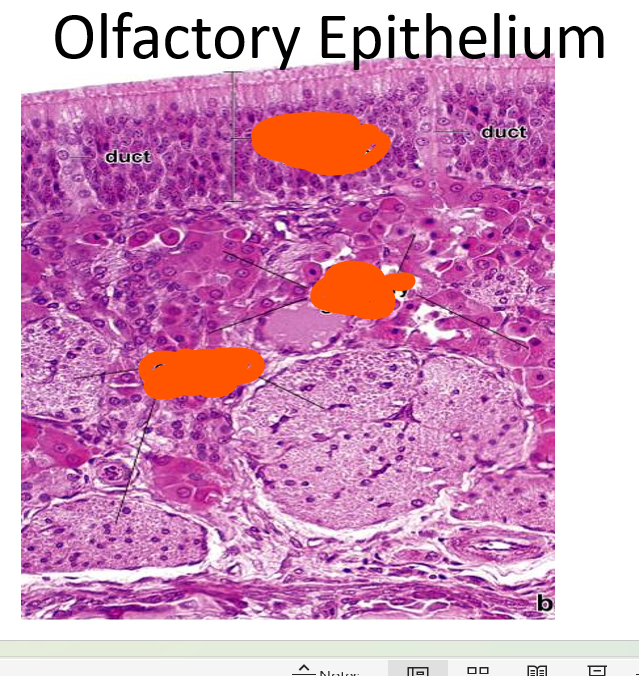
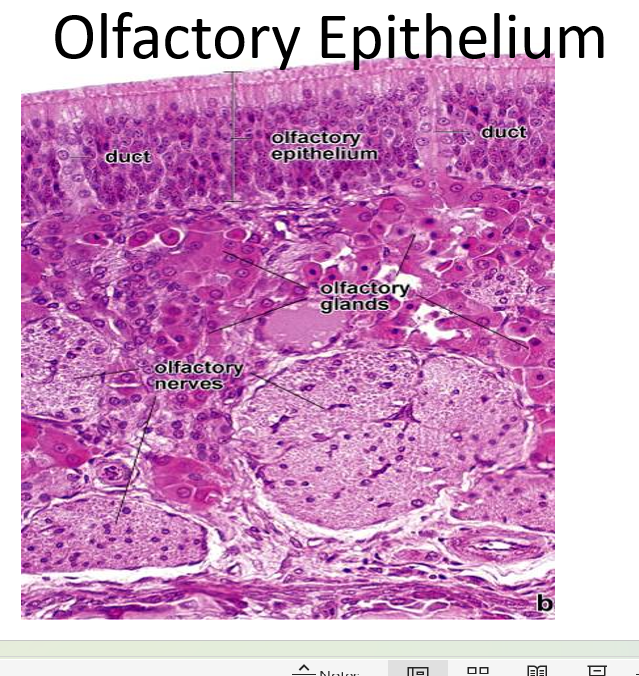
assign these labels to the proper places:
olfactory glands, olfactory nerves, olfactory epithelium
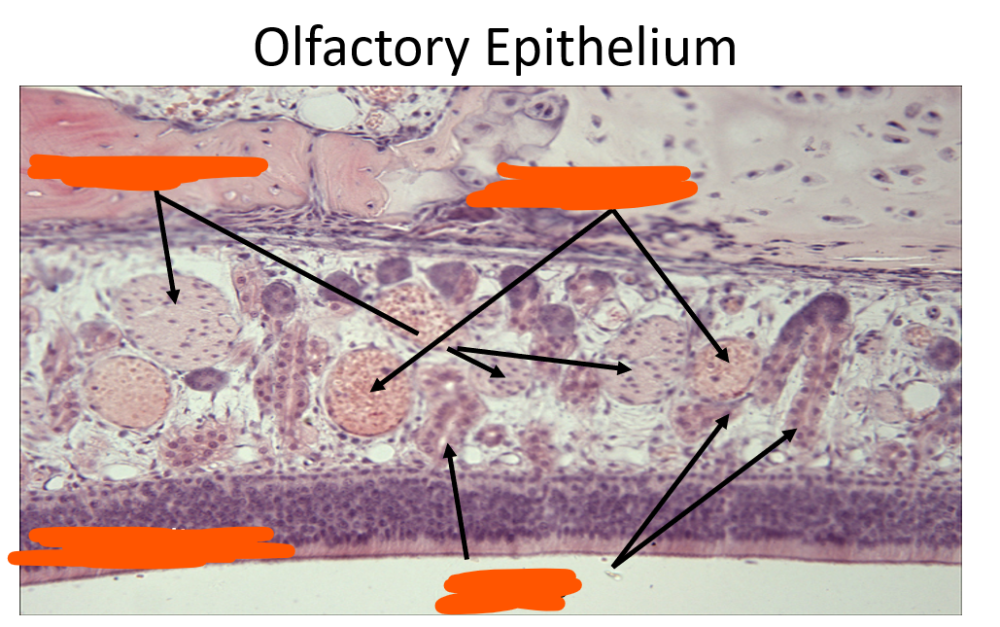
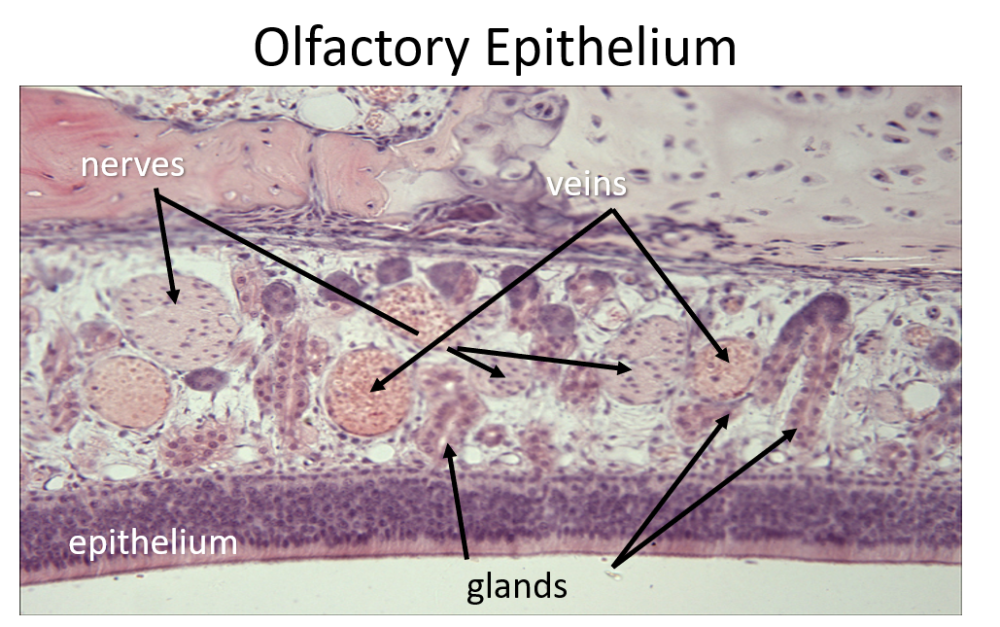
assign these labels to the proper places:
veins, epithelium, glands, nerves
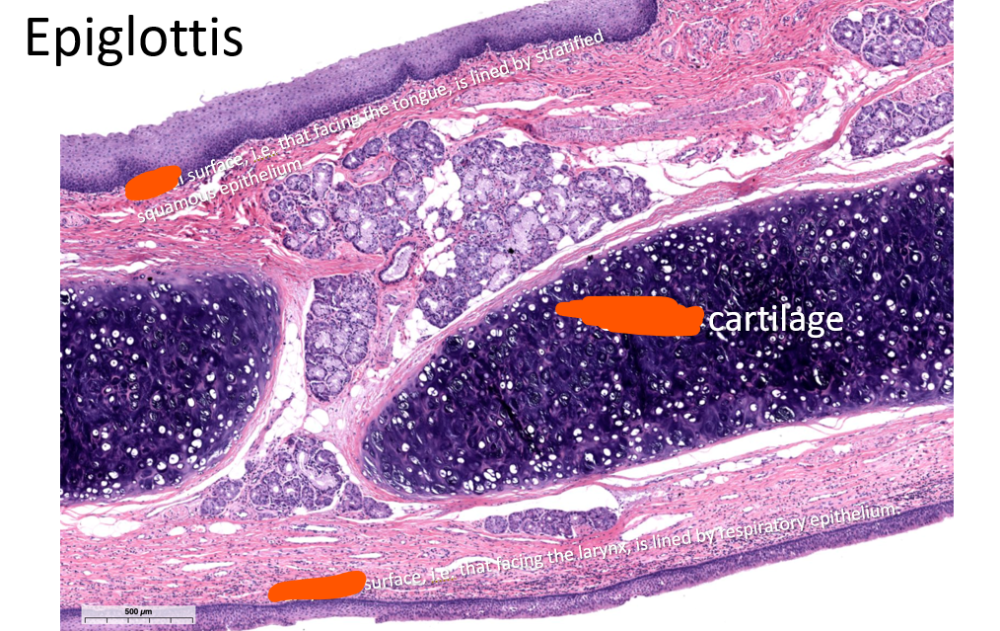
this is epiglottis
lingual
elastic cartilage
laryngeal
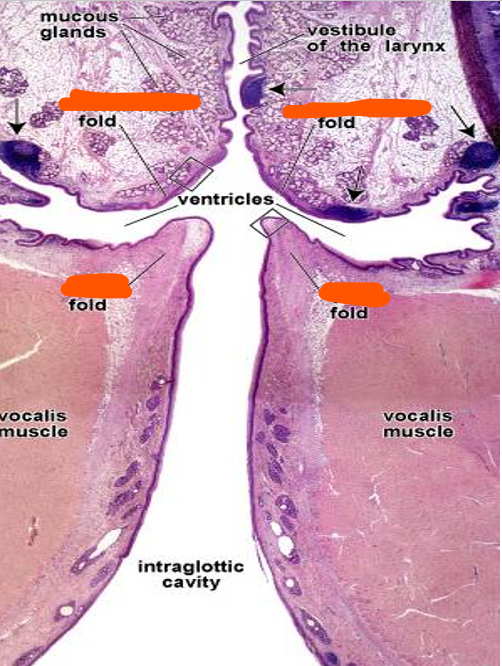
ventricular fold
vocal fold
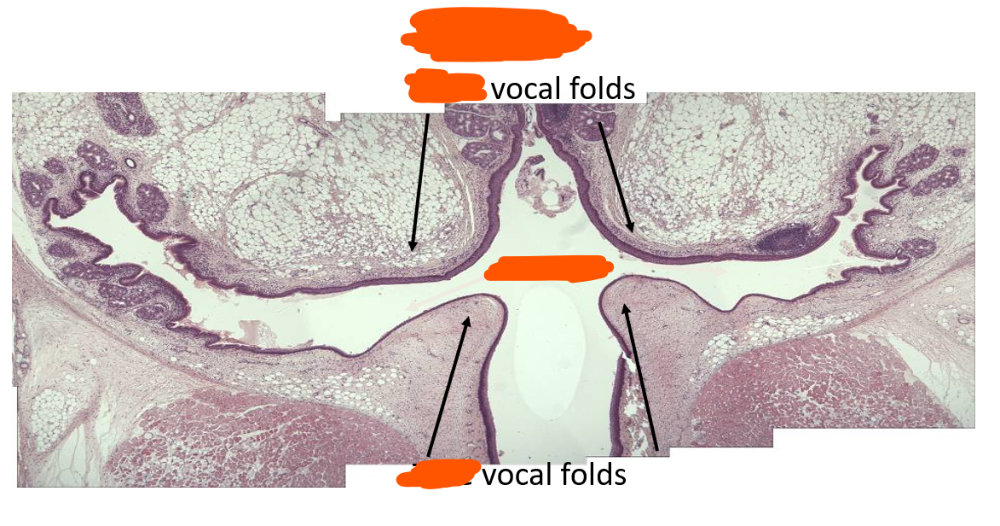
larynx
false vocal folds
ventricles
true vocal folds
The pharynx is located posterior to which two cavities?
A. Nasal and oral cavities
B. Oral and thoracic cavities
C. Nasal and orbital cavities
D. Oral and laryngeal cavities
A. Nasal and oral cavities
Which portion of the pharynx lies above the soft palate and posterior to the nasal cavities?
A. Oropharynx
B. Nasopharynx
C. Laryngopharynx
D. Hypopharynx
B. Nasopharynx
What type of epithelium normally lines the nasopharynx according to this source?
A. Stratified squamous
B. Transitional
C. Respiratory epithelium
D. Simple cuboidal
C. Respiratory epithelium
Which lymphoid structure is located in the posterior wall of the nasopharynx?
A. Palatine tonsil
B. Lingual tonsil
C. Tubal tonsil
D. Pharyngeal tonsil
D. Pharyngeal tonsil
The pharyngeal tonsil is commonly referred to as the:
A. Adenoids
B. Vocal folds
C. Turbinates
D. Ventricles
A. Adenoids
What is the major anatomic role of the larynx?
A. Connect nose to pharynx
B. Connect pharynx to trachea
C. Connect trachea to bronchi
D. Connect mouth to esophagus
B. Connect pharynx to trachea
Which structures are prominent components of the lamina propria of the larynx?
A. Nasal conchae
B. Vocal ligaments
C. Laryngeal cartilages
D. Pharyngeal tonsils
C. Laryngeal cartilages
Which group contains the laryngeal cartilages specifically listed in this source?
A. Epiglottic, nasal, tracheal
B. Thyroid, hyoid, epiglottic
C. Arytenoid, hyoid, nasal
D. Thyroid, cricoid, arytenoid
D. Thyroid, cricoid, arytenoid
The thyroid, cricoid, and arytenoid cartilages are composed primarily of which tissue?
A. Hyaline cartilage
B. Elastic cartilage
C. Fibrocartilage
D. Dense connective tissue
A. Hyaline cartilage
Why are the major laryngeal cartilages important for airflow?
A. They secrete mucus
B. They maintain laryngeal patency
C. They filter particulate matter
D. They warm inspired air
B. They maintain laryngeal patency
In addition to keeping the airway open, the laryngeal cartilages play an important role in:
A. Swallowing
B. Olfaction
C. Vocalization
D. Nasal filtration
C. Vocalization
Which pair of laryngeal folds is located superiorly?
A. True vocal folds
B. Vocal cords
C. Vocal ligaments
D. False vocal folds
D. False vocal folds
False vocal folds are also known as:
A. Ventricular folds
B. Vocal ligaments
C. Arytenoid folds
D. Pharyngeal folds
A. Ventricular folds
What type of epithelium usually covers the false vocal folds?
A. Stratified squamous
B. Pseudostratified columnar
C. Simple squamous
D. Transitional
B. Pseudostratified columnar
The lamina propria of the false vocal folds contains numerous:
A. Mucous glands
B. Lymphoid follicles
C. Serous glands
D. Sebaceous glands
C. Serous glands
Which pair of laryngeal folds is located inferior to the false vocal folds?
A. Ventricular folds
B. Aryepiglottic folds
C. Vestibular folds
D. True vocal folds
D. True vocal folds
What type of epithelium covers the true vocal folds according to this source?
A. Stratified squamous epithelium
B. Pseudostratified columnar epithelium
C. Simple columnar epithelium
D. Transitional epithelium
A. Stratified squamous epithelium
Parallel bundles of elastic fibers within the true vocal folds form the:
A. Vocalis muscles
B. Vocal ligaments
C. Laryngeal glands
D. Arytenoid folds
B. Vocal ligaments
Which muscle lies parallel to the vocal ligaments within the true vocal folds?
A. Cricothyroid muscle
B. Thyroarytenoid cartilage
C. Vocalis muscle
D. Pharyngeal constrictor
C. Vocalis muscle
The vocalis muscles are skeletal muscles innervated by which cranial nerve according to this source?
A. CN V
B. CN VII
C. CN IX
D. CN X
D. CN X
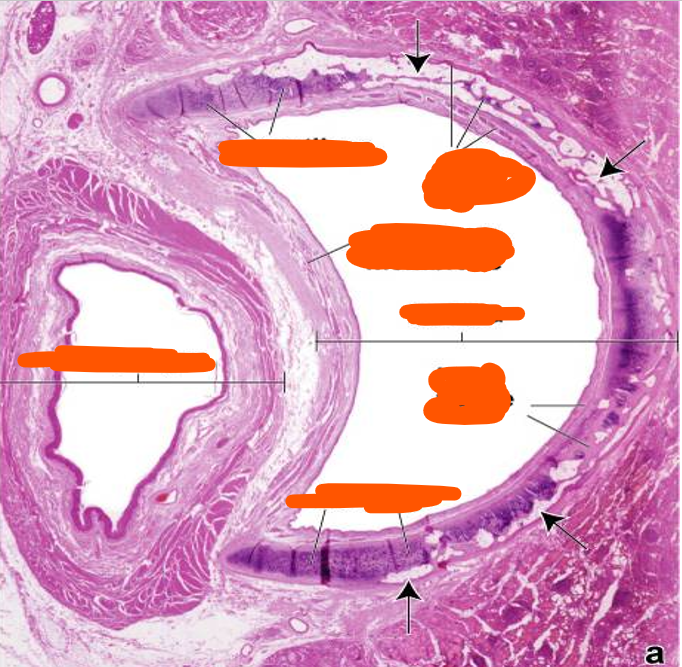
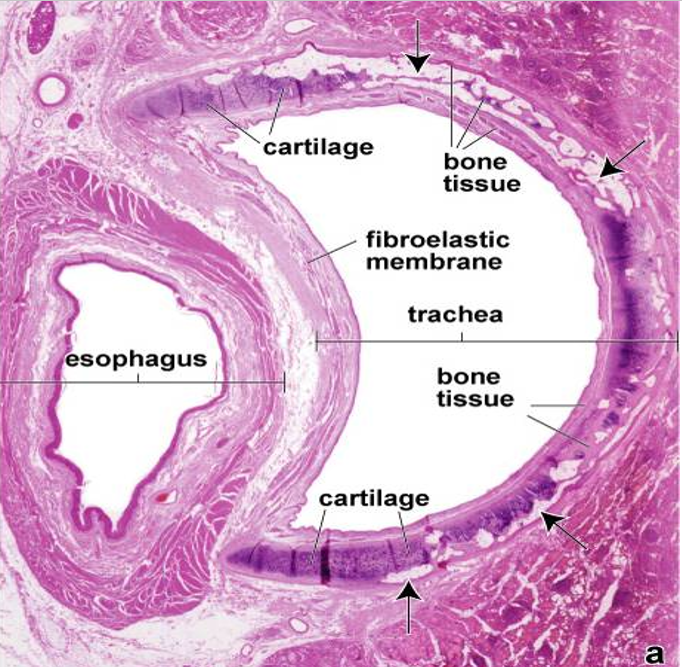
assign these labels to the proper places:
esophagus, cartilage, bone tissue, fibroelastic membrane, trachea
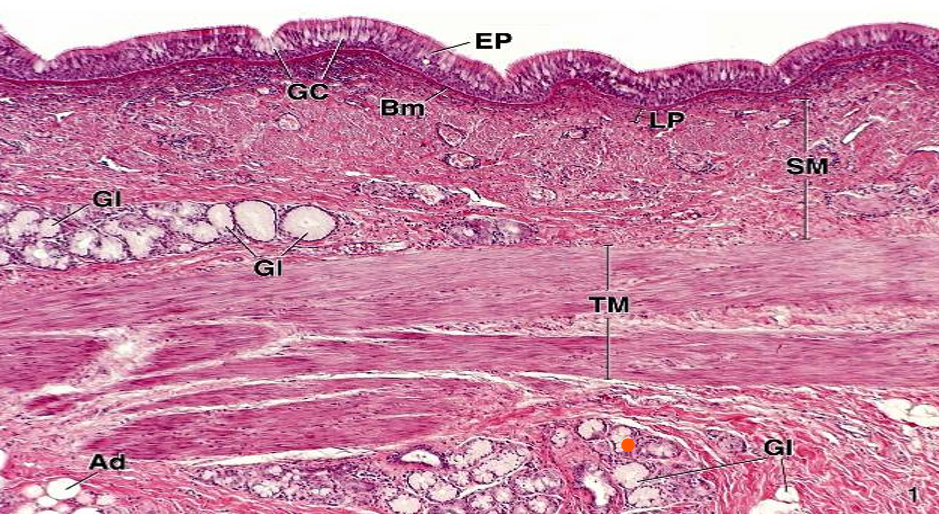
this is ______.
this is trachea.
EP –epithelium
GC – goblet cells
Bm – basement membrane
Gl – glands
SM – smooth muscle
Ad – adipose tissue
What type of epithelium lines the tracheal mucosa?
A. Pseudostratified ciliated columnar
B. Stratified squamous
C. Simple cuboidal
D. Transitional
A. Pseudostratified ciliated columnar
The lamina propria of the tracheal mucosa is especially rich in which extracellular component?
A. Adipose tissue
B. Elastic fibers
C. Hyaline cartilage
D. Keratin
B. Elastic fibers
A tracheal histology section shows an unusually thick layer immediately beneath the epithelial basal lamina. What does this apparent “basement membrane” primarily represent?
A. Muscularis mucosae
B. Hyaline cartilage
C. Thick reticular lamina
D. Elastic cartilage
C. Thick reticular lamina
Because the thick reticular lamina lies beneath the epithelial basal lamina, it is considered part of which tissue compartment?
A. Epithelium
B. Submucosa
C. Cartilage layer
D. Lamina propria
D. Lamina propria
What is the thick reticular lamina of the trachea composed largely of according to this source?
A. Densely packed collagen fibers
B. Elastic cartilage
C. Smooth muscle fibers
D. Adipose tissue
A. Densely packed collagen fibers
Chronic coughing in smokers may cause which tracheal histologic structure to become thicker?
A. Trachealis muscle
B. Reticular basement-membrane region
C. Hyaline cartilage ring
D. Respiratory epithelium
B. Reticular basement-membrane region
How is the connective tissue of the tracheal lamina propria best characterized?
A. Dense regular connective tissue
B. Fibrocartilage
C. Loose connective tissue
D. Dense elastic tissue
C. Loose connective tissue
Which group contains cells normally found within the tracheal lamina propria?
A. Chondrocytes, osteocytes, adipocytes
B. Neutrophils, erythrocytes, platelets
C. Goblet cells, ciliated cells, basal cells
D. Mast cells, plasma cells, macrophages
D. Mast cells, plasma cells, macrophages
The cartilaginous layer of the trachea is composed primarily of which cartilage type?
A. Fibrocartilage
B. Hyaline cartilage
C. Elastic cartilage
D. Calcified cartilage
B. Hyaline cartilage
What is an important mechanical function of the tracheal cartilage?
A. Produce mucus
B. Propel mucus upward
C. Maintain airway patency
D. Generate the cough reflex
C. Maintain airway patency
In addition to maintaining patency, tracheal cartilage permits the trachea to retain a degree of:
A. Contractility
B. Secretory activity
C. Ciliary motion
D. Flexibility
D. Flexibility
What age-related change may occur in tracheal cartilage?
A. Calcification and bone formation
B. Complete cartilage loss
C. Conversion to elastic cartilage
D. Replacement by adipose tissue
A. Calcification and bone formation
Posteriorly, the open ends of the C-shaped tracheal cartilage are connected by which structure?
A. Cricothyroid muscle
B. Trachealis muscle
C. Vocalis muscle
D. Pharyngeal constrictor
B. Trachealis muscle
What type of muscle makes up the trachealis muscle?
A. Skeletal muscle
B. Cardiac muscle
C. Smooth muscle
D. Myoepithelial muscle
C. Smooth muscle
During coughing, contraction of the trachealis muscle helps clear the airway primarily by:
A. Increasing mucus secretion
B. Opening the vocal folds
C. Dilating the tracheal lumen
D. Increasing velocity of expelled air
D. Increasing velocity of expelled air
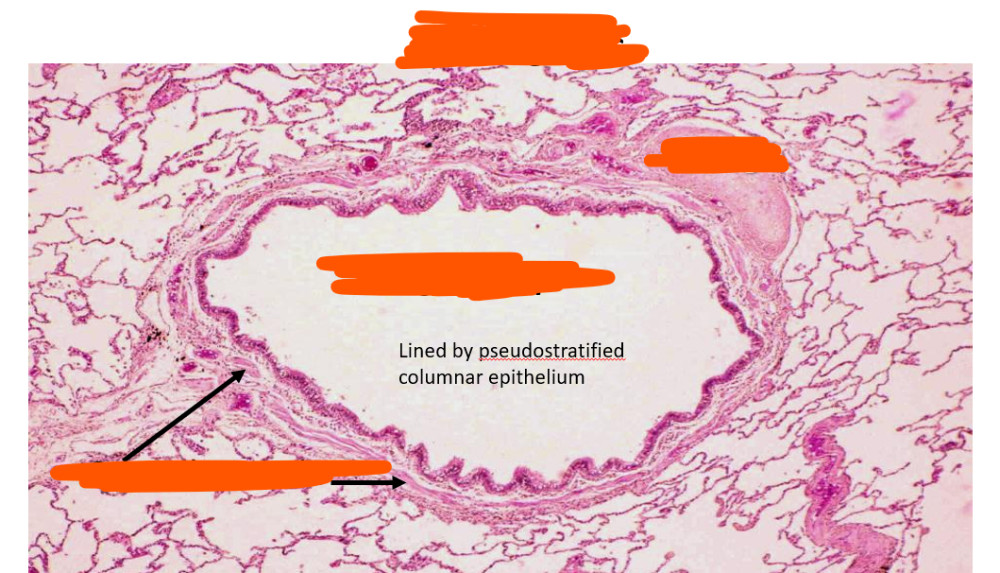
bronchus
cartilage
lumen
smooth muscle
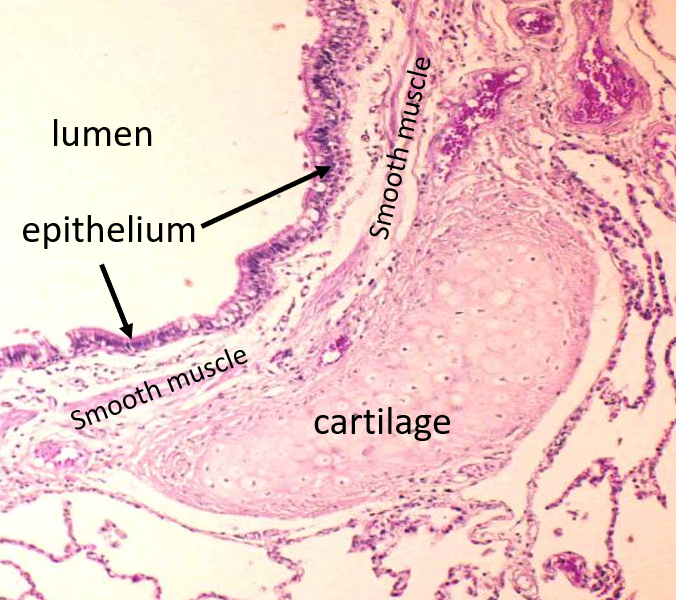
this is what organ?
bronchus
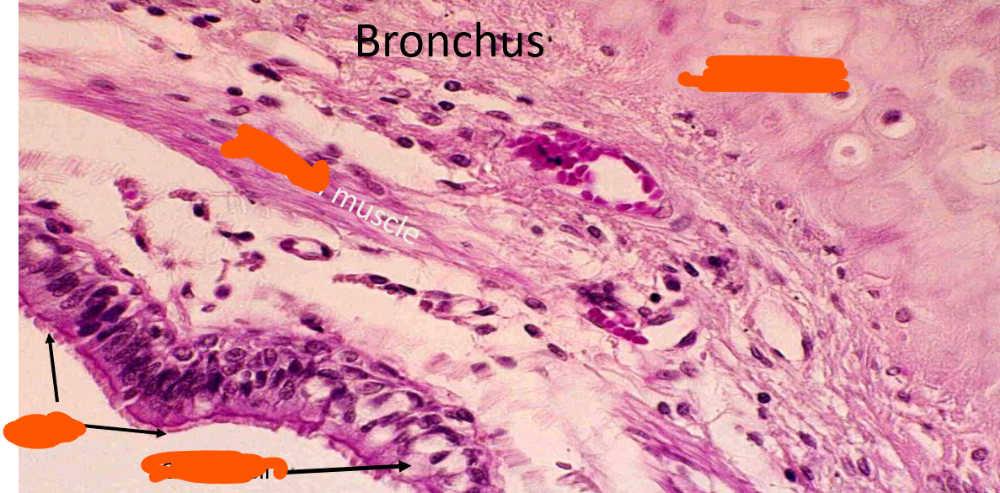
cartilage
smooth muscle
cilia
goblet cells
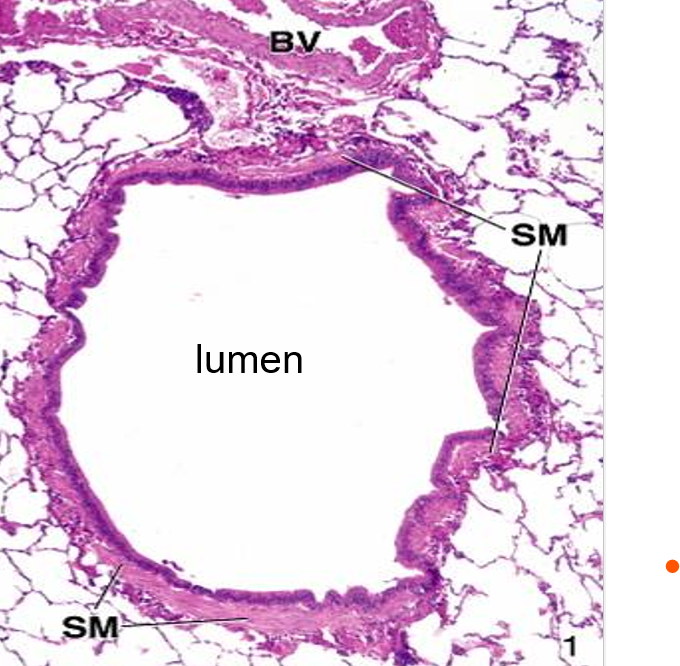
this is a bronchiole. it has no ______, and it is noteworthy for having ____ muscle
cartilage
smooth
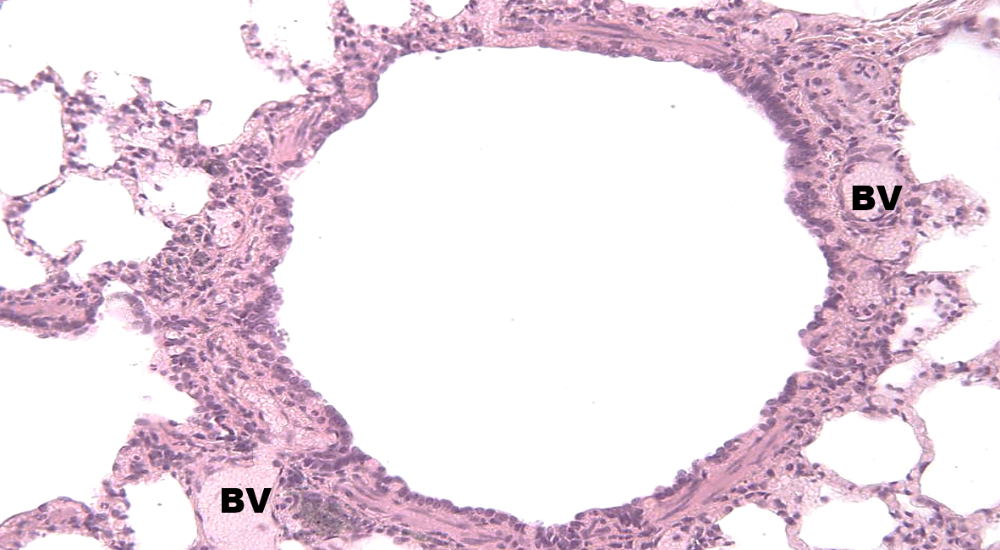
this is _______
this is bronchiole
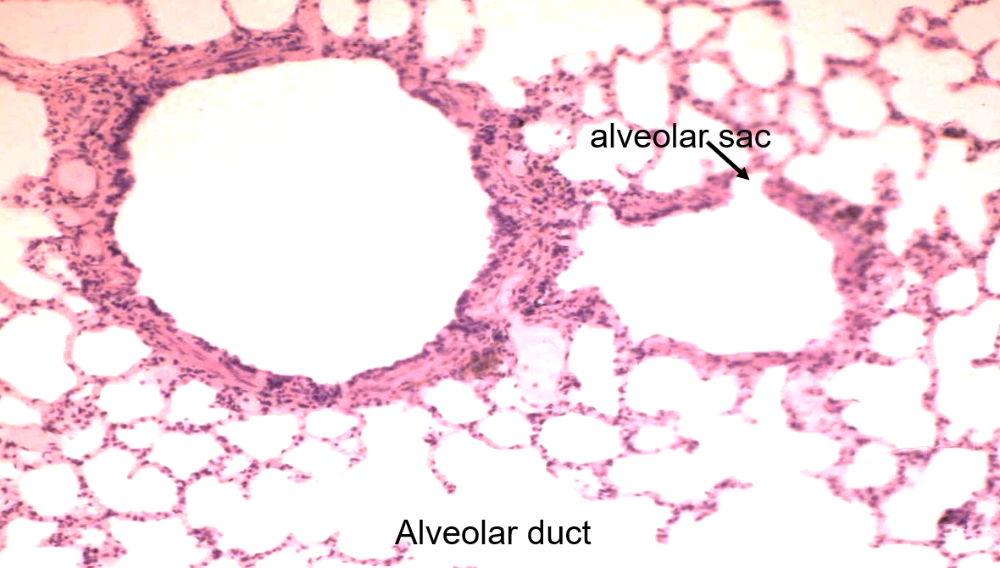
this is _______
this is bronchiole
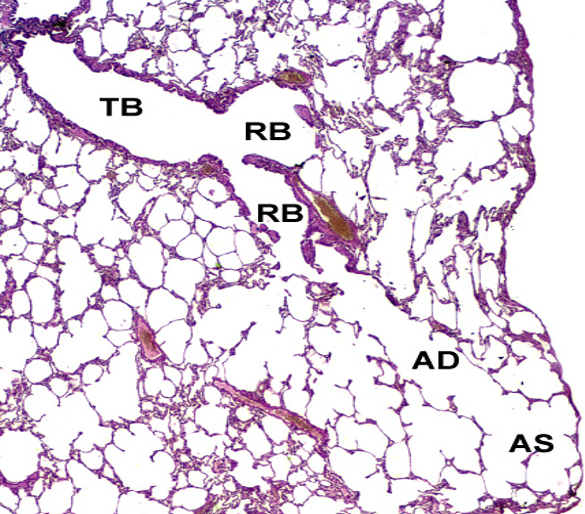
TB – terminal bronchiole
RB – respiratory bronchiole
AD – alveolar duct
AS – alveolar sac.
What type of epithelium initially lines the larger bronchioles?
A. Simple cuboidal
B. Pseudostratified ciliated columnar
C. Stratified squamous
D. Simple squamous
B. Pseudostratified ciliated columnar
As bronchioles decrease in size, respiratory epithelium first transitions to which epithelial type?
A. Stratified columnar
B. Simple squamous
C. Simple ciliated columnar
D. Transitional
C. Simple ciliated columnar
In the smallest bronchioles, the epithelium eventually becomes predominantly:
A. Stratified squamous
B. Pseudostratified columnar
C. Simple columnar
D. Simple cuboidal
D. Simple cuboidal
Where are goblet cells normally found within the bronchiolar tree?
A. Largest bronchioles
B. Smallest bronchioles
C. Terminal bronchioles only
D. All bronchioles equally
A. Largest bronchioles
Which finding may appear abnormally in smaller bronchioles of smokers according to this source?
A. Hyaline cartilage rings
B. Subepithelial glands
C. Goblet cells
D. Stratified squamous cells only
C. Goblet cells
What replaces cartilage as a major structural component of the bronchiolar wall?
A. Dense collagen
B. Elastic cartilage
C. Skeletal muscle
D. Thick smooth muscle
D. Thick smooth muscle
Which histologic feature is a major criterion for distinguishing a bronchiole from a bronchus?
A. Presence of cilia
B. Absence of cartilage
C. Presence of epithelium
D. Presence of smooth muscle
B. Absence of cartilage
In addition to lacking cartilage, bronchioles also characteristically lack:
A. Smooth muscle
B. Ciliated cells
C. Subepithelial glands
D. Connective tissue
C. Subepithelial glands
Which specialized epithelial cell first appears in the bronchioles?
A. Goblet cell
B. Basal cell
C. Type II pneumocyte
D. Club cell
D. Club cell
Club cells were formerly known by which name?
A. Clara cells
B. Brush cells
C. Kulchitsky cells
D. Dust cells
A. Clara cells
What is one important secretion produced by club cells?
A. Mucus
B. Lipoprotein
C. Histamine
D. Collagen
B. Lipoprotein
What is the function of the lipoprotein secreted by club cells according to this source?
A. Increase mucus viscosity
B. Destroy inhaled bacteria
C. Prevent airway-wall adhesion
D. Stimulate bronchoconstriction
C. Prevent airway-wall adhesion
Club-cell secretion helps prevent adjacent bronchiolar walls from sticking together particularly during:
A. Inspiration
B. Coughing
C. Swallowing
D. Expiration
D. Expiration
Which club-cell product can be used as a biomarker for pulmonary epithelial injury?
A. CC16
B. Surfactant protein
B C. IgA
D. Lysozyme
A. CC16
What happens to CC16 levels in bronchoalveolar fluid when the lung is damaged according to this source?
A. They increase markedly
B. They decrease
C. They remain unchanged
D. They disappear from blood only
B. They decrease
Detection of CC16 in the bloodstream may serve as a sign of:
A. Normal expiration
B. Increased mucus production
C. Lung damage
D. Bronchial cartilage growth
C. Lung damage
Which description best characterizes a terminal bronchiole?
A. First airway containing alveoli
B. Largest bronchiole with glands
C. Cartilage-supported conducting airway
D. Smallest purely conducting bronchiole
D. Smallest purely conducting bronchiole
Terminal bronchioles are lined by simple cuboidal epithelium containing which characteristic cell type?
A. Club cells
B. Goblet cells
C. Type I pneumocytes
D. Alveolar macrophages
A. Club cells
During an allergic asthma attack, which cells in the respiratory lamina propria release histamine and other vasoactive mediators?
A. Mast cells
B. Type I pneumocytes
C. Club cells
D. Goblet cells
A. Mast cells
What is the major effect of mast-cell mediators on bronchiolar smooth muscle during an asthma attack?
A. Smooth muscle relaxation
B. Smooth muscle constriction
C. Cartilage contraction
D. Loss of ciliary motion
B. Smooth muscle constriction
According to this source, epinephrine and other sympathomimetic drugs help relieve an asthma attack primarily by causing:
A. Decreased mucus synthesis
B. Mast-cell destruction
C. Bronchiolar smooth muscle relaxation
D. Increased cartilage rigidity
C. Bronchiolar smooth muscle relaxation
Asthma-related bronchoconstriction primarily affects smooth muscle in which airways according to this source?
A. Trachea
B. Alveoli
C. Main bronchi only
D. Bronchioles
D. Bronchioles
What is the inheritance pattern of cystic fibrosis?
A. Autosomal recessive
B. Autosomal dominant
C. X-linked recessive
D. Mitochondrial
A. Autosomal recessive
Cystic fibrosis results from a genetic defect involving which type of membrane protein?
A. Sodium pump
B. Chloride channel
C. Calcium channel
D. Potassium channel
B. Chloride channel
The defective chloride-channel protein in cystic fibrosis primarily disrupts ion transport in which type of tissue?
A. Skeletal muscle
B. Vascular endothelium
C. Exocrine gland epithelium
D. Hepatocytes
C. Exocrine gland epithelium
What happens to chloride secretion in cystic fibrosis according to this source?
A. It increases markedly
B. It remains normal
C. It reverses direction
D. It decreases
D. It decreases
Decreased chloride secretion in cystic fibrosis is accompanied by increased resorption of which substances?
A. Sodium and water
B. Calcium and phosphate
C. Potassium and chloride
D. Protein and glucose
A. Sodium and water
How does altered ion and water transport affect respiratory mucus in cystic fibrosis?
A. It becomes dilute
B. It becomes thick and viscous
C. It becomes alkaline
D. It disappears
B. It becomes thick and viscous
Which airways become obstructed first as thick secretions accumulate in cystic fibrosis according to this source?
A. Main bronchi
B. Trachea
C. Bronchioles
D. Alveolar ducts
C. Bronchioles
As cystic fibrosis airway disease progresses, obstruction later extends from bronchioles into the:
A. Alveoli
B. Pleura
C. Trachea
D. Bronchi
D. Bronchi
What is the primary physiologic function of pulmonary alveoli?
A. Mucus transport
B. Gas exchange
C. Voice production
D. Air filtration
B. Gas exchange
Why does the enormous number of alveoli improve pulmonary function?
A. It slows heart rate
B. It reduces airway resistance only
C. It increases mucus production
D. It greatly increases gas-exchange surface area
D. It greatly increases gas-exchange surface area
How is an individual alveolus structurally described in this source?
A. Thin-walled polyhedral chamber
B. Thick-walled cylindrical tube
C. Cuboidal glandular sac
D. Cartilage-lined spherical cavity
A. Thin-walled polyhedral chamber
An alveolus communicates with a respiratory bronchiole through which distal airway structures?
A. Terminal bronchiole and bronchus
B. Alveolar duct and alveolar sac
C. Trachea and bronchus
D. Pleural cavity and septum
B. Alveolar duct and alveolar sac
Which description best characterizes an alveolar duct?
A. Cartilage-supported airway
B. Mucus-secreting airway
C. Elongated airway bounded mainly by alveoli
D. Thick muscular airway
C. Elongated airway bounded mainly by alveoli
What is an alveolar sac?
A. A single Type II pneumocyte
B. A terminal bronchiole
C. A capillary-filled septum
D. A space surrounded by alveolar clusters
D. A space surrounded by alveolar clusters
Which two epithelial cell types make up the alveolar lining?
A. Type I and Type II pneumocytes
B. Club and goblet cells
C. Ciliated and basal cells
D. Endothelial and mesothelial cells
A. Type I and Type II pneumocytes
Which description best characterizes Type I pneumocytes?
A. Cuboidal secretory cells
B. Extremely thin squamous cells
C. Ciliated columnar cells
D. Macrophage-like cells
B. Extremely thin squamous cells
Type I pneumocytes are attached to neighboring cells by which junctional specialization?
A. Gap junctions
B. Desmosomes
C. Hemidesmosomes
D. Tight junctions
D. Tight junctions
Which description best characterizes Type II pneumocytes?
A. Cuboidal secretory cells
B. Thin squamous cells
C. Ciliated sensory cells
D. Smooth muscle cells
A. Cuboidal secretory cells
Why do Type II pneumocytes cover much less alveolar surface area than Type I pneumocytes despite being similarly numerous?
A. They undergo rapid apoptosis
B. They remain outside alveoli
C. Their taller cuboidal shape covers less surface
D. They lack plasma membranes
C. Their taller cuboidal shape covers less surface
Which combination forms the air-blood barrier according to this source?
A. Cartilage and smooth muscle
B. Surfactant and mucus only
C. Epithelium and lymphatics
D. Alveolar septal components plus surfactant
D. Alveolar septal components plus surfactant
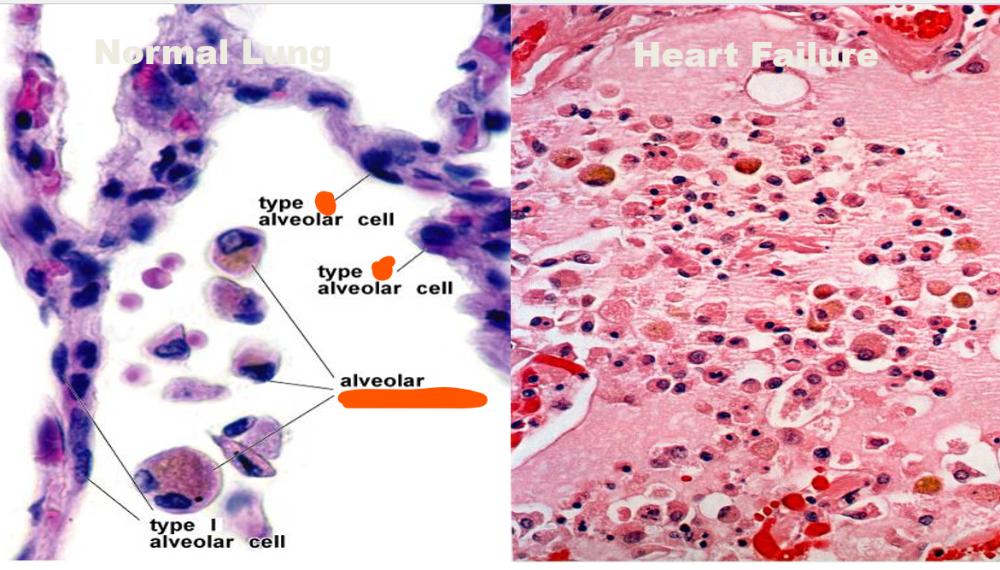
type 1
type 2
alveolar macrophages
Which ultrastructural organelles are characteristic of Type II pneumocytes on electron microscopy?
A. Lamellar bodies
B. Zymogen granules
C. Lysosomal inclusions
D. Weibel-Palade bodies
A. Lamellar bodies
Lamellar bodies within Type II pneumocytes are especially rich in which class of molecules?
A. Glycoproteins
B. Phospholipids
C. Triglycerides
D. Nucleic acids
B. Phospholipids
Which surface-active substance is stored within the lamellar bodies of Type II pneumocytes?
A. Mucin
B. Lysozyme
C. Surfactant
D. Histamine
C. Surfactant
After secretion from Type II pneumocytes, lamellar-body contents are released into the:
A. Pulmonary capillaries
B. Interstitium
C. Bronchioles
D. Alveolar spaces
D. Alveolar spaces
After entering the alveolar space, surfactant spreads over the lining cells as approximately what type of layer?
A. Monomolecular layer
B. Multilayered epithelium
C. Collagenous sheet
D. Mucous plug
A. Monomolecular layer
What is the principal physical effect of pulmonary surfactant at the air-epithelium interface?
A. Increase diffusion distance
B. Reduce surface tension
C. Increase mucus viscosity
D. Stimulate bronchoconstriction
B. Reduce surface tension
What would tend to happen to alveoli during exhalation if pulmonary surfactant were absent?
A. They would hyperinflate
B. They would fill with cartilage
C. They would collapse
D. They would become ciliated
C. They would collapse
Premature infants are particularly susceptible to respiratory distress syndrome because they may have inadequate production of:
A. Mucus
B. Hemoglobin
C. Elastin
D. Surfactant
D. Surfactant
According to this source, neonatal respiratory distress syndrome results from insufficient development of cells needed to produce adequate:
A. Surfactant
B. Hemosiderin
C. Collagen
D. Histamine
A. Surfactant
Emphysema is characterized by permanent dilation of air spaces located distal to which structure?
A. Respiratory bronchiole
B. Terminal bronchiole
C. Main bronchus
D. Trachea
B. Terminal bronchiole
According to this source, chronic airflow obstruction in emphysema is associated with narrowing of the:
A. Alveoli
B. Trachea
C. Bronchioles
D. Pleural cavity
C. Bronchioles
What structural change in emphysema directly contributes to severe impairment of gas exchange?
A. Thickening of cartilage
B. Proliferation of goblet cells
C. Enlargement of lymph nodes
D. Destruction of alveolar walls
D. Destruction of alveolar walls
What is the most common cause of emphysema according to this source?
A. Cigarette smoking
B. Viral pneumonia
C. Pulmonary embolism
D. Heart failure
A. Cigarette smoking
Which occupation is specifically mentioned as having an increased incidence of emphysema?
A. Office workers
B. Coal miners
C. Teachers
D. Farmers
B. Coal miners
What is one surgical treatment for severe emphysema described in this source?
A. Pleurodesis
B. Pneumonectomy
C. Lung volume reduction
D. Tracheostomy
C. Lung volume reduction
What is removed during lung volume reduction surgery for emphysema?
A. Entire healthy lobes
B. Bronchial cartilage
C. Pulmonary arteries
D. Small wedges of damaged lung
D. Small wedges of damaged lung
Why can lung volume reduction surgery improve respiratory function in selected patients with emphysema?
A. Remaining healthy lung expands better
B. It restores destroyed alveoli
C. It increases mucus secretion
D. It creates new bronchioles
A. Remaining healthy lung expands better
In congestive heart failure, what happens to the pulmonary vasculature according to this source?
A. It becomes ischemic
B. Lungs become congested with blood
C. It loses all capillaries
D. Pulmonary blood flow stops
B. Lungs become congested with blood
During pulmonary congestion from heart failure, erythrocytes may escape damaged capillaries and enter the:
A. Pleural cavity
B. Bronchial cartilage
C. Alveolar spaces
D. Tracheal lumen
C. Alveolar spaces
Which cells phagocytose erythrocytes that enter alveoli during congestive heart failure?
A. Type I pneumocytes
B. Type II pneumocytes
C. Club cells
D. Alveolar macrophages
D. Alveolar macrophages
After ingesting erythrocytes in chronic pulmonary congestion, alveolar macrophages accumulate which iron-containing pigment?
A. Hemosiderin
B. Bilirubin
C. Melanin
D. Lipofuscin
A. Hemosiderin
The hemosiderin found in alveolar macrophages during congestive heart failure is derived largely from breakdown of:
A. Surfactant
B. Erythrocytes
C. Collagen
D. Elastin
B. Erythrocytes
A lung specimen from a patient with chronic heart failure contains hemosiderin-filled alveolar macrophages. What are these cells commonly called?
A. Dust cells
B. Foam cells
C. Heart failure cells
D. Clara cells
C. Heart failure cells
Which sequence best describes formation of heart failure cells?
A. Surfactant loss → macrophage death
B. Bronchoconstriction → RBC production
C. Alveolar rupture → collagen uptake
D. RBC leakage → macrophage phagocytosis → hemosiderin
D. RBC leakage → macrophage phagocytosis → hemosiderin