Plasmodium is in the _____ kingdom.
a) archea
b) protozoa
c) bacteria
d) fungi
e) animalia
b) protozoa
Nematodes are in the ____ kingdom.
a) archea
b) protozoa
c) bacteria
d) fungi
e) animalia
e) animalia
Species complex is also called:
Cryptic species
VBD
Vector-borne Disease
Vector-pathogen-host interactions are:
specific
competent vector
biologically able to transmit a certain pathogen
non-competent vector
not able to ttransmit the pathogen
susceptible host
becomes infected when as infected vector transmits the pathogen
non-susceptible host
does NOT become infected when an infected vector transmits the pathogen
What are the 2 types of general vector and host?
(basic basic basic version)
Competent vector
Non-competent vector
Susceptible host
Non-susceptible host
EIP defintion and what the acronym stands for
Extrinsic incubation period
period of time from ingestion of an infected blood meal (from an infected host) to the time of pathogen transmission capability
EIP is highly dependent on
environmental factors
The predominant tissue tropism of yellow fever virus is
hepatotropic (liver)
William Gorgas
applied mosquito-control measures to control yellow fever
improved sanitation also started as a way to control YF
Carlos Finlay
proposed mosquito transmission for yellow fever
Walter Reed Commission
demonstrated mosquito transmission of YFV
Infection with one dengue virus serotype in a person previously infected with another serotype can increase the risk of severe dengue thru a mechanism known as
Antibody-dependent enhancement (ADE)
The import/export of _____ between countries has been implicated in the introduction of A. albopictus in the Americas.
used tires
Infection with West Nile virus in most cases asymptomatic. However, among symptomatic individuals, 1% can develop ______, a more severe form of the illness that can be fatal.
Neuroinvasive disease
Although humans and horses can get infected with West Nile virus and develop severe disease or even die, they are ____ hosts and do not contribute to the virus transmission cycle.
dead-end
West Nile virus was first found in the US in
1990s
Zika virus is genetically closest to ___ virus.
dengue
Besides being transmitted thru mosquito bites, Zika virus can also be transmitted from mother to fetus thru the placenta and thru _____.
sex
An outbreak of ___ virus, involving local infections acquired thru mosq bites, occurred in florida in 2016.
Zika
Zika virus can exhibit neurotropism, leading to neurological conditions in infected individuals, including ____ and _____.
Gullain-Barre syndrome
Congenital Zika Syndrome
___ disease caused by Zika can lead to skin rash, low fever, and conjunctavitis, among other acute symptoms.
Acute
_____ is a possible consequence of Zika virus infection during pregnancy and can include microencephaly and other neurological abnormalities.
Congential Zika Syndrome
D, K, P, C, O, F, G, S.
Domain, kingdom, phylum, class, order, family, genus, species.
Biological vs mechanical transmission
Biological - needs time for the pathogen to complete its life cycle, but more relevant
Mechanical - the longer the time, the lower the chances of it happening, as the pathogen dies or becomes inactivated
biological transmission
the pathogens REPRODUCE or DEVELOP in the arthropod vector before being transmitted to the next vertebrate host.
mechanical transmission
the pathogen DOES NOT reproduce or develop in the vector; the arthropod meerely transmits the pathogen physically from one vertebrate to another
zoonotic malaria
Knowlesi
(but CAN infect humans)
the 4 plasmodium sp that are considered true human parasites
P. falciparum
P. vivax
P. malariae
P. ovale
which species is the most lethal for malaria?
falciparum
Skin rash is a symptom in ___ and ____.
dengue, zika
2 reasons for hematophagy
egg production
energy
hematophagy
blood feeding
what subfamily of mosq is non-hematophagous?
Toxorhynchitinae
It takes ___ to ___ days for the life cycle of a mosq.
7 to 14
General mosq breeding sites:
stagnant or slow-moving water
Anopheles gambiae
Highly anthropophilic (prefers human environs) and anthropophagic (prefers feeding on humans)
also endophilic (prefers to be indoors)
Plasmodium is ___ which means the vector transmits more infectious units than were ingested.
cyclopropagative (the pathogen develops AND multiplies inside vector)
Plasmodium life cycle
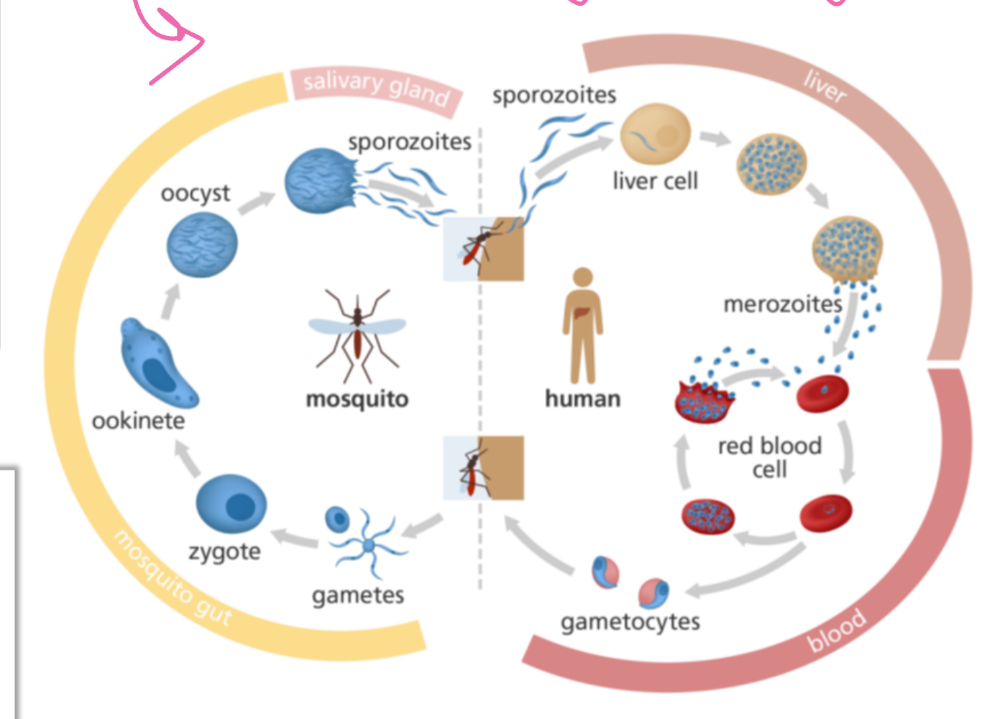
Ronald Ross
discovered that mosquitoes transmitted Plasmodium (avian malaria)
1897
Alphose Laveran
discovered Plasmodium parasites in red blood cells of infected humans
1880
Giovanni Grassi and colleagues
established transmission of human malaria by Anopheles mosquitoes
1898-1900
Henry Shortt and colleagues
discovery of Plasmodium in NHP and human liver
1948
Blood stage of malaria
the release of parasites from parasitized red blood cells triggers paroxysms
Paroxysms
successive episodes of fever, chills and sweats
Malaria occurs predominantly in ___, ___ and ____ areas but there has a rise in ____.
rural, agricultural, peri-urban
urban malaria
Malaria occurs mainly in this region of the world:
Sub-Saharan Africa
Malaria Vector control
insecticides targeting adults and larvae
insecticide treated bed nets
indoor residual spraying (IRS)
____ transmission and _____ threaten the efficacy of IRS and bed net insectidies for malaria.
Outdoor
insectide resistance
Malaria parasite control
early diagnosis (blood smears)
anti-malarial drugs
vaccines (2 vaccines currently being employed to control malaria)
Prevention of malaria in endemic regions, implemented in 2012:
Seasonal malaria chemoprevention (SMC)
_____ for travelers to prevent malaria.
chemoprophylaxis
Major control problems of malaria
parasite resistence to drugs
mosquito resistace to insecticides
other types of mosq adaptations (ex: behavior adaptation)
invasive mosq sp
Malaria was eliminated from the US in _____.
1951
Arbovirus definition
viruses transmitted by arthropods
Arbovirus replication inside the vert host goals
goal is to reach the mosq's salivary glands and be released in the salivary duct with the saliva
also to enter the bloodstream and reach tissues/organs where it can replicate
Tissue tropism:
cells and tissues of a host that support growth of a particular virus
arbovirus replication inside host type
propagative (the vector transmits many more infectious units than were ingested)
Dengue, Yellow Fever and WNV belongs to the genus ______.
Flavivirus
Dengue tropism
systematic virus therefore no single dominant organ tropism
there are ___ different serotypes of dengue.
4
Dengue vectors
MAINLY A. aegypti
but also A. albopictus
Aedes aegypti
Highly anthropophilic and anthropophagic
highly adapted to urban environments
preferred breeding sites: artificial containers
Dengue area of origin
Africa or southeast asia
Aprox __% of people infected with dengue virus are asymptomatic.
75%
Among those who become sick from dengue, ___ can develop severe dengue which can be fatal if not treated.
0.5 - 5%
treatment and vaccine - dengue
no specific treatment exists
3 vaccines have been licensed in 2015
1 no longer commercially available, 1 is suspended, 1 vaccine remains in use
True or False:
Dengue is now endemic in more than 100 countries.
true
estimated annual cases of dengue worldwide
400 million
dengue control and prevention
vector control
prevention of mosq bites
vaccines (with some issues)
quick diagnostic and appropriate palliative care
YFV first isolated where and when
Ghana, 1927
Vector
A. aegypti
YFV tropism and range of clinical symptoms
predominantly hepatotropic (also defined as viscerotropic)
mild illness with flu-like symptoms to severe hemorrhage and severe liver disease
___% of people may develope clinical disease, with ___% developing mild and ____% developing severe disease of YFV.
55%, 33%, 12%
~___% of severe disease can be fatal of YFV
50%
yellow fever - disease progression
incubation 3-6 days
acute phase: fever, headache, musclepain/back pain, nausea, vomiting (all lasting about 3-4 days)
brief remission (most patient recover)
but a minority can progress ti the toxic phase
toxic phase of yellow fever
fever returns, with jaundice, liver and kidney dysfunction, hemorrhage, shock, and potentially mulitple organ failure
Yellow virus was spread mainly via
major global trade
examples of yellow fever consequences
the spanish-american war
panama canal
yellow fever transmission cycle
involves, mosq, non-human primate, and humans
Invasive species 3 things:
can include animals, plants, and microorganisms
non-native sp (or alien) to the ecosystem under consideration
causes economic, environment, or human health harm
Aedes albopictus
asian tiger mosq
invasive sp in the americas
opportunistic feeder
originally from asia
can transmit chikungunya virus, dengue, zika
The range of A. albopictus and A. aegypti is ____ across the US.
expanding
WNV
passerine birds are the main vert hosts
specius of the genus Culex are the main vectors
the main vectors are ornithophilic
zoonotic pathogen
WNV was initially thought to be _____ in the 199 NY outbreak.
Saint Lous encephalitis virus
WNV has a vaccine for ____, not ___
equines, humans
Zika
original cycle involved non-human primates and sylvatic mosq
main vector is A. aegypti
has adapted to urban cycles involving humans and mosqs, w/o the involvement of other vert hosts
a declaration of a Public Health Emergency of International Concern (PHEIC) can lead to:
mobilization of funding and resources
increased international coordination and public health response
enhanced surveillance, reporting, an research efforts
WNV primarily
neurotopic
less than 1% can develop neuroinvasive disease
WNV was 1st found where and when
Africa, 1930s
WNV is:
invasive sp that is now endemic here
leading cause of mosq borne disease in US