Digitalis toxicity can result in what cardiac arrythmia?
Ventricular
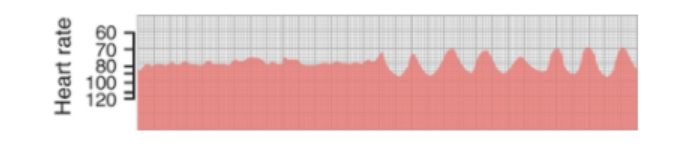
______ ______ ______ - results from spillover of signals from medullary respiratory center into adjacent vasomotor center during respiratory cycles
Respiratory Sinus Arrhthymia
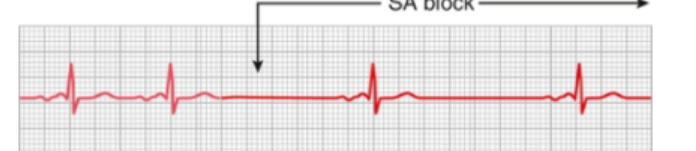
______ ______ ______ – rare, seen on ECG by P wave disappearance & slower impulse generation due to AV node taking over as pacemaker
SA nodal block
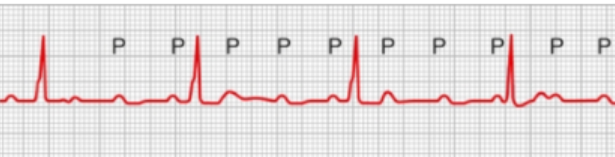
ventricles spontaneously establish own signal
p-wave becomes dissociated from QRS-T complexs
atrial and ventricular rates are different
3rd degree AV block
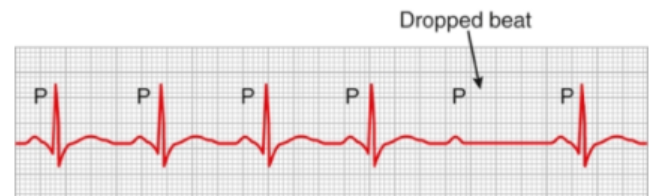
What pathology is shown above?
*hint - ventricles did not depolarize but atria did
2nd dgree AV Block
2nd degree AV block – when AV bundle conduction is slowed enough where sometimes the AP doesn’t pass to the ventricles resulting in _____ _____ (P wave present, QRS complex absent)
dropped beats
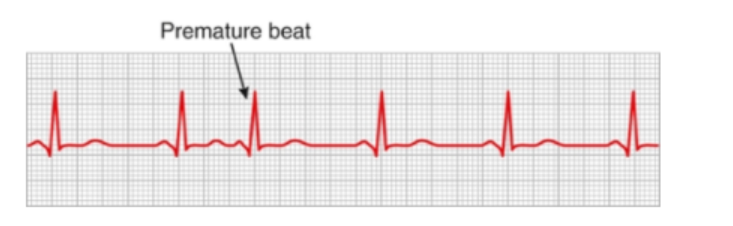
can a premature/ectopic beat occur in normal healthy people?
Yes
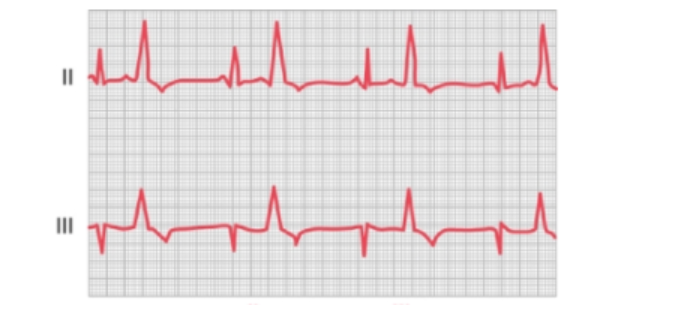
What pathology is shown in the rhthym strip?
Premature Ventricular Contraction
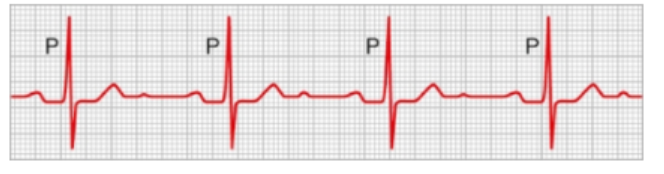
What pathology is shown above?
1st Degree AV Block
prolonged P-R interval, >0.20 sec; results in an incomplete block and typically originates in the AV node
1st degree AV block
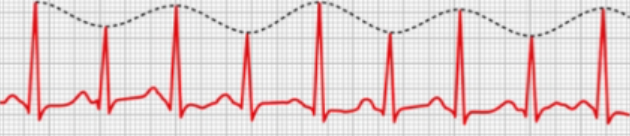
Electrical ________
incomplete intraventricular block. can be due to confitions that depress heart such as ischemia, myocarditis, digitalis toxicity
Electrical Alternans
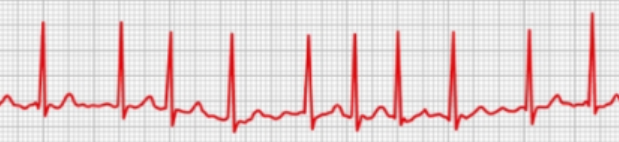
In atrial fibrillaiton is the P wave present?
Is the rate regular or irregular?
no
irregular
What does a circus movement refer to in cardiac muscle?
A. Re-entry of an electrical impulse
B. Complete failure of conduction
C. Increased pacemaker firing
D. Simultaneous ventricular contraction
A. Re-entry of an electrical impulse
During a circus movement, an impulse re-enters what type of tissue?
A. Completely resting tissue
B. Previously excited muscle
C. Necrotic cardiac muscle
D. Unstimulated skeletal muscle
B. Previously excited muscle
Which change can promote a circus movement by giving the impulse a greater distance to travel?
A. Shorter refractory period
B. Faster conduction
C. Longer conduction pathway
D. Increased contractility
C. Longer conduction pathway
Which cardiac condition can create a longer pathway and promote re-entry?
A. Hypertrophic heart
B. Bradycardic heart
C. Normal-sized heart
D. Dilated heart
D. Dilated heart
Which change in electrical conduction can promote a circus movement?
A. Slowed conduction
B. Faster conduction
C. Increased automaticity
D. Increased contractility
A. Slowed conduction
Which condition can slow conduction and promote re-entry?
A. Hypokalemia
B. Purkinje block
C. Increased epinephrine
D. Shortened pathway
A. Hypokalemia
Which two conditions can slow cardiac conduction and promote circus movements?
A. Hypokalemia and exercise
B. Epinephrine and tachycardia
C. Ischemia and hyperkalemia
D. Hypertension and bradycardia
C. Ischemia and hyperkalemia
Which change in the refractory period can promote re-entry?
A. Prolonged refractory period
B. Absent refractory period
C. Unchanged refractory period
D. Shortened refractory period
D. Shortened refractory period
Which substance can shorten the refractory period and promote circus movements?
A. Epinephrine
B. Acetylcholine
C. Adenosine
D. Insulin
A. Epinephrine
Which set contains the three main conditions that promote circus movements?
A. Hypertrophy, fast conduction, long refractory period
B. Long pathway, slow conduction, short refractory period
C. Short pathway, slow rate, long refractory period
D. Fast conduction, short pathway, bradycardia
B. Long pathway, slow conduction, short refractory period
Supraventricular tachycardia includes which two paroxysmal conditions?
A. Atrial and AV nodal tachycardia
B. Ventricular and junctional tachycardia
C. Atrial and ventricular fibrillation
D. Sinus and ventricular tachycardia
A. Atrial and AV nodal tachycardia
Which condition is a type of supraventricular tachycardia?
A. Ventricular fibrillation
B. Atrial paroxysmal tachycardia
C. Torsades de pointes
D. Ventricular tachycardia
B. Atrial paroxysmal tachycardia
Which additional condition is included under supraventricular tachycardia?
A. Sinus bradycardia
B. Ventricular tachycardia
C. AV nodal paroxysmal tachycardia
D. Complete heart block
C. AV nodal paroxysmal tachycardia
Due to AV node aberrant rhythm; causes normal QRS-T complexes but missing/obscured P waves
A. Sinus bradycardia
B. Ventricular tachycardia
C. AV nodal paroxysmal tachycardia
D. Complete heart block
C. AV nodal paroxysmal tachycardia
Paroxysmal supraventricular tachycardia most commonly occurs in which population?
A. Elderly patients with heart failure
B. Adults with prior myocardial infarction
C. Patients with severe valve disease
D. Young, otherwise healthy people
D. Young, otherwise healthy people
What is the usual long-term outcome of this tachycardia predisposition in young patients?
A. Often resolves after adolescence
B. Causes permanent myocardial damage
C. Progresses to heart failure
D. Requires lifelong anticoagulation
A. Often resolves after adolescence
Paroxysmal supraventricular tachycardia usually causes what degree of permanent cardiac harm?
A. Severe permanent damage
B. No permanent harm
C. Progressive valve damage
D. Chronic ventricular failure
B. No permanent harm

_____ _____ _____ – rapid HR with inverted P wave that is partially superimposed onto normal T wave of preceding beat
Atrial paroxysmal tachycardia
Premature contractions can lead to what phenomenon caused by the inability of the ventricles to fill with enough blood resulting in dec stroke volume?
_____ deficit
Pulse deficit
A _____ deficit is the difference between the heart rate counted at the apex (auscultation) and the pulse rate measured at a peripheral site (like the wrist).
pulse
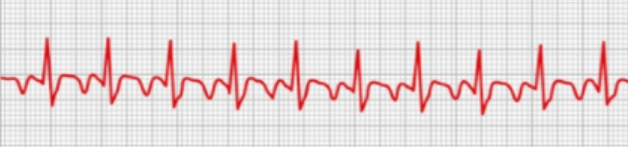
Are p waves present in atrial flutter?
Yes
even tho afib is not ______, pts will have reduced overall ______ pumping ability
fatal
heart
A patient that has Premature Ventricular Contractions is at increased risk for developing what potentially fatal arrthymia?
Ventricular Fibrillation
AV _____ is the only means by which impulses can pass from atria into the ventricles.
AV bundle
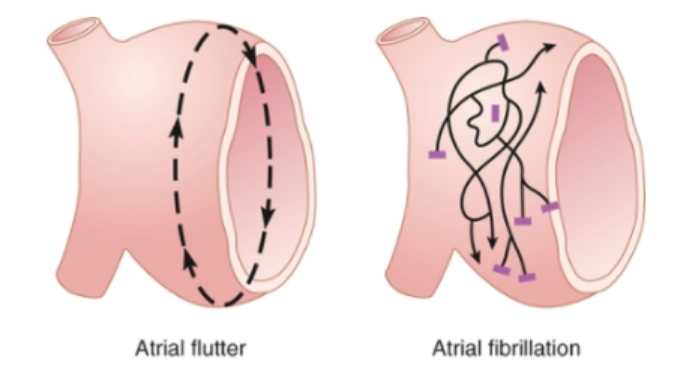
_____ = bunch of random impulses in several diff directions
_____ = single large impulse moving in one direction
Fibrillation
Flutter
increased body temp, increased sympathetic stimulation & toxic heart conditions can cause _______
increased vagal stimulation & in those with carotid sinus syndrome can cause _______
tachycardia
bradycardia
What are the 2 major drug options for Ventricular Tachycardia?
1. _______ (anti-arrythmic) - blocks ____ channels, reduces permeability, blocks rhythmical discharge of focal point
2. _______ (anti-arrythmic) - refractory period prolongation, slows AV conduction via blockage of ____ channels
Lidocaine, Na
Amiodarone, K+
_______ -_______ syndrome:
periodic fainting spells due to _______ block; the brain cannot remain active for more than 4-7 sec without blood - results in fainting. pumping does not occur until 5-30 secs when ventricles escape
Stokes-Adams Syndrome
AV block
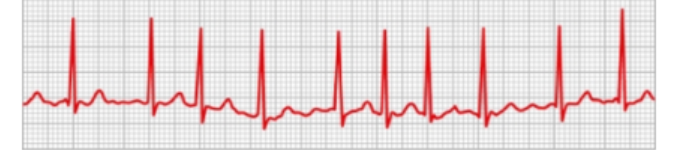
What pathology is shown above?
Atrial Fibrillation
Types of 2nd Degree AV Blocks
1. [...]– fixed number of nonconducted P waves for every QRS complex; caused by abnormality of the bundle of His-Purkinje system, may require pacemaker implantation
2. [...]– characterized by progressive PR interval prolongation until a ventricular beat is dropped & then followed by resetting of PR interval & repeating the abnormal cycle, no tx necessary; almost always caused by abnormality of the AV Node
Type 2
Type I (Wenckebach periodicity)
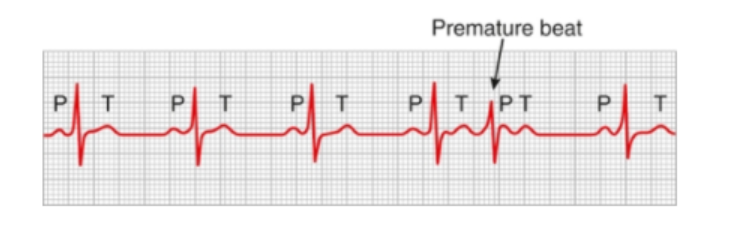
_____ nodal/bundle _____ _____
P wave missing from premature contraction & is superimposed onto QRS-T complex; due to cardiac impulse traveling backwards into the atria as it traveled forwards into ventricles
AV nodal/bundle premature contraction
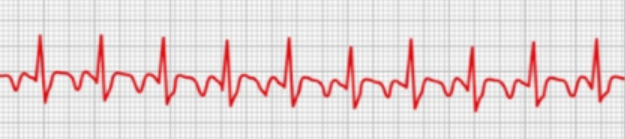
During atrial flutter, one side of atria is _____ while other is _____ , amount of blood pumped by atria is _____.
During atrial flutter, one side of atria is contracting while other is relaxing, amount of blood pumped by atria is slight
What is the mainline treatment for acute Long QT Syndrome?
1. ______ Sulfate
2. ______ -Blockers
3. Cardiac ______ implant --> for long-term/chronic cases
1. Magnesium Sulfate
2. Beta-Blockers
3. Cardiac Defibrillator implant --> for long-term/chronic cases
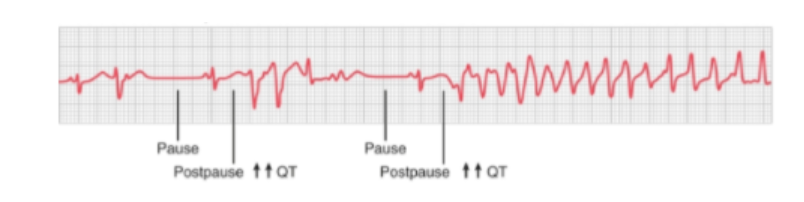
______ ______ ______ = QRS shape changes due to premature beat, pause, then another beat occurs w/ long Q-T interval; triggers arrthymias, tachycardia, v fib
Torsades De Pointes
What electrolytes distrubances can result in Long QT syndromes?
1. Hypo________
2. Hypo________
3. Hypo________
*additionaly Anti-________ drugs
(quinidine) can cause Long-QT syndrome
1. Hypomagenesmia
2. Hypokalemia
3. Hypocalcemia
*additionaly Anti-Arrhythmic drugs
(quinidine) can cause Long-QT syndrome
Rheumatic Fever and Diphtheria can result in what damage to the AV node/bundle?
a.) ischemia
b.) compression
c.) inflammation
c.) inflammation
results in myocarditis
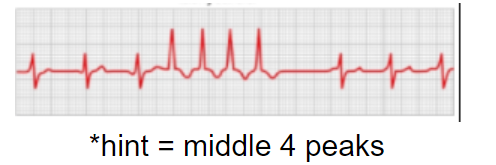
________ ________ ________ – appearance of series of premature ventricular beats w/o any normal beats interspersed; serious condition and doesn't occur unless significant ________ damage is present in the ventricles
Ventricular paroxysmal tachycardia
ischemic
Premature ventricular contraction results in what 3 findings on an ECG?
1. QRS _____ - impulse is conducted thru slowly conducting muscles rather than the Purkinje system
2. _____ QRS (high voltage) - impulses travel in 1 direction (no neutralization)
3. _____ _____ opposite in polarity to QRS
1. QRS prolongation
2. High QRS
3. T wave
What antibiotics (2) can result in the devlopment of Long QT syndrome (disorders that delay ventricular repolarization)?
1. _____
2. _____
1. Fluoroquinolones
2. Erythromycin
How much time must elapse for AV node to pass impulse to ventricles during Atrial Fibrillation?
0.35 seconds
What is the most frequent cause of atrial fibrillation?
_____ enlargement
Atrial Enlargement
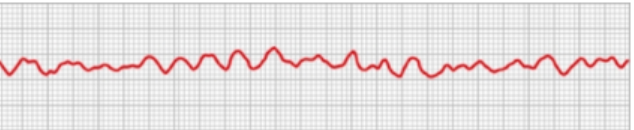
What is this?
Ventricular Fibrillation
What interval and/or complex measurement is useful in determing the severity of Rheumatic Heart Disease?
_____ interval
PR interval
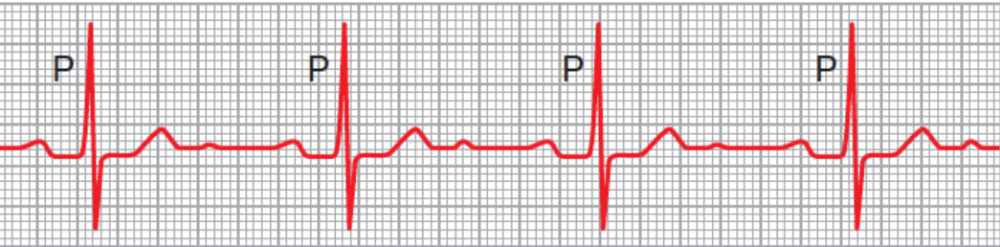
What is this?
first deg av block
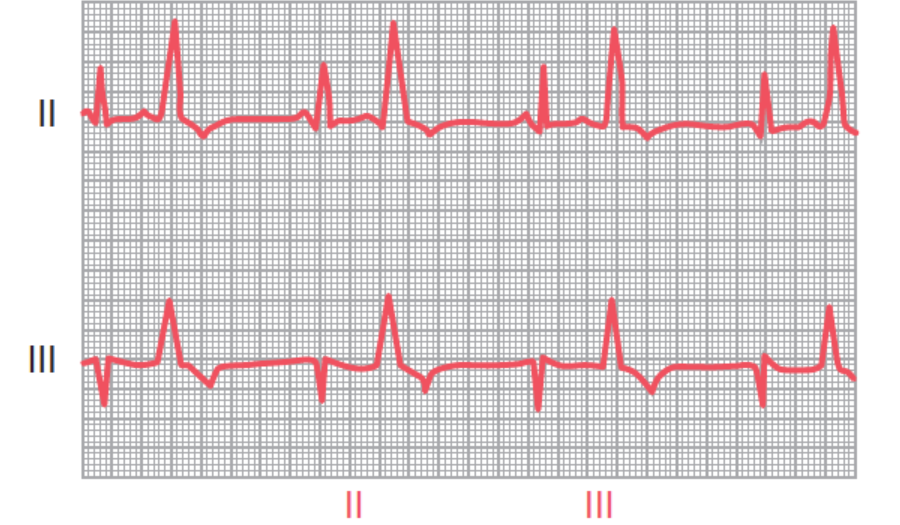
What is this?
Premature ventricular contractions
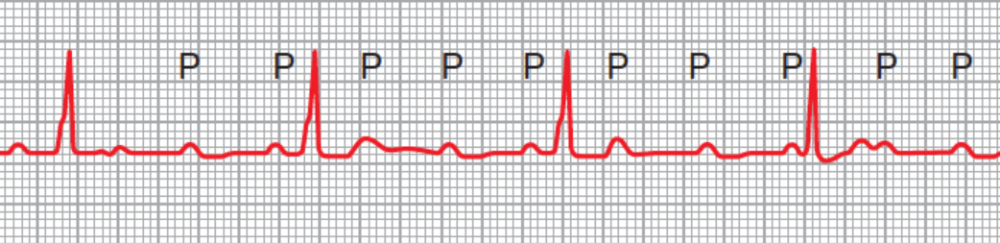
3rd degree AV block
The heart rate usually increases about _____ beats/min for each degree (Fahrenheit) increase in body temperature
10
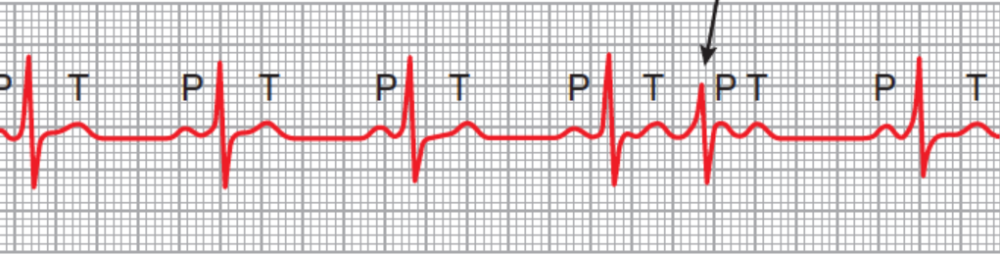
atrioventricular nodal premature contraction
P-R interval usually _______ in length with a faster heartbeat and _______ with a slower heartbeat
decreases
increases
second degree type I block is is _______ and no specific treatment is needed
benign
Which treatment can stop ventricular fibrillation by briefly making all ventricular muscle refractory?
A. Electroshock defibrillation
B. Vagal stimulation
C. Adenosine infusion
D. Carotid massage
A. Electroshock defibrillation
Defibrillation is usually delivered using which waveform?
A. Monophasic
B. Sinusoidal
C. Biphasic
D. Triphasic
C. Biphasic
A patient at high risk for recurrent ventricular fibrillation may receive which device?
A. External pacemaker
B. Holter monitor
C. Loop recorder
D. Implantable cardioverter-defibrillator
D. Implantable cardioverter-defibrillator
What is an important treatment for cardiac arrest?
A. Prolonged CPR
B. Carotid massage
C. Vagal stimulation
D. Exercise
A. Prolonged CPR
Some patients with persistent loss of normal cardiac pacing may require which device?
A. ICD
B. Electronic cardiac pacemaker
C. Coronary stent
D. Prosthetic valve
B. Electronic cardiac pacemaker
After AV conduction suddenly stops, why may the ventricles remain silent for 5–30 seconds?
A. Ventricular fibrillation
B. Complete refractoriness
C. Overdrive suppression
D. Atrial flutter
C. Overdrive suppression
What does overdrive suppression mean?
A. Atria stop firing permanently
B. Purkinje cells fire too rapidly
C. Ventricles become hyperexcitable
D. Ventricular automaticity is temporarily suppressed
D. Ventricular automaticity is temporarily suppressed
Why are ventricular pacemaker cells initially suppressed after AV block?
A. Atria previously drove them faster
B. Ischemia destroys all Purkinje cells
C. Vagus stimulates the ventricles
D. Calcium channels permanently close
A. Atria previously drove them faster
After several seconds of complete AV block, which fibers can begin pacing the ventricles?
A. SA nodal fibers
B. Purkinje fibers
C. Atrial muscle fibers
D. Mitral valve fibers
B. Purkinje fibers
What is the ventricular rhythm produced by Purkinje fibers after AV block called?
A. Atrial escape
B. Sinus escape
C. Ventricular escape
D. Junctional flutter
C. Ventricular escape
A patient becomes markedly bradycardic when mild pressure is placed on the neck. What is the likely diagnosis?
A. Carotid sinus syndrome
B. Atrial flutter
C. Ventricular tachycardia
D. Sinus arrest
A. Carotid sinus syndrome
What causes the bradycardia in carotid sinus syndrome?
A. Sympathetic activation
B. Strong vagal response
C. Purkinje stimulation
D. Increased ventricular automaticity
B. Strong vagal response
Which neurotransmitter mediates the strong cardiac vagal effect in carotid sinus syndrome?
A. Norepinephrine
B. Dopamine
C. Acetylcholine
D. Epinephrine
C. Acetylcholine
Paroxysmal tachycardia is best described as what?
A. Persistent slow rhythm
B. Irregular lifelong rhythm
C. Gradual heart-rate increase
D. Sudden rapid rhythmic discharge
D. Sudden rapid rhythmic discharge
How does paroxysmal tachycardia often end?
A. Ventricles stop contracting
B. SA node regains pacing
C. AV node permanently blocks
D. Purkinje fibers stop working
B. SA node regains pacing
What mechanism is thought to cause many episodes of paroxysmal tachycardia?
A. Valve stenosis
B. Sinus bradycardia
C. Re-entry circus movement
D. Complete AV block
C. Re-entry circus movement
Which maneuver can sometimes stop paroxysmal tachycardia?
A. Exercise
B. Defibrillation always
C. Hyperventilation
D. Vagal reflex
D. Vagal reflex
How can antiarrhythmic drugs help stop re-entry tachycardia?
A. Slow conduction and prolong refractoriness
B. Increase conduction and shorten refractoriness
C. Increase automaticity
D. Shorten action potentials
A. Slow conduction and prolong refractoriness
Why can ventricular fibrillation become harder to reverse if defibrillation is delayed?
A. Atria become hypertrophied
B. AV node becomes calcified
C. Coronary blood flow becomes inadequate
D. Vagus nerve becomes inactive
C. Coronary blood flow becomes inadequate
If immediate defibrillation fails because the heart has become too weak, what can help before another shock?
A. Carotid pressure
B. Vagal stimulation
C. Exercise
D. CPR
D. CPR
According to these notes, what is the main treatment for atrial fibrillation?
A. Electroshock
B. Pacemaker
C. Carotid massage
D. Beta stimulation
A. Electroshock
Which event can directly initiate cardiac fibrillation?
A. Mild exercise
B. Sudden electrical shock
C. Increased preload
D. Sinus bradycardia
B. Sudden electrical shock
Which cardiac problem can initiate fibrillation?
A. Hypertension
B. Valve prolapse
C. Myocardial ischemia
D. Mild tachycardia
C. Myocardial ischemia
When a depolarization wave encounters refractory tissue, what can it do?
A. Immediately disappear
B. Reverse through the SA node
C. Stop all atrial contraction
D. Travel around the refractory area
D. Travel around the refractory area
Inflammation of which structures can depress conduction from atria to ventricles?
A. SA node and atria
B. AV node or AV bundle
C. Ventricular walls
D. Papillary muscles
B. AV node or AV bundle
Simple weakening of the myocardium usually has what effect on heart rate?
A. Stops it
B. Decreases it
C. Increases it
D. Has no effect
C. Increases it
A P wave without a following QRS-T complex in second-degree heart block represents what?
A. Dropped ventricular beat
B. Premature ventricular beat
C. Atrial fibrillation
D. Ventricular escape
A. Dropped ventricular beat
What happens to the QRS complex during a premature ventricular contraction?
A. Becomes shorter
B. Becomes prolonged
C. Disappears
D. Becomes normal
B. Becomes prolonged
Amiodarone has what effect on the cardiac action potential?
A. Shortens it
B. Eliminates it
C. Prolongs it
D. Does not affect it
C. Prolongs it
Amiodarone has what effect on the refractory period?
A. Shortens it
B. Eliminates it
C. Leaves it unchanged
D. Prolongs it
D. Prolongs it
Amiodarone also slows conduction through which structure?
A. AV node
B. Aortic valve
C. SA artery
D. Coronary sinus
A. AV node
In atrial flutter, approximately how many atrial beats occur for each ventricular beat?
A. One
B. Two to three
C. Five to six
D. Eight to ten
B. Two to three
Which form of paroxysmal tachycardia is usually considered particularly serious?
A. Atrial
B. AV nodal
C. Ventricular
D. Sinus
C. Ventricular
Premature contractions can commonly be mechanically triggered during which procedure?
A. Bronchoscopy
B. Colonoscopy
C. Lumbar puncture
D. Cardiac catheterization
D. Cardiac catheterization
Which condition can create an ectopic focus and cause premature beats?
A. Local ischemia
B. Increased sleep
C. Mild exercise
D. Increased vagal tone
A. Local ischemia
How can small calcified plaques promote premature beats?
A. Block all blood flow
B. Irritate nearby cardiac fibers
C. Increase refractory periods
D. Suppress all pacemakers
B. Irritate nearby cardiac fibers
Which type of irritation can create ectopic foci in the AV node, Purkinje system, or myocardium?
A. Mechanical exercise
B. Increased oxygen delivery
C. Toxic irritation
D. Decreased preload
C. Toxic irritation
Which group contains possible causes of toxic ectopic irritation?
A. Exercise, sleep, water
B. Hypotension, anemia, fever
C. Calcium, sodium, potassium
D. Infection, drugs, nicotine, caffeine
D. Infection, drugs, nicotine, caffeine
Most patients with Stokes-Adams attacks are treated with what?
A. Artificial pacemaker
B. Defibrillation every day
C. Vagal stimulation
D. Carotid massage
A. Artificial pacemaker
During ventricular fibrillation, despite massive movement of stimulatory signals throughout the ventricles, the ventricular chambers neither _____ nor _____ but remain in an indeterminate stage of partial contraction, pumping either no blood or negligible amounts
enlarge
contract
Atrial flutter causes fast _____ signals, but the A-V node blocks many of them so the ventricles do not beat too fast.
atrial
when the P-R interval increases to greater than ______ second, the P-R interval is said to be prolonged and the patient is said to have ______-degree incomplete heart block
0.20
first-degree
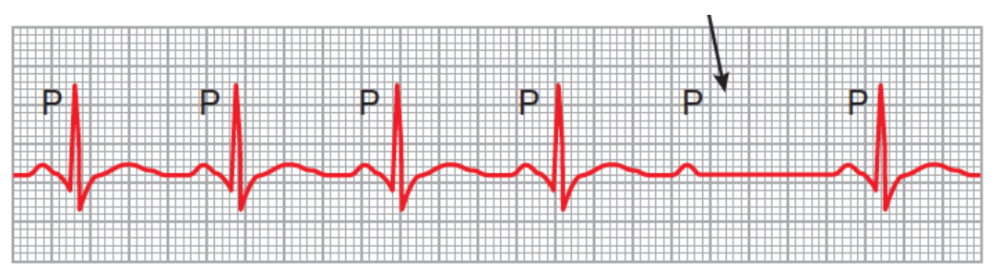
What is this?
second degree AV block
people at risk for ventricular fibrillation will have a _____ implanted
pacemaker
second degree type I block is characterized by progressive ______ of the PR interval until a ventricular beat is dropped and is then followed by resetting of the PR and repeating of the abnormal cycle
prolongation
during rapid stimulation of the heart, the velocity of conduction through the heart muscle ______, which allows a longer time interval for the impulses to travel around the heart
decreases
When the heart contracts ahead of schedule, the ventricles will not have filled with blood normally, and the stroke volume output during that contraction is depressed or almost absent.
Therefore, the ______ may be so weak that it cannot be felt in the radial artery
pulse
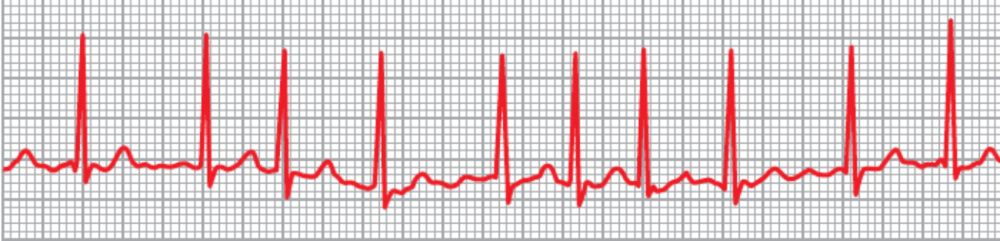
what does this EKG show?
afib
The paroxysm usually ends as suddenly as it began, with the pacemaker of the heart instantly shifting back to the ______ node
sinus
What can compress the AV bundle and block conduction from the atria to the ventricles?
A. Scar tissue or calcification
B. Increased vagal tone
C. High cardiac output
D. Atrial dilation
A. Scar tissue or calcification
Which area of the neck can be pressed to trigger a vagal reflex that may stop paroxysmal tachycardia?
A. Jugular veins
B. Carotid sinuses
C. Thyroid cartilage
D. Supraclavicular fossa
B. Carotid sinuses
What does a cardiotachometer measure from the ECG?
A. P-wave amplitude
B. QRS width
C. Time between QRS complexes
D. ST-segment elevation
C. Time between QRS complexes
After a premature atrial contraction, the next normal beat is slightly delayed. What is this called?
A. Ventricular escape
B. Heart block
C. Overdrive suppression
D. Compensatory pause
D. Compensatory pause
Coronary insufficiency can impair conduction by causing ischemia of which structures?
A. AV node and bundle
B. SA node and atria
C. Papillary muscles
D. Ventricular septum
A. AV node and bundle
Why can cardiac arrest occur during deep anesthesia?
A. Excessive coronary blood flow
B. Severe hypoxia from poor breathing
C. Increased ventricular filling
D. Increased sympathetic stimulation
B. Severe hypoxia from poor breathing
During fibrillation, what happens when an impulse reaches another refractory area?
A. It always stops
B. It returns to SA node
C. It splits into more impulses
D. It causes AV block
C. It splits into more impulses