In peripheral tissues, CO₂ binds directly to amino groups on hemoglobin. What compound is formed?
A. Carboxyhemoglobin
B. Carbaminohemoglobin
C.
Methemoglobin
D. Oxyhemoglobin
B. Carbaminohemoglobin
Why is CO₂ readily released from hemoglobin in the lungs?
A. Oxygenation decreases hemoglobin CO₂ affinity
B.
Deoxygenation decreases hemoglobin CO₂ affinity
C. Acidosis
increases hemoglobin CO₂ binding
D. Bicarbonate permanently
binds hemoglobin
A. Oxygenation decreases hemoglobin CO₂ affinity
Why does O₂ diffuse from alveoli into pulmonary capillary blood?
A. Blood PO₂ exceeds alveolar PO₂
B. Alveolar PO₂ exceeds
blood PO₂
C. Alveolar PCO₂ exceeds blood PCO₂
D.
Hemoglobin actively transports oxygen
B. Alveolar PO₂ exceeds blood PO₂
Pulmonary capillary blood enters the lungs with a PO₂ of 40 mmHg. Alveolar PO₂ is 100 mmHg. What happens next?
A. O₂ diffuses into alveoli
B. CO₂ diffuses into blood
C. O₂ diffuses into blood
D. Oxygen diffusion immediately stops
C. O₂ diffuses into blood
Under normal conditions, oxygen is carried to the tissues almost entirely by _______
hemoglobin
Compared with O₂, how rapidly can CO₂ diffuse across the respiratory membrane?
A. About 5 times faster
B. About 10 times faster
C.
About 20 times faster
D. About 40 times faster
C. About 20 times faster
Why does pulmonary O₂ diffusing capacity increase during exercise?
A. Alveolar walls become thinner
B. More pulmonary
capillaries are recruited
C. Oxygen becomes more soluble
D. Hemoglobin concentration rapidly increases
B. More pulmonary capillaries are recruited
Exercise improves O₂ diffusion partly by improving which relationship, especially in the upper lungs?
A. Pleural pressure gradient
B. Plasma oncotic
pressure
C. Airway resistance gradient
D.
Ventilation-perfusion matching
D. Ventilation-perfusion matching
If the blood flow through a particular tissue is increased, greater quantities of O2 are transported into the tissue and the tissue PO2 becomes _______.
higher
Why do venous RBCs contain more chloride than arterial RBCs?
A. Chloride replaces exiting bicarbonate
B. Chloride binds
directly to CO₂
C. Chloride buffers hydrogen ions
D.
Chloride increases oxygen affinity
A. Chloride replaces exiting bicarbonate
In systemic tissues, which ion movement defines the chloride shift?
A. Chloride exits, bicarbonate enters
B. Chloride enters,
bicarbonate exits
C. Sodium enters, chloride exits
D.
Potassium exits, bicarbonate enters
B. Chloride enters, bicarbonate exits
Why is the respiratory quotient lower during fat metabolism?
A. Less oxygen is consumed
B. More bicarbonate is
retained
C. More oxygen is used per CO₂
D. Less ATP is produced
C. More oxygen is used per CO₂
The carbonic acid formed when CO2 enters the blood in the peripheral tissues _______ the blood pH
decreases
When a person is using exclusively carbohydrates for body metabolism, R rises to ______
1.0
Why does O₂ diffuse from systemic capillaries into surrounding tissues?
A. Tissue PO₂ exceeds capillary PO₂
B. Capillary PO₂ exceeds
tissue PO₂
C. Tissue PCO₂ exceeds capillary PCO₂
D.
Capillary PCO₂ exceeds tissue PCO₂
B. Capillary PO₂ exceeds tissue PO₂
Cellular metabolism causes intracellular PCO₂ to rise. What happens next?
A. CO₂ diffuses into tissue capillaries
B. CO₂ diffuses into
surrounding cells
C. O₂ diffuses into venous blood
D. O₂
remains inside capillaries
A. CO₂ diffuses into tissue capillaries
Which direction does oxygen normally move in systemic tissues?
A. Cells to capillary blood
B. Alveoli to tissue cells
C. Capillary blood to cells
D. Cells to lymphatic vessels
C. Capillary blood to cells
Which statement best explains tissue gas exchange?
A. Both gases move into cells
B. Both gases move into
blood
C. O₂ enters cells, CO₂ enters blood
D. CO₂ enters
cells, O₂ enters blood
C. O₂ enters cells, CO₂ enters blood
The ________ coefficient is the percentage of blood oxygen that leaves the blood and enters the tissues as blood passes through the capillaries
utilization
If tissue cells increase their oxygen consumption, what happens to interstitial PO₂?
A. It rises
B. It falls
C. It remains unchanged
D. It equals arterial PO₂
B. It falls
Why does increased cellular metabolism promote more O₂ diffusion from blood into tissues?
A. Tissue PO₂ rises
B. Capillary PO₂ falls below
tissue
C. Tissue PO₂ falls further
D. Hemoglobin stops
binding oxygen
C. Tissue PO₂ falls further
Which statement best defines pulmonary shunt flow?
A. Blood bypasses alveolar gas exchange
B. Air bypasses
pulmonary capillaries
C. Blood remains inside alveoli
D.
Oxygen bypasses hemoglobin binding
A. Blood bypasses alveolar gas exchange
Normal physiologic shunting partly occurs because bronchial venous blood:
A. Drains only into right atrium
B. Never enters systemic
circulation
C. Becomes fully oxygenated first
D. Mixes
with oxygenated pulmonary blood
D. Mixes with oxygenated pulmonary blood
During strenuous exercise, the body may require up to 20 times the normal amount of O₂. Despite increased cardiac output shortening pulmonary capillary transit time, arterial blood remains nearly fully oxygenated. What best explains this?
A. Pulmonary blood flow decreases
B. O₂ diffusion has large
safety factor
C. Hemoglobin affinity greatly increases
D.
Alveolar ventilation becomes unnecessary
B. O₂ diffusion has large safety factor
At rest, pulmonary capillary blood remains near the alveoli about three times longer than necessary for complete O₂ saturation. What is the main significance of this reserve?
A. Prevents CO₂ from entering blood
B. Allows oxygenation
during faster blood flow
C. Maintains low pulmonary capillary
PO₂
D. Limits oxygen delivery during exercise
B. Allows oxygenation during faster blood flow
During exercise, increased cardiac output may reduce pulmonary capillary transit time by approximately one-half. Why is this usually not a problem in a healthy person?
A. O₂ saturation normally requires entire transit
B. O₂
diffusion stops after exercise begins
C. Exercise decreases
tissue oxygen requirements
D. Blood normally oxygenates well
before exit
D. Blood normally oxygenates well before exit
Which two factors determine the total amount of O₂ available to tissues?
A. Blood O₂ and blood flow
B. Blood CO₂ and
ventilation
C. Hemoglobin and airway resistance
D.
Ventilation and diffusion distance
A. Blood O₂ and blood flow
Which enzyme rapidly catalyzes the reaction of CO₂ and H₂O to form carbonic acid?
A. Carbonic anhydrase
B. Catalase
C. Carbonic
reductase
D. Cytochrome oxidase
A. Carbonic anhydrase
Carbonic anhydrase is found in especially high concentrations in which cells?
A. Platelets
B. Neutrophils
C. Red blood cells
D. Hepatocytes
C. Red blood cells
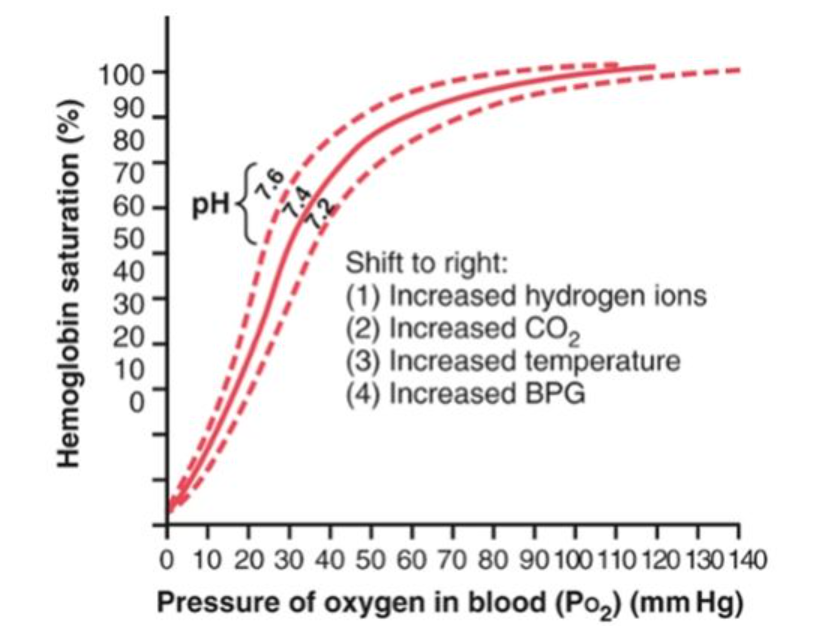
What can cause a shift to the left of the O2-Hb Dissociation curve?
Increase in ______
Increase in ph
Why does blood PO₂ fall from about 104 mmHg to 95 mmHg before entering the left ventricle?
A. Bronchial venous blood mixes in
B. Pulmonary ventilation
suddenly decreases
C. Hemoglobin releases oxygen in veins
D. Carbonic acid consumes dissolved oxygen
A. Bronchial venous blood mixes in
Which blood contributes to the normal venous admixture lowering pulmonary venous PO₂?
A. Coronary arterial blood
B. Bronchial venous blood
C. Pulmonary arterial blood
D. Systemic arterial blood
B. Bronchial venous blood
Why does carbonic acid formation not severely decrease blood pH under normal conditions?
A. Bicarbonate binds all CO₂
B. Hemoglobin buffers most
protons
C. Chloride destroys carbonic acid
D. Oxygen
neutralizes free protons
B. Hemoglobin buffers most protons
Describe the effects of increased or decreased metabolic rate on tissue PCO2:
↑ metabolic rate --> _____ tissue PCO2
↓ metabolic rate
--> _____ tissue PCO2
increased tissue PCO2
decreased tissue PCO2
Describe the effects of increased or decreased blood flow on tissue PCO2:
↓ in BF --> _____ tissue PCO2
↑ in BF --> _____ tissue PCO2
increased tissue PCO2
decreased tissue PCO2
What effect does increased tissue metabolism have on interstitial PO₂?
A. Increases interstitial PO₂
B. Decreases interstitial
PO₂
C. Prevents oxygen diffusion
D. Raises capillary PO₂
B. Decreases interstitial PO₂
What effect does increased tissue blood flow have on interstitial PO₂?
A. Decreases interstitial PO₂
B. Increases interstitial
PO₂
C. Eliminates interstitial oxygen
D. Has no effect
B. Increases interstitial PO₂
In the pulmonary capillaries, oxygen binds to hemoglobin. This makes hemoglobin more acidic and decreases its tendency to bind CO₂ as carbaminohemoglobin. What is the resulting effect?
A. CO₂ is released from hemoglobin
B. CO₂ binds hemoglobin
more strongly
C. Bicarbonate remains trapped in RBCs
D.
Carbonic acid formation is prevented
A. CO₂ is released from hemoglobin
In the lungs, oxygenation of hemoglobin causes H⁺ ions to be released. These H⁺ ions combine with bicarbonate to form carbonic acid, which then dissociates into water and another substance that can diffuse into the alveoli. What is produced?
A. Oxygen
B. Carbon dioxide
C. Chloride
D. Carbaminohemoglobin
B. Carbon dioxide
In most cells, what is the main limiting factor for the rate of metabolic reactions?
A. Oxygen concentration
B. ADP concentration
C. Carbon
dioxide concentration
D. Hemoglobin concentration
B. ADP concentration
Why is oxygen usually not the limiting factor for intracellular metabolism?
A. Cells require very little PO₂
B. Oxygen is produced
intracellularly
C. Hemoglobin enters most cells
D. ADP
directly generates oxygen
A. Cells require very little PO₂
How is most oxygen transported in the blood?
A. Dissolved freely in plasma
B. Bound chemically to
hemoglobin
C. Converted into bicarbonate
D. Bound
primarily to albumin
B. Bound chemically to hemoglobin
Approximately what percentage of blood oxygen is carried bound to hemoglobin?
A. 3%
B. 25%
C. 70%
D. 97%
D. 97%
Approximately what percentage of blood oxygen is transported in dissolved form?
A. 3%
B. 10%
C. 30%
D. 97%
A. 3%
In the lungs, a high PO₂ favors which interaction between oxygen and hemoglobin?
A. Oxygen binds hemoglobin
B. Oxygen leaves hemoglobin
C. Hemoglobin releases BPG
D. Hemoglobin binds carbon dioxide
A. Oxygen binds hemoglobin
In metabolically active tissues, a relatively low PO₂ favors which process?
A. Oxygen release from hemoglobin
B. Oxygen binding to
hemoglobin
C. BPG release from tissues
D. Carbon dioxide
binding oxygen
A. Oxygen release from hemoglobin
During chronic hypoxia, increased BPG shifts the oxygen-hemoglobin dissociation curve rightward. What is the major benefit?
A. Increased oxygen loading in tissues
B. Decreased oxygen
delivery to tissues
C. Increased oxygen unloading in
tissues
D. Decreased hemoglobin oxygen dissociation
C. Increased oxygen unloading in tissues
Increased BPG is especially important as an adaptation to:
A. Hyperoxia
B. Hypoxia
C. Hypercapnia
D.
Respiratory alkalosis
B. Hypoxia
In a pathologic state, cells become located unusually far from nearby capillaries. Oxygen diffusion becomes too slow to maintain adequate intracellular PO₂. What best describes this situation?
A. Blood flow-limited metabolism
B. Oxygen diffusion-limited
metabolism
C. ADP-independent metabolism
D. Carbon
dioxide-limited metabolism
B. Oxygen diffusion-limited metabolism
During oxygen diffusion-limited metabolism, intracellular PO₂ falls below the level required to maintain normal cellular reactions. What no longer primarily determines oxygen use?
A. Intracellular ADP formation
B. Capillary carbon dioxide
level
C. Plasma bicarbonate concentration
D. Hemoglobin
carbon dioxide binding
A. Intracellular ADP formation
Oxygen diffusion-limited metabolism is most likely to occur under which circumstance?
A. Normal resting physiology
B. Routine aerobic
exercise
C. Certain pathologic states
D. Normal
postprandial metabolism
C. Certain pathologic states
Why does CO₂ require a smaller partial-pressure gradient than O₂ for effective diffusion?
A. CO₂ diffuses much more rapidly
B. CO₂ binds hemoglobin
more strongly
C. CO₂ has higher capillary pressure
D. CO₂
requires active transport
A. CO₂ diffuses much more rapidly
After bicarbonate is formed inside an RBC, what normally happens to it?
A. Remains trapped inside RBC
B. Diffuses into the
plasma
C. Binds directly to hemoglobin
D. Converts
immediately into oxygen
B. Diffuses into the plasma
Bicarbonate exits the RBC in exchange for which ion?
A. Sodium
B. Potassium
C. Chloride
D. Calcium
C. Chloride
Which membrane protein allows bicarbonate and chloride to move in opposite directions across the RBC membrane?
A. Sodium-potassium ATPase
B. Bicarbonate-chloride
carrier
C. Calcium ATPase
D. Glucose transporter
B. Bicarbonate-chloride carrier
What 4 factors cause a shift to the right of the O2-Hb Dissociation curve?
Shift to the right (decreased saturation):
_____ pH (increased _____ ions)
_____ CO2
_____ temperature
_____ 2,3-BPG
↓ pH (increased H+ ions)
↑ CO2
↑ temperature
↑ 2,3-BPG
Exercising muscle produces more CO₂ and metabolic acids, increasing H⁺ concentration. What effect does this have on hemoglobin?
A. Increases O₂ affinity
B. Promotes O₂ unloading
C.
Prevents CO₂ formation
D. Promotes O₂ storage
B. Promotes O₂ unloading
Increased tissue temperature during exercise has what effect on oxygen delivery?
A. Promotes O₂ release from hemoglobin
B. Increases
hemoglobin O₂ affinity
C. Prevents oxygen diffusion
D.
Decreases tissue oxygen use
A. Promotes O₂ release from hemoglobin
Which statement best describes the Haldane effect?
A. CO₂ binding promotes O₂ release
B. Bicarbonate binding
promotes CO₂ retention
C. H⁺ binding promotes O₂ loading
D. O₂ binding promotes CO₂ release
D. O₂ binding promotes CO₂ release
The Bohr effect describes:
A. O₂ causing CO₂ release
B. CO₂ promoting O₂ release
C. O₂ increasing bicarbonate formation
D. CO₂ increasing O₂ binding
B. CO₂ promoting O₂ release
A cell develops a higher intracellular ADP concentration during increased metabolic activity. What happens to oxygen usage?
A. Oxygen usage increases
B. Oxygen usage decreases
C.
Oxygen usage stops
D. Oxygen usage remains constant
A. Oxygen usage increases
A decrease in intracellular ADP concentration is associated with:
A. Greater oxygen usage
B. Lower oxygen usage
C.
Greater CO₂ diffusion
D. Increased hemoglobin concentration
B. Lower oxygen usage
How does chloride concentration in venous RBCs compare with arterial RBCs?
A. Lower in venous RBCs
B. Higher in venous RBCs
C.
Equal in both
D. Absent in arterial RBCs
B. Higher in venous RBCs
Why do venous RBCs contain more chloride than arterial RBCs?
A. Chloride increases hemoglobin oxygen affinity
B. Chloride
binds directly to oxygen
C. Chloride converts CO₂ into carbonic
acid
D. Chloride exchanges for exiting bicarbonate
D. Chloride exchanges for exiting bicarbonate
A patient is given a carbonic anhydrase inhibitor, reducing conversion of CO₂ into bicarbonate inside RBCs. What effect is expected on tissue PCO₂?
A. Tissue PCO₂ decreases markedly
B. Tissue PCO₂ rises
substantially
C. Tissue PCO₂ remains unchanged
D. Tissue
PCO₂ falls below arterial levels
B. Tissue PCO₂ rises substantially
Increased tissue metabolism raises both CO₂ and H⁺ concentrations. What happens to the oxygen-hemoglobin dissociation curve?
A. Shifts left
B. Shifts right
C. Becomes
vertical
D. Remains unchanged
B. Shifts right
The rightward shift caused by increased CO₂ and H⁺ is known as which phenomenon?
A. Haldane effect
B. Bohr effect
C. Chloride
shift
D. Shunt effect
B. Bohr effect
Which list correctly identifies the three major forms of CO₂ transport in blood?
A. Dissolved, bicarbonate, carbaminohemoglobin
B.
Bicarbonate, oxyhemoglobin, methemoglobin
C. Dissolved,
chloride, carbonic acid
D. Carbaminohemoglobin, oxygen, chloride
A. Dissolved, bicarbonate, carbaminohemoglobin
What is the major form of CO₂ transport in blood?
A. Dissolved CO₂
B. Bicarbonate
C.
Carbaminohemoglobin
D. Carbonic acid
B. Bicarbonate
Approximately what percentage of CO₂ is transported as bicarbonate?
A. 7%
B. 20%
C. 50%
D. 70%
D. 70%
Approximately what percentage of CO₂ is transported bound to hemoglobin as carbaminohemoglobin?
A. 7%
B. 20%
C. 50%
D. 70%
B. 20%
Carbon monoxide causes severe tissue hypoxia primarily because it:
A. Destroys circulating hemoglobin
B. Competes strongly with
O₂ for hemoglobin
C. Greatly decreases dissolved oxygen
pressure
D. Prevents pulmonary CO₂ diffusion
B. Competes strongly with O₂ for hemoglobin
Why may carbon monoxide poisoning fail to trigger a strong respiratory response to hypoxia?
A. Blood PO₂ may remain normal
B. Blood PCO₂ becomes
extremely low
C. Carbon monoxide blocks chemoreceptors
directly
D. Hemoglobin releases excessive oxygen
A. Blood PO₂ may remain normal