Order the phases of deglutition, starting with what happens first
oral preparatory phase
Oral phase
pharyngeal phase
esophageal phase
..
When administering an oral mechanism exam, and after introducing yourself to your client, typically the first step is to
ask them to sing at least two octaves to assess pitch and range
complete a bedside swallow examination
sanitize your instrumentation
assess the exterior structures of the face and mouth
assess the exterior structures of the face and mouth
Deglutition is another word for
swallowing disorders
mastication
swallowing
oral digestion
swallowing
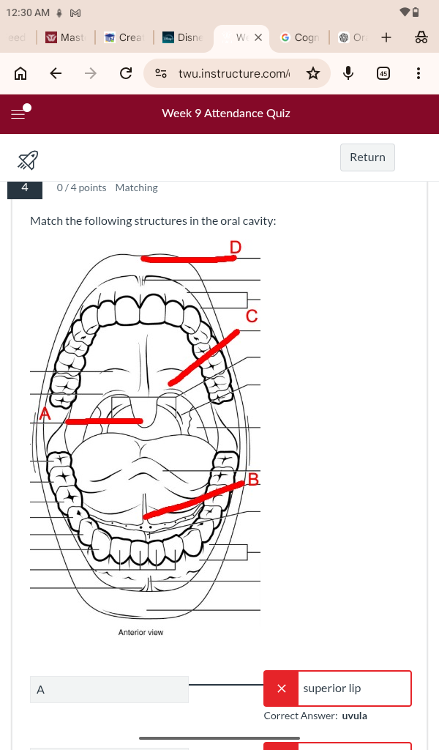
A: uvula
B: lingual frenulum
C: :palatoglossal arch
D: superior lip
..
Review the following statements about the several different classifications of occlusion, and then sort the questions by True or False:
True: In a Class II malocclusion visually presents as a receding chin
False: All malocclusions can cause various challenges in verbal communication
False: The terms “overbite” or “underbite” refer to the protrusion outward horizontally.Correct answer:
False:The terms “overjet” or “underjet” refer to the vertical overlap of the upper and lower teeth
When the lingual frenulum is too short or otherwise malformed, this is
Ankyloglossia
Your 20 deciduous teeth are replaced by Correct answer: (how many) permanent teeth?
32
With oral phonemes, the air escapes from the oral cavity, and with nasal phonemes, it escapes from the nasal cavity.
Correct answer:True
False
True
We open the velopharyngeal port to use the oral tract and close it to use the nasal tract.
TrueCorrect answer:False
False
Review the following statements about resonance, and then sort the questions by True or False:
True
Hypernasal speech is a result of the nasal tract not closing sufficiently.
All the vowels in English are produced with the oral tract open.
False
To produce nasal sounds (e.g /m/, /n/), the levator veli palatini and muscular uvulae close the nasal tract.
:When someone has a head cold, they may sound hypernasal
Review the following statements about the muscles that control the tongue, and categorize them as True or False:
True: Correct answer:The tongue is attached to the mandible, the styloid processes of the temporal bones, and the hyoid bone
False:
The styloglossus originates on the soft palate and elevates the back of the tongue.
Tongue muscles are classified as either external or internal.
The intrinsic muscles move the whole tongue in different directions
- Tongue muscles are classified as either extrinsic or intrinsic.
- The extrinsic muscles move the whole tongue in different directions
- The palatoglossus originates on the soft palate and elevates the back of the tongue.
This muscle allows you to whistle, blow, and suck; and it contributes to the action of
chewing.
orbicularis oris
orbicularis oculi
buccinator
corrugator supercilii
buccinator
This muscle is the primary muscle used for chewing:
masseter
temporalis
medial pterygoid
palatoglossal
masseter
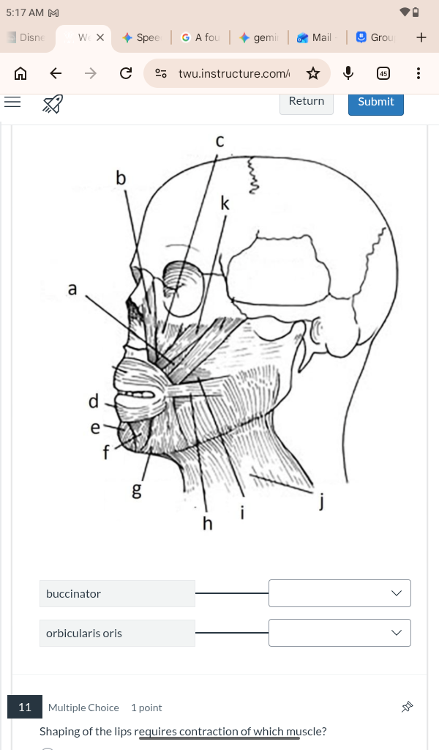
buccinator
orbicularis oris
buccinator: I
orbicularis oris: D
Shaping of the lips requires contraction of which muscle?
orbicularis oris
buccinator
risorius
a & b
orbicularis oris
If you touch your neck with your hand and say “Bob,” you will feel the vibration on your hand at the beginning of the word. This gives you information about
place
space
manner
voicing
voicing
The English sounds /θ/ and /ð/ ("th" in thin and this) are considered:
labio-dental
alveolar
inter-dental
palate-alveolar
inter-dental
Which subsystem acts as the "filter" in the Source-Filter Theory of speech production?
Respiration
Phonation
Articulation and resonance
Audition
Articulation and resonance
According to the Source-Filter Theory, the vocal folds primarily function as the:
filter
resonator
source
articulator
source
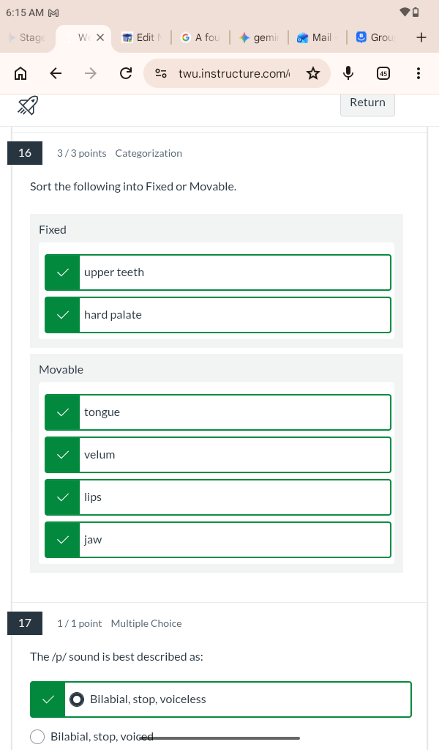
Sort the following into Fixed or Movable.
Fixed:
Upper teeth
Hard palate
Movable:
tongue
velum
lips
:jaw
The /p/ sound is best described as:
Bilabial, stop, voiceless
Bilabial, stop, voiced
Labiodental, fricative, voiceless
Alveolar, stop, voiceless
Bilabial, stop, voiceless
The opening between the oral cavity and the oropharynx is called the:
vestibule
fauces
velum
nasopharynx
fauces
The tongue is considered a muscular hydrostat because it:
Contains cartilage instead of bone
Is composed entirely of smooth muscle
Contains only intrinsic muscles
Has no skeletal support but can move in many directions
Has no skeletal support but can move in many directions
A patient with severe nasal congestion would most likely demonstrate:
hypernasality
hyponasality
aphonia
dysarthria
hyponasality
The process of swallowing is termed dysphagia.
True or False
False
The body’s primary method used to clear the airway from unwanted matter, such as food, saliva, or other foreign matters is the epiglottis.
True
False
False
The term “bolus” refers to the mass of food that is not yet chewed
True
:False
False
What structure inverts to help protect the airway during swallowing?
valleculae
arytenoids
epiglottis
pyriform sinus
epiglottis
You have ____ deciduous teeth that are replaced by _____ permanent teeth.
34; 20
20; 34
20; 32
32; 20
20; 32
During swallowing, what reflexively closes off the entrance to the nasopharynx?
upper esophageal sphincter
epiglottis
soft palate and uvula
epiglottic inversion
soft palate and uvula
In mastication and deglutition, the buccal musculature is not responsible for
Keeping the lips sealed
keeping food or liquid out of the buccal cavity
keeping food or liquid on the molars for chewing
it is responsible for all of the above
Keeping the lips sealed
Preparing food for swallowing is called:
deglutition
trituration
mastication
none of the above
mastication
Which (if any) of the following is not considered part of mastication?
passing the bolus into the pharynx
moving the bolus onto the teeth
mixing the bolus with saliva
all are considered part of the mastication process
passing the bolus into the pharynx
When swallowing, which of the following occurs?
the larynx elevates
the velum elevates
depression of the epiglottis
a & c
a, b, & c
a, b, & c
A patient receiving radiation therapy for head and neck cancer complains that food "sticks" in their mouth and is difficult to swallow. Which condition is MOST likely contributing to this problem?
xerostomia
increased salivation
ankyloglossia
lingual lipase
xerostomia
When you have good velar closure during swallowing
it keeps one from having nasal regurgitation
it keeps post-nasal mucus from entering the airway
it provides a seal for the positive pressure of swallowing
a & c
A&C
Peristalis involves the esophagus creating wave-like motions of both constriction and relaxation of the esophagus.
relaxation
Paralysis of the velum (structure) will result in nasal regurgitation during swallow
Velum
Please match term with descriptor. Realize that some answers may not be used, while others may be used more than once.
In this stage, the bolus makes contact with the faucial pillars.
oral stage
In this stage, the epiglottis lowers to cover the airway.
pharyngeal stage
In this stage, the larynx elevates
pharyngeal stage
In this stage, the bolus is transported toward the pharynx
Oral stage
In this stage, the velum elevates.
pharyngeal stage
In this stage, the vocal folds tightly adduct.
pharyngeal stage
In this stage, food is formed into a bolus
oral preparation stage
In this stage, the lower esophageal sphincter opens
esophageal stage
In this stage, respiration ceases
match:pharyngeal stage
In this stage, the larynx descends
:esophageal stage
Please match term with descriptor. Realize that some answers may not be used, while others may be used more than once.
In this stage, the vocal folds tightly adduct.
match:pharyngeal stage
In this stage, food is formed into a bolus
match:oral preparation stage
In this stage, the lower esophageal sphincter opens
esophageal stage
In this stage, respiration ceases
pharyngeal stage
In this stage, the larynx descends
Esophageal stage
Review the following statements about the structures and function of the pharynx:
True of false
The major regions of the pharynx are the primary-pharynx, the oropharynx, and the laryngopharynx.
False
True or false
The uvula is located between the nasopharynx and the oropharynx.
False
True or false
The eustachian tube drains into the oropharynx
True
The oropharynx contains the palatine tonsils, linguals, and adenoids.
True or false
False
The laryngopharynx is located anteriorly in relation to the larynx.
True or false
False
Speech-language pathologists are only allowed to evaluate and treat swallowing under a physician's supervision.
True or false
False
A patient coughs immediately after taking a sip of water. Which statement BEST explains the purpose of the cough?
It moves food into the esophagus.
It clears material from the airway.
It closes the nasopharynx.
It increases saliva production
It clears material from the airway
Which stage of the swallow is under voluntary control?
Oral stage
Pharyngeal stage
Esophageal stage
All of the above
Oral stage