occipital lobe
processing visual information
cerebellum
coordinating voluntary movement, balance, and motor learning
major relay station for most sensory information traveling to the cerebral cortex
thalamus
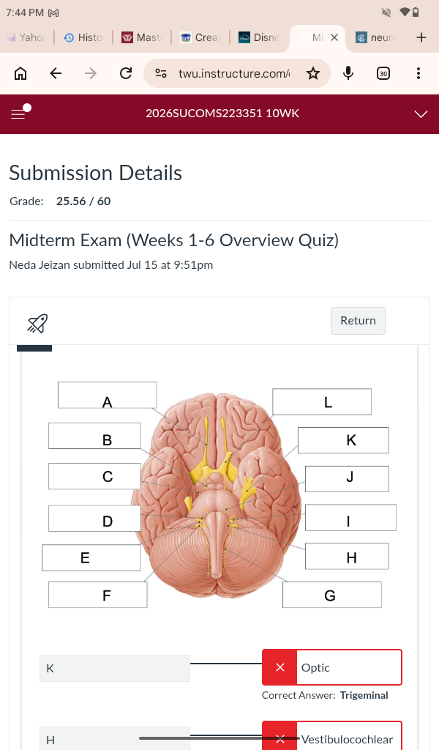
..
K-Trigeminal
H-Hypoglossal
F-Vagus
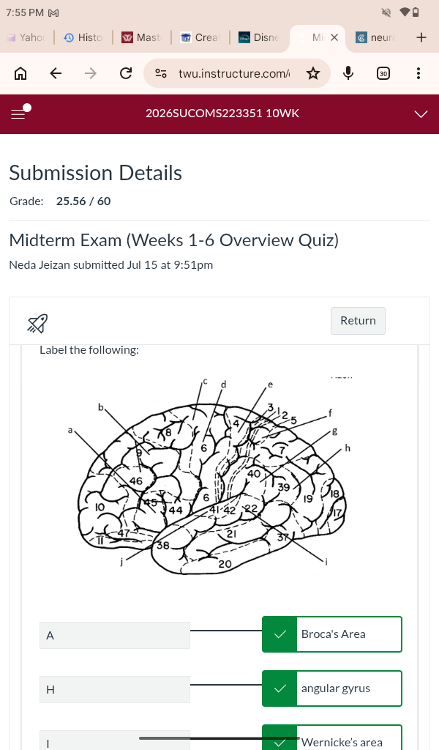
..
A. Broca's Area
H. angular gyrus
I. Wernicke’s area
Assign the characteristics to the following categories
Efferent
auditory information sent from your ears to your brain
receptor sending information that the pan you touched is too hot
Afferent
message sent to muscles controlling your arm and hand to pick up a pan
nerve impulses sent from your brain to move your hand away from a hot pan
confined to the surface
superficial
Farther from the point of attachment or origin of an appendicular structure
distal
below or closer to the ground
inferior
related to the side
lateral
This term means "bending at a joint
flexion
on one's back
supine
Another word for somatic is
volitional
primary
secondary
, Not Selected
automatic
volitional
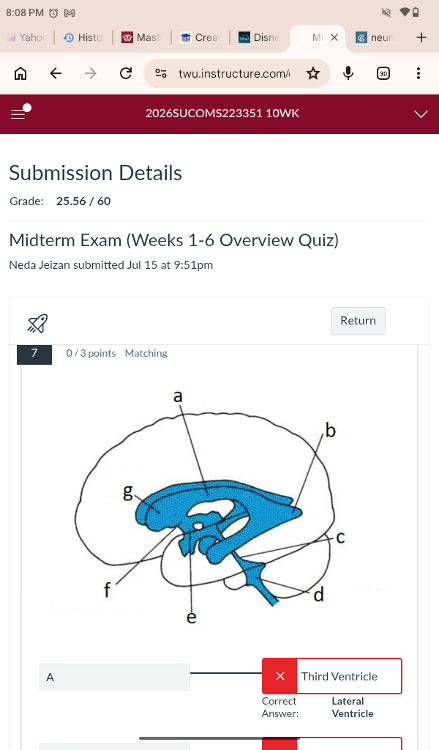
..
A. Lateral Ventricle
D. Fourth Ventricle
E. Third Ventricle
In order from inferior to superior, the three subsystems of speech production are:
Incorrect answer:
- articulation/resonance
respiration
phonation
- respiration
phonation
articulation/resonance
- phonation
respiration
articulation/resonance
- respiration
phonation
articulation/resonance
- respiration
- phonation
- articulation/resonance
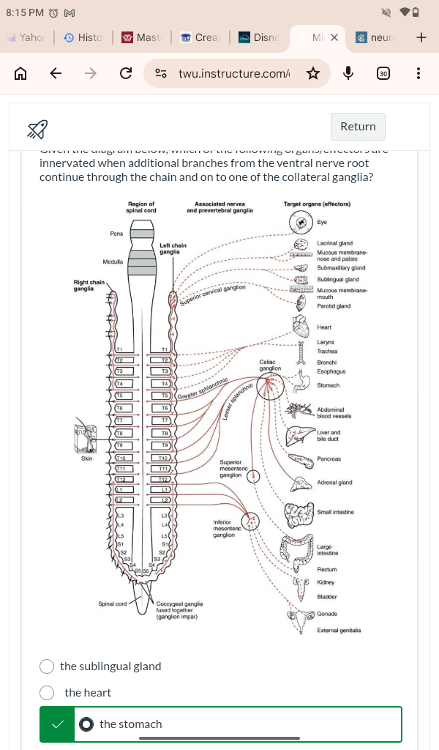
Given the diagram below, which of the following organs/effectors are innervated when additional branches from the ventral nerve root continue through the chain and on to one of the collateral ganglia?
the sublingual gland
the heart
the stomach
the larynx
stomach
The clavicle (commonly known as your collarbone) belongs to which division of the skeleton?
axial,
appendicular,
vertebral
cranial
appendicular
Cerebrospinal fluid is produced primarily by the:Central canal,
Central canal
Choroid plexus,
Median aperture,
Lateral apertures
Choroid plexus
An SLP is evaluating a patient who coughs while drinking thin liquids after a stroke. The clinician wants to visualize all phases of swallowing in real time using X-ray imaging. Which procedure would be MOST appropriate?
PET,
CT
Videofluoroscopy
MRI,
Ultrasonography,
Laryngoscopy
Videofluoroscopy
Which functional division of the nervous system is primarily responsible for voluntary skeletal muscle movement?
Autonomic nervous system ,
Somatic nervous system ,
Cerebral cortex
Thalamus
Somatic nervous system
A collection of neuron cell bodies located in the Peripheral Nervous System is called
Ganglion
Myelin,
Nucleus,
White matter
Ganglion
The cerebral cortex is composed primarily of which type of nervous tissue?
White matter,
Gray matter
Gray and white matter equally,
None of these
Gray matter
A patient has a neurological disorder that damages both the cells responsible for transmitting electrical impulses and the cells that support and protect those signaling cells. Which two cell types are primarily affected?
Cranial and spinal cells
, central and peripheral cells,
:Neurons and glial cells
Epithelial cells and muscle cells
Neurons and glial cells
Which division of the nervous system includes all nervous tissue outside the brain and spinal cord?
Central nervous system,
nervous system,
Respiratory system,
:Peripheral nervous system
Peripheral nervous system
An SLP lightly touches a patient's lips during a cranial nerve examination. The sensory information traveling from the lips to the brain is carried by afferent pathways.
True
False
True
Which structure selectively allows nutrients such as glucose and amino acids to enter nervous tissue while restricting many potentially harmful substances?
Amino acids,
Circle of Willis,
:Myelin sheath
Blood-brain barrier
Blood-brain barrier
Which glial cells primarily provide general support to neurons in the CNS and PNS, respectively?
Astrocytes and satellite cells
Oligodendrocytes and Schwann cells
Microglia and ependymal cells,
Neurons and astrocytes
Astrocytes and satellite cells
A clinician is interested in how the vocal folds vibrate during speech rather than where they are located. Which field is being studied?
physiology,
dissection,
anatomy
endocrinology
physiology
Which plane divides the body into left and right portions?
Sagittal
Coronal,
Transverse,
Oblique
Sagittal
Which movement bends a joint?
Flexion,
Extension,
Abduction,
Rotation
Flexion
Which three subsystems are required for normal speech production?
Hearing, cognition, and articulation/resonance
,Respiration, phonation, and articulation/resonance
Respiration, hearing, and swallowing,
Phonation/resonance, hearing, and cognition
Respiration, phonation, and articulation/resonance
After deciding to tell a friend about her vacation, a speaker chooses the appropriate words and sentence structure. Which level of communication is primarily involved?
Cognitive,
Linguistic
Acoustic,
Physiological
Linguistic
Which of the following is NOT one of the four levels involved in verbal communication?
Cognitive,
Linguistic,
Physiological
Emotional
Emotional
An SLP is working with a patient recovering from a stroke. Which tissue type was directly damaged, leading to impaired communication between the brain and the muscles used for speech?
epithelial
nervous
connective,
muscular,
nervous
A client is asked to repeat the sentence, "Today is a beautiful day." Producing the spoken response is considered part of:
Receptive language,
:Expressive language
Sensory reception
Auditory processing
:Expressive language
Pain from a ruptured spleen is often felt in the left shoulder because irritation of the __________ is interpreted as pain from the shoulder.
vagus nerve
Diaphragm via the phrenic nerve
stomach via the splanchnic nerves,
Brachial plexus
Diaphragm via the phrenic nerve
Which statement best distinguishes a neurotransmitter from a hormone?
Neurotransmitters are produced only in the brain, whereas hormones are produced only in glands.,
Neurotransmitters are released at synapses, whereas hormones are released into the bloodstream.
Hormones act more quickly than neurotransmitters.,
Neurotransmitters can only affect skeletal muscle
Neurotransmitters are released at synapses, whereas hormones are released into the bloodstream.
Which structure releases epinephrine (adrenaline) directly into the bloodstream during a sympathetic response?
Superior cervical ganglion
Adrenal medulla
Adrenal medulla,
Hypothalamus
Adrenal medulla
Which neurotransmitter is released by all preganglionic neurons of the autonomic nervous system?
Acetylcholine
Norepinephrine,
Epinephrine,
Dopamine
Acetylcholine
In the parasympathetic nervous system, which fibers are longer?
Preganglionic fibers
Postganglionic fibers
Preganglionic fibers
Which term refers to maintaining a stable internal environment despite changes inside or outside the body?
Rest and digest
Homeostasis
Sympathetic activity,
Parasympathetic activity,
Homeostasis
A medication blocks the release of norepinephrine from sympathetic neurons. Which effect would MOST likely occur?
Increased heart rate,
Reduced fight-or-flight responses,
Increased sweating
Pupil dilation
Reduced fight-or-flight responses
A neuron that extends from the CNS to an autonomic ganglion is called a:
Postganglionic neuron
Preganglionic neuron
Adrenergic neuron,
Cholinergic neuron
Preganglionic neuron
Which of the following is not one of the three collateral (prevertebral) ganglia that supply autonomic innervation to abdominal organs?
Celiac ganglion,
Cervical ganglia,
Superior mesenteric ganglion,
Inferior mesenteric ganglion
Cervical ganglia
A patient has an injury at C6. Which spinal region is affected?
thoracic,
cervical
Lumbar,
dsacral
cervical
During a fight-or-flight response, which of the following would NOT be expected?
Pupils constrict.
Digestive activity decreases.
Sweating increases.
Glucose is released into the bloodstream.
Pupils constrict
A college student suddenly hears a fire alarm during an exam. Which division of the autonomic nervous system is primarily responsible for the immediate increase in heart rate and alertness?
Parasympathetic division
Sympathetic division
Enteric division,
Somatic division
Sympathetic division
The autonomic nervous system (ANS) is best described as:
Part of the CNS,
A system responsible only for "rest and digest" responses
A motor system that regulates involuntary body functions
Another name for the peripheral nervous system,
A motor system that regulates involuntary body functions
A patient has damage to the ventral root of a spinal nerve but an intact dorsal root. Which finding is MOST likely?
Loss of movement with preserved sensation,
Loss of sensation with normal movement
Loss of movement with preserved sensationLoss of both movement and sensation,
Difficulty understanding spoken language
Loss of movement with preserved sensation
A patient demonstrates tongue weakness during speech but has intact facial sensation and hearing. Which type of fibers is MOST likely impaired?
Sensory fibers only,
Motor fibers only
Mixed sensory and motor fibers,
Autonomic fibers only
Motor fibers only
Which cranial nerve completes the list of nerves most directly involved in speech, hearing, and swallowing? VII, VIII, IX, X, XI, XII, ______
Oculomotor nerve,
Abducens nerve,
Trigeminal nerve
Trochlear nerve
Trigeminal nerve
Incoming auditory information is first processed in the:
Postcentral gyrus,
Precentral gyrus,
:Heschl's gyrus
Angular gyrus
Heschl's gyrus
Which nerves leave the spinal cord as combined sensory and motor fibers before separating into dorsal and ventral roots?
Peripheral nerves,
Cranial
Spinal nerves,
Autonomic nerves
Spinal nerves
An SLP explains to a student that some cranial nerves carry only sensory information, some carry only motor information, and others carry both. How many cranial nerves fall into each category?
3 motor, 4 mixed, 5 sensory
5 motor, 4 mixed, 3 sensory
5 motor, 3 mixed, 4 sensory
4 motor, 3 mixed, 5 sensory
3 motor, 4 mixed, 5 sensory
The cell bodies of most sensory neurons in cranial and spinal nerves are classified as:
Unipolar,
:Bipolar
Tripolar,
Multipolar
Unipolar
Which imaging procedure allows direct visualization of the vocal folds?
MRI,
CT,
:Laryngoscopy
PET
Laryngoscopy
In the Peripheral Nervous System, bundles of axons are called:
Ganglia
Nerves
Axons,
Electrochemical gradients
Nerves
Which statement BEST describes the Peripheral Nervous System (PNS)?
It includes only the cranial nerves.,
is another name for the enteric nervous system.,
contains the brain and spinal cord.,
It consists of all nervous tissue outside the brain and spinal cord
It consists of all nervous tissue outside the brain and spinal cord
Why is the phrenic nerve clinically important for speech production?
It controls facial expression.,
It carries auditory information.,
:It innervates the diaphragm to provide breath support for speech.
It controls tongue movement
It innervates the diaphragm to provide breath support for speech
Following thyroid surgery, a patient presents with a hoarse voice and difficulty swallowing liquids. Damage to which cranial nerve would BEST explain these findings?
CN V,
CN VII,
CN X,
CN XI
CN X
CN X
A patient demonstrates reduced tongue strength and limited tongue movement during speech. Which cranial nerve should the SLP suspect is impaired?
CN VII,
Not SelectedIncorrect answer:
CN VIII
CN XII
CN X,
CN XII
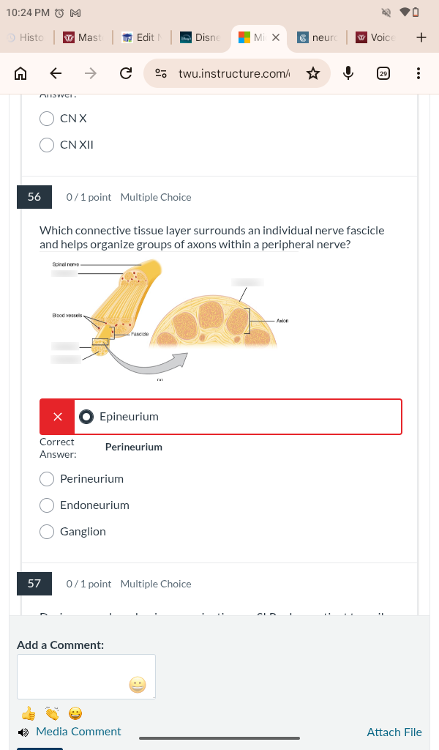
Which connective tissue layer surrounds an individual nerve fascicle and helps organize groups of axons within a peripheral nerve?
Epineurium:
Perineurium,
Endoneurium,
Ganglion
Perineurium
During an oral mechanism examination, an SLP asks a patient to smile, pucker, and stick out their tongue. These tasks primarily assess which type(s) of neural pathways?
Afferent,
Efferent,
Sensory
EfferentInhibitory
Efferent
A patient speaks fluently and understands spoken language but struggles to repeat phrases accurately. Which structure is MOST likely damaged?
Cerebellum,
Hippocampus,
:Arcuate fasciculus
Occipital lobe
Arcuate fasciculus
A patient hears a telephone ringing but cannot recognize what the sound represents. Which statement BEST describes this deficit?
Sensation is impaired, but perception is intact.
Sensation is intact, but perception is impaired.
Both sensation and perception are impaired.
The autonomic nervous system is impaired
Sensation is intact, but perception is impaired.,
A patient has normal muscle strength but demonstrates slow movement initiation and reduced automatic movements. Which structure is MOST likely impaired?
Corpus callosum,
Occipital lobe,
Basal ganglia,
Hippocampus
Basal ganglia
A cut is described as superficial. What does this mean?
It is near the body's surface.
It is deep within tissue.,
It is toward the midline.,
is toward the head
It is near the body's surface
A person hears a familiar voice but cannot identify who is speaking. This problem is best classified as a deficit in
Sensation,
:Perception
Sympathetic response,
Parasympathetic response
Perception
A patient hears spoken words clearly but cannot comprehend their meaning. Which brain area is MOST likely affected?
Wernicke's area
Heschl's gyrus,
Broca's area,
Thalamus
Wernicke's area
A patient speaks in short, effortful phrases but follows spoken directions accurately. Damage to which brain region BEST explains this pattern?
Wernicke's area,
Heschl's gyrus,
Broca's area,
Thalamus
Broca's area
The term efferent describes pathways that primarily carry:
Sensory information toward the CNS,
Motor commands away from the CNS
Blood to nervous tissue,
Cerebrospinal fluid
Motor commands away from the CNS
Which part of the brain is primarily responsible for planning and initiating voluntary movement?
Thalamus
Cerebral cortex
Brainstem,
Spinal cord
Cerebral cortex
The cerebellum is primarily responsible for regulating body temperature and hunger, although it also contributes to balance and coordination.
True,
False
False
An SLP evaluating a patient after a right-hemisphere stroke would expect motor weakness to be more prominent on the left side of the body.
True,
False
True
Which structure serves as the primary communication pathway between the left and right cerebral hemispheres?
Longitudinal fissure
Corpus callosum
Central sulcus,
Thalamus
Corpus callosum
A patient has a gradual narrowing of one of the major arteries supplying the brain, but blood flow to the brain remains adequate because blood is rerouted through connecting arteries. Which arterial structure makes this possible?
Carotid artery,
:Blood-brain barrier
Circle of Willis
Foramen magnum
Circle of Willis,