Which scientist created the germ theory of disease?
Frederick Henle
Paul Ehrlich discovered the first antibacterial agent. It was effective against the spirochete responsible for which disease?
Syphilis
The cultivation of which infectious particles was especially important for vaccine development?
Viruses
What are the five large groups of microbes?
Viruses, bacteria, archaebacteria, fungi, parasites
Which type of microbe is considered the smallest infectious particle?
Virus
A microbe cannot replicate independently and must enter a host cell to reproduce. Which type of microbe is this?
Virus
Bacteria most commonly reproduce by which process?
Asexual division
A bacterial isolate has a cell wall with a thick peptidoglycan layer. Which classification best describes it?
Gram-positive bacterium
A bacterial isolate has a cell wall with a thin peptidoglycan layer with an outer membrane. Which classification best describes it?
Gram-negative bacterium
Which statement correctly compares bacteria and fungi?
A. Bacteria are eukaryotes, whereas fungi are prokaryotes
B. Both bacteria and fungi are prokaryotes
C. Bacteria are prokaryotes, whereas fungi are eukaryotes
D. Both bacteria and fungi are viruses
C. Bacteria are prokaryotes, whereas fungi are eukaryotes
A unicellular fungal form replicates asexually. Which fungal form is being described?
A. Mold
B. Yeast
C. Hypha
D. Spore
B. Yeast
A filamentous fungal form can replicate both asexually and sexually. Which fungal form is being described?
A. Yeast
B. Virus
C. Mold
D. Parasite
C. Mold
A physician suspects a parasitic infection. Which two parts of the history are especially useful for identifying possible exposure?
_____ and _____ history
Travel and dietary history
Which organism is always considered pathogenic?
A. Staphylococcus epidermidis
B. Rabies virus
C. Lactobacillus species
D. Bifidobacterium species
B. Rabies virus
Which organism is always considered pathogenic?
A. Bacillus anthracis
B. Candida albicans
C. Staphylococcus aureus
D. Escherichia coli
A. Bacillus anthracis
Which organism is always considered pathogenic?
A. Streptococcus viridans
B. Shigella
C. Clostridium difficile
D. Enterococcus faecalis
B. Shigella
Which organism is always considered pathogenic?
A. Sporothrix schenckii
B. Saccharomyces cerevisiae
C. Aspergillus fumigatus
D. Candida albicans
A. Sporothrix schenckii
Most human diseases are produced by organisms from which source?
A. Soil reservoirs
B. Arthropod vectors
C. The person’s own microbial flora
D. Hospital water systems
C. The person’s own microbial flora
A single organism is able to cause endocarditis, pneumonia, wound infections, and food poisoning. Which organism is most likely responsible?
Staphylococcus aureus
Which condition can be caused by viruses, bacteria, fungi, and parasites?
A. Meningitis
B. Tetanus
C. Gas gangrene
D. Scarlet fever
A. Meningitis
A patient has a bacterial infection with elevated serum inflammatory markers. Which two proteins are most likely increased?
A. Albumin and transferrin
B. C-reactive protein and procalcitonin
C. Hemoglobin and ferritin
D. Troponin and myoglobin
B. C-reactive protein and procalcitonin
The ability of a bacterium to cause disease is usually determined by which microbial property?
A. Ribosomal size
B. Virulence factors
C. Host cell nucleus
D. Fungal morphology
B. Virulence factors
Repetitive microbial structures are recognized by the immune system as which pattern?
A. MHC class I molecules
B. Pathogen-associated molecular patterns
C. Antibody constant regions
D. T-cell receptor domains
B. Pathogen-associated molecular patterns
Pathogen-associated molecular patterns primarily induce which part of the immune system?
A. Innate immune system
B. Humoral memory system
C. Passive immune system
D. Allergic immune system
A. Innate immune system
Extracellular bacterial and fungal structures commonly activate which immune pathway?
A. Complement system
B. Cytotoxic T-cell deletion
C. Somatic hypermutation
D. Central tolerance
A. Complement system
Complement activation at an extracellular bacterial or fungal infection site mainly recruits which cells?
A. Eosinophils and basophils
B. Neutrophils and macrophages
C. B cells and plasma cells
D. Mast cells and erythrocytes
B. Neutrophils and macrophages
Human cells infected with intracellular microbes respond by shutting down cellular processes and activating which type of immune response?
A. Cytolytic cellular responses
B. IgE-mediated allergic responses
C. Antibody neutralization
D. Complement membrane attack
A. Cytolytic cellular responses
Which cells participate in the immune response to intracellular microbial infection?
A. NK cells, T cells, and macrophages
B. Neutrophils, eosinophils, and basophils
C. Plasma cells, mast cells, and platelets
D. B cells, erythrocytes, and fibroblasts
A. NK cells, T cells, and macrophages
What is the best way to protect an individual from infection?
A. Broad-spectrum antibiotics
B. Prevent exposure or contact
C. Increase microbial flora
D. Activate complement directly
B. Prevent exposure or contact
After preventing exposure or contact, what is the second-best measure for protecting an individual from infection?
A. Immunization against the microbe
B. Suppression of inflammation
C. Elimination of normal flora
D. Delayed antibiotic therapy
A. Immunization against the microbe
Which description best defines dimorphic fungi?
A. Yeast in the environment and mold in the body
B. Mold in the environment and spherical form in the body
C. Bacteria in the environment and fungi in the body
D. Parasites in the environment and viruses in the body
B. Mold in the environment and spherical form in the body
Which group contains examples of dimorphic fungi?
A. Candida, Aspergillus, Cryptococcus
B. Histoplasma, Blastomyces, Coccidioides
C. Staphylococcus, Streptococcus, Bacillus
D. Giardia, Entamoeba, Plasmodium
B. Histoplasma, Blastomyces, Coccidioides
A unicellular organism lacks a nuclear membrane, mitochondria, Golgi complex, and endoplasmic reticulum. It reproduces asexually. What type of organism is this?
A. Eukaryotic organism
B. Prokaryotic organism
C. Dimorphic fungus
D. Multicellular parasite
B. Prokaryotic organism
Which feature is characteristic of a prokaryotic organism?
A. Well-defined nucleus
B. Mitochondria
C. No nuclear membrane
D. Endoplasmic reticulum
C. No nuclear membrane
An organism contains a well-defined nucleus, mitochondria, Golgi bodies, and endoplasmic reticulum. What type of organism is this?
A. Prokaryotic organism
B. Eukaryotic organism
C. Virus
D. Prion
B. Eukaryotic organism
Which feature is characteristic of eukaryotic organisms but not prokaryotic organisms?
A. Asexual reproduction
B. Well-defined nucleus
C. Cell membrane
D. Ribosomes
B. Well-defined nucleus
Microbes in the Human Microbiome Project were identified using sequencing of targeted regions of which gene?
A. 23S ribosomal RNA gene
B. 16S ribosomal RNA gene
C. 16S messenger RNA gene
D. 23S messenger RNA gene
B. 16S ribosomal RNA gene
Which body site has the greatest taxonomic and genetic diversity of microbes?
Intestine
Which body site has the least taxonomic and genetic diversity of microbes?
Vagina
____ microbiome: Species present at a ____ ____ in 95% or more of individuals
Core
specific site
Which function is provided by the normal microbiome?
A. Destroying all innate immune activity
B. Preventing colonization by unwanted pathogens
C. Eliminating the need for adaptive immunity
D. Preventing all bacterial growth
B. Preventing colonization by unwanted pathogens
Which function is provided by the microbiome in its symbiotic relationship with the host?
A. Producing needed metabolic functions
B. Blocking mucin production
C. Preventing IgA production
D. Inhibiting all immune stimulation
A. Producing needed metabolic functions
The microbiome helps the host by stimulating which part of the immune system?
_____ immunity
Innate immunity
Most body sites are colonized by which type of bacteria due to low oxygen availability?
A. Obligate aerobic bacteria
B. Anaerobic or facultative anaerobic bacteria
C. Acid-fast bacteria only
D. Intracellular bacteria only
B. Anaerobic or facultative anaerobic bacteria
Anaerobic and facultative anaerobic bacteria commonly colonize the mouth, intestine, and genitourinary tract because these sites have low levels of what?
Oxygen
What is now a major concern with broad-spectrum antibiotic use?
A. Increased oxygen delivery to tissues
B. Permanent elimination of viruses
C. Disruption of the microbiome
D. Increased fungal cell wall synthesis
C. Disruption of the microbiome
Gut bacteria metabolize complex carbohydrates, including cellulose, into which products?
A. Long-chain triglycerides
B. Short-chain fatty acids
C. Bile acids
D. Ketone bodies
B. Short-chain fatty acids
Which 3 short-chain fatty acids are produced by gut bacterial metabolism of complex carbohydrates?
Propionate, Acetate, Butyrate
Changes in the ratio of Bacteroidetes and Firmicutes can lead to higher efficiency in which process?
A. Destruction of short-chain fatty acids
B. Storage of metabolic by-products
C. Elimination of all carbohydrates
D. Suppression of bacterial metabolism
B. Storage of metabolic by-products
Microbiota prime innate immunity by stimulating production of which protective mucus component?
Mucin
Microbiota prime innate immunity by stimulating production of which antibody at mucosal surfaces?
IgA
Microbiota prime innate immunity by promoting release of which protective molecules?
A. Antimicrobial peptides
B. Thyroid hormones
C. Complement inhibitors
D. Digestive bile salts
A. Antimicrobial peptides
Clostridioides difficile overgrowth after antibiotic exposure causes disease by expressing what?
A. Enterotoxins
B. Exotoxins
C. Urease
D. Collagen cross-linking enzymes
A. Enterotoxins
Antibiotic-associated colitis is classically caused by proliferation of which bacteria after normal flora suppression?
A. Bacteroides fragilis
B. Clostridioides difficile
C. Helicobacter pylori
D. Streptococcus pneumoniae
B. Clostridioides difficile
A gut microbiota efficiently breaks down complex carbohydrates and allows more nutrients to be internalized rather than excreted. This increases susceptibility to what two conditions?
Obesity and metabolic syndrome
A patient has chronic relapsing C. difficile colitis despite treatment. Which therapy can restore a healthier microbiome?
A. Stool transplant
B. Broad-spectrum antibiotics indefinitely
C. Total colectomy as first-line therapy
D. IgE blockade
A. Stool transplant
Necrotizing enterocolitis is an intestinal disease classically seen in which population?
A. Elderly adults
B. Adolescents
C. Infants
D. Pregnant patients
C. Infants
Early-onset necrotizing enterocolitis is associated with dominance of which organisms?
A. Enterobacteriaceae
B. Firmicutes, especially Staphylococcus
C. Saccharomyces species
D. Bacteroides fragilis
B. Firmicutes, especially Staphylococcus
Late-onset necrotizing enterocolitis is associated with dominance of which organisms?
A. Enterobacteriaceae
B. Firmicutes, especially Staphylococcus
C. Lactobacillus species
D. Rabies virus
A. Enterobacteriaceae
______ ______ is associated with increased bacteria that produce mucin-degrading sulfatases.
Ulcerative colitis
Production of which bacterial protein activity is responsible for degradation of the intestinal wall lining?
A. Mucin-degrading sulfatases
B. Hemolysin
C. DNA gyrase
D. Reverse transcriptase
A. Mucin-degrading sulfatases
Which toxic bacterium is a precursor to colonic hyperplasia and colorectal tumors?
______ ______
Bacteroides fragilis
Which 2 organisms are among the most common probiotics?
Gram-positive bacteria and yeasts
Which gram-positive bacterial genera are commonly used as probiotics?
A. Staphylococcus and Streptococcus
B. Bifidobacterium and Lactobacillus
C. Bacillus and Clostridium
D. Corynebacterium and Listeria
B. Bifidobacterium and Lactobacillus
Which yeast is commonly used as a probiotic?
A. Candida albicans
B. Aspergillus fumigatus
C. Saccharomyces
D. Cryptococcus neoformans
C. Saccharomyces
Which two bacterial phyla are especially efficient at breaking down complex carbohydrates in the gut?
A. Actinobacteria and Proteobacteria
B. Bacteroidetes and Firmicutes
C. Spirochetes and Chlamydiae
D. Cyanobacteria and Fusobacteria
B. Bacteroidetes and Firmicutes
Increased abundance of Bacteroidetes and Firmicutes in the gut microbiome improves the breakdown of which dietary component?
A. Complex carbohydrates
B. Nucleic acids
C. Heme iron
D. Steroid hormones
A. Complex carbohydrates
The microbiota can release which two cytokines?
IL-1β and IL-22
Microbiota-induced IL-22 primarily helps protect the host by increasing what? _____ _____
Epithelial resistance
Microbiota-induced IL-1β primarily promotes which immune response?
Recruitment of ______ cells
Recruitment of inflammatory cells
What is the role of Methanobrevibacter smithii in the gut?
Enhances dietary _____ digestion and promotes _____ accumulation
Enhances dietary glycan digestion and promotes fat accumulation
Which statement best describes the gut microbiome population?
A. Taxonomic diversity is low and functional redundancy is absent
B. Taxonomic diversity is great and functional redundancy is conserved
C. Taxonomic diversity is absent and functional redundancy is random
D. Taxonomic diversity is fixed and functional redundancy is impossible
B. Taxonomic diversity is great and functional redundancy is conserved
Most of the approximately 200 unique bacterial species in the gut belong to which phyla?
A. Actinobacteria, Bacteroidetes, and Firmicutes
B. Proteobacteria, Cyanobacteria, and Spirochetes
C. Chlamydiae, Fusobacteria, and Rickettsiae
D. Archaebacteria, viruses, and fungi
A. Actinobacteria, Bacteroidetes, and Firmicutes
Which organism is an example of Actinobacteria in the gut?
A. Bifidobacterium
B. Bacteroides
C. Ruminococcus
D. Faecalibacterium
A. Bifidobacterium
Which organism is an example of Bacteroidetes in the gut?
A. Eubacterium
B. Bacteroides
C. Blautia
D. Bifidobacterium
B. Bacteroides
Which set contains examples of Firmicutes in the gut?
A. Bacteroides and Bifidobacterium
B. Eubacterium, Ruminococcus, Faecalibacterium, Blautia
C. Shigella, Salmonella, and Vibrio
D. Histoplasma, Blastomyces, and Coccidioides
B. Eubacterium, Ruminococcus, Faecalibacterium, and Blautia
Short-chain fatty acids produced by gut microbiota help limit which organisms?
A. Undesirable bacteria
B. Host epithelial cells
C. Protective lymphocytes
D. Red blood cells
A. Undesirable bacteria
To kill bacterial spores, surgical equipment should be autoclaved by steaming at what temperature and duration?
A. 100°C for 5 minutes
B. 121°C for 15 minutes
C. 37°C for 30 minutes
D. 60°C for 60 minutes
B. 121°C for 15 minutes
Why is autoclaving required for surgical equipment contaminated with bacterial spores?
A. Spores are resistant and require steam sterilization
B. Spores are killed by room-temperature drying
C. Spores lack protective structures
D. Spores are destroyed by visible light only
A. Spores are resistant and require steam sterilization
Quaternary ammonium compounds act mainly by impairing what?
A. DNA replication
B. Cell membrane permeability
C. Ribosomal translocation
D. Peptidoglycan cross-linking
B. Cell membrane permeability
A disinfectant kills microbes by free radical oxidation. Which agent is being described? _____ _____
C. Hydrogen peroxide
Chlorhexidine acts by ______ cell membranes and ______ intracellular components.
Chlorhexidine acts by disrupting cell membranes and coagulating intracellular components.
Saturated steam sterilization classically uses which temperature and duration?
____°C for ____ minutes
121°C for 15 minutes
Which sterilizing agent is used for temperature- or pressure-sensitive items?
_____ _____ gas
Ethylene oxide gas
Hydrogen peroxide acts as a sterilant through which mechanism?
A. Alkylation of sulfhydryl groups
B. Halogenation of nucleic acids
C. Free radical oxidation
D. Denaturation of proteins
C. Free radical oxidation
What are the three levels of disinfection?
A. Sterile, aseptic, contaminated
B. High-level, intermediate-level, low-level
C. Aerobic, anaerobic, facultative
D. Chemical, physical, biologic
B. High-level, intermediate-level, low-level
Bacterial spores may survive even after which level of disinfection?
High-level disinfection
Many microbes remain viable after which level of disinfection?
Low-level disinfection
Which disinfectants are used for invasive-procedure items that cannot withstand sterilization?
A. High-level disinfectants
B. Low-level disinfectants
C. Quaternary ammonium compounds
D. Hand antiseptics
A. High-level disinfectants
Intermediate-level disinfectants are used when contamination with which organisms is unlikely?
A. Enveloped viruses
B. Normal skin flora
C. Bacterial spores
D. Gram-positive bacteria
C. Bacterial spores
Which group contains examples of intermediate-level disinfectants?
A. Chlorhexidine, PCMX, triclosan
B. Ethylene oxide, formaldehyde, β-propiolactone
C. Alcohols, iodophors, phenolic compounds
C. Alcohols, iodophors, phenolic compounds
Which item can be cleaned using intermediate-level disinfection?
A. Blood pressure cuff
B. Fiberoptic endoscope
C. Stethoscope
D. EKG electrode
B. Fiberoptic endoscope
Which item can be cleaned using intermediate-level disinfection?
A. Laryngoscope
B. Bed rail
C. Blood pressure cuff
D. Stethoscope
A. Laryngoscope
Which item can be cleaned using intermediate-level disinfection?
A. Hospital floor
B. EKG electrode
C. Bed sheet
D. Vaginal speculum
D. Vaginal speculum
Which item can be cleaned using intermediate-level disinfection?
A. Blood pressure cuff
B. Anesthesia breathing circuit
C. Stethoscope
D. Patient gown
B. Anesthesia breathing circuit
Quaternary ammonium compounds are classified as which type of disinfectant?
Low-level disinfectants
Which item can be cleaned using low-level disinfection?
A. Blood pressure cuff
B. Flexible endoscope
C. Surgical implant
D. Laryngoscope
A. Blood pressure cuff
Which item can be cleaned using low-level disinfection?
A. Surgical scalpel
B. Vaginal speculum
C. Fiberoptic endoscope
D. EKG electrode
D. EKG electrode
Which item can be cleaned using low-level disinfection?
A. Surgical prosthesis
B. Laryngoscope
C. Stethoscope
D. Flexible endoscope
C. Stethoscope
Alcohols have excellent activity against most groups of organisms except which form? ____
Spores
Alcohols tend to dry the skin surface because they remove what? _____
Lipids
Alcohols lack which important antimicrobial property after application?
____ ____
Residual activity
Alcohols are inactivated by which substance?
____ ____
Organic matter
What increases the activity of alcohols as disinfectants?
Presence of _____
Presence of water
Why is 70% alcohol more active than 95% alcohol as a disinfectant?
A. Water improves alcohol activity
B. Higher alcohol concentration kills spores
C. Organic matter activates alcohol
D. Lipids prevent alcohol activity
A. Water improves alcohol activity
Iodine and iodophors act mainly through which mechanism?
______ of DNA, RNA, and proteins
Halogenation
The efficiency of iodine and chlorine solutions is increased in what type of solution?
A. Alkaline solution
B. Neutral solution
C. Acidic solution
C. Acidic solution
Which two factors decrease the effectiveness of chlorhexidine?
_____ material and _____ pH
Organic material and high pH
The activity of para-chloro-meta-xylenol is limited mainly to which organisms?
____-____ ____
Gram-positive bacteria
Triclosan is an antiseptic agent against _____ but not many other organisms
bacteria
Triclosan is commonly found in which products?
A. Surgical implants and contact lenses
B. Autoclaves and gas chambers
C. Deodorant and some toothpaste
D. Blood agar and culture plates
C. Deodorant and some toothpaste
Sterilization with ethylene oxide is optimal at approximately what relative humidity?
A. 30%
B. 5%
C. 70%
D. 95%
A. 30%
Ethylene oxide exerts sporicidal activity through which mechanism?
_____ of _____ _____ groups
Alkylation of reactive chemical groups
Ethylene oxide blocks essential ____ processes by ____ terminal hydroxyl, carboxyl, amino, and sulfhydryl groups
metabolic
alkylating
Formaldehyde and β-propiolactone are strong examples of which type of gas?
Alkylating gases
The effectiveness of sterilization is monitored using which test organism?
A. Staphylococcus aureus
B. B. subtilis spores
C. Clostridioides difficile toxin
D. Bacteroides fragilis
B. B. subtilis spores
Which class of compounds can be used as sterilants or high-level disinfectants?
_____
Aldehydes
What concentration of hydrogen peroxide kills most bacteria?
A. 1-2%
B. 70-95%
C. 3-6%
D. 10-25%
C. 3-6%
What concentration of hydrogen peroxide can kill all organisms, including spores?
A. 1-2%
B. 3-6%
C. 70-95%
D. 10-25%
D. 10-25%
Hydrogen peroxide should be used to disinfect which item?
A. Plastic implants
B. Bed sheets
C. Wooden furniture
D. Blood agar plates
A. Plastic implants
Hydrogen peroxide should be used to disinfect which item?
A. Blood pressure cuffs
B. Contact lenses
C. Paper charts
D. Cotton towels
B. Contact lenses
Hydrogen peroxide should be used to disinfect which item?
A. Hospital floors
B. Patient gowns
C. Stethoscope tubing
D. Surgical prostheses
D. Surgical prostheses
Phenolic compounds are active against mycobacteria because the mycobacterial cell wall has a high concentration of what?
_____
Lipids
Which disinfectant class has activity against normally resilient mycobacteria?
A. Phenolic compounds
B. Quaternary ammonium compounds
C. PCMX
D. Alcohol-free detergents
A. Phenolic compounds
Which halogenated bisphenol has activity against gram-positive bacteria?
A. Hydrogen peroxide
B. Hexachlorophene
C. Ethylene oxide
D. Formaldehyde
B. Hexachlorophene
What is the mechanism of action of quaternary ammonium compounds?
Denature ____ ____ to release ____ components
Denature cell membranes to release intracellular components
At low concentrations, quaternary ammonium compounds have what effect?
A. Fungistatic
B. Fungicidal
C. Bactericidal
D. Bacteriostatic
D. Bacteriostatic
At high concentrations, quaternary ammonium compounds have what effect?
A. Fungistatic
B. Fungicidal
C. Bactericidal
D. Bacteriostatic
C. Bactericidal
Which 3 genera are resistant to quaternary ammonium compounds?
A) Staphylococcus, Streptococcus, Escherichia
B) Listeria, Shigella, Enterococcus
C) Pseudomonas, Mycobacteria, and Trichophyton
D) Salmonella, Proteus, Klebsiella
C) Pseudomonas, Mycobacteria, and Trichophyton
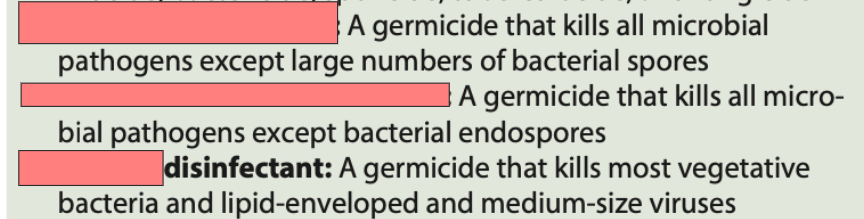
high level
intermediate level
low level
Sterilization vs disinfection?
Sterilization destroys all microbes while disinfection destroys most
An antiseptic agent is used to reduce the amount of ____ on the ____
microbes
skin
Alcohols would be classified as an _____ agent
antiseptic
_____ _____ is used to sterilize heat-sensitive items. The sterilization process is relatively slow.
Ethlyne oxide
Aldehydes and ethylene oxide exert their effects through _____
peracetic acid and hydrogen peroxide exert their effects through _____
alkylation
oxidation
_____ act by disturbing lipid containing membranes and leaking cell contents
Phenols
What is the most commonly used non-selective culture media?
____ ____
Blood agar
The _____ _____ pattern on blood agar is present with partial lysis of RBCs
alpha hemolysis
The _____ _____ pattern on blood agar is present with full lysis of RBCs
beta hemolysis
The _____ _____ pattern on blood agar is present with lack of lysis of RBCs
gamma hemolysis
Phase-Contrast Microscopy allows the ____ ____ to be examined by creating a ____ ____
internal details
3D image
What is the function of fluorochromes?
1. Absorb _____ wavelength UV or ultrablue light
2.
Emit energy at a _____ visible wavelength
short
higher
Why do organisms appear bright on a dark background in fluorescent microscopy?
The stained organisms emit _____ light while the background stays _____
visible
dark
Compared with the light absorbed by a fluorochrome, the light emitted by the fluorochrome has:
A. A shorter wavelength and higher energy
B. A longer
wavelength and lower energy
C. The same wavelength and same
energy
D. No wavelength because it is invisible
B. A longer wavelength and lower energy
Which statement best describes the role of a fluorochrome?
A. It makes organisms visible by emitting light after
excitation
B. It kills organisms before they are viewed
C.
It increases the magnification of the microscope
D. It prevents
antibodies from binding organisms
A. It makes organisms visible by emitting light after excitation
Why does electron microscopy have higher resolution than light microscopy?
A. It uses thicker specimens
B. It uses electrons with much
shorter wavelengths
C. It stains organisms with fluorescent
antibodies
D. It uses electrons with much longer wavelengths
B. It uses electrons with much shorter wavelengths
Can viruses generally be visualized using electron microscopy?
Yes
A researcher wants to view the internal structure of a virus by allowing electrons to pass through the specimen. Which microscope should be used?
A. Transmission electron microscope
B. Scanning
electron microscope
C. Fluorescent microscope
D.
Dark-field microscope
A. Transmission electron microscope
A scientist wants a three-dimensional image of the surface of a bacterial cell. Which microscope is most appropriate?
A. Transmission electron microscope
B. Scanning
electron microscope
C. Bright-field microscope
D.
Phase-contrast microscope
B. Scanning electron microscope
Which statement best describes scanning electron microscopy?
A. Electrons pass directly through the center of the
specimen
B. It is mainly used to view internal organelles in
thin sections
C. It uses fluorescent dyes to label
organisms
D. Electrons bounce off the surface of the specimen
at an angle
D. Electrons bounce off the surface of the specimen at an angle
The resolving power of a microscope refers to its ability to:
_____ the _____ of a specimen
increase
brightness
Which factor improves the resolving power of a microscope?
A. Increasing the angle of light entering the retina
B. Decreasing the angle of light entering the retina
C.
Increasing the angle of light entering the lens
D. Decreasing
the angle of light entering the lens
D. Decreasing the angle of light entering the lens
Resolving power is mainly determined by the ______ of light used and the ______ of light entering the ______ lens
wavelength
angle
objective
Why does oil immersion improve resolving power?
It _____ _____ /_____ of light
It reduces dispersion/refraction of light
The India ink method is a classic _______ staining technique in which the background is _______ while the cells remain _______.
negative
darkened
unstained
What two organisms can be detected using the India ink stain?
1. ______
2. Encapsulated ______ ______
1. Cryptococcus
2. Encapsulated Bacillus anthracis
What part of the organism does India ink stains dye?
1. The ______ rather than the cell
2. This creates a
______ ______ around the ______ cell
1. The background rather than the cell
2. This creates a
clear halo around the yeast cell
What is the advantage of darkfield microscopy?
Resolving power is significantly _____ compared to _____
improved
brightfield
Darkfield microscopy has a _____ that prevents transmitted light from illuminating the specimen
condensor
What is the disadvantage of darkfield microscopy?
Difficult to study the organism's _____ structure
internal
The limitation of brightfield microscopy is the ______ of the image
resolution
Types of stains
The ____ stain is the best known and most widely used stain and forms the basis for the phenotypic classification of bacteria
The ____ ____ and ____ stains are invaluable for identifying protozoan parasites
____-____ stain is used to identify blood parasites
Gram
iron hematoxylin and trichrome
Wright-Giemsa
What is a mnemonic for 6 organisms that can be identified via Wright-Giemsa stain?
Help, Certain Bugs Really Try Patience
Which organism can be identified using a Wright-Giemsa stain?
A. Staphylococcus aureus
B.
Enterococcus faecalis
C. Aspergillus
fumigatus
D. Helicobacter pylori
D. Helicobacter pylori
Which organism can be identified using a Wright-Giemsa stain?
A. Chlamydia trachomatis
B. Neisseria
gonorrhoeae
C. Treponema pallidum
D.
Candida albicans
A. Chlamydia trachomatis
Which organism can be identified using a Wright-Giemsa stain?
A. Leptospira interrogans
B. Borrelia
burgdorferi
C. Treponema pallidum
D.
Clostridium tetani
B. Borrelia burgdorferi
Which organism can be identified using a Wright-Giemsa stain?
A. Bacillus anthracis
B. Mycoplasma
pneumoniae
C. Rickettsia rickettsii
D.
Legionella pneumophila
C. Rickettsia rickettsii
Which organism can be identified using a Wright-Giemsa stain?
A. Trypanosomes
B. Dermatophytes
C.
Nontuberculous mycobacteria
D. Prions
A. Trypanosomes
Which organism can be identified using a Wright-Giemsa stain?
A. Toxoplasma gondii
B. Giardia
lamblia
C. Plasmodium species
D.
Entamoeba histolytica
C. Plasmodium species
In vitro cultures depend on 3 things for success
1. ____ of
infection
2. Patient's ____ reponse
3. Quality of ____ media
1. Site of infection
2. Patient's immune reponse
3. Quality
of culture media
MacConkey agar is a selective media for gram ______ bacteria which contains ______ ______ to inhibit growth of gram ______
negative
bile salts
positive
What is the main difference between the Ziehl-Neelsen stain and the Kinyoun method?
A. Ziehl-Neelsen uses Gram stain, while Kinyoun uses India
ink
B. Ziehl-Neelsen requires heat, while Kinyoun can be
performed cold
C. Ziehl-Neelsen stains fungi, while Kinyoun
stains viruses
D. Ziehl-Neelsen uses iodine, while Kinyoun uses
crystal violet
B. Ziehl-Neelsen requires heat, while Kinyoun can be performed cold
Which acid-fast staining method is also called the hot acid-fast stain?
A. Kinyoun method
B. India ink stain
C.
Ziehl-Neelsen stain
D. Wright-Giemsa stain
C. Ziehl-Neelsen stain
Which acid-fast staining method can be performed without heating the slide?
A. Ziehl-Neelsen stain
B. Kinyoun method
C.
Gram stain
D. Silver stain
B. Kinyoun method
Why is heat used in the Ziehl-Neelsen stain?
A. To destroy bacterial endospores
B. To remove
mycolic acids from the cell wall
C. To help carbolfuchsin
penetrate the waxy cell wall
D. To make bacteria fluoresce
C. To help carbolfuchsin penetrate the waxy cell wall
Acid-fast stains are especially useful for organisms with:
A. Thick peptidoglycan only
B. A capsule made of
polysaccharide
C. No cell wall
D. Mycolic acid-rich cell walls
D. Mycolic acid-rich cell walls
What makes chocolate agar brown?
A. Lactose fermentation
B. Heated hemoglobin
C.
Bile salts
D. Crystal violet
B. Heated hemoglobin
Why is chocolate agar considered enriched?
It contains extra _____ from lysed _____ blood cells
It contains extra nutrients from lysed red blood cells
MacConkey agar is differential because it separates bacteria based on their ability to:
A. Form spores
B. Ferment lactose
C. Produce
mycolic acid
D. Invade red blood cells
B. Ferment lactose
A gram-negative rod grows pink colonies on MacConkey agar. What does this suggest?
A. It is acid-fast
B. It ferments lactose
C. It
cannot ferment lactose
D. It is gram-positive
B. It ferments lactose
A gram-negative rod grows colorless colonies on MacConkey agar. What does this suggest?
A. It is a lactose nonfermenter
B. It is a lactose
fermenter
C. It is inhibited by bile salts
D. It has
heated hemoglobin
A. It is a lactose nonfermenter
What type of agar is used to isolate Staphylococci? What color are the colonies in the presence of S. aureus?
_____ _____ agar
_____
Mannitol salt agar
yellow
Blood agar is commonly used to differentiate species of ______.
Streptococcus
What are the magnifications of the following objective lenses?
Low power: [...]
High dry: [...]
Oil immersion: [...]
Low power: 10x
High dry: 40x
Oil immersion: 100x
Can Light microscopy view viruses?
No
Which type of microscopy will allow you to see the internal details
of a bacteria?
A. Light microscopy
B. Fluorescent
C.
Electron
D. Phase-contrast
E. Dark
D. Phase-contrast
The iron hematoxylin and trichrome stains are invaluable for identifying ______ ______
protozoan parasites
What organisms are acid-fast bacteria?
1. M______
2. N______
3. C______
1. Mycobacteria
2. Nocardia
3. Cryptosporidium
Xylose-lysine deoxycholate (XLD) agar is used to detect ______ and ______.
salmonella
shigella
1. What color is Shigella on XLD agar? ____
2. What color is
Salmonella on XLD agar? ____
3. What compound is added to
Salmonella to create that color? ____ ammonium citrate
1. Red
2. Black
3. Ferric ammonium citrate
Shigella [does/does not] produce H2S and Salmonella [does/does not] produce H2S
Shigella does not produce H2S and Salmonella does produce H2S
_____-_____ agar is the recommended medium for antibiotic susceptibility testing of bacteria
Mueller-Hinton
Sabouraud dextrose agar is used to isolate _____.
fungi
Which type of microscopy would detect Treponema pallidum (etiologic agent of syphilis) and Leptospira spp. (leptospirosis)?
______
Darkfield
_____ microscopy involves a specimen that is brightly illuminated with a dark background
Darkfield
Brightfield microscopy uses which method to view a sample?
A. Electron reflection
B. Transillumination
C.
Fluorescent emission
D. Magnetic resonance
B. Transillumination
What is the correct order of light movement in a brightfield microscope?
A. Ocular lens → objective lens → specimen → light
source
B. Objective lens → ocular lens → light source →
specimen
C. Specimen → light source → ocular lens → objective
lens
D. Light source → specimen → objective lens → ocular lens
D. Light source → specimen → objective lens → ocular lens
Why are stains often used in brightfield microscopy?
A. To make organisms glow on a dark background
B. To
increase contrast between the specimen and background
C. To
make electrons pass through the specimen
D. To make viruses
visible without magnification
B. To increase contrast between the specimen and background
Thioglycolate broth is an enrichment broth used when there may be very few ______ in the sample. It helps recover both ______ and ______ bacteria.
bacteria
aerobic and anaerobic bacteria.
Which medium is commonly used for the isolation of Mycobacterium tuberculosis?
A. MacConkey agar
B. Lowenstein-Jensen
C.
Chocolate agar
D. Sabouraud agar
B. Lowenstein-Jensen
Middlebrook agar is used primarily to culture _______
myobacteria
The best brightfield microscopes have a resolving power of approximately 0.2 μm, which allows most _____, but not _____, to be visualized.
bacteria
viruses
Which agar is used to isolate Corynebacterium diphtheriae?
A. Blood agar
B. Chocolate agar
C. Cystine-tellurite agar
D. MacConkey agar
C. Cystine-tellurite agar
What agar is used to isolate Bordetella pertussis?
_____-_____ agar
Regan-Lowe agar
Selective media are designed to recover ____ organisms and ____ growth of unwanted organisms
Selective media are designed to recover specific organisms and suppressing growth of unwanted organisms
Acridine orange is best classified as which type of stain?
A. Acid-fast stain
B. Fluorescent stain
C.
Negative stain
D. Capsule stain
B. Fluorescent stain
Acridine orange can be used to stain which organisms?
____ and ____
Bacteria and fungi
What is the function of a condenser?
______ the light on the specimen
focuses
How can you calculate the total magnification of an image?
(______ lens mag) * (______ lens mag)
objective
ocular
____ ____ are used in electron microscopy to direct a beam of electrons from a tungsten ____ through a ____ and onto a screen
Magnetic coils
filament
specimen
Yeasts are Gram-_____ organisms
positive
What counterstain is retained by Gram-negative organisms?
_____
safranin
What two substances must be present in the media for Legionella to grow?
1. _____
2. _____
1. Cysteine
2. Iron
Which set includes the 3 types of acid-fast stains?
A. Gram, India ink, silver stain
B. Wright-Giemsa, PAS,
methenamine silver
C. Ziehl-Neelsen, Kinyoun,
auramine-rhodamine
D. Capsule stain, endospore stain, Lugol iodine
C. Ziehl-Neelsen, Kinyoun, auramine-rhodamine
Which acid-fast stain is a fluorescent method?
A. Auramine-rhodamine method
B. Kinyoun method
C.
Ziehl-Neelsen stain
D. Lugol iodine stain
A. Auramine-rhodamine method
Lugol iodine is used in microscopy to help differentiate:
_____ from host _____ _____ cells
Amoebae from host white blood cells
A child with epiglottitis has Haemophilus influenzae. Which medium is classically used to culture it?
A. Chocolate agar
B. Sabouraud agar
C. Thayer-Martin agar
D. Lowenstein-Jensen agar
A. Chocolate agar
Inhibitory mold agar is selective for the isolation of:
_____ _____ other than dermatophytes
Pathogenic fungi
What are the 3 steps that are repeated in PCR?
1. ______- separates the ______ into 2 strands
2.
______- (annealing)- allows ______ to bind to the 2
strands
3. ______- temperature is increased and ______ ______
adds dNTPs to the strand
1. Heating- separates the dsDNA into 2 strands
2. Cooling
(annealing)- allows primers to bind to the 2 strands
3.
Elongation- temperature is increased and DNA Polymerase adds dNTPs to
the strand
What is the most common nucleic acid amplification method?
PCR
The primary goal of RT-PCR (Reverse Transcription-Polymerase Chain Reaction) is to _____ and _____ RNA targets
detect
amplify
A laboratory uses nested PCR to detect trace pathogen DNA in a clinical sample. Why does this technique provide greater sensitivity than standard PCR?
A. It performs two amplification rounds
B. It uses
fluorescent nucleotide probes
C. It eliminates primer annealing
steps
D. It directly sequences amplified DNA
A. It performs two amplification rounds
Which strategy describes the selection and timing of the primers used during the two distinct amplification rounds of a nested PCR assay?
A. Utilizing the exact same primer pair for both the first and second rounds
B. Employing random hexamer primers to initiate amplification in each consecutive round
C. Utilizing two distinct, sequential primer pairs where the second pair binds internal to the first amplicon
D. Initiating the first round with RNA primers followed by DNA primers in the second round
C. Utilizing two distinct, sequential primer pairs where the second pair binds internal to the first amplicon
Why is the nested PCR process described as a “funneling” approach?
A. It enriches the desired target
B. It converts RNA into
DNA
C. It separates fragments by size
D. It measures
fluorescence continuously
A. It enriches the desired target
What happens to background material during nested PCR?
A. It becomes preferentially amplified
B. It is progressively
diluted
C. It binds the second primers
D. It prevents target amplification
B. It is progressively diluted
Which sequence best describes nested PCR?
A. Sequencing followed by amplification
B. Amplification
followed by digestion
C. Reverse transcription followed by
PCR
D. Traditional PCR then internal amplification
D. Traditional PCR then internal amplification
A RNA amplification test proceeds at a constant temperature (isothermal) without repeated heating and cooling cycles. Which method does this best describe?
A. Nested PCR
B. Standard PCR
C.
Transcription-mediated amplification
D. Ziehl-Neelsen staining
C. Transcription-mediated amplification
Which enzyme first converts RNA into
complementary DNA during
transcription-mediated amplification?
_____ _____
Reverse transcriptase
In transcription-mediated amplification, RNA polymerase is mainly responsible for producing ______ copies from a ______ template
RNA
DNA
Why does single-stranded RNA simplify detection in transcription-mediated amplification?
It does not need to be ______ before detection
denatured
What is an isothermal amplification method for detection of specific RNA and DNA sequences?
_____ _____ _____ (_____)
strand displacement amplification (SDA)
When does amplification of the target sequence in SDA occur?
when the _____ creates a _____ at the _____ end and then _____ _____ binds to the _____ site
when the endonuclease creates a nick at the 5' end and then DNA Polymerase binds to the nick site
A rural clinic needs a rapid nucleic acid amplification test for a pathogen but lacks a thermocycler. The test uses multiple primers and runs at a constant temperature. Which method is being described?
____-____ amplification
Loop-mediated amplification
Loop-mediated amplification is best described as which type of amplification method?
A. Isothermal variation of strand displacement
amplification
B. Heat-cycled variation of nested PCR
C.
Antibody-based detection of microbial antigens
D. Culture-based
isolation of fastidious bacteria
A. Isothermal variation of strand displacement amplification
Loop-mediated amplification can amplify which type of target sequence?
____ or ____
RNA or DNA
In loop-mediated amplification, amplified products can be monitored in real time by measuring:
_____ _____ turbidity
Magnesium pyrophosphate turbidity
Which feature makes LAMP especially attractive for resource-limited settings?
A. It requires expensive fluorescence microscopy
B. It
is rapid and does not require costly instrumentation
C. It
requires repeated heating and cooling cycles
D. It only works
after organisms are grown in culture
B. It is rapid and does not require costly instrumentation
DNA fragments of different sizes or structures can be distinguished by their _____ _____ in an agarose or polyacrylamide gel
electrophoretic mobility
restriction fragment length polymorphism (RFLP) is the technique where specific strains of microorganisms can be distinguished by cutting ____ ____ with ____ that recognize specific DNA sequences
genomic DNA
enzymes
What do restriction endonucleases do during RFLP analysis?
A. Copy the DNA
B. Join DNA fragments
C. Translate viral proteins
D. Cut DNA at specific sequences
D. Cut DNA at specific sequences
Two bacterial strains are digested with the same restriction enzyme but produce different DNA fragment patterns. What is the best explanation?
The strains have different _____ sequences affecting _____ sites
The strains have different DNA sequences affecting restriction sites
The pattern of DNA fragments produced in RFLP analysis is mainly used to determine:
A. Whether a bacterium ferments lactose
B. Whether a
virus has an envelope
C. The relatedness of different microbial
strains
D. The oxygen requirement of a microorganism
C. The relatedness of different microbial strains
DNA can be visualized by staining with _____ _____
ethidium bromide
Standard gel electrophoresis does not separate the fragments well because they are too large. Which technique should be used?
A. Standard PCR
B. Pulsed-field gel
electrophoresis
C. Gram staining
D.
Transcription-mediated amplification
B. Pulsed-field gel electrophoresis
Pulsed-field gel electrophoresis is especially useful for separating large _____ fragments from _____.
DNA
bacteria
What is the key feature of pulsed-field gel electrophoresis?
A. It uses antibodies to detect microbial antigens
B.
It repeatedly changes the direction of the electric field
C. It
uses heat cycles to amplify bacterial DNA
D. It stains acid-fast
organisms with carbolfuchsin
B. It repeatedly changes the direction of the electric field
A gel shows different banding patterns from bacterial isolates after large genomic DNA fragments are separated. What can these patterns help determine?
A. Whether the bacteria are lactose fermenters
B.
Whether the bacteria are obligate aerobes
C. Whether the
bacteria are closely related strains
D. Whether the bacteria
have capsules
C. Whether the bacteria are closely related strains
What occurs in a Western Blot?
1. Microbial proteins are _______ with a strong reducing
agent
2. Microbial proteins are then ______ by size on a
polyacrylamide gel by ______
3. Proteins are transferred onto a
nitrocellulose ______ by "______" and then overlaid
with the patient's serum (with antibodies)
4. Nitrocellulose is
______ and ______ to detect ______ binding to specific microbial protein
denatured
separated, electrophoresis
membrane, blotting
wash and stained, antibodies
______ is a powerful diagnostic tool used to amplify a desired fragment of DNA
PCR
How many primers are needed for polymerase chain reaction (PCR)?
_____ (one for the _____ end of each DNA strand)
two
3'
What type of primer is used in a polymerase chain reaction (PCR)?
In the body, _____ primers are used; in the test tube, _____ primers are used
RNA
DNA
PCR requires the addition of all _____ deoxynucleotide triphosphates (dNTPs) for DNA synthesis
four
Transcription mediated amplification is an _____ amplification method
RNA
What type of probe is used to bind protein when using a Western blot?
_____ _____
Labeled antibody
What disease would a western blot be useful for?
_____ _____
Lyme disease
A lab wants to determine whether a bacterial isolate contains a specific antibiotic resistance gene. Which sequencing approach is most appropriate?
____ sequencing
targeted sequencing
A hospital is investigating whether several bacterial isolates from different patients are genetically related during an outbreak. Which sequencing method is most useful for subtyping/genotyping?
____ ____ sequencing
whole genome
Scientists commonly sequence ribosomal RNA genes to identify ____ and ____
bacteria and fungi
A titer is a measure of how much a sample can be ______ before ______ can no longer be detected.
diluted
antibodies
_____ development is one of the more traditional methods used to generate _____ antibodies, enabling the production of highly sensitive binders.
Hybridoma
monoclonal
Hybridomas are cells formed via fusion between a short-lived _____-producing B cell and an _____ _____ cell.
short-lived antiboyd-producing B cell
immortal myeloma cell
What are the disadvantages of monoclonal antibodies?
They are often ____ ____ - cannot identify two different strains of the ____ virus
They are often too specific - cannot identify two different strains of the same virus
The ____ ____ is the concentration range where antigen and antibody are in the right proportions to form a large cross-linked lattice.
That lattice becomes too large to stay dissolved, so it _____ and helps us detect antigen-antibody binding.
equivalence zone
precipitates
Single radial immunodiffusion measures ____ concentration by letting antigen diffuse outward into ____ -containing agar. A precipitin ____ forms at the equivalence zone, and the ring size ____ as antigen concentration increases.
antigen
antibody
ring
increases
What does the Ouchterlony double-diffusion test detect?
A. Antigen-antibody precipitation
B. Bacterial movement
C. Viral genome replication
D. Red blood cell size
A. Antigen-antibody precipitation
Ouchterlony testing may help diagnose which infections?
A. Influenza and measles
B. Malaria and giardiasis
C. Histoplasma, Blastomyces, and Coccidioides
D. Staphylococcus and Streptococcus
C. Histoplasma, Blastomyces, and Coccidioides
In the immuno-double diffusion technique, a visible ____ ____ occurs when the concentrations of antibody and antigen reach equivalence
precipitin line
In an enzyme immunoassay, the _____ is linked to an _____.
That antibody binds the target _____.
Then you add a _____ for the enzyme.
If the antibody is bound to antigen, the enzyme acts on the substrate and produces a detectable signal, usually a ____ change.
antibody, enzyme
antigen
substrate
color
Which enzyme can be conjugated to an antibody in an enzyme immunoassay?
A. DNA polymerase
B. Horseradish peroxidase
C.
Reverse transcriptase
D. Restriction endonuclease
B. Horseradish peroxidase
Which enzyme can be conjugated to an antibody in an enzyme immunoassay?
A. DNA polymerase
B. Alkaline phosphatase
C.
Reverse transcriptase
D. Restriction endonuclease
B. Alkaline phosphatase
_____ _____ _____ is used for population analysis of antigen-positive cells
Immunofluorescence flow cytometry
What does flow cytometry analyze?
A. Cells fixed within solid tissue
B. Cells moving through suspension
C. Viruses growing on agar
D. Antibodies inside a test tube
B. Cells moving through suspension — Individual suspended cells pass through the flow cytometer for analysis.
Flow cytometry is especially useful for identifying which cells?
A. Red blood cells
B. Bone-forming cells
C. Skin cells
D. Lymphocytes
D. Lymphocytes
What 3 things does Flow cytometry assess for?
1. _______
2. _______
3. _______ expression
1. Size
2. Granularity
3. Protein expression
Which of the following cell types has the smallest size and is the
least granular?
[Lymphocytes/Monocytes/PMNs]
Lymphocytes
Which of the following cell types has the largest size and is the
most granular?
[Lymphocytes/Monocytes/PMNs]
PMNs
What occurs in a direct ELISA
used to detect the presence of a _____ _____
1. _____ is
placed at bottom of well
2. Primary _____ enzyme binds to _____
3. _____ is added to create a colorful solution (if antibody
binds to antigen)
specific antigen
Antigen
antibody, antigen
Substrate
What occurs in an indirect ELISA?
used to detect the presence of an _____
1. _____
is placed at bottom of well
2. _____ _____ binds to antigen
3. _____ _____ enzyme binds to primary antibody
4.
_____ is added to create a colorful solution (if antibody is present)
antibody
antigen
primary antibody
secondary antibody
substrate
What type of analysis has been used to confirm ELISA results in patients who are suspected to have HIV?
____ ____
Western Blot
specific _____ antibody found is a good indicator of a recent primary infection
IgM
_____ or recurrence later in life causes an anamnestic (secondary or booster) response
Reinfection
What lab values indicate seroconversion or reinfection?
at least a _____ increase in _____ _____ between serum obtained during the acute phase of disease and that obtained at least 2-3 weeks later during the convalescent (recovery) phase
4x
antibody titer
Early infection: antibodies often target accessible viral ____ antigens.
Later infection: cell lysis releases intracellular viral proteins, allowing antibodies to form against ____ viral antigens.
surface
internal
What is is an immunologic test used to detect the presence of either a specific antigen or antibody in a patient's blood sample
ELISA
What is the main purpose of single radial immunodiffusion?
A. Determine antibiotic resistance genes
B. Detect and
quantify antigen
C. Identify viral RNA sequences
D.
Distinguish influenza strains
A. Determine antibiotic resistance genes
The Ouchterlony immuno-double-diffusion technique is primarily used to determine:
A. The concentration of antigen in serum
B. The
relatedness of different antigens
C. The presence of viral
nucleic acid
D. The oxygen tolerance of bacteria
B. The relatedness of different antigens
Which statement best compares single radial immunodiffusion and Ouchterlony double diffusion?
A. Both involve antigen-antibody precipitin complex formation
B. Both are used mainly to amplify DNA
C. Both require
fluorescent antibodies
D. Both measure antiviral antibody titers only
A. Both involve antigen-antibody precipitin complex formation
A clinician wants to detect and localize microbial antigens on the surface of infected cells. Which methods would be most appropriate?
A. RFLP and pulsed-field gel electrophoresis
B.
Ouchterlony and thioglycolate broth
C. Immunofluorescence and
enzyme immunoassay
D. Gram stain and acid-fast stain
C. Immunofluorescence and enzyme immunoassay
How is protein expression detected during flow cytometry?
A. Fluorescently labeled antibodies
B. Restriction enzymes
C. Red blood cell clumping
D. Bacterial staining
A. Fluorescently labeled antibodies — The antibodies bind specific proteins on or inside cells.
What type of test is a home pregnancy test?
A. Western blot assay
B. Double-diffusion assay
C. Lateral-flow visual assay
D. Hemagglutination assay
C. Lateral-flow visual assay
What is done first in passive hemagglutination?
A. RBCs are coated with antigen
B. Antibodies are destroyed
C. Viruses are added to agar
D. Lymphocytes are separated
A. RBCs are coated with antigen
What causes clumping in passive hemagglutination?
A. Antigens destroy red blood cells
B. Complement dissolves the antigens
C. Patient antibodies cross-link coated RBCs
D. Viral proteins enter the RBCs
C. Patient antibodies cross-link coated RBCs
What does clumping indicate in passive hemagglutination?
A. The patient lacks antibodies
B. The patient has specific antibodies
C. The red cells are infected
D. The antigen has disappeared
B. The patient has specific antibodies
What is seroconversion?
A. Loss of all antibodies
B. Conversion of RNA into DNA
C. Production of antibody after infection
D. Destruction of infected cells
C. Production of antibody after infection
During early viral infection, antibodies often target which antigens?
A. Accessible viral surface antigens
B. Hidden nuclear proteins
C. Host-cell ribosomes
D. Bacterial cell walls
A. Accessible viral surface antigens
Why may antibodies against internal viral proteins appear later?
A. Surface proteins become invisible
B. Cell lysis releases internal proteins
C. Viruses stop producing antigens
D. Antibodies enter the viral genome
B. Cell lysis releases internal proteins
What does hemagglutination-inhibition testing commonly measure?
A. Bacterial antibiotic resistance
B. Viral particle size
C. Antiviral antibody titers
D. T-cell granularity
C. Antiviral antibody titers
How do antiviral antibodies affect hemagglutination?
A. They increase red-cell clumping
B. They inhibit red-cell clumping
C. They destroy all red cells
D. They coat red cells with antigen
B. They inhibit red-cell clumping
Hemagglutination-inhibition testing can help distinguish strains of which virus?
A. Influenza virus
B. Hepatitis B virus
C. Herpes simplex virus
D. Human papillomavirus
A. Influenza virus
How are monoclonal antibodies produced?
A. By many unrelated immune cells
B. By clones of one parent cell
C. By several different antigens
D. By complement proteins
B. By clones of one parent cell