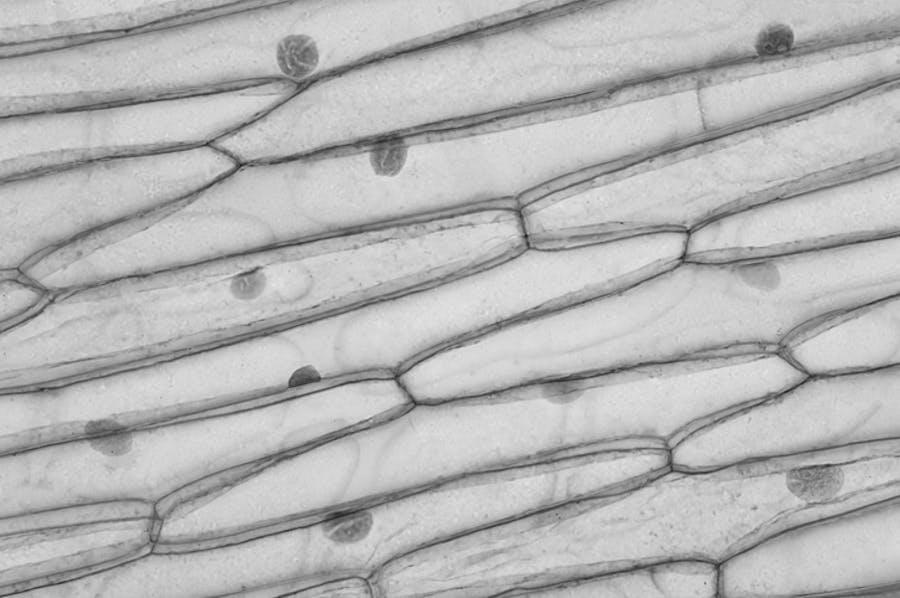
To which type of organism do the cells shown in the microphotograph below belong?
Plant
These organelles are one of the largest in plant cells. Their content varies and can affect the osmotic pressure. What is the name of this organelle?
Vacuole
What structures are found in eukaryotes but not in prokaryotes?
Golgi apparatus and nuclear membrane.
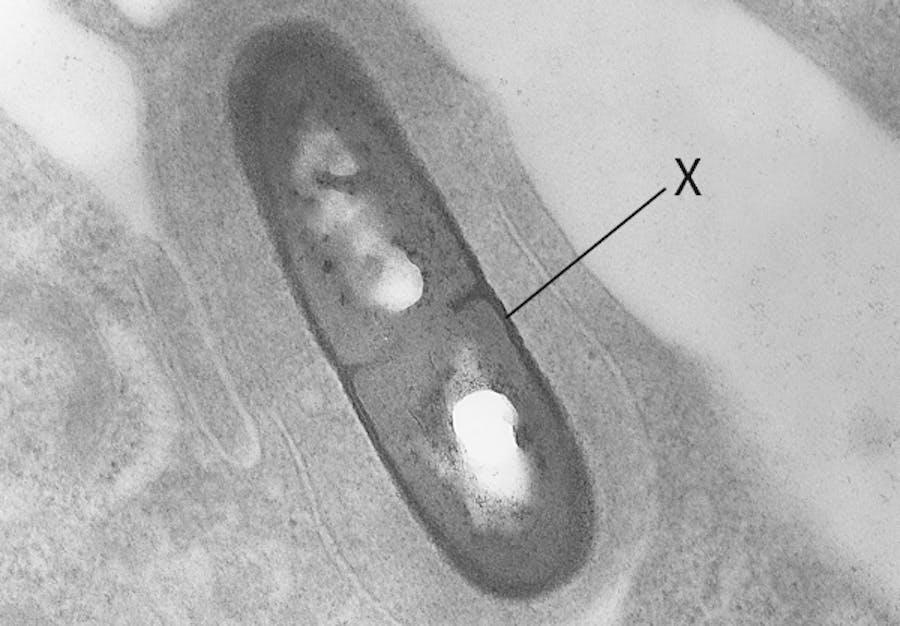
Which structure is identified in the electron micrograph of a bacterium below?
Cell wall
State the size of ribosome found in prokaryotic cells. Give the size in Svedberg units, including the unit symbol (S).
70s
A specimen is measured to be approximately 1 μm in width when observed under a microscope. Which of the following is most likely to be the specimen?
Bacterium
A student is comparing the light and electron microscopes. Which of the statements correctly describes one difference and one similarity between the two microscopes?
a) The light microscope has a lower magnification than the electron microscope. However, both microscopes have similar resolution.
b) The electron microscope has a lower resolution than the light microscope, and both can be used to observe living specimens.
c) The electron microscope has a higher resolution than the light microscope, and both can be used to observe non-living specimens.
d) The light microscope has a higher magnification than the electron microscope. However, both microscopes have similar resolution.
c) The electron microscope has a higher resolution than the light microscope, and both can be used to observe non-living specimens.
In which of the following types of cell are centrioles always found?
a) Plant cells
b) Prokaryotic cells
c) Fungal cells
d) Animal cells
d) Animal cells
Which process of life can be sexual or asexual?
Reproduction
What is the difference between prokaryotic and eukaryotic DNA?
Eukaryotic DNA is associated with histones, whereas prokaryotic DNA is not.
Which of the following is a disadvantage of using an electron microscope to observe organisms and cells?
a) Specimens cannot be viewed in full, natural colour.
b) They have a greater range of magnification.
c) They can see the smallest of cell structures.
d) They have a much higher resolution.
a) Specimens cannot be viewed in full, natural colour.
Which of these observations gives the most support to the endosymbiotic theory for the origin of eukaryotic cells?
a) The similarity in size between the ribosomes of prokaryotes and the ribosomes within mitochondria and chloroplasts.
b) The size difference between most prokaryotic cells and most eukaryotic cells.
c) The molecular differences between the plasma membranes of prokaryotes and eukaryotes.
d) The observation that some eukaryotic cells lack mitochondria.
a) The similarity in size between the ribosomes of prokaryotes and the ribosomes within mitochondria and chloroplasts.
Identify what eukaryotic chromosomes are composed of.
DNA and histone proteins.
Which of the following does not provide evidence for the endosymbiotic theory?
a) Both mitochondria and chloroplasts have their own nucleus.
b) Both mitochondria and chloroplasts have double membranes.
c) Both mitochondria and chloroplasts have 70S ribosomes.
d) Both mitochondria and chloroplasts divide like prokaryotic cells.
a) Both mitochondria and chloroplasts have their own nucleus.
Which of the following features is found in all living cells?
a) Cell wall
b) Nucleus
c) Plasma membrane
d) RNA as genetic material
c) Plasma membrane
Which of the following organisms do not have histones associated with their DNA?
a) Eukaryotes
b) Arthropods
c) Eubacteria
d) Fungi
c) Eubacteria
Which of the following eukaryotic organelles would not be visible underneath a standard light microscope?
a) 80S ribosomes
b) Cell wall
c) Nucleus
d) Central vacuole
a) 80S ribosomes
Which organelle contains digestive enzymes that are released and break down pathogens ingested during phagocytosis?
Lysosome