1) Regeneration, the regrowth of lost body parts, normally follows ________. A) all types of asexual reproduction B) fission C) fragmentation D) parthenogenesis
C
2) Asexual reproduction results in offspring that are genetically identical to their parent. What type of cell process occurs to generate this type of offspring? A) mitosis B) meiosis C) cell fusion D) fertilization
A
3) What makes sexually reproduced offspring genetically different from their parents? A) genetic recombination during meiosis B) genetic recombination during mitosis C) crossing over during mitosis D) Sexual reproduction does not produce genetically different offspring.
A
4) Which of the following organisms reproduces by fission? A) lamprey B) bluefin tuna C) whiptail lizards D) stony corals
D
5) On a submarine expedition to the ocean bottom, you discover a population of fish that are only female. What type of reproduction does this fish most likely use? A) sexual B) budding C) cloning D) parthenogenesis
D
6) Sexual reproduction ________. A) results in over half of the offspring being female B) produces offspring of greater genetic variety compared to offspring resulting from asexual reproduction C) is completed more rapidly than asexual reproduction D) is better suited to environments with relatively constant conditions
B
7) Environmental cues that influence the timing of reproduction generally do so by ________. A) increasing the body temperature B) providing access to water for external fertilization C) increasing ambient temperature most favorable for sex D) direct effects on hormonal control mechanisms
D
8) Evidence that parthenogenic whiptail lizards are derived from sexually reproducing ancestors includes ________. A) the requirement for male-like behaviors in some females before their partners will ovulate B) the development and then regression of testes prior to sexual maturation C) the observation that all of the offspring are haploid D) the persistence of a vestigial penis among some of the females
A
9) In an animal that switches between sexual and asexual reproduction, when is sexual reproduction more likely to occur? A) when conditions for survival are favorable B) when conditions for survival are unfavorable C) when males and females find each other D) What conditions favor sexual over asexual remains a complete mystery.
B
10) Genetic mutations in asexually reproducing organisms lead to more evolutionary changes than do genetic mutations in sexually reproducing ones because ________. A) asexually reproducing organisms, but not sexually reproducing organisms, pass all mutations on to their offspring B) sexually reproducing organisms can produce more offspring in a given time than can asexually reproducing organisms C) more genetic variation is present in organisms that reproduce asexually than is present in those that reproduce sexually D) asexually reproducing organisms have more dominant genes than organisms that reproduce sexually
A
11) Asexual reproduction results in greater reproductive success than does sexual reproduction when ________. A) pathogens are rapidly diversifying B) there is some potential for rapid overpopulation C) a species is expanding into diverse geographic settings D) a species is in a stable and favorable environment
D
12) Sexual reproduction ________. A) allows animals to conserve resources and reproduce only during optimal conditions B) can produce diverse phenotypes that may enhance survival of a population in a changing environment C) enables males and females to remain isolated from each other while rapidly colonizing habitats D) guarantees that both parents will provide care for each offspring
B
13) For water fleas of the genus Daphnia, switching from a pattern of asexual reproduction to sexual reproduction coincides with ________. A) environmental conditions becoming more favorable for offspring B) greater abundance of food resources for offspring C) periods of temperature or food stresses on adults D) exhaustion of an individual's supply of eggs
C
14) Among nonmammalian vertebrates, the cloaca is an anatomical structure that functions as ________. A) a specialized sperm-transfer device produced only by males B) a shared pathway for the digestive, excretory, and reproductive systems C) a source of nutrients for developing sperm in the testes D) a gland that secretes mucus to lubricate the vaginal opening
B
15) Females of many insect species, including honeybee queens, can store gametes shed by their mating partners in ________. A) their nests B) the abdominal tract C) the uterus D) the spermatheca
D
16) Animals that have external fertilization are most likely to reproduce in which of the following areas? A) sand dune B) polar ice sheet C) shallow lake D) tallgrass prairie
C
17) In close comparisons, external fertilization often yields more offspring than does internal fertilization. However, internal fertilization typically offers the advantage that ________. A) it requires less time and energy to be devoted to reproduction B) the smaller number of offspring produced often receive a greater amount of parental investment C) it permits the most rapid population increase D) it requires expression of fewer genes and maximizes genetic stability
B
18) You decide to study two species of birds, both of which form monogamous pairs. In species 1, eggs are almost always from the pair. In species 2, many eggs are fathered by neighboring males. What prediction about testes size is logical? A) Species 1 has larger testes B) Species 2 has larger testes C) No relationship exists D) Testes are identical in size
B
19) What would you expect in female birds where extra-pair mating is common? A) Females have sperm from multiple males in reproductive tracts B) Females only use partner sperm C) Ovaries are larger D) Females produce more oocytes
A
20) Egg laying in fruit flies can be triggered when males deposit sperm. Selective advantage for males is ________. A) less sperm needed B) more eggs fertilized C) ensures male sperm is used D) less energy used
C
21) Which female structure is analogous in function to the vas deferens? A) urethra B) oviduct C) uterus D) vagina
B
22) Follicular cells remaining after ovulation become ________. A) ovarian endometrium B) corpus luteum C) uterine lining D) placenta
B
23) At fertilization, oogonium has produced ________. A) one secondary oocyte B) two primary oocytes C) four secondary oocytes D) four zygotes
A
24) Which of the following are similar between spermatogenesis and oogenesis in vertebrate animals? Both oogenesis and spermatogenesis ________.
I) begin at the onset of sexual maturity
II) result in the
production of four functional haploid cells from one diploid cell III)
lead to the production of gametes from germ cells
IV) are
complete at the time of birth
A) Both I and II
B) Both III and IV
C) Both II and
III
D) Only III
D
25) Mature sperm and ova are similar in that they ________. A) have same chromosome number B) same size C) both have flagella D) produced lifelong
A
26) Erectile tissue in mammals includes ________. A) penis and clitoris B) vas deferens and oviduct C) testes and ovaries D) prostate and ovaries
A
27) In human males, semen and urine both travel through the ________. A) vas deferens B) seminal vesicle C) urethra D) ureter
C
28) Human sperm cells first arise in the ________. A) prostate gland B) vas deferens C) seminiferous tubules D) epididymis
C
29) Removal of seminal vesicles would ________. A) stop sperm production B) prevent sperm exit C) greatly reduce semen volume D) move testes
C
30) Increasing the temperature of the human scrotum by 2°C (that is,
near the normal body core temperature) and holding it there would most
likely ________.
A) reduce the fertility of the man by impairing
the production of gonadal steroid hormones
B) reduce the
fertility of the man by impairing spermatogenesis
C) reduce the man's sexual interest
D) increase the fertility
of the affected man by enhancing the rate of steroidogenesis
B
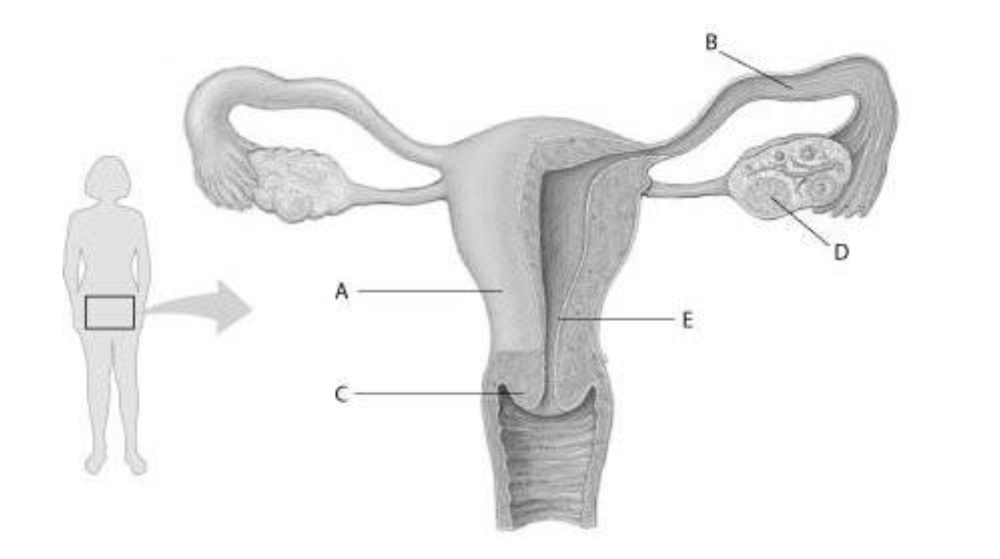
31) Corpus luteum is labeled ________. A) A B) B C) C D) D
D
32) Cervix is labeled ________. A) A B) C C) D D) E
B
33) Site of embryo implantation is ________. A) B B) C C) D D) E
D
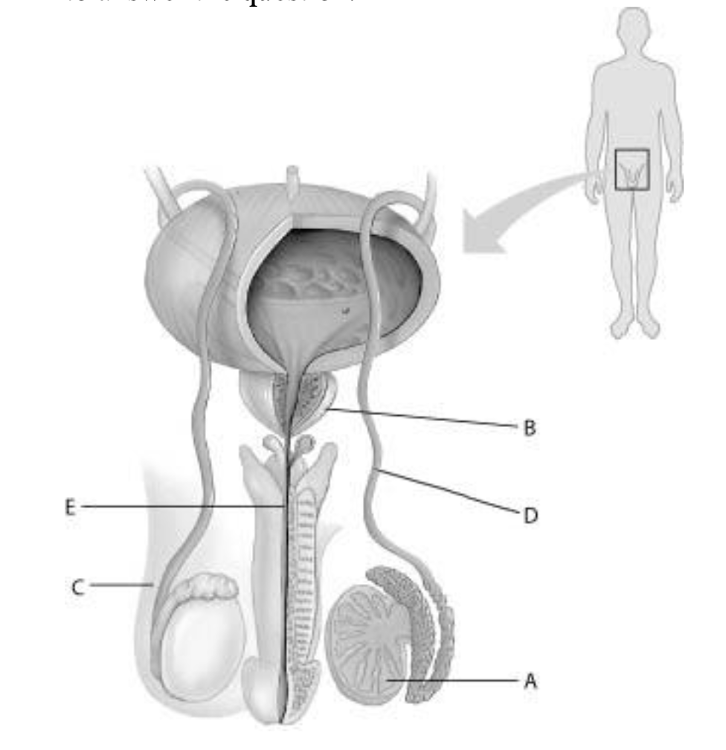
34) Prostate gland is labeled ________. A) A B) B C) C D) D
B
35) Vas deferens is labeled ________. A) A B) B C) C D) D
D
36) Same number in spermatogenesis and oogenesis for ________. A) timing B) functional gametes C) meiotic divisions required D) cell types
C
37) Correct statement about human reproduction is ________. A) spermatogonia are haploid B) both require same temperature C) oocyte completes meiosis II after sperm entry D) sperm form near lumen
C
38) Early puberty caused by tumor in ________. A) hypothalamus B) anterior pituitary testosterone C) testes estrogen D) anterior pituitary gonadotropins
D
39) Male primary sex characteristics include ________. A) voice deepening B) seminal vesicles and ducts C) skeleton growth D) facial hair
B
40) The primary difference between estrous and menstrual cycles is
that ________.
A) the endometrium shed by the uterus during the
estrous cycle is reabsorbed with no extensive fluid flow out of the
body, whereas the shed endometrium of menstrual cycles is excreted
from the body
B) behavioral changes during estrous cycles are
much less apparent than those of menstrual cycles
C) season and
climate have less pronounced effects on estrous cycles than they do on
menstrual cycles
D) copulation normally occurs across the
estrous cycle, whereas in menstrual cycles copulation only occurs
during the period surrounding ovulation
A
41) Ovarian cycle order is ________. A) follicular → luteal → secretory B) menstrual → proliferative → secretory C) follicular → ovulation → luteal D) proliferative → luteal → ovulation
C
42) Uterine cycle order is ________. A) follicular → luteal → secretory B) menstrual → proliferative → secretory C) follicular → ovulation → luteal D) proliferative → luteal → ovulation
B
43) Progesterone receptor mutation causes ________. A) no secondary sex traits B) uterus cannot support pregnancy C) enlarged endometrium D) no mammary development
B
44) Leydig cells respond to LH by producing ________. A) inhibin B) testosterone C) oxytocin D) progesterone
B
45) Sertoli cells release ________. A) inhibin B) LH C) FSH D) GnRH
A
46) Corpus luteum function is to ________. A) nourish egg B) maintain hormone production C) stimulate mammary glands D) support second trimester
B
47) Menopause is ________. A) ovarian unresponsiveness to FSH/LH B) pituitary decline C) uterine lining loss D) GnRH halt
A
48) Hormone to induce immediate ovulation is ________. A) estrogen B) progesterone C) LH D) FSH
C
49) Hormone to induce ovulation in days is ________. A) estrogen B) progesterone C) LH D) FSH
A
50) Labor contractions increased by ________. A) inhibin B) LH C) oxytocin D) prolactin
C
51) Pregnancy marker in urine is ________. A) progesterone B) estrogen C) FSH D) hCG
D
52) Permanent contraception methods are ________. A) condoms B) condoms and pills C) vasectomy and tubal ligation D) diaphragm and implant
C
53) Procedure preventing oocytes reaching uterus is ________. A) vasectomy B) endometriosis C) tubal ligation D) withdrawal
C
54) Vasectomy ________. A) stops sperm production B) stops testosterone C) prevents implantation D) blocks sperm from urethra
D
55) Positive feedback in labor ensures ________. A) follicle development B) continued contractions C) prostaglandin inhibition D) receptor decrease
B
56) Drug used to induce labor is ________. A) progesterone B) LH C) FSH D) oxytocin
D
57) Ectopic pregnancy fails because ________. A) orientation B) no hCG C) oviduct cannot support development D) hormones cannot reach fetus
C
58) Environmental estrogen study significance is ________. A) animal level B) environmental relevance C) nonlethal dose D) standard assay
B
59) Safe estrogen concentration is ________. A) 2.5 B) 12.5 C) 25 D) 100
C
60) Lack of alcohol filter in placenta because ________. A) no time to evolve B) important molecules would be blocked C) blood mixing D) beneficial alcohol effects
B
61) Parthenogenesis is ________. A) sex change B) cell growth C) sex reversal D) unfertilized egg development
D
62) Male/female shared system is ________. A) vas deferens B) urethra C) seminal vesicle D) prostate
B
63) Not properly paired is ________. A) seminiferous tubule—cervix B) vas deferens—oviduct C) testosterone—estradiol D) scrotum—labia majora
A
64) LH/FSH peak occurs ________. A) menstruation B) follicular start C) pre-ovulation D) secretory phase
C
65) Organ development occurs in ________. A) first trimester B) second trimester C) third trimester D) blastocyst stage
A
66) True statement is ________. A) all mammals menstruate B) lining shed vs reabsorbed C) estrous more frequent D) ovulation timing differs
B
67) Same number in reproduction is ________. A) meiotic interruptions B) gametes produced C) meiotic divisions D) cell types
C
68) False statement is ________. A) fertilization in oviduct B) temp differs C) meiosis completes after sperm entry D) sperm near lumen
D