After assessing a patient with amyotrophic lateral sclerosis (ALS), the nurse finds that the oral communication of the patient is impaired. Which term should the nurse document in the patient’s medical record?
1.Dysarthria
2.Motor neuron death
3.Muscle weakness
4.Respiratory muscle weakness
1.Dysarthria
When caring for a patient diagnosed with multiple sclerosis who reports muscle spasticity, which medication would the nurse most anticipate being ordered?
1.Glatiramer (Copaxone)
2.Corticosteroids
3.Tizanidine (Zanaflex)
4.Fingolimod (Gilenya)
3.Tizanidine (Zanaflex)
Which spinal cord disorder is characterized by the buildup of scar tissue or plaques?
1.Multiple sclerosis (MS)
2.Spinal cord tumors
3.Herniated nucleus pulposus
4.Amyotrophic lateral sclerosis (ALS)
1.Multiple sclerosis (MS)
The nurse is teaching about interventions for a patient with neurogenic shock. Which statement indicates effective learning?
1.“I should prepare to administer fluids and vasopressors.”
2.“I will observe the insertion of a pulmonary artery catheter.”
3.“I should avoid implementing thromboembolism prophylaxis.”
4.“I will observe the insertion of an arterial line with continuous blood pressure monitoring.”
1.“I should prepare to administer fluids and vasopressors.”
Which clinical manifestation would the nurse anticipate in a patient diagnosed with multiple sclerosis (MS)?
1.Insomnia
2.Hypertension
3.Double vision
4.Migraine headache
3.Double vision
When caring for a patient with neurogenic shock prescribed a continuous infusion of dobutamine, which nursing intervention would be appropriate?
1.Administer the medication through a 22-gauge IV catheter
2.Assist with insertion of an arterial line
3.Monitor the patient’s neurological status frequently
4.Begin the infusion at 20 mcg/kg/min and titrate based on blood pressure
2.Assist with insertion of an arterial line
The nurse is assisting a nursing student in caring for a patient diagnosed with autonomic dysreflexia (AD). Which action performed by the student nurse is correct?
1.Not placing an indwelling urinary catheter in the patient
2.Applying antiembolism stockings on the patient
3.Monitoring the patient’s blood pressure every 20 minutes
4.Checking the patient’s body for the presence of pressure ulcers
4.Checking the patient’s body for the presence of pressure ulcers
Which is a clinical manifestation of amyotrophic lateral sclerosis (ALS)? Select all that apply.
1.Double or blurred vision
2.Difficulty swallowing
3.Fasciculation
4.Tremor
5.Memory loss
2.Difficulty swallowing
3.Fasciculation
A patient reports blurred vision and feeling an electric shock sensation when moving the head. Which spinal cord disorder does this indicate?
1.Multiple sclerosis (MS)
2.Spinal cord trauma
3.Herniated nucleus pulposus
4.Amyotrophic lateral sclerosis (ALS)
1.Multiple sclerosis (MS)
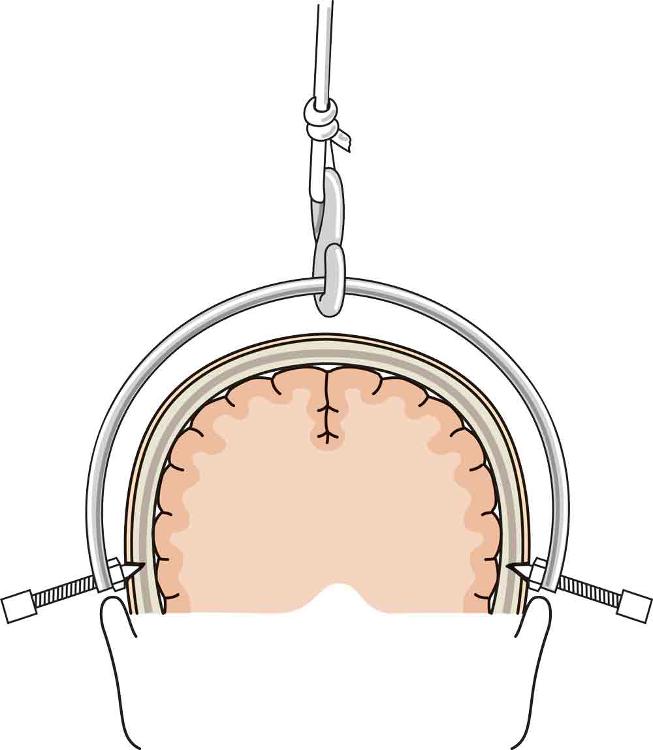
The nurse is caring for a patient with a cervical injury wearing this device. Which anticipated problem should the nurse monitor for? Select all that apply.
1.Pin site infections
2.Skin breakdown
3.Swallowing problems
4.Hypertension
5.Pin loosening
1.Pin site infections
2.Skin breakdown
3.Swallowing problems
5.Pin loosening
The nurse is teaching about the pathophysiology of spinal cord tumors. Which statement indicates effective learning? Select all that apply.
1.“The primary spinal tumors include both benign and malignant tumors.”
2.“Secondary spinal tumors are metastases, so they are always benign.”
3.“The compression and stretching of fiber tracts are caused by abnormal tissue growth.”
4.“The extramedullary area is located outside the dura.”
5.“The spinal tumors are classified in several ways, including the area of the spine.”
1.“The primary spinal tumors include both benign and malignant tumors.”
3.“The compression and stretching of fiber tracts are caused by abnormal tissue growth.”
5.“The spinal tumors are classified in several ways, including the area of the spine.”
Which medication used for treating multiple sclerosis (MS) mimics the effects of hormones produced in the adrenal glands?
1.Corticosteroids
2.Immunosuppressants
3.Anticholinergics
4.Analeptics
1.Corticosteroids
In which type of multiple sclerosis (MS) is the disease activity initiated in the spinal cord?
1.Relapsing remitting
2.Primary progressive
3.Secondary progressive
4.Progressive relapsing
2.Primary progressive
A patient involved in an automobile accident has severe spinal cord injuries. If the patient is having difficulty with diaphragmatic breathing, which level of the spinal cord is injured?
1.C6 to C7
2.T1 to T5
3.T6 to T12
4.Below L1
1.C6 to C7
The nurse is teaching about the epidemiology of spinal cord trauma. Which statement indicates effective learning?
1.“The injury to the spinal cord occurs from hyperextension or vertical compression.”
2.“Spinal cord trauma can’t occur from indirect damage.”
3.“Spinal cord trauma might not occur when not using protective gear during risk-prone work or sports.”
4.“Spinal cord trauma commonly affects men 35 to 60 years old in the United States.”
1.“The injury to the spinal cord occurs from hyperextension or vertical compression.”
Which pain medication is most likely to be prescribed to a patient with herniated nucleus pulposus? Select all that apply.
1.Diazepam
2.Pregabalin
3.Duloxetine
4.Gabapentin
5.Cyclobenzaprine
2.Pregabalin
3.Duloxetine
4.Gabapentin
For which complication of multiple sclerosis (MS) would the nurse monitor the patient?
1.Anxiety
2.Muscle pain
3.Headaches
4.Bladder dysfunction
4.Bladder dysfunction
The nurse is teaching about monitoring for clinical manifestations when assessing spinal shock in a patient. Which statement indicates effective teaching? Select all that apply.
1.“The patient would have low urine output.”
2.“The patient may develop paralytic ileus.”
3.“The patient might be hypotensive.”
4.“The patient would have a decreased heart rate.”
5.“The patient would not show reflexes if tapped on the knee.”
1.“The patient would have low urine output.”
2.“The patient may develop paralytic ileus.”
5.“The patient would not show reflexes if tapped on the knee.”
When caring for a patient newly prescribed fingolimod (Gilenya) for multiple sclerosis, for which adverse effects would the nurse monitor?
1.Nausea and vomiting
2.Decreased liver enzymes
3.Flushing and dyspnea
4.Heart failure signs and symptoms
1.Nausea and vomiting
Paralytic ileus is a complication of spinal cord injury related to which body system?
1.Cardiovascular
2.Gastrointestinal
3.Neurological
4.Musculoskeletal
2.Gastrointestinal
Which is a clinical manifestation of herniated nucleus pulposus? Select all that apply.
1.Neck pain
2.Scoliosis
3.Back pain radiating to other parts of the body
4.Paralysis
5.Pain in the legs
1.Neck pain
5.Pain in the legs
The nurse is caring for a patient with amyotrophic lateral sclerosis (ALS). Which complication should the nurse monitor the patient for?
1.Seizures
2.Paralysis
3.Pneumonia
4.Muscle spasm
3.Pneumonia
Which factor would be present for a diagnosis of multiple sclerosis (MS)?
1.Five symptomatic events
2.MRI changes in two locations
3.Lumbar puncture with elevated WBCs
4.Electrophysiological tests
2.MRI changes in two locations
The nurse is teaching about caring for a patient who has undergone surgery for herniated nucleus pulposus. Which statement indicates effective learning? Select all that apply.
1.“Changes in respiratory rate and effort may indicate a cerebrospinal fluid leak.”
2.“I will inspect the surgical site to detect signs of hemorrhage or a cerebrospinal fluid leak.”
3.“Monitoring the neurological status of the patient helps to detect early and subtle changes.”
4.“I will advise the patient to maintain the body in good alignment since it helps to prevent infection.”
5.“Encouraging range-of-motion exercises in the patients decreases the risk of contracture development.”
2.“I will inspect the surgical site to detect signs of hemorrhage or a cerebrospinal fluid leak.”
3.“Monitoring the neurological status of the patient helps to detect early and subtle changes.”
5.“Encouraging range-of-motion exercises in the patients decreases the risk of contracture development.”
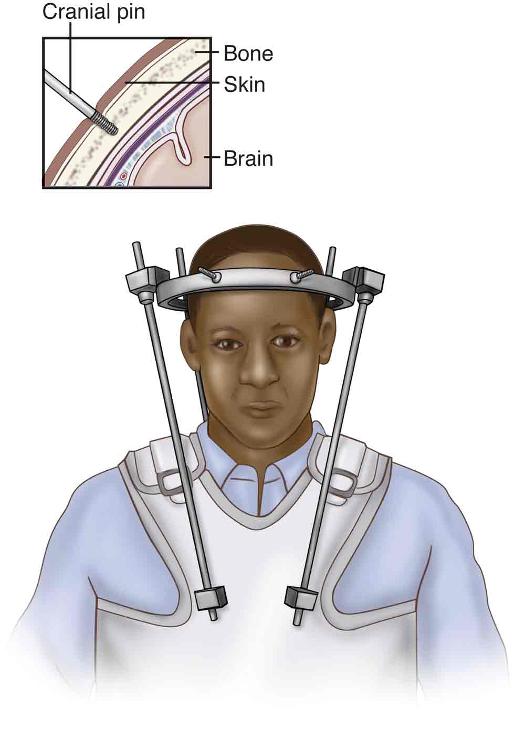
This nurse is caring for a patient with this stabilization device. Which is the priority action by the nurse to prevent complications?
1.Administer pain medications.
2.Clean pins to prevent infection.
3.Confirm that weights are hanging freely.
4.Monitor for bleeding at pin sites.
2.Clean pins to prevent infection.
When caring for a patient admitted for an acute exacerbation of multiple sclerosis (MS), which intervention would be appropriate?
1.Avoid performing range of motion (ROM) exercises until the patient is out of the acute phase
2.Hold the dose of corticosteroid until the patient’s symptoms improve
3.Turn the patient every 4 to 6 hours
4.Implement fall risk precautions
4.Implement fall risk precautions
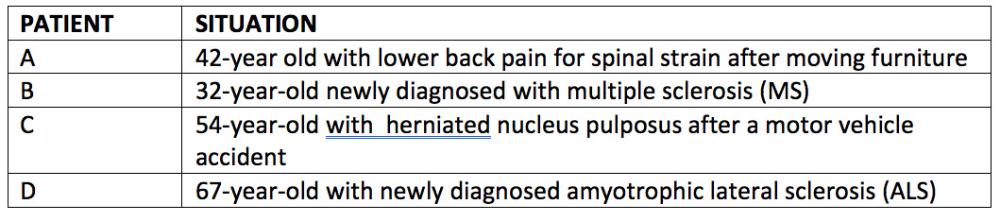
Which patient is the most appropriate candidate for administration of riluzole?
1.Patient A
2.Patient B
3.Patient C
4.Patient D
4.Patient D
Which medication would the nurse anticipate being ordered for a patient diagnosed with multiple sclerosis who reports bladder spasms?
1.Tolterodine (Detrol)
2.Milk of magnesia
3.Methylprednisolone (Solu-Medrol)
4.Tizanidine (Zanaflex)
1.Tolterodine (Detrol)
When providing discharge teaching to a patient prescribed Baclofen for multiple sclerosis, which statement by the patient would indicate understanding?
1.“I need to check my blood sugar often while taking this medication.”
2.“I will avoid taking this drug before driving.”
3.“I need to monitor my urine output closely.”
4.“This medication may give me suicidal thoughts.”
2.“I will avoid taking this drug before driving.”
A patient is diagnosed with amyotrophic lateral sclerosis (ALS) characterized by flaccidity. Which complication is associated with this condition?
1.Dementia
2.Dysphagia
3.Lower back pain
4.Slurred speech
3.Lower back pain
The nurse is caring for a patient with concerning symptoms. Complete the bowtie by dragging and dropping the condition the patient is experiencing, two collaborative actions the nurse should anticipate related to the condition, and two parameters the nurse should monitor.
Correct answer
Action to take:
1. Prepare for lumbar puncture
2. Draw blood test for infectious and inflammatory illnesses
Condition most likely experiencing
1.Multiple Sclerosis
Parameters to Monitor
1.Depression
2. Bladder Dysfunction
Action to take:
1. Prepare for lumbar puncture
2. Draw blood test for infectious and inflammatory illnesses
Condition most likely experiencing
1.Multiple Sclerosis
Parameters to Monitor
1.Depression
2. Bladder Dysfunction
A patient reports numbness, pain, weakness in the lower extremities, and an inability to control motor movement. The primary healthcare provider prescribes gabapentin and tramadol. Which outcome is expected from this intervention?
1.Decreased lower back pain
2.Suppression of spinal cord tumors
3.Reduced symptoms of multiple sclerosis
4.Relief from symptoms associated with amyotrophic lateral sclerosis (ALS)
1.Decreased lower back pain
The nurse is caring for a patient diagnosed with multiple sclerosis (MS) who reports the condition has been steadily worsening without any improvement or break from the signs and symptoms. Which type of MS would the patient likely have?
1.Primary progressive
2.Secondary progressive
3.Relapsing remitting
4.Progressive relapsing
4.Progressive relapsing
Which type of multiple sclerosis (MS) is characterized by the gradual progression of symptoms without remissions?
1.Relapsing remitting
2.Primary progressive
3.Progressive relapsing
4.Secondary progressive
2.Primary progressive