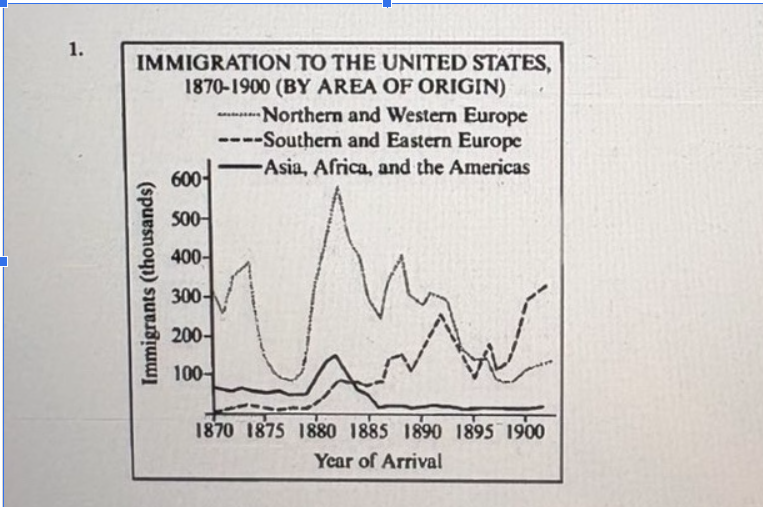
Which of the following best accounts for the curve on the graph above depicting immigration to the United States from Asia, Africa and the Americas between 1882 and 1900?
(A) Rapid expansion of the British Empire into the Southern Hemisphere
(B) Restrictive congressional legislation
(C) Immigration to less-settled areas of the world
(D) Improved worldwide economic conditions
(E) Reduction of potential immigrant populations by widespread epidemics
(B) Restrictive congressional legislation
"To turn the administration of our civic affairs wholly over to men may mean that the American city will continue to push forward in its commercial and industrial development, and continue to lag behind in those things which make a city healthful and beautiful.... If women have in any sense been responsible for the gentler side of life which softens and blurs some of its harsher conditions, may they not have a duty to perform in our American cities?... A woman would fulfill her traditional responsibility to her own children; if she would educate and protect from danger factory children who must find their recreation on the street... then she must bring herself to the use of the ballot that latest implement for self-government."
- Which of the following would have been most likely to support the sentiments expressed by Addams in the excerpt?
(A) Know-Nothings
(B) Machine politicians
(C) Southern Democrats
(D) Settlement house workers
(D) Settlement house workers
"Formerly the individual was the pioneer of civilization; now, the railroad is the pioneer, and the individual follows, or is only slightly in advance... The wild roses are blooming today, and the sod is yet unturned.. where, in a year or two will be heard the screech of the locomotive and the tramp of the approaching legions, another year will bring the beginning of the change; towns and cities will spring into existence, and the steam whistle and the noise of saws and hammers, and the click and clatter of machinery, the sound of industry will be heard. The prairies will be golden with the ripening harvest, and the field and the forest, the mine and the river, will all yield their abundance to the ever growing multitude.”
- Which of the following contributed most to the process described in the excerpt?
(A) The industrialization of urban areas in the Northeast
(B) The building of new roads and canals
(C) Increased immigration from eastern Europe
(D) Legislation that facilitated the distribution of western-land
(D) Legislation that facilitated the distribution of western-land
- The settlement pattern described in the except was most similar to earlier settlement patterns in that it was
(A) discouraged by the federal government through legislation
B) motivated largely by the desire to expand Protestant Christianity
(C) accompanied by conflict with American Indians over landownership
(D) the source of political divisions over the expansion of slavery
(C) accompanied by conflict with American Indians over landownership
- Which of the following was a long-term result of the developments described in the excerpt?
(A) The growth of political tensions between the United States and Mexico
(B) A conflict with Great Britain over the northern border of the United States
(C) A large-scale African American migration to the region
(D) The creation of farmers' groups to resist corporate control of agricultural markets
(D) The creation of farmers' groups to resist corporate control of agricultural markets
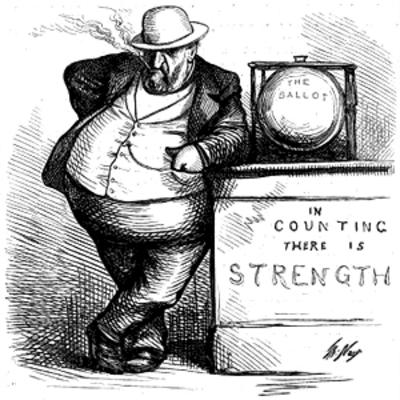
Which of the following changes to the United States during the nineteenth century most directly contributed to the development depicted in the image?
(A) The rapid growth of cities
(B) The dismantling of the national bank
(C) The acquisition of territory in the West
(D) The rise of the People's (Populist) Party
(A) The rapid growth of cities
(A) social reform efforts by settlement-house workers
(B) poll taxes and literacy tests that blocked African Americans from voting
(C) the power gained by urban political machines
D) the exclusion of women from voting
(C) the power gained by urban political machines
"We have conquered many of the neighboring tribes of Indians, but we have never thought of holding them in subjection —never of incorporating them into our Union....To incorporate Mexico, would be the very first instance of the kind of incorporating an Indian race; for more than half of the Mexicans are Indians, and the other is chanposed chiefly of mixed tribes.... Ours, sir, is the Government of a white race... [It is professed and talked about to erect these Mexicans into a Territorial Government, and place them on an equality with the people of the United States. I protest utterly against such a project."
Senator John C. Calhoun, "Conquest of Mexico" speech, 1848
- Which of the following events best represents a continuity of the sentiments expressed by Senator Calhoun in the speech?
(A) The United States rejection of membership in the League of Nations
(B) Support for assimilationist policies in the 1880s and 1890s
(C) The Supreme Court decision in Plessy v. Ferguson
(D) The Great Migration of African Americans out of the South in the 1910s
(C) The Supreme Court decision in Plessy v. Ferguson
"There remains, then, only one mode of using great fortunes; but in this we have the true antidote for the temporary unequal distribution of wealth, the reconciliation of the rich and the poor- reign of harmony.... Under its sway we shall have an ideal state, in which the surplus wealth of the few will become, in the best sense, the property of the many, because administered for the common good, and this wealth, passing through the hands of the few, can be made a much more potent force for the elevation of our race than if it had been distributed in small sums to the people themselves. Even the poorest can be made to see this, and to agree that great sums gathered by some of their fellow-citizens and spent for public purposes, from which the masses reap the principal benefit, are more valuable to them than if scattered among them through the course of many years in trifling amounts." — Andrew Carnegie, "Wealth," 1889
- The "temporary unequal distribution of wealth" that Carnegie refers to in the except resulted most directly from the
(A) growth of cities in both size and number
(B) consolidation of corporations into trusts and holding companies
(C) efforts by workers to organize local and national unions
(D) government policy of reducing tariffs to promote free trade
(B) consolidation of corporations into trusts and holding companies
1. Which of the following policies would Carnegie most likely have supported?
(A) The use of federal power to redistribute wealth
(B) Government creation of jobs for unemployed people
(C) Increased regulation of corporations
(D) Laissez-faire economics
(D) Laissez-faire economics
11. "Competition is a law of nature ... and can no more be done away with than gravitation. ... [I]f we do not like survival of the fittest, we have only one possible alternative, survival of the unfittest. The former is the law of civilization, the latter is the law of anti-civilization."
The quote above is an example of which of the following schools of thought?
(A) Dialectical materialism
(B) Utopian socialism
(C) Social Darwinism
(D) Transcendentalism
(C) Social Darwinism
- "Every contract, combination in form of trust or otherwise, or conspiracy, in restraint of trade or commerce in any territory of the United States....is hereby declared illegal."
The passage above was most effectively used for which purpose in the late nineteenth century?
(A) Supporting the goals of Social Darwinists
(B) Restricting the power of monopolies and trusts
(C) Limiting the power of labor unions
(D) Regulating railroads and grain storage silos
(C) Limiting the power of labor unions
- "If they dare to come out in the open field and defend the gold standard as a good thing, we will fight them to the uttermost. Having behind us the producing masses of this nation and the world, supported by the commercial interests, the laboring interests, and the toilers everywhere, we will answer their demand for a gold standard by saying to them: You shall not press down upon the brow of labor this crown of thorns; you shall not crucify mankind upon a cross of gold."
William Jennings Bryan, 1896
(A) Urban workers
(B) Railroad executives
(C) New York City financiers
(D) Midwestern farmers
(E) White-collar and professional workers
(D) Midwestern farmers
"The Negro race, like all races, is going to be saved by its exceptional men. The problem of education, then, among Negroes must first of all deal with the Talented Tenth; it is the problem of developing the Best of this grace that they may guide the Mass away from the contamination and death of the Worst, in their own and other races. Now the training of men is a difficult and intricate task. Its technique is a matter for educational experts, but its object is for the vision of seers. If we make money the object of man-training, we shall develop money-makers but not necessarily men; if we make technical skill the object of education, we may possess artisans but not, in nature, men. Men we shall have only as we make manhood the object of the work of the schools-intelligence, broad sympathy, knowledge of the world that was and is, and of the relation of men to it." — W. E. B. Du Bois, "The Talented Tenth." 1903
- The perspective expressed in the except most directly supported the national expansion of
(A) vocational job training
(B) financial aid for college
(C) exams for civil service jobs
(D) access to higher education
(D) access to higher education
- "This, then, is held to be the duty of the man of wealth: to consider all surplus revenues which come to him simply as trust funds, which he is called upon to administer and strictly bound as a matter of duty to administer in the manner which, in his judgment, is best calculated to produce the most beneficial results for the community the man of wealth thus becoming the mere agent and trustee for his poorer brethren."
These sentiments are most characteristic of
(A) transcendentalism
(B) pragmatism
(C) the Gospel of Wealth
(D) the Social Gospel
(E) Reform Darwinism
(C) the Gospel of Wealth
- "Another marked characteristic of the Anglo-Saxon is what may be called an instinct or genius for colonizing. His unequaled energy, his indomitable perseverance, and his personal independence, made him a pioneer. He excels all others in pushing his way into new countries."
Americans advocating the ideas expressed in the passage above would be most accurately described as
(A) transcendentalists
(B) Populists
(C) scientific managers
(D) Social Darwinists
(E) Mugwumps
(D) Social Darwinists
"So many people ask me what they shall do; so few tell me what they can do. Yet this is the pivot wherein all must tum.”
"I believe that each of us who has his place to make should go where men are wanted, and where employment is not bestowed as alms. Of course, I say to all who are in want of work, GoWest!..”
"On the whole I say, stay where you are; do as well as you can; and devote every spare hour to making yourself familiar with the conditions and dexterity required for the efficient conservation of out-door industry in a new country. Having mastered these, gather up your family and GoWest!"
- Which of the following most accurately describes a group who acted on ideas such as those in the excerpt?
(A) Business leaders planning to promote philanthropy
(B) Activists calling for preservation of the western wilderness
(C). Southern European immigrants seeking opportunity in urban areas
(D) Northern European immigrants pursuing mining, farming, and ranching
(D) Northern European immigrants pursuing mining, farming, and ranching
"So many people ask me what they shall do; so few tell me what they can do. Yet this is the pivot wherein all must tum.”
"I believe that each of us who has his place to make should go where men are wanted, and where employment is not bestowed as alms. Of course, I say to all who are in want of work, GoWest!..”
"On the whole I say, stay where you are; do as well as you can; and devote every spare hour to making yourself familiar with the conditions and dexterity required for the efficient conservation of out-door industry in a new country. Having mastered these, gather up your family and GoWest!"
1. The fulfillment of advice such as that in the except most directly contributed to which of the following in the late nineteenth century?
(A) The economic decline and depopulation of eastern cities
(B) Competition for resources among White settlers and American Indians
(C) The outbreak of war with Mexico over control of territory
(D) Restrictions on immigration from eastern and southern Europe
(B) Competition for resources among White settlers and American Indians
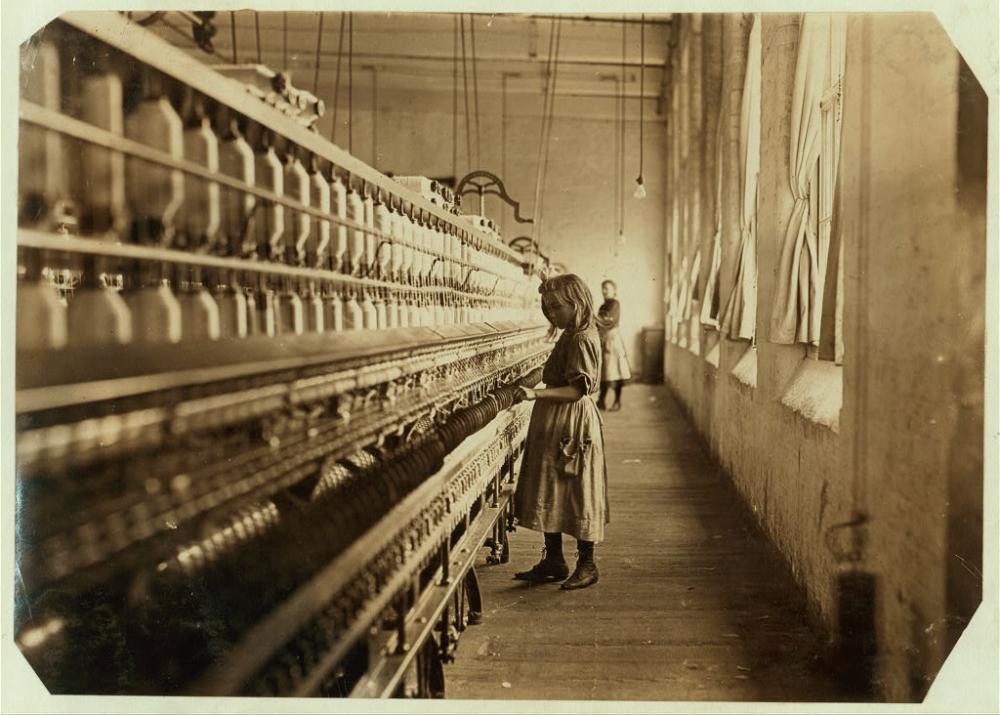
- The conditions shown in the photograph emerged most directly as a result of which of the following?
(A) Overpopulation that forced farming families to migrate to urban centers
(B) The movement to promote child labor to instill values of hard work and frugality
(C) The preference of factory owners for a cheap labor force
(D) The need for increased family income during the Great Depression
(C) The preference of factory owners for a cheap labor force
"In August 1865, the photographer Marcus Ormsbee... took a formal portrait of several groups of craft workers in their different shops... At the center of the photograph, at Outcault's carpentry shop, stands the conventional artisan trio of master, journeyman, and apprentice, still at the heart of the city's workshop world yet class differences mark these craftsmen's every feature.... Brooding above everyone, a new brick manufactory seals off its employees from the street and from public view. Small shop and large enterprise converge; New York remains a blend of old and new."
- Which of the following most directly led to the changes described in the excerpt?
(A) Innovative uses of photography to achieve social change
(B) Technological innovations in the production of goods
(C) The economic hardship resulting from years of civil war in the United States
(D) The end of the apprenticeship system in craft work
(B) Technological innovations in the production of goods
- Which of the following is one important continuity in urban life in the United States throughout the nineteenth century?
(A) Anarchism and similar radical ideologies attracted many workers.
(B) Settlement houses assisted immigrants with adapting to life in the United States.
(C) Workers and employers consistently maintained amicable relationships.
(D) Immigrants formed an important part of the manufacturing workforce
(D) Immigrants formed an important part of the manufacturing workforce
- The conditions described in the except most directly contributed to the
(A) decrease in tariffs for manufactured goods
(B) growth of an organized labor movement
(C) expansion of government regulation of industry
(D) loss of class distinctions in the United States
(B) growth of an organized labor movement
"Beginning in the 1930s and lasting into the 1940s, black Chicago experienced a cultural renaissance... Chicago had become a major destination for black southern migrants.... It was also an urban industrial center. This fact gave a unique working-class and internationalist perspective to the cultural work that would take place there....”
"A desire to live freely in "the metropolis' continued to characterize the aspirations of migrants as second-wave Chicago migrants arrived... The 1930s and 1940s witnessed a resurgence of black working-class political radicalism that was captured and reflected in the expressive visual and literary productions of Chicago Black Renaissance artists."
- Before moving to Chicago, the people described in the except most likely were engaged in which of the following?
(A) Sharecropping or tenant farming
(B) Gang labor on the railways
(C) Mining and other extractive industries
(D) Manufacturing in urban factories
(A) Sharecropping or tenant farming
"As the early years at Hull House show, female participation in that area of reform grew out of a set of needs and values peculiar to middle-class women in the late nineteenth and early twentieth century. Settlement workers did not set out to become reformers. They were rather women trying to fulfill existing social expectations for self-sacrificing female service while at the same time satisfying their need for public recognition, authority, and independence. In the process of attempting to weave together a life of service and professional accomplishment, they became reformers as the wider world defined them."
— Robyn Muncy, historian, Creating a Female Dominion in American Reform, 1890-1935, published in 1991
- Settlement house work as described by Muncy had the most in common with women's activism during which of the following earlier periods?
(A) The Protestant evangelism of the mid-1700s
(B) The decade leading up to the American Revolution
(C) The two decades following the American Revolution
(D) The Second Great Awakening in the first half of the 1800s
(D) The Second Great Awakening in the first half of the 1800s
- Women working in settlement houses such as Hull House initially sought to help
(A) formerly enslaved men and women adjust to life after slavery
(B) immigrants adapt to American customs and language
(C) farmers fight unfair banking practices
(D) American Indians resist encroachment on their lands
(B) immigrants adapt to American customs and language
"Americans faced an overwhelming task after the Civil War and emancipation: how to understand the tangled relationship between two profound ideas—healing and justice.... [T]hese two aims never developed in historical balance. One might conclude that this imbalance between outcomes of sectional healing and racial justice was simply America's inevitable historical condition...But theories of inevitability.. are rarely satisfying.... The sectional reunion after so horrible a civil war was a political triumph by the late nineteenth century, but it could not have been achieved without the resubjugation of many of those people whom the war had freed from centuries of bondage. This is the tragedy lingering on the margins and infesting the heart of American history from Appomattox to World War I."
David W. Blight, historian, Race and Reunion: The Civil War in American Memory, 2001
- Which of the following most directly supports Blight's argument in the excerpt?
(A) The Supreme Court decision in Plessy v. Ferguson
(B) The election of seventeen African Americans to Congress between 1869 and 1877
(C) The industrialization of some segments of the southern economy in the late nineteenth century
(D) emergence of the first national civil rights organizations, such as the Afro-American League and the NAACP
(A) The Supreme Court decision in Plessy v. Ferguson
"Probably no other individual [than Cornelius Vanderbilt, 1794-1877] made an equal impact over such an extended period on America's economy and society.... He vastly improved and expanded the nation's transportation infrastructure, contributing to a transformation of the very geography of the United States.... Far ahead of many of his peers, he grasped one of the great changes in American culture: the abstraction of economic reality, as the connection faded between the tangible world and the new devices of business, such as paper currency, corporations, and securities...One person cannot move the national economy single-handedly but no one else kept his hands on the lever for so long or pushed so hard."
- Which of the following developments in the late nineteenth and early twentieth centuries most directly represented a continuation of the pattern described in the excerpt?
(A) The growth of international immigration to the United States
(B) The expansion of sharecropping and tenant farming in the South
(C) The consolidation of corporations into large trusts and holding companies
(D) The organization of workers into local and national unions
(C) The consolidation of corporations into large trusts and holding companies
- Which of the following ideas was most often used to justify the success and wealth of those like Vanderbilt?
(A) The Social Gospel
(B) Social Darwinism
(C) Preservationism
(D) Imperialism
(B) Social Darwinism
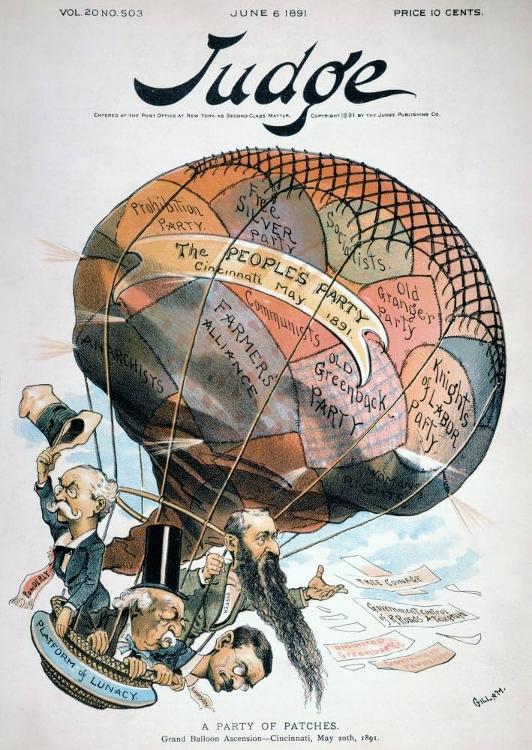
- The cartoonist most likely supported
(A) reform of local government
(B) women's political equality
(C) redistribution of wealth
(D) government policies favoring corporations
(D) government policies favoring corporations
- The People's (Populist) Party emerged most directly in response to which of the following late-nineteenth-century trends?
(A) The efforts of businesses to gain control over markets and resources abroad
(B). The influx of migrants from Asia and southern and Eastern Europe
(C) The growth of corporate power in agriculture and the economy
(D) The development of political machines
(C) The growth of corporate power in agriculture and the economy
- The cartoon suggests that the disparate groups that favored the People's (Populist) Party typically shared which of the following?
(A) The idea that wealthy people had some obligation to help people living in poverty
(B) Belief in a stronger federal government role in the United States economic system
(C) Support for United States expansionism
(D) Advocacy of individual rights
(B) Belief in a stronger federal government role in the United States economic system
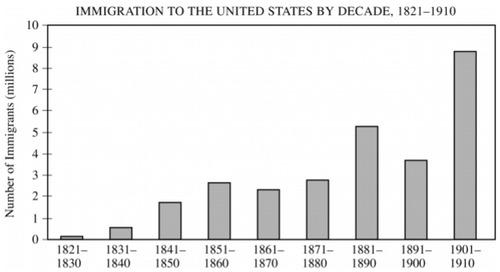
- Which of the following most directly contributed to the overall trend depicted in the graph?
(A) Global fluctuations in credit and stock markets
(B) The transformation of the United States into an industrial society
(C) Progressive Era reforms of social conditions in the United States
(D) The outbreak of global war
(B) The transformation of the United States into an industrial society
- The majority of immigrants who arrived in the United States between 1821 and 1880 settled in the
(A) West and Midwest
(B) South and Midwest
(C) South and Northeast
(D) Midwest and Northeast
(D) Midwest and Northeast
“The Erie Canal poured into New York City [wealth] far exceeding that which its early friends predicted... In the city, merchants, bankers, warehousemen, [and] shippers... seized the opportunity to perfect and specialize their services, fostering round after round of business innovations that within a decade of the opening of the Erie Canal had made New York by far the best place in America to engage in commerce....”
"...Even before its economic benefits were realized fully, rival seaports with hopes of tapping interior trade began to imagine dreadful prospects of permanent eclipse. Whatever spirit of mutual good feeling and national welfare once greeted [internal improvements] now disappeared behind desperate efforts in cities... to create for themselves a westward connection."
- Which of the following later developments had an effect most similar to that described in the excerpt?
(A) The invention of the mechanical reaper in the 1830s
(B) The annexation of Texas in the 1840s
(C) The growth of political party competition in the 1850s
(D) The completion of the first transcontinental railroad in the 1860s
(D) The completion of the first transcontinental railroad in the 1860s
36. "Money is power, and you ought to be reasonably ambitious to have it. You ought because you can do more good with it than you could without it. Money printed your Bible, money builds your churches....”
“The man who gets the largest salary can do the most good with the power that is furnished to him. Of course he can if his spirit be right to use it for what it is given to him. I say, then, you ought to have money."
The quotation above is an example of
(A) transcendentalism
(B) existentialism
(C) The Gospel of Wealth
(D) The Social Gospel
(E) Reform Darwinism
(C) The Gospel of Wealth
“First. - That the union of the labor forces of the United States this day consummated shall be permanent and perpetual.
Second. - Wealth belongs to him who creates it...
The interests of rural and civil labor are the same; their enemies are identical…
1. We demand free and unlimited coinage of silver and gold at the present legal ratio of 16 to 1…
3. We demand a graduated income tax....
RESOLVED, That we demand a free ballot and a fair count in all elections... through the adoption of the Australian or secret ballot system.”
(A) American Party
(B) Greenback Labor Party
(C) Populist Party
(D) Socialist Party
(E) Progressive Party
(C) Populist Party
"We demand a graduated income tax... Transportation being a means of exchange and a public necessity, the government should own and operate the railroads.... The land, including all the natural sources of wealth, is the heritage of the people, and should not be monopolized for speculative purposes, and alien ownership of land should be prohibited.... [W]e demand a free ballot and a fair count... to every legal voter.... [W]e favor a constitutional provision limiting the office of President and Vice-President to one term, and providing for the election of Senators of the United States by a direct vote of the people."
- Activists formed the Populist Party most directly in response to the
(A) growth of corporate power in agriculture and economic instability in farming
(B) emergence of concerns about abuses of the environment
(C) development of reform movements inspired by the Second Great Awakening
(D) rise of monopolies and reduction of wages for industrial workers
(A) growth of corporate power in agriculture and economic instability in farming
- Which of the following best describes the overarching goals of the Populist Party in the late nineteenth century?
Establishment of a transcontinental network of trains and the improvement of roads in the western
(A) United States
(B) Expansion of United States influence in Central America and access to new international markets
(C) Social and political reform guided by the idea of the survival of the fittest
(D) Cooperative democracy and a stronger governmental role in the economic system
(D) Cooperative democracy and a stronger governmental role in the economic system
"We are just now making a great pretense of anxiety to civilize the [American] Indians.... As we have taken into our national family seven millions of Negroes ... it would seem that the time may have arrived when we can very properly make at least the attempt to assimilate our two hundred and fifty thousand Indians.
"The school at Carlisle is an attempt on the part of the government to do this.... Carlisle fills young Indians with the spirit of loyalty to the stars and stripes, and then moves them out into our communities to show by their conduct and ability that the Indian is no different from the white or the colored, that he has the inalienable right to liberty and opportunity that the white and the negro have."
- Pratt's arguments in the excerpt in support of his school for American Indians had most in common with the arguments of which of the following groups?
(A) Business leaders in the later 1800s who maintained that laissez-faire policies would best encourage economic growth
(B) Some social reformers in the later 1800s who founded settlement houses for newly arrived immigrants
(C) African American activists in the early 1900s who advocated for separation from White society
(D) Anti-imperialists in the early 1900s who opposed United States governance of non-White peoples overseas
(B) Some social reformers in the later 1800s who founded settlement houses for newly arrived immigrants
- Many American Indians of the 1890s responded to policies such as those of the Carlisle Indian Industrial School by
(A) creating new political organizations
(B) migrating to unsettled territories
(C) engaging in large-scale armed resistance
(D) seeking to preserve their cultural and tribal identities
(D) seeking to preserve their cultural and tribal identities
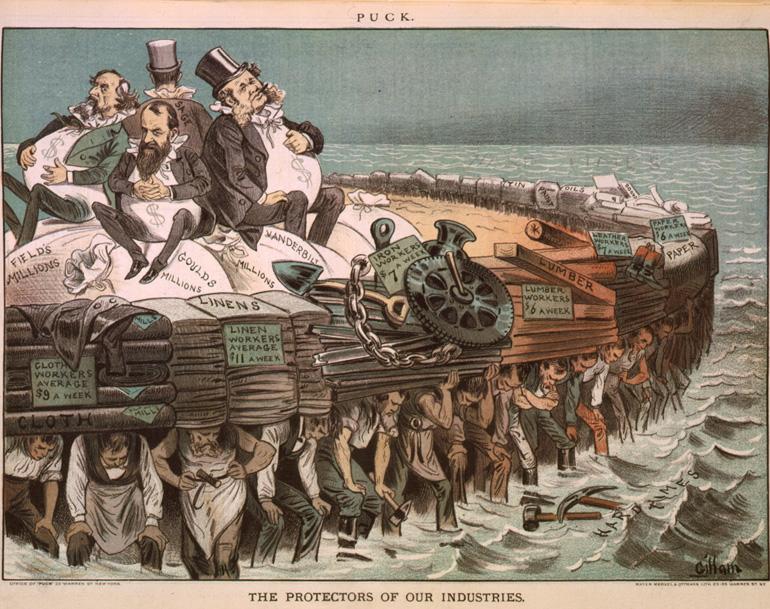
42. Which of the following arguments did some late-nineteenth-century leaders use to justify the situation depicted in the image?
(A) The federal government provided social welfare services for people living in poverty.
(B) Immigrant workers contributed to economic growth in the United States.
(C) Evolutionary principles determined that people succeeded based on their merits.
(D) The reliance on male laborers protected women from the dangers of factory work.
(C) Evolutionary principles determined that people succeeded based on their merits.
- The situation depicted in the image contributed most immediately to
(A) the organization of new labor unions to confront managerial power
(B) businesses seeking control over markets and resources outside the United States
(C) efforts by southern leaders to achieve industrial development similar to that of the North
(D) the creation of a federal agency to regulate the money supply
(A) the organization of new labor unions to confront managerial power
- The image was created most directly in response to the
(A) provision of government subsidies for transportation
(B) rampant consumerism of the middle class
(C) increased migration of people from southern and eastern Europe
(D) consolidation of corporations into trusts and holding companies
(D) consolidation of corporations into trusts and holding companies
Which of the following most directly affected the lives of the late-nineteenth-century workers?
(A) Widespread movement to suburban neighborhoods
(B) Groups that advocated for women's voting rights
(C) Alternative visions of a good society offered through utopianism
(D) Political machines that provided social services in exchange for votes
(D) Political machines that provided social services in exchange for votes
"Yet, after all our years of toil and privation, dangers and hardships upon the ... frontier, monopoly is taking our homes from us by an infamous system of mortgage foreclosure, the most infamous that has ever disgraced the statutes of a civilized nation.... How did it happen? The government, at the bid of Wall Street, repudiated its contracts with the people; the circulating medium was contracted.... As Senator Plumb [of Kansas] tells us, 'Our debts were increased, while the means to pay them was decreased.' [A]s grand Senator... Stewart [of Nevada] puts it, "For twenty years the market value of the dollar has gone up and the market value of labor has gone down, till today the American laborer, in bitterness and wrath, asks which is the worst: the black slavery that has gone or the white slavery that has come?"
- People who agreed with the argument made in the speech would most likely have recommended which of the following solutions?
(A) Separate but equal segregated facilities to increase job opportunities for white workers
(B) Continuation of the gold standard as the basis for money
(C) Reduced government involvement in the economy in order to create more competition
(D) A stronger government role in the economic system
(D) A stronger government role in the economic system
- In the speech, Lease was reacting primarily to the problems faced by which of the following groups?
(A) Bankers
(B) Southern European migrants
(C) Farmers
(D) African Americans
(C) Farmers
- Lease's views best reflect the influence of which of the following developments in social and political movements in the 1890s?
(A) Increased calls for radical overthrow of the federal government
(B) Rising grassroots challenges to the dominant economic system
(C) Greater support for corporate power in agriculture
(D) Emerging ideological justifications for inequities of wealth
(B) Rising grassroots challenges to the dominant economic system
"Is a tractor bad? Is the power that turns the long furrows wrong? If this tractor were ours, it would be good-not mine, but ours.... We could love that tractor then as we have loved this land when it was ours. But this tractor does two things—it turns the land and turns us off the land. There is little difference between this tractor and a tank. The people are driven, intimidated, hurt by both."
- Which of the following movements expressed ideas most similar to the ideas expressed in the excerpt?
(A) Abolitionism in the 1830s and 1840s
(B) Nativism in the 1840s and 1850s
(C) Populism in the 1890s and early 1900s
(D) The counterculture of the 1960s and 1970s
(C) Populism in the 1890s and early 1900s
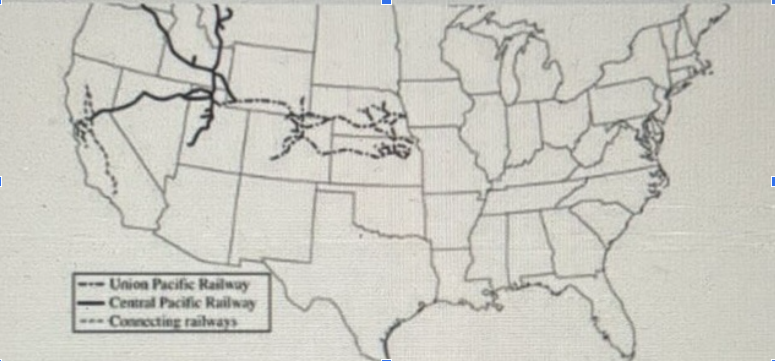
- Which of the following was a primary cause of the developments depicted on the map?
(A) Southern states encouraged former slaves to seek employment on the railroads in the West.
(B) American Indians voluntarily relocated to centralized settlements to free space for transportation systems
(C) Federal subsidies encouraged the growth of infrastructure.
(D) Labor unions lobbied for projects that expanded jobs in the railroad industry.
(C) Federal subsidies encouraged the growth of infrastructure.
- The developments depicted on the map most directly contributed to the
(A) decline of sharecropping in the Southeast
(B) heightening of nativist feelings against foreign-born workers in the West
(C) passage of federal legislation to protect endangered species of animals and plants
(D) unprecedented prosperity for farmers as crop prices rose and transportation prices fell
(B) heightening of nativist feelings against foreign-born workers in the West
- The developments depicted on the map most strongly affected American Indians by
(A) increasing armed conflict with United States citizens and threatening traditional ways of life
(B) promoting economic growth through new lines of trade with previously isolated communities
(C) encouraging the federal government to recognize American Indian sovereignty
(D) reducing contact with White settlers due to the abandonment of old overland routes to the Pacific
(A) increasing armed conflict with United States citizens and threatening traditional ways of life
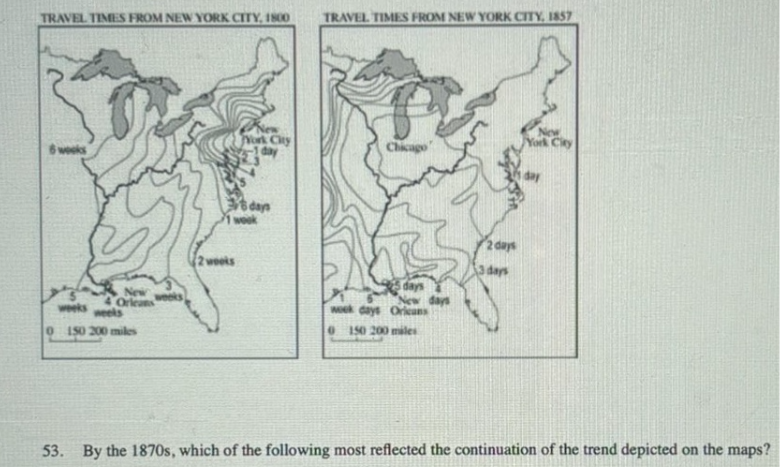
(A) The purchase of automobiles by most households in the United States
(B) The extension of electrical power to most homes in the United States
(C) The completion of transcontinental railroads
(D) The development and use of the cotton gin in the South
(C) The completion of transcontinental railroads
Question refers to the except below...
"Article 2: [T)he United States now solemnly agrees that no persons... shall ever be permitted to pass over, settle upon, or reside in... this reservation for the use of said Indians.
"Article 6: If any individual belonging to said tribes of Indians, or legally incorporated with them, being the head of a family, shall desire to commence farming, he shall have the privilege to select...a tract of land within said reservation, not exceeding three hundred and twenty acres in extent.
"Article 11: [T)he tribes who are parties to this agreement hereby stipulate that they will relinquish all right to occupy permanently the territory outside their reservations... but yet reserve the right to hunt on any lands north of North Platte, and on the Republican Fork of the Smoky Hill river, so long as the buffalo may range thereon in such numbers as to justify the chase.... They will withdraw all opposition to the construction of the railroads now being built on the plains..
They will not attack any persons at home, or travelling, nor molest or disturb any wagon trains, coaches, mules, or cattle belonging to the people of the United States."
- The conflict between the Sioux nation and the United States was primarily driven by differing
(A) styles of farming
(B) claims to land
(C) forms of government
(D) family structures
(B) claims to land
- Which of the following contributed to reducing the conflict that article 11 and similar provisions of other treaties were designed to address?
(A) The rerouting of several major railroads to avoid tribal lands
(B) A decrease in the number of White settlers traveling near reservations
(C) The implementation of government conservation policies that protected large areas of public land
(D) The destruction of nearly the entire population of buffalo
(D) The destruction of nearly the entire population of buffalo
- Which of the following was typical of agreements such as the Fort Laramie Treaty between the United States government and American Indians in the post-Civil War West?
(A) American Indians in controlling the activities of White settlers.
(B) They generally led to the formation of strong, independent American Indian nations.
(C) They usually lasted a short time before being broken by settlers' incursions onto American Indian reservations.
(D) They led to the abandonment of most reservations as American Indian families sought economic opportunities in urban areas.
(C) They usually lasted a short time before being broken by settlers' incursions onto American Indian reservations.
- Article 6 of the treaty most likely reflected which of the following sentiments?
(A) A desire by many American Indians to change their way of life
(B) A hope held by some in government that American Indians would adopt lifestyles similar to the lifestyles of White settlers
(C) A need felt by many American Indians to more clearly legitimize their claims to the land
(D) A wish by some in government to protect American Indian landholdings from encroachments by railroads
(B) A hope held by some in government that American Indians would adopt lifestyles similar to the lifestyles of White settlers
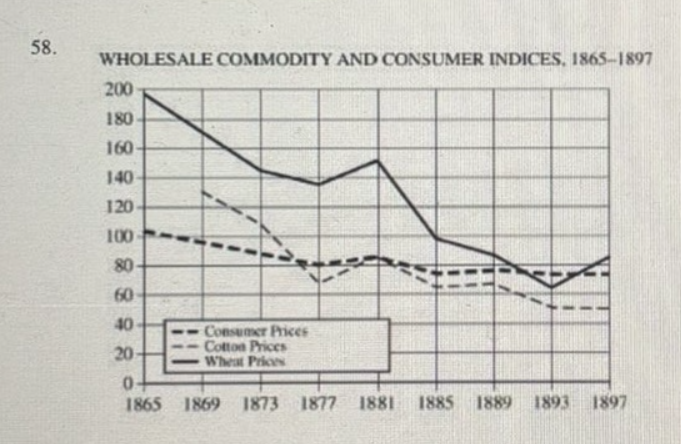
- The chart above supports which of the following conclusions regarding economic conditions in the United States during the last third of the nineteenth century?
(A) Americans with relatively stable incomes found it increasingly difficult to make ends meet.
(B) Wheat farming became more lucrative.
(C) Many American farmers struggled financially.
(D) Cheap foreign goods were the primary cause for the decline in prices.
(E) Industrial workers refused to demand higher wages due to declining prices
(C) Many American farmers struggled financially.
“The normal condition of all the territory of the United States is that of freedom. That as our Republican fathers, when they had abolished slavery in all our national [wester] territory, ordained that 'no person should be deprived of life, liberty or property, without due process of law, it becomes our duty by legislation, whenever such legislation is necessary, to maintain this provision of the Constitution against all attempts to violate it; and we deny the authority of Congress, of a territorial legislature, or of any individuals, to give legal existence to slavery in any territory of the United States."
59. The ideas expressed in the except were most directly influenced by the
(A) nativist movement
(B) free-soil movement
(C) Texas independence movement
(D) temperance movement
(B) free-soil movement
"[I am] commanded to explain to the Japanese that... [the United States] population has rapidly spread through the country, until it has reached the shores of the Pacific Ocean; that we have now large cities, from which, with the aid of steam vessels, we can reach Japan in eighteen or twenty days; [and] that... the Japan seas will soon be covered with our vessels.
*Therefore, as the United States and Japan are becoming every day nearer and nearer to each other, the President desires to live in peace and friendship with your imperial majesty, but no friendship can long exist, unless Japan ceases to act toward Americans as if they were her enemies.
"Many of the large ships-of-war destined to visit Japan have not yet arrived in these seas, though they are hourly expected; and [the United States has], as an evidence of [its] friendly intentions... brought but four of the smaller ones, designing, should it become necessary, to return to Edo [Tokyo] in the ensuing spring with a much larger force."
- The excerpt best supports the conclusion that in the 1850s, the United States government
(A) sought to prevent Japan from forming a naval alliance with the British empire
(B) was willing to intimidate Asian countries like Japan to secure economic opportunities
(C) attempted to monopolize Japanese commerce and to exclude the participation of Europeans in trade
(D) was interested in making the government of Japan more democratic
(B) was willing to intimidate Asian countries like Japan to secure economic opportunities