A block has a mass of 3.00 kg.
A horizontal
force of 9.00 N is applied to it.
What is the acceleration of the block?
Answer: 3.00 m/s²
A block with a mass of 4.00 kg is pushed with a force of 20.0 N.
What is the acceleration?
Answer: 5.00 m/s²
...
A force of 12.0 N acts on a 6.00 kg object.
What is the acceleration of the object?
Answer: 2.00 m/s²
...
A 1.50 kg cart is pulled with a force of 3.00 N.
What is its acceleration?
Answer: 2.00 m/s²
...
If F = 6.00 N and m = 2.50 kg, what is the magnitude of the acceleration for the block shown in the figure? The surface is frictionless.
2.40m/s2
A force of 10.0 N acts at 60° above
the horizontal on a 2.00 kg block.
Surface is frictionless.
Find the acceleration.
Answer: 2.50 m/s²
...
A 4.00 kg block is pulled with a 20.0
N force at 30° above the horizontal.
Surface is frictionless.
Find the acceleration.
Answer: 4.33 m/s²
...
A 3.00 kg object is pushed with a 9.00
N force at 45° to the horizontal.
Surface is frictionless.
Find the acceleration.
Answer: 2.12 m/s²
...
A 5.00 kg block is pulled by a 15.0
N force at 60° above the horizontal.
Surface is frictionless.
Find the acceleration.
Answer: 1.50 m/s²
...
A 3.00 kg block is pulled with a 10.0
N force at 30° above horizontal.
Coefficient of friction = 0.20.
Find:
- Normal force
- Friction force
Answers:
- N=26.4 N
- f=5.28 N
...
A 4.00 kg block is pulled with 12.0
N at 60° above horizontal.
μ=0.15
Find:
- Normal force
- Friction force
Answers:
- N=28.8 N
- f=4.32 N
...
A 2.00 kg object is pulled with 8.00
N at 45° above horizontal.
μ=0.10
Find:
- Normal force
- Friction force
Answers:
- N=14.0 N
- f=1.40 N
...
A 5.00 kg block is pulled with 20.0
N at 30° above horizontal.
μ=0.25\mu = 0.25μ=0.25
Find:
- Normal force
- Friction force
Answers:
- N=39.0 N
- f=9.75 N
...
A 4 kg object accelerates at 3
m/s².
Find the force.
Answer: 12.00 N
...
A 2.5 kg mass accelerates at 4
m/s².
Find the force.
Answer: 10.00 N
...
A 6 kg block accelerates at 1.5
m/s².
Find the force.
Answer: 9.00 N
...
A force of 15 N acts on a 5 kg
mass.
Find the acceleration.
Answer: 3.00 m/s²
...
A 2 kg object is pushed with 8 N of
force.
Find the acceleration.
Answer: 4.00 m/s²
...
10 kg block experiences a 25 N
force.
Find the acceleration.
Answer: 2.50 m/s²
...
A mass of 3 kg on the floor is pulled by a force 60 N acting at 30. Calculate the acceleration of the mass along the floor, in m/s2
17.32 m/s²
A 4 kg block is pulled with 40 N at
60°.
Find acceleration along the floor.
Answer: 5.00 m/s²
...
A 2 kg block is pulled with 20 N at
30°.
Find acceleration.
Answer: 8.66 m/s²
...
A 5 kg object is pulled with 50 N
at 45°.
Find acceleration.
Answer: 7.07 m/s²
...
A 3 kg block is pulled with 30 N at
60°.
Find acceleration.
Answer: 5.00 m/s²
...
A 4 kg block is pulled by:
- F1=6 horizontal
- F2=10N at 60∘
Find the acceleration.
Answer: 2.25 m/s²
...
A 3 kg block is pulled by:
- F1=5N horizontal
- F2=9N at 30∘
Find the acceleration.
Answer: 4.27 m/s²
...
A 6 kg block is pulled by:
- F1=12 N horizontal
- F2=8N at 45∘
Find the acceleration.
Answer: 2.94 m/s²
...
A 2 kg block is pulled by:
- F1=4 N horizontal
- F2=6N at 30∘
Find the acceleration.
Answer: 3.60 m/s²
...
A 10 kg box sits on the floor.
Find the normal force.
Answer: 98.00 N
...
A 4.5 kg object rests on a table.
Find the
normal force.
Answer: 44.10 N
...
A 20 kg crate is on a flat surface.
Find the
normal force.
Answer: 196.00 N
...
A 10 kg block is pulled with 40 N
at 30° upward.
Find the normal force.
Answer: 78.0 N
...
A 5 kg object is pulled with 20 N
at 60° upward.
Find the normal force.
Answer: 32.7 N
...
A 8 kg block is pulled with 30 N at
45° upward.
Find the normal force.
Answer: 59.2 N
...
A mass of 37 kg on the floor is pushed by a force 110 N acting at 30o downwards. Calculate the normal force on the mass from the floor (in newtons).
417.6
A 20 kg block is pushed with 50 N
at 30° downward.
Find the normal force.
Answer: 221 N
...
A 10 kg object is pushed with 40 N
at 60° downward.
Find the normal force.
Answer: 133.6 N
...
A 15 kg crate is pushed with 30 N
at 45° downward.
Find the normal force.
Answer: 168.2 N
...
Practice 1
A 5 kg block is pushed with 10
N.
μs=0.5
The block does not move.
Find the
friction force.
Answer: 10 N
...
An 8 kg box is pushed with 20
N.
μs=0.4
The box does not move.
Find friction.
Answer: 20 N
...
A 12 kg crate is pulled with 30
N.
μs=0.7
The crate stays still.
Find friction.
Answer: 30 N
...
A 2 kg block rests on a 30°
incline.
Find the friction force.
Answer: 9.8 N
...
A 4 kg block sits on a 15°
incline.
Find friction.
Answer: 10.1 N
...
A 3 kg block rests on a 25°
incline.
Find friction.
Answer: 12.4 N
...
A 5 kg block is pulled with 40
N.
μk=0.3
Find the acceleration.
Answer: 5.06 m/s²
...
A 3 kg block is pulled with 15
N.
μk=0.2
Find acceleration.
Answer: 3.04 m/s²
...
A 10 kg crate is pulled with 60
N.
μk=0.25
Find acceleration.
Answer: 3.55 m/s²
...
A 5 kg block is pulled with a 50 N
force at 30° above the horizontal.
The
coefficient of kinetic friction is 0.2.
Find the acceleration.
Answer: 7.24 m/s²
...
A 4 kg block is pulled with a 30 N
force at 45° above the horizontal.
μk=0.25
Find the acceleration.
Answer: 4.43 m/s²
...
A 2 kg block is pulled with a 20 N
force at 30° above the horizontal.
μk=0.3
Find the acceleration.
Answer: 6.49 m/s²
...
A 6 kg crate is pulled with a 60 N
force at 60° above the horizontal.
μk=0.2
Find the acceleration.
Answer: 4.32 m/s²
...
A mass of 3 kg is on the floor. It is pushed by a force F1 = 6 N
acting horizontally to the right, and a second force F2 = 15 N acting
at 30 degrees above the horizontal. The coefficient of kinetic
friction is μk = 0.2.
Calculate the acceleration of the mass
along the floor (in m/s²).
Answer: 4.69 m/s²
...
Practice Question 2
A mass of 2.5 kg is on the floor. It is
pushed by a force F1 = 5 N acting horizontally to the right, and a
second force F2 = 20 N acting at 45 degrees above the horizontal. The
coefficient of kinetic friction is μk = 0.3.
Calculate the
acceleration of the mass along the floor (in m/s²).
Answer: 5.54 m/s²
...
A mass of 4 kg is on the floor. It is pushed by a force F1 = 10 N
acting horizontally to the right, and a second force F2 = 18 N acting
at 30 degrees above the horizontal. The coefficient of kinetic
friction is μk = 0.25.
Calculate the acceleration of the mass
along the floor (in m/s²).
Answer: 4.88 m/s²
...
A mass of 1.5 kg is on the floor. It is pushed by a force F1 = 4 N
acting horizontally to the right, and a second force F2 = 12 N acting
at 60 degrees above the horizontal. The coefficient of kinetic
friction is μk = 0.2.
Calculate the acceleration of the mass
along the floor (in m/s²).
Answer: 3.80 m/s²
...
An automobile of mass 1000 kg moving at 30 m/s is braked suddenly with a constant braking force of 4000 N. How far does the car travel before stopping, in meters?
112.5
An airplane of mass 6000 kg is given a thrust (force) by its engines that causes the plane to have an acceleration of 0.7 m/s2. What was the value of the thrust (in newtons)?
...
Practice Question 1
An automobile of mass 800 kg is moving at
20 m/s. It is braked with a constant force of 3200 N.
How far
does the car travel before stopping (in meters)?
Answer: 50.0 m
...
A car of mass 1200 kg is moving at 25 m/s. A constant braking force
of 6000 N is applied.
How far does the car travel before
stopping (in meters)?
Answer: 62.5 m
...
A truck of mass 2000 kg is moving at 18 m/s. It experiences a braking
force of 5000 N.
How far does it travel before stopping (in
meters)?
Answer: 64.8 m
...
A car of mass 1500 kg is moving at 30 m/s. A braking force of 7500 N
is applied.
How far does the car travel before stopping (in
meters)?
Answer: 90.0 m
...
An airplane of mass 6000 kg is given a thrust (force) by its engines that causes the plane to have an acceleration of 0.7 m/s2. What was the value of the thrust (in newtons)?
4200N
The mass of an object on earth is 5.6 kg. What will be its mass on the Moon?
5.6kg
The mass of an object on earth is 15 kg. What will be its weight on the Moon, in newtons?
24N
If we know an object is moving at constant velocity, we may assume:
the net force acting on the object is zero.
If we know that a nonzero net force is acting on an object, which of the following must we assume regarding the object's condition? The object is:
being accelerated.
Which of the following is an example of the type of force that acts at a distance?
magnetic electrical gravitationaL
The four fundamental forces of nature are:
all field forces
According to the First Law of Motion, an object moving with a constant velocity must be experiencing a non-zero net (resultant) force on it.
False
If you push on a table with a force = F, and the table does not move (maybe due to being bolted to the floor), the table pushes back on you with a force of equal magnitude F.
True
The earth has 81 times more mass than the Moon. The gravitational force with which the Earth pulls the Moon is greater than that with which the Moon pulls the Earth.
False
Two teams are playing Tug of War. Both teams are pulling the rope backwards with the same force, so that none is winning. If the force applied by each team is 200 N, what is the tension in the rope at the point 'A' that is in-between the two teams?
200 N
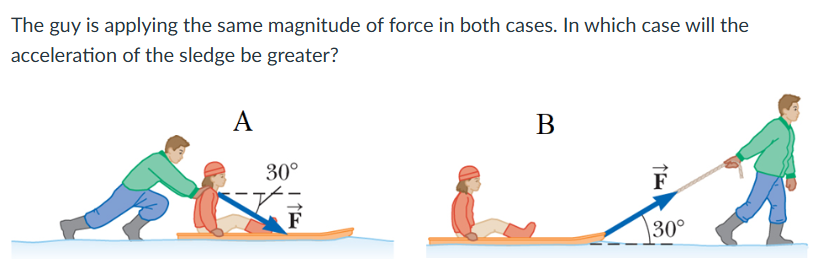
The guy is applying the same magnitude of force in both cases. In which case will the acceleration of the sledge be greater?
If there is no friction between sledge and ground Acceleration is same for both A and B
If there is friction between sledge and ground B will have more acceleration
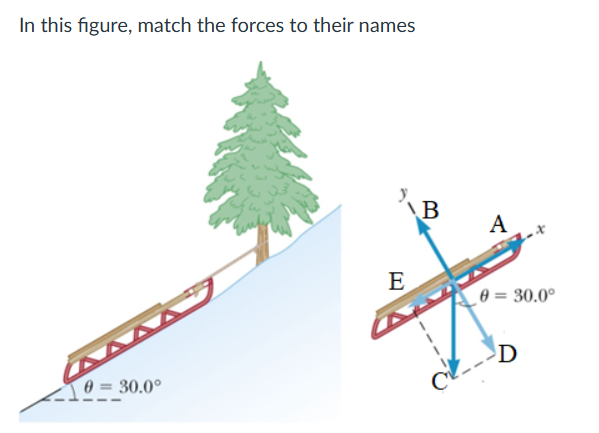
In this figure, match the forces to their names
Normal Force Weight Tension in the string B C A
The value of acceleration due to gravity on Mars’ surface is 3.80
m/s2. An astronaut's
backpack has a mass of 50.0 kg on Earth.
What does it weigh on Mars?
a. 180 N
b. 190 N
c. 490
N
d. 50.0 N
b. 190 N
The value of acceleration due to gravity on the Moon’s surface is
1.60 m/s².
An astronaut's backpack has a mass
of 40.0 kg on Earth.
What does it weigh on the Moon?
a. 64 N
b. 160 N
c. 400 N
d. 40.0 N
Answer:
a. 64 N
...
The value of acceleration due to gravity on Jupiter’s surface is
24.8 m/s².
An astronaut's backpack has a mass
of 20.0 kg on Earth.
What does it weigh on Jupiter?
a. 49.6 N
b. 248 N
c. 496 N
d. 20.0 N
Answer:
c. 496 N
...
The value of acceleration due to gravity on Mars’ surface is
3.70 m/s².
An astronaut's backpack has a mass
of 60.0 kg on Earth.
What does it weigh on Mars?
a. 222 N
b. 180 N
c. 600 N
d. 60.0 N
Answer:
a. 222 N
...
The value of acceleration due to gravity on the Moon’s surface is
1.60 m/s².
An astronaut's backpack has a mass
of 75.0 kg on Earth.
What does it weigh on the Moon?
a. 75.0 N
b. 120 N
c. 180 N
d. 600 N
Answer:
b. 120 N
...
A car of mass 1200 kg is accelerated at 3.00 m/s2. What is the force being applied?
a. 2400 N
b. 3600 N
c. 600 N
d. 400 N
b. 3600 N
A car of mass 900 kg is accelerated at 2.00
m/s².
What is the force being applied?
a. 450 N
b. 1800 N
c. 2000 N
d. 900 N
Answer:
b. 1800 N
...
A car of mass 1500 kg is accelerated at 4.00
m/s².
What is the force being applied?
a. 375 N
b. 6000 N
c. 1500 N
d. 4500 N
Answer:
b. 6000 N
...
A car of mass 800 kg is accelerated at 5.00
m/s².
What is the force being applied?
a. 4000 N
b. 160 N
c. 800 N
d. 3000 N
Answer:
a. 4000 N
...
A car of mass 1100 kg is accelerated at 2.50
m/s².
What is the force being applied?
a. 275 N
b. 1375 N
c. 2750 N
d. 3850 N
Answer:
c. 2750 N
...
When three forces are acting on an object, can it be in a state of rest?
a. Yes
b. No
Explanation
An object is at rest when the net force on it is zero.
That means all the forces acting on it cancel each other out.
So even if three forces are acting on an object, it can still be at rest if their vector sum equals zero.
Example:
- One force pulls left.
- Two forces pull right.
- If the total rightward force equals the leftward force, the object does not move.
This condition is called equilibrium.
yes
You push a table to the right, and the table moves. The force that
you exert on the table
is FY, and the force that the table exerts
on you is FT. Which of the following is true?
a. |FY| = |FT|.
|FY| acts on the Table, and |FT| acts on you.
b. |FY| >
|FT|.
c. |FY| < |FT|.
d. |FY| = |FT|. Both forces act on
the Table.
Newton’s Third Law states:
For every action force, there is an equal and opposite reaction force.
So:
- You push the table with force FY.
- The table pushes you back with force FT.
- These forces are:
- Equal in magnitude
- Opposite in direction
- Acting on different objects
You are going in a car on a straight road at some speed in the
forward direction. As
you apply the brakes, your car starts to
slow down. What is the direction of your
acceleration?
a. In
the forward direction.
b. In the backward direction.
c. Towards your right
d. Towards your left.
e. There
is no direction to acceleration.
Concept: Direction of Acceleration
Acceleration is the direction of the change in velocity, not the direction of motion.
The car is moving forward.
When you apply the brakes, the car slows down.
Slowing down means the acceleration is opposite the direction of motion.
So if the car is moving forward, the acceleration must be backward.
In the experiment using the inclined plane, the acceleration down the
plane was
measured to be 0.85 m/s2 when the mass of the car was
1.50 kg. If an extra 1.50 kg is
put on top of the car, will the
acceleration change for the same inclined plane? Assume
there is
no friction in either case.
a. Yes. The acceleration will become
more than 0.85 m/s2
b. Yes. The acceleration will become less
than 0.85 m/s2
c. No. The acceleration will remain the same.
Mass is not in the equation
So changing the mass does not change the acceleration
Even if you double the mass:
The gravitational force doubles.
But the inertia (resistance to motion) also doubles.
These effects cancel out.
So the acceleration stays the same.
A car of mass 800 kg is parked on an inclined road of angle of
incline = 10°. If the
coefficient of friction between the tires
and the road is 0.20, will the car slip downwards?
a. Yes
b. No
...

Three forces, A, B and C are acting on a box of mass 12 kg, each trying to pull it in its own direction. The forces are: A = 50 N in the +X-direction, B = 30 N in −X-direction, and C = 20 N in the +Y-direction. Ignore friction. What will be the magnitude and direction of the resultant acceleration?
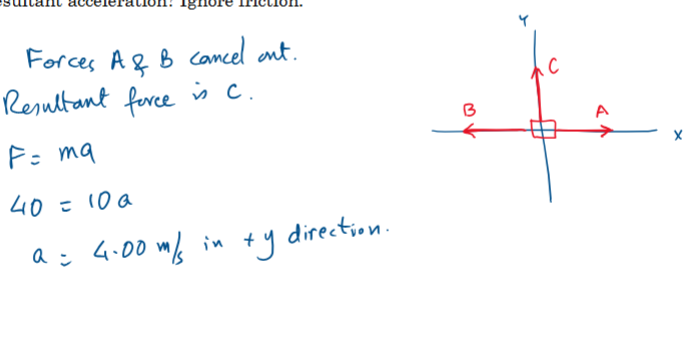
Answer:
Magnitude: 2.36 m/s²
Direction: 45.0° above the
+X-direction (north of east)
Three forces, A, B and C are acting on a box of mass 8.0 kg, each trying to pull it in its own direction. The forces are: A = 60 N in the +X-direction, B = 60 N in −X-direction, and C = 40 N in the −Y-direction. Ignore friction. What will be the magnitude and direction of the resultant acceleration?
Answer:
Magnitude: 5.00 m/s²
Direction: −Y-direction (south)
...
Three forces, A, B and C are acting on a box of mass 15 kg, each trying to pull it in its own direction. The forces are: A = 25 N in the +X-direction, B = 55 N in −X-direction, and C = 40 N in the +Y-direction. Ignore friction. What will be the magnitude and direction of the resultant acceleration?
Answer:
Magnitude: 3.33 m/s²
Direction: 53.1° north of
west (or 126.9° from +X)
...
Three forces, A, B and C are acting on a box of mass 10 kg, each trying to pull it in its own direction. The forces are: A = 70 N in the +X-direction, B = 20 N in −X-direction, and C = 50 N in the +Y-direction. Ignore friction. What will be the magnitude and direction of the resultant acceleration?
Answer:
Magnitude: 7.07 m/s²
Direction: 45.0° above the
+X-direction (north of east)
...
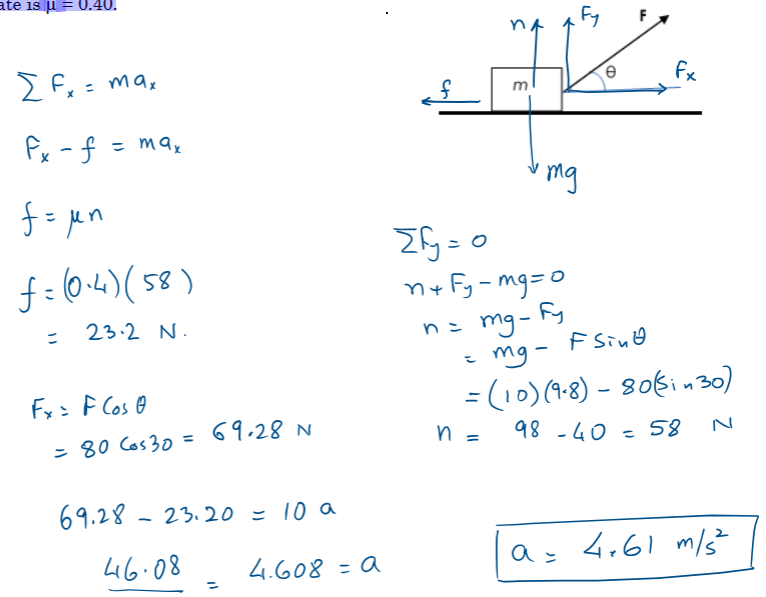
Calculate the acceleration of the crate of mass m = 10.0 kg, if it is
pulled by a force of
F = 80.0 N at an angle θ = 30°. The
coefficient of friction between the floor and the crate is μ = 0.40.
Calculate the acceleration of the crate of mass m = 12.0
kg, if it is pulled by a force of
F = 90.0
N at an angle θ = 25°.
The coefficient
of friction between the floor and the crate is μ = 0.35.
Answer:
1.92 m/s²
...
Calculate the acceleration of the crate of mass m = 8.0
kg, if it is pulled by a force of
F = 70.0
N at an angle θ = 40°.
The coefficient
of friction between the floor and the crate is μ = 0.30.
Answer:
3.47 m/s²
...
Calculate the acceleration of the crate of mass m = 15.0
kg, if it is pulled by a force of
F = 100.0
N at an angle θ = 20°.
The coefficient
of friction between the floor and the crate is μ = 0.45.
Answer:
0.73 m/s²
...
Calculate the acceleration of the crate of mass m = 9.0
kg, if it is pulled by a force of
F = 85.0
N at an angle θ = 35°.
The coefficient
of friction between the floor and the crate is μ = 0.25.
Answer:
4.30 m/s²
...