EN1B-You have a cube of modeling clay in your hands. Which of the following changes to the shape of this cube of clay will decrease its surface area relative to its volume?
Round the clay up into a sphere.
EN1B-The large surface area in the gut directly facilitates ____.
absorption

EN1B-Both the volume and the surface area for three different cells were measured. These values are listed in the following table:
Cell 2 since it has the highest surface area-to-volume ratio which facilitates the exchange of materials between a cell and its environment.
EN1B-Villi and microvilli in the small intestine ____.
increase the surface area to increase the efficiency of nutrient absorption
EN1C-Upon activation by stomach acidity, the secretions of the parietal cells ____.
initiate the chemical digestion of protein in the stomach
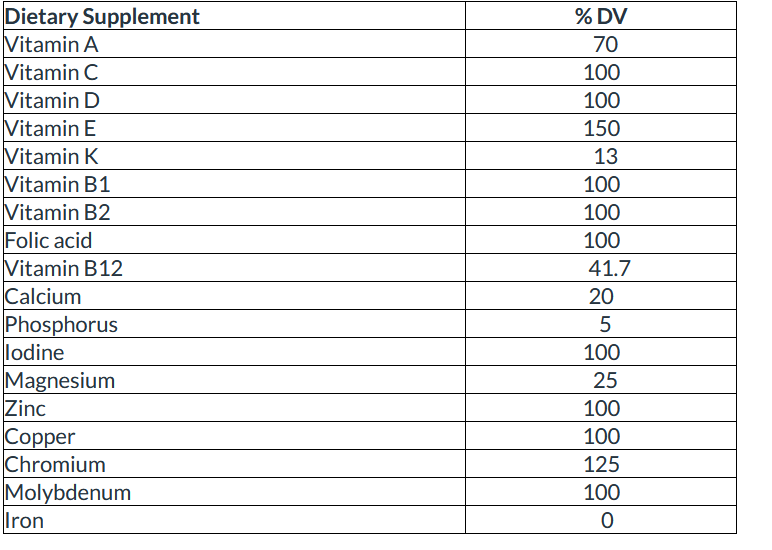
The following table shows the contents of a multivitamin supplement
and its percentage of recommended daily values (%DV).
EN1C-The most likely reason that some of the vitamins and
minerals in this supplement are found at less than 100% is that ____.
it is dangerous to overdose on fat-soluble vitamins such as A and K
EN1C-A zoologist analyzes the jawbones of an extinct mammal and concludes that it was an herbivore. The zoologist most likely came to this conclusion based upon ____.
the shape of the teeth
EN1C-Evolutionary adaptations that help diverse animals directly exchange matter between cells and the environment include ____.
an external respiratory surface, a small body size, and a two-cell-layered body
EN1D-Which of the following statements describes a key component of the induced fit hypothesis of enzyme catalysis?
Binding of substrate to the active site changes the shape of the active site of an enzyme.
EN1D-You have discovered an enzyme that can catalyze two different chemical reactions. Which of the following is most likely to be correct?
Either the enzyme has two distinct active sites or the reactants involved in the two reactions are very similar in size and shape.
EN1E-Which of the following statements about enzyme function is correct?
Enzymes can lower the activation energy of reactions, but they cannot change the equilibrium point because they cannot change the net energy output.
EN1E-Which of the following is true of enzymes?
Enzymes increase the rate of chemical reaction by lowering activation energy barriers.
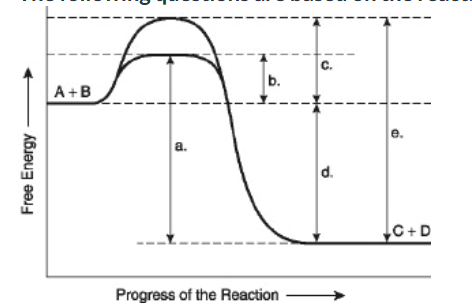
The following questions are based on the reaction A +
B « C + D shown in the accompanying
figure.
EN1E-Which of the following represents the
activation energy required for the non-catalyzed reaction in the figure?
C
The following questions are based on the reaction A +
B « C + D shown in the accompanying
figure.
EN1E-Which of the following represents the
activation energy required for the enzyme-catalyzed reaction in the figure?
B
EN1F-Pepsin is an enzyme produced in the stomach that attacks proteins to break them down into smaller peptide molecules. Which one of the following statements about this enzyme is true?
Pepsin will cease to function in the small intestine as basic secretions from the pancreas neutralize the pH.
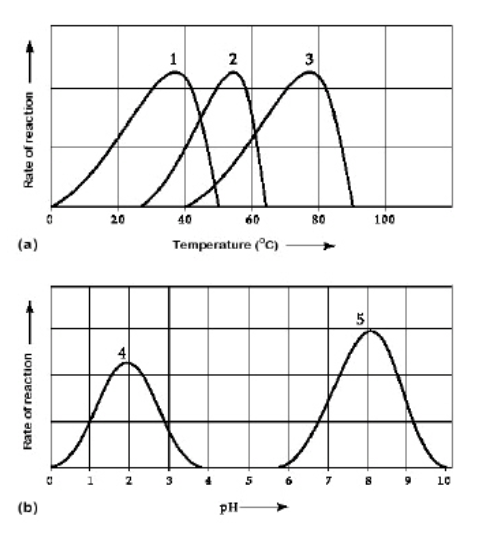
Activity of various enzymes at various temperatures (a) and at
various pH (b).
EN1F-Which curves on the
graphs may represent the temperature and pH profiles of an enzyme
taken from a bacterium that lives in a mildly alkaline hot springs at
temperatures of 70°C or higher?
curves 3 and 5
EN1F-When you have a severe fever, what may be a grave consequence if this is not controlled?
change in the folding of enzymes
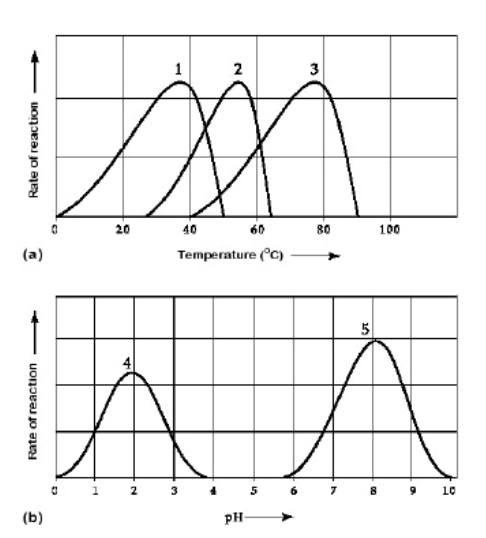
Activity of various enzymes at various temperatures (a) and at
various pH (b).
EN1F-Which temperature and
pH profile curves on the graphs were most likely generated from
analysis of an enzyme from a human stomach where conditions are
strongly acid?
curves 1 and 4
EN1G-During a laboratory experiment, you discover that an enzyme-catalyzed reaction has a DG of -20 kcal/mol. If you double the amount of enzyme in the reaction, what will be the DG for the new reaction?
-20 kcal/mol
EN1G-Characterization of the complete three-dimensional structure of a newly purified protein suggests that it catalyzes the breakdown of a large substrate. The protein consists of a single polypeptide chain. It has a large pocket that appears to be the binding site for the substrate and a smaller indentation that appears to be the binding site for a regulatory molecule. What do these structural observations suggest about the mechanism by which the activity of this protein is likely regulated?
It is probably an enzyme that is regulated by noncompetitive inhibition.
EN1G-HIV is the virus that causes AIDS. In the mid-1990s, researchers discovered an enzyme in HIV called protease. Once the enzyme's structure was known, researchers began looking for drugs that would fit into the active site and block it. If this strategy for stopping HIV infections were successful, it would be an example of what phenomenon?
competitive inhibition
Use the following information to answer the question
below.
A series of enzymes catalyze the
reaction X ® Y ® Z ® A. Product A binds to the enzyme that converts X
to Y at a position remote from its active site. This binding
decreases the activity of the enzyme.
EN1G-With respect
to the enzyme that converts X to Y, substance A functions as ____.
allosteric inhibitor
EN1H-Living organisms increase in complexity as they grow, resulting in a decrease in the entropy of an organism. How does this relate to the second law of thermodynamics?
As a consequence of growing, organisms cause a greater increase in entropy in their environment than the decrease in entropy associated with their growth.
EN1H-Chemical equilibrium is relatively rare in living cells. An example of a reaction at chemical equilibrium in a cell would be ____.
a chemical reaction in which both the reactants and products are not being produced or used in any active metabolic pathway at that time in the cell
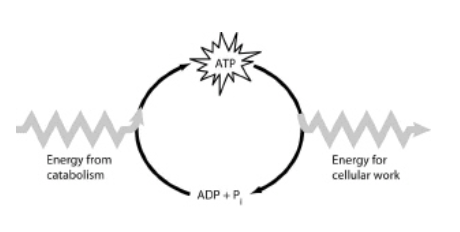
EN1H-Which of the following is the most correct interpretation of the figure?
ATP is a molecule that acts as an intermediary to store energy for cellular work.
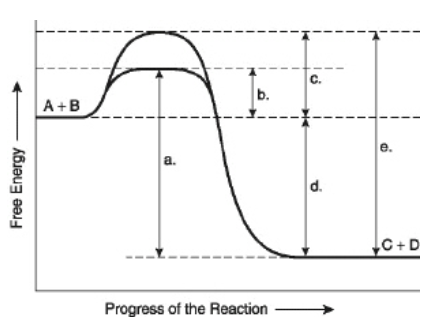
The following question is based on the reaction A +
B « C + D shown in the accompanying
figure.
EN1H-Which of the following in the figure would be the
same in either an enzyme-catalyzed or a noncatalyzed
reaction?
EN1H-Which of the following in the
figure would be the same in either an enzyme-catalyzed or a
noncatalyzed reaction?
d.
EN1M-You are studying a large tropical reptile that has a high and relatively stable body temperature. How would you determine whether this animal is an endotherm or an ectotherm?
You subject this reptile to various temperatures in the lab and find that its body temperature and metabolic rate change with the ambient temperature. You conclude that it is an ectotherm.
EN1M-An example of an ectothermic organism that has few or no behavioral options when it comes to its ability to adjust its body temperature is a ____.
sea star living deep in the ocean
EN1M-An animal's inputs of energy and materials would exceed its outputs if ____.
it is growing and increasing its mass
EN1M-There are advantages and disadvantages to adaptations. Animals that are endothermic are likely to be at the greatest disadvantage in ____.
environments with variable and limited food sources
EN2F-The difference between pinocytosis and receptor-mediated endocytosis is that ____.
pinocytosis is nonselective in the molecules it brings into the cell, whereas receptor-mediated endocytosis offers more selectivity.
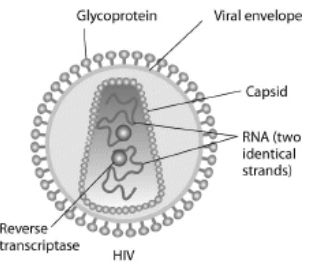
Use the paragraph and accompanying figure to answer the
following questions.
Human immunodeficiency
virus (HIV) infects cells that have both CD4 and CCR5 cell surface
molecules. The viral nucleic acid molecules are enclosed in a protein
capsid, and the protein capsid is itself contained inside an envelope
consisting of a lipid bilayer membrane and viral glycoproteins. One
hypothesis for viral entry into cells is that binding of HIV membrane
glycoproteins to CD4 and CCR5 initiates fusion of the HIV membrane
with the plasma membrane, releasing the viral capsid into the
cytoplasm. An alternative hypothesis is that HIV gains entry into the
cell via receptor-mediated endocytosis, and membrane fusion occurs in
the endocytotic vesicle. To test these alternative hypotheses for HIV
entry, researchers labeled the lipids on the HIV membrane with a red
fluorescent dye.
EN2F-What would be observed by live-cell
fluorescence microscopy immediately after HIV entry if HIV is
endocytosed first, and then later fuses with the endocytotic vesicle membrane?
The red fluorescent dye-labeled lipids will appear in the infected cell's interior.
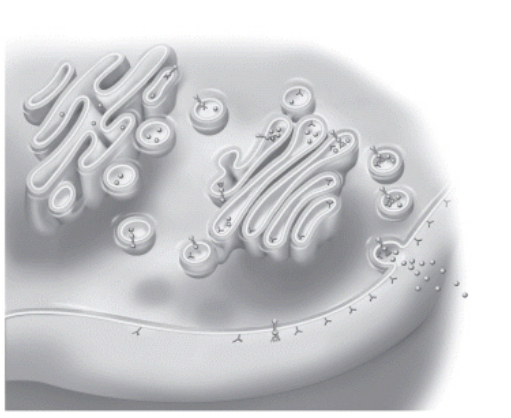
EN2F-Suppose that the cell shown in this figure is secreting insulin, a protein hormone, via exocytosis. Which statement most accurately describes why this mechanism of transport is ideal for insulin secretion?
Proteins are large molecules that cannot be transported efficiently across the membrane via transport proteins.
EN2F-In marine sponges, intracellular digestion of peptides is usually immediately preceded by ____.
phagocytosis
EN3A-Once labor begins in childbirth, contractions increase in intensity and frequency, causing more contractions to occur until delivery. The increasing labor contractions of childbirth are an example of which type of regulation?
positive feedback
EN3A-Positive feedback differs from negative feedback in that ____.
the positive feedback's effector responses are in the same direction as the initiating stimulus rather than opposite of it
EN3B-In a healthy person, after a large meal, the production of ____ will increase. After fasting, the production of ____ will increase.
insulin; glucagon
EN3B-Organisms maintain dynamic homeostasis (internal balance)
through behavioral and physiological mechanisms.
Which of the
following statements is an accurate explanation of a negative feedback
mechanism used by animals to regulate body temperature?
A ground squirrel’s hypothalamus detects changes in environmental temperatures and responds by activating or suppressing metabolic heat production.
EN3B-Which of the following is an example of negative feedback?
When the level of glucose in the blood increases, the pancreas produces and releases the hormone insulin. Insulin acts to decrease blood glucose. As blood glucose decreases, the rate of production and release of insulin decreases as blood glucose decreases.
EN3B-When the body's blood glucose level rises, the pancreas secretes insulin and, as a result, the blood glucose level declines. When the blood glucose level is low, the pancreas secretes glucagon and, as a result, the blood glucose level rises. Such regulation of the blood glucose level is the result of ____.
negative feedback
EN3D-An example of a properly functioning homeostatic control system is seen when ____.
the kidneys excrete salt into the urine when dietary salt levels rise
EN3D-Which principle of heat exchange is the most important explanation for why birds look larger in colder weather because they fluff their feathers?
Fluffing creates a pocket of air near the bird that acts as insulation.
EN3D-Chum salmon (Oncorhynchus keta) are born in freshwater environments and then migrate to the sea. Near the end of their lives, they return to the freshwater stream where they were born to spawn. In freshwater, water constantly diffuses into the body and ions are lost from the body. In salt water, body water diffuses out of the body and excess ions are gained from the water. A salmon's gills have special cells to pump salt in or out of the body to maintain homeostasis. In response to the salmon's moves between freshwater and salt water, some cells in the gills are produced and others are destroyed. These changes made in the cells of the gills during the lifetime of an individual salmon are an example of which of the following?
acclimatization
EN3D-Hummingbirds are small birds that require a regular food supply. When hummingbirds are faced with a situation that decreases their food supply, such as a storm, which of the following adaptations would be most useful for the bird to survive such an unpredictable and short-term absence of food resources?
torpor