according to our class, what are the two main keys as to how the immune system functions?
recognition and response
distinguish between primary and secondary lymphoid tissue and provide an example of each
primary: bone marrow and thymus -> where lymphocytes are created and where they mature
secondary: lymph nodes and spleen -> where mature lymphocytes go to be activated by antigen encounters
what are the major tenets of the clonal selection theory?
individual B and T receptors are randomly generated by gene segment rearrangements, individual specificity
receptor engagement is necessary for activation of the cell
when a B or T cell interacts with specific (cognate) antigen, selected and activated
B and T cell receptors recognize self-antigens will be eliminated during development
what are the three major functions of the innate immune system?
physical and chemical barriers infection
cellular responses to infection
activation of adaptive immune system
what activates the classical complement pathway? alternative? mannose-binding lectin?
classical: activated by antibody (adaptive)
mannose binding lectin: activated by binding to mannose on microbial cell surfaces (innate)
alternative: spontaneous activation/hydrolysis (innate)
which event initiates the body's immune response against a pathogen?
PAMP/DAMP -> PPR interactions in primary response
what are the characteristics that distinguish innate immunity and adaptive immunity?
innate: minutes to hours, limited and fixed specificity, same each time; barriers, phagocytes, pattern recognition molecules
adaptive: days, highly diverse, adapts to improve, more rapid and effective with each subsequent exposure, T and B lymphocytes, antigen-specific receptors
which of the following cells are of myeloid origin and which are of lymphoid origin? which are generally considered to be cells of innate immune system and which are generally considered to be cells of the adaptive immune system?
macrophages: myeloid, innate
B cells: lymphoid, adaptive
dendritic cells: myeloid, innate
NK cells: lymphoid, innate
T cells: lymphoid, adaptive
basophils: myeloid, innate
neutrophils: myeloid, innate
what are the three main outcomes of complement activation?
opsonization: facilitating uptake and killing by phagocytes
inflammation: recruitment of inflammatory cells
lysis: perforation of pathogen cell membrane
in terms of memory response, how does the innate immune response change from primary to secondary response? how does the adaptive immune response change from primary to secondary response?
innate: does not change between primary and secondary response because it non-specific and does not have memory
adaptive: adapts to improve between primary and secondary response it is specific and has memory
relative to immune cell receptors, what is meant by the term 'germ-line encoded'? based on that definition, distinguish between receptors of the innate immune system and receptors of the adaptive immune system
germline encoded -> immune cell receptors are coded directly by genes in the DNA, not a product of recombination innate immune receptors are germline, but adaptive immune receptors are a product of recombination
what are the four stage of leukocyte migration/trafficking?
rolling
activation
firm adhesion
diapedesis
what are the three signals involved in the three-signal hypothesis? identify the molecules involved in each signal
signal 1: MHC II/antigen presenting cell which binds with TCR on CD4+ T cell
signal 2: CD80/86 (B7) is an antigen presenting cell which binds with CD28 on CD4+ T cell
signal 3: cytokine on antigen presenting cell which binds to cytokine receptor on CD4+ T cell
list and briefly describe six effector function of antibodies?
neutralization
ADCC
degranulation
agglutination
opsonization
complement activation
define the term epitope. what is the difference between a sequential epitope and a conformational epitope?
epitope: the region of an antigen that is what the antibody recognizes and binds to (antigenic determinant) - immunodominant: bring stronger immune response
a sequential epitope is amino acids the antigen are sequential in terms of linear structure where as conformational epitopes are amino acids that are far apart and brought together during protein folding
for MHC class I and MHC class II list (a) the type of antigen each presents and (b) the cell type that each presents TO
MHC class I presents endogenous antigens to cytotoxic T cells (CD8+), all nucleated cells
MHC class II presents exogenous antigen to helper T cells (CD4+), APCs
how would you define a inflammatory cytokine? an anti-inflammatory cytokine? what are some general examples of each type?
pro-inflammatory: signaling molecules that induce and regulate inflammation (IL-1, IL-6, TNFa, chemokines)
anti-inflammatory: signaling molecules that reduce and stop inflammation (IL-10, TGF-B)
what are the three major types of cells that are 'helped' by helper T cells?
macrophages, cytotoxic T cells, and B cells
commonalities: cell-cell, CD40L on T cell, CD40 on other cell
secretes cytokines
what is a checkpoint inhibitor? what is the important T cell molecule involved in checkpoint inhibition?
checkpoint inhibitor: immunotherapy drug that blocks proteins on immune cells to release the natural "brakes" which allows it to attack cancer cells
important T cell molecules: PD-1
what is meant by the term 'MHC restriction'
the T cell CANNOT recognize antigen that is NOT presented by MHC or put another; only MHC-bound antigen will be recognized by the T cell
B cells not MHC restricted
what is the function of the RAG 1/2 complex?
recombination activating gene (complex)
picks and recombines assemble various gene segments into a segment of DNA that can be expressed
regulate VDJ recombination
list and briefly describe the four types of B cell receptor diversification. which types occur during development? what type occurs after activation?
somatic recombination: random VDJ pairing, during development
combinatorial diversity: the randomness of heavy and light chain pairing, during development
junctional diversity: hairpin overhangs generated by Artemis, leads to new sequence, during development
somatic hypermutation: after activation
briefly distinguish between monoclonal and polyclonal antibodies?
monoclonal: antibodies recognize a single epitope on a single antigen
polyclonal: antibodies recognize multiple epitopes on the same antigen
antibody
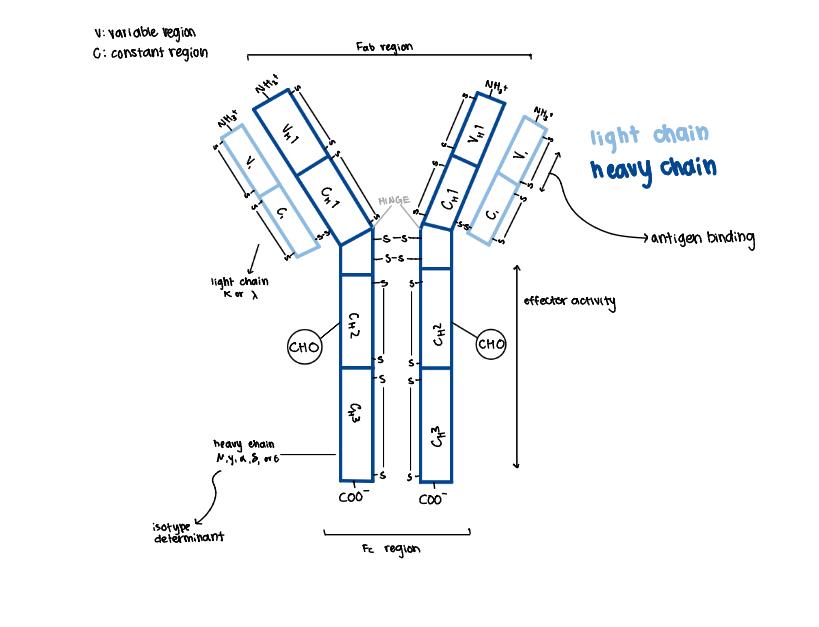
what is meant by the term 'allelic exclusion'?
once a successful in frame heavy chain (and light) rearrangement has been made, rearrangement at the other heavy chain locus stops and that allele is no longer expressed