The restriction enzyme EcoRI recognizes the sequence G↓AATTC and cut between G and A to yield sticky ends. Which of the following is true of DNA after it is treated with EcoR
All of the DNA will have blunt ends
Some of the DNA will have single-stranded regions ending in AA and others will end in G.
All of the DNA fragments will have single-stranded regions ending in G.
All of the DNA will be circular.
All of the DNA fragments will have single-stranded regions ending in AA.
All of the DNA fragments will have single-stranded regions ending in AA.
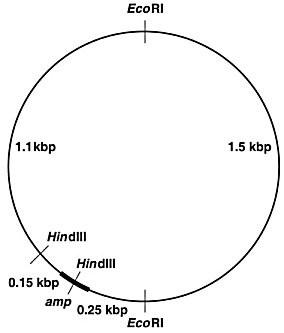
In the figure, after digestion with the appropriate restriction enzyme(s), what is the smallest piece of DNA containing the entire ampicillin-resistance (amp) gene?
3.00 kbp
1.08 kbp
1.50 kbp
0.25 kbp
0.17 kbp
1.50kpb
Self-replicating DNA used to transmit DNA from one organism to another is a ________.
clone
library
PCR
Southern blot
vector
Vector
A population of bacterial cells carrying a desired plasmid is called a ________.
library
clone
Southern blot
PCR
vector
Clone
PCR can be used to identify an unknown bacterium because ________.
DNA polymerase will replicate any bacterial DNA
all cells have RNA
the DNA primer is specific to specific target DNA sequences
all cells have DNA
DNA can be electrophoresed
the DNA primer is specific to specific target DNA sequences
Choose the best pair to complete the following sentence. While ________ is/are responsible for the diversity of life, ________ is/are responsible for shaping a population with organisms possessing characteristics that enhance selection; mutations
properties; vectors
microbes; DNA
vectors; rDNA
mutations; selection.
mutations; selection.
The most important property of a DNA vector is
the fact that it contains a marker.
the size of the vector.
its ability to replicate within the cell.
that it contains an ability to integrate into the chromosome.
that the inserted genes that lack exons.
its ability to replicate within the cell.
The following steps must be performed to make a bacterium produce
human
protein X.
1-Translation
2-Restriction
enzyme
3-Prokaryotic transcription
4-DNA
ligase
5-Transformation
6-Eukaryotic
transcription
7-Reverse transcription
Which of the following
places the steps in the correct order?
6, 7, 2, 4, 5, 3, 1
5, 2, 3, 4, 7, 6, 1
6, 2, 1, 3, 4, 5, 7
6, 7, 2, 3, 4, 5, 1
1, 2, 3, 5, 4, 7, 6
6, 7, 2, 4, 5, 3, 1
Which of the following techniques is NOT used to introduce recombinant DNA into plants?
Ti plasmids and Agrobacterium
electroporation
gene guns
protoplast fusion
microinjection
microinjection
In the past, Pap test for cervical cancer used to involve microscopic examination of cervical cells for cancerous cells. A new, rapid diagnostic test, to detect human papilloma virus (HPV) DNA before cancer develops is done without microscopic exam. Of the steps for the Fast HPV test listed below. What is the second step?
Lyse human cells.
Add enzyme-linked antibodies against DNA-RNA.
Add enzyme substrate.
The order is unimportant.
Add an RNA probe for HPV DNA.
Add an RNA probe for HPV DNA.
The random shotgun method is used in
genome sequencing.
RFLP analysis.
amplification of unknown DNA.
transforming plant cells with recombinant DNA.
forensic microbiology.
genome sequencing.
The fact that people continue to be concerned about the safety of DNA technology can be attributed to which of the following?
Both that it is impossible to prove something is safe under all conditions and that science can only provide supporting evidence for hypotheses.
It is impossible to prove something is safe under all conceivable conditions.
People are suspicious of science, in general.
Science can definitively disprove hypotheses but can only provide supporting evidence for hypotheses.
There is mounting scientific evidence that DNA technology is unsafe.
Both that it is impossible to prove something is safe under all conditions and that science can only provide supporting evidence for hypotheses.
How many fragments of DNA will EcoRI produce from the plasmid shown in the figure?
1
2
3
4
5
2
Which enzyme would cut this strand of DNA?
GCATGGATCCCAATGC
Enzyme Recognition
Pst ICTGC↓G
G↑ACGTCEnzyme
Recognition
BamHI G↓GATCC
CCCTAG↑GEnzyme
Recognition
EcoRI G↓AATTC
CTTAA↑GEnzyme
Recognition
HaeIII GG↓CC
CC↑GGEnzyme
Recognition
HindIII A↓AGCTT
TTCGA↑A
Enzyme Recognition
BamHI G↓GATCC
CCCTAG↑G
The application of "suicide" genes in genetically modified organisms ________.
provides a means to eliminate non-modified organisms
prevents the growth of the modified organisms in the environment
kills the modified organisms before they are released in the environment
provides for resistance of the modified organisms to pesticides
deletes genes necessary for modified organism's growth
prevents the growth of the modified organisms in the environment
What does RNAi technology involve?
Preventing protein production by destroying specific mRNA.
Sequencing small pieces of the genome and assembling them with a computer.
Both introducing siRNA into a cell and destroying specific mRNA.
Introducing a vector with a siRNA sequence into a cell.
Stimulating reverse transcriptase to produce mRNA.
Both introducing siRNA into a cell and destroying specific mRNA.
The following steps are used to make DNA fingerprints. What is the third step?
Digest with a restriction enzyme
Perform electrophoresis
Add stain
Lyse cells
Collect DNA
Digest with a restriction enzyme
Most cells can take up DNA from their surroundings without chemical treatment.
True or False
False
Most cells can take up DNA from their surroundings without chemical treatment.
reverse transcriptase
DNA polymerase
RNA polymerase
spliceosome
DNA ligase
reverse transcriptase
Biotechnology involves thedevelopment of disease-resistant crop plants.
use of microorganisms to make desired products and the use of animal cells to make vaccines.
use of microorganisms to make desired products, the use of animal cells to make vaccines, and the development of disease-resistant crop plants.
use of animal cells to make vaccines.
use of microorganisms to make desired products.
use of microorganisms to make desired products, the use of animal cells to make vaccines, and the development of disease-resistant crop plants.
The term biotechnology refers exclusively to the use of genetically engineered organisms to produce desired products.
True or False
False
A vector is a self-replicating segment of DNA such as a plasmid or viral genome.
True or False
True
Which of the following is NOT a desired characteristic of DNA vectors used in gene cloning procedures?
has a selectable marker
circular form of DNA or integrates into the host chromosome
large sizemay replicate in several species
self-replication
large size
A source of heat-stable DNA polymerase is
Thermus aquaticus.
Pseudomonas.
Agrobacterium tumefaciens.
Saccharomyces cerevisiae.Bacillus thuringiensis.
Thermus aquaticus.
A restriction fragment is ________.
a segment of DNA which contain cutting site(s) for restriction enzymes
a segment of mRNA which contain cutting site(s) for restriction enzymes
a gene
a segment of tRNA which contain cutting site(s) for restriction enzymes
cDNA
a segment of DNA which contain cutting site(s) for restriction enzymes
Restriction enzymes function as:
Bacterial endonucleases that digest phage DNA
Viral endonucleases that damage host DNA
Animal endonucleases that splice RNA
Bacterial endonucleases that splice DNA
Bacterial endonucleases that digest phage DNA
The reaction catalyzed by reverse transcriptase is
tRNA → mRNA.
mRNA → protein.
mRNA → cDNA.
DNA → mRNA.
DNA → DNA.
mRNA → cDNA.
Place the steps of constructing a genomic library in order.
I.
Digest phage with restriction enzyme.
II. Lyse cells of interest
and precipitate DNA.
III. Introduce constructs via transformation
into competent E. coli cells.
IV. Perform ligation
reaction with genome fragments and phage.
V. Digest genomic DNA
with restriction enzyme.
I, II, III, IV, V.
V, IV, I, III. II.
II, V, I, IV, III.
IV, II, III, I, V.
II, I, III, V, IV.
II, V, I, IV, III.
The presents of an antibiotic-resistance gene in a bacterial plasmid used in genetic engineering will make ________.
direct selection possible
replica plating possible
the recombinant cell unable to survive
the recombinant cell dangerous
all of the above
direct selection possible
Which of the following is an advantage of using E. coli to make a human gene product?
Endotoxin may be in the product.
It cannot process introns.Its genes are well known.
It does not secrete most proteins.
Endotoxin may be in the product and it does not secrete most proteins.
Its genes are well known.
A single double-stranded copy of a gene is replicated by PCR. After 3 replication cycles, how many double-stranded DNA molecules present after the last cycle?
4
Thousands
8
16
2
8
Which of the following places the steps in the PCR procedure in the
correct order?
1) Incubate at 94°C to denature DNA
strands;
2) Incubate at 72°C for DNA synthesis;
3) Incubate
at 60°C for primer hybridization.
1, 2, 3
3, 2, 1
3; 1; 2
2; 1; 3
1, 3, 2
1,3,2
In order to determine whether a person carries a certain mutant gene, a primer and a heat-stable DNA polymerase must be utilized in the process called ________.
site-directed mutagenesis
PCR
transformation
translation
restriction mapping
PCR
Assume you have discovered a cell that produces a lipase that works in cold water for a laundry additive. You can increase the efficiency of this enzyme by changing one amino acid. This is done bysite-directed mutagenesis.
selection.
irradiating the cells.
enrichment.
selective breeding.
site-directed mutagenesis.
One advantage of a viral vector over a plasmid vector is that the
plasmid vector is circular.
viral vector can accept a PCR fragment.
the viral vector can accept larger pieces of DNA and the plasmid vector is circular.
viral vector can accept much larger pieces of DNA.
viral vector can harbor a selection marker.
viral vector can accept much larger pieces of DNA.
The practice of breeding plants and animals for desirable traits, such as high crop yield, is called natural selection.
True or False
False
A shuttle vector is a plasmid that is used to move pieces of DNA among organisms such as bacterial, fungal and plant cells.
True or False
True
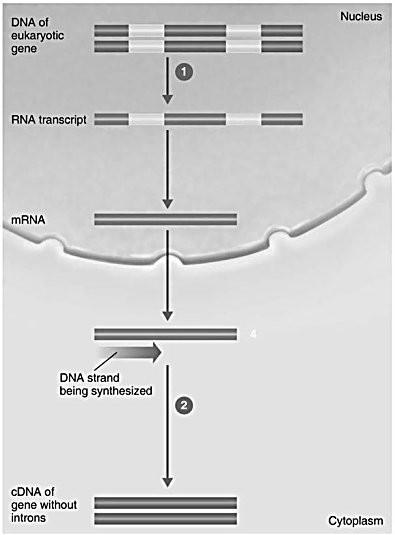
In the figure, the enzyme used in step 1 is ________.
DNA ligase
RNA polymerase
reverse transcriptase
spliceosome
DNA polymerase
RNA polymerase
An advantage of cDNA over genomic DNA is that it ________.
does not contain exonsis
easy to isolate
does not contain intronscan
form very large DNA fragment
contains selectable markers
does not contain introns
One of the advantages in using yeast Saccharomyces cerevisiae over bacteria Escherichia coli to produce a human protein is that:
It can be engineered to produce human proteins unlike E. coli.
It will be less likely to express the protein.
It will be more likely to continuously secrete the protein.
Its genome is well understood unlike E. coli.
It has a genome only 4 times larger than E. coli.
It will be more likely to continuously secrete the protein.
Which of the following is not an agricultural product made by recombinant DNA technology?
Pectinase Bacillus
thuringiensis insecticide
Frost retardant
Nitrogenase (nitrogen fixation)
Glyphosate-resistant crops
Pectinase
If you have inserted a gene in the Ti plasmid, the next step in genetic engineering is
inserting the Ti plasmid into a plant cell.
splicing T DNA into a plasmid.
transformation of an animal cell.
inserting the Ti plasmid into Agrobacterium.
transformation of E. coli with Ti plasmid.
inserting the Ti plasmid into Agrobacterium.
The Bt toxin derived from Bacillus thuringiensis has been introduced into some crop plants to make them resistant to insect destruction.
True or False
True
The Ti plasmid isolated from Agrobacterium can be used to insert DNA into any type of plant.
True or False
False
One of the first commercial accomplishments of recombinant DNA technology was the production of human insulin using genetically engineered E. coli.
True or False
True
The study of genetic material taken directly from the environment isreverse genetics.
metagenomics.
bioinformatics.
proteomics.
forensic microbiology.
metagenomics.
Which of the following are used by the Centers for Disease Control and Prevention to track outbreaks of foodborne disease?
Reverse-transcriptase PCR (rtPCR)
DNA fingerprints
Restriction fragment length polymorphisms (RFLP)
DNA fingerprints and restriction fragment length polymorphisms
DNA fingerprints, restriction fragment length polymorphisms, and reverse-transcriptase PCR(rtPCR)
DNA fingerprints, restriction fragment length polymorphisms, and reverse-transcriptase PCR(rtPCR)
Which of the following are used to silence specific genes and hold promise for treating cancer or viral diseases, such as hepatitis B?
DNA fingerprinting
reverse transcriptase PCR (rtPCR)
complementary DNA (cDNA)
tumor-inducing plasmids (Ti plasmids)
RNA interference (RNAi)
RNA interference (RNAi)
The Human Genome Project, which was completed in 2003, was focused on
cloning all of the genes of the human genome.
determining all of the proteins encoded by the human genome.
determining the nucleotide sequence of the entire human genome.
finding a cure for all human genetic disorders.
identifying all of the genes in the human genome.
determining the nucleotide sequence of the entire human genome.
The application of rDNA technology in agriculture include ________.
antisense DNA to prevent softening of tomatoes
Pseudomonas expressing Bt toxin
disease resistant food animal
santisense DNA and disease resistant food animals
antisense DNA, Bt-expressing Pseudomonas and disease resistant food animals
antisense DNA, Bt-expressing Pseudomonas and disease resistant food animals