Amino acids and proteins
Which functional group is LEAST important in biochemistry?
A. Amine
B. Ester
C. Aromatic
D. Hydroxyl
E. Amide
C. Aromatic
All of the following are examples of fibrous proteins except:
A. Fingernails
B. Insulin
C. Skin
D. Bones
E. Wool
B. Insulin
Collagen is an example of a (an):
A. Storage protein
B. Structural protein
C. Hormone
D. Enzyme
E. Transport protein
B. Structural protein
Which amino acid is not chiral?
A. Phenylalanine
B. Alanine
C. Arginine
D. Cysteine
E. Glycine
E. Glycine
Which type of interaction is not directly involved in maintaining tertiary structure?
A. Hydrophobic interactions
B. Disulfide bridges
C. Peptide bonds
D. Salt bridges
E. Hydrogen bonding
C. Peptide bonds
All of the following are major functions of proteins except:
A. Transport of necessary chemicals
B. Storage of energy
C. Control of biochemical reactions
D. Support for organs or tissue
E. Protection against foreign substances
B. Storage of energy
The peptide bond joining amino acids into proteins is a specific example of an _______ bond.
A. Amide
B. Ester
C. Glycosidic
D. Hydrogen
E. Carbonyl
A. Amide
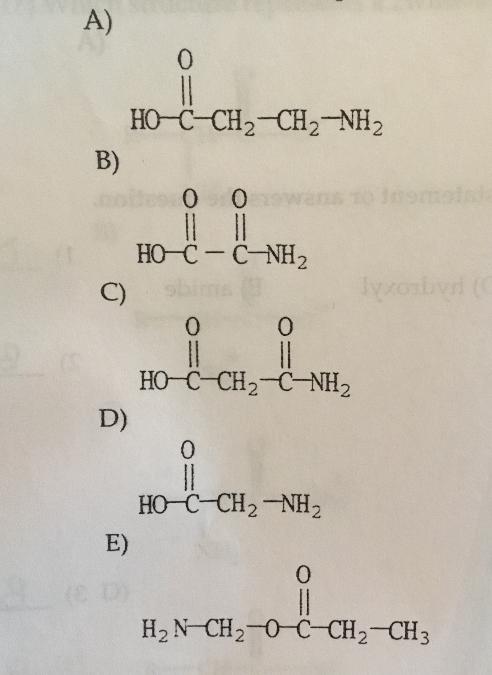
Which molecule is an alpha amino acid?
D.
Which amino acid can form covalent sulfur-sulfur bonds?
A. Phenylalanine
B. Proline
C. Cysteine
D. Methionine
E. Glycine
C. Cysteine
All of the following can be classified as biomolecules except:
A. Nuclei acids
B. Lipids
C. Carbohydrates
D. Proteins
E. All are biomolecules
E. All are biomolecules
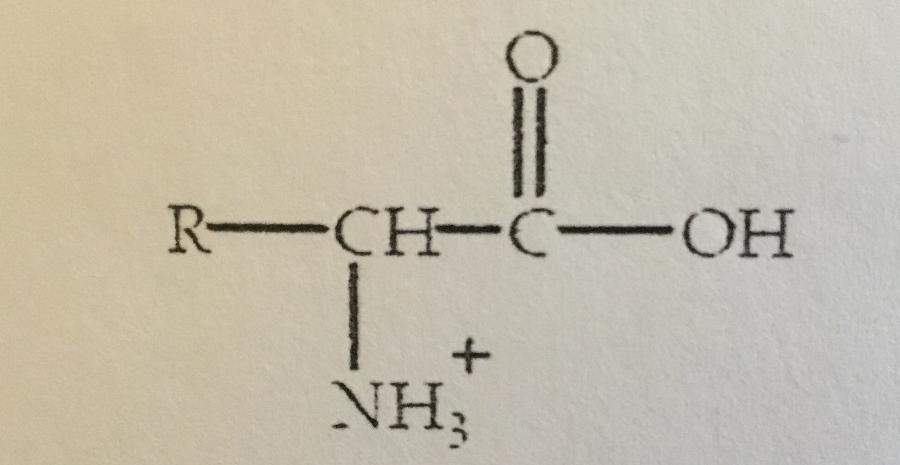
An amino acid will have the form shown at:
A. Any pH other than 7.0
B. A pH less than its isoelectric point
C. A pH grater than its isoelectric point
D. A pH of 7.0
E. Its isoelectric point
B. A pH less than its isoelectric point.
Polar R groups, along with acidic and basic R groups, are said to be ______ because they are attracted to water molecules.
A. Unreactive
B. Hydrophobic
C. Ionized
D. Hydrophilic
E. None of the above
D. Hydrophilic
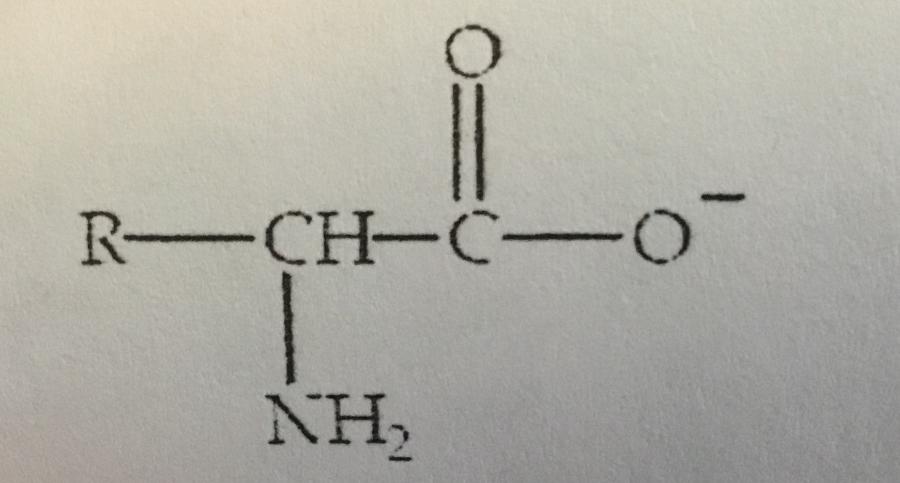
An amino acid has the form shown at,
A. A pH grater than its isoelectric point
B. A pH less than its isoelectric point
C. A pH of 7.0
D. It’s isoelectric point.
E. Any pH other than 7.0
A. A pH greater than its isoelectric point
Serum albumin is an example of a (an)
A. Enzyme
B. Transport protein
C. Structural protein
D. Storage protein
E. Protective protein
B. Transport protein
The C-terminal amino acid in the peptide, Ala-Leu-Gly-His-Pro is,
A. Proline
B. Leucine
C. Glycine
D. Histidine
E. Alanine
A. Proline
The N-terminal amino acid in the peptide, Ala-Leu-Gly-His-Pro is,
A. Glycine
B. Proline
C. Leucine
D. Alanine
E. Histidine
D. Alanine