Chapter 1: Orientation of the Human Body (Exam 1)
What is the definition of Anatomy?
The study of the structure of the human body
What is the definition of Physiology?
Study of body function
What is microscopic anatomy?
- Study of structures that can only be seen with a microscope
What is the order of hierarchy of structural organization?
- Chemical Level
- Cellular Level
- Tissue Level
- Organ Level
- Organ System Level
- Organismal Level
On which level are atoms the tiny building blocks of matter?
Chemical level
On which level are macromolecules the building blocks of structures?
Cellular level
Define Cells
- It is the basic unit of life and all organisms are composed of cells
- All cells come from pre-existing cells
Define Organ
A group of tissues that perform a common function or functions
Define Tissue
A group of cells that reform a common function or functions
What are the four types of tissue?
- Epithelial
- Connective
- Muscle
- Nervous
What is organ system? Give examples
A group of organs that perform a common function or functions
- Respiratory System
- Nervous System
- Muscular System
- Digestive System
Describe Anatomical Position
- Person stands erect with feet flat on ground
- Toes pointing forward
- Eyes facing forward
- Palms face anteriorly with thumbs pointed away
What does the axial region consist of?
It is the main axis:
- Head
- Neck
- Trunk
The trunk consists of
- Thorax
- Abdomen
- Pelvis
- Perineum
The appendicular region consists of
Limbs or appendages
Describe superior in anatomical position
Toward the head end or upper part of a structure or the body
Above
Describe inferior in anatomical postion
Away from the head if toward the lower part of a structure or the body;
Below
Describe medial in anatomical position
Toward or at the midline of the body
On the inner side of
Describe lateral in anatomical position
Away from the midline of the body
On the outer side of
Describe Proximal in anatomical position
Closer to the origin of the body part or the point of attachment of a limb to the body trunk
Describe distal in anatomical position
Father from the origin of a body part or the option of attachment of a limb to the body trunk
Describe Anterior (ventral) in anatomical position
Toward or at the front of the body
In front of
Describe Posterior (dorsal) in anatomical position
Toward or at the back of the body;
Behind
Describe the midsagittal plane

On the midline of body a plane extends vertically and divides the body into left and right parts
Describe the frontal (coronal) plane
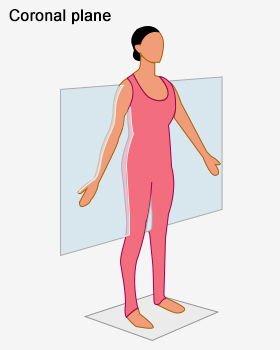
Extends vertically and divides the body into anterior and posterior parts
Describe the transverse plane

Runs horizontally from right to left, dividing the body into superior and inferior parts
What are the two large cavities of the body?
- Dorsal Body Cavity
- Ventral Body Cavity
How is the dorsal body cavity subdivided?
- Cranial Cavity
- Vertebral Cavity
Cranial cavity encloses the ...
Brain
Vertebral cavity encloses the ...
Spinal cord
Ventral body cavity contains which organs?
Visceral organs
Lungs, heart, intestines and kidneys
What are the two main divisions of the ventral body cavity?
Thoracic cavity and abdominopelvic cavity
What are the three parts of the thoracic cavity?
- Pleural Cavity
- Mediastinum
- Pericardial cavity
Pleural cavity contains the ...
Lungs
Mediastinum contains the ...
Heart and the other thoracic organs
The heart is surrounded by?
The pericardial cavity
What are the two parts of the abdominopelvic cavity?
Abdominal cavity
Pelvic cavity
What is the superior part of abdominopelvic cavity?
abdominal cavity
What does the abdominal cavity contain?
The liver, stomach, kidneys and organs
What is the inferior part of the abdominal cavity?
Pelvic cavity
What does the pelvic cavity contain?
The bladder, some reproductive organs and the rectum
Many organs in the abdominopelvic cavity are surrounded by?
Peritoneal cavity
What cavities are serous cavities?
- Pleural cavity
- Pericardial cavity
- Peritoneal cavity
What are serous cavities lined with?
Serous membrane (serosa)