Biology Final 2016
A thermosensory neuron in the skin converts heat energy to nerve impulses via a conversion called _____.
sensory transduction
Sensory adaptation is apparent when _____.
a person is no longer aware of a heavy necklace that was put on earlier in the day
Sensory transduction in the auditory system is much like transduction of _____.
mechanosensory stimuli
The energy for sensory transduction by the lateral line system in fish comes from _____.
water movements
The visual information used by honeybees includes these elements that are not apparent to humans.
the ability to distinguish ultraviolet radiation and 300 flashes of light per second
When light first enters the human eye, the first structure that it must pass through is the _____.
cornea
Rods and cones are similar in that they both _____.
release glutamate as the primary neurotransmitter
The sense described as umami is one of _____.
savory and delicious sensation on the tongue
Myosin heads have binding sites for _____.
ATP and actin
Among these choices, the most energy-efficient form of animal movement, per kg of body mass, is _____.
swimming by large fish
The perceived pitch of a sound depends on
which region of the basilar membrane was set in motion.
The cochlea is an organ of auditory transduction that contains
fluid and cells that can undergo mechanosensory transduction.
The lateral line system in fish transduces sensory information in a manner that, among these choices, is most similar to
human vestibular sense.
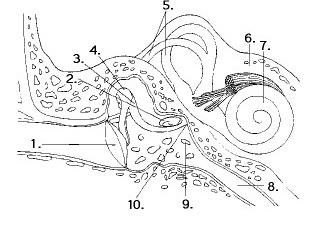
Hair cells are found in structures represented by numbers
5 and 7
Rods exposed to light will
hyperpolarize due to the closing of sodium channels.
An injury to the occipital lobe will likely impair function of the
primary visual cortex.
The olfactory bulb is located
in the brain.
The calcium ions released into the cytosol during excitation of skeletal muscle bind to
troponin.
A skeletal muscle with abnormally low levels of calcium ions would be impaired in
initiating contraction.
The fundamental excitable cell in the nervous system is the _____.
neuron
The central canal of the spinal cord and the ventricles of the human brain contain a filtrate of the blood, called _____.
cerebrospinal fluid
The knee-jerk reflex has sensory neurons arising in the _____, interneurons in the _____, and efferent neurons that stimulate contraction in the _____.
quadriceps muscle ... spinal cord ... quadriceps muscle
As vertebrates evolved, the increasingly complex structure of the brain conferred increasingly complex function, especially apparent in the _____.
cerebral cortex, which is greatly expanded in humans, other primates, and cetaceans
Dolphins can be awake and asleep at the same time because _____.
one side of the brain can sleep while the other side maintains swimming and breathing behaviors
Emotion, motivation, olfaction, behavior, and memory, in humans, are mediated by the _____.
limbic system
Motor cortex and somatosensory cortex are _____.
organized in similar manner adjacent to each other, and are anatomically similar from one person to the next
In adult humans, short-term memory relies on connections in the _____ whereas long-term memories appear to be based in the _____.
hippocampus ... cerebral cortex
Addiction onset by cocaine and amphetamines is characterized by increased _____.
persistence of dopamine in the brain's synapses
Parkinsonism is characterized by the loss of _____.
dopaminergic neurons
Myelinated neurons are especially abundant in the
white matter in the brain and the white matter in the spinal cord.
Although an exact count is not available, it is likely that the human brain has as many as
100 billion neurons.
Calculation, contemplation, and cognition are human activities associated with increased activity in the
cerebrum.
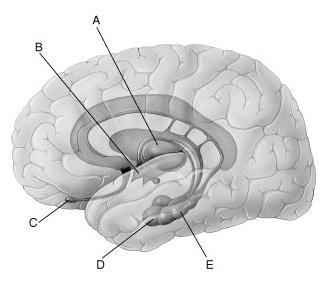
In the figure, which letter points to the amygdala?
D
Of these choices, neuronal communication between the brain and the muscles of the leg is best conceptualized as _____.
electrical and chemical signaling
The "information receiving" section of a neuron is its _____.
dendrites
Choose the set that includes the most charged compounds that are more abundant inside neurons, in the cytosol, than outside the neurons, in the extracellular fluid.
potassium ions and proteins
Ions move in the direction opposite to that favored by the chemical concentration gradient when _____.
they are pumped by proteins that require ATP hydrolysis and when the electrical charge gradient repulses or attracts them
In a neuron, during the depolarization phase that may trigger an action potential _____.
some voltage-gated sodium channels are open
The simultaneous arrival of graded depolarization and a graded hyperpolarization of equal but opposite magnitude at a particular location on the dendritic membrane is likely to _____.
cancel each other out, making it appear as if there was no change in membrane potential
Select the choice that describes neurons with the fastest conduction velocity for action potentials.
thick, myelinated neurons
A nerve poison that blocks acetylcholine receptors on dendrites would _____.
reduce the binding of acetylcholine to its receptors on the postsynpatic membrane
At the neuromuscular junction, the arrival of acetylcholine on the muscle most immediately causes _____.
a graded depolarization
Acetylcholine receptors on skeletal muscles are described as being "ionotropic" receptors because _____.
binding of acetylcholine to the receptor protein converts the protein to an open ion channel
Most of the neurons in the human brain are
interneurons.
An amino acid that operates at inhibitory synapses in the brain is
GABA.
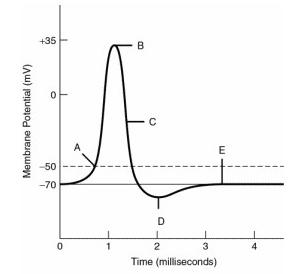
The minimum graded depolarization needed to operate the voltage-gated sodium channels is indicated by the label
A
When several EPSPs arrive at the axon hillock from different dendritic locations, depolarizing the postsynaptic cell to threshold for an action potential, this is an example of
spatial summation.
Hormones are _____.
chemical signals between cells, transported in blood or hemolymph
The hormone epinephrine causes opposite effects in two populations of target cells because _____.
each set of target cells has different receptor-transduction mechanisms
Oxytocin secretion and milk release from the mammary glands of lactating female mammals are initiated by _____.
the physical sensation of the baby sucking at the nipple
In their mechanism of action, a difference between lipid-soluble and water-soluble hormones is that _____.
lipid-soluble hormones bind to an intracellular receptor and this hormone-receptor complex binds to DNA
The counter-regulatory functions of the pancreas refer to the fact that it _____.
releases one hormone that reduces glucose levels in the blood and another that increases them
This disorder typically arises prior to puberty and is generally treated by injections of the hormone missing from the affected individual's bloodstream.
Type I diabetes mellitus
The anterior and posterior lobes of the pituitary differ in that _____.
many anterior pituitary hormones regulate other endocrine glands whereas posterior pituitary hormones regulate nonendocrine tissues
How does the adrenal gland respond to stress?
The adrenal medulla secretes epinephrine and norepinephrine in response to short-term stress.
Jet lag occurs when a person moves rapidly from one time zone to another, causing conflict between the body's biological rhythm and the new cycle of light and dark. Some scientists suspect that jet lag may result from disruption of the daily cycle of secretion of the hormone known as _____.
melatonin
Which category of signal exerts its effects on target cells by binding to membrane-bound receptor proteins?
neurohormones
Different body cells can respond differently to the same peptide hormones because
a target cell's response is determined by the components of its signal transduction pathways.
The endocrine glands include the
parathyroid glands.
Testosterone is an example of
an androgen.
A cell with membrane-bound proteins that selectively bind a specific hormone is called that hormone's
target cell.
Prostaglandins are local regulators whose chemical structure is derived
fatty acids.