Lab
Identify and give the function of the microscope. Condenser, iris diaphragm, objective lens, ocular lens, fine-coarse focus adjustment
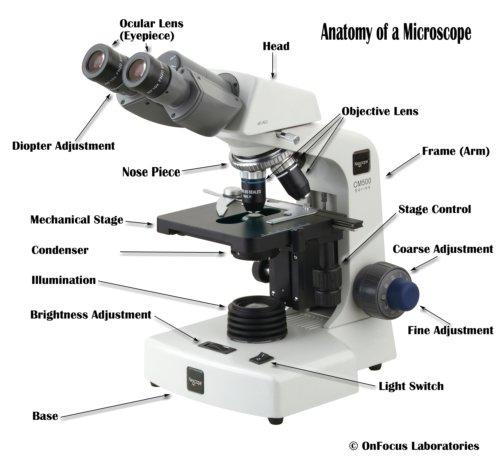
Terms to Understand: Resolution, depth of field, working distance, illumination
Resolution:Ability to see details of object
Depth of field: Vertical distance through which the object is in focus
Working Distance:Between the objective and the slide.
Illumination: lighting
Be able to calculate the total magnification of a compound light microscope.
Know the function of immersion oil
Function of immersion oil is to prevent refraction (loss) of light
Estimate the size of an object in a microscope if you know the diameter of the field.
Example: To determine the field of view for a 40x objective (total magnification 400x) insert the values for the 10x objective (total magnification of 100x)
(100) x (2mm)= (400)x (Y)= 200mm=400Y
200mm/400 = Y
.5=Y
Calculate how to prepare any volume of any culture medium, given the amount of dehydrated power used to prepare one liter.
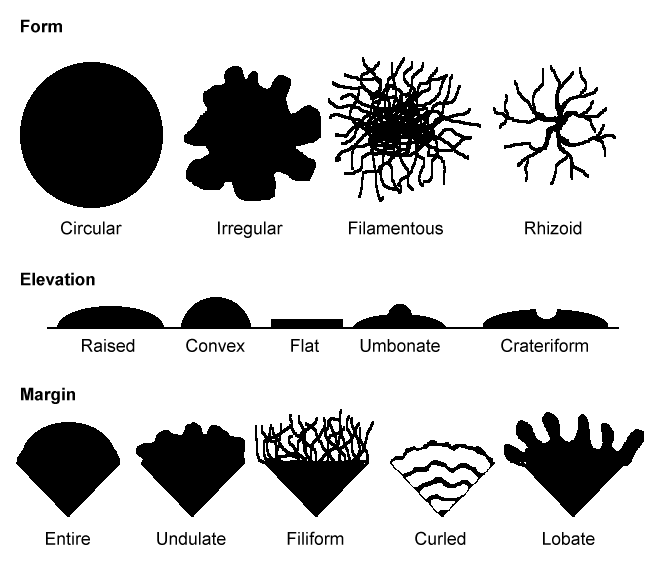
Describe a colonys shape, size, optical properties, margin, elevation, color
Use a drawing of a petri dish and words to describe how to prepare a streak plate.
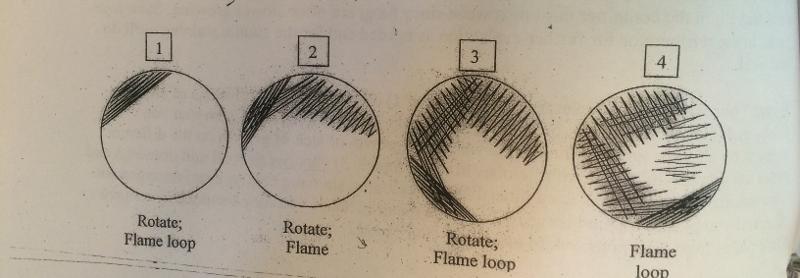
1) Aseptically load the loop once
2) streak, using a tight zig zag pattern in the first "quadrant" on SM agar plate
3) flame loop to sterilize it, can use portion of agar to cool loop
4) Reload, overlapping streaks into the 1st section
5)Repeat #3, 4 by overlapping 4-5 times into the second quadrant
6) Repeat #3, 4 by overlapping into the 3rd quadrant
Describe the proper orientation of petri dishes in the incubator and refrigerator.
Incubator: Inverted
why are smears heat fixed?
You heat fix the bacteria to kill it and make it adhear to the slide
What is the difference between simple and differential stains?
Simple stains:
Positive stain: dye with positive charge on colored part attached to cell wall with color. Ex: crystal violet, methylene blue, safranin
Negative Stain: dye with negative charge on colored part leaves cells unstained, background colors Ex: congo red, nigrosin
Differential stains:
Use of 2 or may dyes
After satining, one group of cells are one color; a different type of cell has a different color
Example: Gram += purple; Gram -=pink
Select the proper sequence for making smears from solid and liquid media.
What are the color of gram positive and gram negative organisms?
Gram Positive: Purple
Gram Negative: Pink
What are the reagents, in order of use, in the gram stain?
Gram's Crystal Violet, Grams Iodine, Acetone/alcohol, Gram Safrainin (Come In And Stain)
What are the functions of the reagents?
Gram Crystal Violet- Primary stain
Gram Iodine- a mordant that increases affinity between the dye and cell wall
Acetone/alcohol- decolorizing agent
Gram's safranin- secondary stain
Why do some organisms stain unevenly in terms of gram positiveness?
What are the common genera of the endospore producing bacteria?
Prokaryotic
What are the colors of the spores and cells in the methods (Schaeffer-Fulton & Gram Stain) used to stain endospores forming bacteria?
Spores stain green while the vegetative cells are red.
What is the purpose of using heat during the endospore staining process?
Heat drives the stain into the cells.
What are two advantages of using staining rather than positive staining?
How does negative staining differ from positive staining?
Positive stain: dye with positive charge on colored part attached to cell wall with color. Ex: crystal violet, methylene blue, safranin
Negative Stain: dye with negative charge on colored part leaves cells unstained, background colors Ex: congo red, nigrosin