FInal Exam
A prokaryotic cell will not have
a) chloroplasts
b) mitochondria
c) nuclei
d) all of the above
d) all of the above
The golgi apparatus is
a) a membraneous structure
b) a very large cell compartment
c) Associated with processing and export material
d) A and B
e) A and C
a) a membraneous structure
Which of the following would be useful in visualizing a living prokaryotic cell
a) a compound light microscope
b) a scanning electron microscope
c) a transmission electron microscope
d) a microwave scope
b) a scanning electron microscope
When studying a typical eukaryotic cell -an object that is 2 microns in size is most likely
a) subcellular
b) cellular
c) existential
d) ethereal
a) subcellular
The typical yeast strain used for making bread or beer is
a) Prokaryotic
b) Eukaryotic
c) Archean
b) Eukaryotic
The metabolism of hydrogen peroxide is probably occurring in
a) the nucleus
b) the lysosome
c) the chloroplast
d) the peroxisome
d) the peroxisome
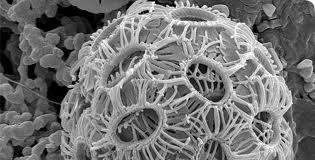
The above image was generate using
a) a fluorescent microscope
b) a scanning electron microscope
c) a transmission electron microscope
d) a microwave scope
b) A scanning electron microscope
Endosymbiotic theory suggests that
a) mitochondria are derived from an ancestral prokaryote
b) the nucleus is derived from an ancestral prokaryote
c) the chloroplast is derived from an ancestral prokaryote
d) A and B
e) A and C
e) A and C
Na+ is considered one of the major groups of biological molecules
a) true
b) false
b) false
The reactive group -C=O is
a) a carbonyl
b) basic
c) weakly polar
d) A and B
e) A and C
d) A and B
You have isolated an organism that can catabolize polysaccharides that are connected by an alpha 1,4 linkage. Which of the following would be a good carbon source for this organism
a) fructose
b) amylose
c) cellulose
d) palmitic acid
c) cellulose
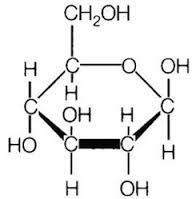
The above molecule is
a) a sugar
b) a lipid
c) an amino acid
d) A and B
a) a sugar
Fructose and Glucose are
a) monosaccharides
b) lipids
c) isomers
d) both a and b
e) both a and c
e) both a and c
Which of the following is a good example of an amphipathic molecule
a) glucose
b) a glycolipid
c) a lipid
d) a protein
a) glucose
If a phospholipid is added to water the molecules with produce micelles. Which part of the phospholipid will associate with the water molecules?
a) hydrocarbon tails
b) phosphate
c) a and b
d) the nitrogen atoms
b) phosphate
In the reaction A + B <---> C + D the (delta) G will be positive and the rate will be largely
a) to the left (toward A + B)
b) to the right (toward C + D)
c) at equilibrium
d) stopped
b) to the right (toward C + D)
Isoprene are often subunits of
a) steroids
b) carotenoids
c) bile and salts
d) A and B
e) All of the above
a) steroids
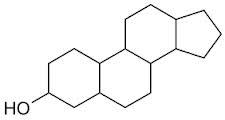
The above molecule is
a) a protein
b) a sugar
c) a steroid
d) a sphingolipid
c) a steroid
Nucleic acids contain a sugar as a portion of the molecule
a) true
b) false
a) true
The 5-prime carbon of most nucleic acids often is associated with
a) adenine
b) purines
c) phosphates
d) hydroxyl groups
b) purines
In the following formula regarding free energy ( G=H-TS), S is defined as
a) free energy
b) temperature
c) stored energy
d) entropy
d) entropy
ATP: when used in many biological reactions often results in
a) Increased S
b) a positive (delta) G
c) a negative (delta) G
d) Production of Adenosine
d) production of adenosine
In the reaction A + B <---> C + D: increasing the amount of A and B will probably shift the (delta) G to
a) zero
b) negative
c) positive
d) no change
b) negative
An enzyme defined as a kinase is involved with
a) most biological reactions
b) transfer of a sugar
c) transfer of a phosphate
d) production of dihydroxyacetone phosphate
c) transfer of a phosphate
What enzyme associated with gluconeogensis is necessary to reverse the step associated with pyruvate kinase in glycolysis
a) phophooenolpyruvate carboxykinase
b) phosphofructokinase
c) enolase
d) fructose- 1,6-diphosphate phosphatase
c) enolase
When using yeast to make bread there is probably an increase in
a) sugar
b) oxygen
c) acetaldehyde
d) lactate
a) sugar
The metabolism of fatty acids in a typical eukaryotic cell occurs
a) in the mitochondria
b) with a degrading of two carbon units at a time
c) with the direct production of NADH2
d) A and B
e) all of the above
d) A and B
Low oxygen levels will result in
a) a slow down of the TCA cycle because of high levels of NADH
b) a slow down of the TCA cycle because of low levels of NADH
c) an increase in the TCA cycle because of high levels of NADH
d) an inquired in the TCA cycle because of low levels of NADH
a) a slowdown of the TCA cycle because of high levels of NADH
The TCA cycle occurs
a) in the cytosol
b) in the mitochondria
c) in the chloroplasts
d) in the nucleus
b) in the mitochondria
In biological systems the cleavage of a protein to its amino acids and a starch to its monosaccharides is a process of
a) condensation
b) polymerization
c) hydrolysis
d) ATP utilization
c) hydrolysis
In a typical eukaryotic cell, glycolysis occurs in
a) the mitochondria
b) the cytosol
c) both a and b
d) none of the above
b) the cytosol
(GRE) Glucose is a simple sugar with the formula C6H12O6. If two glucose molecules are joined to form a disaccharide the molecular formula would be
a) C6H12O6
b) C12H24O12
c) C12H23O11
d) C12H22O11
d) C12H22O11
(GRE) Glycogen is a polymer of which of the following?
a) Fructose
b) Glucose
c) Sucrose
d) Cellulose
e) Galactose
b) Glucose
You and your lab partner have found a living organism and it contains membranes and DNA. You would classify this organism as a
a) prokaryote
b) eukaryote
c) you cannot classify the organism based on this information
d) plant
c) you cannot classify the organism based on this information
The DNA in your skin cells is found in
a) the nucleus
b) the mitochondria
c) the chloroplast
d) A and C
e) A and B
f) A, B, and C
b) the mitochondria
Where does the glycolysis occur in a eukaryotic cell
a) cytoplasm
b) mitochondria
c) nucleus
d) all of the above
e) A and B
a) cytoplasm
You and your lab partner are growing a cell line in the presence of glucose. When your lab partner adds a drug that mimics the presence of citrate it will
a) inhibit the conversion of dihydroxyacetone to glyceraldehydes-3-phosphate
b) directly inhibit electron transport
c) decrease activity of phosphofructokinase
d) increase activity of phosphofructokinase
d) increase activity of phosphofructokinase
FADH2 is produced during
a) glycolysis
b) TCA cycle
c) Fatty Acid Metabolism
d) A and B
e) B and C
f) all of the above
b) TCA cycle
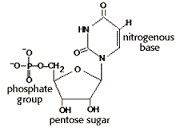
The above molecule is found in
a) DNA
b) polysaccharides
c) fats
d) all of the above
e) none of the above
a) DNA
Metabolism of fats in a typical human cell involves
a) production of acetyl CoA
b) mitochondria
c) A and B
d) None of the above
c) A and B
The hydrolysis of ATP in the cytoplasm
a) has a very positive (delta) G
b) has a very negative (delta) G
c) has a (delta) G of zero
d) (delta) G can not be measured for this reaction
b) has a very negative (delta) G
How many acetyl CoA molecules are produced from one glucose following glycolysis
a) one
b) two
c) three
d) four
b) two
How many CO2 molecules are produced during lactate fermentation
a) 0
b) 1
c) 2
d) 3
c) 2
Where does the TCA cycle occur in a typical eukaryotic cell
a) cytoplasm
b) mitochondria
c) chloroplasts
d) a and b
e) a, b, and c
b) mitochondria
Which of the following is NOT a direct product of fatty acid metabolism
a) Acetyl CoA
b) NADH
c) FADH2
d) ATP
e) None of the above
d) ATP
Which of the following molecules is transported into the mitochondria
a) acetyl CoA
b) fatty acids
c) pyruvate
d) a and b
e) b and c
f) all of the above
e) b and c
A typical eukaryotic cell is about
a) 2000 micrometers
b) 200 micrometers
c) 20 micrometers
d) 0.2 micrometers
c) 20 micrometers
A symport is
a) two substances transported together in the same direction
b) two substances transported together in opposite directions
c) a simple pore for ion transport
d) an example of simple diffusion
a) two substances transported together in the same direction
Which is the following part of the glycocalyx
a) a glycolipid
b) a glycoprotein
c) a phospholipid
d) A and B
e) A,B, and C
d) A and B
The most common lipid in a human cell is
a) sphingosine
b) glycosphingolipids
c) phospholipid
d) cholesterol
c) phospholipid
Isolation of the molecule chlorophyll is probably best accomplished with a
a) polar solvent
b) nonpolar solvent
b) nonpolar solvent
You have isolated a membrane that contains a voltage gated transporter. Which of the following is probably carried by this transporter?
a) lipids
b) proteins
c) ions
d) sugars
c) ions
You have homogenized a plasma membrane and mixed it with oil and water. You would expect the fatty acids to orient with the
a) oil layer
b) water layer
c) not in either layers
d) gated transporters
a) oil layer
Which of the following may increase membrane fluidity
a) a decrease in cholesterol
b) a decrease in fatty acid length
c) an increase in unsaturation
d) a and b
e) all of the above
a) a decrease in cholesterol
Photosynthetic electron transport occurs
a) in the stroma
b) in the intermembrane space
c) on the inner envelope membrane
d) on the thylakoid membrane
e) in the outer envelope membrane
d) on the thylakoid membrane
The CO2 membrane transporter is more prevalent in cells that line the lung
a) true
b) false
b) false
Chloroplasts contain a reducible lipid in the membrane. Which of the following is a similar molecule in a mitochondrion?
a) cytochrome c
b) plastocyanin
c) ubiquinone
d) ferridoxin
d) ferridoxin
A typical mitochondrion is about
a) .01 microns
b) 1 micron
c) 100 microns
d) 1000 microns
b) 1 micron
Chlorophyll is a protein
a) true
b) false
b) false
Which of the following will not passively cross a typical cell membrane
a) H+
b) water
c) Cl-
d) O2
e) A and C
f) B and D
e) A and C
Which of the following has a higher concentration outside a typical plant cell
a) K+
b) H+
c) Na+
d) A and B
e) B and C
b) H+
Most of the ATP for a typical animal cell is produced
a) from glycolysis
b) from the TCA cycle
c) in a mitochondrion
d) from photosynthesis
a) from glycolysis
Carotenes and xanthophylls are considered to be
a) reaction center pigments
b) accessory pigments
c) electron transfer molecules
d) oxygen donors to light induced electron transfer
a) reaction center pigments
Two protons of light are used to drive photosynthesis in most eukaryotes. This is because
a) a reaction center has two chlorophylls
b) carotenoids absorb one and xanthophyll the other
c) there are two linked photosystems
d) NADPH picks up two photons
c) there are two linked photosystems
Glucose transport into and out of the liver can be described as
a) facilitated diffusion
b) simple diffusion
c) glycogen associated transport
d) ATP driven
a) facilitated diffusion
Sodium transport from sweat glands can be described as
a) voltage gated transport
b) ligand gated transport
c) stress gated transport
d) light gated transport
b) ligand gated transport
The electrons acquired from NADH in a mitochondrion are derived from
a) acetyl CoA produced from pyruvate
b) acetyl CoA produced from fatty acid metabolism
c) acetyl CoA produced from RUBISCO
d) A and B
e) All of the above
a) acetyl CoA produced from pyruvate
In comparison to cytoplasm plant vacuoles usually contain
a) elevated Na+
b) elevated K+
c) elevated H+
d) decreased H+
e) decrease K+
c) elevated H+
The final electron acceptor in electron transport in mitochondria is
a) CO2
b) O2
c) NADH
d) FADH2
e) C and D
b) O2
Passive transport may utilize a protein
a) true
b) false
a) true
Both O2 and CO2 are either produced or used in mitochondria. How are they transported into this organelle?
a) CO2 moves out and O2 moves in via antiproton mechanism
b) CO2 and O2 move across by diffusion
c) CO2 moves in and O2 moves out via a antiport mechanism
d) CO2 moves out and O2 moves in via a symport mechanism
b) CO2 and O2 move across by diffusion
ELVISLIVES is an example of
a) primary
b) secondary
c) tertiary
d) quarternary
e) misguided old rocking rollers living a lie
a) primary
A denatured protein has
a) lost conformation
b) gained conformation
c) increased tertiary structure
d) increased solubility
a) lost conformation
Chaperons are
a) lipids that facilitate protein folding
b) proteins that facilitate protein folding
c) protein transporter
d) people that make sure no hanky pinky occurs
b) proteins that facilitate protein folding
The recognition of a foreign molecule by your immune system is an example of
a) protein ligand interaction
b) protein-protein interaction
c) protein substrate interaction
d) all of the above
e) none of the above
a) protein ligand interaction
Cysteine is important for establishing
a) primary structure
b) secondary structure
c) quaternary structure
d) hydrophillic behavior
c) quaternary structure
An antiport is
a) two substances transported together in the same direction
b) two substances transported together in opposite directions
c) a simple pore for ion transport
d) an example of simple diffusion
b) two substances transported together in opposite directions
You have isolated a solution containing 1 mole of a functional protein. When you denature by gentle heating the solution you can isolate 4 moles of a given polypeptide. Your conclusion is
a) you have cleaved the amino acid backbone and created four peptides
b) you have disrupted the quaternary structure
c) you have increased enzyme activity
d) this result is not possible
b) you have disrupted the quaternary structure
In the formula RATE=Vmax[S/(S+Km)] the letter S is defined as
a) entropy
b) enzyme activity
c) substrate concentration
d) substrate synthesis
c) substrate concentration
End product inhibition is usually the result of competition of the end product and the substrate for the active site of the enzyme
a) true
b) false
a) true
You have isolated enzyme A which catalyzes the conversion of x to y. This reaction is not directly associated with ATP as a substrate but when you add a chemical that inhibits all protein kinase function the activity of enzyme A decreases. This is probably due to
a) Inactivation of enzyme A because it is a protein kinase
b) inactivation of enzyme A because its activity is positively regulated by a protein kinase
c) reconversion of y to x
d) over production of ATP
b) inactivation of enzyme A because its activity is positively regulated by a protein kinase
Where do you typically find cholesterol in a cell?
a) within the plant vacuole
b) on the outer surface of an animal cell
c) embedded in an animal membrane
d) all of the above
c) embedded in an animal membrane
The inner membrane of the chloroplast envelope is permeable to which of the following molecules
a) O2
b) CO2
c) H+
d) Cl-
e) A and B
f) C and D
g) All of the above
e) A and B
Integral membrane proteins can make pores
a) true
b) false
a) true
You have isolated a drug that digests carbohydrate chains but has the side effect of gastrointestinal distress. This is probably due to
a) disruption of sodium transport of glucose
b) disruption of ATPase transporters
c) Disruption of K+ transport
d) disruption of glycocalyx structure
d) disruption of glycocalyx structure
Coupled transporters always require ATP hydrolysis
a) true
b) false
b) false
Increasing the soil of pH for a typical plant will result in
a) an increase in Mg++ uptake
b) a decrease in Mg++ uptake
c) an increase in the activity of the sodium potassium ATPase pump
d) A and C
e) B and C
b) a decrease in Mg++ uptake
You have isolated a drug that inhibits the sodium potassium ATPase pump in an animal cell line. When you treat cells with the drug there is an immediate inhibition of pyruvate into the cytoplasm but there is a lag before there is an inhibition of pyruvate uptake into the mitochondrion. This is probably due to
a) a lack of ATP production
b) A build up of citrate
c) A depletion of pyruvate in the cytoplasm
d) inhibition of the mitochondrial membrane carrier for pyruvate
c) A depletion of pyruvate in the cytoplasm
The acetylcholine receptor discussed in lecture is an example of
a) ATPase pump
b) a gated transporter
c) a ligand bound H+ transporter
d) all of the above
e) none of the above
b) a gated transporter
Ribosomes are found in
a) the cytoplasm
b) the matrix
c) the stroma
d) all of the above
d) all of the above
The molecule Q has a higher affinity for electrons compared to NADH dehydrogenase
a) true
b) false
a) true
The H+ potential across the inner membrane of an active mitochondrion can be
a) ten-fold
b) 100-fold
c) 1000-fold
d) 10000-fold
a) ten-fold
Neutrophil attack at an infection site is mediated by
a) protein kinase activity
b) ATP hydrolysis
c) Glycocalyx interactions
d) Actin driven
c) Glycocalyx interactions
Glucose transport into and out of the liver can be described as
a) facilitated diffusion
b) simple diffusion
c) glycogen associated transport
d) ATP driven
a) facilitated diffusion
Passive transport may utilize a protein
a) true
b) false
a) true
In comparison to the cytoplasm the vacuoles in plants usually contain
a) elevated Na+
b) elevated K+
c) elevated H+
d) decreased H+
e) decreased K+
c) elevated H+
Disulfide bonds in a protein often result in stabilization of
a) primary structure
b) secondary structure
c) tertiary structure
d) peptide bond formations
c) tertiary structure
Where in a plant cell will the pH decrease in response to exposure to sunlight
a) the cytoplasm
b) the stroma
c) the thylkoid
d) the lysosome
e) the matrix
f) the inter membrane space
c) the thylkoid
You isolated molecules from spinach leaves using a buffer that creates an organic phase and a water phase. Where in the isolation would you find chlorophyll?
a) neither phase
b) water phase
c) organic phase
d) both phases
c) organic phase
A signal sequence can best be described as
a) cAMP
b) DAG
c) A stretch of amino acids typically 15-60 subunits in length
d) A and B
c) A stretch of amino acids typically 15-60 subunits in length
Transport of a newly synthesized protein into a nucleus requires
a) movement through a membrane translocator
b) movement through a nuclear pore
c) a symporter
d) an anitporter
b) movement through a nuclear pore
Proteins transported from the cytoplasm to the chloroplast matrix are
a) unfolded
b) moved in the folded state via a porin
c) moved via a symporter
d) moved via an antiporter
e) c and d
a) unfolded
The N- terminal end of a functional chloroplast matrix protein has the same N- terminus as the cytosolic form
a) true
b) false
b) false
Deletion of a mitochondrial signal sequence will probably result in
a) a nuclear protein
b) a secreted protein
c) a cytosolic protein
d) no protein
c) a cytosolic protein
You have mutated a gene so that one of three stop transfer sequences of the protein product is eliminated. This will most like result in
a) a lumen protein
b) a cytosolic protein
c) misplacement of the protein in the membrane
d) a mitochondrial protein
b) a cytosolic protein
You have recently discovered a way to label vesicles that are leaving the ER. Where do you hypothesize that the label will appear next as cell development progresses?
a) the membrane
b) the cis-golgi
c) the trans-golgi
d) the endosome
e) the nucleus
b) the cis-golgi
You have created an antibody that binds the protein clathrin. When you use this antibody to purify material from a cell culture what would you expect to isolate?
a) nuclei
b) mitochondria
c) newly formed vesicles
d) A and B
e) all of the above
c) newly formed vesicles
V-snares are found on
a) targets
b) vesicles
c) organelles
d) ribosomes
b) vesicles
A cell that constantly secretes a hormone can best be described as
a) busy
b) regulated
c) constitutive
d) steroidal
c) constitutive
You stick your finger with a pin. The inflammation that results is an example of
a) endocrine signal
b) paracrine signal
c) neuronal signal
d) contact-dependent signal
b) paracrine signal
An example of a slow response to an extracellular signal is
a) synthesis of a membrane protein
b) production of mRNA
c) Ca++ release
d) GTP binding
e) A and B
f) C and D
f) C and D
An example of a fast response to an extracellular signal is
a) synthesis of a membrane protein
b) production of mRNA
c) Ca++ release
d) GTP binding
e) A and B
f) C and D
c) Ca++ release
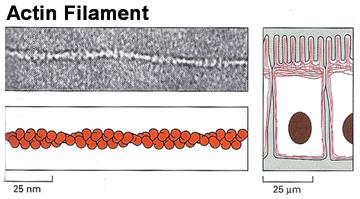
The above figure represents structures produced by
a) intermediate filaments
b) microtubules
c) actin
d) sacromeres
c) actin
Which of the following compounds will disrupt the formation of these structures
a) phalloidin
b) taxol
c) cytochalasins
d) relaxin
c) cytochalasins
RAS is
a) a protein
b) a lipid
c) a second messenger
d) an ion channel
a) a protein
Receptors for the steroid-type hormones occur largely
a) at a seven pass receptor
b) at RAS
c) at a cytoplasmic receptor
d) in the nucleus
d) in the nucleus
Active G proteins may target
adenylate cyclase
Most G proteins are in the "on" position when bound to
GTP
A-kinase
adds phosphates to target proteins
Enzyme linked receptors
a) often are associated with growth regulation
b) are considered a tyrosine regulation
c) often autophosphorylate
d) all of the above
d) all of the above
The three components of the cytoskeleton are
intermediate, filaments, actin filaments, microtubules
The structure of the nucleus is associated with
Lamins
Hair and feathers are
Keratins
The tensile strength given to human skin is largely associated with
intermediate filaments
a drug that destroys centrosomes will probably alter
Ciliary movement
The flanking region of a sarcomere is
a Z-disc
In a non-contracting skeletal muscle cell the Ca++ levels are elevated on
troponin
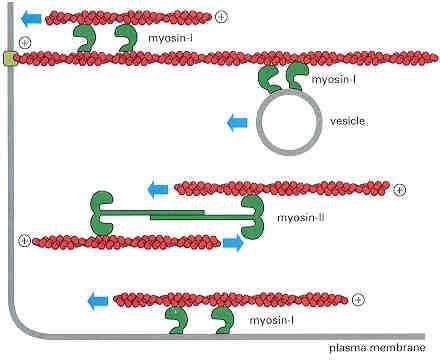
Know the actin filament and Myosin I
In a DNA double helix
a) the strands contain a sugar-phosphate backbone
b) adenine equals thymine
c) adenine equals cytosine
d) the two DNA strands run parallel
e) both A and B
e) both A and B
Semiconservative replication can best be described as
each daughter DNA molecule consists of one strand from the parent DNA molecule
Which of the following is true of RNA polymerase
It has a higher error rate in comparison to DNA polymerase
Which of the following statements is true of DNA replication in a cell
DNA synthesis begins with the production of an RNA primer
Which of the following makes RNA
A) RNA polymerase
B) single stranded binding protein
C) Primase
D) A and B
E) A and C
E) A and C
A gene from a human is inserted into a bacterial cell. However, the gene product is not produced. Which of the following may explain this lack of activity
a) the gene may contain introns
b) the gene has an incorrect promoter
c) A and B
c) A and B
You have developed a drug that crosslinks (covalently links) signal stranded binding protein to DNA. When you add this drug to a replication cell you would expect most of the single stranded binding protein to be connected to
a) the leading strand
b) the lagging strand
c) both strands
b) the lagging strands
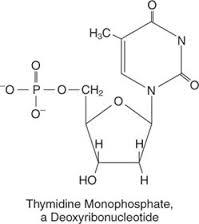
The above molecule is
a) a DNA molecule
b) RNA
c) Both DNA and RNA
d) neither
b) RNA
You have discovered a mutant form of DNA polymerase in which there is no proof reading function. Which of the following properties do you expect the mutant polymerase to have?
a) it will polymerize in both the 5' to 3' direction and function as a nuclease in the 3'-5' direction
b) it will polymerize more slowly than normal
c) to replicate the same amount of DNA it will hydrolyze fewer deoxyribonucleotides compared to the normal polymerase
d)to replicate the same amount of DNA it will hydrolyze more deoxyribonucleotides compared to the normal polymerase
to replicate the same amount of DNA it will hydrolyze fewer deoxyribonucleotides compared to the normal polymerase
Your skin is exposed to elevated levels of UV light from the sun. If you have progeny what percentage might contain a mutation because of the exposure
0%
Which of the following is found as part of fully processed mRNA found in the cytoplasm?
a) a poly A tail
b) a 5' methyl G
c) introns
d) A and B
d) A and B
Snurps are
a) RNA protein complexes responsible for splicing together exons
b) RNAs responsible for splicing together exons
c) protein complexes responsible for splicing together eons
a) RNA protein complexes responsible for splicing together exons
A chromosome is
a dna molecule and associated proteins
DNA Polymerase makes few errors when replicating DNA. This is because
it has a 3'-5' exonuclease
Your DNA is reacting with water and the guanine bases are being removed. this is known as
depurination
A major difference between a prokaryotic gene and eukaryotic gene is
RNA polymerase in a eukaryotic cell interacts with a protein platform
Which of the following proteins are most abundant at the replication fork?
single-stranded binding protein
Which bases are found in DNA
A G C T
the human genome is composed of about
3 X 10⁹ base pairs
application of sunscreen to your skin prior to sun exposure hopefully prevents
thymine dimers
Which of the following is not found on a messenger RNA
the TATA box
The codon usage for the amino acid proline is CC and then any other base. This is an example of
wobble
Messenger RNA is produce by
RNA polymerase II
How many aminoacyl tRNA synthases are there in a typical eukaryotic cell
20
Some portions of DNA during replication contain uracil. This is a result of
RNA primers
the amino acid is attached to a tRNA at
the 3' end
An example of signal transduction could be
a hormone signal converter to a change in gene expression
a paracrine signal is an example of
short distance communication
cell signals can be
peptides, amino acids, steroids
Cell communication across a synapse is associated with
neuronal signal transduction
Steroid hormones usually bind to
interior receptors
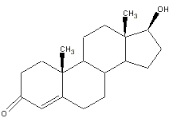
The above molecule is an example of
a steroid cell signal
three common types of cell receptors are
Ion channel, G protein-linked, enzyme-linked
the largest class of cell surface receptors is
enzyme linked receptors
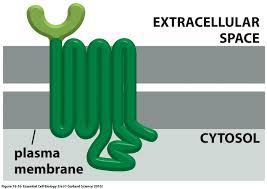
the above receptor is
a seven pass receptor
which of the following are examples of G-protein targets
Ion Channels
Adenylate cyclase results in
cAMP
Phospholipase C results in
inositol triphosphate and diacylglycerol
The advantages of cAMP and inositol triphosphate in a message cascade is that they are
small molecules that diffuse rapidly, are synthesized so that they can be amplified by producing large amounts of the product, and are lipophilic
cAMP levels are regulated by the following
a phosphodiesterase and adenylate cyclase
Hormone>>>Seven-Pass Receptor>>> G-protein>>> adenylate cyclase>>> ***>>> gene regulatory protein>>> transcription factor.
Fill in the ***
A-Kinase
the substrate for adenylate cyclase is
cAMP
second messengers can result in elevated cytoplasmic calcium. The calcium is usually supplied by
the ER
Calcium levels in the cell may alter directly or indirectly the activity of the following protein kinases
CaM Kinase
Calmodulin binds
Calcium
Enzyme linked receptors when functional usually exist as
activated monomers and self phosphorylating enzymes
the receptor for initiation of the RAS cascade is
a tyrosine kinase
RAS binds to
GTP
High tensile strength, diameter of 10nm, and associated with most animal cells describes
intermediate filaments
your hair is similar to
microtubules
Keratins are
intermediate filaments
during prophase the nuclear membrane "breakdown. this is due to
a change in the lamin phosphorylation
Microvilli are composed of
actin filaments
as microtubules age
GTP is hydrolyzed
Kinesins are associated with movement along
a microtubule from - to +
You have treated a cell with taxol and find that a specific cell movement is inhibited. This movement is associated with
microtubules
The motor proteins associated with flagella are
myosin
Movement of a flagellum in a unicellular organism is similar to the function of muscle cell movement in animals. true or false?
true
actin is not found in plant cells. true or false?
false
in the cell cortex region, you would expect to find very high levels of thymosin. true or false?
false
troponin is a calcium binding protein. true or false?
true
Telemers are located
at the end of your chromosome
nucleosomes
are protein structures the eukaryotic DNA can wrap around
replication of origins often have a segment of DNA that is
AT rich
the number of replication origins in a human cell is
thousands
a codon represent DNA for
one amino acid
Okazaki fragments are found
on the lagging strand