Chapter 17- From Gene To Protein
Aisha do item 1
item 1
The flow of information in a cell proceeds in what sequence?
from DNA to RNA to protein
A codon consists of _____ bases and specifies which _____ will be inserted into the polypeptide chain.
three ... amino acid

In the diagram below, the gray unit represents _____.
RNA polymerase
In the diagram below, the green unit represents _____.
the promoter
In the diagram below, the two blue strands represent _____.
DNA
Which of these correctly illustrates the pairing of DNA and RNA nucleotides?
GTTACG
CAAUGC
The direction of synthesis of an RNA transcript is _____.
5' —> 3'
What is the process called that converts the genetic information stored in DNA to an RNA copy?
Transcription
DNA does not store the information to synthesize which of the following?
Organelles
Transcription begins at a promoter. What is a promoter?
A site in DNA that recruits the RNA Polymerase
Which of the following statements best describes the promoter of a protein-coding gene?
The promoter is a nontranscribed region of a gene.
What determines which base is to be added to an RNA strand during transcription?
Base pairing between the DNA template strand and the RNA nucleotides
Which of the following terms best describes the relationship between the newly synthesized RNA molecule and the DNA template strand?
Complementary
What happens to RNA polymerase II after it has completed transcription of a gene?
It is free to bind to another promoter and begin transcription.
What is the function of RNA polymerase?
It unwinds the double helix and adds nucleotides to a growing strand of RNA.
Where does RNA polymerase begin transcribing a gene into mRNA?
It starts after a certain nucleotide sequence called a promoter.
Based on this information, what is the minimum size of a codon for these hypothetical Martian life-forms?
5 bases
Aisha do part A item 8 A & B
Aisha do part A item 8 A & B
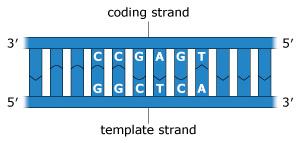
Enter the sequence of bases as capital letters with no spaces and no punctuation. Begin with the first base added to the growing RNA strand, and end with the last base added.
UGAGCC
For any given gene, what ultimately determines which DNA strand serves as the template strand?
the base sequence of the gene's promoter
Which three statements correctly describe the processing that takes place before a mature mRNA exits the nucleus?
A poly-A tail (50-250 adenine nucleotides) is added to the 3' end of the pre-mRNA.
Noncoding sequences called introns are spliced out by molecular complexes called spliceosomes.
A cap consisting of a modified guanine nucleotide is added to the 5' end of the pre-mRNA.
During RNA processing a(n) _____ is added to the 5' end of the RNA.
modified guanine nucleotide
During RNA processing a(n) _____ is added to the 3' end of the RNA.
a long string of adenine nucleotides
Spliceosomes are composed of _____.
snRNPs and other proteins
The RNA segments joined to one another by spliceosomes are _____.
exons
Translation occurs in the _____.
cytoplasm
After an RNA molecule is transcribed from a eukaryotic gene, what are removed and what are spliced together to produce an mRNA molecule with a continuous coding sequence?
introns ... exons
How would this molecule have to be altered, to be used in RNA transcription?
Both (a) and (b).Add another OH to the sugar & (b) Remove a CH3 group from the base.
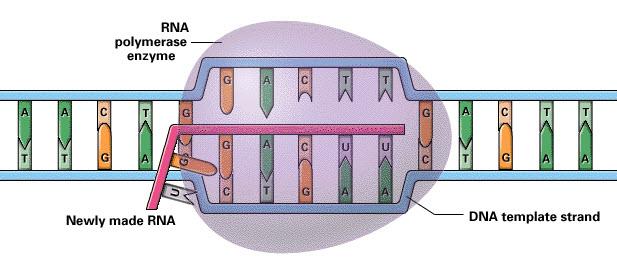
You can tell this diagram is showing transcription rather than replication because ...
(b) only one strand is being used as template.
(c) the product contains U.
Which of the following statements about ribozymes is/are correct?
In some genes, intron RNA functions as a ribozyme and catalyzes its own excision.
Ribozymes are RNA molecules that function as enzymes.
A ribosome can be regarded as one large ribozyme.
The average length of a transcription unit along a eukaryotic DNA molecule is about 27,000 nucleotide pairs, whereas an averaged-sized protein is about 400 amino acids long. What is the best explanation for this fact?
Most eukaryotic genes and their RNA transcripts have long noncoding stretches of nucleotides that are not translated.
Which of the following mutations would likely be most dangerous to a cell?
Deletion of one nucleotide
Which of the following molecules is/are produced by translation? Include molecules that are subject to further modification after initial synthesis.
Aminoacyl-tRNA synthetase
RNA polymerase
Which of the following molecules are produced by transcription?
Messenger RNA & Ribozymes
Which of the following mutations would be most likely to have a harmful effect on an organism?
a single nucleotide insertion downstream of, and close to, the start of the coding sequence
Which component is not directly involved in translation?
DNA
Which of these is currently considered the best definition of a gene?
A gene codes for either a polypeptide or an RNA molecule.
What does a mutagen cause?
a change in the sequence of DNA
True or false? A codon is a group of three bases that can specify more than one amino acid.
False
Which of the following statements about mutations is false?
A knock-out mutation results in a total absence of the mutated protein.
If a DNA sequence is altered from TAGCTGA to TAGTGA, what kind of mutation has occurred?
Deletion.
Which mutation(s) would not change the remainder of the reading frame of a gene sequence that follows the mutation(s)?
One addition and one deletion mutation.
If the sequence ATGCATGTCAATTGA were mutated such that a base were inserted after the first G and the third T were deleted, how many amino acids would be changed in the mutant protein?
Two.
If a mutated DNA sequence produces a protein that differs in one central amino acid from the normal protein, which of the following kinds of mutations could have occurred?
An addition mutation and a deletion mutation.
Generally speaking, which of the following mutations would most severely affect the protein coded for by a gene?
a frameshift deletion at the beginning of the gene
How is translation initiated?
The small ribosomal subunit binds to the mRNA.
The tRNA bearing methionine binds to the start codon.
The large ribosomal subunit binds to the small one.
The start codon signals the start of translation.
All of the above.
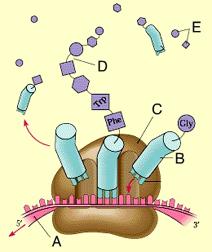
Which of these is a tRNA?
B
Where does translation take place?
Ribosome
Which nucleic acid is translated to make a protein?
mRNA
Which of the following processes is an example of a post-translational modification?
Phosphorylation
Which of the following steps occurs last in the initiation phase of translation?
The large ribosomal subunit joins the complex.
At which site do new aminoacyl tRNAs enter the ribosome during elongation?
A-site
What is meant by translocation?
The ribosome slides one codon down the mRNA.
True or false. A tRNA with an anticodon complementary to the stop codon catalyzes the reaction by which translation is terminated.
False
Which one of the following is true of tRNAs?
None of the above.
What is a ribozyme?
a biological catalyst made of RNA
What name is given to the process in which a strand of DNA is used as a template for the manufacture of a strand of pre-mRNA?
transcription
What name is given to the process in which the information encoded in a strand of mRNA is used to construct a protein
translation
What name is given to the process in which pre-mRNA is edited into mRNA?
RNA processing
Polypeptides are assembled from _____.
amino acids
RNA processing converts the RNA transcript into _____.
mRNA
Do item 4 Part A
Aisha
AISHA Do item 5 Part A & B on part b homework
AISHA