3063 chapter 5 part 3
Variation in Language-Development Rate
Variation in Language-Development Rate
The rate at which a group
of children develop their receptive and expressive language abilities
can vary considerably. One way to gauge the variability in infants’
receptive and expressive vocabularies is by examining norm-referenced
measures of language, such as the MacArthur–Bates Communicative
Development Inventories
(CDI; Fenson et al., 1993; Fenson,
Pethick, et al., 2000). We describe the norming process for the CDI in
Chapter 4, but what is important to note in this discussion is the
variability among the more than 1,800 infants’ expressive and
receptive vocabularies in the sample (Bates et al., 1995). The number
of words the infants understood at age 12 months ranged between 15 and
150, whereas the number of
words the infants produced at the
same age ranged between 0 and 30. As young children develop,
differences between their receptive and expressive vocabularies
becomes even more apparent. For example, the Bates et al. (1995)
sample reveals
that the number of words toddlers understood at
age 16 months ranged between approximately 80 and 300, whereas the
number of words toddlers produced at the same age ranged between
approximately 0 and 150. This means even toddlers who
seem to
say many words (compared to their same-age peers) might potentially
understand twice as many word.
Variations in infants’ receptive and expressive vocabularies can be
accounted for only partly by age. Bates and colleagues (1995) reported
that age accounts for only 22% of the variance in the number of words
infants produce. Therefore, other factors explain the remaining 78% of
the variance. Two variables of interest
in interpreting
variation in infants’ vocabularies are socioeconomic status (SES), and
the amount of talk parents engage in with their children. Researchers
have determined that how much parents talk to their infants and young
children is related to the parents’ SES, but, regardless of SES, the
more parents talk to their children, the more rapidly children’s
vocabulary grows and the better children
perform on measures of
verbal and cognitive competence at age 3 years (Hart & Risley,
1995, 1999
..
Variation in Language-Learning Styles
Variation in Language-Learning Styles
Infants differ, too, in
the ways they use language for communicative purposes. The main factor
affecting this variation is the infants’ predominant style for using
language, which researchers describe as either expressive or
referential (Nelson, 1973).
Expressive language learners use
language primarily for social exchanges. Their early vocabularies
contain several words and phrases that allow them to express their
needs and describe their feelings as they interact with other people.
Common first words for expressive language learners include hi and bye-bye
referential language
In contrast, referential language learners use language primarily to refer to people and objects. They enjoy labeling things they see, and they like when adults provide labels for them. Their early vocabularies contain a large proportion of object labels, including words such as ball, doggie, and juice (Nelson, 1973
Variation at the Extremes of the Typical Range for Language Development
Variation at the Extremes of the Typical Range for Language Development The final language-development difference among infants involves certain children who fall at either end of the language-development continuum: late talkers and early talkers.We describe more severe variations in language development in Chapter 10.
..
Late Talkers. Late talkers are children who exhibit early delays in
their expressive (rather than receptive) language development.
Although there is no clinical diagnosis for being a late talker, one
common definition considers children to be late talkers if they
produce fewer than 50 words by age 2 (Rescorla, 1989). Zubrick,
Taylor, Rice,
and Slegers (2007) estimate that about 13.4% of
the general population are late talkers (and they mention this figure
is consistent with prior research estimating prevalence rates to be
10%–20%). These researchers also report that males are about three
times
more likely to be late talkers than females, and infants
who are born earlier than 37 weeks’ gestation, or who are less than
85% of their optimum birth weight are about twice as likely to be late
talkers than infants without such neurobiological issues.
Late talkers are of concern to parents and clinicians. Being a late
talker does not necessarily mean a child will have a language delay or
impairment; however, it can be an important predictor of being
diagnosed with a delay or impairment at a later age. Many late talkers
can achieve normal language levels by age 3 or 4 years.
However,
they may still exhibit delays in subtle aspects of language
development, and perform at significantly lower levels on measures of
verbal short-term memory, sentence formulation, word retrieval,
auditory processing of complex information, and elaborated verbal
expression than their age-matched, typically developing
peers at
ages 6, 7, and 8 years (Rescorla, 1993b
Early Talkers
Early Talkers. Early talkers are children who are ahead of their
peers in expressive language use. Bates and colleagues (1995) defined
early talkers as children between ages 11 and 21 months who score in
the top 10% for vocabulary production for their age on the
MacArthur–Bates CDI. Whereas children developing language typically
produce an average of 200 words at 21 months, early talkers produce
an average of 475 words (Thal, Bates, Goodman, &
Jahn-Samilo, 1997). Although few studies on early talkers have been
conducted, research results suggest these children have an advantage
over their age-matched, typically developing peers on measures of
vocabulary, grammar, and verbal reasoning throughout early childhood
(Robinson, Dale, & Landesman, 1990).
How Do Researchers and Clinicians
Measure Language Development
in Infancy?
How Do Researchers and Clinicians
Measure Language Development
in Infancy?
Many methods are available for measuring
language development. In this section, we discuss ways in which
researchers measure language achievements as they strive to understand
the course of language development. We also describe methods
clinicians use to measure language development as they seek to
determine whether children are progressing typically in their
receptive and expressive achievements.
..
People have likely been intrigued by how infants and young children
develop language for thousands of years. One early “research study”
involved a king in ancient Egypt who had two infants raised in silence
to determine what language the infants would speak on their own. For
the many centuries that followed, biographical and diary studies, such
as Charles Darwin’s 1877, “A Biographical Sketch of an Infant” were
perhaps the only way to document infants’ language achievements.
It wasn’t until the second half of the twentieth century that
technology, such as the tape recorder, video recorder, and computer,
began to change the study of language development in fundamental ways
(Slobin, 2014). Beginning in the latter part of the 20th century
and into the 21st century, researchers have been applying
noninvasive neuroimaging technologies to the study of language
development, changing the field further.
The fact that infants cannot tell adults what they know about
language poses some interesting challenges with regard to measuring
their language achievements. As a result, researchers who measure
language achievements in infancy have de-
vised an array of
creative methods to shed light on infants’ developing systems,
including habituation–dishabituation tasks, the switch task variation
on habituation–dishabituation tasks, the intermodal preferential
looking paradigm, naturalistic ob-bservation, and neuroimaging technologies.
..
Habituation–Dishabituation Tasks
Habituation–Dishabituation Tasks
Habituation of an infant
consists of presenting the same stimulus repeatedly (e.g., an image of
a brown dog on a TV screen) until his or her attention to the stimulus
decreases by a predetermined amount. For example, an infant might see
a brown dog on the screen and he might initially look at the dog for
about 8 out of 10 sand look away from the screen for about 2 out of 10
s. After he becomes bored
with the image of the brown dog, his
looking time will decrease; he might look at the screen for about 3
out of 10 s and look away from the screen for about 7 out of 10 s
..
Dishabituation describes the infant’s renewed interest in a stimulus
according to some predetermined threshold. For example, the
infant who became habituated to the image of a brown dog might next
see a brown cat on the screen and might again look at the screen for a
longer period (e.g., for 8 out of 10 s). Researchers use
habituation–dishabituation tasks to determine whether infants detect
differences in prelinguistic and linguistic stimuli and how
infants organize these stimuli categorically.
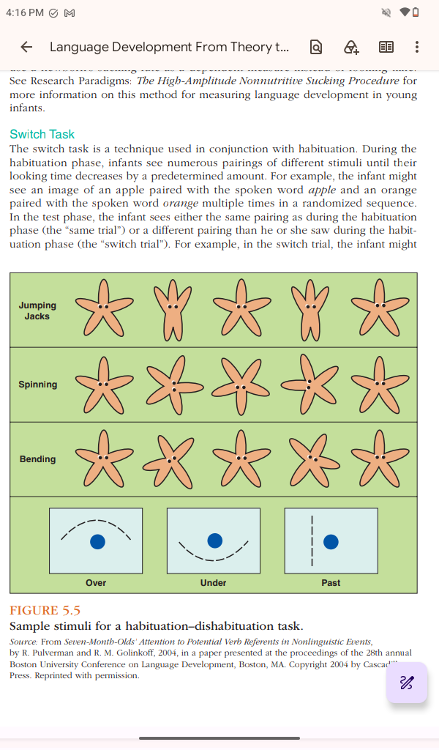
Test trial Description Example
1. Control
Description: Same event as in
habituation trials
Explanation: The starfish performs
jumping jacks back and
forth over the ball.
2. Path change
Description: Same manner as in the
habituation trials, but
different path
Expiation: The starfish performs
jumping jacks back and
forth under the ball.
3. Manner change
Description: Same path as in the
habituation trials, but
different manner
Explanation: The starfish spins back
and forth over the ball.
4. Path and manner
change
Description: Different path and
manner than in the
habituation trials
Explanation:The starfish bends
alongside the ball back
and forth.
In a study by Pulverman and Golinkoff (2004), researchers were
interested in determining the extent to which infants attend to
potential verb referents (e.g., bending, spinning) as they watch
motion events. These researchers habituated in- fants to one of nine
stimulus events involving an animated starfish actor and a green ball,
which serves as a point of reference (e.g., the starfish does jumping
jacks over the ball). Infants were said to have habituated when
the time of their visual fixation to the stimulus during three trials
(Trials 4–6, Trials 7–9, etc.) decreased to less than 65% of their
visual fixation time in the first three trials. Once the infants were
habituated, researchers presented four test trials in a random order:
By measuring infants’ dishabituation, researchers determined that
young infants
are sensitive to the nonlinguistic aspects of
manner and path that potentially serve as verb labels in their native
language. See Figure 5.5 for an illustration of the
habituation–dishabituation stimuli from Pulverman and Golinkoff’s
(2004) study. Note, too, that in the study, the starfish enacted the
motions in a continuous manner back
and forth along the paths
depicted at the bottom of the illustration.
Pulverman and Golinkoff used this task to investigate infants’
attention to specific aspects of motion events that languages label
with verbs. For example, English verbs tend to label the manner of an
action in motion events (how an action occurs—stagger, stroll,
stumble) and place the path of an action (where an agent moves
in relation to a point of reference—enter, exit) in a different part
of the sentence outside of the verb (“He staggered out of the house”).
By contrast, Spanish verbs tend to label the path of an action and
place the manner of an action in a different part of the sentence
outside of
the verb (rough translation = “He exited the house in
a staggering manner”). The aim of the study was to determine whether
infants pay attention to the manner and/or the path of an action in
motion events, and more specifically, whether infants pay particular
attention to the aspects of motion events that verbs in their language
label (manner for
English)
..
In the habituation phase of the task, the computer presents a series
of trials in which an animated starfish spins over a ball. The
beginning of each new trial contains an attention-getter that is used
to refocus the infant’s attention to the screen. In this video, the
attention-getter is a flashing blue and white shape accompanied by a
sound. Note
that as the infant loses interest with the
presentation, he begins to look away from the screen more frequently.
A researcher positioned out of the infant’s view behind the video
screen monitors the infant’s attention to the presentation and presses
a keyboard
button to indicate when the infant is attending and
when he is not attending to the presentation. Meanwhile, the computer
uses specific criteria to determine when the infant is officially
“bored” with the presentation. Once these criteria have been met, the
dishabituation phase of the task begins.
..
The purpose of the dishabituation phase is to determine whether the
infant notices subtle changes to the video presentation, based on
assumption that he will demonstrate a renewed interest in the video
when he detects something new. In this example, once
the infant
is habituated, he views a series of five test trials, three of which
serve to measure his attention to novel changes, one of which serves
as a familiar “control” to the test trials, and the last of which
serves to verify that the infant is capable of increasing
his
looking time to a completely novel stimulus. In the first test trial,
the animated starfish performs toe-touch actions over the ball; here,
the manner of action is novel, but the path the starfish takes is
familiar. If the infant was attending to the manner of action
in
the habituation phase of the task, he would be surprised by the new
manner of action and his looking time to the screen should increase
relative to the last few trials of the habituation phase. If he was
not attending to the manner of action during the habituation phase, he
should remain bored by the display as evidenced by a low level of
attention to the screen.
..
Two important features of the experiment are worth mentioning here.
First, the infant’s mother must close her eyes throughout the
presentation so that she cannot direct the infant’s attention to the
screen at any time (advertently or inadvertently). Second, the
researcher is positioned behind the screen wearing headphones so
that she is unaware of which display the infant is watching.
In the second test trial, the control trial, the infant sees the familiar action of the starfish spinning over the ball. The assumption of the control trial is that the infant will not demonstrate a renewed interest in this display.
In the third test trial, the infant sees the starfish perform jumping jacks under the ball. The infant should demonstrate interest in this display if he notices that either the manner of action or the path the starfish takes are different from those presented in the habituation trials.
In the fourth test trial, the infant sees the starfish spin next to the ball. Here, the infant should demonstrate interest in the display if he notices that the path the starfish takes is different from the path the starfish used in the habituation trial.
..
Finally, the infant sees a smiling baby in what is called the
recovery trial. The pur- pose of the recovery trial is to indicate
whether the infant renews his interest toward a completely novel
stimulus. Infants who do not demonstrate an increased looking time in
the recovery trial compared to the last few trials of the habituation
phase may not
have yielded reliable data during the
dishabituation phase of the study. In such cases, researchers usually
elect to disregard the individual’s data.
..
In another version of the habituation–dishabituation paradigm, researchers use a newborn’s sucking rate as a dependent measure instead of looking time. See Research Paradigms: The High-Amplitude Nonnutritive Sucking Procedure for more information on this method for measuring language development in young infants.
..
Switch Task
Switch Task
The switch task is a technique used in conjunction
with habituation. During the habituation phase, infants see numerous
pairings of different stimuli until their looking time decreases by a
predetermined amount. For example, the infant might see an image of an
apple paired with the spoken word apple and an orange paired with the
spoken word orange multiple times in a randomized sequence.
In
the test phase, the infant sees either the same pairing as during the
habituation phase (the “same trial”) or a different pairing than he or
she saw during the habituation phase (the “switch trial”). For
example, in the switch trial, the infant might see an image of an
apple paired with the spoken word orange or an image of an orange
paired with the spoken word apple. Researchers presume that an infant
who learned the original pairings during the habituation trials will
look longer at
the switch trial than at the same trial during
the test phase. After the test phase, the infant watches a control
trial that includes a novel stimulus he or she did not see during the
habituation phase. Researchers expect an infant will look longer at
the stimulus presented during the control trial than at stimuli he or
she has
already viewed.
Intermodal Preferential Looking Paradigm
Intermodal Preferential Looking Paradigm
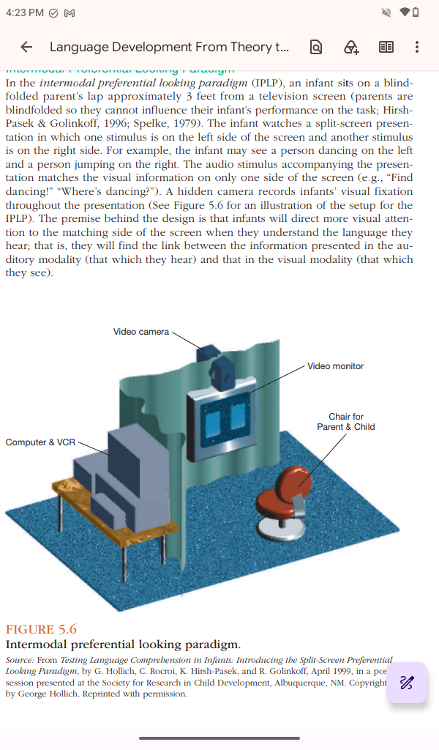
In the intermodal
preferential looking paradigm (IPLP), an infant sits on a blindfolded
parent’s lap approximately 3 feet from a television screen (parents
are blindfolded so they cannot influence their infant’s performance on
the task; HirshPasek & Golinkoff, 1996; Spelke, 1979). The infant
watches a split-screen presentation in which one stimulus is on the
left side of the screen and another stimulus is on the right side. For
example, the infant may see a person dancing on the left
and a
person jumping on the right. The audio stimulus accompanying the
presentation matches the visual information on only one side of the
screen (e.g., “Find dancing!” “Where’s dancing?”). A hidden camera
records infants’ visual fixation throughout the presentation (See
Figure 5.6 for an illustration of the setup for the IPLP). The premise
behind the design is that infants will direct more visual
atten-
tion to the matching side of the screen when they
understand the language they hear; that is, they will find the link
between the information presented in the auditory modality (that which
they hear) and that in the visual modality (that which they see).
The High-Amplitude Nonnutritive Sucking Procedure
The High-Amplitude Nonnutritive Sucking Procedure
As you read
about the high-amplitude nonnutritive
sucking procedure, recall
our discussion of behavior-
ism in Chapter 4.
Researchers
use the high-amplitude nonnutri-
tive sucking procedure to
determine whether infants
have a priori preferences for certain
sound stimuli over
others. Because young infants cannot speak,
point,
or otherwise directly indicate what they think about
speech sounds, researchers use an infant’s natural
sucking
reflex as an indirect way to learn about his or
her
speech-processing abilities.
In this procedure, a nonnutritive
pacifier is con-
nected to a computer. The infant sucks on the
pac-
ifier as he or she listens to audio stimuli played on
a loudspeaker. The computer delivers a particular
sound
stimulus each time the infant sucks on the
pacifier. This
stimulus reinforces the infant’s sucking
behavior within the
first 2 or 3 min of the study. As
the audio stimulus reinforces
the behavior, the infant
becomes conditioned and sucks more
frequently
when he or she likes the sound and sucks less
of-
ten when he or she does not like or is bored with the
sound.
Some researchers have used this procedure to
determine, for example, that 2-month-olds can distin-
guish
between their native language and a foreign lan-
guage (Mehler et
al., 1988). Other researchers have
determined that infants of
the same age can retain in-
formation about speech sounds they
hear for brief in-
tervals (e.g., Jusczyk, Kennedy, &
Jusczyk, 1995).
Researchers have used the IPLP to explore a variety of linguistic and
prelinguistic hypotheses. For example, Kuhl and Meltzoff (1982) used
the IPLP to discover that 4-month-old infants prefer to look at a face
whose mouth movesnin concert with a speech sound than at a face whose
mouth produces a differ-ent speech sound. More recently, researchers
using the IPLP have found infants tend to associate novel labels with
whole objects rather than object parts, even
when one of the
parts is interesting (Hollich, Golinkoff, & Hirsh-Pasek, 2007),
for example.
..
interactive intermodal pref-
erential looking paradigm (IIPLP)
There is also an interactive version of the IPLP, the interactive
intermodal pref- erential looking paradigm (IIPLP), in which the
infant is able to hold and explore objects before the experimenter
affixes them to a board for the test trials. Rather than measuring the
infant’s attention to the matching side of a television screen,
researchers measure attention to the target object as it appears
alongside another
object on a board.
Learn More About 5.10 (Continued)
The purpose of the study is to
determine the extent to which young children can utilize social cues
(such as a speaker’s eye gaze toward an object) to learn the name of a
novel
object. In the beginning of the video, the experimenter
presents two familiarization trials to ensure the child understands
the task at hand; this requires that the child, Adam, direct his
attention toward the object requested. After the experimenter allows
Adam to play
with the block and keys for a predetermined period
of time, she places them onto a Fagan board and requests that he look
at the keys. The premise is that he will look longer toward the keys
if he understands the label. Next, the experimenter allows the child
to play with each of two novel objects (a wand with sparkles and a
bottle opener). She then assesses whether he has a prefer- ence for
either of these two objects in what is called a salience trial. In the
salience
trial, the experimenter asks Adam to look at the board
using neutral requests. If he has an a priori preference for either of
the two objects, he should look longer toward that object.
In the training phase, the experimenter provides several labels for
one of the novel objects (“modi”) and she looks at that object to
provide a cue that she is labeling it. The test phase of the
experiment consists of four trials to assess whether the child has
learned the new word. In the first two test trials, the experimenter
asks Adam to “find the modi,” assuming that he will devote a greater
amount of attention to the
labeled object than the nonlabeled
object. In the third trial, the new label trial, the experimenter asks
Adam to “find the danu.” The assumption guiding this trial is that if
Adam understands that the bottle opener is called “modi,” he will look
toward the un-
named object (the wand with sparkles) when the
experimenter uses the word “danu.” In the final trial, termed the
recovery trial, the experimenter again asks Adam to “find the modi,”
with the assumption that Adam should redirect his attention to the
labeled object. Note that during the salience trial and the four test
trials, the mother’s eyes remain closed so she is unaware of which
side of the board the target object will appear. The child’s looking
time toward objects during the salience trial and each of the four
test tri-
als is recorded using a video camera to be coded
offline after he leaves the lab.
..
Naturalistic Observation
Naturalistic Observation
Naturalistic observation involves
systematically observing and analyzing an infant’s communicative
behavior in everyday situations. Such observation usually takes place
in the infant’s home. Researchers may videotape, audiotape, and take
notes as the infant interacts naturally with the people around him or
her. The researchers
may elect to gather information during
specific activities, such as dinnertime or free play with a parent.
Researchers targeting specific language forms or prelinguistic behaviors may alternatively devise a semistructured or structured observation in a laboratory. During structured observations, researchers may provide infants with specific props or ask the same questions of all infants in the study as a point of comparison.
..
The Child Language Data Exchange System (CHILDES) database (available
at
http://childes.psy.cmu.edu) is an invaluable source for
researchers interested in gain-
ing access to naturalistic and
structured language samples to answer questions about language
development. The CHILDES system contains transcripts and audio
files of naturalistic and structured observations in more than
30 languages as well as software for coding and analyzing these
transcripts (CLAN).
According to the CHILDES Web site, CHILDES originated in 1984 in an
effort to create a system to facilitate the exchange of child language
data. Collecting and transcribing child language data is notoriously
time-consuming, and the methods by which researchers collect and
transcribe language samples can vary greatly (e.g.,
whether or
not a researcher indicates grammatical omissions in a language sample;
whether or not a researcher indicates phonological errors in a speech
sample). CHILDES addresses these issues by providing a way for
researchers to standardize their own language samples, using the CLAN
transcription software, and to share
their data with other
researchers who might be interested in using those data to answer
different questions.
..
Neuroimaging Technologies
Neuroimaging Technologies
There are a number of neuroimaging technologies available to study
language development in infancy and throughout the lifespan.
Researchers use two main types. First are methods that measure changes
in the brain’s electrical activity, such as event-related potential
(ERP) and magnetoencephalography (MEG). Second are
methods that
measure changes in the brain’s blood flow (hemodynamic response), such
as functional magnetic resonance imaging (fMRI), or functional near
infrared spectroscopy (fNIRS) (Kovelman, 2012).
Neuroimaging studies in infancy have focused largely on infants’
perception of the phonemes that make up their native language or
languages. Kovelman (2012) describes that researchers can use an
“oddball” paradigm with any of the imaging methods. Using the oddball
paradigm, researchers present a standard stimulus (e.g.,
the
sound /ba/) about 80% of the time and an “oddball” stimulus (e.g., the
sound/da/) about 20% of the time. They then analyze the infant’s
electric or hemodynamic brain response to the oddball versus the
standard stimulus to determine the extent to which infants detect
differences in the sounds. A number of studies using neuroimaging
technologies to study infants’ perception of phonemes have replicated
the results of studies of research paradigms that do not measure brain
activity (e.g., Petitto et al., 2012).
Clinicians
Clinicians
As we discussed, infants in their first year begin to
establish many foundations for later language achievements. However,
they are not true conversationalists at this age. In general, gauging
whether children are lagging in their language skills is difficult
before they reach toddlerhood, when their expressive language begins
to
emerge. However, in some instances, clinicians (including
pediatricians, speech– language pathologists, and clinical
psychologists) do examine infants’ language
skills. Such
examinations may be necessary for infants born with developmental
disabilities (e.g., cleft palate) or for infants who, for unknown
reasons, seem to be lagging in meeting key milestones. Next, we
discuss two informal measures of language development that clinicians
use with infants: informal language screens and
parent-report measures.
Informal Language Screens
Informal Language Screens
Informal language screens for infants
involve checklists of common early language milestones that clinicians
and parents can use to check off whether or not an infant exhibits
each behavior in question. The National Institute on Deafness and
Other
Communication Disorders (http://www.nidcd.nih.gov) offers
a series of development language screens that parents and clinicians
can use informally. See Figure 5.7 for an example of a screen for
infants from birth to age 3 months, a screen for infants age 4 months
to age 6 months, and a screen for infants age 7 months to 1 year of age.
Parent-Report Measures
Parent-Report Measures
Not only is having parents report
directly on their infant’s development a quick way to gauge an
infant’s progress, but researchers believe such reporting to be a
reliable and valid measure of language ability when compared with
other direct assessments (P. Dale, 1991, 1996). Parents report on
specific language behaviors, using checklists and questionnaires.
Common self-report measures for infants include
the Language
Development Survey (LDS; Rescorla, 1993a), and the MacArthur–Bates CDI
(Fenson et al., 1993; Fenson, Pethick, et al., 2000). To expand on
just one of these measures, we provide some detail on the CDI next.
Bates and Carnevale (1993) explain that the CDI grew out of an
interest in capturing the most valid and reliable data possible on
children’s language. Because parents presumably spend more time with
their own children than does any other person, they are well
positioned to report on infrequent, new, and unpredictable
language behaviors as those behaviors emerge. For centuries,
researchers, such as Charles Darwin, have captured rich information
about their own children’s language development in diary studies. The
developers of the CDI, realizing that diary studies are time-consuming
and do not generalize to larger populations of children, aimed to
“bottle” the diary studies and administer them on a larger
scale
(p. 440). As researchers were developing the CDI, they created three
rules to strengthen the reliability and validity of the instrument.
First, they decided to ask only about current behaviors, as
retrospective reports tend not to be accurate. Second, they decided to
ask only about salient behaviors that are just starting to emerge and
that parents can reasonably keep track of. Third, they decided to rely
on parents’ recognition rather than recall. For example, the CDI
asks whether a child says certain words, such as dog, cat, or bird,
rather than ask the parent to list the animal names the child produces
(e.g., “What animal names does your child say?”). As we mentioned in
Chapter 4, the CDI was originally normed in English on a sample of
more than 1,800 infants and toddlers. According to the
CDI Web
site (http://mb-cdi.stanford.edu/), the CDI is available in 63
languages as
of 2015.
..
This chapter begins with a discussion of the major
lan-
guage-development milestones infants achieve,
includ-
ing the ability to perceive speech sounds and to use
speech sounds as a way to break into the continuous
streams of speech they hear. Other milestones include
being aware of and attending to actions and the
inten-
tions underlying actions; categorizing objects, actions,
and events according to perceptual and conceptual
fea-
tures; and producing early vocalizations that are
precur-
sors to language.
Some early foundations for
language development
that follow from infants’ social
interactions with other
people include infant-directed speech,
joint reference
and attention, the daily routines of infancy,
and care-
giver responsiveness. Infants’ major achievements in
language form, content, and use during the first year
include various types of vocal development (moving
from
sounds of distress, such as crying, to advanced
forms, such as
multisyllabic strings) to producing their
first word and using
several new pragmatic functions af-
ter about age 8 months, when
they are communicating
intentionally.
Although infants
follow a fairly predictable pattern
of language development
during the first year, some as-
pects of this development vary.
An individual infant’s
expressive and receptive vocabularies
differ in size and,
among a group of infants, there are
differences in the
language-development rate, language-learning
style,
communicative purpose, and starting time for
produc-
ing speech. Various factors account for such
differences.
Researchers and clinicians measure language
devel-
opment in infancy using a variety of creative methods.
Some major research paradigms include
habituation–
dishabituation tasks, the switch task (which
incorporates
habituation), the intermodal preferential looking
par-
adigm, the interactive intermodal preferential looking
paradigm, naturalistic observation, and neuroimaging
technologies. Two clinical methods for gathering
infor-
mation about infants’ language progress include
infor-
mal language screens and parent-report measures.
..
Part 1: Internalized Learning
Frontal lobe
The frontal lobe
is the largest lobe of the brain and is located at the front of the
brain. The frontal lobe also helps us communicate and control
movements. The frontal lobe supports communication because it contains
areas involved in speech production and the motor cortex. If the
frontal lobe is impaired, a person may have difficulty producing
speech, coordinating movements, and expressing thoughts clearly.
Part 2: Neuroplasticity Reflection
Skill: Technology When I
started elementary school, I started to learn how to use technology.
My technology experience taught me the concept of neural plasticity by
developing my skills and improving
them over time with practice.
This experience helped me continue to learn and relearn my
communication skills throughout the lifespan
..
The difference between language and speech is that language is a system of symbols used for thoughts and communication. It is a code that contributes to a system called morphemes and conventions. Speech is the behavior that allows humans to express language when spoken. For example, when a person formulates ideas using language, they must then transmit the message through speech. This includes the four muscle systems of respiration, phonation, resonance, and articulation.
I found it fascinating that children can learn language in
different forms, including speaking and sign language. Although
language and speech are related, they do not mean the same thing.
For
example, children who learn sign language can reach many of
the same language milestones as children who learn spoken language.
This shows that language development does not depend
only on
speech but on a person's ability to understand and use a system of communication.
One concept that expanded my thinking is how speech is formed. At first, I did not know anything about the developmental meaning of speech or how it was formed. However, as I read the book and the course materials, I learned that speech does not develop by itself. It takes multiple muscle systems working together to produce speech. For example, in the trachea, a stream of air moves through the vocal cords, creating vibration. Then it travels through the oral and nasal cavities, where it resonates. Finally, the airflow is manipulated by the oral articulators, including the tongue and teeth, to produce speech sounds that combine into words and sentences.
Another concept that expanded my thinking is that language can be described in many ways. This can include symbols, gestures, and facial expressions. For example, many years ago, symbols were used as representations of specific concepts associated with specific sounds, which I find fascinating. Gestures and facial expressions are also used by children before they develop spoken words. All three of these forms relate to how children learn and develop a language.
I believe learning about language and speech is very important in
my career because my job will be supporting and helping diverse
groups of people with their communication needs. Much of what I will
do relates to sound and understanding how communication develops. For
instance, if I work with a child, I need to understand how language
works and what tools and techniques I can use to help enhance that
child's language development. The same applies to speech. I need
to
know how speech develops so that I can help a child learn how
to speak.
The concepts of language and speech matter because children can be exposed to many aspects of language that they have not yet experienced. When they understand concepts such as nouns, verbs, adverbs, and emotions they are able to enhance their thinking and begin to communicate more effectively. It also promotes socialization among children, allowing them to use their language skills in a variety of settings
..
Interactive Lecture Assignment
● Phonology
●
Morphology
● Syntax
● Semantics
● Pragmatics
Phonology
1. Stop has only one syllable
2. The first
sound is “S”
3. There are 4 phonemes
4. If you take out the
S in stop it will be top
5. Bat rhymes with cat
6. There
are 3 syllables in the word elephant
7. The first sound of dog
is “D”
8. Plate without the P is late
Morphology
Add morphemes to the word teach
Teacher,
teaching, teachers, taught, teachable, reteach
Syntax
Step 1 child says
“ Baby eat”
“Bus
stop”
“Mom cook”
Step 2
Utterance
Baby eat
Bus stop
Mom cook
Morphemes
Baby+eat
Bus+stop
Mom+cook
Count
2,2,2
Step 3: Count the Utterance
There are 3 utterance
Step 4: Calculate MLU
● morphemes = 6
● utterances =
3
MLU= 6÷3=2.0
Answer
MLU=2.0
Semantics
Dog, cat, deer, bird, chicken, bat,
fish,
Vehicle —> car—> ride
Fruit —> Apple—>
sour
Piece of furniture —>bed—> sleep
Brain, sounds,
words, communication, language, autism
Pragmatics
One social communication I learned was that
whenever a family member comes to my family
home I have to go
greet them. In my family not greeting the guest is a sign of
disrespect. So I
always greet guests.
In my family it was
considered rude to not greet guests.
..
y Assignment 4: Theory ~ Genie
Genie’s language outcome falls
into the category of the Critical Period Hypothesis. This is also
called the sensitive period, where phases of normal development are
most sensitive to abnormal
environmental conditions. In Genie’s
case, since she was isolated from the world, her development was
abnormal. This included not knowing how to communicate, behave, or do
many things that a typical teenager can do. The Critical Period
hypothesis best explains her language outcomes because she was not
exposed to language development as a child, which
caused her to
not fully develop.
The theory that is least able to explain Genie’s case is the Behaviorist Theory. This theory suggests that language is learned through reinforcement of desirable verbal behaviors. Even though Genie received support and rehabilitation after she was rescued, she was still unable to communicate normally. She continued to struggle with grammar and never fully developed her language skills.
Before learning about Genie, I never thought about how much of my
daily life depends on language. I am well aware of how important
language can be because a person can really struggle when they are
unable to communicate. I heard a phrase before from a teacher that
said, “It's the language”. I never knew what she meant by that, but I
figured that she blamed language for my performance in her class or
because I was not fully developed in my curriculum. Either
way,
from watching Genie, I have gained a better understanding of how
essential language is in a person's daily life and why it is important
to never stop practicing it
..
Pageof 3Weekly Assignment 5: Milestone Myths
1. Myth: Infants do
not learn language until they say their first word.
Inaccurate:
This myth is inaccurate because infants begin to learn language
from
birth.They are able to recognize patterns and sounds before
they can talk.
Reference: Chapter 5, What Major
Language-Development Milestones Occur in
Infancy? (p.
123)
2. Myth: Babbling is just meaningless
noise.
Inaccurate: This myth is inaccurate because babbling is
actually words. When a
child babbles he/she is making sounds and
rhythms. So there is a meaning to
babbling.
Reference:
Chapter 5, Early Vocalizations (p. 129)
3. Myth: Infants can only
hear and recognize the sounds of their own language.
Inaccurate:
This myth is inaccurate because infants are able to
distinguish
language from all over the world. This includes
recognizing their own native
language as they get more sensitive
to sounds.
Reference: Chapter 5, Detection of Nonnative Phonetic
Differences (p. 125)
4. Myth: Infants learn language only by
hearing words.
Inaccurate: This myth is inaccurate because
Infants can also learn a language by
social interactions. This
includes two infants' reactions towards one another.
Reference:
Chapter 5, Early Foundations for Language Development (p. 123)
5.
Myth: Infants cannot understand other people's actions or
intentions.
Inaccurate: This myth is inaccurate because around 9
months, infants are able to
recognize goal-directed
actions.
Reference: Chapter 5, Awareness of Actions and
Intentions (p. 127)
6. Myth: Toddlers first words are just random
sounds.
Inaccurate: This myth is inaccurate because around 12
months toddlers are able
to use words that reflect on meaningful
communication.
Reference: Chapter 6, First words (p. 159)
7.
Myth: Gestures are less important than speech in language
development.Inaccurate: This myth is inaccurate because toddlers use
gestures all the time.
For example a 14 month old can use
gestures to demonstrate vocabulary.
Reference: Chapter 6,
Gestures (p. 160)
8. Myth: Toddlers learn language only from
spoken words, not social interaction.
Inaccurate: This myth is
inaccurate because toddlers are very influenced by
social
interactions. This includes a toddler who can point at something,
making it
into a meaningful word.
Reference: Chapter 6,
Mirror Neurons and Gestures (p. 162)
9. Myth: Toddlers make
speech “mistakes” randomly.
Inaccurate: This myth is inaccurate
because speech patterns are considered
rule-governed. For example
the word mama is not random, it reflects on the
toddlers
organizational speech.
Reference: Chapter 6, Phonological
Processes (p. 170)
10. Myth: Learning two languages confuses
toddlers and delays development.
Inaccurate: This myth is
inaccurate because toddlers do not get confused when
they know
two languages. Instead of them having delayed development, they
will
increase their phonetics.
Reference: Chapter 6,
Language Diversity and Differences (p. 183)Refrance
Turnbull, K.
L., & Justice, L. M. (2020). Language Development from Theory to
Practice (3rd
ed.).
..