Instructions for Side by Side Printing
- Print the notecards
- Fold each page in half along the solid vertical line
- Cut out the notecards by cutting along each horizontal dotted line
- Optional: Glue, tape or staple the ends of each notecard together
3063 chapter 5 part 3
front 1 Variation in Language-Development Rate | back 1 Variation in Language-Development Rate |
front 2 Variations in infants’ receptive and expressive vocabularies can be
accounted for only partly by age. Bates and colleagues (1995) reported
that age accounts for only 22% of the variance in the number of words
infants produce. Therefore, other factors explain the remaining 78% of
the variance. Two variables of interest | back 2 .. |
front 3 Variation in Language-Learning Styles | back 3 Variation in Language-Learning Styles |
front 4 referential language | back 4 In contrast, referential language learners use language primarily to refer to people and objects. They enjoy labeling things they see, and they like when adults provide labels for them. Their early vocabularies contain a large proportion of object labels, including words such as ball, doggie, and juice (Nelson, 1973 |
front 5 Variation at the Extremes of the Typical Range for Language Development | back 5 Variation at the Extremes of the Typical Range for Language Development The final language-development difference among infants involves certain children who fall at either end of the language-development continuum: late talkers and early talkers.We describe more severe variations in language development in Chapter 10. |
front 6 .. | back 6 Late Talkers. Late talkers are children who exhibit early delays in
their expressive (rather than receptive) language development.
Although there is no clinical diagnosis for being a late talker, one
common definition considers children to be late talkers if they
produce fewer than 50 words by age 2 (Rescorla, 1989). Zubrick,
Taylor, Rice, Late talkers are of concern to parents and clinicians. Being a late
talker does not necessarily mean a child will have a language delay or
impairment; however, it can be an important predictor of being
diagnosed with a delay or impairment at a later age. Many late talkers
can achieve normal language levels by age 3 or 4 years. |
front 7 Early Talkers | back 7 Early Talkers. Early talkers are children who are ahead of their
peers in expressive language use. Bates and colleagues (1995) defined
early talkers as children between ages 11 and 21 months who score in
the top 10% for vocabulary production for their age on the
MacArthur–Bates CDI. Whereas children developing language typically
produce an average of 200 words at 21 months, early talkers produce
|
front 8 How Do Researchers and Clinicians | back 8 How Do Researchers and Clinicians |
front 9 .. | back 9 People have likely been intrigued by how infants and young children
develop language for thousands of years. One early “research study”
involved a king in ancient Egypt who had two infants raised in silence
to determine what language the infants would speak on their own. For
the many centuries that followed, biographical and diary studies, such
as Charles Darwin’s 1877, “A Biographical Sketch of an Infant” were
|
front 10 The fact that infants cannot tell adults what they know about
language poses some interesting challenges with regard to measuring
their language achievements. As a result, researchers who measure
language achievements in infancy have de- | back 10 .. |
front 11 Habituation–Dishabituation Tasks | back 11 Habituation–Dishabituation Tasks |
front 12 .. | back 12 Dishabituation describes the infant’s renewed interest in a stimulus
|
front 13 Test trial Description Example Description: Same event as in Explanation: The starfish performs 2. Path change Description: Same manner as in the Expiation: The starfish performs 3. Manner change Description: Same path as in the Explanation: The starfish spins back 4. Path and manner Description: Different path and Explanation:The starfish bends | back 13 In a study by Pulverman and Golinkoff (2004), researchers were
interested in determining the extent to which infants attend to
potential verb referents (e.g., bending, spinning) as they watch
motion events. These researchers habituated in- fants to one of nine
stimulus events involving an animated starfish actor and a green ball,
which serves as a point of reference (e.g., the starfish does jumping
|
front 14 Pulverman and Golinkoff used this task to investigate infants’
attention to specific aspects of motion events that languages label
with verbs. For example, English verbs tend to label the manner of an
action in motion events (how an action occurs—stagger, stroll,
| back 14 .. |
front 15 In the habituation phase of the task, the computer presents a series
of trials in which an animated starfish spins over a ball. The
beginning of each new trial contains an attention-getter that is used
to refocus the infant’s attention to the screen. In this video, the
attention-getter is a flashing blue and white shape accompanied by a
sound. Note | back 15 .. |
front 16 The purpose of the dishabituation phase is to determine whether the
infant notices subtle changes to the video presentation, based on
assumption that he will demonstrate a renewed interest in the video
when he detects something new. In this example, once | back 16 .. |
front 17 Two important features of the experiment are worth mentioning here.
First, the infant’s mother must close her eyes throughout the
presentation so that she cannot direct the infant’s attention to the
screen at any time (advertently or inadvertently). Second, the
In the second test trial, the control trial, the infant sees the familiar action of the starfish spinning over the ball. The assumption of the control trial is that the infant will not demonstrate a renewed interest in this display. In the third test trial, the infant sees the starfish perform jumping jacks under the ball. The infant should demonstrate interest in this display if he notices that either the manner of action or the path the starfish takes are different from those presented in the habituation trials. In the fourth test trial, the infant sees the starfish spin next to the ball. Here, the infant should demonstrate interest in the display if he notices that the path the starfish takes is different from the path the starfish used in the habituation trial. | back 17 .. |
front 18 Finally, the infant sees a smiling baby in what is called the
recovery trial. The pur- pose of the recovery trial is to indicate
whether the infant renews his interest toward a completely novel
stimulus. Infants who do not demonstrate an increased looking time in
the recovery trial compared to the last few trials of the habituation
phase may not | back 18 .. |
front 19 In another version of the habituation–dishabituation paradigm, researchers use a newborn’s sucking rate as a dependent measure instead of looking time. See Research Paradigms: The High-Amplitude Nonnutritive Sucking Procedure for more information on this method for measuring language development in young infants. | back 19 .. |
front 20 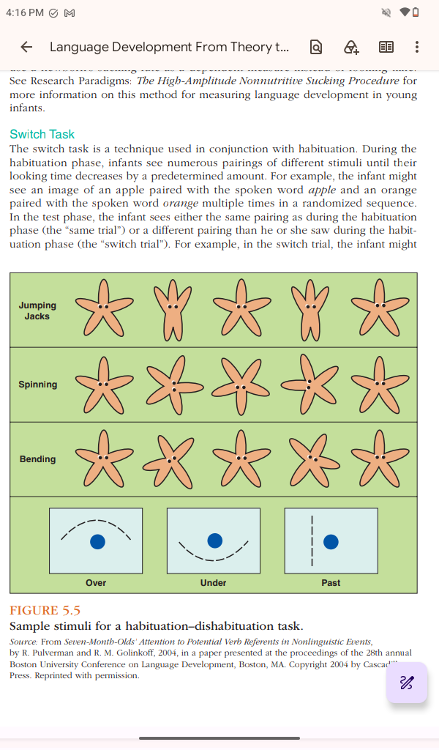 Switch Task | back 20 Switch Task |
front 21 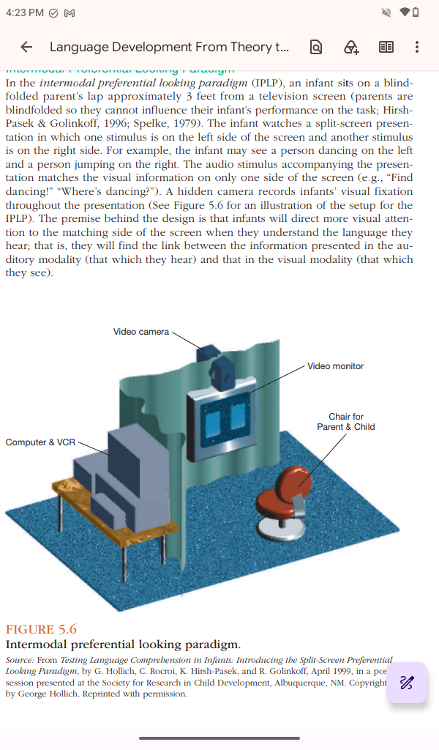 Intermodal Preferential Looking Paradigm | back 21 Intermodal Preferential Looking Paradigm |
front 22 The High-Amplitude Nonnutritive Sucking Procedure | back 22 The High-Amplitude Nonnutritive Sucking Procedure |
front 23 Researchers have used the IPLP to explore a variety of linguistic and
prelinguistic hypotheses. For example, Kuhl and Meltzoff (1982) used
the IPLP to discover that 4-month-old infants prefer to look at a face
whose mouth movesnin concert with a speech sound than at a face whose
mouth produces a differ-ent speech sound. More recently, researchers
using the IPLP have found infants tend to associate novel labels with
whole objects rather than object parts, even | back 23 .. |
front 24 interactive intermodal pref- | back 24 There is also an interactive version of the IPLP, the interactive
intermodal pref- erential looking paradigm (IIPLP), in which the
infant is able to hold and explore objects before the experimenter
affixes them to a board for the test trials. Rather than measuring the
infant’s attention to the matching side of a television screen,
researchers measure attention to the target object as it appears
alongside another |
front 25 Learn More About 5.10 (Continued) In the training phase, the experimenter provides several labels for
one of the novel objects (“modi”) and she looks at that object to
provide a cue that she is labeling it. The test phase of the
experiment consists of four trials to assess whether the child has
learned the new word. In the first two test trials, the experimenter
asks Adam to “find the modi,” assuming that he will devote a greater
amount of attention to the | back 25 .. |
front 26 Naturalistic Observation | back 26 Naturalistic Observation |
front 27 Researchers targeting specific language forms or prelinguistic behaviors may alternatively devise a semistructured or structured observation in a laboratory. During structured observations, researchers may provide infants with specific props or ask the same questions of all infants in the study as a point of comparison. | back 27 .. |
front 28 The Child Language Data Exchange System (CHILDES) database (available
at According to the CHILDES Web site, CHILDES originated in 1984 in an
effort to create a system to facilitate the exchange of child language
data. Collecting and transcribing child language data is notoriously
time-consuming, and the methods by which researchers collect and
transcribe language samples can vary greatly (e.g., | back 28 .. |
front 29 Neuroimaging Technologies | back 29 Neuroimaging Technologies There are a number of neuroimaging technologies available to study
language development in infancy and throughout the lifespan.
Researchers use two main types. First are methods that measure changes
in the brain’s electrical activity, such as event-related potential
(ERP) and magnetoencephalography (MEG). Second are Neuroimaging studies in infancy have focused largely on infants’
perception of the phonemes that make up their native language or
languages. Kovelman (2012) describes that researchers can use an
“oddball” paradigm with any of the imaging methods. Using the oddball
paradigm, researchers present a standard stimulus (e.g., |
front 30 Clinicians | back 30 Clinicians |
front 31 Informal Language Screens | back 31 Informal Language Screens |
front 32 Parent-Report Measures | back 32 Parent-Report Measures |
front 33 Bates and Carnevale (1993) explain that the CDI grew out of an
interest in capturing the most valid and reliable data possible on
children’s language. Because parents presumably spend more time with
their own children than does any other person, they are well
positioned to report on infrequent, new, and unpredictable
| back 33 .. |
front 34 This chapter begins with a discussion of the major
lan- Some major research paradigms include
habituation– | back 34 .. |
front 35 Part 1: Internalized Learning Part 2: Neuroplasticity Reflection | back 35 .. |
front 36 The difference between language and speech is that language is a system of symbols used for thoughts and communication. It is a code that contributes to a system called morphemes and conventions. Speech is the behavior that allows humans to express language when spoken. For example, when a person formulates ideas using language, they must then transmit the message through speech. This includes the four muscle systems of respiration, phonation, resonance, and articulation. I found it fascinating that children can learn language in
different forms, including speaking and sign language. Although
language and speech are related, they do not mean the same thing.
For One concept that expanded my thinking is how speech is formed. At first, I did not know anything about the developmental meaning of speech or how it was formed. However, as I read the book and the course materials, I learned that speech does not develop by itself. It takes multiple muscle systems working together to produce speech. For example, in the trachea, a stream of air moves through the vocal cords, creating vibration. Then it travels through the oral and nasal cavities, where it resonates. Finally, the airflow is manipulated by the oral articulators, including the tongue and teeth, to produce speech sounds that combine into words and sentences. Another concept that expanded my thinking is that language can be described in many ways. This can include symbols, gestures, and facial expressions. For example, many years ago, symbols were used as representations of specific concepts associated with specific sounds, which I find fascinating. Gestures and facial expressions are also used by children before they develop spoken words. All three of these forms relate to how children learn and develop a language. I believe learning about language and speech is very important in
my career because my job will be supporting and helping diverse
groups of people with their communication needs. Much of what I will
do relates to sound and understanding how communication develops. For
instance, if I work with a child, I need to understand how language
works and what tools and techniques I can use to help enhance that
child's language development. The same applies to speech. I need
to The concepts of language and speech matter because children can be exposed to many aspects of language that they have not yet experienced. When they understand concepts such as nouns, verbs, adverbs, and emotions they are able to enhance their thinking and begin to communicate more effectively. It also promotes socialization among children, allowing them to use their language skills in a variety of settings | back 36 .. |
front 37 Interactive Lecture Assignment Phonology Morphology Syntax Step 2 Baby eat Bus stop Mom cook Morphemes Baby+eat Bus+stop Mom+cook Count 2,2,2 Step 4: Calculate MLU Semantics Pragmatics | back 37 .. |
front 38 y Assignment 4: Theory ~ Genie The theory that is least able to explain Genie’s case is the Behaviorist Theory. This theory suggests that language is learned through reinforcement of desirable verbal behaviors. Even though Genie received support and rehabilitation after she was rescued, she was still unable to communicate normally. She continued to struggle with grammar and never fully developed her language skills. Before learning about Genie, I never thought about how much of my
daily life depends on language. I am well aware of how important
language can be because a person can really struggle when they are
unable to communicate. I heard a phrase before from a teacher that
said, “It's the language”. I never knew what she meant by that, but I
figured that she blamed language for my performance in her class or
because I was not fully developed in my curriculum. Either | back 38 .. |
front 39 Pageof 3Weekly Assignment 5: Milestone Myths | back 39 .. |