CE Midterm
Sunken cheeks, wasting of temporalis muscles, flushing of face indicate ______ ______
systemic illness
Pale, puffy face = ______
hyperthyroidism
Goiter
nephritis
parkinsonism
nephritis
Startled expression = ______
hyperthyroidism
Goiter
nephritis
parkinsonism
hyperthyroidism
Immobile stare = ______
hyperthyroidism
Goiter
nephritis
parkinsonism
parkinsonism
______ = enlarged thyroid glands
hyperthyroidism
Goiter
nephritis
parkinsonism
Goiter
most common endocrine cancer
thyroid cancer
thyroid cancer seen more in men or women?
women
5-year survival rate all thyroid cancers = ___%
97
Thryoid Cancer- Decreasing or Increasing # of cases each year?
Increasing
Thryoid cancer: has been ___ death rate in men and ___ in women
increasing
stable
___ and ___ cancer includes cancers of mouth, nose, sinuses, salivary glands, throat, and lymph nodes
head and neck
___ % of all head and neck cancers linked to tobacco use
85
Mastoid process - part of ___ (impt in ear disease)
temporal
Mouth principle muscle- ___ ___
it surrounds lips and closes lips
orbicularis oris
Eye principle muscle - ___ ___ (___ eyelid)
orbicularis oculi
closes
___ - thin, superficial muscle of neck, crossing outer
border of
mandible and extending over lower anterior portion of face
Platysma
Platysma Action- pull mandible ___ and ___
downward
backwards
Which muscle of mastication is described as the strongest and thickest facial muscle responsible for powerful jaw closure?
Masseter
The primary action of the masseter muscle is to:
A. Depress
mandible forward
B. Elevate and retract mandible
C.
Protrude mandible laterally
D. Stabilize hyoid bone
B. Elevate and retract mandible
A clinician palpates strong tension over the cheek while a patient
clenches their teeth. Which muscle is being assessed?
A.
Temporalis
B. Buccinator
C. Masseter
D. Medial pterygoid
C. Masseter
Muscles of mastication insert primarily onto which bone to produce chewing movements?
Mandible
Which cranial nerve provides motor innervation to the muscles of
mastication?
A. Facial nerve (CN VII)
B. Glossopharyngeal
nerve (CN IX)
C. Trigeminal nerve (CN V)
D. Hypoglossal
nerve (CN XII)
C. Trigeminal nerve (CN V)
The trigeminal nerve carries sensory information from which of the
following regions?
A. Neck muscles
B. Face, oral cavity,
and teeth
C. Larynx and pharynx
D. Scalp and posterior neck
B. Face, oral cavity, and teeth
The sternocleidomastoid divides the neck into which two major
anatomical regions?
A. Superior and inferior triangles
B.
Medial and lateral compartments
C. Anterior and posterior
triangles
D. Superficial and deep triangles
C. Anterior and posterior triangles
Which muscle elevates the sternum during forced respiration and helps form the boundary between neck triangles?
SCM
The sternocleidomastoid originates from which two structures?
A. Manubrium and clavicle
B. Clavicle and scapula
C.
Sternum and hyoid
D. Mastoid and clavicle
A. Manubrium and clavicle
The insertion of the sternocleidomastoid muscle is located on
the:
A. Zygomatic arch
B. Mandibular angle
C.
Mastoid process
D. Occipital protuberance
C. Mastoid process
Motor innervation of the sternocleidomastoid muscle is primarily
supplied by which cranial nerve?
A. CN X
B. CN XI
C.
CN XII
D. CN VII
B. CN XI
The sternocleidomastoid muscle lies superficial to which important
vascular and neural structure bundle?
A. Brachial plexus
B. Carotid sheath
C. Thoracic duct
D. Vertebral canal
B. Carotid sheath
Which structure is NOT contained within the carotid sheath?
A.
Internal jugular vein
B. Vagus nerve
C. Common carotid
artery
D. Phrenic nerve
D. Phrenic nerve
Which boundary helps form the inferior border of the anterior
triangle of the neck?
A. Clavicle
B. Mandible
C.
Mastoid process
D. Hyoid bone
A. Clavicle
Which of the following structures is located within the anterior
triangle of the neck?
A. Brachial plexus
B. Thyroid
gland
C. Vertebral artery
D. Spinal cord
B. Thyroid gland
Which gland found in the anterior triangle contributes to saliva
production?
A. Parotid gland
B. Sublingual gland
C.
Submandibular gland
D. Lacrimal gland
C. Submandibular gland
Which organ within the anterior triangle is directly involved in voice production?
Larynx
Enlargement of which structures in the anterior triangle most
commonly reflects immune response to infection?
A. Salivary
ducts
B. Lymph nodes
C. Carotid arteries
D. Thyroid follicles
B. Lymph nodes
The thyroid gland consists of two lobes connected by which
structure?
A. Ligamentum flavum
B. Thyroid isthmus
C. Median raphe
D. Cricoid ligament
B. Thyroid isthmus
The thyroid gland primarily wraps around which two structures in the
neck?
A. Esophagus and vertebrae
B. Larynx and
trachea
C. Pharynx and esophagus
D. Mandible and hyoid
B. Larynx and trachea
The thyroid isthmus typically lies across the trachea just inferior
to which cartilage?
A. Thyroid cartilage
B. Arytenoid
cartilage
C. Cricoid cartilage
D. Epiglottic cartilage
C. Cricoid cartilage
The primary function of the thyroid gland is to: secrete _____ hormones
thyroid
Which muscles form the posterior boundary of the posterior triangle of the neck?
Which structure forms the inferior boundary of the posterior triangle of the neck?
Trapezius
Clavicle
A key structure commonly located within the posterior triangle of the
neck is the:
A. Thyroid gland
B. Larynx
C. Lymph
nodes
D. Esophagus
C. Lymph nodes
Approximately how many lymph nodes are typically present on each side
of the neck?
A. 25
B. 50
C. 75
D. 150
C. 75
During physical examination, range of motion of the neck is commonly
assessed to evaluate for:
A. Cranial nerve damage
B. Neck
masses or stiffness
C. Cardiac abnormalities
D. Pulmonary restriction
B. Neck masses or stiffness
A painful neck mass most commonly suggests:
A. Acute
infection
B. Congenital lesion
C. Malignancy
D. Metastasis
A. Acute infection
mass present for months may be _____
neoplastic
A neck mass present for only a few days most likely indicates:
A. Inflammation
B. Congenital abnormality
C. Metastatic
disease
D. Thyroid carcinoma
A. Inflammation
A neck mass present for months to years without change in size is
most consistent with:
A. Rapid malignancy
B. Acute
abscess
C. Lesion
D. Severe inflammation
C. Lesion
A neck mass that fluctuates in size while eating most likely results
from:
A. Thyroid enlargement
B. Salivary gland
blockage
C. Lymphatic metastasis
D. Thyroglossal cyst
B. Salivary gland blockage
In patients younger than 20 years old, a neck mass is most commonly
due to:
A. Metastatic carcinoma or congenital mass
B.
Enlarged tonsillar node or congenital mass
C. Thyroid cancer or
congenital mass
D. Gastric metastasis or congenital mass
B. Enlarged tonsillar node or congenital mass
A midline neck mass in a young patient most strongly suggests which
condition?
A. Dermoid cyst
B. Thyroglossal cyst
C.
Salivary obstruction
D. Metastatic lesion
B. Thyroglossal cyst
In patients aged 20–40 years, neck masses are most commonly related
to:
A. Thyroid disease
B. Metastatic cancer
C.
Congenital anomalies
D. Salivary tumors
A. Thyroid disease
In patients older than 40 years, a new neck mass should be
considered:
A. Benign until proven malignant
B. Malignant
until proven otherwise
C. Congenital until proven
malignant
D. Infectious until proven benign
B. Malignant until proven otherwise
A midline neck mass is most commonly associated with:
A.
Metastatic disease
B. Congenital or benign lesions
C.
Salivary tumors
D. Lymphatic obstruction
B. Congenital or benign lesions
A lateral neck mass is most commonly suggestive of:
A.
Congenital cyst
B. Benign thyroid disease
C. Neoplastic
process
D. Salivary obstruction
C. Neoplastic process
Metastatic tumors in the upper neck most commonly originate from
cancers of the:
A. Breast and stomach
B. Head and
neck
C. Kidney and bladder
D. Liver and pancreas
B. Head and neck
Metastatic tumors in the lower neck most commonly originate from
cancers of the:
A. Lung and pancreas
B. Breast and
stomach
C. Thyroid and larynx
D. Brain and spinal cord
B. Breast and stomach
The most common cause of neck stiffness is:
A. Cervical
fracture
B. Muscle sprain or strain
C. Spinal
infection
D. Disc herniation
B. Muscle sprain or strain
Neck stiffness caused by muscular injury most commonly involves which
muscle?
A. Sternocleidomastoid
B. Trapezius
C.
Levator scapulae
D. Scalenes
C. Levator scapulae
The levator scapulae muscle connects the cervical spine to which
structure?
A. Mandible
B. Shoulders
C. Sternum
D. Hyoid bone
B. Shoulders
The levator scapulae is primarily located along which region of the
neck?
A. Anterior neck only
B. Back and side of neck
C. Deep anterior triangle
D. Midline posterior neck
B. Back and side of neck
The levator scapulae muscle receives motor innervation primarily from which cervical spinal nerves?
C3–C4
Sudden neck stiffness accompanied by high fever, nausea, vomiting,
and headache should raise concern for:
A. Cervical
radiculopathy
B. Meningeal irritation
C. Thyroid
enlargement
D. Cervical disc degeneration
B. Meningeal irritation
Neck stiffness accompanied by fever should prompt:
A. Immediate
surgical referral
B. Routine observation only
C. Medical
evaluation
D. Physical therapy only
C. Medical evaluation
Neck pain may occur as referred pain from which organ system?
A. Respiratory system
B. Cardiovascular system
C.
Gastrointestinal system
D. Renal system
B. Cardiovascular system
A patient with angina or myocardial infarction may complain of pain
radiating to which area?
A. Lower back
B. Neck
C.
Abdomen
D. Hip
B. Neck
Neck pain associated with myocardial ischemia is best explained
by:
A. Direct cervical injury
B. Referred pain
C.
Local muscle spasm
D. Thyroid inflammation
B. Referred pain
The most common psychological reaction to head and neck disease is:
Depression
During inspection of the head and neck, which structure should be examined for lesions and hair characteristics?
Scalp
During embryologic development, the thyroid gland migrates downward
along which structure of the neck?
A. Lateral cervical
region
B. Midline of the neck
C. Posterior cervical
region
D. Submandibular space
B. Midline of the neck
Failure of the embryologic thyroid migration tract to close may
result in formation of a:
A. Branchial cleft cyst
B.
Dermoid cyst
C. Thyroglossal duct cyst
D. Salivary abscess
C. Thyroglossal duct cyst
A thyroglossal duct cyst forms when the persistent tract fills
with:
A. Blood or lymph
B. Fluid or thick mucous-like
material
C. Air or gas
D. Fat or connective tissue
B. Fluid or thick mucous-like material
A thyroglossal duct cyst most commonly appears as which type of neck
mass?
A. Hard irregular lateral mass
B. Midline soft round
mass
C. Deep posterior triangular mass
D. Painful
supraclavicular mass
B. Midline soft round mass
Thyroglossal duct cysts are most commonly detected during which
period of life?
A. Late adulthood
B. Adolescence
C.
Early childhood
D. Prenatal period
C. Early childhood
The typical size of a thyroglossal duct cyst is approximately
comparable to a:
A. Marble
B. Ping pong ball
C. Golf
ball
D. Tennis ball
B. Ping pong ball
Before surgical removal of a thyroglossal duct cyst, clinicians must
confirm the presence of a:
A. Normal parathyroid gland
B.
Functional pituitary gland
C. Normal thyroid gland
D.
Normal salivary gland
C. Normal thyroid gland
Thyroid tissue within a thyroglossal duct cyst may rarely develop
which condition?
A. Hyperplasia
B. Thyroid cancer
C.
Calcification
D. Fibrosis
B. Thyroid cancer
Forward displacement or bulging of the eyeball observed during
examination is termed:
A. Exophoria
B. Proptosis
C.
Enophthalmos
D. Ptosis
B. Proptosis
Bilateral proptosis is classically associated with which
disorder?
A. Hashimoto thyroiditis
B. Graves disease
C. Pituitary adenoma
D. Cushing syndrome
B. Graves disease
Enlargement of the thyroid gland commonly results in:
A. Jaw
asymmetry
B. Enlarged neck
C. Facial paralysis
D.
Orbital edema
B. Enlarged neck
Prominent superficial veins in the neck may be observed in patients
with:
A. Goiter
B. Lymphadenitis
C. Dermoid
cyst
D. Tonsillar hypertrophy
A. Goiter
Multiple nodular neck masses are most commonly associated with:
A. Thyroid lymphoma
B. Multinodular goiter
C. Thyroglossal
cyst
D. Parathyroid adenoma
B. Multinodular goiter
Auscultation of the neck during physical examination is commonly
performed to detect:
A. Thyroid nodules
B. Jugular venous
waves
C. Carotid bruits
D. Cervical muscle spasms
C. Carotid bruits
What approach? Anterior or Posterior?
Pt neck flexed and turning chin slightly to right- relax SCM on that side and easier to perform
Left hand of doc displace larynx to left and during swallowing, displaced left thyroid lobe palpated between examiner's right thumb and left SCM muscle
Anterior
What approach? Anterior or Posterior?
- patient neck slightly extended
- Again push thyroid to
one side while patient swallow and doc rolls hand
over thyroid
cartilage
- Hard for examiner to feel thyroid gland in normal state
Posterior
For thyroid exam:
Unusual ____ - cancer or scarring
____ - toxic goiter
hardness
Softness
When palpating lymph nodes of the head and neck, the examiner should
assess for:
A. Warmth, pulse, color
B. Mobility,
consistency, tenderness
C. Diameter, bruit, fluctuation
D.
Shape, contour, transillumination
B. Mobility, consistency, tenderness
Tender cervical lymph nodes are most commonly associated with:
A. Malignancy
B. Inflammation
C. Congenital cysts
D. Fibrosis
B. Inflammation
Fixed, firm lymph nodes on neck palpation are most concerning
for:
A. Viral infection
B. Acute inflammation
C.
Malignancy
D. Salivary obstruction
C. Malignancy
Tenderness of the thyroid gland is most commonly associated
with:
A. Chronic fibrosis
B. Acute infection or
hemorrhage
C. Benign adenoma only
D. Metastatic spread only
B. Acute infection or hemorrhage
If the thyroid gland is enlarged, additional examination should
include:
A. Auscultation
B. Transillumination
C.
Percussion
D. Ophthalmoscopy
A. Auscultation
Which part of the stethoscope is best used to auscultate an enlarged thyroid gland?
Bell
During thyroid auscultation, the bell of the stethoscope is placed
over the:
A. Cricoid cartilage
B. Thyroid lobes
C.
Carotid bifurcation
D. Suprasternal notch
B. Thyroid lobes
A bruit heard over the thyroid gland represents:
A. Air moving
in trachea
B. Turbulent blood flow
C. Vocal cord
vibration
D. Lymphatic obstruction
B. Turbulent blood flow
A systolic bruit heard over the superior pole of the thyroid is
highly suggestive of:
A. Thyroglossal cyst
B. Toxic
goiter
C. Acute thyroid abscess
D. Multinodular carcinoma
B. Toxic goiter
To palpate the supraclavicular nodes, the examiner is best
positioned:
A. In front of patient
B. Behind patient
C. Beside patient
D. Above patient
B. Behind patient
Supraclavicular nodes are palpated by placing the fingers:
A.
Over the mastoid process
B. Beneath the mandible
C. In the
medial supraclavicular fossae
D. Over the thyroid isthmus
C. In the medial supraclavicular fossae
While palpating the supraclavicular nodes, the examiner presses
deeply:
A. Above and lateral to mandible
B. Over tracheal
rings
C. Into and behind clavicles
D. Into posterior
triangle only
C. Into and behind clavicles
Which adjacent muscle serves as a landmark during palpation of supraclavicular nodes?
Sternocleidomastoid
Supraclavicular lymph nodes are most likely to become palpable when
the patient:
A. Swallows
B. Exhales fully
C.
Inspires deeply
D. Turns head laterally
C. Inspires deeply
Iodine deficiency = thyroid ______
enlarged
Causes of ______ - infection, AI disease, cancer, isolated nodules
goiter
______ thyroid = hyperthyroidism, hypothyroid, or simple or multinodular goiter of normal function
Enlarged
Pemberton’s sign is primarily used to detect obstruction in which
anatomical region?
A. Thoracic inlet
B. Cervical spinal
canal
C. Carotid bifurcation
D. Posterior triangle
A. Thoracic inlet
Pemberton’s sign is tested by asking the patient to:
A. Rotate
the head side to side
B. Elevate both arms overhead
C.
Take repeated deep breaths
D. Flex the neck forward
B. Elevate both arms overhead
During the Pemberton maneuver, the patient’s arms are raised until
they:
A. Cross over chest
B. Touch the side of head
C. Reach shoulder level
D. Extend straight forward
B. Touch the side of head
A positive Pemberton’s sign initially presents with:
A. Sudden
hypotension and neck vein dilation
B. Facial suffusion and neck
vein dilation
C. Severe neck pain and neck vein dilation
D. Rapid heart rate and neck vein dilation
B. Facial suffusion and neck vein dilation
If the Pemberton maneuver continues for 1–2 minutes in a positive
test, the patient’s face may become:
A. Pale
B.
Edematous
C. Erythematous
D. Cyanotic
D. Cyanotic
The most common cause of hyperthyroidism is:
A. Thyroid
adenoma
B. Hashimoto thyroiditis
C. Diffuse toxic
goiter
D. Multinodular goiter
C. Diffuse toxic goiter
Diffuse toxic goiter is also known as:
A. Graves disease
B. Addison disease
C. Cushing syndrome
D. Paget disease
A. Graves disease
Graves disease is classified as which type of disorder?
A.
Infectious disorder
B. Autoimmune disorder
C. Genetic
structural disorder
D. Degenerative disorder
B. Autoimmune disorder
Graves disease is caused by production of which antibody?
A.
Thyroid peroxidase antibody
B. Thyroid-stimulating
immunoglobulin
C. Antithyroglobulin antibody
D. Anti-TSH
receptor blocker
B. Thyroid-stimulating immunoglobulin
A patient with hyperthyroidism most commonly presents with which skin
finding?
A. Cool, dry skin
B. Warm skin
C. Thickened
plaques
D. Hyperpigmented patches
B. Warm skin
Which neurologic symptom is commonly associated with
hyperthyroidism?
A. Hand tremor
B. Facial paralysis
C. Loss of reflexes
D. Muscle rigidity
A. Hand tremor
Which psychiatric symptom is frequently seen in
hyperthyroidism?
A. Depression and insomnia
B. Anxiety and
insomnia
C. Hallucinations and insomnia
D. Memory loss and insomnia
B. Anxiety and insomnia
Heat intolerance in hyperthyroidism is primarily due to:
A.
Reduced metabolism
B. Increased metabolic rate
C.
Decreased circulation
D. Impaired sweating
B. Increased metabolic rate
Which reproductive symptom may occur in women with hyperthyroidism?
Amenorrhea
Excessive sweating associated with hyperthyroidism is termed:
A. Hyperthermia
B. Hyperhidrosis
C. Hyperemia
D. Hyperplasia
B. Hyperhidrosis
Which ocular sign is classically associated with Graves
disease?
A. Ptosis
B. Proptosis
C.
Enophthalmos
D. Strabismus
B. Proptosis
Hyperthyroidism may also cause cardiovascular symptoms such as:
A. Bradycardia
B. Palpitations
C. Heart block
D. Hypotension
B. Palpitations
Changes in which structure may occur in hyperthyroidism leading to
abnormal growth patterns?
A. Teeth
B. Nails
C.
Cartilage
D. Tendons
B. Nails
Hyperthyroidism may occasionally be caused by which thyroid
abnormality?
A. Cold nodule
B. Fibrotic nodule
C.
Hot nodule
D. Calcified nodule
C. Hot nodule
Patient with exophthalmos, weight loss, palpitations:
Thyroglossal duct cyst
Thyroid carcinoma
Graves’ Disease
Graves’ Disease
Older patient with firm, non-tender thyroid nodule:
Thyroglossal duct cyst
Thyroid carcinoma
Graves’ Disease
Thyroid carcinoma
Young patient with midline neck mass moving with swallowing:
Thyroglossal duct cyst
Thyroid carcinoma
Graves’ Disease
Thyroglossal duct cyst
Patient with progressively enlarging lateral neck mass:
Laryngeal SCC
Lymphoma or metastatic carcinoma
Meningitis
Lymphoma or metastatic carcinoma
Neck stiffness, fever, photophobia:
Laryngeal SCC
Lymphoma or metastatic carcinoma
Meningitis
Meningitis
Elderly male smoker with hoarseness >2 weeks:
Laryngeal SCC
Lymphoma or metastatic carcinoma
Meningitis
Laryngeal SCC
During axillary examination, proper technique requires the pectoral
muscles to be:
A. Contracted firmly
B. Fully relaxed
C. Slightly flexed
D. Rotated laterally
B. Fully relaxed
When examining the patient’s right axilla, the examiner supports the
patient’s right forearm with the examiner’s:
A. Left thumb
B. Opposite shoulder
C. Right hand
D. Left elbow
C. Right hand
In right axillary palpation, the examining fingers are usually those
of the examiner’s:
A. Left hand
B. Right hand
C.
Dominant hand
D. Both thumbs
A. Left hand
At the start of palpating the axilla, the examiner’s fingers should
be placed:
A. Beneath the clavicle
B. Low in the
axilla
C. Over the scapula
D. Near the sternum
B. Low in the axilla
As the patient’s right arm is drawn medially, the examiner should
move the palpating hand:
A. Upward into the axilla
B.
Outward from the chest
C. Down across the ribs
D. Back
toward the scapula
A. Upward into the axilla
In addition to the axilla, which regions are specifically included in
this lymph node exam?
A. Inguinal and femoral
B. Occipital
and tonsillar
C. Supraclavicular and subclavian
D.
Epitrochlear and popliteal
C. Supraclavicular and subclavian
Which finger movement is recommended for detecting adenopathy in the
axilla?
A. Sharp repetitive tapping
B. Broad linear
strokes
C. Small circular motions
D. Static deep pressure
C. Small circular motions
During this palpation technique, the examiner’s fingers are described
as:
A. Sliding under muscles
B. Riding over the ribs
C. Pressing behind the sternum
D. Hooking above the clavicle
B. Riding over the ribs
Freely mobile axillary nodes measuring 3 to 5 mm are generally
considered:
A. Common benign findings
B. Definite
metastatic disease
C. Evidence of thyroid spread
D. Signs
of vascular obstruction
A. Common benign findings
Small mobile axillary lymph nodes most often suggest lymphadenitis
secondary to:
A. Upper GI infection
B. Minor hand
trauma
C. Thyroid inflammation
D. Deep neck abscess
B. Minor hand trauma
Which body region is specifically mentioned as a source of trauma
leading to these reactive nodes?
A. Foot and ankle
B.
Abdomen and chest
C. Hand and arm
D. Face and scalp
C. Hand and arm
After one axilla has been examined, the other should be assessed with
the examiner’s:
A. Same left hand
B. Dominant
shoulder
C. Opposite hand
D. Right forearm
C. Opposite hand
Orthostatic hypotension: Dizziness may accompany the _____ in blood pressure. In most affected patients, there is also an _____ in heart rate.
drop
increase
Risk factors: old age, meds, cardiac, heat exposure, bed rest, pregnancy, alcohol
What is this?
Orthostatic hypotension
Korotkoff sounds are best described as:
A. High-pitched venous
clicks
B. Turbulent arterial sounds
C. Pleural friction
rubs
D. Valve closure noises
B. Turbulent arterial sounds
Korotkoff sounds are produced when a blood pressure cuff:
A.
Partially occludes an artery
B. Completely blocks venous
return
C. Compresses the radial nerve
D. Expands the
vessel wall
A. Partially occludes an artery
Which Korotkoff phase is most accurate for determining diastolic
blood pressure in adults?
A. Phase 1
B. Phase 3
C.
Phase 4
D. Phase 5
D. Phase 5
Compared with phase 4 muffling, phase 5 is preferred because it
reflects:
A. Earlier systolic ejection
B. Sound
disappearance
C. Venous reopening
D. Peak arterial recoil
B. Sound disappearance
Masked hypertension refers to patients who:
A. Have only
elevated office readings
B. Show normal readings only at
night
C. Appear normal in clinic
D. Develop hypotension
during stress
C. Appear normal in clinic
Masked hypertension is especially concerning because it indicates
increased risk of:
A. Renal stones
B. Thyroid
disease
C. Cardiovascular disease
D. Pulmonary fibrosis
C. Cardiovascular disease
If the patient’s arm is not supported at heart level during BP
measurement, the reading may be falsely high because the patient is
performing:
A. Passive stretching
B. Isometric
exercise
C. Dynamic contraction
D. Respiratory straining
B. Isometric exercise
Failure to support the arm properly most directly causes an
artificially elevated:
A. Pulse deficit
B. Blood pressure
reading
C. Respiratory rate
D. Oxygen saturation
B. Blood pressure reading
Pressing too hard with the diaphragm significantly lowers which
measurement?
A. Diastolic pressure
B. Mean arterial
pressure
C. Systolic pressure
D. Pulse amplitude
A. Diastolic pressure
When positioning the cuff, the bladder should be centered over
the:
A. Radial artery
B. Ulnar artery
C. Brachial
artery
D. Axillary artery
C. Brachial artery
During blood pressure measurement by palpation, the systolic pressure
is identified by the:
A. Disappearance of radial pulse
B.
Return of brachial pulse
C. Muffling of Korotkoff sounds
D. Peak carotid upstroke
B. Return of brachial pulse
Coarctation of the aorta may occur as an isolated defect or in
association with which cardiac lesion?
A. Atrial septal
defect
B. Mitral valve prolapse
C. Bicuspid aortic
valve
D. Tricuspid atresia
C. Bicuspid aortic valve
Which additional congenital lesion is commonly associated with
coarctation of the aorta?
A. Ventricular septal defect
B.
Patent foramen ovale
C. Ebstein anomaly
D. Aortic regurgitation
A. Ventricular septal defect
In a new patient with hypertension, evaluation for coarctation should
always include blood pressure measurement in the:
A. Upper
extremity
B. Lower extremity
C. Left arm
D. Right wrist
B. Lower extremity
During blood pressure assessment for suspected coarctation, the
patient is positioned:
A. Supine
B. Sitting upright
C. Prone
D. Standing
C. Prone
For lower-extremity blood pressure measurement in suspected
coarctation, the cuff is placed around the:
A. Distal calf
B. Anterior knee
C. Posterior midthigh
D. Lateral ankle
C. Posterior midthigh
When measuring leg blood pressure for coarctation, the stethoscope is
commonly placed over the:
A. Femoral triangle
B. Popliteal
fossa
C. Inguinal ligament
D. Greater saphenous vein
B. Popliteal fossa
In addition to the popliteal artery, which distal artery may be used
for auscultation during this exam?
A. Ulnar artery
B.
Temporal artery
C. Dorsalis pedis artery
D. Axillary artery
C. Dorsalis pedis artery
Which other distal artery may be used when checking lower-extremity
pressure in suspected coarctation?
A. Posterior tibial
artery
B. Deep brachial artery
C. Common carotid
artery
D. Radial artery
A. Posterior tibial artery
A leg systolic blood pressure lower than the arm systolic pressure
should raise suspicion for:
A. Aortic stenosis
B.
Coarctation of the aorta
C. Mitral regurgitation
D.
Pulmonary hypertension
B. Coarctation of the aorta
Suspicion for coarctation increases further when the femoral pulse
is:
A. Bounding compared with carotid
B. Irregular
compared with brachial
C. Absent only during expiration
D.
Delayed compared with radial
D. Delayed compared with radial
In a normal patient, the femoral and radial pulses should:
A.
Alternate in timing
B. Peak at the same time
C. Differ by
one beat
D. Vary with inspiration only
B. Peak at the same time
Which pulse comparison is specifically useful when evaluating
possible coarctation of the aorta?
A. Carotid and brachial
B. Radial and femoral
C. Popliteal and ulnar
D. Dorsalis
pedis and carotid
B. Radial and femoral
A delayed femoral pulse relative to the radial pulse is classically
termed:
A. Pulsus paradoxus
B. Radiofemoral delay
C.
Pulsus alternans
D. Water-hammer pulse
B. Radiofemoral delay
The reason lower-extremity blood pressure is important in new
hypertension evaluation is that coarctation can:
A. Cause
isolated low arm pressure
B. Be missed without leg
comparison
C. Present only with bradycardia
D. Eliminate
all distal pulses
B. Be missed without leg comparison
During general inspection, the examiner should first assess the
patient’s:
A. State of consciousness and grooming
B. Liver
span and spleen size
C. Deep tendon reflexes
D. Urinary
output and intake
A. State of consciousness and grooming
In overall inspection, nutritional status is evaluated because
chronically ill patients are more often:
A. Obese from
inactivity
B. Cachectic rather than overweight
C. Muscular
from compensation
D. Edematous from overhydration
B. Cachectic rather than overweight
A thin body habitus with poor muscle development, small bone
structure, and malnourishment is termed:
A. Sthenic
B.
Hypersthenic
C. Asthenic
D. Mesomorphic
C. Asthenic
An athletic build with well-developed muscles and bones is most
consistent with which body type?
A. Ectomorphic
B.
Cachectic
C. Hypersthenic
D. Sthenic
D. Sthenic
A short, rounded body habitus with good musculature but frequent
weight problems is described as:
A. Hypersthenic
B.
Asthenic
C. Marfanoid
D. Wasted
A. Hypersthenic
During inspection, asymmetry is important because it may
suggest:
A. Normal anatomic variation only
B. Underlying
focal pathology
C. Exclusive psychiatric disease
D.
Laboratory artifact
B. Underlying focal pathology
Left supraclavicular swelling on inspection should raise concern
for:
A. Lung abscess
B. Hyperthyroidism
C. Gastric
carcinoma
D. Appendicitis
C. Gastric carcinoma
A miotic pupil in the setting of asymmetry may suggest a:
A.
Tumor of the lung apex
B. Frontal lobe infarct
C. Parotid
gland cyst
D. Pituitary adenoma
A. Tumor of the lung apex
A left-sided varicocele may be a clue to:
A. Aortic
stenosis
B. Hypernephroma
C. Pancreatitis
D. Diverticulitis
B. Hypernephroma
Inspection of speech patterns can provide important information
about:
A. Cranial nerve function
B. Renal perfusion
C. Thyroid hormone levels
D. Peripheral pulses
A. Cranial nerve function
A basic mental status screen during inspection should include
orientation to:
A. Age, sex, and occupation
B. Person,
place, and date
C. Time, pulse, and gait
D. Memory,
reflexes, and mood
B. Person, place, and date
Which of the following is one of the cardinal signs of
inflammation?
A. Bradycardia
B. Pallor
C.
Redness
D. Cyanosis
C. Redness
Which set correctly lists the classic cardinal signs of
inflammation?
A. Swelling, heat, redness, pain, disturbed
function
B. Fever, hypotension, edema, rash, syncope
C.
Pallor, tremor, weakness, cough, confusion
D. Cyanosis, bruit,
jaundice, fever, rigidity
A. Swelling, heat, redness, pain, disturbed function
The pain associated with swelling is primarily caused by:
A.
Loss of arterial flow
B. Increased pressure on nerve
fibers
C. Excess neurotransmitter release
D. Reduced
venous turbulence
B. Increased pressure on nerve fibers
Which inspection finding best reflects a disturbance of function as
part of inflammation?
A. Inability to use the affected
part
B. Blue discoloration of nails
C. Loud bowel
sounds
D. Hyperreflexia in both legs
A. Inability to use the affected part
Which body type is most likely to be described as thin with poor
musculature?
A. Endomorphic
B. Hypersthenic
C.
Sthenic
D. Ectomorphic
D. Ectomorphic
During palpation of the chest, an abnormal impulse on the right side
is most concerning for:
A. Ascending aortic aneurysm
B.
Right pleural effusion
C. Mitral valve prolapse
D. Splenic enlargement
A. Ascending aortic aneurysm
A pulsatile mass palpated in the abdomen should raise concern
for:
A. Distended bladder
B. Inflamed gallbladder
C.
Abdominal aortic aneurysm
D. Fecal impaction
C. Abdominal aortic aneurysm
An acutely tender right upper quadrant mass that descends with
inspiration is most likely:
A. Enlarged pancreas
B. Hepatic
abscess
C. Right renal tumor
D. Inflamed gallbladder
D. Inflamed gallbladder
Which condition is most likely to change the percussion note?
A.
Solid abdominal tumor
B. Collapsed lung
C. Small inguinal
hernia
D. Thyroid nodule
B. Collapsed lung
A dull percussion note in the lower midline abdomen of a man most
likely represents:
A. Distended urinary bladder
B. Fecalith
in sigmoid colon
C. Enlarged prostate
D. Pelvic kidney
A. Distended urinary bladder
When examining the heart, chest, and abdomen, auscultation should
be:
A. Used only after palpation
B. Performed by itself
first
C. Combined with other techniques
D. Limited to
abnormal patients
C. Combined with other techniques
Absence of normal bowel sounds should raise concern for:
A.
Functional dyspepsia
B. Surgical emergency
C. Thyroid
crisis
D. Mild dehydration
B. Surgical emergency
Daylight is preferred for physical examination because artificial
light may:
A. Dampen transmitted voice sounds
B. Blur
vascular pulsations
C. Reduce tactile fremitus
D. Mask skin
color changes
D. Mask skin color changes
Before beginning the examination, the examiner should:
A.
Reassure the patient repeatedly
B. Start with
auscultation
C. Wash hands
D. Dim the room lights
C. Wash hands
During the exam, it is best to:
A. Minimize unnecessary
movement
B. Reposition after every step
C. Alternate
standing and sitting
D. Examine one system at a time
A. Minimize unnecessary movement
Physical examination is generally organized by:
A. Chief
complaint sequence
B. Organ system categories
C. Laboratory
priorities
D. Body regions
D. Body regions
By convention, the examiner stands:
A. At the patient’s
left
B. At the patient’s right
C. Behind the patient
D.
At the foot of bed
B. At the patient’s right
By convention, the examiner primarily uses the:
A. Right
hand
B. Left hand
C. Stronger hand only
D. Nondominant hand
A. Right hand
Which statement should the examiner avoid during the
examination?
A. “Please take a breath”
B. “Tell me if
tender”
C. “Roll toward me”
D. “That’s normal”
D. “That’s normal”
Universal precautions assume that all blood and body fluids may
contain:
A. Only hepatitis B
B. Only HIV
C. Blood-borne
pathogens
D. Normal skin flora
C. Blood-borne pathogens
In occupational exposure, the most important source of HIV, HBV, and
HCV infection is:
A. Saliva
B. Blood
C. Sweat
D. Tears
B. Blood
Which preventive measure is specifically recommended for healthcare
workers regarding HBV?
A. Routine chest imaging
B. Monthly
blood cultures
C. Daily mask fit testing
D. HBV vaccination
D. HBV vaccination
Which item is considered a protective barrier?
A. Gloves
B.
Reflex hammer
C. Otoscope
D. Tongue depressor
A. Gloves
Which is also listed as a protective barrier?
A.
Tourniquet
B. Gown
C. Lubricant gel
D. Alcohol swab
B. Gown
Which item belongs to standard protective barriers?
A.
Stethoscope cover
B. Bed sheet
C. Mask
D. ID badge
C. Mask
Which piece of equipment is included among protective
barriers?
A. Eye protection
B. Bedside drape
C.
Specimen cup
D. Wrist brace
A. Eye protection
Compared with lung collapse, which finding generally does not alter
the percussion note?
A. Pleural effusion
B.
Pneumothorax
C. Lobar collapse
D. Solid abdominal mass
D. Solid abdominal mass
Which finding most strongly supports acute gallbladder
inflammation?
A. Right-sided chest impulse
B. RUQ mass
descends inspiration
C. Midline dull pelvic note
D.
Pulsatile abdominal mass
B. RUQ mass descends inspiration
Which statement best reflects proper overall exam technique?
A.
Examine by systems only
B. Skip gloves if blood absent
C.
Integrate methods and precautions
D. Use artificial light for skin
C. Integrate methods and precautions
Transmission-based precautions are primarily intended to:
A.
Decrease pathogen transmission in hospitals
B. Replace standard
vital sign assessment
C. Eliminate all diagnostic
uncertainty
D. Reduce need for hand hygiene
A. Decrease pathogen transmission in hospitals
Which infection requires airborne precautions?
A.
Influenza
B. Tuberculosis
C. Clostridioides
difficile
D. Cellulitis
B. Tuberculosis
A patient with suspected varicella should be placed in a:
A.
Positive-pressure room
B. Standard semiprivate room
C.
Negative-pressure room
D. Droplet isolation bay
C. Negative-pressure room
Which personal protective equipment is specifically required for
airborne precautions?
A. Surgical mask
B. Face shield
only
C. Sterile gloves
D. N95 respirator
D. N95 respirator
Droplet precautions are used for pathogens spread primarily
by:
A. Large respiratory droplets
B. Contaminated needles
only
C. Blood transfusion exposure
D. Fecal-oral spores alone
A. Large respiratory droplets
Which precaution category is most appropriate for many respiratory
viruses?
A. Airborne precautions
B. Droplet
precautions
C. Contact precautions
D. Reverse isolation
B. Droplet precautions
Under droplet precautions, appropriate protective equipment
includes:
A. Surgical mask and gloves
B. Gown and N95
only
C. Cap and shoe covers
D. Eye shield only
A. Surgical mask and gloves
Contact precautions are mainly used for pathogens spread by:
A.
Aerosolized nuclei
B. Waterborne exposure
C. Skin contact or
surfaces
D. Vector transmission
C. Skin contact or surfaces
Which infection is a classic indication for contact
precautions?
A. Tuberculosis
B. Varicella
C.
Influenza
D. Clostridioides difficile
D. Clostridioides difficile
Which combination is standard for contact precautions?
A. N95
and eye shield
B. Surgical mask and gown
C. Gloves and face
shield
D. Gown and gloves
D. Gown and gloves
After a needlestick injury, the affected area should first
be:
A. Flushed vigorously with water
B. Covered and
ignored
C. Scrubbed with alcohol only
D. Compressed until
bleeding stops
A. Flushed vigorously with water
After initial cleansing of a needlestick injury, the next step is
to:
A. Return to work immediately
B. Seek guidance from the
needlestick coordinator
C. Start antibiotics
automatically
D. Order a chest radiograph
B. Seek guidance from the needlestick coordinator
When indicated after needlestick exposure, HIV postexposure
prophylaxis should be started:
A. After serology confirms
infection
B. At the next annual checkup
C. As soon as
possible
D. Only if symptoms develop
C. As soon as possible
Following a needlestick injury, the exposed provider should also be
tested for:
A. Hepatitis B or hepatitis C
B. Measles and
mumps
C. Varicella and rubella
D. Syphilis and gonorrhea
A. Hepatitis B or hepatitis C
Which vaccine is specifically recommended for all healthcare workers
with direct patient contact?
A. Rabies vaccine
B. Hepatitis
B vaccine
C. Polio booster only
D. Yellow fever vaccine
B. Hepatitis B vaccine
In addition to hepatitis B vaccination, healthcare workers should
receive the:
A. Pneumococcal series every month
B. Tetanus
booster every season
C. Meningococcal vaccine yearly
D.
Annual influenza vaccine
D. Annual influenza vaccine
The most important contributors to validity of the physical
examination are:
A. Expensive equipment and speed
B. Imaging
confirmation and repetition
C. Clinical experience and technique
reliability
D. Patient age and body habitus
C. Clinical experience and technique reliability
False-positive and false-negative findings primarily reduce
the:
A. Precision of examination techniques
B. Cost of the
examination
C. Need for documentation
D. Safety of isolation rooms
A. Precision of examination techniques
Which factor can distort the examiner’s interpretation of a physical
finding?
A. Room temperature
B. Unconscious bias
C.
Dominant hand preference
D. Presence of family members
B. Unconscious bias
Which statement best reflects a core goal of the physical
exam?
A. Every exam finding is equally reliable
B. Technique
matters more than experience
C. Bias has no effect on
interpretation
D. Reliable methods improve diagnostic validity
D. Reliable methods improve diagnostic validity
Measures the proportion of actual positives correctly identified:
specificty
sensitivity
negative predictive value
positive predictive value
sensitivity
Measures the proportion of actual negatives correctly identified:
specificty
sensitivity
negative predictive value
positive predictive value
specificty
The probability that a person with a positive test actually has the disease:
specificty
sensitivity
negative predictive value
positive predictive value
positive predictive value
The probability that a person with a negative test actually does not have the disease:
specificty
sensitivity
negative predictive value
positive predictive value
negative predictive value
breathlessness, chronic coughing (with or without
mucus),
wheezing, tightness in chest, and frequent clearing of the throat
COPD
COPD can be diagnosed with ________
spirometry
Which muscles provide the primary power for normal inspiration?
A. Intercostals and diaphragm
B. Rectus abdominis and pectoralis
minor
C. SCM and trapezius
D. Latissimus dorsi and
serratus posterior
A. Intercostals and diaphragm
Under normal resting conditions, expiration is usually:
A.
Forced by abdominal contraction
B. Passive
C. Driven by
diaphragm descent
D. Controlled by limb muscles
B. Passive
The primary breathing center is located in the:
A. Pons
B. Midbrain
C. Medulla
D. Cerebellum
C. Medulla
The trachea normally bifurcates into the main bronchi at
approximately:
A. T2–T3
B. T3–T4
C. T5–T6
D. T4–T5
D. T4–T5
Compared with the left main bronchus, the right main bronchus
is:
A. Shorter, wider, and straighter
B. Narrower, longer,
and more curved
C. Longer, wider, and more horizontal
D.
Shorter, narrower, and more oblique
A. Shorter, wider, and straighter
Which airway sequence is correct from larger to smaller
structures?
A. Bronchi → alveolar sac → bronchioles → alveolar
duct
B. Bronchi → bronchioles → alveolar duct → alveolar
sac
C. Bronchioles → bronchi → alveolar sac → alveolar
duct
D. Bronchi → alveolar duct → bronchioles → alveolar sac
B. Bronchi → bronchioles → alveolar duct → alveolar sac
Which type of fissure is present in both lungs?
A. Horizontal
fissure
B. Accessory fissure
C. Oblique fissure
D.
Costomediastinal fissure
C. Oblique fissure
On the anterior chest, the oblique fissure begins near the:
A.
Fourth rib at MCL
B. Fifth rib at MAL
C. Seventh rib at
AAL
D. Sixth rib at MCL
D. Sixth rib at MCL
As it courses laterally, the oblique fissure reaches approximately
the:
A. Fifth rib at MAL
B. Sixth rib at MAL
C.
Fifth rib at MCL
D. Fourth rib at PSL
A. Fifth rib at MAL
Posteriorly, the oblique fissure ends near the:
A. T1 spinous
process
B. T3 spinous process
C. T5 spinous process
D. T7 spinous process
B. T3 spinous process
Which lobe lies inferior to the right oblique fissure?
A. Right
upper lobe
B. Right middle lobe
C. Right lower lobe
D. Left lower lobe
C. Right lower lobe
Which lobes lie superior to the right oblique fissure?
A. Right
middle only
B. Right upper only
C. Right lower and
middle
D. Right upper and middle
D. Right upper and middle
Which lobe lies inferior to the left oblique fissure?
A. Left
lower lobe
B. Left upper lobe
C. Lingula
D. Right
lower lobe
A. Left lower lobe
Which lobe lies superior to the left oblique fissure?
A. Left
lower lobe
B. Left upper lobe
C. Right upper lobe
D.
Lingula only
B. Left upper lobe
A foreign body is more likely to enter the right main bronchus
because it is:
A. Longer and narrower
B. More posterior
and curved
C. Shorter, wider, and straighter
D. More
superior and vertical only
C. Shorter, wider, and straighter
Which statement about the horizontal fissure is correct?
A. It
is found in both lungs
B. It is present only in the right
lung
C. It separates the lower lobe
D. It runs to the T3 spine
B. It is present only in the right lung
The horizontal fissure separates which two lobes?
A. Right
upper from right middle
B. Right middle from right lower
C. Left upper from left lower
D. Right upper from right lower
A. Right upper from right middle
The horizontal fissure extends from the sternal border of the:
A. Third rib
B. Fifth rib
C. Fourth rib
D. Sixth rib
C. Fourth rib
Laterally, the horizontal fissure reaches the:
A. Fourth rib at
MCL
B. Fifth rib at MAL
C. Sixth rib at MAL
D. Fifth
rib at AAL
B. Fifth rib at MAL
The bifurcation of the trachea is called the:
A. Hilum
B.
Glottis
C. Carina
D. Pleura
C. Carina
The carina lies approximately at the level of the:
A. T2
vertebra
B. T6 vertebra
C. T5 vertebra
D. T4 vertebra
D. T4 vertebra
The angle of Louis is an important landmark because it approximates
the level of the:
A. Carina
B. Apex of lung
C.
Xiphoid process
D. Diaphragmatic dome
A. Carina
At the end of expiration, the right hemidiaphragm is located
anteriorly near the:
A. Third rib
B. Seventh rib
C.
Sixth rib
D. Fifth rib
D. Fifth rib
Posteriorly, the right hemidiaphragm at end-expiration is near:
A. T7
B. T9
C. T11
D. T5
B. T9
The right hemidiaphragm normally sits slightly higher than the left
primarily because of the:
A. Heart
B. Spleen
C.
Liver
D. Stomach
C. Liver
Which pulmonary symptom is most common?
A. Cough
B.
Hemoptysis
C. Wheezing
D. Pleurisy
A. Cough
A cough is best described as a:
A. Quiet inspiratory
effort
B. Coordinated forced expiration
C. Passive recoil
maneuver
D. Repeated inspiratory spasm
B. Coordinated forced expiration
Repeated closure of which structure interrupts the cough
reflex?
A. Epiglottis
B. Vocal fold
C. Carina
D. Glottis
D. Glottis
During coughing, expiratory muscles contract against a partially
closed glottis, causing:
A. Lower pleural pressure
B.
Complete airway collapse
C. High intrapulmonary pressure
D. Loss of chest wall recoil
C. High intrapulmonary pressure
When the glottis suddenly opens during a cough, the result is:
A. Bronchospasm
B. Explosive rush of air
C. Silent
expiration
D. Inspiratory wheeze
B. Explosive rush of air
The most common cause of chronic cough is probably:
A. Tobacco
smoking
B. Pulmonary fibrosis
C. Heart failure
D. Tuberculosis
A. Tobacco smoking
Smoker’s cough is caused primarily by:
A. Cold air
exposure
B. Recurrent aspiration
C. Viral
inflammation
D. Inhaled tobacco irritants
D. Inhaled tobacco irritants
Smoker’s cough is usually most prominent:
A. After meals
B. At night
C. In the morning
D. During exercise
C. In the morning
A psychogenic cough is typically:
A. Productive and
purulent
B. Nonproductive and stress-related
C. Bloody and
painful
D. Positional and nocturnal
B. Nonproductive and stress-related
Psychogenic cough should be diagnosed only:
A. After chest
CT
B. In children only
C. If sputum is absent
D.
After excluding other causes
D. After excluding other causes
Uninfected sputum is usually described as:
A. Odorless mucoid
material
B. Foul-smelling green pus
C. Thick bloody
secretion
D. Frothy pink fluid
A. Odorless mucoid material
Uninfected sputum most commonly appears:
A. Black and
granular
B. Transparent whitish-gray
C. Yellow and
opaque
D. Rust-colored and sticky
B. Transparent whitish-gray
Sputum containing pus is termed:
A. Serous
B.
Mucoid
C. Purulent
D. Hemorrhagic
C. Purulent
Purulent sputum is often what color?
A. Clear or silver
B. White or black
C. Blue or brown
D. Yellow or greenish
D. Yellow or greenish
Hemoptysis can occur when pulmonary emboli cause:
A. Pleural
fibrosis
B. Bronchial spasm
C. Pulmonary infarction
D. Tracheal collapse
C. Pulmonary infarction
Hemoptysis from pulmonary embolism is associated with necrosis of
the:
A. Pericardium
B. Pulmonary parenchyma
C.
Bronchial cartilage
D. Diaphragmatic pleura
B. Pulmonary parenchyma
The most common cause of hemoptysis is probably:
A.
Bronchitis
B. Lung abscess
C. Tuberculosis
D.
Pulmonary edema
A. Bronchitis
Patients with hemoptysis may report which associated sensation?
A. Cold pressure in throat
B. Tingling in the neck
C.
Sharp abdominal pain
D. Warmth in the chest
D. Warmth in the chest
Sudden shortness of breath that awakens a patient from sleep is
called:
A. Orthopnea
B. Platypnea
C. Paroxysmal
nocturnal dyspnea
D. Trepopnea
C. Paroxysmal nocturnal dyspnea
Which feature best characterizes paroxysmal nocturnal dyspnea?
A. Occurs only with exertion
B. Improves when sitting up
C. Worsens in recumbency only during daytime
D. Relieved by
lying on one side
B. Improves when sitting up
Difficulty breathing while lying flat is termed:
A.
Orthopnea
B. Trepopnea
C. Hyperpnea
D. Platypnea
A. Orthopnea
A patient who needs multiple pillows to sleep most likely has:
A. Pleuritic pain
B. Orthopnea
C. Trepopnea
D. Hemoptysis
B. Orthopnea
Dyspnea that occurs while sitting upright and improves when lying
down is called:
A. Paroxysmal nocturnal dyspnea
B.
Orthopnea
C. Trepopnea
D. Platypnea
D. Platypnea
A patient reports breathing is easier only when lying on the left
side. This is called:
A. Platypnea
B. Trepopnea
C.
Orthopnea
D. Bradypnea
B. Trepopnea
Unexplained dyspnea should prompt further questioning about:
A.
Industrial exposure
B. Childhood height
C. Hand
dominance
D. Visual acuity
A. Industrial exposure
Wheezes are best described as:
A. Low-pitched pleural
sounds
B. Inspiratory crackling noises
C. High-pitched
sounds from narrowed airways
D. Harsh sounds from the pharynx
C. High-pitched sounds from narrowed airways
Wheezes are usually heard most prominently during:
A.
Inspiration
B. Breath holding
C. Swallowing
D. Expiration
D. Expiration
The usual mechanism producing wheezing is:
A. Complete airway
collapse
B. Partially obstructed airflow
C. Fluid in the
pleural space
D. Vibration of the diaphragm
B. Partially obstructed airflow
Which condition is a classic cause of wheezing due to
bronchospasm?
A. Asthma
B. Pneumothorax
C. Pulmonary
fibrosis
D. Pleural effusion
A. Asthma
Which of the following can also cause wheezing?
A. Mucosal
edema
B. Liver enlargement
C. Bradycardia
D.
Esophageal rupture
A. Mucosal edema
Loss of elastic support in the airways may contribute to:
A.
Stridor only
B. Pleural friction rub
C. Wheezing
D.
Bronchial breathing only
C. Wheezing
Which structural abnormality can cause wheezes?
A. Tortuous
airways
B. Enlarged thymus
C. Flattened diaphragm
only
D. Kyphosis alone
A. Tortuous airways
Which obstructive problem may produce wheezing?
A. Pericardial
tamponade
B. Foreign body obstruction
C. Splenic
infarct
D. Renal colic
B. Foreign body obstruction
A decrease in wheezing may indicate:
A. Airway opening or
severe worsening
B. Resolution of all lung disease
C.
Better diaphragmatic strength only
D. Improved cardiac output only
A. Airway opening or severe worsening
In acute asthma, disappearance of wheezing may be dangerous because
it can reflect:
A. Pleural inflammation
B. Rising oxygen
delivery
C. Progressive airway closure
D. Clearing of
secretions only
C. Progressive airway closure
A “silent chest” during an acute asthmatic attack is:
A. A
reassuring sign
B. Typical after recovery
C. Expected in
mild disease
D. An ominous sign
D. An ominous sign
A silent chest in asthma most strongly suggests:
A. Worsening
obstruction
B. Simple vocal cord dysfunction
C. Isolated
pulmonary embolism
D. Resolved bronchospasm
A. Worsening obstruction
Central cyanosis most commonly results from:
A. Excess oxygen
extraction in fingers
B. Inadequate gas exchange in the
lungs
C. Local venous obstruction only
D. Peripheral
vasospasm from cold
B. Inadequate gas exchange in the lungs
Which location is most useful for detecting central cyanosis?
A. Oral mucous membranes and lips
B. Popliteal fossae and
heels
C. Fingertips after warming
D. Abdomen and lower back
A. Oral mucous membranes and lips
Cyanosis of the nails accompanied by warm hands is most suggestive
of:
A. Peripheral vasoconstriction
B. Raynaud
phenomenon
C. Venous stasis
D. Central cyanosis
D. Central cyanosis
A cyanotic area that does not disappear after warming is most
consistent with:
A. Acrocyanosis
B. Peripheral
cyanosis
C. Central cyanosis
D. Local cold exposure
C. Central cyanosis
Which nail finding may accompany longstanding central cyanosis?
A. Clubbing
B. Koilonychia
C. Beau lines
D. Splinter hemorrhages
A. Clubbing
Central cyanosis typically becomes more pronounced with:
A.
Sleep
B. Eating
C. Warming the hands
D. Exercise
D. Exercise
Peripheral cyanosis occurs primarily because of:
A. Impaired
hemoglobin synthesis
B. Pleural inflammation
C. Excessive
oxygen extraction in the periphery
D. Increased pulmonary blood flow
C. Excessive oxygen extraction in the periphery
Peripheral cyanosis is usually limited to the:
A. Tongue and
lips
B. Fingers, toes, and nose
C. Chest wall and
abdomen
D. Soft palate and frenulum
B. Fingers, toes, and nose
Which feature best distinguishes peripheral cyanosis from central
cyanosis?
A. It disappears when the area is warmed
B. It
causes clubbing early
C. It worsens with exercise only
D.
It is most visible on the lips
A. It disappears when the area is warmed
Hereditary methemoglobinemia is a cause of:
A. Intermittent
pleuritic pain
B. Secondary clubbing
C. Obstructive sleep
apnea
D. Congenital cyanosis
D. Congenital cyanosis
Pleuritic chest pain is usually caused by inflammation of the:
A. Visceral pleura
B. Pericardium
C. Parietal pleura
D. Diaphragmatic muscle
C. Parietal pleura
Pleuritic pain is classically described as:
A. Dull and
pressure-like after meals
B. Sharp and worse with
inspiration
C. Burning and relieved by exercise
D.
Crushing and radiating to jaw
B. Sharp and worse with inspiration
Snoring is strongly associated with:
A. Obstructive sleep
apnea
B. Pleural effusion
C. Pulmonary embolism
D. Bronchiectasis
A. Obstructive sleep apnea
Which patient profile is most suggestive of obstructive sleep
apnea?
A. Thin patient with hemoptysis
B. Athlete with
pleuritic pain
C. Young patient with cyanosis
D.
Overweight patient with daytime sleepiness
D. Overweight patient with daytime sleepiness
Nasal flaring on general assessment most directly suggests:
A.
Facial nerve palsy
B. Increased work of breathing
C.
Chronic sinus drainage
D. Central cyanosis only
B. Increased work of breathing
Prominent use of the sternocleidomastoid and trapezius during
inspiration suggests:
A. Normal quiet breathing
B. Pain
from rib fracture only
C. Airway obstruction
D. Isolated
cardiac disease
C. Airway obstruction
Increased anteroposterior chest diameter is commonly seen in:
A. Advanced COPD
B. Lobar pneumonia
C. Acute
pericarditis
D. Pleural friction syndrome
A. Advanced COPD
When the AP diameter equals the lateral chest diameter, the finding
is called:
A. Flail chest
B. Funnel chest
C.
Kyphoscoliosis
D. Barrel chest
D. Barrel chest
Flail chest is characterized by:
A. Unilateral absent breath
sounds
B. Fixed chest expansion
C. Paradoxical inward
chest movement during inspiration
D. Bilateral wheezing with cough
C. Paradoxical inward chest movement during inspiration
Flail chest is most commonly associated with:
A. Severe
asthma
B. Tension pneumothorax
C. COPD exacerbation
D. Multiple rib fractures
D. Multiple rib fractures
Kyphoscoliosis is best described as:
A. Straight spine with
increased chest depth
B. Flattened diaphragm from
emphysema
C. Inward sternum with valve disease
D. Abnormal
AP diameter with lateral spinal curvature
D. Abnormal AP diameter with lateral spinal curvature
The major respiratory consequence of severe kyphoscoliosis is:
A. Excess mucus production
B. Restricted chest and lung
expansion
C. Isolated tracheal deviation
D. Increased
diffusion capacity
B. Restricted chest and lung expansion
Pectus excavatum is associated with:
A. Tricuspid
stenosis
B. Aortic dissection
C. Mitral valve
prolapse
D. Pulmonary fibrosis
C. Mitral valve prolapse
Which finding favors central rather than peripheral cyanosis?
A. Blue toes that improve with warming
B. Cyanosis limited to
the nose
C. Cool fingers with acrocyanosis
D. Blue lips
with oral mucosal discoloration
D. Blue lips with oral mucosal discoloration
Tactile fremitus is most useful for assessing the:
A. Density
of underlying lung tissue
B. Cardiac output at rest
C.
Strength of intercostal muscles
D. Diameter of the bronchi
A. Density of underlying lung tissue
Which process typically increases tactile fremitus?
A. Pleural
air
B. Lung consolidation
C. Chest wall obesity
D. Hyperinflation
B. Lung consolidation
Pneumonia increases tactile fremitus primarily because the lung
becomes:
A. More solid
B. More elastic
C. More
compliant
D. More vascular
A. More solid
Which factor would most likely decrease tactile fremitus?
A.
Lobar consolidation
B. Bronchial narrowing
C. Excess chest
wall fat
D. Thickened pleura only
C. Excess chest wall fat
Air in the chest cavity generally causes tactile fremitus to:
A. Increase sharply
B. Become asymmetric only
C. Remain
unchanged
D. Decrease
D. Decrease
Fluid in the chest cavity usually causes tactile fremitus to:
A. Increase bilaterally
B. Decrease
C. Localize to the
trachea
D. Become tympanitic
B. Decrease
Overexpansion of the lungs, as in emphysema, generally causes tactile
fremitus to:
A. Increase
B. Alternate with
inspiration
C. Decrease
D. Become absent only posteriorly
C. Decrease
Which percussion note is expected over normal lung?
A.
Resonant
B. Tympanic
C. Dull
D. Flat
A. Resonant
Which percussion note is expected over the stomach?
A.
Flat
B. Dull
C. Tympanic
D. Resonant
C. Tympanic
Percussion over the liver normally produces a:
A. Hyperresonant
note
B. Dull note
C. Flat tympany
D. Resonant note
B. Dull note
Which percussion note is expected over the thigh?
A.
Resonant
B. Tympanic
C. Dull
D. Flat
D. Flat
Which combination best fits pneumonia?
A. Decreased fremitus,
increased resonance
B. Increased fremitus, diminished
resonance
C. Decreased fremitus, normal resonance
D.
Increased fremitus, increased resonance
D. Increased fremitus, increased resonance
Which combination best fits pneumothorax?
A. Increased
fremitus, dull percussion
B. Decreased fremitus, dull
percussion
C. Decreased fremitus, increased resonance
D.
Increased fremitus, flat percussion
C. Decreased fremitus, increased resonance
Which combination best fits pleural effusion?
A. Decreased
fremitus, decreased resonance
B. Increased fremitus, increased
resonance
C. Increased fremitus, normal resonance
D.
Decreased fremitus, increased resonance
A. Decreased fremitus, decreased resonance
Smoker with chronic cough, dyspnea, barrel chest, pursed-lip breathing
Emphysema (COPD)
Young patient with wheezing, intermittent dyspnea, and nocturnal cough
Asthma
Patient with fever, productive cough, bronchial breath sounds, dullness on percussion
Pneumonia
Post-op patient with sudden dyspnea, pleuritic chest pain, tachycardia
Pulmonary Embolism
Thin young male with sudden chest pain and absent breath sounds on one side
Spontaneous Pneumothorax
Patient with dull percussion, absent breath sounds, and tracheal shift away
Large Pleural Effusion
Which cerebral structure subserves higher mental, sensory, motor, and
associative processing?
A. Cerebellum
B. Cerebrum
C.
Thalamus
D. Medulla
B. Cerebrum
A patient has a small infarct causing impaired voluntary movement of
the right arm and leg. The lesion most likely involves the:
A.
Postcentral gyrus
B. Calcarine cortex
C. Precentral
gyrus
D. Transverse temporal gyrus
C. Precentral gyrus
Fibers arising from the primary motor cortex normally govern:
A. Ipsilateral visceral smooth muscle
B. Contralateral skeletal
movement
C. Bilateral auditory reflexes
D. Ipsilateral
sensory integration
B. Contralateral skeletal movement
A cortical lesion produces flaccid paralysis of the left face, arm,
and leg. The lesion is most likely in the:
A. Right precentral
gyrus
B. Left precentral gyrus
C. Right postcentral
gyrus
D. Left internal capsule
A. Right precentral gyrus
A patient reports numb “pins-and-needles” over the right body after a
cortical stroke. The damaged cortex is most likely the:
A. Left
postcentral gyrus
B. Right precentral gyrus
C. Left
temporal pole
D. Right occipital cortex
A. Left postcentral gyrus
The primary sensory cortex is located in the:
A. Precentral
gyrus
B. Superior temporal gyrus
C. Postcentral
gyrus
D. Cingulate gyrus
C. Postcentral gyrus
The primary visual cortex is centered in the:
A. Frontal
lobe
B. Parietal operculum
C. Temporal pole
D.
Occipital lobe
D. Occipital lobe
The fissure closely associated with primary visual cortex is
the:
A. Central sulcus
B. Lateral sulcus
C.
Calcarine fissure
D. Parieto-occipital sulcus
C. Calcarine fissure
The calcarine fissure anatomically separates the:
A. Cuneus and
lingual gyri
B. Uncus and amygdala
C. Precentral and
postcentral gyri
D. Caudate and putamen
A. Cuneus and lingual gyri
A patient with a right visual cortex lesion develops a left visual
field deficit. The most likely deficit is:
A. Bitemporal
hemianopsia
B. Left monocular blindness
C. Left homonymous
hemianopsia
D. Right homonymous hemianopsia
C. Left homonymous hemianopsia
Occipital cortical irritation may cause all of the following
except:
A. Flashes of light
B. Rainbow-like
phenomena
C. Contralateral field loss
D. Complete central blindness
D. Complete central blindness
In a classic primary visual cortex lesion, which visual function is
often preserved?
A. Peripheral temporal field
B. Red-green
discrimination
C. Central macular vision
D. Binocular
depth perception
C. Central macular vision
The primary auditory cortex lies in the:
A. Occipital
lobe
B. Temporal lobe
C. Insular cortex
D. Parietal lobe
B. Temporal lobe
The gyrus most closely associated with primary auditory cortex is
the:
A. Angular gyrus
B. Cingulate gyrus
C. Fusiform
gyrus
D. Transverse temporal gyrus
D. Transverse temporal gyrus
A destructive lesion of primary auditory cortex most
characteristically causes:
A. Complete cortical deafness
B. Contralateral hyperacusis
C. Tinnitus without true
deafness
D. Loss of vestibulo-ocular reflexes
C. Tinnitus without true deafness
Which structure is classically linked to emotion as part of the
limbic system?
A. Caudate nucleus
B. Amygdala
C.
Globus pallidus
D. Subthalamic nucleus
B. Amygdala
The basal ganglia are most directly involved in modulation of:
A. Olfaction and memory storage
B. Vision, pupillary reflexes,
autonomic integration
C. Fine voluntary movement, posture,
autonomic integration
D. Language and reading comprehension
C. Fine voluntary movement, posture, autonomic integration
Basal ganglia lesions are most likely to produce:
A. Aphasia
and apraxia
B. Tremor and rigidity
C. Blindness and
anosmia
D. Hemianesthesia and neglect
B. Tremor and rigidity
The thalamus lies on each side of the:
A. Lateral
ventricle
B. Fourth ventricle
C. Cerebral aqueduct
D. Third ventricle
D. Third ventricle
All sensory pathways except which modality relay through the
thalamus?
A. Vision
B. Pain
C. Olfaction
D. Temperature
C. Olfaction
In addition to sensory relay, the thalamus is a major site for:
A. Motor modulation
B. CSF production
C. Language
generation
D. Memory consolidation
A. Motor modulation
A patient retains crude pain and temperature perception despite
destruction of primary sensory cortex. Which structure most likely
preserves this function?
A. Hypothalamus
B. Thalamus
C. Amygdala
D. Cerebellum
B. Thalamus
The structure most responsible for maintaining alertness and
attention by electrically exciting the cerebral cortex is the:
A. Hippocampus
B. Hypothalamus
C. Thalamus
D. Putamen
C. Thalamus
Emotional coloring of sensory experiences is strongly associated with
the:
A. Thalamus
B. Medulla
C. Pons
D. Cerebellum
A. Thalamus
Which pair is included with the hypothalamic region?
A. Optic
chiasm, neurohypophysis
B. Pineal gland, pulvinar
C.
Mamillary body, colliculi
D. Fornix, caudate tail
A. Optic chiasm, neurohypophysis
Which function is most characteristically hypothalamic?
A. Fine
touch localization
B. Voluntary motor initiation
C. Water
balance regulation
D. Auditory discrimination
C. Water balance regulation
The brainstem consists of the:
A. Midbrain, pons, medulla
B. Diencephalon, pons, cerebellum
C. Midbrain, thalamus,
medulla
D. Pons, medulla, cerebrum
A. Midbrain, pons, medulla
Cranial nerve nuclei associated with the brainstem are
primarily:
A. CN I–VI
B. CN II–VIII
C. CN
III–XII
D. CN V–XII only
C. CN III–XII
The brainstem reticular formation is most important for:
A.
Smell discrimination
B. Constant muscle stimulation
C.
Color vision processing
D. Language comprehension
B. Constant muscle stimulation
Injury to the ascending reticular activating system would most
directly impair:
A. Consciousness and arousal
B. Voluntary
eye movements
C. Contralateral pain sensation
D. Fine
distal coordination
A. Consciousness and arousal
Which structure contains the superior and inferior colliculi?
A. Pons
B. Medulla
C. Midbrain
C. Midbrain
The motor nuclei of which cranial nerves are located in the
midbrain?
A. II and III
B. III and IV
C. IV and
V
D. V and VI
B. III and IV
A lesion causing vertical gaze difficulty with impaired upward gaze
most likely involves the:
A. Inferior colliculus
B.
Cerebral peduncle
C. Superior colliculus
D. Vestibular nuclei
C. Superior colliculus
The superior colliculi are functionally part of the:
A.
Auditory system
B. Visual system
C. Limbic system
D.
Somatic sensory system
B. Visual system
The inferior colliculi are functionally part of the:
A.
Auditory system
B. Visual system
C. Vestibular
system
D. Extrapyramidal system
A. Auditory system
A focal lesion of the cerebral peduncle would most likely
cause:
A. Ipsilateral flaccid weakness
B. Contralateral
spastic paralysis
C. Bilateral hearing loss
D. Upward gaze deviation
B. Contralateral spastic paralysis
Relative to the cerebellum, the pons lies:
A. Dorsal
B.
Lateral
C. Ventral
D. Caudal
C. Ventral
Relative to the medulla, the pons is:
A. Rostral
B.
Caudal
C. Posterior
D. Inferior only
A. Rostral
Which cranial nerve range is classically associated with the
pons?
A. CN I–IV
B. CN V–VIII
C. CN IX–XII
D.
CN III–VI
B. CN V–VIII
The acoustic/vestibular nuclei are associated with:
A. CN
VI
B. CN VII
C. CN VIII
D. CN IX
C. CN VIII
The medulla is located between the:
A. Midbrain and pons
B. Pons and spinal cord
C. Thalamus and pons
D. Cerebellum
and cord
B. Pons and spinal cord
A medullary lesion classically causes loss of pain and
temperature:
A. Ipsilaterally
B. Bilaterally
C.
Contralaterally
D. Segmentally only
C. Contralaterally
Hemiplegia from a medullary lesion is typically:
A.
Ipsilateral
B. Contralateral
C. Bilateral
D. Axial only
B. Contralateral
Cranial nerve deficits from a medullary lesion most often
occur:
A. Contralaterally
B. Bilaterally
C.
Ipsilaterally
D. Cortically only
C. Ipsilaterally
Which cranial nerve group is most associated with the medulla?
A. CN V–VIII
B. CN IX–XII
C. CN II–V
D. CN III–VI
B. CN IX–XII
The cerebellum is located in the:
A. Middle cranial fossa
B. Posterior cranial fossa
C. Anterior cranial fossa
D.
Suprasellar cistern
B. Posterior cranial fossa
The midline cerebellar structure is the:
A. Flocculus
B.
Nodulus
C. Vermis
D. Tonsil
C. Vermis
The cerebellum consists of a vermis and:
A. Four lobules
B. Two lateral hemispheres
C. Two anterior horns
D. Paired
peduncles only
B. Two lateral hemispheres
Which function is most characteristic of the cerebellum?
A.
Hormonal secretion
B. Motor coordination
C. Language
production
D. Pain localization
B. Motor coordination
The cerebellum is especially important for fine movements of
the:
A. Eyes
B. Feet
C. Hands
D. Jaw
C. Hands
Which finding is most consistent with a cerebellar lesion?
A.
Resting pill tremor
B. Intention tremor
C. Spastic
diplegia
D. Fasciculations only
B. Intention tremor
Rapid alternating movement difficulty is called:
A.
Dysmetria
B. Dysarthria
C. Dysdiadochokinesia
D. Dysesthesia
C. Dysdiadochokinesia
A patient with a cerebellar lesion is most likely to have:
A.
Staggering gait
B. Aphasia
C. Hemianopia
D. Anosmia
A. Staggering gait
Proximally, the spinal cord is continuous with the:
A.
Pons
B. Medulla
C. Midbrain
D. Cerebellum
B. Medulla
Distally, the spinal cord attaches to the first part of the:
A.
Sacrum
B. Ilium
C. Coccyx
D. Femur
C. Coccyx
The anterior horn of spinal gray matter is primarily:
A.
Sensory
B. Motor
C. Autonomic sensory
D. Associative only
B. Motor
Sympathetic preganglionic neurons are located in the lateral horn
from:
A. C1–C8
B. T1–L2
C. L1–S2
D. S2–S4
B. T1–L2
The posterior horn of spinal gray matter is primarily:
A.
Motor
B. Sensory
C. Parasympathetic
D. Extrapyramidal
B. Sensory
In the spinal cord, gray matter is:
A. Peripheral
B.
Lateral only
C. Central
D. Dorsal only
C. Central
In the spinal cord, white matter is:
A. Central
B.
Peripheral
C. Segmental only
D. Horn-restricted
B. Peripheral
The anterior white column contains the ventral:
A. Rubrospinal
tract
B. Corticospinal tract
C. Reticulospinal tract
D. Spinocerebellar tract
B. Corticospinal tract
The ascending tract in the anterior white column is the
ventral:
A. Spinothalamic tract
B. Spinocerebellar
tract
C. Corticobulbar tract
D. Cuneocerebellar tract
C. Corticobulbar tract
The ventral corticospinal tract is mainly involved in:
A. Pain
transmission
B. Voluntary motion
C. Reflex
proprioception
D. Hearing reflexes
B. Voluntary motion
The ventral spinothalamic tract carries:
A. Vibration
B.
Joint position
C. Light touch
D. Fine motor output
C. Light touch
The lateral white column contains the lateral:
A. Spinothalamic
tract only
B. Corticospinal tract
C. Fasciculus
gracilis
D. Medial lemniscus
B. Corticospinal tract
Which tract in the lateral white column conveys reflex
proprioception?
A. Ventral corticospinal
B. Fasciculus
cuneatus
C. Spinocerebellar tract
D. Ventral spinothalamic
C. Spinocerebellar tract
The lateral spinothalamic tract is found in the:
A. Posterior
column
B. Lateral column
C. Anterior horn
D. Dorsal root
B. Lateral column
The posterior white column contains the fasciculi:
A. Gracilis
and cuneatus
B. Spinothalamic and gracilis
C. Cuneatus and
corticospinal
D. Rubrospinal and gracilis
A. Gracilis and cuneatus
Which sensation is carried by the posterior columns?
A. Crude
touch only
B. Pain and temperature
C. Vibration
sense
D. Auditory input
C. Vibration sense
Which modality is also carried in the posterior columns?
A.
Passive motion
B. Light reflexes
C. Voluntary motor
output
D. Sympathetic outflow
A. Passive motion
Two-point discrimination is carried mainly by the:
A. Lateral
spinothalamic tract
B. Posterior white column
C. Ventral
corticospinal tract
D. Spinoreticular tract
B. Posterior white column
How many pairs of spinal nerves are present?
A. 30 pairs
B. 31 pairs
C. 32 pairs
D. 33 pairs
B. 31 pairs
The cell bodies of dorsal root fibers are in the:
A. Ventral
horn
B. Lateral horn
C. Dorsal root ganglion
D.
Sympathetic chain
C. Dorsal root ganglion
A spinal reflex is best defined as coordination between afferent and
efferent neurons at the:
A. Same spinal level
B. Same
cerebral hemisphere
C. Opposite dorsal horn
D. Brainstem
level only
A. Same spinal level
A patient loses pinprick on the right body after a left cord lesion.
Pain and temperature fibers normally:
A. Cross within 1–2
segments
B. Cross in medulla only
C. Stay uncrossed to
cortex
D. Decussate in pons
A. Cross within 1–2 segments
After crossing, pain and temperature fibers ascend in the:
A.
Ipsilateral dorsal column
B. Contralateral lateral spinothalamic
tract
C. Ventral corticospinal tract
D. Ipsilateral
spinocerebellar tract
B. Contralateral lateral spinothalamic tract
Pain and temperature information ultimately projects from the
thalamus to the:
A. Precentral gyrus
B. Cerebellar
vermis
C. Postcentral gyrus
D. Superior colliculus
C. Postcentral gyrus
Conscious proprioceptive fibers first ascend in the:
A. Lateral
spinothalamic tract
B. Spinocerebellar tract
C. Medial
longitudinal fasciculus
D. Dorsal columns
D. Dorsal columns
Proprioceptive fibers from the cord initially synapse in:
A.
Contralateral pontine nuclei
B. Ipsilateral gracile or cuneate
nuclei
C. Ventral horn neurons
D. Inferior olivary nucleus
B. Ipsilateral gracile or cuneate nuclei
Proprioceptive fibers decussate in the:
A. Medial
lemniscus
B. Internal capsule
C. Superior cerebellar
peduncle
D. Lateral spinothalamic tract
A. Medial lemniscus
Headache is the most common:
A. Cerebellar complaint
B.
Cranial neuropathy
C. Neurologic symptom
D. Vestibular disorder
C. Neurologic symptom
A sudden severe headache should raise concern for:
A. Migraine
only
B. Muscle spasm
C. Cluster headache
D. Stroke
D. Stroke
Continuous headaches are most often associated with:
A. Muscle
spasm
B. Vascular rupture
C. Seizure aura
D. Labyrinthitis
A. Muscle spasm
Recurrent headaches are classically associated with:
A. Stroke
or tumor
B. Migraine or cluster headache
C. Meningitis
only
D. Cerebellar infarction
B. Migraine or cluster headache
Throbbing headaches most strongly suggest:
A. Muscular
causes
B. Psychogenic causes
C. Vascular problems
D.
Demyelinating disease
C. Vascular problems
Pain from the sinuses, eyes, or teeth causing headache is:
A.
Radicular pain
B. Central pain
C. Neuropathic pain
D. Referred pain
D. Referred pain
Headaches may be accompanied by:
A. Visual phenomena, nausea,
vomiting
B. Aphasia, tremor, ptosis
C. Deafness, ataxia,
syncope
D. Rigidity, hiccups, amnesia
A. Visual phenomena, nausea, vomiting
Migraine is best described as:
A. Monophasic pressure
headache
B. Biphasic aura then headache
C. Brief stabbing
facial pain
D. Constant occipital pain
B. Biphasic aura then headache
The prodromal phase of migraine is called the:
A. Tonic
phase
B. Postictal phase
C. Aura
D. Clonus
C. Aura
During migraine aura, a patient may experience:
A. Photophobia,
blurred vision, scotoma
B. Hemiplegia, aphasia, fever
C.
Deafness, tinnitus, ptosis
D. Myoclonus, cyanosis, apnea
A. Photophobia, blurred vision, scotoma
As a migraine aura fades, the next phase usually is:
A. Deep
sleep
B. Headache onset
C. Generalized seizure
D.
Nasal drainage
B. Headache onset
Classic migraine pain is typically:
A. Bilateral and
electric
B. Occipital and brief
C. Unilateral and
pulsating
D. Diffuse and nonthrobbing
C. Unilateral and pulsating
Migraine duration commonly lasts:
A. Seconds to minutes
B. Minutes only
C. Weeks continuously
D. Hours to days
D. Hours to days
Which is a recognized migraine trigger?
A. Birth control
pills
B. Hearing loss
C. Gentamicin exposure
D.
Tongue biting
A. Birth control pills
Which dietary item can precipitate migraine?
A. Yogurt
only
B. Chocolate
C. White rice
D. Plain bread
B. Chocolate
Migraine commonly has which background feature?
A. Family
history
B. Male predominance only
C. Brainstem
lesion
D. Focal deafness
A. Family history
Cluster headaches are attributed to:
A. Corticospinal
irritation
B. Oculosympathetic disturbances
C. Temporal
lobe seizure
D. Dorsal column failure
B. Oculosympathetic disturbances
The classic cluster headache patient is a middle-aged:
A. Woman
with vertigo
B. Child with fever
C. Man with eye
pain
D. Teen with aura
C. Man with eye pain
Cluster headache pain usually centers around the:
A. Jaw
B. Ear
C. Temple only
D. Eye
D. Eye
A single cluster headache attack usually lasts:
A. Up to 1
hour
B. 6 to 12 hours
C. 2 to 4 days
D. Less than 5 seconds
A. Up to 1 hour
Cluster headaches often awaken patients:
A. After meals for 2-4
weeks
B. During exercise for 2-4 weeks
C. From sleep
repeatedly for 2-4 weeks
D. Only at noon for 2-4 weeks
C. From sleep repeatedly for 2-4 weeks
Which finding occurs during a cluster headache?
A.
Contralateral mydriasis
B. Ipsilateral miosis
C. Bilateral
papilledema
D. Facial fasciculations
B. Ipsilateral miosis
Which additional sign supports cluster headache?
A. Ptosis and
tearing
B. Tongue biting
C. Cyanosis and apnea
D.
Bilateral deafness
A. Ptosis and tearing
Cluster headaches may be precipitated by:
A. Caffeine
withdrawal
B. High altitude
C. Alcohol
D. Hyperglycemia
C. Alcohol
A child briefly stares, loses awareness for 10 seconds, then rapidly
returns to normal. This is most consistent with:
A. Myoclonic
seizure
B. Absence seizure
C. Tonic-clonic seizure
D. Febrile convulsion
B. Absence seizure
Generalized tonic-clonic seizure may begin with:
A. Aura of
giddiness
B. Visual neglect only
C. Isolated tearing
D. Sudden deafness
A. Aura of giddiness
During the tonic phase of a grand mal seizure, the patient typically
has:
A. Rhythmic jerking only
B. Intact awareness
C.
Rigidity with possible apnea
D. Isolated eyelid twitching
C. Rigidity with possible apnea
During the clonic phase, a patient may have:
A. Conjunctival
edema only
B. Salivation and eye rolling
C. Fixed rigidity
only
D. Normal continence
B. Salivation and eye rolling
Which feature is common after a generalized tonic-clonic
seizure?
A. Immediate normal memory
B. Brief vertigo
only
C. Instant return to baseline
D. Postictal confusion
or deep sleep
D. Postictal confusion or deep sleep
Sudden brief contractions of the eyelids and forearms without loss of
consciousness suggest:
A. Absence seizure
B. Febrile
seizure
C. Myoclonic seizure
D. Atonic seizure
C. Myoclonic seizure
Febrile convulsions are most common in children:
A. 6 months to
6 years
B. Birth to 3 months
C. 7 to 12 years
D. 13
to 18 years
A. 6 months to 6 years
Vertigo is best described as:
A. Weakness without
imbalance
B. Aphasia with confusion
C. Spinning with
unsteady walking
D. Numbness with diplopia
C. Spinning with unsteady walking
Acute vertigo may be accompanied by:
A. Nausea, vomiting,
sweating
B. Hemianopsia, neglect, aphasia
C. Ptosis,
miosis, tearing
D. Tongue biting, cyanosis, apnea
A. Nausea, vomiting, sweating
A patient has severe vertigo, vomiting, hearing loss, tinnitus, and
nystagmus away from the affected ear. The most likely diagnosis
is:
A. Cluster headache
B. Meniere disease
C.
Absence seizure
D. Supratentorial lesion
B. Meniere disease
A medication known to damage the labyrinth and cause deafness
is:
A. Penicillin
B. Diazepam
C. Gentamicin
D. Acetaminophen
C. Gentamicin
Dizziness with stumbling should raise concern for:
A.
Migraine
B. Stroke
C. Meniere disease
D. Cluster headache
B. Stroke
Persistent unsteadiness upright due to vestibular-ocular-cerebellar
disruption is:
A. Vertigo
B. Ataxia
C.
Hemiparesis
D. Paresthesia
B. Ataxia
Ataxia is typically worsened when the patient:
A. Watches the
feet
B. Lies flat
C. Closes the eyes
D. Eats sugar
C. Closes the eyes
Ataxia is often improved when the patient:
A. Closes both
eyes
B. Watches the feet
C. Turns rapidly
D. Hyperventilates
B. Watches the feet
Motor ataxia usually reflects abnormality of the:
A. Cerebellum
and central vestibular pathways
B. Dorsal root ganglion
only
C. Frontal eye fields only
D. Peripheral sympathetic chain
A. Cerebellum and central vestibular pathways
Motor ataxia classically produces a:
A. Narrow-based gait
B. Magnetic gait
C. Wide-based lurching gait
D. Shuffling
festinating gait
C. Wide-based lurching gait
Hemiparesis, paresthesia, hemianopsia, garbled speech, and limb
weakness suggest a:
A. Brainstem lesion
B. Peripheral
neuropathy
C. Cerebellar lesion
D. Supratentorial lesion
D. Supratentorial lesion
Nystagmus, vomiting, diplopia, altered consciousness, and yawning
suggest a:
A. Supratentorial lesion
B. Brainstem
lesion
C. Basal ganglia lesion
D. Dorsal column lesion
B. Brainstem lesion
Which symptom pair best matches brainstem lesion localization?
A. Diplopia and nystagmus
B. Hemianopsia and aphasia
C.
Eye pain and ptosis
D. Tinnitus and scotoma
A. Diplopia and nystagmus
After head trauma, a patient develops progressive confusion from a
venous bleed beneath the dura. This is most consistent with:
A.
Subdural hematoma
B. Epidural hematoma
C. Subarachnoid
hemorrhage
D. Intraparenchymal bleed
A. Subdural hematoma
Head trauma with a subdural hematoma may commonly produce:
A.
Isolated tinnitus
B. Changes in consciousness
C. Pure
expressive aphasia
D. Intention tremor
B. Changes in consciousness
Sudden painless visual loss should make you think first of:
A.
Acute glaucoma or detachment
B. Optic neuritis or
detachment
C. Vascular accident or detachment
D. Cataract
formation or detachment
C. Vascular accident or detachment
Chronic painless visual loss is more suggestive of:
A. Optic
pathway compression
B. Acute retinal ischemia
C.
Closed-angle glaucoma
D. Ocular migraine only
A. Optic pathway compression
Which condition is classically painful?
A. Chronic open-angle
glaucoma
B. Acute closed-angle glaucoma
C. Amaurosis
fugax
D. Retinal radiation injury
B. Acute closed-angle glaucoma
Which glaucoma pattern is usually not painful?
A. Acute angle
closure
B. Secondary neovascular glaucoma
C. Chronic
open-angle glaucoma
D. Traumatic glaucoma only
C. Chronic open-angle glaucoma
Visual loss occurring before a headache is most characteristic
of:
A. Retinal detachment
B. Amaurosis fugax
C.
Migraine
D. Optic tract compression
C. Migraine
Transient monocular visual loss lasting only minutes from carotid
disease is:
A. Diplopia
B. Amaurosis fugax
C.
Scotoma
D. Papilledema
B. Amaurosis fugax
Amaurosis fugax is most commonly due to disease of the:
A.
External carotid artery
B. Middle cerebral artery
C.
Basilar artery
D. Internal carotid artery
D. Internal carotid artery
Amaurosis fugax usually lasts:
A. Up to 3 minutes
B. 30
to 60 minutes
C. Several hours
D. 1 to 2 days
A. Up to 3 minutes
Diplopia most directly involves dysfunction of:
A. CN II, III,
IV
B. CN III, IV, VI
C. CN V, VII, VIII
D. CN IX, X, XII
B. CN III, IV, VI
Which condition is a recognized cause of diplopia?
A. Thyroid
disease
B. Parkinson disease
C. Trigeminal neuralgia
D. Dementia only
A. Thyroid disease
Another classic cause of diplopia is:
A. Chorea
B.
Footdrop
C. Myasthenia gravis
D. Shingles
C. Myasthenia gravis
Brainstem lesions may produce:
A. Diplopia
B. Isolated
anosmia
C. Monocular blindness only
D. Intact eye movements
A. Diplopia
A complete oculomotor palsy most classically causes:
A. Ptosis
and mydriasis
B. Ptosis and miosis
C. Tearing and
ptosis
D. Ptosis and proptosis
A. Ptosis and mydriasis
In a complete CN III palsy, all extraocular movements are lost
except:
A. Adduction
B. Elevation
C. Abduction
D. Depression
C. Abduction
A painful complete CN III palsy should raise concern for:
A.
Posterior communicating aneurysm
B. Basilar migraine
C.
Meniere disease
D. Temporal arteritis only
A. Posterior communicating aneurysm
Another cause of complete CN III palsy is:
A. Carotid
dissection
B. Cavernous sinus thrombosis
C. Vestibular
neuritis
D. Frontal lobe tumor
B. Cavernous sinus thrombosis
Language problems and slurred speech are common in:
A. Migraine
aura
B. Stroke
C. Meniere disease
D. Shingles
B. Stroke
Dementia is best defined as:
A. A single disease
B. Fixed
memory loss
C. Progressive cognitive impairment
D. Only
Alzheimer pathology
C. Progressive cognitive impairment
Dementia most often impairs:
A. Orientation, memory,
judgment
B. Vision, hearing, smell
C. Reflexes, tone,
strength
D. Pupils, gaze, balance
A. Orientation, memory, judgment
Which is the most common cause of dementia listed here?
A.
Parkinson disease
B. Vitamin B12 deficiency
C. Tertiary
syphilis
D. Alzheimer disease
D. Alzheimer disease
Which is also a listed cause of dementia?
A. Normal pressure
hydrocephalus
B. Acute otitis media
C. Cluster
headache
D. Retinal detachment
A. Normal pressure hydrocephalus
Transient ischemic attacks are best described as:
A. Long
seizures with recovery
B. Short focal deficits
C.
Progressive memory loss
D. Painful eye attacks
B. Short focal deficits
TIAs usually last:
A. Only a few minutes
B. Several
weeks
C. At least one day
D. Until sleep occurs
A. Only a few minutes
TIAs are followed by complete:
A. Weakness progression
B.
Visual decline
C. Recovery
D. Aphasia worsening
C. Recovery
Roughly what fraction of patients with TIAs develop stroke within 4–5
years?
A. 10%
B. 20%
C. 30%
D. 50%
C. 30%
Which gait best matches Parkinson disease?
A. Wide-based
lurching gait
B. Short quick shuffling gait
C. Steppage
gait with footdrop
D. Spastic circumduction gait
B. Short quick shuffling gait
Physiologic tremor usually occurs at:
A. 2 to 4 per
second
B. 10 to 12 per second
C. 20 to 24 per second
D. 1 per second
B. 10 to 12 per second
Physiologic tremor becomes more obvious:
A. After
exercise
B. During sleep
C. After eye closure
D.
With cooling only
A. After exercise
Intention tremor is typically:
A. Fast and resting
B.
Slow and movement-worsened
C. Brief and facial
D. Constant
and painless
B. Slow and movement-worsened
Intention tremor frequency is usually:
A. 8 to 10 per
second
B. 10 to 12 per second
C. 2 to 4 per second
D. 15 to 20 per second
C. 2 to 4 per second
Which is a listed cause of intention tremor?
A. Multiple
sclerosis
B. Huntington disease
C. Trigeminal
neuralgia
D. Acute glaucoma
A. Multiple sclerosis
Which other setting can cause intention tremor?
A. Thyroid eye
disease
B. Alcohol withdrawal
C. Internal carotid
stenosis
D. Retinal detachment
B. Alcohol withdrawal
Chorea is characterized by:
A. Involuntary jerky
movements
B. Rhythmic resting tremor
C. Sustained muscle
rigidity
D. Painful tonic spasms
A. Involuntary jerky movements
Chorea is classically associated with:
A. Parkinson
disease
B. Alzheimer disease
C. Huntington disease
D. Meniere disease
C. Huntington disease
Huntington disease commonly includes:
A. Personality change,
dementia
B. Ptosis, mydriasis
C. Hearing loss,
vertigo
D. Eye pain, halos
A. Personality change, dementia
Lower extremity numbness is especially common in:
A. Multiple
sclerosis
B. Diabetes mellitus
C. Trigeminal
neuralgia
D. Cluster headache
B. Diabetes mellitus
Numbness occurring essentially anywhere is more typical of:
A.
Diabetes mellitus
B. Peripheral arterial disease
C.
Multiple sclerosis
D. Lumbar stenosis only
C. Multiple sclerosis
Proximal arm weakness makes it hardest to:
A. Button
clothing
B. Use keys
C. Write
D. Brush hair
D. Brush hair
Distal arm weakness most impairs:
A. Reaching upward
B.
Shaving overhead
C. Buttoning clothes
D. Rising from bed
C. Buttoning clothes
Distal leg motor weakness classically causes:
A. Wide-based
gait
B. Footdrop
C. Stooped posture
D. Intention tremor
B. Footdrop
Proximal leg weakness makes it difficult to:
A. Climb
stairs
B. Grip keys
C. Read fine print
D. Speak fluently
A. Climb stairs
Trigeminal neuralgia is best described as:
A. Extreme jabbing
facial pain
B. Burning dermatomal rash
C. Persistent dull
occipital pain
D. Bilateral jaw weakness
A. Extreme jabbing facial pain
Trigeminal neuralgia most often involves which divisions?
A.
Ophthalmic and cervical
B. Maxillary and mandibular
C.
Facial and vestibular
D. Frontal and occipital
B. Maxillary and mandibular
Trigeminal neuralgia may be provoked by:
A. Touch, chewing,
cold
B. Standing, coughing, heat
C. Sleep, darkness,
rest
D. Reading, blinking, noise
A. Touch, chewing, cold
Herpes zoster infection of a sensory root is called:
A.
Impetigo
B. Cellulitis
C. Shingles
D. Erysipelas
C. Shingles
Shingles typically produces:
A. Painless macules
B.
Linear vesicular eruption
C. Diffuse urticaria
D. Bullous
palm rash
B. Linear vesicular eruption
In shingles, the rash usually appears:
A. Before all pain
B. 3–4 days after pain
C. Months after weakness
D. Only
after fever resolves
B. 3–4 days after pain
Pain in shingles follows the:
A. Vascular territory
B.
Muscle compartment
C. Sensory root distribution
D. Cranial
suture line
C. Sensory root distribution
____ ____ of the ulnar aspect of the forearm and hand may be responsible for epitrochlear adenopathy. Epitrochlear nodes are also observed in non-Hodgkin ____.
Acute infections
lymphoma
true or false for carotids: It is often helpful to ask the patient to hold their breath during the auscultation. Usually, either nothing or transmitted heart sounds are heard.
true
carotids: The presence of a _____ should be noted. This may be a _____ resulting from local atherosclerotic disease of the carotid artery. Loud murmurs originating from the heart can occasionally be transmitted to the _____. With experience, the examiner can determine whether the disorder is local in the neck or distal in the heart.
murmur
bruit
neck
_____ is responsible for motor, sensory, associative, and higher mental functions
Cerebrum
Chief sensory and motor integrating mechanism
thalamus
Maintains and regulates consciousness, alertness, and attention by electrically exciting the cerebral cortex
thalamus
Acts to maintain orientation in space and modulate movements
Responsible for fine movements of the hands
cerebellum
Coordinates and refines muscle group actins for smoothness and accuracy
cerebellum
80% of the brain blood supply is from the ________
ICAs
_____ horn contains sympathetic preganglionic neurons from T1-L2
lateral
Lateral CS tract does _____ movement
Spinocerebellar tracts do
_____ proprioception
voluntary
reflex
_____ _____ column is btwn the posterolateral and posterior median sulci: Contains ascending fibers of the fasciculus gracilis and cuneatus
Posterior white
_____ fibers pass into dorsal columns, fasciculus gracilis or cuneatus to their ipsilateral nuclei, cross in the _____ _____, thalamus, postcentral gyrus
Proprioception
medial lemniscus
wide-based gait with irregular placement of the feet and poor center of gravity, with lurching to each side: _____ ataxia due to ______
motor
lurching
Understand written and verbal commands but cannot repeat them: _____ lobe lesion
frontal
Patient has difficulty understanding written and verbal commands and cannot repeat them: _____ lobe lesion
Temporoparietal
_____ is failure to recognize a sensory stimulus despite normal primary sensation
Agnosnia
_____ _____ is when a patient has normal vision and can’t recognize an object.
Visual agnosia
_____ _____ is failure to recognize based on palpation.
Tactile agnosia
_____ is inability to perform a voluntary movement in absence of
deficits in motor strength, sensation, or
coordination
_____ is decreased ability to perform the activity
_____ apraxia: the patient is unable to construct or draw simple design
Apraxia
Dyspraxia
Constructional
still able to wrinkle forehead in _____ lesion
UMN
Pt lies on back and tongue blade is quickly stroked horizontally
laterally to medially towards the umbilicus. This will cause a
contraction of the abdominal muscles with umbilicus deviating towards
stimulus
a. Abdominal superficial reflex
b. Oppenhiem’s sign
c. Chaddock’s sign
d. Hoffmann’s sign
a. Abdominal superficial reflex
stroke the lateral aspect of foot and if the big toe
dorsiflexes then its indicative of pyramidal tract disease
a. Abdominal superficial reflex
b. Oppenhiem’s sign
c. Chaddock’s sign
d. Hoffmann’s sign
c. Chaddock’s sign
downward pressure along the shin causes the big toe to
dorsiflex. If this happens then it is also indicative of
pyramidal track
a. Abdominal superficial reflex
b. Oppenhiem’s sign
c. Chaddock’s sign
d. Hoffmann’s sign
b. Oppenhiem’s sign
the patient’s hand is pronated, and the Doc grabs the terminal
phalanx of the middle finger between the index finger and thumb.
With a sharp jerk, the phalanx is passively flexed and suddenly released.
Hoffmann’s sign
ability to identify a number “written” in the palm of one’s hand:
a. Graphesthesia
b. Stereognosis
c. diadochokinetic
d. Romberg
a. Graphesthesia
Graphesthesia indicates an issue in what lobe?
parietal
Have the pt attempt to identify and object
placed in the hand.
Have the pt close his or her eyes. And place like a paperclip or coin
or key in the pt hand and ask
them what is it?
a. Graphesthesia
b. Stereognosis
c. Diadochokinetic
d. Romberg
b. Stereognosis
which one is parietal and occipital lobe issue?
a. Graphesthesia
b. Stereognosis
c. Diadochokinetic
d. Romberg
b. Stereognosis
adiadochokinetic vs diadochokinetic
too little vs too much in rapid alternating movements
A patient with severe cerebral hemispheric injury develops abnormal
flexion of the upper extremities with extension of the lower
extremities. This posture is called:
A. Decerebrate
posturing
B. Decorticate posturing
C. Choreiform
posturing
D. Dystonic posturing
B. Decorticate posturing
Pt with midbrain or pons lesions have:
A. Decorticate
posture
B. Decerebrate posture
C. Hemiballismus
D. Athetosis
B. Decerebrate posture
A 68-year-old man with severe COPD reports fatigue, worsening dyspnea, and a 20-lb unintentional weight loss over the past 10 months. His BMI remains within the normal range. The physician is concerned about nutritional status and pulmonary prognosis. Which of the following statements best explains the nutritional risk in this patient?
A. COPD patients losing ≥15% weight risk malnutrition
B.
COPD patients losing ≥35% weight risk malnutrition
C. COPD
patients losing ≥5% weight risk malnutrition
D. COPD patients
losing ≥25% weight risk malnutrition
A. COPD patients losing ≥15% weight risk malnutrition
Which measure best reflects lean body mass and correlates with pulmonary prognostic markers such as six-minute walk distance, dyspnea, predicted FEV₁, airway obstruction, lung hyperinflation, and total lung capacity?
A. Body mass index
B. Fat-free mass index
C.
Waist-to-hip ratio
D. Basal metabolic rate
B. Fat-free mass index
A COPD patient has a normal body weight but reduced skeletal muscle strength and poor exercise tolerance. Imaging shows reduced lean tissue mass despite stable total body weight. Which explanation best accounts for this finding?
A. Increased adipose storage masks muscle loss
B. Fat-free
mass depletion reduces peripheral muscle strength
C. Elevated
BMI increases respiratory workload
D. Lean mass increases oxygen consumption
B. Fat-free mass depletion reduces peripheral muscle strength
Which physiologic function most directly depends on adequate nutritional intake in COPD patients?
A. Surfactant synthesis and exercise capacity
B. Bronchial
mucus production and exercise capacity
C. Respiratory muscle
strength and exercise capacity
D. Alveolar macrophage activation
and exercise capacity
C. Respiratory muscle strength and exercise capacity
Which mechanism best explains the increased susceptibility to respiratory infections in nutritionally depleted COPD patients?
A. Increased airway smooth muscle tone and mucosal
resistance
B. Enhanced neutrophil apoptosis and mucosal
resistance
C. Decreased cell-mediated immunity and mucosal
resistance
D. Increased pulmonary capillary permeability and
mucosal resistance
C. Decreased cell-mediated immunity and mucosal resistance
Which combination best represents antioxidant nutrients linked to improved lung function?
A. Vitamin A, zinc, copper, folate
B. Vitamin C, vitamin E,
β-carotene, selenium
C. Vitamin D, calcium, magnesium,
iron
D. Vitamin B6, niacin, riboflavin, biotin
B. Vitamin C, vitamin E, β-carotene, selenium
Investigators note that individuals with diets rich in tea, fruits, vegetables, and whole grains show improved lung function and slower disease progression. These foods likely benefit COPD patients primarily because they are:
A. High in antioxidants with protective pulmonary effects
B.
High in saturated fats increasing caloric intake
C. Rich in
simple carbohydrates increasing ventilation efficiency
D.
Sources of dietary nitrates improving airway tone
A. High in antioxidants with protective pulmonary effects
Laboratory testing reveals increased oxidative stress within airway tissues. Which mechanism best explains these findings?
A. Excess nitric oxide suppressing macrophages
B. Imbalance
between reactive oxygen species and antioxidants
C. Decreased
mitochondrial respiration in pneumocytes
D. Increased surfactant
degradation by proteases
B. Imbalance between reactive oxygen species and antioxidants
A patient with advanced COPD reports decreased food intake despite access to adequate food. He states he simply does not feel hungry most of the time. Which factor most directly explains this contributor to weight loss?
A. Reduced appetite
B. Increased caloric expenditure
C. Excess gastric acid secretion
D. Increased insulin release
A. Reduced appetite
A COPD patient complains that constant coughing and sputum production make eating unpleasant and difficult. Which mechanism best explains this effect on nutrition?
A. Increased gastric motility and swallowing difficulty
B.
Altered taste and swallowing difficulty
C. Increased insulin
sensitivity and swallowing difficulty
D. Reduced intestinal
absorption and swallowing difficulty
B. Altered taste and swallowing difficulty
A patient with severe COPD lives alone and reports difficulty maintaining adequate nutrition. He states that preparing meals makes him short of breath and extremely tired. Which COPD-related factor most directly contributes to his weight loss?
A. Dyspnea and fatigue limiting food preparation
B.
Increased intestinal absorption
C. Reduced respiratory
rate
D. Increased appetite from hypoxia
A. Dyspnea and fatigue limiting food preparation
A COPD patient with persistent sadness and loss of interest in normal activities reports a reduced desire to eat and progressive weight loss. Which factor best explains this mechanism?
A. Hyperthyroidism
B. Depression causing anorexia
C.
Increased gastric acid
D. Accelerated metabolism
B. Depression causing anorexia
A patient with advanced COPD reports feeling full after only a few bites of food and sometimes has difficulty swallowing. Examination reveals severe lung hyperinflation. Which mechanism best explains this symptom?
A. Lung hyperinflation compressing abdominal organs
B.
Reduced intestinal compressing abdominal organs
C. Increased
pancreas compressing abdominal organs
D. Enhanced gastric
emptying compressing abdominal organs
A. Lung hyperinflation compressing abdominal organs
Which cytokine most directly contributes to weight loss, muscle loss, and increased resting energy requirements in COPD?
A. Tumor necrosis factor-α
B. Interleukin-2
C.
Transforming growth factor-β
D. Interferon-γ
A. Tumor necrosis factor-α
A COPD patient with severe muscle wasting undergoes endocrine evaluation. Laboratory studies reveal low circulating leptin and testosterone levels. Which metabolic effect best explains the muscle loss observed in this patient?
A. Increased protein synthesis
B. Increased protein
catabolism
C. Increased glycogen storage
D. Decreased
lipid metabolism
B. Increased protein catabolism
A cachectic patient with severe COPD has elevated circulating growth hormone levels but persistent muscle wasting and metabolic dysfunction. Which mechanism best explains this paradox?
A. Increased insulin resistance
B. Growth hormone
resistance
C. Excess cortisol secretion
D. Reduced thyroid
hormone activity
B. Growth hormone resistance
A patient with advanced COPD reports severe fatigue and early muscle exhaustion during minimal exertion. Laboratory studies show reduced phosphocreatine stores in skeletal muscle. Which metabolic consequence most directly explains the exercise intolerance?
A. Reduced mitochondrial respiration
B. Early lactic
acidosis
C. Increased glucose oxidation
D. Reduced fatty
acid metabolism
B. Early lactic acidosis
A researcher studying severe COPD finds abnormalities in the metabolism of a branched-chain amino acid critical for muscle protein synthesis. Which amino acid is most likely involved?
A. Valine
B. Isoleucine
C. Leucine
D. Lysine
C. Leucine
Certain electrolytes (calcium, magnesium, potassium and phosphorus) are especially important because depletion may contribute to the impairment of ______ muscle function.
respiratory
When severely undernourished COPD patients are rapidly re-fed with glucose infusions, careful attention must be paid to these electrolytes to avoid ______ ______
refeeding syndrome
ghrelin improves body composition by decreasing muscle ______.
wasting
A nutrition plan is being designed for a patient with COPD and chronic systemic inflammation. Which dietary lipid pattern is least desirable because it may promote a proinflammatory state and worsen inflammatory burden?
A. High omega-6 PUFA intake
B. High omega-3 fish oil
intake
C. Low-bioactive fatty acid intake
D. Balanced
unsaturated fat intake
A. High omega-6 PUFA intake
A clinician modifies a COPD patient’s diet to reduce inflammation by replacing one class of polyunsaturated fatty acids with less bioactive fats derived from fish oils. Which change best reflects this strategy?
A. Replace omega-3 with omega-6
B. Replace omega-6 with
omega-3
C. Replace saturated fat with trans fat
D. Replace
omega-9 with cholesterol
B. Replace omega-6 with omega-3
assess ______ as a predictor of mortality
albumin
Which statement best explains why immunosuppressive drugs can significantly affect nutrition management?
A. They alter metabolism and intake
B. They improve gut
absorption only
C. They reduce wound healing needs
D. They
prevent steroid complications
A. They alter metabolism and intake
A patient taking cyclosporine develops hyperkalemia with elevated serum cholesterol and triglyceride levels. Which dietary modification is most appropriate?
A. Reduce potassium, saturated fat, cholesterol
B. Increase
potassium, carbohydrate, protein
C. Reduce calcium, fiber,
fluids
D. Increase sodium, cholesterol, fat
A. Reduce potassium, saturated fat, cholesterol
A transplant patient is switched from cyclosporine to tacrolimus. Which metabolic complication should the care team monitor most closely?
A. Hyperkalemia
B. Hyperglycemia
C. Hypocalcemia
D. Hyperuricemia
B. Hyperglycemia
A patient taking azathioprine complains of poor intake because of persistent gastrointestinal upset. Which adverse-effect combination is most characteristic of this drug?
A. Constipation, dry mouth, bloating
B. Nausea, vomiting,
diarrhea
C. Hyperphagia, edema, dyspepsia
D. Reflux,
constipation, ileus
B. Nausea, vomiting, diarrhea
A patient receiving mycophenolate mofetil reports chronic loose stools and upper abdominal discomfort. Which adverse-effect pair best matches this medication?
A. Diarrhea and dyspepsia
B. Hyperglycemia and edema
C. Hyperkalemia and nausea
D. Osteoporosis and vomiting
A. Diarrhea and dyspepsia
Which nutritional consequence is most strongly associated with corticosteroid therapy?
A. Hyperglycemia with obesity risk
B. Hypoglycemia with
cachexia
C. Hyperkalemia with dehydration
D. Malabsorption
with anemia
A. Hyperglycemia with obesity risk
While palpating the carotid artery of a healthy patient, the examiner notes a smooth contour with an upward stroke that is steeper and more rapid than the downward stroke. Which pulse description is most accurate?
A. Normal pulse
B. Diminished pulse
C. Increased
pulse
D. Double-peaked pulse
A. Normal pulse
A frail patient with low cardiac output has a carotid pulse that feels small and weak. The examiner notes only a gentle pressure rise before reaching a distinct peak. Which pulse type is present?
A. Normal pulse
B. Diminished pulse
C. Increased
pulse
D. Double-peaked pulse
B. Diminished pulse
During carotid palpation, the examiner feels a large, strong, hyperkinetic pulse with a rapid rise of the ascending limb and a quick sharp tap at the peak. Which pulse type best matches this finding?
A. Normal pulse
B. Diminished pulse
C. Increased
pulse
D. Double-peaked pulse
C. Increased pulse
A patient’s carotid waveform is described as having a prominent percussion wave and tidal wave, with or without an additional dicrotic wave. Which pulse description is most accurate?
A. Normal pulse
B. Diminished pulse
C. Increased
pulse
D. Double-peaked pulse
D. Double-peaked pulse
A clinician evaluating a patient’s pulse explains that cardiac rhythm on physical exam can be broadly described using which 3 categories?
A. Regular, regularly irregular, irregularly irregular
B.
Normal, diminished, increased, double-peaked
C. Sinus,
junctional, ventricular
D. Tachycardic, bradycardic, normocardic
A. Regular, regularly irregular, irregularly irregular
A patient’s pulse is irregular, but the irregularity repeats in a definite, predictable pattern on palpation. Which rhythm description is most accurate?
A. Regular
B. Regularly irregular
C. Irregularly
irregular
D. Sinus tachycardia
B. Regularly irregular
A patient’s pulse has no repeating pattern whatsoever, with grossly variable intervals between beats. Which rhythm description best fits this finding?
A. Regular
B. Regularly irregular
C. Irregularly
irregular
D. Bigeminal
C. Irregularly irregular
A medical student tries to classify an abnormal pulse only by palpation. The attending says the best method to definitively diagnose the rhythm is:
A. Carotid auscultation
B. Apical palpation
C.
Electrocardiography
D. Blood pressure cuff
C. Electrocardiography
Which finding is most consistent with premature beats?
A. Completely random pauses only
B. Isolated extra beats in
regular rhythm
C. Beat groups of three only
D. Continuous
rapid regular rhythm
B. Isolated extra beats in regular rhythm
A patient has a coupled rhythm in which beats occur in pairs. The first beat is a sinus beat, followed by a premature beat that is usually ventricular. This pattern is called:
A. Trigeminy
B. Bigeminy
C. Fibrillation
D. Flutter
B. Bigeminy
A premature beat occurs very early in diastole. When assessing the rhythm only by palpation, what pitfall may occur?
A. The sinus beat feels exaggerated
B. The premature beat
may be missed
C. The rhythm appears fully regular
D. The
pulse pressure widens greatly
B. The premature beat may be missed
A patient has a grossly irregular pulse with no detectable pattern on physical exam. Which arrhythmia is classically associated with this finding?
A. Atrial fibrillation
B. Sinus bradycardia
C.
Ventricular bigeminy
D. First-degree AV block
A. Atrial fibrillation
A dermatology student is reviewing the structure of the skin. Which layer contains keratin-producing cells that undergo maturation, keratinization, and shedding in a cycle that takes approximately 4 weeks?
A. Epidermis
B. Dermis
C. Subcutaneous tissue
D.
Reticular layer
A. Epidermis
A patient presents with a deep skin laceration that disrupts the dense connective tissue stroma containing sensory and autonomic nerve fibers and forming the bulk of the skin. Which layer has most likely been damaged?
A. Epidermis
B. Dermis
C. Subcutaneous tissue
D. Hypodermis
B. Dermis
A surgeon makes an incision deep enough to reach the third layer of skin composed largely of fatty connective tissue that cushions underlying structures. Which layer is this?
A. Epidermis
B. Dermis
C. Subcutaneous tissue
D.
Stratum corneum
C. Subcutaneous tissue
A patient presents with excessive sweating of the palms and soles during stress. Which sweat glands are primarily responsible for this pattern of secretion?
A. Apocrine glands
B. Eccrine glands
C. Sebaceous
glands
D. Ceruminous glands
B. Eccrine glands
A clinician explains that certain sweat glands are larger and mainly located in the axillae, areolae, pubic region, and perineum. Which glands are being described?
A. Eccrine glands
B. Sebaceous glands
C. Apocrine
glands
D. Meibomian glands
C. Apocrine glands
A teenager with acne has overactivity of glands associated with hair follicles that produce an oily secretion called sebum and are distributed across most of the body. Which glands are involved?
A. Eccrine glands
B. Apocrine glands
C. Sebaceous
glands
D. Ceruminous glands
C. Sebaceous glands
During a nail exam, a clinician points to the whitish semilunar area at the base of the nail plate that represents proliferating epithelial cells from the nail matrix. What is this structure called?
A. Cuticle
B. Lunula
C. Nail bed
D. Nail fold
B. Lunula
A patient develops goosebumps in response to cold exposure. Which muscle attached to the hair follicle below the sebaceous gland is responsible for this reaction?
A. Arrector pili
B. Orbicularis pili
C. Dermal
flexor
D. Sebaceous constrictor
A. Arrector pili
A patient complains of generalized itching without a visible rash. The clinician explains that pruritus may indicate either a skin condition or:
A. Vitamin deficiency only
B. Internal systemic
illness
C. Bacterial colonization only
D. Local nerve injury
B. Internal systemic illness
A patient’s nails show splitting, discoloration, ridging, thickening, and separation from the nail bed. These findings are best described as:
A. Nail hypertrophy only
B. Normal aging changes
C.
Nail abnormalities or dystrophy
D. Nail bed infections only
C. Nail abnormalities or dystrophy
A dermatology resident explains that many skin diseases cannot be cured directly and treatment often focuses on symptom relief rather than elimination of the underlying cause. This approach is called:
A. Preventive treatment
B. Curative therapy
C.
Palliative therapy
D. Prophylactic therapy
C. Palliative therapy
A patient develops recurrent rashes during periods of intense psychological stress. Which factor most likely contributes to this skin reaction?
A. Viral activation only
B. Anxiety as a stressor
C.
Increased melanin production
D. Reduced immune activity
B. Anxiety as a stressor
What is true?
A. Moisture occurs only in infections
B. Moisture may occur
with fever or emotions
C. Moisture occurs only in endocrine
disease
D. Moisture occurs only in dehydration
B. Moisture may occur with fever or emotions
dystrophic state in which the nail plate thins & a
cuplike
depression develops; also called “spoon nail”
a. terry's nails
b. lindsay's nails
c. splinter hemorrhages
d. koilonychia
d. koilonychia
Most commonly associated with iron deficiency anemia:
a. terry's nails
b. lindsay's nails
c. splinter hemorrhages
d. koilonychia
d. koilonychia
Entirely white except for a band of pink at the distal tip:
a. terry's nails
b. lindsay's nails
c. splinter hemorrhages
d. koilonychia
a. terry's nails
also called “half-and-half nails”
a. terry's nails
b. lindsay's nails
c. splinter hemorrhages
d. koilonychia
b. lindsay's nails
blood spots that appear underneath the nail
a. terry's nails
b. lindsay's nails
c. splinter hemorrhages
d. koilonychia
c. splinter hemorrhages
Presence is most often related to local, light trauma:
a. terry's nails
b. lindsay's nails
c. splinter hemorrhages
d. koilonychia
c. splinter hemorrhages
white transverse line or band that result from poisoning or
an
acute systemic illness
a. terry's nails
b. lindsay's nails
c. beau's lines
d. mees' bands
d. mees' bands
transverse grooves or depressions parallel to the lunula
a. terry's nails
b. lindsay's nails
c. beau's lines
d. mees' bands
c. beau's lines

what is this?
common wart
A patient presents with a small rough growth on the finger. The clinician explains it is a common wart. Which definition best describes a common wart?
A. Malignant dermal tumor from UV damage
B. Benign epidermal
growth caused by HPV
C. Autoimmune destruction of
keratinocytes
D. Bacterial infection of hair follicles
B. Benign epidermal growth caused by HPV
A child develops several warts after sharing towels with a classmate who also had warts. What is the most likely mode of transmission?
A. Airborne droplets only
B. Bloodborne spread
C.
Person-to-person contact
D. Vector transmission
C. Person-to-person contact
On physical examination, a wart on the hand is palpated and appears as a firm raised lesion with a rough keratinized surface. Which description best matches the classic morphology of a wart?
A. Soft papule with smooth surface
B. Firm nodule with rough
keratinous surface
C. Flat macule with scaling border
D.
Fluctuant cystic lesion
B. Firm nodule with rough keratinous surface
A patient undergoes surgical treatment for a common wart. Because the lesion is confined to the epidermis, which surgical approach is typically sufficient for complete removal?
A. Excision to level of dermis
B. Removal to subcutaneous
tissue
C. Removal to muscle fascia
D. Full-thickness skin excision
A. Excision to level of dermis

is this squamous or basal?
squamous

is this squamous or basal?
basal
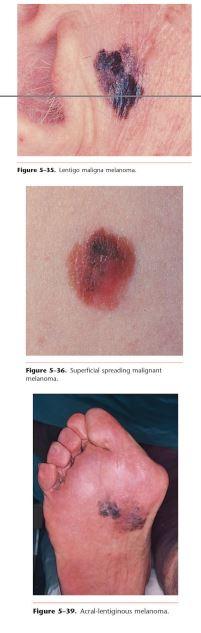
what is this?
melanoma
A biopsy from a sun-exposed skin lesion shows a malignant neoplasm of keratinocytes arising in the epidermis with local invasion into the dermis. Which diagnosis is most likely?
A. Basal cell carcinoma
B. Squamous cell carcinoma
C.
Seborrheic keratosis
D. Common wart
B. Squamous cell carcinoma
A skin lesion presents as a scaling, crusting nodule that intermittently ulcerates and bleeds. Which diagnosis is most consistent with this morphology?
A. Basal cell carcinoma
B. Squamous cell carcinoma
C.
Dermatofibroma
D. Lipoma
B. Squamous cell carcinoma
A clinician evaluates a cutaneous malignancy that developed mainly on chronically sun-exposed skin. Which diagnosis is most strongly associated with predominant development on skin exposed to sunlight?
A. Squamous cell carcinoma
B. Basal cell carcinoma
C.
Melanoma in situ
D. Psoriasis
A. Squamous cell carcinoma
A malignant skin lesion is diagnosed as a neoplasm of basal cells of the epidermis and is noted to be the most common skin malignancy. Which diagnosis is this?
A. Squamous cell carcinoma
B. Basal cell carcinoma
C.
Merkel cell carcinoma
D. Keratoacanthoma
B. Basal cell carcinoma
A pearly skin lesion with a rolled, well-defined border and a central ulcerated depression is found on the face. Which diagnosis is most likely?
A. Basal cell carcinoma
B. Squamous cell carcinoma
C.
Actinic keratosis
D. Common wart
A. Basal cell carcinoma
Which feature best distinguishes basal cell carcinoma from squamous cell carcinoma?
A. Rapid growth with frequent metastasis
B. Preference for
mucosal surfaces
C. Deep muscle invasion at onset
D. Slow
growth with rare metastasis
D. Slow growth with rare metastasis
A biopsy from a deeply pigmented skin lesion shows a malignant neoplasm of melanocytes in the epidermis. Which diagnosis is most likely?
A. Basal cell carcinoma
B. Squamous cell carcinoma
C.
Melanoma
D. Common wart
C. Melanoma
Which statement best characterizes the epidemiology and prognosis of melanoma?
A. It is uncommon and rarely fatal
B. It is common but never
metastasizes
C. It is uncommon but highly fatal
D. It is
common and always curable
C. It is uncommon but highly fatal
A dermatologist notes that melanoma incidence has been:
A.
Falling steadily for decades
B. Increasing faster than other
malignancies
C. Stable across all age groups
D. Lower than
all skin cancers
B. Increasing faster than other malignancies
Which skin finding is most consistent with the usual pigmentation pattern of melanoma?
A. Flesh-colored translucent papule
B. Uniform pink macule
only
C. Varied black, blue, brown lesion
D. Yellow waxy plaque
C. Varied black, blue, brown lesion
Which melanoma subtype is frequently seen in geriatric patients and appears in areas of sun-exposed, sun-damaged skin?
A. Nodular melanoma
B. Lentigo maligna melanoma
C.
Acral-lentiginous melanoma
D. Superficial spreading melanoma
B. Lentigo maligna melanoma
A lesion is diagnosed as the most common type of melanoma, accounting for about 70% of all cases, and appears as an irregularly colored plaque with sharp notches and variegated pigmentation. Which subtype is this?
A. Lentigo maligna melanoma
B. Nodular melanoma
C.
Acral-lentiginous melanoma
D. Superficial spreading melanoma
D. Superficial spreading melanoma
Which melanoma subtype carries an excellent prognosis if diagnosed early?
A. Superficial spreading melanoma
B. Nodular melanoma
C. Lentigo maligna melanoma
D. Acral-lentiginous melanoma
A. Superficial spreading melanoma
A dark blue-black skin lesion has grown rapidly over several months. It represents the second most common melanoma subtype, comprising about 15% of cases. Which diagnosis is most likely?
A. Lentigo maligna melanoma
B. Nodular melanoma
C.
Superficial spreading melanoma
D. Acral-lentiginous melanoma
B. Nodular melanoma
Which melanoma subtype is the most common form seen in African Americans and Asians and occurs on non-hair-bearing parts of the body?
A. Nodular melanoma
B. Lentigo maligna melanoma
C.
Acral-lentiginous melanoma
D. Superficial spreading melanoma
C. Acral-lentiginous melanoma
In white individuals, melanomas tend to occur predominantly:
A.
On the palms and soles
B. In the oral mucosa
C. In the
lower extremities and back
D. On the eyelids only
C. In the lower extremities and back
Which melanoma locations are associated with a worse prognosis than lesions on the extremities?
A. Face, ears, eyelids
B. Back, axillae, neck, scalp
C. Hands, feet, nails
D. Abdomen, chest, groin
B. Back, axillae, neck, scalp
Melanoma occurs more often after which sun-exposure pattern in fair-skinned individuals?
A. Chronic occupational sun exposure
B. Brief intense sun
exposure
C. No sun exposure
D. Night-shift light exposure
B. Brief intense sun exposure
Less than 5% of all melanomas occur in:
A. White patients
B. Asian patients
C. African-American patients
D.
Geriatric patients
C. African-American patients

Cafe-au-lait spots, contact dermatitis, lipoma, neurofibroma?
contact dermatitis

Cafe-au-lait spots, contact dermatitis, lipoma, neurofibroma?
lipoma

Cafe-au-lait spots, contact dermatitis, lipoma, neurofibroma?
Cafe-au-lait spots

Cafe-au-lait spots, contact dermatitis, lipoma, neurofibroma?
neurofibroma
A patient presents with a soft-tissue mass under the skin that feels rubbery and is composed of benign subcutaneous fat. Which diagnosis is most likely?
A. Neurofibroma
B. Lipoma
C. Dermatofibroma
D.
Sebaceous cyst
B. Lipoma
Which statement best describes a lipoma?
A. Malignant tumor of adipose tissue
B. Most common soft
tissue cancer
C. Common benign subcutaneous fat growth
D.
Epidermal proliferation of neural tissue
C. Common benign subcutaneous fat growth
A child is noted to have several flat, well-circumscribed brown patches on the trunk. Which lesion best matches this description?
A. Cafe-au-lait spots
B. Neurofibromas
C.
Lipomas
D. Telangiectasias
A. Cafe-au-lait spots
Cafe-au-lait spots result from:
A. Dermal hemorrhage
B.
Increased hyperactive melanocytes
C. Epidermal neural
proliferation
D. Subcutaneous fat hypertrophy
B. Increased hyperactive melanocytes
An adult is found to have 7 cafe-au-lait spots, each measuring 2 cm
in diameter. This finding should raise concern for:
A.
Psoriasis
B. Basal cell carcinoma
C.
Neurofibromatosis
D. Melanoma
C. Neurofibromatosis
A dermal tumor produced by focal proliferation of neural tissue with
a normal overlying epidermis is called:
A. Lipoma
B.
Neurofibroma
C. Dermatofibroma
D. Nevus
B. Neurofibroma
Which feature best distinguishes a neurofibroma from many other skin
tumors?
A. It arises from subcutaneous fat
B. The
epidermis remains normal
C. It is highly keratinized
D. It
usually ulcerates early
B. The epidermis remains normal
On palpation, cutaneous neurofibromas are typically:
A. Hard
and fixed
B. Fluctuant and tender
C. Soft in
consistency
D. Rubbery like fat
C. Soft in consistency

What is this?
contact dermatitis, tinea corporis, psoriasis, onychomycosis
psoriasis

What is this?
contact dermatitis, tinea corporis, psoriasis, onychomycosis
tinea corporis

What is this?
contact dermatitis, tinea corporis, psoriasis, onychomycosis
onychomycosis
The underlying dermis displays mild inflammation:
contact dermatitis, fungal infections, psoriasis, onychomycosis
fungal infections
A patient presents with a chronic noninfectious skin disorder that often runs in families and may also affect the joints and nails. Which condition best fits this description?
A. Psoriasis
B. Tinea corporis
C. Impetigo
D.
Contact dermatitis
A. Psoriasis
A patient with psoriasis presents with sharply demarcated plaques that are slightly raised and covered with thick scale due to excess keratin production. Which description best characterizes these lesions?
A. Vesicular plaques with crusting
B. Well-defined
hyperkeratotic plaques
C. Diffuse macular erythema
D.
Ulcerated nodular lesions
B. Well-defined hyperkeratotic plaques
A patient with psoriasis complains of severe itching and symmetric lesions. Which body locations are most characteristically involved?
A. Palms, soles, eyelids
B. Abdomen, chest, groin
C.
Elbows, knees, scalp, intergluteal cleft
D. Face, ears, neck
C. Elbows, knees, scalp, intergluteal cleft
Dermatophyte infections affecting the skin, hair, and nails most commonly belong to which genera?
A. Candida, Aspergillus, Cryptococcus
B. Trichophyton,
Microsporum, Epidermophyton
C. Histoplasma, Blastomyces,
Coccidioides
D. Malassezia, Rhodotorula, Sporothrix
B. Trichophyton, Microsporum, Epidermophyton
What does the term “tinea” specifically indicate?
A. Bacterial infection
B. Viral infection
C. Fungal
cause
D. Parasitic infestation
C. Fungal cause
A patient presents with a fungal infection in which organisms invade the nail bed. This condition is also noted to be the most common nail disorder. Which diagnosis is most likely?
A. Psoriatic nail disease
B. Onychomycosis
C.
Paronychia
D. Clubbing
B. Onychomycosis
A patient with onychomycosis notices gradual worsening of the nail over time. Which set of nail changes is most characteristic?
A. Color, structure, texture changes
B. Pulse, temperature,
sensation changes
C. Curvature, bleeding, ulceration
changes
D. Matrix, lunula, cuticle changes
A. Color, structure, texture changes
Inflammation of the nail bed in onychomycosis promotes:
A. Nail
bed atrophy and thinning
B. Hyperkeratosis and thickening
C. Matrix necrosis and shedding
D. Clubbing and sponginess
B. Hyperkeratosis and thickening
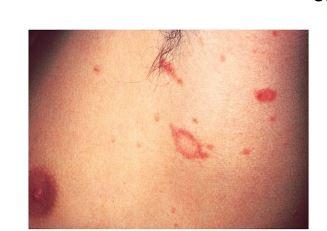
What is this?
Herpesvirus, Pityriasis rosea, Herpes zoster, Acne
Pityriasis rosea

What is this?
Herpesvirus, Pityriasis rosea, Herpes zoster, Acne
Herpes zoster

What is this?
Herpesvirus, Pityriasis rosea, Herpes zoster, Acne, tinea versicolor
Acne

what is this?
Herpesvirus, ganglion cyst, Pityriasis rosea, Herpes zoster, Acne, tinea versicolor
ganglion cyst

what is this?
Herpesvirus, ganglion cyst, Pityriasis rosea, Herpes zoster, Acne, tinea versicolor,
tinea versicolor
A 22-year-old patient presents with a common, acute, self-limiting inflammatory skin disease of unknown cause that typically appears during the spring. Which diagnosis best matches this description?
A. Pityriasis rosea
B. Herpes zoster
C. Psoriasis
D. Tinea corporis
A. Pityriasis rosea
A patient develops a widespread rash that was preceded several days earlier by a single lesion resembling tinea corporis. What is this initial lesion called?
A. Sentinel lesion
B. Herald patch
C. Primary
plaque
D. Index lesion
B. Herald patch
A patient diagnosed with pityriasis rosea asks how long the rash will last. The clinician explains that the condition usually persists for approximately:
A. 1–2 days
B. 1 week
C. 3–6 weeks
D. 3–6 months
C. 3–6 weeks
A patient presents with shingles, characterized by a painful vesicular eruption following a dermatomal distribution. Which diagnosis best fits this condition?
A. Psoriasis
B. Herpes zoster
C. Pityriasis rosea
D. Tinea corporis
B. Herpes zoster
The underlying cause of herpes zoster is the reactivation of which virus?
A. Herpes simplex virus
B. Epstein–Barr virus
C.
Varicella-zoster virus
D. Cytomegalovirus
C. Varicella-zoster virus
Herpesvirus infections are commonly encountered in which group of patients?
A. Patients with HIV infection
B. Patients with asthma
C. Patients with hypertension
D. Patients with diabetes
A. Patients with HIV infection
In patients with HIV, the presence of herpesvirus infections is thought to be:
A. Protective against opportunistic infections
B. Predictive
of future progression to AIDS
C. A marker of viral cure
D.
Unrelated to disease progression
B. Predictive of future progression to AIDS
The likelihood of herpesvirus infection becomes extremely high when CD4+ T-cell counts drop below which threshold?
A. 500 cells/mm³
B. 300 cells/mm³
C. 200
cells/mm³
D. 100 cells/mm³
D. 100 cells/mm³
Acne is best described as which type of disease?
A. Viral disease of sweat glands and sebaceous glands
B.
Pustular disease of hair follicles and sebaceous glands
C.
Fungal disease of epidermis and sebaceous glands
D. Autoimmune
disease of dermis and sebaceous glands
B. Pustular disease of hair follicles and sebaceous glands
Which lesions are considered the primary lesions in acne?
A. Vesicles, bullae, plaques
B. Pustules, papules,
comedones
C. Nodules, ulcers, scales
D. Macules,
petechiae, purpura
B. Pustules, papules, comedones
Within the dermis in acne, the hair follicle becomes occluded by a collection of:
A. Melanin, collagen, lymphocytes
B. Keratin, sebum,
inflammatory cells
C. Fibrin, platelets, erythrocytes
D.
Calcium, lipids, macrophages
B. Keratin, sebum, inflammatory cells
A patient presents with a chronic, painless lesion on the dorsum of the wrist that is fluctuant and cystic. Which diagnosis best fits this description?
A. Lipoma
B. Ganglion cyst
C. Neurofibroma
D.
Sebaceous cyst
B. Ganglion cyst
A ganglion cyst develops because of leakage of which substance through the tendon sheath of a joint capsule?
A. Lymphatic fluid
B. Synovial fluid
C. Blood
plasma
D. Interstitial fluid
B. Synovial fluid
The name “Bible cyst” originated from a historical treatment method in which clinicians attempted to rupture the cyst by:
A. Freezing the lesion with ice
B. Striking it with a Bible
or large book
C. Injecting alcohol into the cyst
D.
Compressing it with bandages
B. Striking it with a Bible or large book
When multiple small ganglion cysts appear near one another, they may look like separate lesions but are usually connected by:
A. Shared epidermal tract
B. Fibrous dermal bridge
C.
Common deep tissue stalk
D. Lymphatic channel
C. Common deep tissue stalk
A small pale red skin lesion with a pulsating central arteriole and radiating “legs” is identified on the upper chest. What is the most likely diagnosis?
A. Telangiectasia
B. Spider angioma
C. Hemangioma
D. Purpura
B. Spider angioma
Spider angiomas are most commonly found on which body areas?
A. Face, neck, arms, upper trunk
B. Lower legs and
ankles
C. Palms and soles
D. Abdomen and groin
A. Face, neck, arms, upper trunk
Spider angiomas are more commonly associated with which patient populations?
A. Children and athletes
B. Elderly men only
C.
Pregnant women and liver disease
D. Patients with kidney disease
C. Pregnant women and liver disease

Vitiligo, Scabies, Urticaria, Insect bites, Pyoderma gangrenosum, Erythema multiforme
Vitiligo

Vitiligo, Scabies, Urticaria, Insect bites, Pyoderma gangrenosum, Erythema multiforme, Karposi’s sarcoma
Urticaria

Vitiligo, Scabies, Urticaria, Insect bites, Pyoderma gangrenosum, Erythema multiforme, Karposi’s sarcoma
Erythema multiforme
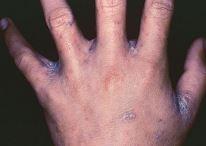
Karposi’s sarcoma, Vitiligo, Scabies, Urticaria, Insect bites, Pyoderma gangrenosum, Erythema multiforme, Norwegian scabies
Scabies

Vitiligo, Scabies, Urticaria, Norwegian scabies, Insect bites, Pyoderma gangrenosum, Erythema multiforme, Karposi’s sarcoma
Norwegian scabies

Vitiligo, Scabies, Urticaria, Norwegian scabies, Insect bites, Pyoderma gangrenosum, Karposi’s sarcoma, Erythema multiforme
Pyoderma gangrenosum

Vitiligo, Scabies, Urticaria, Karposi’s sarcoma, Norwegian scabies, Insect bites, Pyoderma gangrenosum, Erythema multiforme
Insect bites

Vitiligo, Scabies, Urticaria, Karposi’s sarcoma, Norwegian scabies, Insect bites, Pyoderma gangrenosum, Erythema multiforme
Karposi’s sarcoma
Vitiligo lesions are best described morphologically as:
A. Large macules that are totally depigmented
B. Raised
vesicles with scaling
C. Nodular plaques with erythema
D.
Small papules with crusting
A. Large macules that are totally depigmented
A patient with urticaria develops transient wheals after exposure to an allergen. Which mechanism most directly causes the dermal edema seen in this condition?
A. Keratin overproduction in epidermis
B. Release of
histamine increasing vascular permeability
C. Decreased dermal
blood flow
D. Increased melanocyte activity
B. Release of histamine increasing vascular permeability
A patient develops an immunologic skin reaction with lesions triggered by infection or medications. The rash contains several lesion types including papules, bullae, plaques, and distinctive target-shaped lesions. Which diagnosis best fits this presentation?
A. Psoriasis
B. Erythema multiforme
C. Tinea
corporis
D. Urticaria
B. Erythema multiforme
Erythema multiforme:
A. Intraepidermal vesicle separation with papillary
inflammation
B. Dermal fibrosis separation with papillary
inflammation
C. Subepidermal separation with papillary
inflammation
D. Hyperkeratosis separation with papillary inflammation
C. Subepidermal separation with papillary inflammation
The condition involves mucous membranes and represents the most severe form associated with erythema multiforme. What is this condition called?
A. Toxic epidermal necrolysis
B. Stevens–Johnson
syndrome
C. Pemphigus vulgaris
D. Bullous pemphigoid
B. Stevens–Johnson syndrome
Scabbies physical finding?
A. Vesicular plaque
B. Linear ulcer
C. Burrow
D.
Hyperkeratotic scale
C. Burrow
symptoms appear faster in norweigen or normal scabbies?
norweigen
norweigen scabbies has (less/more) itching than normal scabbies?
less
Neglected personal hygiene & impaired immune system lead to:
A. Psoriasis
B. Erythema multiforme
C. Tinea
corporis
D. Norweigen Scabbies
D. Norweigen Scabbies
Pyoderma gangrenosum is associated with what gastric issue?
IBS
Pyoderma gangrenosum: male or female more?
female
The classic form of the disease is a RARE, slow-growing neoplasm occurring mostly on the lower extremities:
Vitiligo, Scabies, Urticaria, Karposi’s sarcoma, Norwegian scabies, Insect bites, Pyoderma gangrenosum, Erythema multiforme
Karposi’s sarcoma
More common in older men of Mediterranean or Jewish eastern European descent:
Vitiligo, Scabies, Urticaria, Karposi’s sarcoma, Norwegian scabies, Insect bites, Pyoderma gangrenosum, Erythema multiforme
Karposi’s sarcoma
true or false: Some patients with classic KS may develop another type of cancer before the KS lesions appear or even later in life
true
true or false: The risk of developing KS is closely linked to the CD8+ count.
false
cd4+
KS: Average length of patient survival from the onset of the disease is ____ months
18

Erythema nodosum, Scleroderma, Lichen planus, Seborrheic warts, Seborrheic dermatitis
Seborrheic dermatitis

Erythema nodosum, Scleroderma, Lichen planus, Seborrheic warts, Seborrheic dermatitis
Erythema nodosum

Erythema nodosum, Scleroderma, Lichen planus, Seborrheic warts, Seborrheic dermatitis
Lichen planus

Erythema nodosum, Scleroderma, Lichen planus, Seborrheic warts, Seborrheic dermatitis
Seborrheic warts

Erythema nodosum, Scleroderma, Lichen planus, Seborrheic warts, Seborrheic dermatitis
Scleroderma
A patient with progressive systemic sclerosis develops skin tightening and multiorgan involvement due to the fundamental pathologic process underlying the disease. Which change best explains the symptoms of scleroderma?
A. Buildup of collagen in skin and organs
B. Loss of elastin
in epidermis only
C. Acute neutrophilic dermal
infiltration
D. Keratin accumulation within follicles
A. Buildup of collagen in skin and organs
A woman with long-standing scleroderma is found to have stony-hard nodules in the soft tissues of her hands. Which process best explains this finding?
A. Fat necrosis
B. Soft tissue calcification
C.
Granuloma formation
D. Fibrous cyst formation
B. Soft tissue calcification
In scleroderma, which vascular abnormality is most associated with visceral involvement?
A. Large-vein thrombosis and small artery changes
B.
Lymphatic obstruction and small artery changes
C. Microvessel
and small artery changes
D. Capillary hemangioma formation and
small artery changes
C. Microvessel and small artery changes
A patient presents with tender erythematous subcutaneous nodules that are symmetrically distributed on both shins. Which diagnosis is most likely?
A. Erythema nodosum
B. Urticaria
C. Psoriasis
D. Cellulitis
A. Erythema nodosum
The pathogenesis of erythema nodosum is most strongly associated with which immune mechanism?
A. Type I immediate hypersensitivity
B. Type II
antibody-mediated injury
C. Type III immune complex
deposition
D. Type IV delayed hypersensitivity
D. Type IV delayed hypersensitivity
A patient with erythema nodosum develops lesions that are initially flat, firm, hot, red, and painful. Which description best matches the early morphology?
A. Flat firm hot painful lumps
B. Flaccid vesicles with
crusting
C. Pearly papules with ulceration
D. Soft nodules
with pitting
A. Flat firm hot painful lumps
After appearing, lesions of erythema nodosum typically begin to regress after:
A. 1 to 2 days
B. 1 to 2 weeks
C. 3 to 6 weeks
D.
2 to 3 months
B. 1 to 2 weeks
Patient usually experiences severe pain as the lesions ulcerate:
Erythema nodosum, Scleroderma, Lichen planus, Seborrheic warts, Seborrheic dermatitis
Lichen planus
greasy-looking scale in a seborrheic distribution, associated with HIV infection:
Erythema nodosum, Scleroderma, Lichen planus, Seborrheic warts, Seborrheic dermatitis
Seborrheic dermatitis
failure of keratinocytes to mature normally:
Erythema nodosum, Scleroderma, Lichen planus, Seborrheic warts, Seborrheic dermatitis
Seborrheic warts
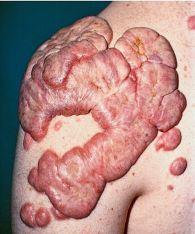
nelvi, keloid, Pemphigus vulgaris, Atopic dermatitis, Bullous pemphigoid, Erythema migrans, Bullous diabeticorum
keloid

nelvi, keloid, Pemphigus vulgaris, Atopic dermatitis, Bullous pemphigoid, Erythema migrans, Bullous diabeticorum
Nevi

nelvi, keloid, Pemphigus vulgaris, Atopic dermatitis, Bullous pemphigoid, Erythema migrans, Bullous diabeticorum
Pemphigus vulgaris

nelvi, keloid, Pemphigus vulgaris, Atopic dermatitis, Bullous pemphigoid, Erythema migrans, Bullous diabeticorum
Bullous pemphigoid

nelvi, keloid, Pemphigus vulgaris, Atopic dermatitis, Bullous pemphigoid, Erythema migrans, Bullous diabeticorum
Atopic dermatitis

nelvi, keloid, Pemphigus vulgaris, Atopic dermatitis, Bullous pemphigoid, Erythema migrans, Bullous diabeticorum
Erythema migrans

Tuberous sclerosis, Anthrax, Bullous diabeticorum, Cutaneous larva migrans, Smallpox
Bullous diabeticorum

Tuberous sclerosis, Anthrax, Bullous diabeticorum, Cutaneous larva migrans, Smallpox
Anthrax

Tuberous sclerosis, Anthrax, Bullous diabeticorum, Cutaneous larva migrans, Smallpox
Cutaneous larva migrans

Tuberous sclerosis, Anthrax, Bullous diabeticorum, Cutaneous larva migrans, Smallpox
Tuberous sclerosis

Tuberous sclerosis, Anthrax, Bullous diabeticorum, Cutaneous larva migrans, Smallpox
Smallpox
hyperproliferative response of fibrous tissue to injury,
inflammation, or
infection:
nelvi, keloid, Pemphigus vulgaris, Atopic dermatitis, Bullous pemphigoid, Erythema migrans, Bullous diabeticorum
keloid
Disease is caused by the production of antibodies to the
intercellular
junctions of the epidermis
nelvi, keloid, Pemphigus vulgaris, Atopic dermatitis, Bullous pemphigoid, Erythema migrans, Bullous diabeticorum
Pemphigus vulgaris
No racial predilection, & the disease is NOT as serious as pemphigus
nelvi, keloid, Pemphigus vulgaris, Atopic dermatitis, Bullous pemphigoid, Erythema migrans, Bullous diabeticorum
Bullous pemphigoid
form of eczema; common disease associated with other
atopic
diseases such as asthma & allergic rhinitis:
nelvi, keloid, Pemphigus vulgaris, Atopic dermatitis, Bullous pemphigoid, Erythema migrans, Bullous diabeticorum
Atopic dermatitis
many patients have elevated levels of serum IgE:
nelvi, keloid, Pemphigus vulgaris, Atopic dermatitis, Bullous pemphigoid, Erythema migrans, Bullous diabeticorum
Atopic dermatitis
occurs in patients with long-standing diabetes:
Tuberous sclerosis, Anthrax, Bullous diabeticorum, Cutaneous larva migrans, Smallpox
Bullous diabeticorum
Topical application of thiabendazole is the treatment:
Tuberous sclerosis, Anthrax, Bullous diabeticorum, Cutaneous larva migrans, Smallpox
Cutaneous larva migrans
rapid progression of high fever, severe respiratory distress,
&
cardiovascular collapse:
Tuberous sclerosis, Anthrax, Bullous diabeticorum, Cutaneous larva migrans, Smallpox
Anthrax
distinctive erythematous, vesicular rash, centrifugal in distribution:
Tuberous sclerosis, Anthrax, Bullous diabeticorum, Cutaneous larva migrans, Smallpox
Smallpox