AS Math Pure Maths Flash Cards
Complete the square, 2 ways
x2+ 6x + 22
Like normal half bx and then take away or add whats necessary, where (x+3)squared and then + or - n to match equation.
Shortcut for this is the formula. (x+b/2)squared - (b/2)squared
*if there is a coefficient in front of x2 then factorise the x2 + 6x part, solve and then multiply it all again. Then add the +22
For a quadratic function how to sketch a graph and find turning point. and cubics
If coefficient of x2 is positive, the graph will be a positive U-shaped curve and vice versa.
Find y and x intercepts by making x and y 0 in the equation.
Find the turning point by either: using the equation x = -b/2a from the equation. This gives x and to find y sub value of x in original equation. If a is positive it is a min point, and if negative then max point. The original equation is y = ax2 + bx + c.
or complete the square to form a(x+p)2 + q where the coordinate are (-p, q)
For a cubic its the same thing however 3 set of brackets to find 3 values of x. and then make x zero to find y.
*When x is large and positive, y is large and negative and vice versa when negative leading coefficient. When positive. Large positive x → large positive y and vise versa. This is basically the slope direction. it tells you whether its going up or down and how much at certain point for exponential curve.
Discriminant formula and rules
b2 - 4ac
If greater than zero quadratic graph will cross the x - axis twice.
If zero only once, if less then 0 times resulting in no solutions for x.
If the discriminant is a square number x will be 2 rational numbers.
Inequalities equations and on graph rules
Write equations like -2<x<5. If you divide or multiply both sides by a negative reverse the sign.
For a line graph or a quadratic with an equation in form y= - when y is greater shade above the parabola and when y is less shade below.
For quadratic when you in form x= - if x is greater than shade outside the roots of x and if x is smaller shade inside.
Midpoint of a line and distance between two points (length of line segment)
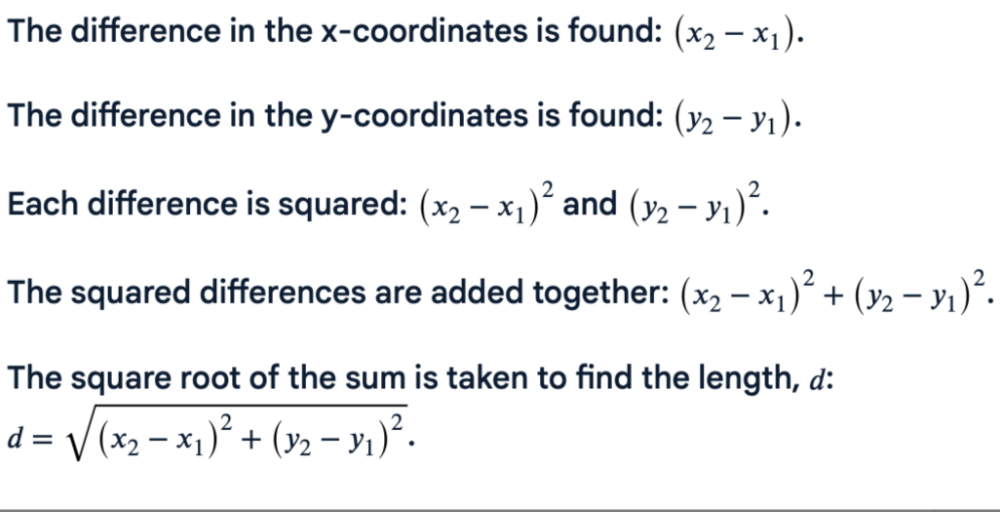
the midpoint is found by finding the mean of x and y. add the x coordinates together and divide by 2 to find the new x coordinate and same for y.
To find equation for perpendicular line using x and y points and gradient.
Find the negative reciprocal and sub into formula where y1 and x1 are the x and y coordinates:
y-y1 = gradient (x-x1)
When doing it to find the tangent line equation where centre of circle is zero and given a point. Find gradient from 0 to the point, fill in point as x and y.
Different types of curves based off equations
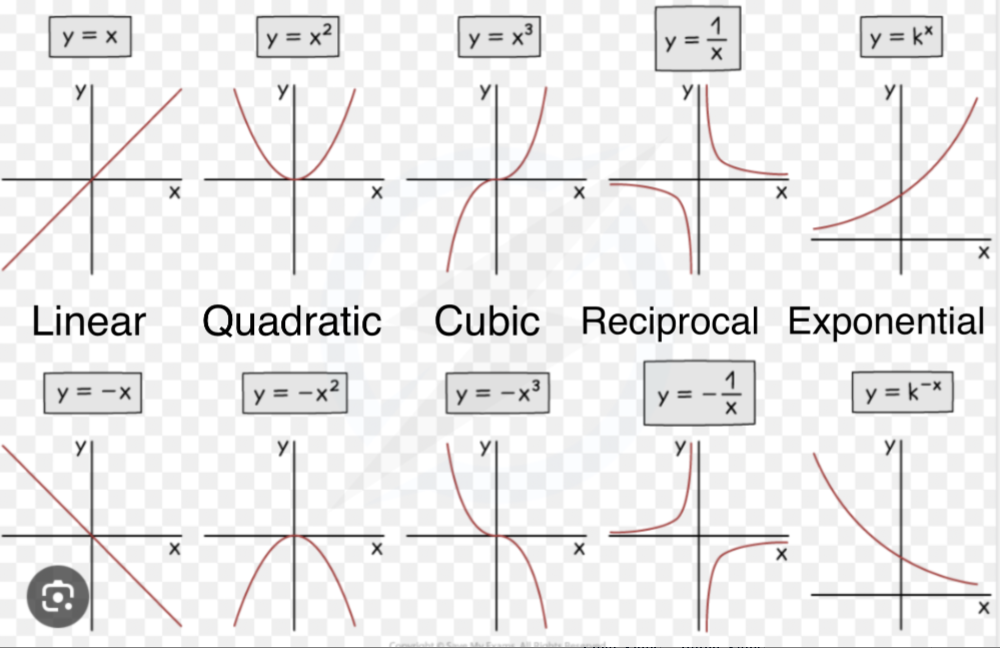
Exponential curve rules
y = xn
When n is an even integer the curve is more than zero and when odd its less.
if n is bigger then it will go above the curve where n is smaller.
For a recipricoral function how to sketch a graph and find the asymptotes. reciprocal rules.
standard form equation is y = a/x + q
when a is negative the graph will be top left and bottom right and vice versa.
The graph will intercept x if q is not equal to 0. To find the x intercept make y = 0 and find for x in the above equation.
One asymptote is the y axis and the other is equal to y = q
for k/xn form when k is positive constant, if n is odd then curves will be diagonal across each other, when n is even then they will be opposite.
Inverse proportion
Inverse proportion = The statement A is inversely proportional to is written:
A ∝ 1/B then to solve replace 1 with the constant.
Find the 2 points that the diameter goes between when give 3 points on a circle.
Option 1 ; find the lengths between each point and with pythagorus theorem, two lengths squared that = third length squared, the third is the diameter.
Option 2: find gradient of each line. Two lines gradients will multiply to -1, the diameter is the one that doesn't.
Equation of a circle.
equation at centre (0.0) = x2 + y2 = radius2
general equation anywhere = radius2 = (x-a)2 + (y-b)2 where (a,b) is the centre of the circle and (x,y) is a point on the circumference.
To see if it passes through a point sub x and y of that point in and see if it adds up.
Sequences definitions and types. Periodic, arithmetic, geometric. Fibonacci numbers, triangle numbers, natural numbers.
A periodic sequence repeats itself regularly. The number of terms before the sequence repeats is called the period. An example of a periodic sequence is the sequence 5,7,−1,3,5,7,−1,3,5,7,... This has period 4.
An arithmetic sequence has the same difference between each term and the next term. (common difference) This difference can be positive or negative. An example of an arithmetic sequence is 8,5,2,−1,... This has a difference of −3
A geometric series has the same ratio between each term and the previous term.
A Fibonacci sequence is a series of numbers where each number is the sum of the two preceding ones.
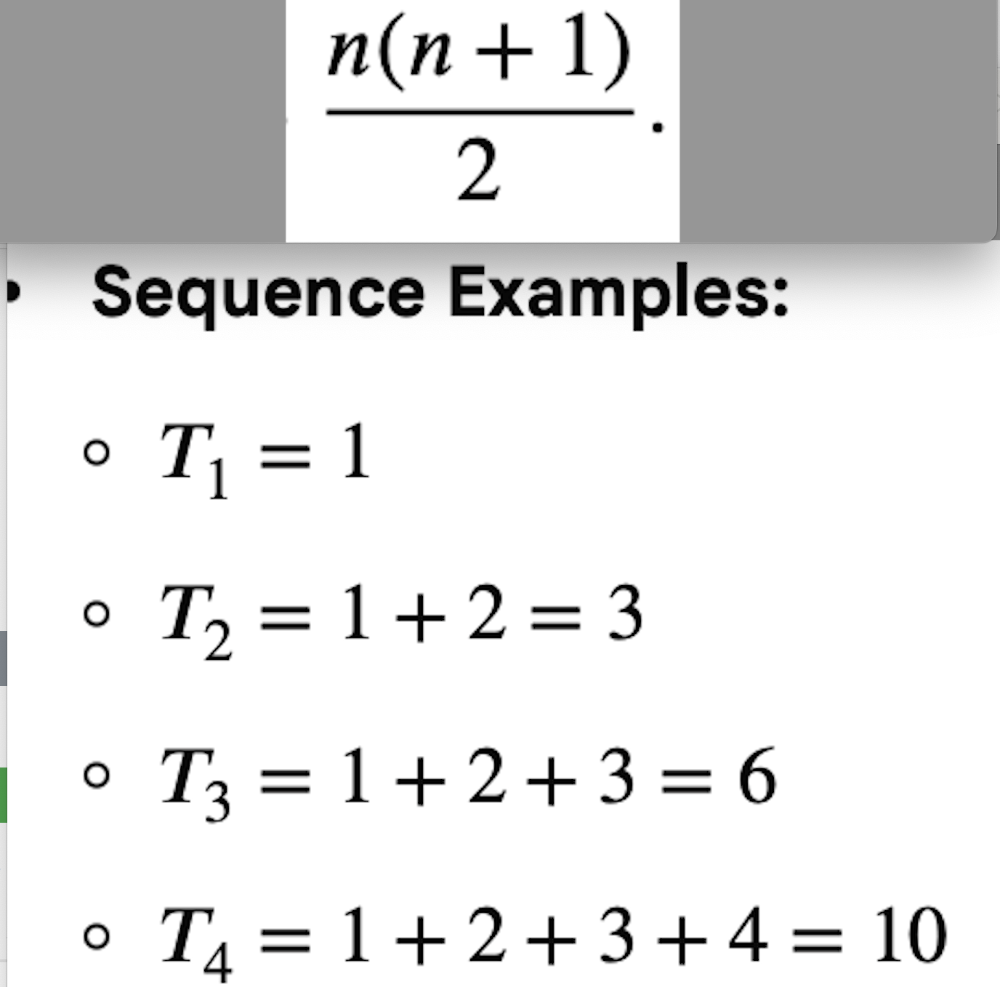
Triangle numbers represent dots arranged in rows, where each row has one more dot than the previous one, forming a triangle.
Natural numbers are the counting numbers 1,2,3,4,5...
Sigma notation
Represents the sum of a sequence within a range. equation is to the right, At the bottom is the starting integer and the end is at the top, add up values in between.
Inductive vs deductive
Deductive is the direct formula to find a value of the sequence, the term to term role.
Inductive is the formula to get the next value in the sequence. a is the start number and put k as the value of the previous term to the one we are finding.
formula to find sum of sequences, infinity and value of term for geometric. plus logarithms
for arithmetic
Sn = n/2( 2a + (n + 1 ) d) or if we know the last term of the sequence L
Sn = n/2 ( a + L)
The Sn for natural numbers = n(n+1)/2
for geometric - ratio is r, first term a. kth term = ark-1
when r is over 1 = a(rn - 1) / r-1
when r below 1 = a(1-rn ) / 1-r
can find sum of infinity when r is a fraction -
a / 1-r
When solving for n use logarithm to bring it down.
say have 0.9n < 0.37 become n x log(0.9) > log (0.37) then solve with calculator. (this < sign was reversed as 0.9 is less than 1)
Binomial expansions
eg. (x+2)3 the x terms will be going down gradually. x3 x2 x and 1. To decode the coefficients the second term in bracket in this case 2, which has the power of whatever is needed to make the two powers add up to 3 or whatever the exponent is. This figure is multiplied by the corresponding numbers from the row pascals triangle (as exponent is 3, will be third row).
Always starts and ends in 1. other numbers are the two numbers above added together.
To find the pascal triangle to fit in without drawing triangle for each use equation - n! / r! x (n/r)!
n is the power of the equation and r is power of second figure in bracket.
transformation equations from y=f(x) curve
For f(x+a), f(x-a), f(x)+a, and f(x)-a moves either y or x up or down. When the negative is outside the bracket it gets taken from y. and when it's inside it gets added to x, and vise versa. (normal for y outside, opposite for x always inside)
for y=f(ax) it stretches x by 1/a and for and y = af(x) it stretches y by a. so sub x/a or ay into new equation.
-f(x) is a refection on the x axis and f(-x) is a reflection across your axis.
To differentiate with fractions and roots also
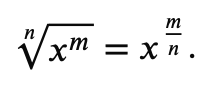
multiply coefficient by the power snd the way 1 from the power. nxn-1
for roots first rewrite with coefficient and if the root is the denominator just write it as a negative or vise versa if already negative.
how to find stationary points on a cubic graph and if max or min
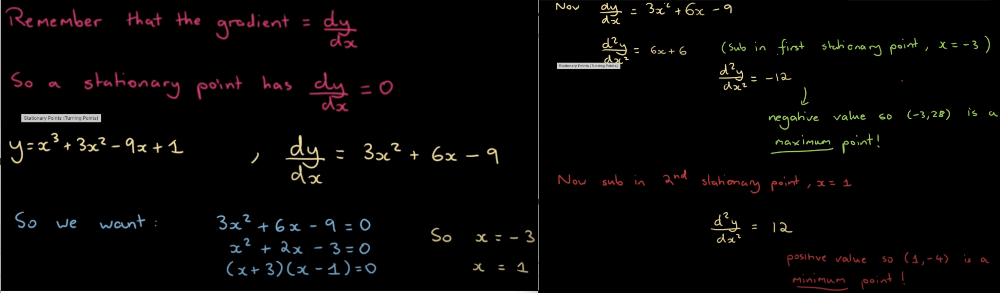
at stationary point dy / dx = 0 so differentiate the equation to find its new version and sub y for zero to find the values for x. then sub x into original equation to find y. 42 second differential when finding max and min points on a cubic graph card image first differentiate once, then do it a second time to find the new equation. Into the new equation sub the stationary point value for x and if it is positive it is the minimum point.
approximate average curve gradient by adding h. to find the limit
f stands for the curve equation
f(x+h) - f(x) / h
to get add h to the point for x you are given and put it into the equation. and then take away just the point x in the equation. and then divide h on bottom.
the chain rule
for differentiating function in a function . differentiate the outside then multiply it by derivative of inside.
(x2 + 1)3 becomes 3(x2 + 1)2 x by 2x
formula like dV/dt= dV/Dx x Dx/dt the Dx's cancel out to give dV/dt. in this case V is for volume and t for time so it is to get volume change but can do for any with same cancel out principal.
Integration formula
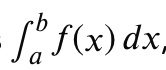
reverse of differentiation
formulas (1 / n + 1) xn+1 + c
Put in x and n is the number over xn when given that figure. Solve for c from the rest of equation ie. 3 + c = 2
The symbol f with an and b shows range. put in b and an into equation and take a figure from b figure. the x is the expression being integrated. Use this to find the area of a curve and to get an and b factorise the curve equation to get the values of x. when for two lines that intersect find x points where the lines intercept.
Integration to find curve areas
For shaded area between curve and line. Find point they intercept and use this for range. Calculate the range of each line to get area of each, and then subtract one value form area to get shaded area. usually take away from whichever is higher, can figure this out by subbing in random number for x and seeing which value is higher.
Volumes of integration
If region on a curve between x=a and x=b rotated 360 around x axis. formula is
π abf(y2)dx so if curve y = x2 from x=0 and x=2 f2 0 (x4)dx (dx means integrated)
is rotates around y axis same idea but need to turn y=x2 to make x the subject.
formula is π abf(x2)dx so if equation formula y=x-2then x=y+2 and (y+2)2 = x2
finding lengths of edges of triangle in centre of unit circle using trig
For side adjacent to angle - Cos(the angle) x hypotenuse (always 1 for unit circle)
For opposite - sin(the angle) x hypotenuse.
tan is sin(angle) / cos(angle)
to get other answers as can be multiple. for sin 180-x, for cos 360-x, for tan 180 + x
solving trig equations
solve the equation then put it into trig formula and then use to get other answers as can be multiple. for sin 180-x, for cos 360-x, for tan 180 + x to get other answers.
for example sin2x = 0.4 then sinx = 0.2 so do sin-1(0.2)
radians and length of arc and area
a radian is equal to 2pie half a semi circle is equal to 1 pie and 180 degrees.
convert using formula radians = degree x pie/180
arc - s = ro (s is length , r is radius, o is angle in radians.
area - 1/2 r2 o