Treatment delivery 1
Standard wedges are used to:
A.Modulate the beam intensity across the field
B.Scatter the raw electron beam across the treated area
C.Monitor the dose rate and beam symmetry
D.Tilt isodose lines so that the dose is adequately distributed throughout the target volume
D. Tilt isodose lines so that the dose is adequately distributed throughout the target volume
Patients treated while sitting upright are limited to treatment of the:
A.Pelvis
B.Whole abdomen
C.Upper torso
D.Extremities
c. Upper torso
Bite block systems may be used in head and neck irradiation for the purpose of :
A.Reducing the volume of oral mucosa in treatment fields
B.Facilitating easier breathing during treatment
C.Protecting the teeth from secondary radiation
D.Keeping the patient’s mouth open
A.Reducing the volume of oral mucosa in treatment fields
Which of the following best describes a four-field box technique?
A.Usually used when treating the head and neck
B.Fields are arranged 180° apart
C.The beams consist of AP, PA, Rt. lat, and Lt. lat
D.All of the above are correct
c. The beams consist of AP, PA, Rt. lat, and Lt. lat
When constructing a head cast in simulation, it is important to:
A.Make sure the head is in the position that the physician requested before making cast.
B.Use the headrest that the patient thinks is the most comfortable
C.When treating the neck, use a solid headrest for patient comfort
D.All of the above are important to follow
A.Make sure the head is in the position that the physician requested before making cast.
The purpose of an immobilization device is to:
A.Make the patient comfortable
B.Aid in reproducing and maintain the position
C.Help the therapist to deliver correct dose
D.All of the above
B.Aid in reproducing and maintain the position
IMRT allows for:
1.Increased dose to tumor
2.Decreased dose to tumor
3.Increased dose to healthy tissue
4.Decreased dose to healthy tissue
1.Increased dose to tumor
4.Decreased dose to healthy tissue
The use of dynamic multi-leaf collimation is an important component of:
A.Reverse Treatment Delivery
B.Intensity Modulated Radiation Therapy
C.Digital Reconstruction of Images
D.Noncoplanar Treatment Delivery
B.Intensity Modulated Radiation Therapy
Which of the following is a principal advantage of IMRT over conventional 3D conformal therapy?
A.Fewer long term side effects
B.Better dose distribution to the tumor volume
C.Better normal tissue sparing
D.All of the above are advantages
D.All of the above are advantages
A patient is treated isocentrically, with opposing fields, on an 80 cm SAD 4 MV linear accelerator. The original setup was for midplane treatment at a depth of 10 cm. You recheck SSDs and note that the SSD for field #1 is 71 and the SSD for field #2 is 73. What is the new patient separation?
A.16 cm
B.20 cm
C.24 cm
D.10 cm
A.16 cm
80-71=9 cm
80-73=7 cm
Patients undergoing irradiation for breast cancer can be
positioned:
1. supine
2. lithotomy
3. prone
4.
lateral oblique
A.1
B.1, 3
C.1, 3, 4
D.1, 2, 3, 4
C.1, 3, 4
The physicist has completed monthly calibrations and discovers that the dose rate has been 248 MU/minute instead of the intended 250 MU/minute for the past month. This means that all patients treated within that time have received:
A.2 more monitor units than calculated
B.2 less monitor units than calculated
C.The intended dose over a longer time per fraction
D.The intended dose over a shorter time per fraction
C.The intended dose over a longer time per fraction
Which of the following is not a way to move small bowel out of a pelvis field:
A.Use a belly board
B.Placing the patient prone
C.Having the patient drink contrast before treatment
D.Treating with a full bladder
C.Having the patient drink contrast before treatment
In proton treatment, the dose distribution spikes at a depth that corresponds to the initial energy of the treatment beam. The sudden change in dose distribution is called the:
A.Buildup
B.Dose Maximum
C.Dose Falloff
D.Bragg Peak
D.Bragg Peak
When treating a prostate cancer patient, which immobilization devices would be appropriate?
1.Alpha cradle
2.Foot/toe block
3.Wing board
4.Vac-lok bag
Alpha cradle
Foot/toe block
Vac-lok bag
During administration of dose, the patient should be closely monitored for:
A.Patient comfort
B.Psychological Support
C.Treatment Accuracy
D.Documentation
C.Treatment Accuracy
In which of the following diseases is it important to include regional lymphatics?
A.T1 glottic larynx carcinoma
B.GBM
C.Nasopharynx carcinoma
D.Osteosarcoma of the femur
C.Nasopharynx carcinoma
Why should a patient’s arms be positioned above his/her head during radiation treatments of a primary lung cancer?
A.Patient comfort
B.Avoid treating normal tissue
C.Capture an additional device charge
D.Physician preference
B.Avoid treating normal tissue
When simulating a breast patient, you could utilize all of the following immobilization devices, except?
- Wing board
- Breast slant board
- Vac-Lok bag
- Aquaplast head holder
D. Aquaplast head holder
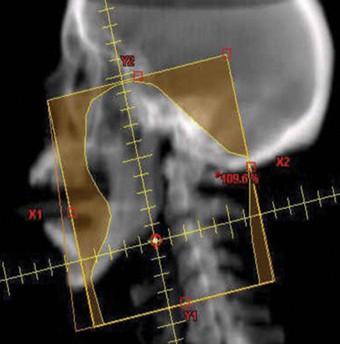
The digitally reconstructed radiograph shown is likely the initial treatment field for treatment of the:
A.Hypopharynx
B.Base of Tongue
C.Nasopharynx
D.Supraglottic Larynx
C.Nasopharynx
The DRR shown is likely for treatment of a nasopharyngeal carcinoma with margin on the nasopharynx and inclusion of jugulodigastric, submandibular, mid jugular, and posterior cervical lymphatics.