Shock and Sepsis Chapter 14
Which abnormal laboratory finding would be indicative of disseminated intravascular coagulation (DIC) associated with septic shock?
Increased platelet count
Decreased D-dimer levels
Short prothrombin time
Decreased amount of fibrinogen
Decreased amount of fibrinogen
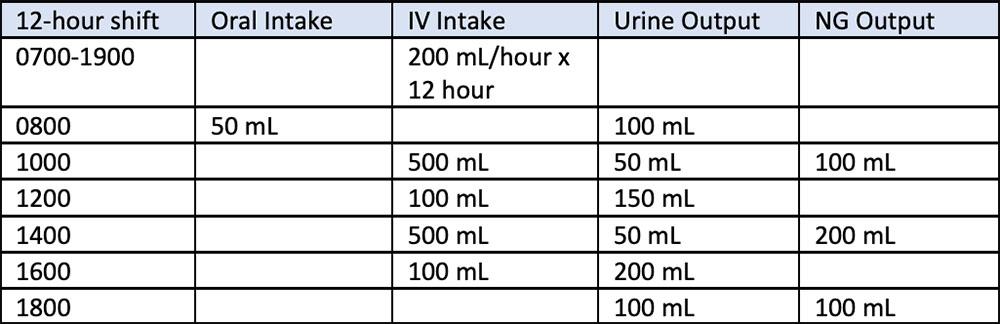
The nurse is calculating the shift intake for an unstable patient who is in septic shock. What is the final intake total? Enter the numeral only.
3650
While caring for a patient with burns and excessive loss of fluids, the nurse is concerned that the patient is in the compensatory stage of shock. Which assessment finding would cause the nurse to think this? Select all that apply.
Anuria
Cool, pale skin
Lethargy
Weak pulses
Hypotension
Cool, pale skin
Weak pulses
Which statement would accurately describe the role of aldosterone during shock states?
Aldosterone is released when blood pressure is too high.
Aldosterone causes an increased excretion of sodium.
Aldosterone results in water retention to increase blood pressure.
Aldosterone causes glucose to be released by the body for energy.
Aldosterone results in water retention to increase blood pressure.
The nurse is caring for a patient in the emergency department who has been admitted for septic shock as a result of a urinary tract infection. The patient weighs 187 pounds. How many milliliters per hour of lactated Ringer’s would the nurse administer over the next 3 hours? Record as a whole number.
850
Which physiologic change would result in increased cardiac output?
Decreased contractility
Increased afterload
Decreased heart rate
Increased preload
Increased preload
The nurse identifies that a patient in cardiogenic shock has poor cardiac contractility. What medication should the nurse request from the provider?
Dobutamine
Nitroglycerin
Phenylephrine
Vasopressin
Dobutamine
The trauma nurse is preparing to care for a patient who was involved in a motor vehicle accident and has massive blood loss. Which item should the nurse have prepared in the room before the patient arrives? Select all that apply.
IV start kits with 20-gauge needles
Bags of 0.9% NaCl
Central venous catheter insertion kit
High-flow oxygen delivery devices
Intubation equipment
Bags of 0.9% NaCl
Central venous catheter insertion kit
High-flow oxygen delivery devices
Intubation equipment
The nurse observes that a patient is in the late stage of septic shock. Which assessment supports the nurse’s conclusion?
Temperature of 101.2ᵒF (38.4ᵒC)
Lethargy and coma
Bounding pulses
Warm, flushed skin
Lethargy and coma
The nurse is assessing a patient at risk for shock. Vital signs include: Temperature 97.8ᵒF (36.5ᵒC), HR 87 beats per minute, respirations 16 breaths per minute, blood pressure 110/75, oxygen saturation 95%. Which stage of shock do these vital signs reflect?
Initial stage
Refractory stage
Progressive stage
Compensatory stage
Initial stage
When assessing the cardiovascular system of a patient experiencing hypovolemic shock, which assessment finding would the nurse anticipate?
Hypertension
Bradycardia
Wide pulse pressure
Weak, thready pulses
Weak, thready pulses
The nurse is caring for a postoperative patient after a ruptured spleen was removed. Which assessment change is most concerning?
Hypertension
A bulb drain in the lower abdomen with 50 mL serous fluid
Jugular venous distention with the head of the bed at a 45-degree angle
A central venous pressure (CVP) of 1 cm H2O
A central venous pressure (CVP) of 1 cm H2O
The nurse is caring for an older adult patient admitted a week ago with pneumonia and a urinary tract infection. Blood cultures were positive upon admission, and the patient has been unstable since admission. The nurse notes that the serum creatinine and liver enzymes are increasing. Which conclusion can be made?
The infection is worsening and has spread to other organs.
The patient’s condition has stabilized.
The patient is developing complications from the sepsis.
Treatments have been effective.
The patient is developing complications from the sepsis.
The nurse is talking to a critical patient’s family about hypovolemic shock. Which statement made by the significant other indicates an understanding of the teaching? Select all that apply.
“Hypovolemic shock can occur from severe blood loss or fluids.”
“Vomiting is the most common cause of hypovolemic shock.”
“If dehydration is treated quickly, shock can be prevented.”
“If he had taken antibiotics as prescribed, shock would not have occurred.”
“I should have taken him to the hospital when he first became confused.”
“Hypovolemic shock can occur from severe blood loss or fluids.”
“If dehydration is treated quickly, shock can be prevented.”
“I should have taken him to the hospital when he first became confused.”
Which hemodynamic alteration would the nurse expect when caring for a patient diagnosed with cardiogenic shock resulting from myocardial infarction?
Increased central venous pressure
Increased cardiac output
Bradycardia and hypotension
Decreased systemic vascular resistance
Increased central venous pressure
When caring for a patient diagnosed with severe cardiogenic shock whose family has decided to withdraw life support, which nursing intervention would be appropriate?
Administer pain medications on a set schedule.
Continue obtaining blood samples in case the family changes their mind.
Titrate vasopressor medications to maintain blood pressure within set parameters.
Educate the family members about the dying process.
Educate the family members about the dying process.
The nurse is admitting a patient with severe diarrhea related to Clostridium difficile colitis. Which type of shock is the patient at the greatest risk for?
Obstructive shock
Distributive shock
Cardiogenic shock
Hypovolemic shock
Hypovolemic shock
While treating a patient, the nurse finds that the patient has extensive shunting of blood away from nonessential organs. The patient shows symptoms of lethargy and has severe metabolic acidosis. Which stage of shock is the patient experiencing?
Progressive
Compensatory
Initial
Refractory
Progressive
The healthcare provider is administering spinal anesthesia to a patient before surgery. Which assessment change is most concerning?
Heart rate of 52 beats per minute
Blood pressure of 135/78 mm Hg
SvO2 of 65%
Central venous pressure (CVP) of 8 cm H2O
Heart rate of 52 beats per minute
Which physical assessment finding will the nurse report during hand-off when the patient is in the compensatory stage of shock?
Bradypnea
Oliguria
Hypertension
Decreased cardiac output
Oliguria
Which abnormal laboratory finding would help the nurse confirm a suspected diagnosis of septic shock?
Lactate 1.8 mg/dL
Serum pH 7.51
PaCO2 40 mm Hg
Blood urea nitrogen (BUN) 18 mg/dL
Serum pH 7.51
The nurse is caring for a patient in cardiogenic shock after a cardiac arrest. The patient is placed on an intra-aortic balloon pump (IABP). The chest x-ray shows that the tip of the catheter is just below the aortic arch, about 2 cm from the left subclavian artery. Which action should the nurse take?
Have the chest x-ray repeated for better visualization.
Confirm that the catheter is secured in that location.
Call the provider to adjust the catheter placement.
Confirm the waveform demonstrates accurate placement.
Confirm that the catheter is secured in that location.
The nurse is caring for a patient receiving a continuous infusion of dobutamine for the treatment of cardiogenic shock. Which assessment is the priority for the nurse to perform?
Potassium levels
Respiratory status
Chest pain level
Urine output
Potassium levels
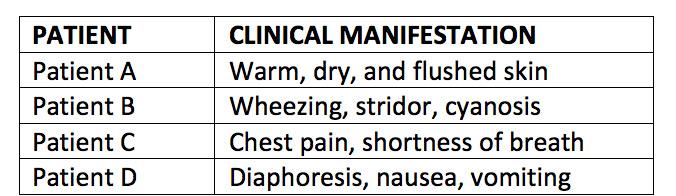
The nurse received a hand-off report on each of these four patients. Which patient is demonstrating signs of anaphylactic shock?
Patient A
Patient B
Patient C
Patient D
Patient B
The nurse is treating a patient who received burns over 40% of his lower body in a flash fire incident 2 hours ago. Which order is the highest priority in the first 30 minutes? Select all that apply.
Obtain blood cultures
Administer vasopressors
Initiate broad-spectrum antibiotics
Measure central venous pressure (CVP)
Measure lactate levels
Obtain blood cultures
Initiate broad-spectrum antibiotics
Measure lactate levels
Arrange the order of progression of septic shock.
- Late septic shock
- Multiorgan dysfunction syndrome
- Sepsis
- Early septic shock
- Systemic inflammatory response
- Infection
1.Infection
2.Systemic inflammatory response
3.Sepsis
4.Early septic shock
5.Late septic shock
6.Multiorgan dysfunction syndrome
The nurse is teaching a student nurse about the different kinds of shock and asks the student to list a cause of obstructive shock. Which example by the student nurse would be correct?
Anaphylaxis
Gastrointestinal bleeding
Neurogenic shock
Pulmonary embolism
Pulmonary embolism
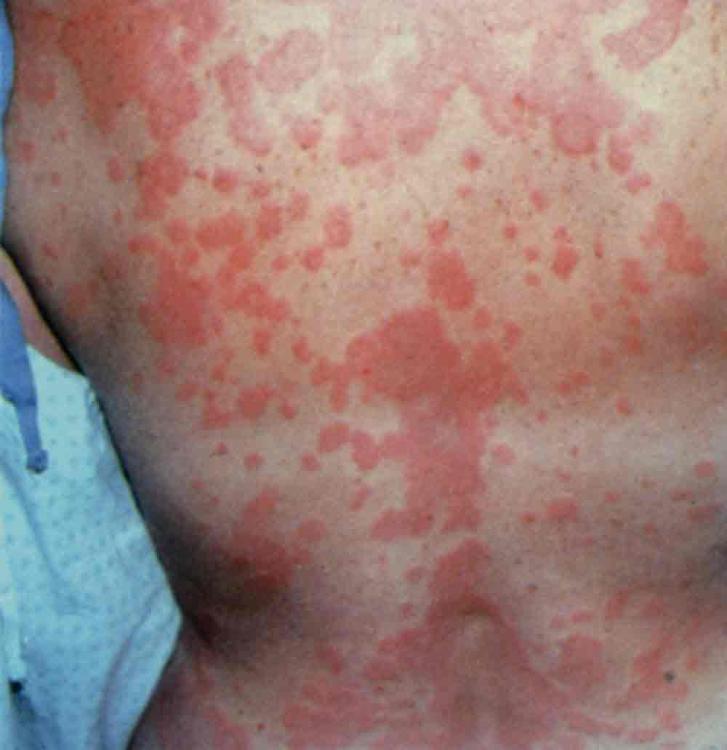
The nurse administers the first dose of IV ampicillin. Ten minutes later, the patient calls the nurse and says, “I feel funny.” The nurse observes the rash shown. Which action should the nurse take next? Select all that apply.
Obtain a full set of vital signs.
Stop the antibiotic infusion.
Notify the provider.
Place the patient on oxygen at 4 L/min per nasal cannula.
Auscultate the lungs
Obtain a full set of vital signs.
Stop the antibiotic infusion.
Notify the provider.
Auscultate the lungs
Obtain a full set of vital signs.Stop the antibiotic infusion.Notify the provider.Place the patient on oxygen at 4 L/min per nasal cannula.Auscultate the lungs
Dopamine
Epinephrine
Norepinephrine
Nitroglycerin
Vasopressin
Dopamine
Epinephrine
Norepinephrine
Vasopressin
A patient recently had mediastinal chest tubes removed after surgery and is experiencing obstructive shock from cardiac tamponade. Which assessment change would the nurse observe?
Weak peripheral pulses
Increased urine output
Increased bowel sounds
Valvular click
Weak peripheral pulses
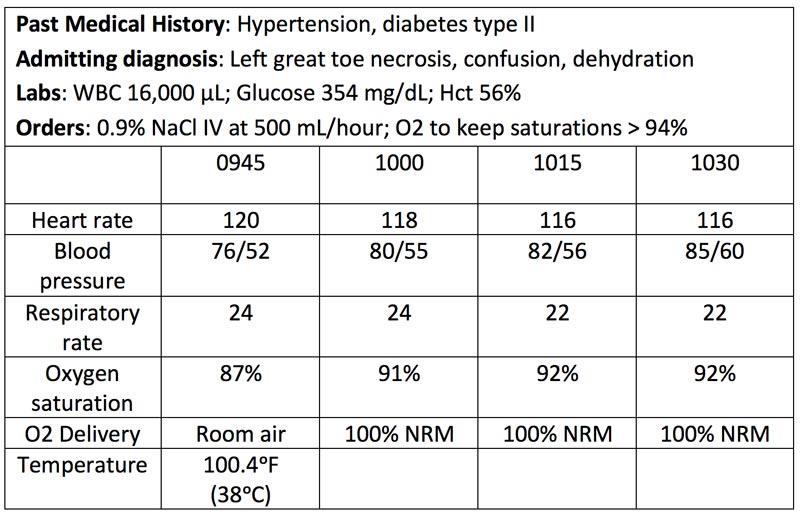
The nurse in the emergency department is caring for a newly admitted patient. Analyze the information and determine which statement is correct.
The patient’s condition is improving from the medical interventions provided.
The patient is in the compensatory stage of shock.
Additional intervention with fluids and medications is not needed.
Wound culture and IV antibiotics are the priority medical interventions.
The patient’s condition is improving from the medical interventions provided.
Which nursing intervention would be appropriate for a patient experiencing cardiogenic shock and with a pulmonary artery catheter?
Keep the inflation port locked at all times.
Maintain clean technique when handling the catheter.
When obtaining a blood sample, withdraw slowly through the distal port.
Take all readings at the end of respiratory inspiration.
When obtaining a blood sample, withdraw slowly through the distal port.