MOD 5
The concept of treating all samples, whether known or unknown, as potentially hazardous(or pathogenic) materials is known as __________.
Universal precautions
List at least 3 observations a researcher would be sure to note while assesing an unknown microbiol sample.
1. Size and shape
2. Any observable motility
3. Gram status (positive or negative)
4. The presence of any chemical reactions
5. Changes in color localized to the organism or the surrounding media
6. Capture or draw images of any of the characteristics described above
While observing an unknown sample of limited amounts, a researcher must determine the following observations: (1) the presence of any motility and (2) its Gram status using the same sample--the liquid sample cannot be divided. Which would you determine first and why?
I would determine first the presence of any motility. This is because gram staining requires heat fixation, which would kill the organism, making it impossible to determine if it has any motility. It is relatively easy and makes the most sense to go from a wet mount to heat fixing the sample, and in this way, we would be able to determine both motility first and then gram status. If we go the other way around, we'd be able to determine gram status, but motility because the organism would be dead.
A faculative anaerobe is a microorganism capable of growth under what conditions?
A faculative anaerobe is capable of growth in conditions with oxygen (aerobic) or without (anaerobic).
As Streptococcus is catalase negative, would it thrive or die in the presence of peroxides? Why?
Streptococcus would die in the presence of perioxides. This is because it is catalase negative, meaning it lacks the proper enzyme to breakdown peroxides, which are harmful. If the peroxides cannot be broken down, they will eventually cause cell death.
Streptococcus is most often streaked onto:
Chocolate agar
EMB agar
Blood agar
Spirit blue agar
Blood agar
True or False: The Lancefield groups are used to subdivide antigenic groups of gamma-hemolytic Streptococcus.
False-- the Lancefield groupings are used to subdivide beta-hemolytic Strep
The distinctions for Lancefield subgroupings lie in its: (select all that apply)
Hemolytic activity
Catalase activity
Carbohydrate composition of antigens
All of the above
Carbohydrate composition of antigens
Left untreated, strep throat can progress to _____, which displays ______ hemolytic activity.
Strep. Strepticemia; gamma
Strep. Pharyngitis; alpha
Rheumatic fever; beta
Strep. pharyngitis; beta
Rheumatic fever; beta
True or False: Under most circumstances, staphylococcus can be found in ~80% of human population where it remains non-symptomatic.
False-- staphylococcus is only found (non-symptomatic) in ~30% of the human population
Define commensal bacteria
Commensal bacteria are bacteria that neither benefit or harm its host from which it gets its nutrients
Match the step of infection to its description.
Invasion
Evasion
Transmission
A. Pathogen passes through or between cells to access deeper tissues and nutrients
B. Pathogen suppresses host's immune system so it can continue replicating
C. Pathogen is passed to another host to restart the lifecycle
Invasion: A
Evasion: B
Tranmission: C
Match the following diseases with their respective
symptoms:
1. Folliculitis
2. Scalded-skin syndrome
3.
Impetigo
4. Conjunctivitis
5. Ophthalmia neonatorum
Infection occurs at time of birth
Ruptured pustules;
treated with penicillin
Childhood skin disease near
mouth/nose
Infection of thin, transparent scleral tissue
Pus filled lesions on skin or hair
Folliculitis: Pus filled lesions on skin or hair
Scalded-skin
syndrome: Ruptured pustules; treated with penicillin
Impetigo:
Childhood skin disease near mouth/nose
Conjunctivitis: Infection
of thin, transparent scleral tissue
Ophthalmia
neonatorum: Infection occurs at time of birth
True or False: Thr causative agent of conjunctivitis can be either bacterial or viral.
True
True or False: An acid-fast stain is best suited to identify tuberculosis (as opposed to a Gram stain).
True
True or False: Although TB must be inhaled and reside in the lung in order to cause infection, TB can also spread to the brain, spine, and kidneys.
True
Identify the disease based on the following (select all that apply):
It is a small, acid-fast rod usually remaining asymptomatic for up to 20 years. It affects the skin, nerves, upper respiratory tract, and eyes of infected individuals.
Bacterial conjunctivitis
Scalded-skin syndrome
Leprosy
Hansen's disease
Tuberculosis
Leprosy
Hansen's disease
True or Falase: Directly ingesting costridium or its associated spores will not cause illness in adults.
True
A 5-month-old child is given honey at breakfast and begins showing symptoms consistent with botulism. Would this child's illness be classified as foodborne, infant, or wound botulism? Explain why you chose this answer.
Infant botulism. Pediatrcians specifically tell parents not to give honey to infants younger than 6 months of age. The child described is 5-months and was given honey. The bacteria can be found in the honey, and when the child consumed it, it was able to colonize in its GI tract because it does not have adult microbiota that would prevent this (it is still in the process of developing) and produce the toxin. No wound was described, so we can rule out wound botulism, and although the honey is considered food and was consumed, we can rule out foodborne botulism because this type of botulism is commonly brought upon when canned foods are contaminated and eaten (low acid and anaerobic conditions are found in such canned foods).
True or False: Although there is no cure for tetanus, it can be prevented through vaccination.
True
Identify the medical condition characterized by robust carbohydrate fermentation under anaerobic conditions, swelling of the infected areas and fever.
Gas gangrene - one of the main symptoms of this medical condition is intense gas production which is caused by C. perfringens when it ferments carbohydrates under anaerobic condtions
Why does the alpha toxin (perfringolysin) produced during an infection of gas gangrene cause cell death?
Perfringolysin perforates/forms pores in the plasma membrane of host cells. These pores in the membrane result in an uncontrolled ion flux which leads to cell lysis/death.
You develop a fever, chills, and pneumonia after recently returning from a getaway weekend where you sat in a hot tub. What bacterial disease would a doctor suspect is causing your symptoms? Would the doctor suscpect you contracted it from another person?
Legionnaires. No, the doctor would not suscpect this because Legionella, which is the bacteria that causes legionnaires, can only be transmitted through small droplets that are inhaled. Direct with another person does not transmit this disease.
True or False: Bubonic plague is often characterized by painfully swollen lymph nodes.
True
Which form of the plague is the most rare? What does it target?
Septicemic plague, which targets the blood system
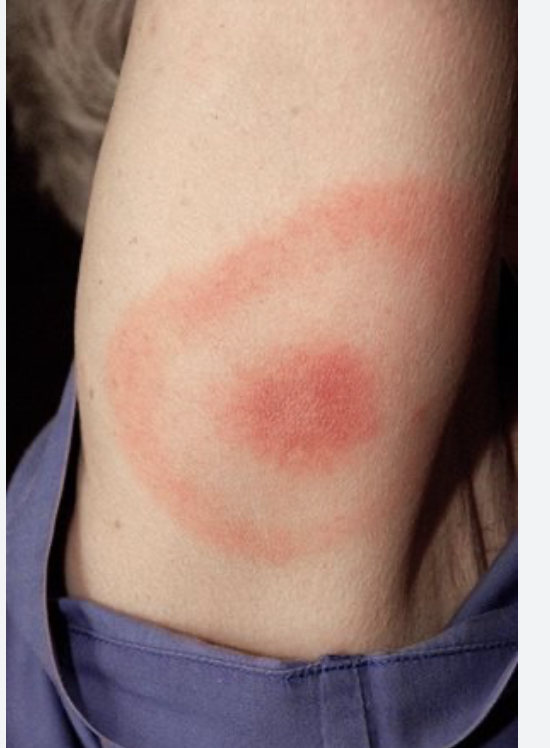
Identify the following disease:
Tetanus
Scaled-skin syndrome
Gas gangrene
Lyme disease
Lyme disease
Syphilis is caused by:
Diplococcic bacteria
RNA virus
Staphylococcus bacteria
Diplococcic bacteria
Gram-negative spirochete
Gram-negative spirochete
True of False: Chlyamida is an obligate parasite and as such can be grown on agar plates alone.
False -- an obligate parasite requires a host (viable cells) to be present for its growth.
Match the following diseases with their respecitve symptoms if left untreated:
Gonorrhea
Syphillis
Chlamydia
A. Paralysis, blindness, and dementia
B. Painfully swollen lymph nodes
C. Cardiac and neurological complications
D. Respiratory failure associated with lock-jaw
E. Infertility and pelvic inflammatory disease
F. Sore throat, ocular discharge, and fever
Gonorrhea: Cardiac and neurolgocial complications
Syphillis:
Paralysis, blindness, and dementia
Chlamydia: Infertility and
pelvic inflammatory disease
Define the concept of universal precautions.
The concept of universal precautions means any and all samples, whether known or unknown, are to be treated as potentially hazardous (or pathogenic) materials.
Rheumatic fever displays _____ hemolytic acitvity and occurs when _____ is left untreated.
Beta; Strep. Pharyngitis
Beta; Rheumatic fever
Alpha; Strep. Pharyngitis
Gamma; Strep. Septicemia
Beta; Strep. Pharyngitis
True or False: Under most circumstances, staphylococcus can be found in ~30% of human population where it remains pathogenic.
False. While staphylococcus can be found in ~30% of the human population, it remains non-symptomatic.
True or False: Only directing ingesting the pre-formed clostridium toxin (neither the bacteria nor its spores) will cause disease in adults.
True -- the mature (adult) microbiota is capable of killing the bacteria/spores
True or False: There are currently no cures for tetanus
True
Describe the symptoms and treatment regimen for someone infected with Clostridium perfringens.
Clostridium perfringens, which is the bacterium that causes gas gangrene. Symptoms of gas gangrene include muscle necrosis, swelling of infected areas, fever, and intense gas production. Treatment includes removal of all infected tissue, which often results in the amputation of affected areas and heavy antibiotic therapies.
The alpha-toxin perfringolysin is associated with which medical condition caused by Gram-positive anaerobic bacteria?
Tetanus
Leprosy
Botulism
Gas gangrene
Gas gangrene
You develop a fever, chills, and pneumonia after recently using a warm midst vaporizer in an attempt to open your sinuses. What bacterial disease would a doctor suspect is causing your symptoms? Would the doctor suspect you contracted it from touching (potentially) contaminated doorknobs?
Legionnaires. No, legionella cannot be spread by direct contact between people. Legionella can only be transmitted through small droplets that can be inhaled.
True or False: Pneumonic plague is often characterized by painfully swollen lymph nodes.
False--pneumonic plague targets the respiratory system while bubonic targets the lymph system
Which form of plague is highly virulent? What does it target?
Pneumonic plague. Respiratory system
Gonnorrhea is caused by:
Gram-negative spirochete
Staphylococcus bacteria
Diplococcic bacteria
RNA virus
Diplococcic bacteria
True or False: Chlyamida is an obligate parasite and as such can be grown on agar plates alone.
False. An obligate parasite requires a host (viable cells) to be present for its growth