PreMat Stuff from My Own Notes
nerve plexuses
when a bunch of nerves come together
anterior rami
go out to body wall and to limbs
come together in a plexus
mix and form the peripheral nerves that innervate the limbs
posterior rami
just go to epaxial muscles that run along vertebral column
describe how three separate spinal (segmental) nerves innervate skin
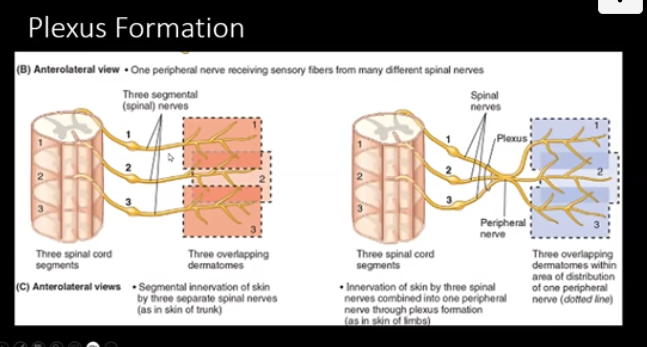
spinal segment 1 - gives off segmental nerve which goes off to dermatome 1
spinal segment 2 - gives off segmental nerve which goes off to dermatome 2
spinal segment 3 - gives off segmental nerve which goes off to dermatome 3
- essentially, one spinal nerve innervates one segment of skin
- have some innvervation overlapping
- would see this in the skin of the trunk
describe how three separate spinal (segmental) nerves form a plexus
spinal nerves 1, 2, and 3 come together and form a plexus and then it eventually splits into three and supply three different dermatomes
- would see this in the skin of the limbs
plexus formation
- one spinal cord segment can contribute motor axons to different nerves from a plexus - for example from C5 axons go to radial nerve, axillary nerve, subscapular nerves etc.
- one nerve can have sensory axons that synapse within multiple spinal cord segments
- for example, the radial nerve has a plexus, then at the plexus, they distribute each to different segments from C5 to C6 to C7 down to T1
brachial plexus
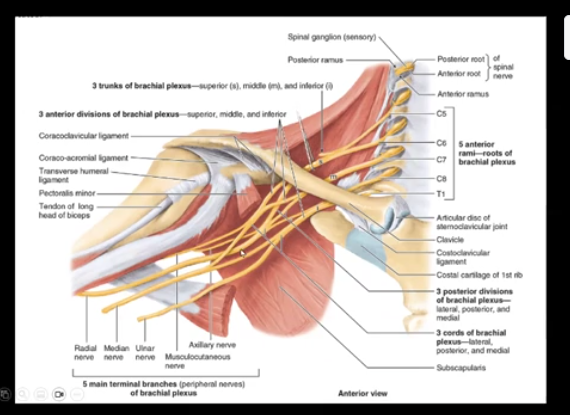
- mixing of axons in the plexus - either sensory going back or motor leaving a spinal cord segment and traveling at various branches of the plexus to get to the different muscle targets
- 3 anterior divisions - superior, middle, inferior
- 3 trunks of brachial plexus - superior, middle, and inferior
sympathetic nervous system
- typically thought of motor but also has sensory components
- preganglionic neurons are in the intermediolateral cell column from T1-L1 or L2 or L3
postganglionic neurons
- are in sympathetic ganglia
- paravertebral - located along the sympathetic chain
- prevertebral - located along the abdominal aorta
lateral horn
column of gray matter that has preganglionic sympathetic neurons
- T1-T6 those spinal cord segments will innervate structures in the head (salivary gland and eye to heart and lungs and esophagus)
- T7-T11 - will innervate stomach, liver, gallbladder, pancreas
sympathetic chain
is on either side of the vertebral column, ganglia at each level
- anterior aspect of aorta are prevertebral ganglia
prevertebral ganglia
on anterior aspect of aorta, can be called pre-aorta bc theyre in front of aorta
Parietal (somatic) Somatic Distribution
Postganglionic sympathetic axons leave and do things such as innervate the arrector pilli muscles, constrict blood vessels, innervate sweat glands
Visceral Distribution
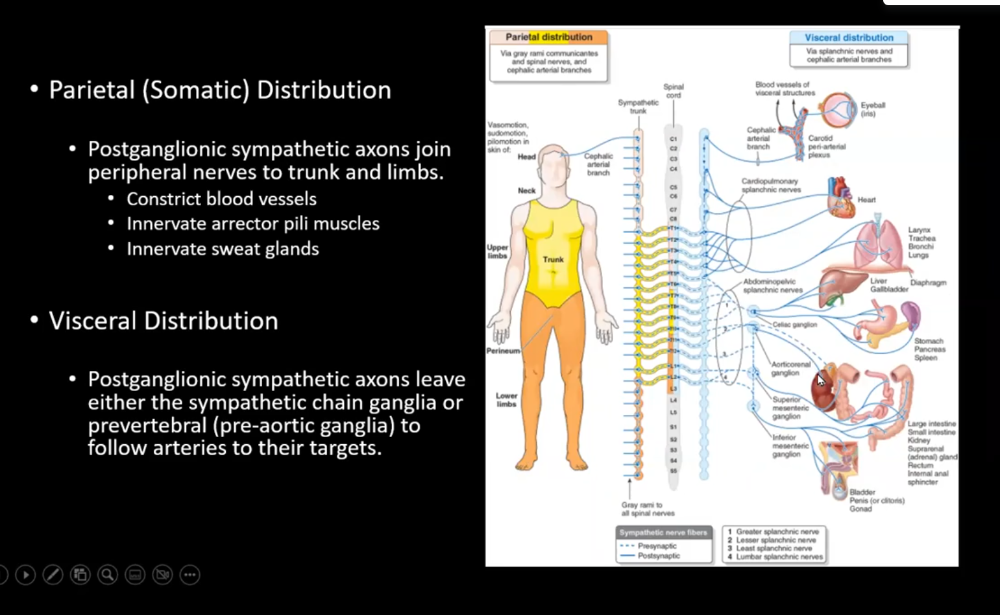
Postganglionic sympathetic axons leave either the sympathetic chain ganglia or prevertebral (pre-aortic ganglia) to follow arteries to their targets
- for example celiac ganglion, follows celiac artery out to targets
- aortica renal ganglion goes out to kidneys
- superiormesenteric to colon
parasympathetic nervous system
also called craniosacral
has efferents and afferents
Preganglionic neurons in nuclei of the brainstem or sacral S2-S4 spinal cord
Postganglionic neurons are in ganglia in the head or associated with thoracic and abdominopelvic viscera
Four cranial nerves have preganglionic parasympathetic nuclei or in otherwords
have parasympathetic axons that start in special nuclei in the brainstem, then travel to ganglia and control things like pupil size, saliva, and organ function
read image again
facial
superior salivatory nucleus
glossopharyngeal
inferior salivatory nucleus
vagus
dorsal motor nucleus
edinger westphal nucleus
preganglionic neurons will synapse with postanglionic in the orbit behind the eye to cause pupil to constrict or when looking at near objects
in midbrain, part of the brainstem
enteric nervous system
in the GI tract, there are two interconnected plexuses that control intrinsic activity of the GI tract - submucosal plexus (Meissner's) and Myenteric plexus (Auerbach's) between the outer and inner layers of smooth muscle
Meissner's
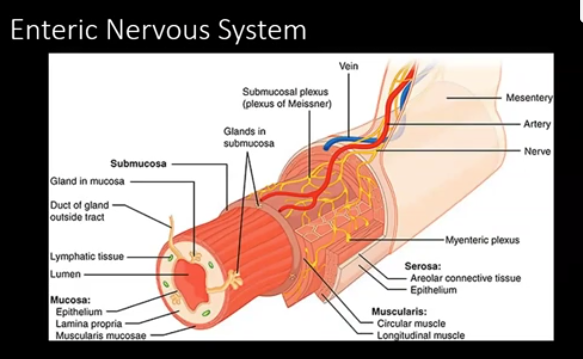
in the submucosa, has sensory and visceromotor neurons
regulates mucosal events (secretion from glands or localized movement)
Auerbach's (myenteric)
main function is peristalsis by regulating smooth muscle
Visceral Sensation
afferents carry info from viscera to spinal cord
distention - feel bladder filling, sends info back to nervous system when we're hungry or satiety
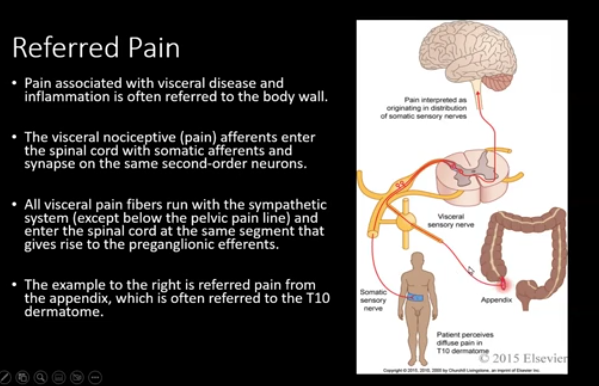
visceral pain is generally poorly localized and may be referred to body wall and interpreted as somatic pain (referred pain)
- patients with ischemic pain from the heart they will feel pain in left shoulder down to medial aspect of left upper limb because axons from the heart synapse in T1-T5 spinal cord segments. Axons also come from shoulder and upper limb synapsing in those same segments; they synapse on the same second order neuron and so the body will interpret pain from being shoulder and upper limb
Referred Pain
glaborous
smooth
thin skin has
hair and sebaceous glands
skin has
epidermis and dermis
hypodermis
is superficial fascia and not part of skin
functions of skin
- protection
- prevents dehydration
- thermal regulation - vasodilation or constriction (when cold)
- sensation - receptors for touch, temp, and pain
- synthesis and storage of vitamin D
dermis
is connective tissue