Anatomy JV Exam 3: Eye Micro
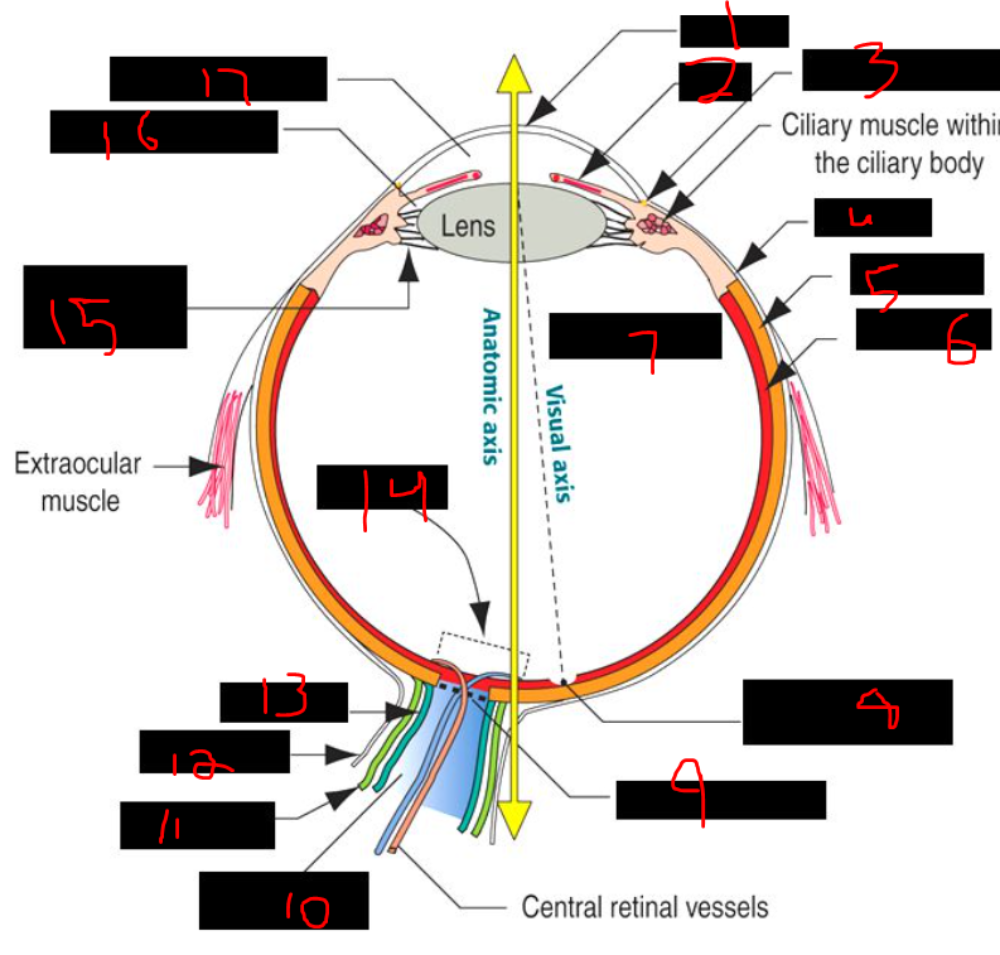
What is 1?
cornea
What is 2?
iris
What is 3?
canal of schlemm
What is 4?
sclera
What is 5?
choroid
What is 6?
retina
What is 7?
vitreous cavity
What is 8?
fovea centralis
What is 9?
lamina cribrosa
What is 10?
optic nerve
What is 11?
arachnoid
What is 12?
dura mater
What is 13?
pia mater
What is 14?
optic disk
What is 15?
suspensory ligaments
What is 16?
posterior chamber
What is 17?
anterior chamber
at one point in embryo do you first notice signs of eye development?
______ days of gestation
22 days of gestation
The optic vesicles form through the ______ of the developing ______, which gives rise to the optic ______.
evagination, forebrain, cup
As the optic vesicle contacts the ______ ______, it induces the formation of ______ ______, a specialization that gives rise to the lens.
surface ectoderm, lens placodes
The lens placodes originate from the ______ ______ and ultimately develop into the ______ of the ______.
surface ectoderm, lens, eye
The lens placode is a ______ of the ______ ______ that ultimately gives rise to the ______.
specialization, surface ectoderm, lens
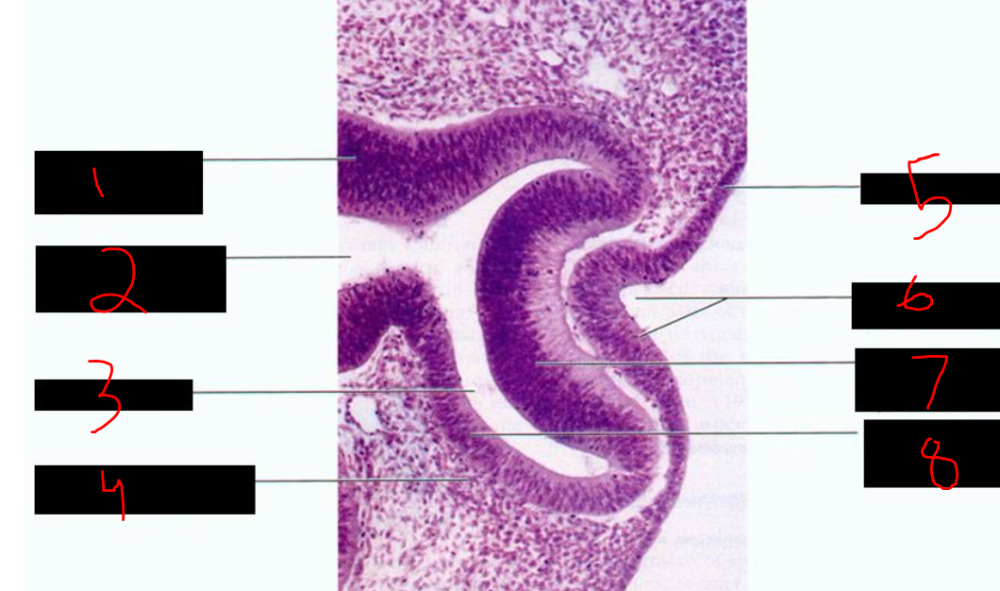
What is 1?
wall of optic stalk
What is 2?
cavity of optic stalk
What is 3?
intraretinal space
What is 4?
mesenchyme
What is 5?
surface ectoderm
What is 6?
lens pit
What is 7?
inner layer of optic cup
What is 8?
outer layer of optic cup
The intraretinal space is a ______ space, present even in ______, and is the site of ______ ______.
potential, adults, retinal detachment
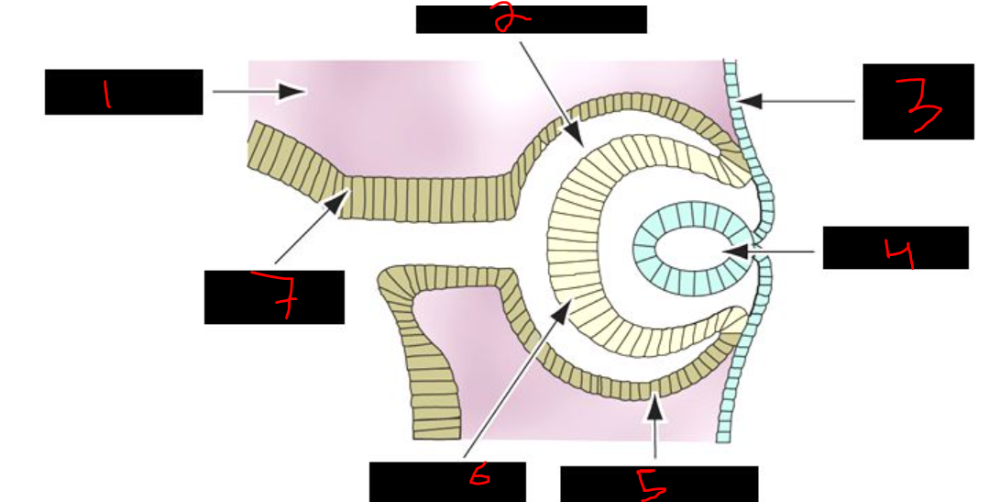
What is 1?
mesenchyme
What is 2?
intraretinal space
What is 3?
surface ectoderm
What is 4?
lens vesicle
What is 5?
pigmented layer
What is 6?
neural layer
What is 7?
optic stalk
The formation of the optic fissure is significant because it allows the ______ ______ to reach the ______ ______ of the developing ______.
hyaloid artery, inner chamber, eye
The hyaloid artery eventually becomes the ______ ______ of the ______.
central artery, retina
The cornea is derived from ______ and mostly from ______, with the epithelium forming due to induction from the developing ______.
ectoderm, mesoderm, lens
The developing lens induces the overlying ______ to form the ______ ______, while the rest of the cornea originates from ______.
ectoderm, corneal epithelium, mesoderm
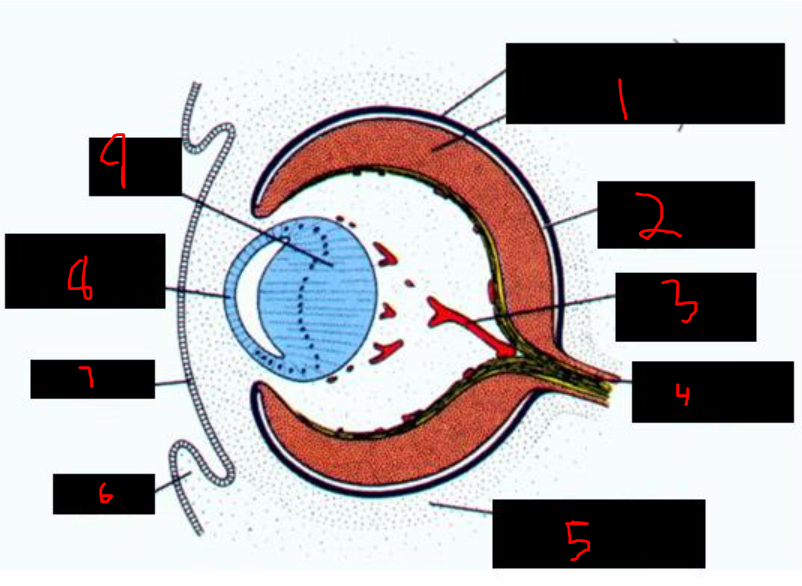
This is about how far along?
~7 weeks
What is 1?
pigment layer
neural layer
of the retina
What is 2?
intrarenal space
What is 3?
hyaloid vessel
What is 4?
optic nerve fibers
What is 5?
undifferentiated mesenchyme
What is 6?
eyelid
What is 7?
ectoderm
What is 8?
anterior lens epithelium
What is 9?
lens fibers
The undifferentiated mesenchyme around the eye primordium gives rise to the ______ layer, which is continuous with the ______ and ______ layers of the optic nerve.
choroid, pia, arachnoid
The scleral layer forms from loose mesenchyme and is continuous with the ______ ______ of the ______ ______.
dura mater, optic nerve
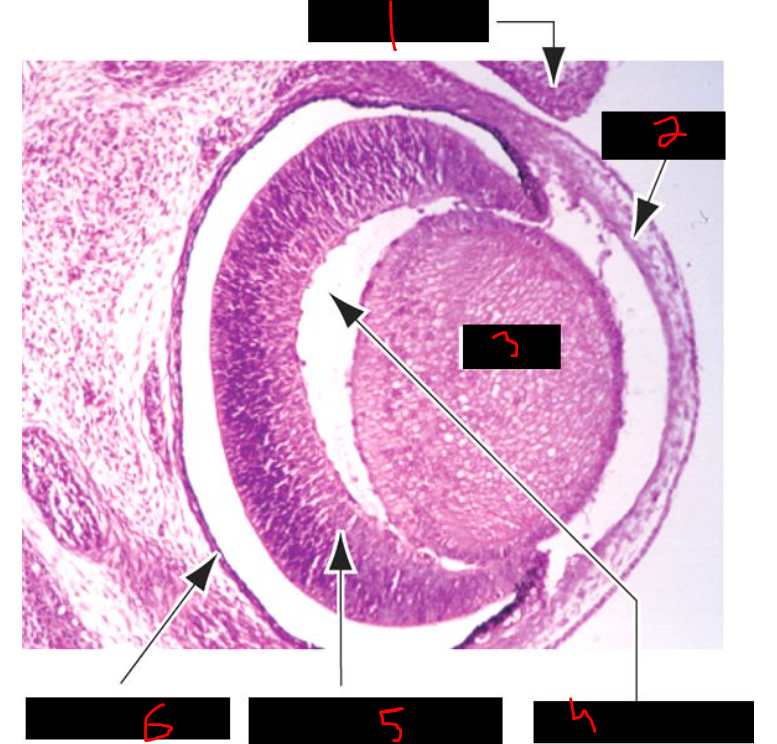
What is 1?
future eyelid
What is 2?
cornea
What is 3?
lens
What is 4?
vitreous chamber
What is 5?
neural layer (retina)
What is 6?
pigmented layer
The outermost layer of the eye is the ______ coat, composed of the ______, a dense connective tissue forming the white of the eye, and the ______, which is anterior, transparent, and avascular.
fibrous, sclera, cornea
The middle layer of the eye is the ______ coat or ______ tract, consisting of the ______, ______ ______, and ______ from posterior to anterior.
vascular, uveal, choroid, ciliary body, iris
The innermost layer of the eye is the ______, which lies internal to the vascular coat and functions as the light-sensitive ______ layer.
retina, neural
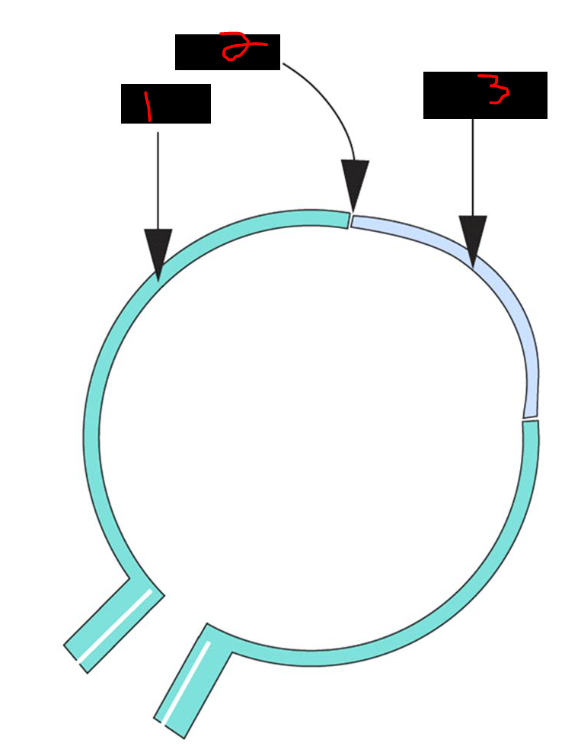
which layer of the eye?
outermost - fibrous coat
What is 1?
sclera
What is 2?
limbus
What is 3?
cornea
The middle layer of the eye, also called the ______ ______ or ______, includes the ______ posteriorly, the ______ ______ anteriorly, and the ______ at the most anterior position.
vascular coat, uvea, choroid, ciliary body, iris
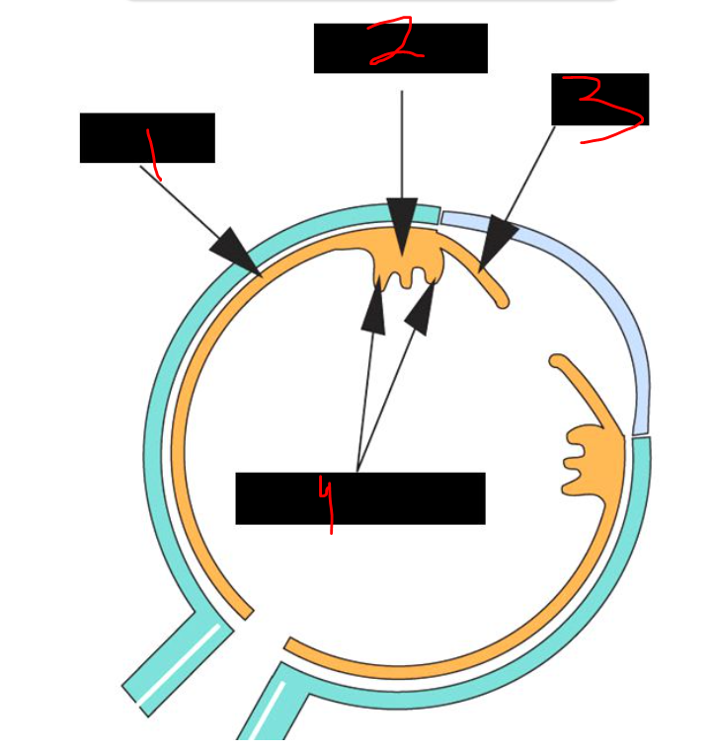
which layer of the eye?
middle - vascular coat, uvea, uveal tract
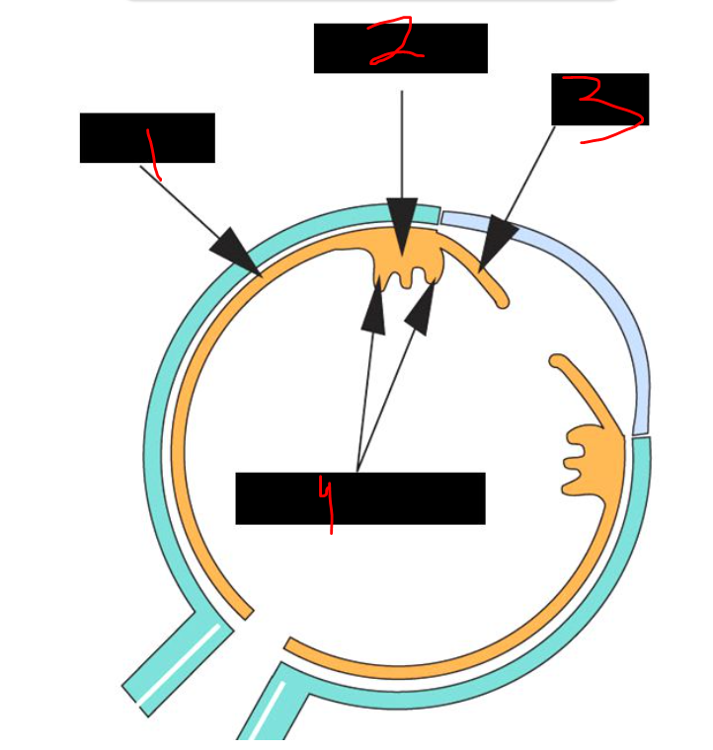
What is 1?
choroid
What is 2?
ciliary body
What is 3?
iris
What is 4?
ciliary process
The innermost layer of the eye, called the ______, includes the ______, which is part of the CNS with ______ layers, and the ______ ______, the transition zone from 10 to ______ layers, marking the anterior limit of the neuroretina.
retina, neuroretina, 10, ora serrata, 2
The ora serrata is the area of transition from a ______-layered sensory retina to a ______-layered non-sensory ______.
10, 2, retina
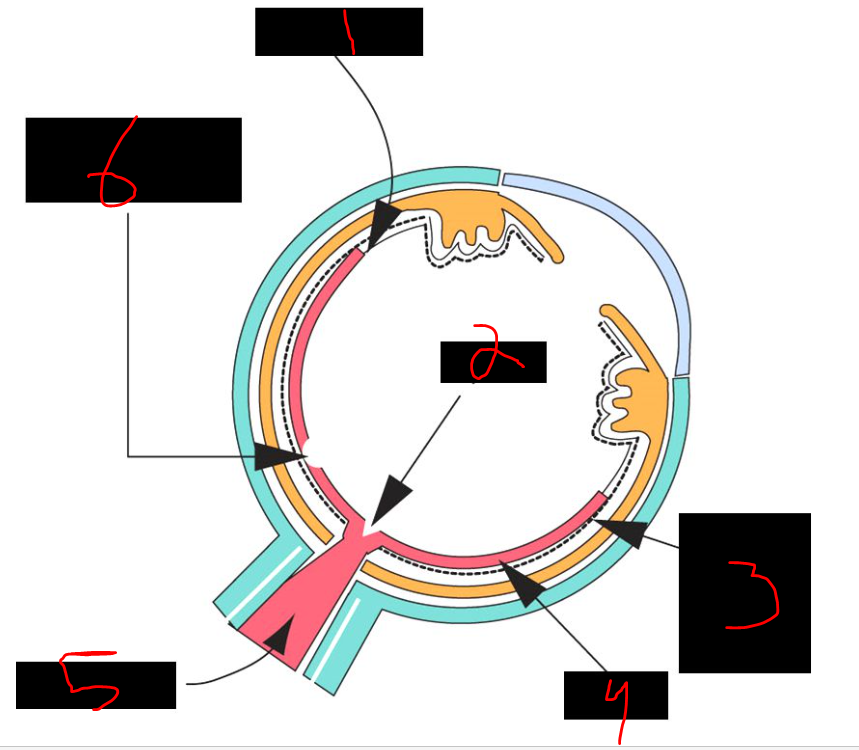
which layer of the eye?
innermost - retina
What is 1?
ora serrata
What is 2?
papilla
What is 3?
outer pigmented layer
What is 4?
retina
What is 5?
optic nerve
What is 6?
macula lutea and fovea
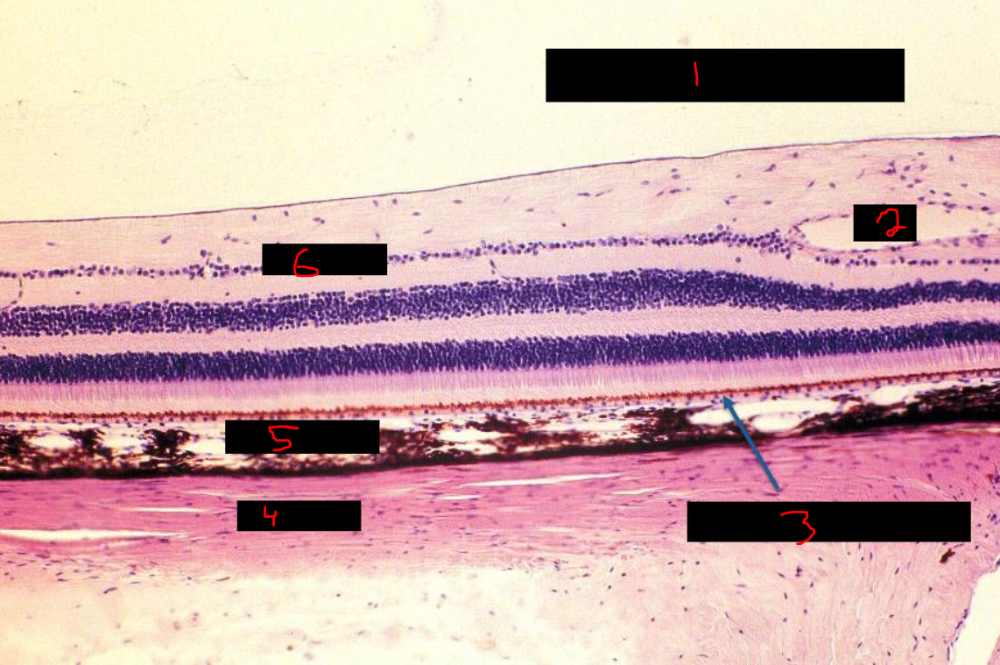
What is 1?
vitreous chamber
What is 2?
bv
What is 3?
pigmented layer
What is 4?
sclera
What is 5?
choroid
What is 6?
retina
The five layers of the cornea, from outermost to innermost, are the ______ _______, ______'s layer (basement membrane), the ______ (connective tissue), ______'s membrane, and the corneal ______.
corneal epithelium, Bowman, stroma, Descemet, endothelium
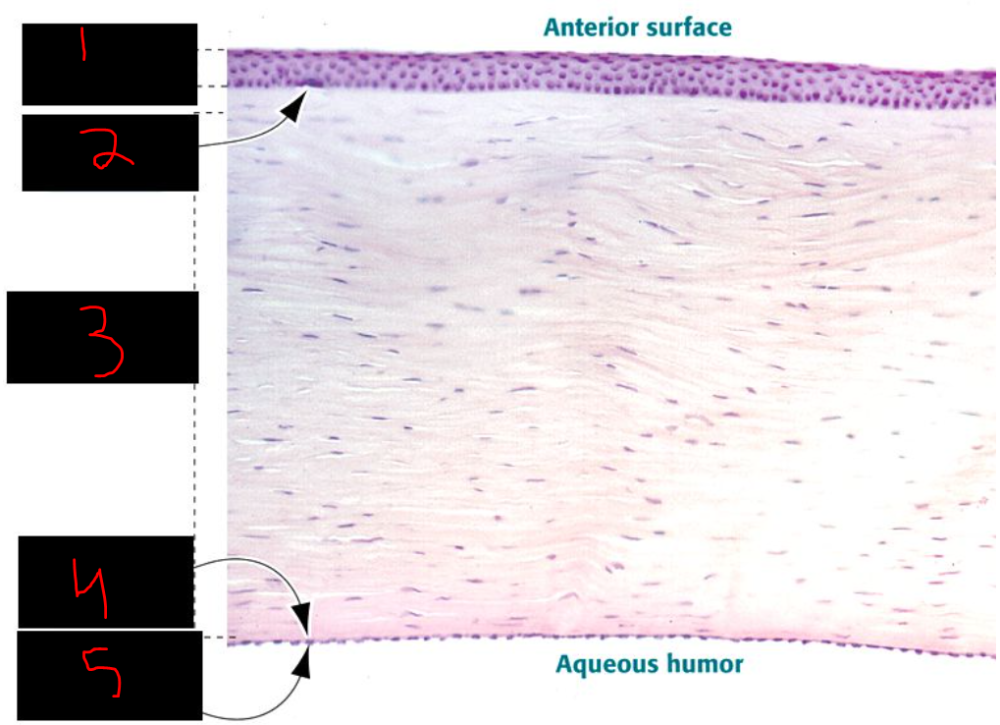
What is 1?
corneal epithelium
What is 2?
Bowman's layer
What is 3?
Stroma
What is 4?
descemet's membrane
What is 5?
corneal endothelium
The cornea is innervated by ______ nerves that are ______ in the stroma and become ______ after crossing ______'s layer, supplied by the ______ nerve (CN ______).
myelinated, unmyelinated, Bowman, trigeminal, V
The layers of the choroid from inside to outside begin with the ______ ______, also called ______'s membrane, which contains ______ layers.
lamina elastica, Bruch, 5
Following Bruch's membrane, the choroid includes the ______, which contains capillaries essential to the outer retina, the ______ layer with larger vessels, and the ______, which is closest to the ______.
choriocapillaris, vessel, epichoroid, sclera
which layer of the choroid is nearest the sclera?
______
epichoroid
Bruch's membrane is a ______-layered basement membrane of the inner layer of the ______ and serves as the ______ ______ ______.
5, choroid, blood retinal barrier
Bruch's membrane is composed of the basal lamina of the ______ ______ of the retina, ______ fibers, ______ fibers, more ______ fibers, and the basal lamina of the ______ ______.
pigmented epithelium, collagen, elastic, collagen, choroidal capillaries
The ciliary body is a specialized structure of the ______ layer of the eye, also called the ______ ______ or ______, containing the ______ muscle with smooth muscle in two orientations, ______ fibers that suspend the lens posteriorly, and ______ processes that produce aqueous humor.
middle, vascular coat, uvea, ciliary, zonule, ciliary
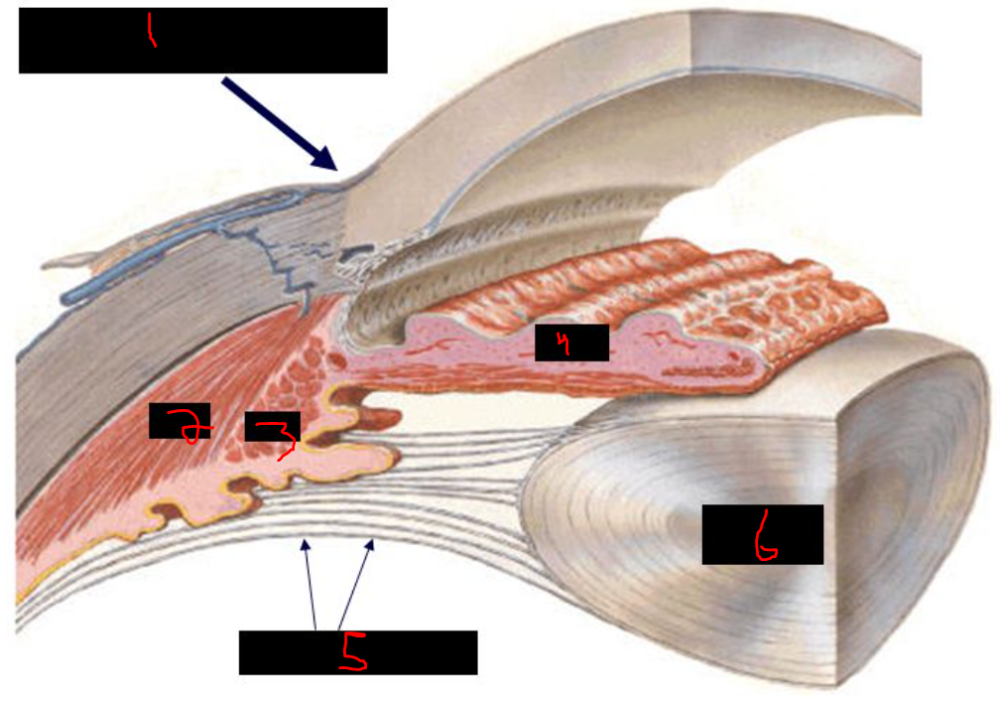
What is 1?
limbus corneae
What is 2?
SM
What is 3?
SM
What is 4?
Iris
What is 5?
zonule fibers
What is 6?
lens
what structures produce aqueous humor?
_____ _____ - projections from the _____ _____
ciliary processes - projections from the ciliary body
Ciliary muscles are innervated by ______ postganglionic parasympathetics from the ______ ganglion, whose preganglionic neurons originate in the ______-______ nucleus of the oculomotor complex in the ______.
postganglionic, ciliary, Edinger-Westphal, midbrain
The ciliary body contains ______ processes that produce ______ ______, and the ______ muscle, which contains ______ muscle that contracts under ______ influence during the ______ reflex.
ciliary, aqueous humor, ciliary, smooth, parasympathetic, accommodation
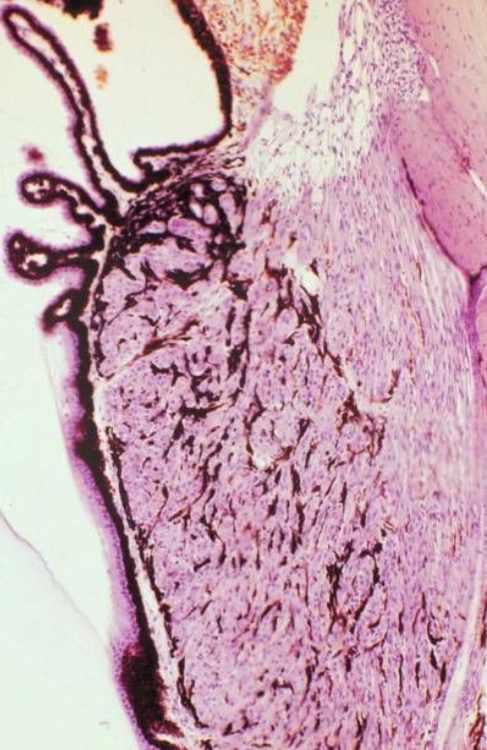
what is shown here?
ciliary body w/ ciliary processes
The most anterior part of the middle layer of the eye, also called the ______ ______ or ______ ______, is the ______.
vascular coat, uveal tract, iris
Eye color is determined by the number of ______: few melanocytes result in ______ eyes, many melanocytes cause ______ eyes, and an intermediate number leads to ______ or ______ eyes.
melanocytes, blue, brown, green, gray
what is the central aperture of the iris? ______
pupil
In dim light, ______ sympathetic nerve fibers innervate the ______ ______, causing the pupil to ______; in bright light, ______ parasympathetic nerve fibers from the ______ ganglion innervate the ______ ______, causing the pupil to ______.
postsynaptic, dilator pupillae, dilate, postsynaptic, ciliary, sphincter pupillae, constrict
The constrictor pupillae muscle, which is ______ muscle, is innervated by ______ parasympathetic fibers from the ______ ganglion, with preganglionic neurons in the ______ -______ nucleus of the ______ complex in the ______.
smooth, postganglionic, ciliary, Edinger-Westphal, oculomotor, midbrain
Fixed and dilated pupils may indicate damage to the ______ involving the ______ -______ nucleus in the ______, leading to unopposed action of the ______ ______ muscle, which is innervated by the ______ nervous system.
brainstem, Edinger-Westphal, midbrain, dilator pupillae, sympathetic
Preganglionic neurons that innervate the dilator pupillae muscle are located in the ______ ______ ______ of the ______ spinal cord.
intermediolateral cell column, T1
The dilator pupillae muscle is composed of ______ cells, which form an indeterminant layer just anterior to the ______ ______ ______ of the iris.
myoepithelial, posterior pigmented epithelium
Horner's syndrome includes ______, or drooping of the upper eyelid due to paralysis of ______ muscle; ______, or loss of sweating on the affected side; ______, a small constricted pupil from unopposed ______ pupillae action; and flushing of the ______ and ______ due to vasodilation.
ptosis, Muller's, anhidrosis, miosis, sphincter, face, neck
The lens is ______ and receives oxygen and nutrients from the ______ humor and ______ humor.
avascular, aqueous, vitreous
The normal state of the lens is ______, as it would be for ______ vision; however, the ______ or ______ fibers can hold it in a ______ state.
thickened, near, suspensory, zonule, flattened
For distant vision, the ciliary muscles ______, the zonule fibers become ______, and the lens is held in a ______ shape.
relax, tense, flat
For near vision, ______ stimulation causes the ciliary muscles to ______, reducing tension on ______ fibers, allowing the lens to become ______, and the pupils to ______.
parasympathetic, contract, zonule, thickened, constrict
Presbyopia is an age-related condition, typically after age ______, in which the lens loses ______ and can no longer ______ when ______ on the zonule fibers is released by contraction of the ______ muscles, resulting in difficulty focusing on ______ objects.
40, flexibility, thicken, tension, ciliary, near
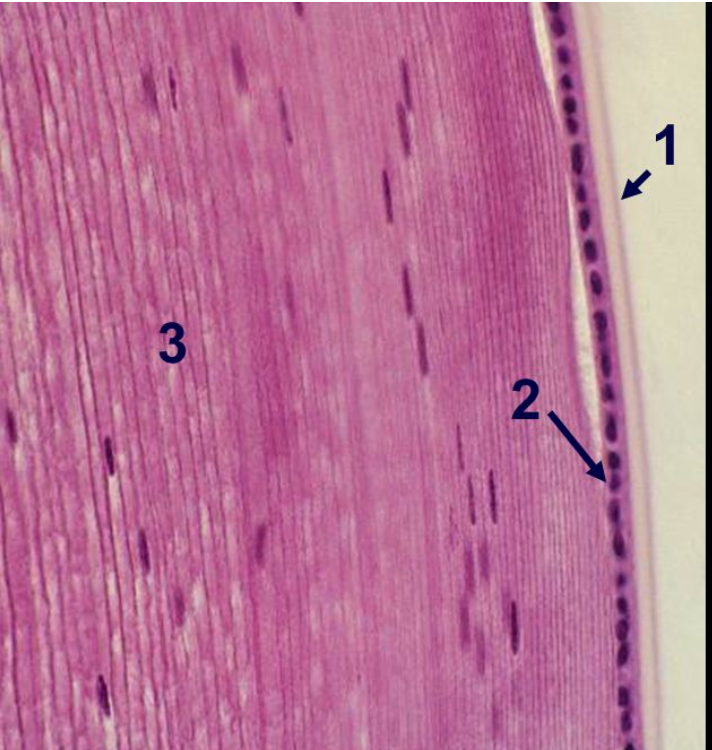
What is 1?
1) lens capsule
What is 2?
2) subcapsular epithelium
What is 3?
3) lens substance
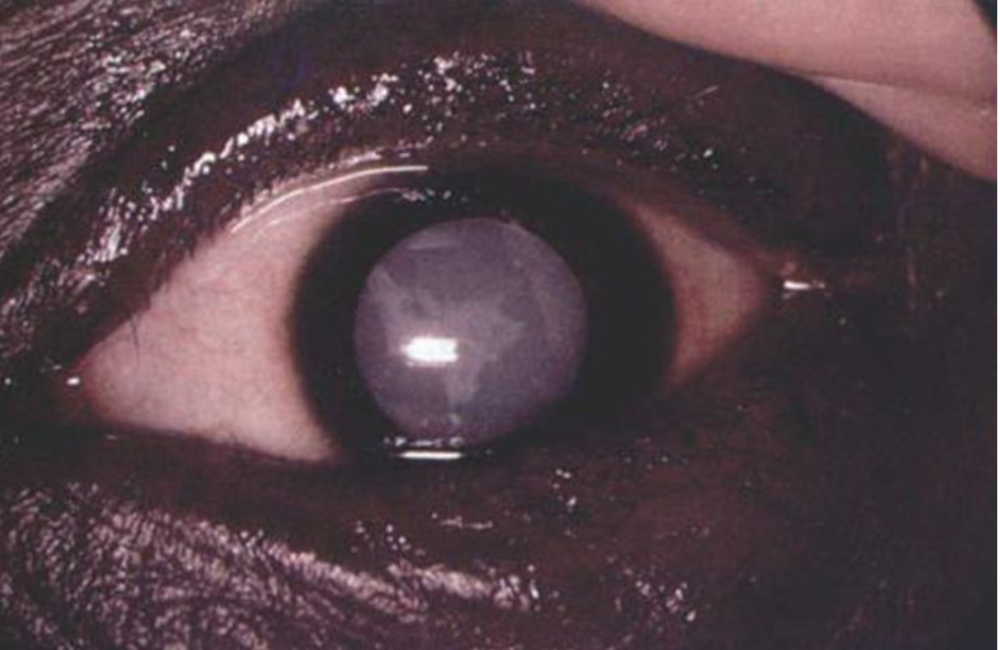
What is this?
cataracts
Cataracts are an ______ of the ______, commonly associated with advancing ______ and leading to impaired vision.
opacity, lens, age
In diabetes mellitus, high levels of ______ or ______ in the lens stroma draw ______ into the region, causing ______ and potentially thickening the lens, leading to diabetic ______.
glucose, sorbitol, water, cataracts, myopia
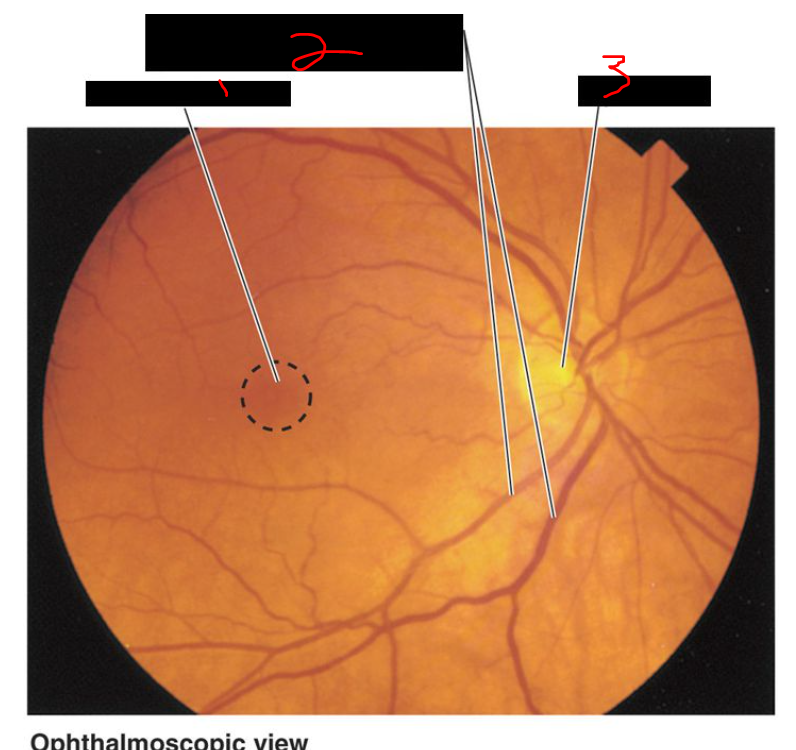
What is 1?
macula of retina
What is 2?
branches of retinal vessels (arterioles and venules)
What is 3?
optic disk
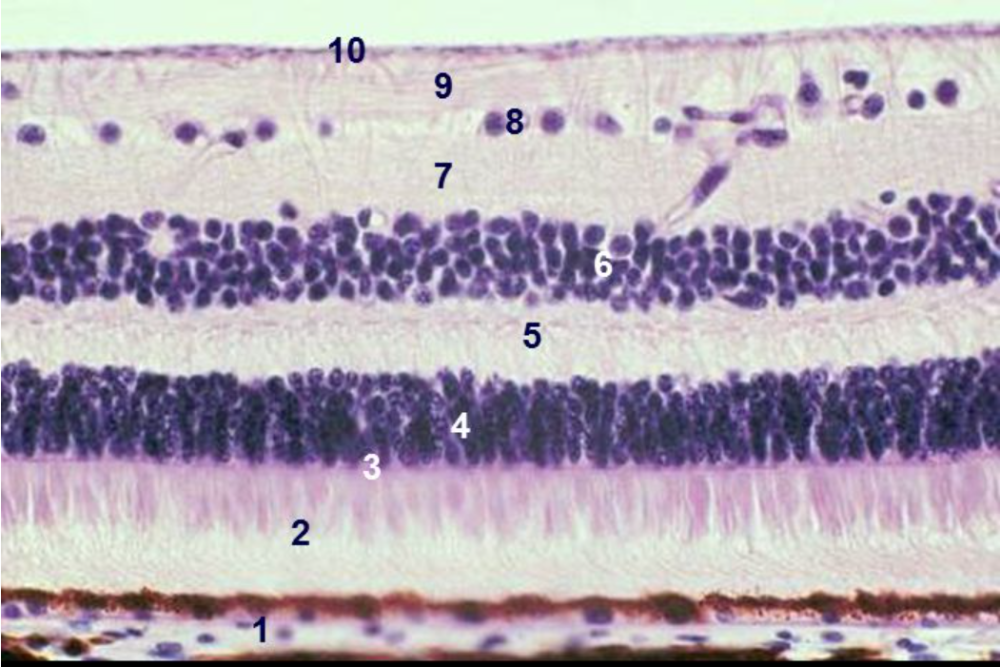
What are these?
layers of the neuroretina
What is 1?
1) pigmented epithelium
What is 2?
2) layer of rods & cones or outer segments of rods & cones
What is 3?
3) external or outer limiting membrane
What is 4?
4) external or outer nuclear layer
What is 5?
5) external or outer plexiform layer
What is 6?
6) internal or inner nuclear layer
What is 7?
7) internal or inner plexiform layer
What is 8?
8) ganglion cell layer
What is 9?
9) optic nerve fiber layer
What is 10?
10) inner limiting membrane
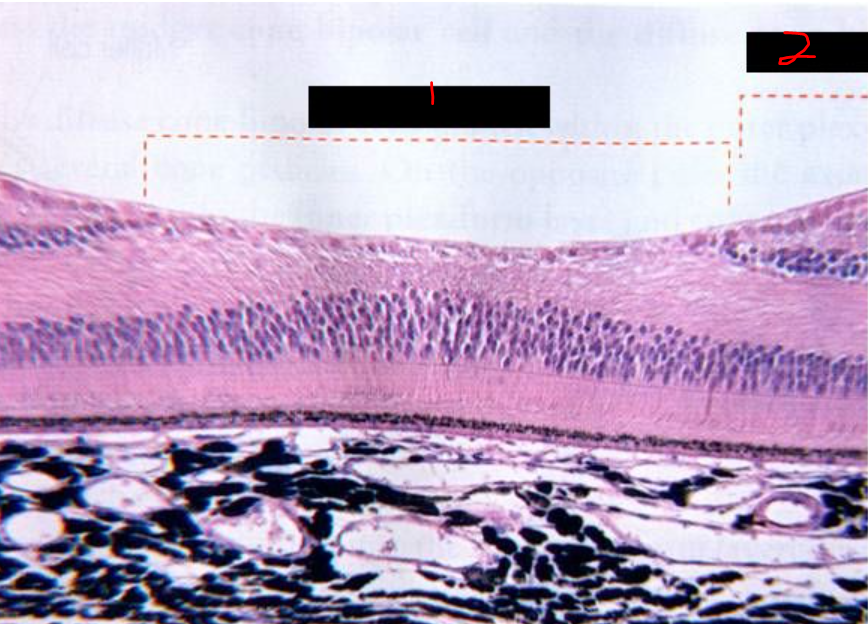
What is 1?
fovea centralis
What is 2?
macula
Layer 1 of the neuroretina is the ______ ______, a single layer of ______ cells that absorbs ______ to prevent reflection, stores and releases ______ ______ as a ______ precursor, and ______ membrane from photoreceptor lamellae.
pigmented epithelium, polygonal, light, vitamin A, rhodopsin, phagocytoses
There are approximately ______ million rods and ______ million cones in the retina, making ______ the more numerous photoreceptor type.
130, 6.5, rods
Rods are distributed throughout the ______, while cones are most concentrated in the region of the ______ ______.
neuroretina, fovea centralis
Rhodopsin is found in the membrane-bound ______ or ______ of the cylindrical ______ segment of ______ photoreceptors, with about ______ discs present.
discs, lamellae, outer, rod, 1000
what type of vision are rods & cones important/responsible for?
rods - ______ ______ (______ ______ )
cones - ______ ______ & ______
twlight vision (low light)
visual acuity & color
what is this area called?
optic papilla
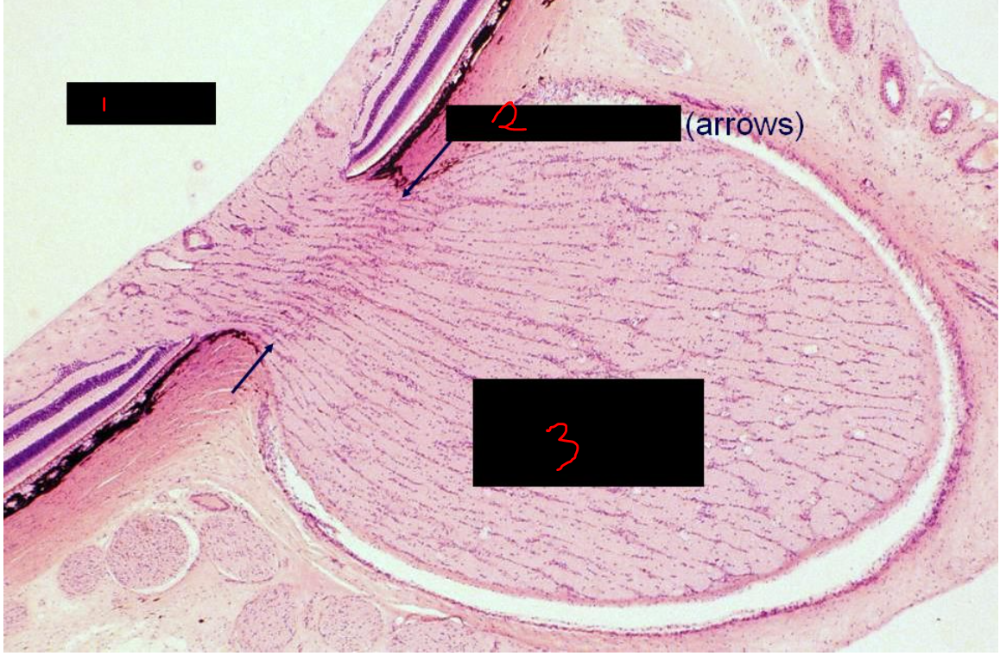
What is 1?
vitreous
What is 2?
lamina cribosa (arrows)
What is 3?
optic nerve
(CNS myelinated by oligodendrocytes)
The lamina cribosa is a layer of ______ found at the optic ______ that prevents ______ cells from passing, resulting in myelin and ______ being present only on the ______ nerve side, not the ______ side.
connective tissue, papilla, oligodendroglia, oligodendroglia, optic, retinal
The retina receives blood from the ______ in the choroid layer, supplying the outer retina including the pigmented epithelium and receptors, and from branches of the ______ ______ artery, which supply the inner layers.
choriocapillaris, central retinal
Occlusion of the ______ ______ artery causes ischemic death of ______ ______ cells and results in instant ______; this can be caused by emboli from ______ plaques or clots traveling to the artery.
central retinal, retinal ganglion, blindness, atherosclerotic
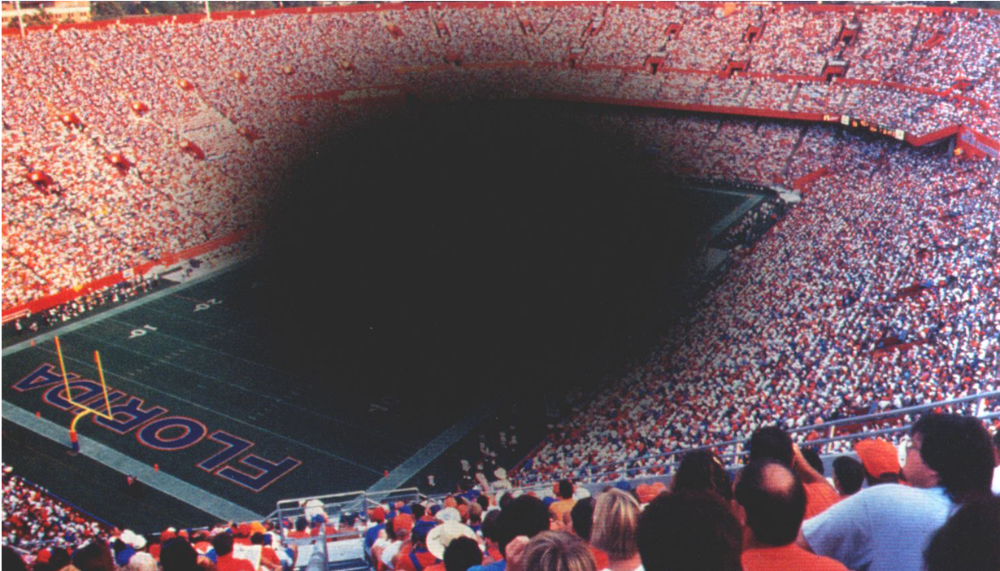
what condition does this patient have?
age related macular degeneration (ARMD)
Age-related macular degeneration (ARMD) has two types: ______ ARMD, which accounts for about ______% of cases, and ______ ARMD, which makes up about ______% and causes the most severe vision loss.
dry, 90, wet, 10
age-related macular degeneration: both types ______ ______ from their ______ ______
separate photoreceptors, blood supply
Dry ARMD involves accumulation of ______ between ______'s membrane and the ______ ______, leading to gradual retinal damage.
drusen, Bruch, pigmented epithelium
Wet ARMD is characterized by growth of new ______ ______ that push against the ______ ______, causing further separation and more severe vision loss.
blood vessels, pigmented epithelium
how do you test for ARMD?
______ ______
amsler grid
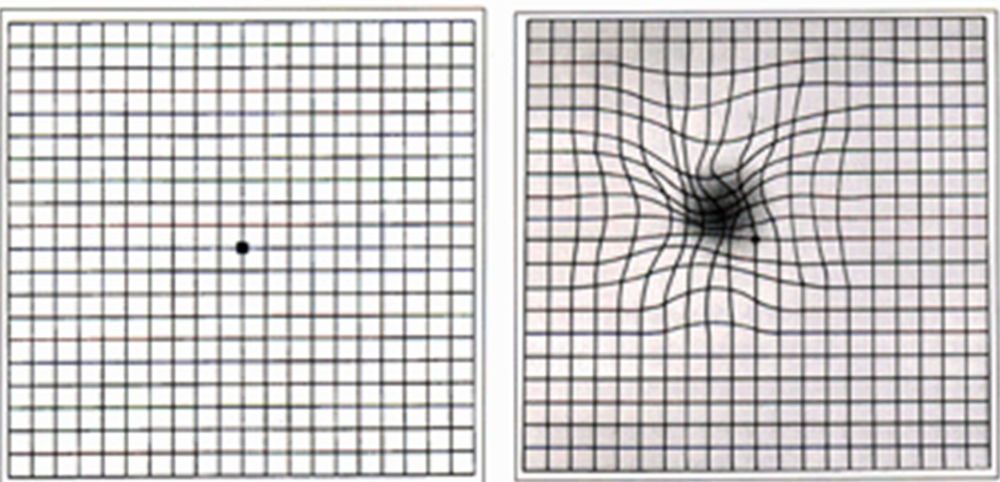
What is this?
amsler grid test
Retinal detachment occurs between the ______ ______ and the photoreceptors of the ______ ______; this separation deprives photoreceptors of ______ and ______, leading to their death.
pigmented epithelium, neural retina, oxygen, nutrients
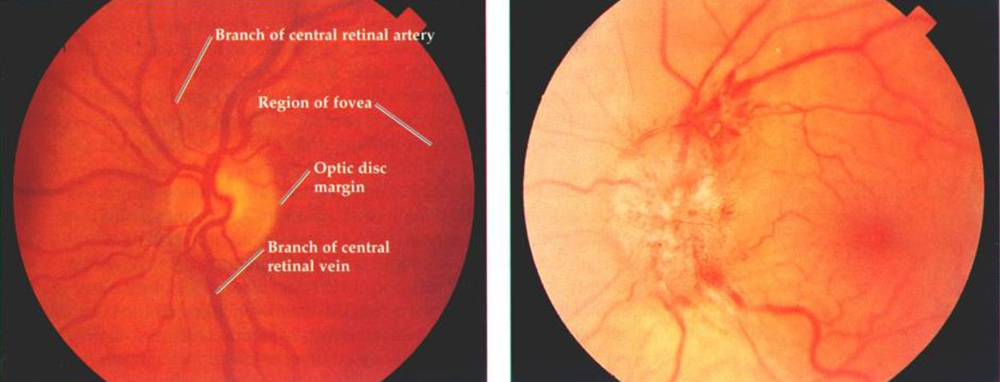
What condition is this?
papilladema
Papilledema is the bulging of the ______ disc or papilla into the eye due to increased ______ ______.
optic, intracranial pressure
The anterior chamber of the eye is bounded anteriorly by the ______, posteriorly by the ______, and laterally by the angle of the ______, occupied by the ______ ______ through which aqueous humor drains to the ______ of Schlemm.
cornea, iris, limbus, trabecular meshwork, canal
The posterior chamber of the eye is bounded anteriorly by the ______, posteriorly by the ______ and ______ fibers, and peripherally by the ______ ______.
iris, lens, zonule, ciliary processes
Aqueous humor drains by collecting in the ______ ______, then passing into the ______ of Schlemm, which encircles the eye, and ultimately entering the ______ circulation via the ______ veins.
trabecular meshwork, canal, venous, aqueous
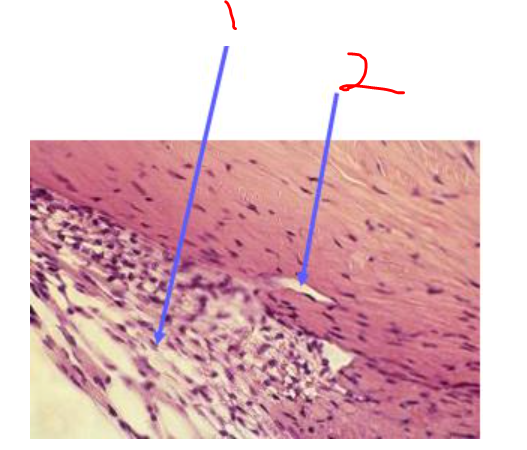
What is 1?
trabecular meshwork
What is 2?
canal of schlemm
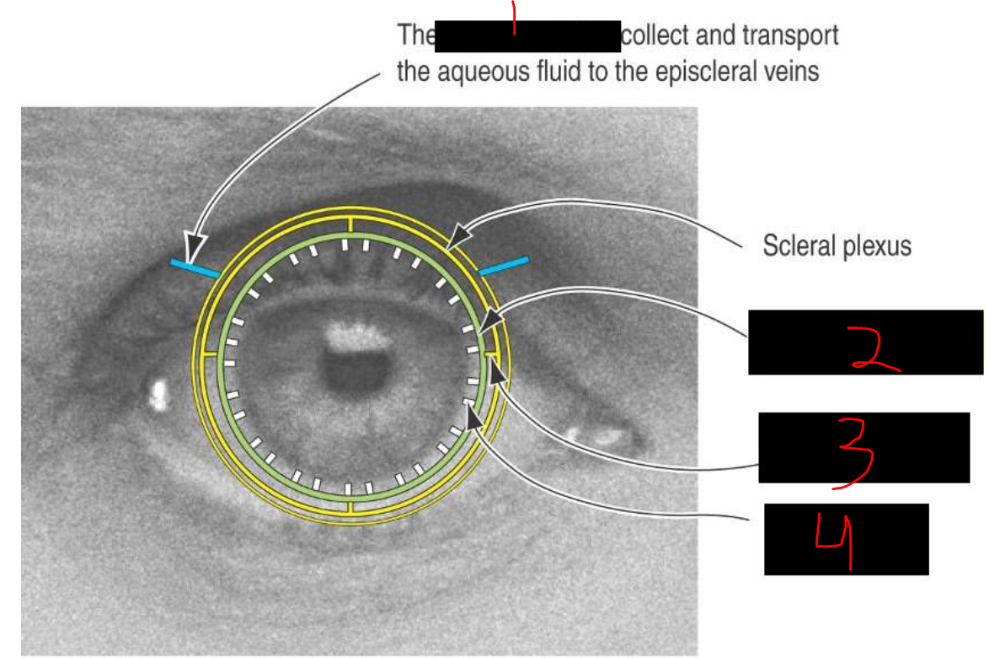
What is 1?
aqueous veins
What is 2?
canal of schlemm
What is 3?
external collecting channel
What is 4?
trabecular meshwork
The two main types of glaucoma are ______ ______ glaucoma, which is the most common and a major cause of blindness, and ______ ______ (also called ______-angle) glaucoma, which is rarer.
primary open-angle, primary closed-angle, narrow
Primary open-angle glaucoma features a normal ______ of the anterior chamber, caused by slow blockage of the ______ of Schlemm, leading to a gradual, often unnoticed increase in intraocular pressure and eventual visual field ______.
angle, canal, defects
Primary closed-angle glaucoma occurs when the angle of the anterior chamber is blocked by the ______; it opens when the pupil is ______ and closes when the pupil ______, causing rapid onset symptoms like ocular ______, blurred vision, and halos around ______.
iris, constricted, dilates, pain, lights
Optic cupping is caused by increased ______ pressure and is a sign or symptom of ______.
intraocular, glaucoma
In optic cupping, the optic disc appears ______ and ______, which can lead to ______ atrophy and neuronal ______.
pale, enlarged, retinal, death
The vitreous body is a homogenous, transparent ______ that fills the large ______ chamber in the ______ segment of the eye, composed of about ______% water, collagen, and ______.
gel, vitreous, posterior, 99, GAGs
The vitreous body contains ______, which synthesize collagen and GAGs, and functions to help maintain the ______ in its proper position.
halocytes, retina
Floaters are ______ in the vitreous, usually aggregates of ______ proteins, seen as fine ______ particles moving about; they are typically benign but a sudden increase can indicate serious ______ disease.
deposits, vitreal, dust-like, eye
During a vitrectomy, the ______ or ______ vitreous humor is removed and replaced with ______ to maintain the eye’s shape and keep the ______ in position.
cloudy, bloody, saline, retina
Age-related macular degeneration (ARMD) specifically affects the ______ and the ______ ______ of the eye.
macula, fovea centralis