Anatomy JV Exam 3: Anterior Triangle
what vertebral level is the hyoid bone?
_____
C3
what vertebral level is the thryoid cartilage?
_____-_____
C4-C5
what vertebral level is the cricoid cartilage?
_____
C6
at what rings is the isthmus of the thyroid gland?
around level of _____ through _____ _____ rings
2nd, 4th, tracheal
at what level does the common carotid a. bifurcate?
_____
C4
major structures that pass between the head and the thorax can be accessed through _______ _______
anterior triangle
major structures that pass between the head and the upper limb can be accessed through the ______ ______
posterior triangle
what are the boundaries of the anterior & posterior triangles of the neck?
anterior - ______ ______ of ______ , ______ , ______
posterior - ______ , ______ ______ ______ , ______
anterior midline of neck, SCM, mandible
SCM, middle 1/3 clavicle, trapezius
the platysma muscle lies within what fascia?
______ ______ ______
superficial cervical fascia
The platysma muscle has its superior attachment where it blends with the muscles of ________ ________, and its inferior attachment is to fascia over the ________ and ________ ________ muscles. It is innervated by the ________ branch of the ________ nerve (CN ________).
facial expression, deltoid, pectoralis major, cervical, facial, VII,
The ________ nerves (C___ & C___ of the cervical plexus) pierce it to innervate the skin.
supraclavicular, 3, 4
The superficial cervical fascia contains ________ nerves, ________ vessels, ________ vessels, ________, and the ________ muscle.
cutaneous, blood, lymphatic, fat, platysma
what are the layers/regions of deep cervical fascia?
-________ fascia
-________ fascia
-________ fascia
investing, pretracheal, prevertebral
The investing layer of deep cervical fascia splits to enclose the ________ and ________ muscles, the ________ and ________ glands, and at the ________ to create the ________ space.
sternocleidomastoid, trapezius, submandibular, parotid, manubrium, suprasternal
where does the investing layer of deep cervical fascia attach posteriorly?
attaches to ________ ________ & ________ ________
attaches to ligamentum nucahe & spinous processes
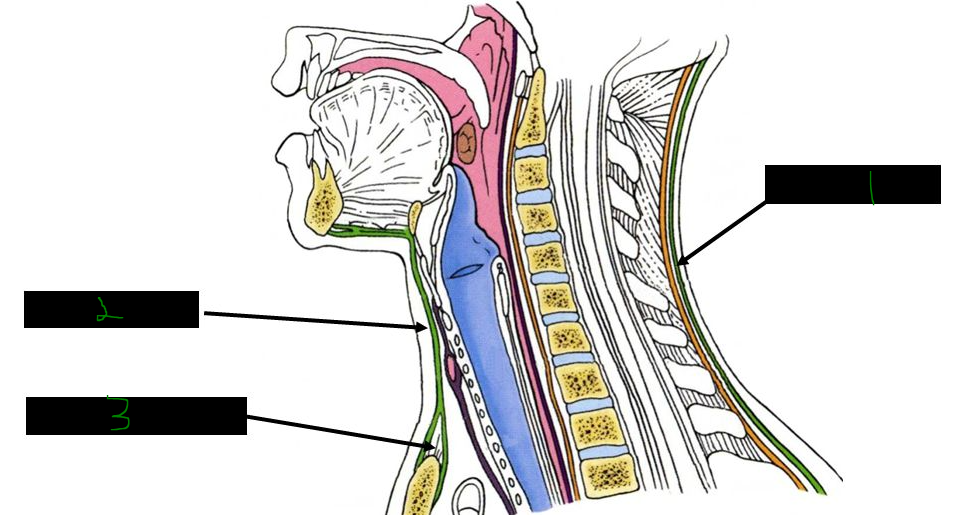
What is 1?
investing layer
What is 2?
investing layer
What is 3?
suprasternal space
what layer encloses structures in the visceral part of the neck?
______ ______
pretracheal layer
The pretracheal layer of deep cervical fascia extends from the ________ bone inferiorly to blend with the ________ ________ of the heart.
hyoid, fibrous pericardium
The ________ fascia is a posterior continuation of the pretracheal fascia and surrounds the ________ and ________.
buccopharyngeal, pharynx, esophagus
The pretracheal fascia has a ________ layer enclosing the infrahyoid muscles and a ________ layer enclosing the thyroid gland, trachea, and esophagus; it also forms ligaments that suspend the ________ and ________ muscles.
muscular, visceral, digastric, omohyoid
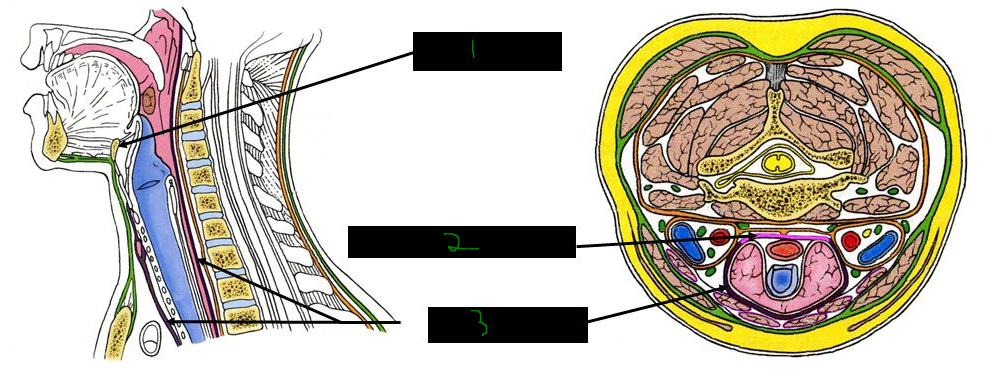
What is 1?
hyoid bone
What is 2?
buccopharyneal
What is 3?
pretracheal
_____ is name change/continuation or pretracheal fasica, not another layer
buccopharyngeal
the prevertebral layer of deep cervical fascia extends laterally to surround what structures?
_____ _____ & _____ _____ (_____ _____)
brachial plexus & axillary vessels (axillary sheath)
The ________ fascia is a second layer of prevertebral fascia located between the ________ portion of the prevertebral fascia and the ________ fascia.
alar, posterior, buccopharyngeal
The alar fascia extends from the ________ to ________ and subdivides the ________ space, terminating laterally at the ________ sheath.
cranium, C7, retropharyngeal, carotid
The carotid sheath contains the ________ & ________ carotid arteries, ________ vein, ________ nerve, deep cervical ________ nodes, sympathetic nerve ________, and the ________ sinus nerve.
common, internal, internal jugular, vagus, lymph, fibers, carotid
carotid sheath extends from ________ ________ to root of the ________
cranial base
neck
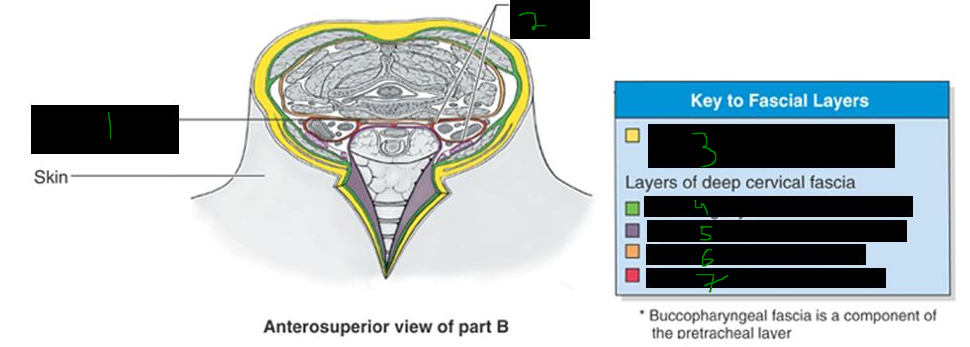
What is 1?
retropharyngeal space
What is 2?
carotid sheath
What is 3?
subcutaneous tissue of neck (superficial cervical fascia)
What is 4?
investing layer
What is 5?
pretracheal layer
What is 6?
prevertebral layer
What is 7?
alar fascia and caritid sheath
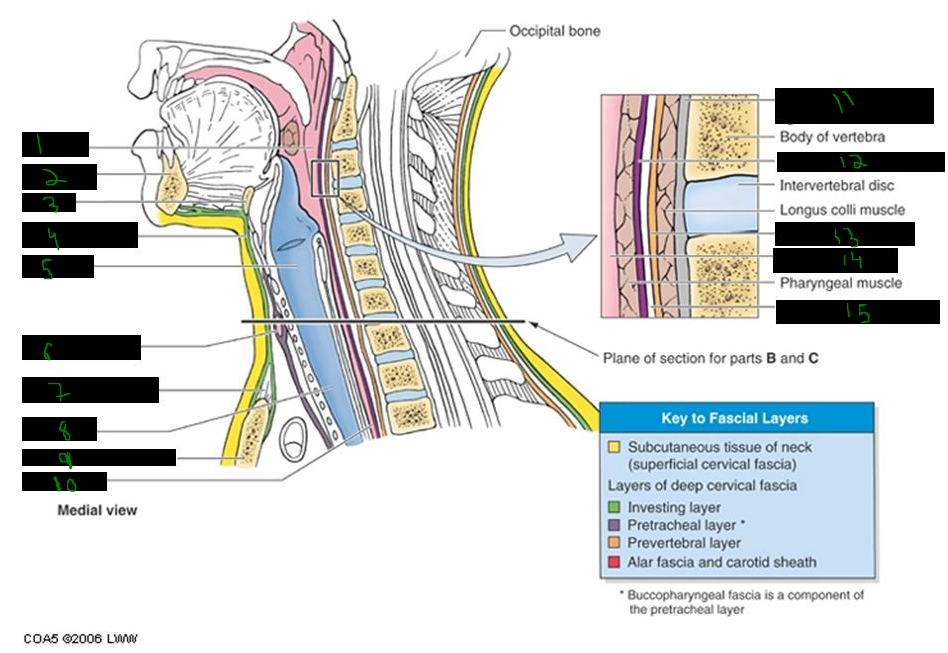
What is 1?
pharynx
What is 2?
mandible
What is 3?
hyoid
What is 4?
investing fascia
What is 5?
larynx
What is 6?
thyroid isthmus
What is 7?
suprasternal space
What is 8?
trachea
What is 9?
manubrium of sternum
What is 10?
esophagus
What is 11?
anterior longitudinal ligament
What is 12?
buccopharyngeal fascia
What is 13?
prevertebral fascia
What is 14?
pharynx
What is 15?
retropharyngeal space
at what vertebral level does the alar fascia fuse w/ the buccopharyngeal fascia?
____
T4
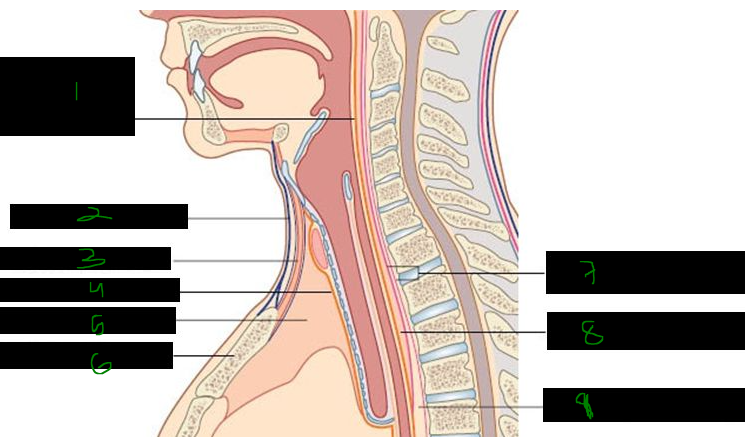
What is 1?
buccopharyngeal fascia
What is 2?
investing layer
What is 3?
infrahyoid muscles
What is 4?
pretracheal fascia
What is 5?
pretracheal space
What is 6?
manubrium of sternum
What is 7?
prevertebral layer
What is 8?
retropharyngeal spcae
What is 9?
fascial space with prevertebral layer
an infection in the pretracheal space can spread where?
from ___ to ___
from neck to pericardium
The retropharyngeal space is located between the ________ and ________ layers of fascia, and infection here can spread to the ________ mediastinum.
alar, buccopharyngeal, superior
The prevertebral space (aka the "danger space") lies between the ________ and ________ fascial layers, and infection here can spread to the ________ mediastinum and down to the ________.
alar, prevertebral, posterior, diaphragm
what are the subdivisions of the anterior triangle?
________/________ ________
________ ________ ________
________ ________ (unpaired)
________ ________/________ ________
submandibular/digastric triangle
superior carotid triangle
submental triangle (unpaired)
inferior carotid/muscular triangle
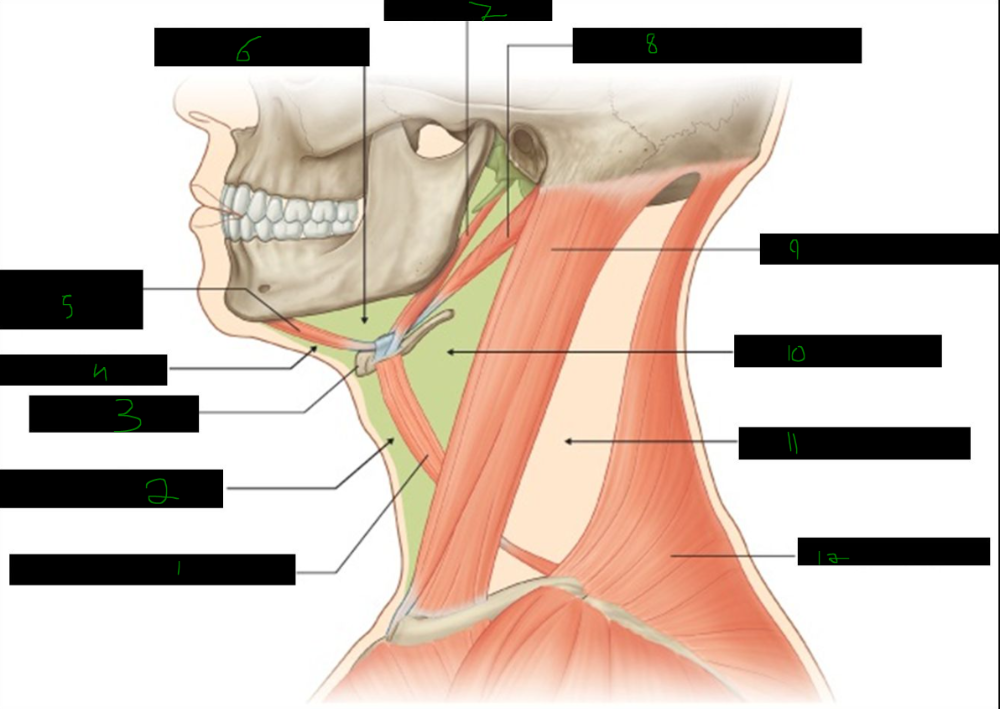
What is 1?
superior belly of omohyoid muscle
What is 2?
muscular triangle
What is 3?
hyoid bone
What is 4?
submental triangle
What is 5?
anterior belly of digastric muscle
What is 6?
submandibular triangle
What is 7?
stylohyoid muscle
What is 8?
posterior belly of digastric muscle
What is 9?
sternocleidomastoid muscle
What is 10?
carotid triangle
What is 11?
posterior triangle
What is 12?
trapezius muscle
what forms the roof & floor of the anterior triangle?
roof - ____ ____ & the ____ muscle
floor - ____ covering the ____ , ____ , & ____ gland
roof - superficial fascia & the platysma muscle
floor - fascia covering the pharynx, larynx, & thyroid gland
The submental triangle is an _______ neck triangle bounded by the _______ symphysis, anterior belly of the _______ muscle, and the body of the _______ bone.
unpaired, mandibular, digastric, hyoid
The contents of the submental triangle include the submental _______ nodes and tributaries forming the anterior _______ vein.
lymph, jugular
The submandibular triangle, also known as the _______ triangle, is a _______ neck triangle bounded by the lower border of the _______, anterior belly of the _______, and posterior belly of the _______.
digastric, paired, mandible, digastric, digastric
The carotid sheath in the superior carotid triangle contains the common _______, internal _______, internal jugular , and vagus (_______) nerve.
carotid, carotid, vein, X
Branches of the external carotid artery in the superior carotid triangle include superior _______, ascending _______, _______, _______, _______, posterior _______, _______, and superficial _______.
thyroid, pharyngeal, lingual, facial, occipital, auricular, maxillary, temporal
Other contents of the superior carotid triangle include tributaries of the internal jugular , hypoglossal () nerve, and roots of the _______ cervicalis (superior and inferior).
vein, XII, ansa
Additional nerves in the superior carotid triangle include the cervical branch of the facial () nerve, accessory () nerve, and transverse cervical _______.
VII, XI, nerve
The superior carotid triangle is a _______ neck triangle bounded by the posterior belly of the _______, superior belly of the _______, and anterior border of the _______.
paired, digastric, omohyoid, SCM
The contents of the superior carotid triangle include the carotid _______, which contains the common _______, internal _______, internal _______, and vagus (_______) nerve.
sheath, carotid, carotid, vein, jugular, X
The inferior carotid triangle, also known as the _______ triangle, is a _______ neck triangle bounded by the midline of the _______, superior belly of the _______, and anterior border of the _______.
muscular, paired, neck, omohyoid, SCM
The contents of the inferior carotid triangle include the _______ muscle, _______ muscle, _______, _______ muscle, thyroid and _______ glands, and the _______.
sternohyoid, sternothyroid, omohyoid, thyrohyoid, parathyroid, pharynx
The _______ muscles are a group that elevate the _______ bone and can lower the _______ when the hyoid is fixed from below.
suprahyoid, hyoid, mandible
The stylohyoid muscle is innervated by the _______ nerve, which is cranial nerve _______.
facial, VII
The digastric muscle has two bellies: the _______ belly is innervated by the facial nerve (VII), while the _______ belly is innervated by the _______ nerve.
posterior, anterior, mylohyoid
The mylohyoid nerve is a _______ of the inferior _______ nerve, which comes from cranial nerve _______.
branch, alveolar, V3
The _______ muscle is innervated by the mylohyoid nerve, while the _______ muscle is innervated by the C1 anterior ramus via the _______ nerve.
mylohyoid, geniohyoid, hypoglossal
The geniohyoid muscle receives innervation from the _______ anterior ramus that travels via cranial nerve _______, which is the _______ nerve.
C1, XII, hypoglossal
The _______ muscles are a group that _______ the hyoid bone, opposite to the action of the suprahyoid muscles.
infrahyoid, depress
Three infrahyoid muscles - the _______, _______, and _______ - are all innervated by C1-3 anterior rami via the ansa cervicalis.
sternohyoid, omohyoid, sternothyroid
The _______ muscle is the exception among infrahyoid muscles, receiving innervation from the _______ anterior ramus via the _______ nerve.
thyrohyoid, C1, hypoglossal
The ansa _______ carries nerve fibers from spinal segments _______ -_______ to innervate most infrahyoid muscles.
cervicalis, C1, C3
While most infrahyoid muscles receive innervation via the ansa cervicalis, the thyrohyoid muscle is innervated via cranial nerve _______, which is the _______ nerve.
XII, hypoglossal
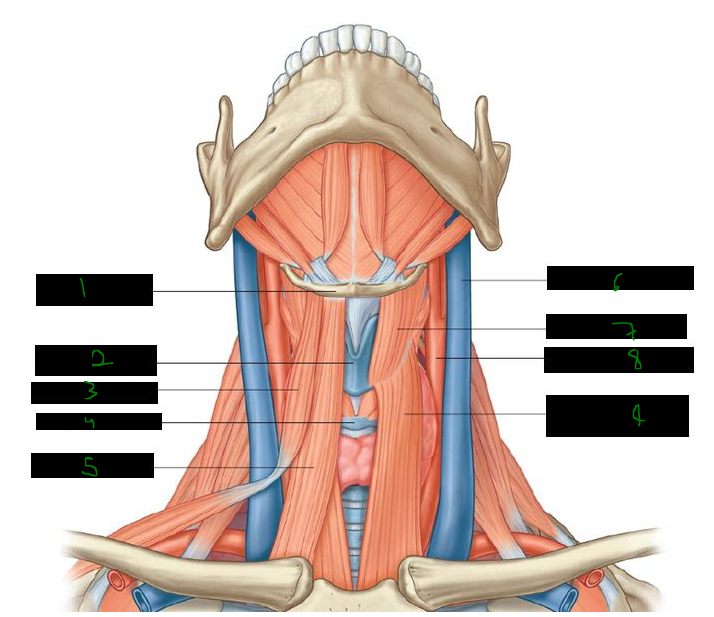
What is 1?
hyoid bone
What is 2?
thyroid cartilage
What is 3?
omohyoid muscle
What is 4?
cricoid cartilage
What is 5?
sternohyoid muscle
What is 6?
internal jugular vein
What is 7?
thyrohyoid muscle
What is 8?
common carotid artery
What is 9?
sternothyroid muscle
what muscles are innervated by C1 ant rami via hypoglossal n (XII)?
_____ (_____ group)
_____ (_____ group)
thyrohyoid (infrahyoid group)
geniohyoid (suprahyoid group)
The branches of the external carotid artery are: _______ _______ (1st branch), _______ pharyngeal, _______, _______, _______, posterior _______, and the two terminal branches _______ and superficial _______.
superior thyroid, ascending, lingual, facial, occipital, auricular, maxillary, temporal
Some Anatomists Like Freaking Out Poor Medical Students
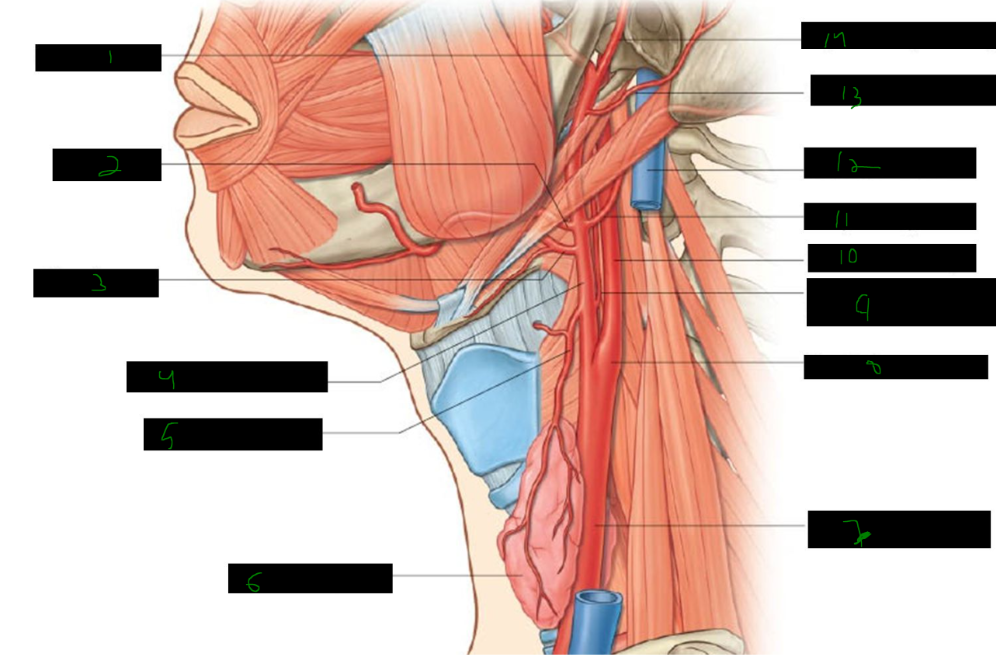
What is 1?
maxillary artery
What is 2?
facial artery
What is 3?
lingual artery
What is 4?
external carotid artery
What is 5?
superior thyroid artery
What is 6?
thyroid gland
What is 7?
common carotid artery
What is 8?
carotid sinus
What is 9?
ascending pharyngeal artery
What is 10?
internal carotid artery
What is 11?
occipital artery
What is 12?
internal jugular vein
What is 13?
posterior auricular artery
What is 14?
superficial temporal artery
The first branch of the external carotid artery is the _______ _______ artery.
The terminal branches of the external carotid artery are the _______ _______ artery and the _______ artery.
superior thyroid
superficial temporal, maxillary
The common carotid and external carotid pulses can be palpated in the _______ triangle of the neck, with the common carotid felt _______ to the larynx and the external carotid felt immediately _______ to the pharynx midway between the superior margin of the _______ cartilage and below the greater horn of the _______ bone.
anterior, posterolateral, lateral, thyroid, hyoid
The glossopharyngeal nerve emerges deep to the _______ process and passes between the internal and external _______ arteries.
styloid, carotid
The glossopharyngeal nerve sends sensory branches to the carotid _______ and the _______.
sinus, pharynx
The glossopharyngeal nerve passes across the lateral border of the _______ muscle and innervates it.
stylopharyngeus
The glossopharyngeal nerve continues anteriorly, deep to the _______, to reach the base of the _______ and the palatine _______.
hyoglossus, tongue, tonsil
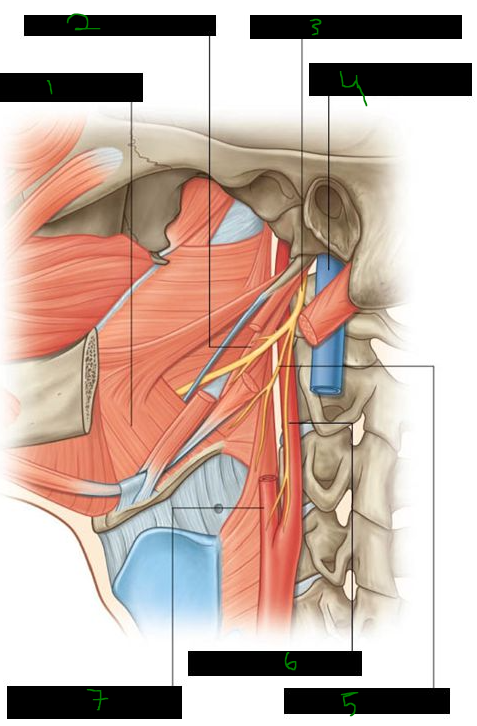
What is 1?
hyoglossus muscle
What is 2?
stylopharyngeus muscle
What is 3?
glossopharyngeal nerve IX
What is 4?
internal jugular vein
What is 5?
pharyngeal branch
What is 6?
carotid sinus branch
What is 7?
external carotid artery
The vagus nerve enters the _______ sheath and descends through the neck medial to the _______ jugular vein and posterior to the _______ arteries.
carotid, internal, carotid
The vagus nerve sends motor branches to the _______, sensory branches to the carotid _______, and gives off the superior _______ nerve and possibly a _______ branch.
pharynx, body, laryngeal, cardiac
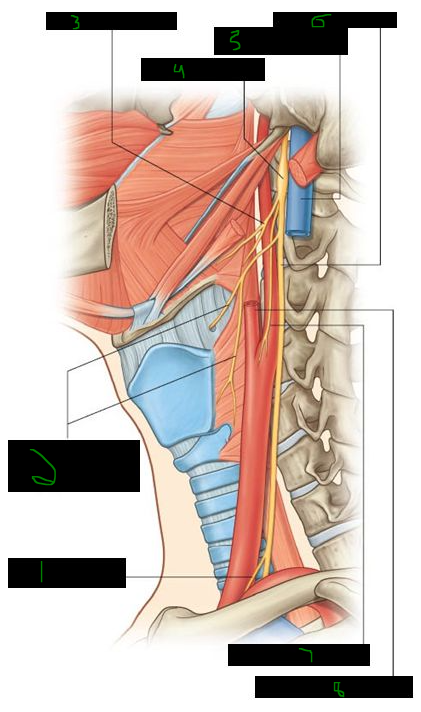
What is 1?
cardiac branch
What is 2?
internal and external branches of superior laryngeal nerve
What is 3?
pharyngeal branch
What is 4?
inferior ganglion
What is 5?
internal jugular vein
What is 6?
vagus nerve X
What is 7?
carotid body branch
What is 8?
external carotid artery
The carotid sinus contains _______ that detect changes in arterial _______ pressure.
The carotid sinus is innervated primarily by the _______ nerve (cranial nerve _______) with contributions from the _______ nerve (cranial nerve _______).
baroreceptors, blood
glossopharyngeal, IX, vagus, X
The carotid body is located on the _______ side of the carotid bifurcation near the carotid _______, functions as a _______ that monitors _______ levels in blood, and is innervated by the _______ nerve with contributions from the _______ nerve.
deep, sinus, chemoreceptor, O2, glossopharyngeal, vagus
The accessory nerve descends medial to the _______ _______ vein and crosses its lateral surface deep to the _______ muscle.
The accessory nerve gives _______ branches in the anterior triangle and innervates the _______ and _______ muscles.
internal jugular, SCM
no, SCM, trapezius
The hypoglossal nerve crosses between the _______ _______ vein and _______ _______ artery, hooks around the _______ artery, travels deep to the posterior belly of the _______ and _______ muscles, then travels superficial to the _______ and disappears deep to the _______; it gives _______ branches in the anterior triangle en route to the _______.
internal jugular, internal carotid, occipital, digastric, stylohyoid, hyoglossus, mylohyoid, no, tongue
The transverse cervical nerve is a branch of the _______ plexus from spinal segments _______ and _______, loops around the _______ muscle, and provides _______ innervation to the skin of the _______ triangle.
cervical, C2, C3, SCM, sensory, anterior
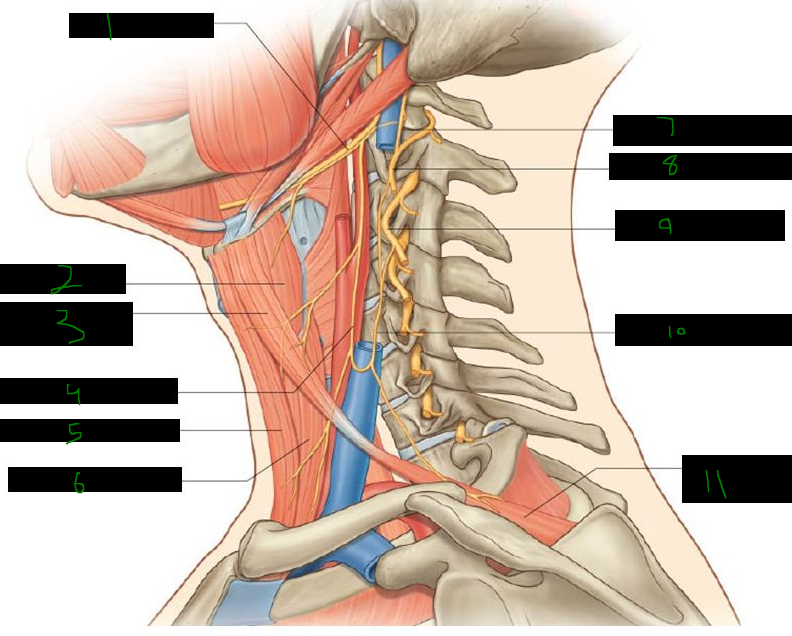
What is 1?
hypoglossal nerve
What is 2?
thyrohoid muscle
What is 3?
omohyoid muscle (superior belly)
What is 4?
superior root of ansa cervicalis
What is 5?
sternohyoid muscle
What is 6?
sternothyroid muscle
What is 7?
C1
What is 8?
C2
What is 9?
C3
What is 10?
inferior root of ansa cervicalis
What is 11?
omohyoid muscle (inferior belly)
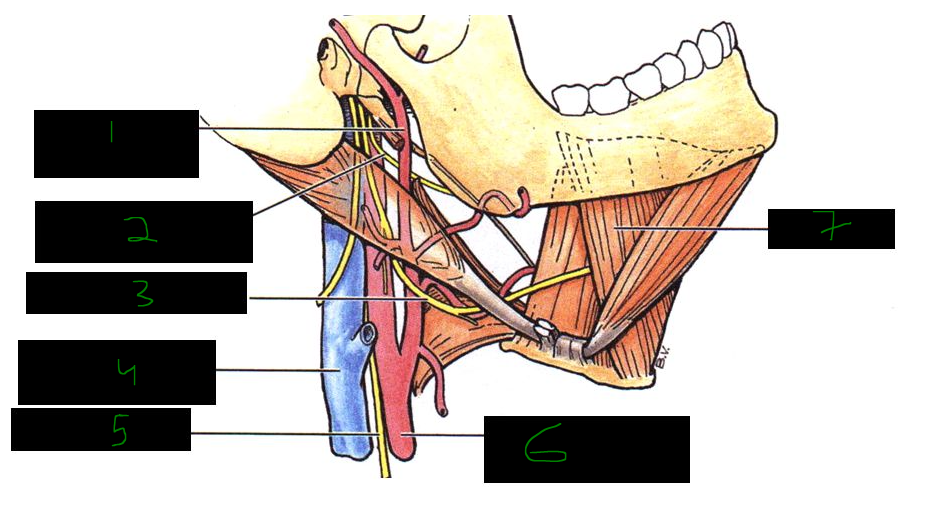
What is 1?
external carotid artery
What is 2?
glossopharyngeal nerve
What is 3?
hyoglossal nerve
What is 4?
internal jugular vein
What is 5?
vagus nerve
What is 6?
common carotid artery
What is 7?
mylohyoid
which cervical nerves form the roots of the ansa cervicalis
superior root - branches of ___, ___
inferior root - branches of ___, ___
C1, C2
C2, C3
The thyroid gland receives blood from the _______ _______ artery, the first branch of the _______ _______ artery, and the _______ _______ artery, a branch of the _______ trunk.
superior thyroid, external carotid, inferior thyroid, thyrocervical
During a thyroidectomy, care must be taken not to damage the _______ nerves and to retain the _______ _______ glands.
laryngeal, parathyroid