Instructions for Side by Side Printing
- Print the notecards
- Fold each page in half along the solid vertical line
- Cut out the notecards by cutting along each horizontal dotted line
- Optional: Glue, tape or staple the ends of each notecard together
Anatomy JV Exam 3: Anterior Triangle
front 1 what vertebral level is the hyoid bone? _____ | back 1 C3 |
front 2 what vertebral level is the thryoid cartilage? _____-_____ | back 2 C4-C5 |
front 3 what vertebral level is the cricoid cartilage? _____ | back 3 C6 |
front 4 at what rings is the isthmus of the thyroid gland? around level of _____ through _____ _____ rings | back 4 2nd, 4th, tracheal |
front 5 at what level does the common carotid a. bifurcate? _____ | back 5 C4 |
front 6 major structures that pass between the head and the thorax can be accessed through _______ _______ | back 6 anterior triangle |
front 7 major structures that pass between the head and the upper limb can be accessed through the ______ ______ | back 7 posterior triangle |
front 8 what are the boundaries of the anterior & posterior triangles of the neck? anterior - ______ ______ of ______ , ______ , ______ posterior - ______ , ______ ______ ______ , ______ | back 8 anterior midline of neck, SCM, mandible SCM, middle 1/3 clavicle, trapezius |
front 9 the platysma muscle lies within what fascia? ______ ______ ______ | back 9 superficial cervical fascia |
front 10 The platysma muscle has its superior attachment where it blends with the muscles of ________ ________, and its inferior attachment is to fascia over the ________ and ________ ________ muscles. It is innervated by the ________ branch of the ________ nerve (CN ________). | back 10 facial expression, deltoid, pectoralis major, cervical, facial, VII, |
front 11 The ________ nerves (C___ & C___ of the cervical plexus) pierce it to innervate the skin. | back 11 supraclavicular, 3, 4 |
front 12 The superficial cervical fascia contains ________ nerves, ________ vessels, ________ vessels, ________, and the ________ muscle. | back 12 cutaneous, blood, lymphatic, fat, platysma |
front 13 what are the layers/regions of deep cervical fascia? -________ fascia -________ fascia -________ fascia | back 13 investing, pretracheal, prevertebral |
front 14 The investing layer of deep cervical fascia splits to enclose the ________ and ________ muscles, the ________ and ________ glands, and at the ________ to create the ________ space. | back 14 sternocleidomastoid, trapezius, submandibular, parotid, manubrium, suprasternal |
front 15 where does the investing layer of deep cervical fascia attach posteriorly? attaches to ________ ________ & ________ ________ | back 15 attaches to ligamentum nucahe & spinous processes |
front 16 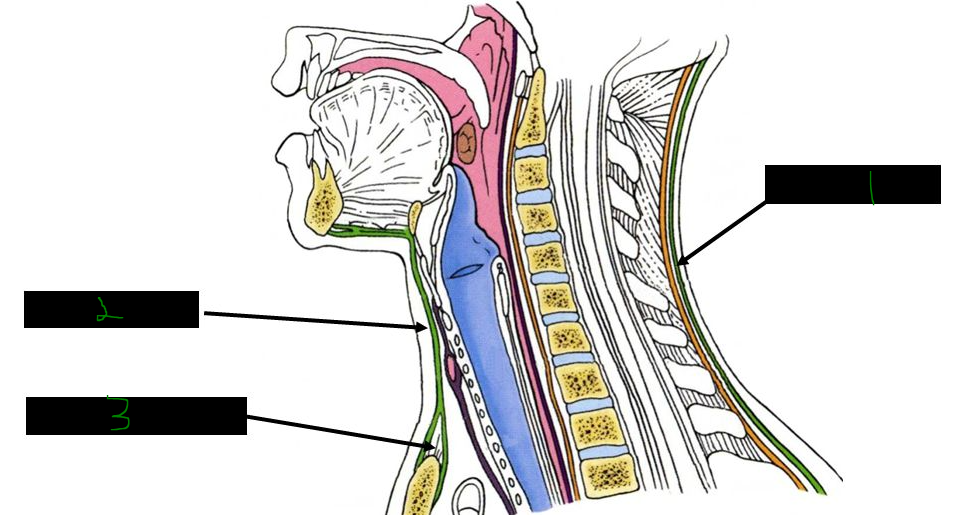 What is 1? | back 16 investing layer |
front 17 What is 2? | back 17 investing layer |
front 18 What is 3? | back 18 suprasternal space |
front 19 what layer encloses structures in the visceral part of the neck? ______ ______ | back 19 pretracheal layer |
front 20 The pretracheal layer of deep cervical fascia extends from the ________ bone inferiorly to blend with the ________ ________ of the heart. | back 20 hyoid, fibrous pericardium |
front 21 The ________ fascia is a posterior continuation of the pretracheal fascia and surrounds the ________ and ________. | back 21 buccopharyngeal, pharynx, esophagus |
front 22 The pretracheal fascia has a ________ layer enclosing the infrahyoid muscles and a ________ layer enclosing the thyroid gland, trachea, and esophagus; it also forms ligaments that suspend the ________ and ________ muscles. | back 22 muscular, visceral, digastric, omohyoid |
front 23 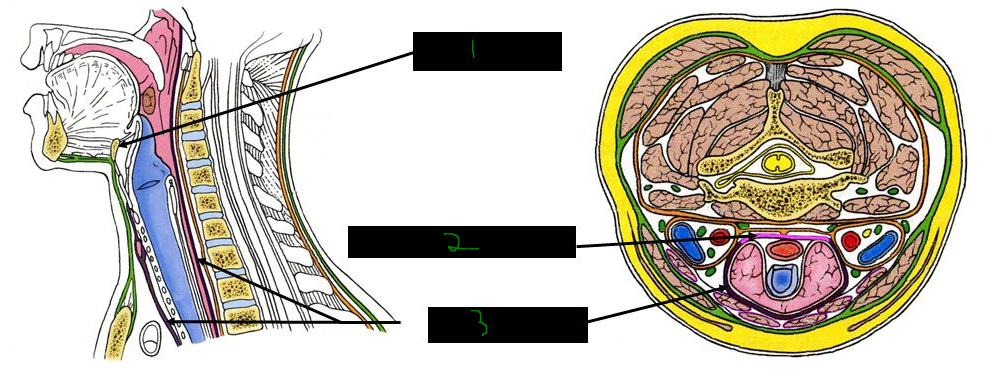 What is 1? | back 23 hyoid bone |
front 24 What is 2? | back 24 buccopharyneal |
front 25 What is 3? | back 25 pretracheal |
front 26 _____ is name change/continuation or pretracheal fasica, not another layer | back 26 buccopharyngeal |
front 27 the prevertebral layer of deep cervical fascia extends laterally to surround what structures? _____ _____ & _____ _____ (_____ _____) | back 27 brachial plexus & axillary vessels (axillary sheath) |
front 28 The ________ fascia is a second layer of prevertebral fascia located between the ________ portion of the prevertebral fascia and the ________ fascia. | back 28 alar, posterior, buccopharyngeal |
front 29 The alar fascia extends from the ________ to ________ and subdivides the ________ space, terminating laterally at the ________ sheath. | back 29 cranium, C7, retropharyngeal, carotid |
front 30 The carotid sheath contains the ________ & ________ carotid arteries, ________ vein, ________ nerve, deep cervical ________ nodes, sympathetic nerve ________, and the ________ sinus nerve. | back 30 common, internal, internal jugular, vagus, lymph, fibers, carotid |
front 31 carotid sheath extends from ________ ________ to root of the ________ | back 31 cranial base neck |
front 32 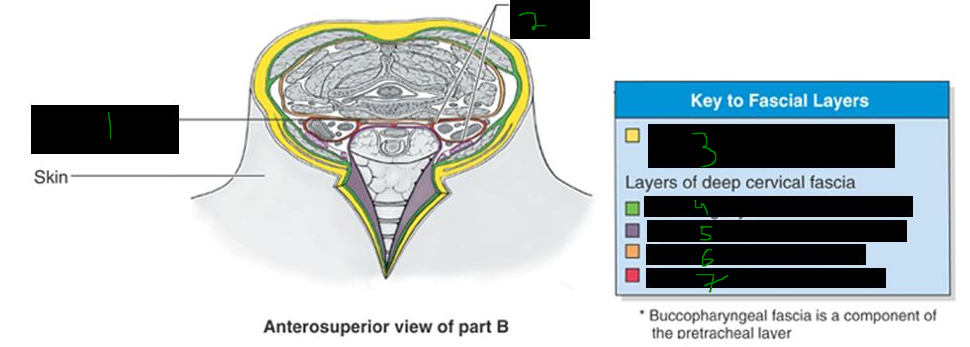 What is 1? | back 32 retropharyngeal space |
front 33 What is 2? | back 33 carotid sheath |
front 34 What is 3? | back 34 subcutaneous tissue of neck (superficial cervical fascia) |
front 35 What is 4? | back 35 investing layer |
front 36 What is 5? | back 36 pretracheal layer |
front 37 What is 6? | back 37 prevertebral layer |
front 38 What is 7? | back 38 alar fascia and caritid sheath |
front 39 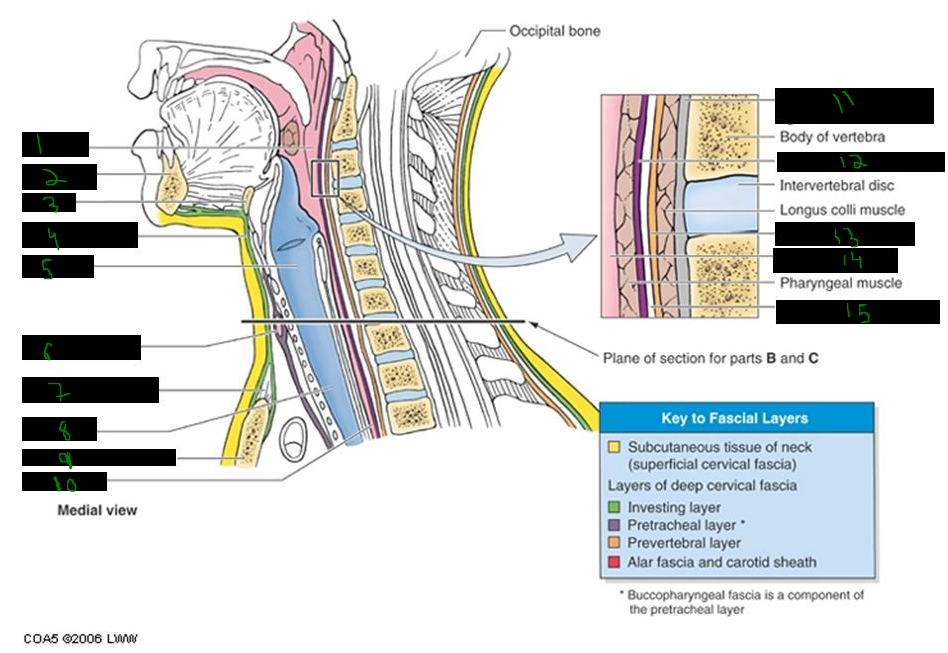 What is 1? | back 39 pharynx |
front 40 What is 2? | back 40 mandible |
front 41 What is 3? | back 41 hyoid |
front 42 What is 4? | back 42 investing fascia |
front 43 What is 5? | back 43 larynx |
front 44 What is 6? | back 44 thyroid isthmus |
front 45 What is 7? | back 45 suprasternal space |
front 46 What is 8? | back 46 trachea |
front 47 What is 9? | back 47 manubrium of sternum |
front 48 What is 10? | back 48 esophagus |
front 49 What is 11? | back 49 anterior longitudinal ligament |
front 50 What is 12? | back 50 buccopharyngeal fascia |
front 51 What is 13? | back 51 prevertebral fascia |
front 52 What is 14? | back 52 pharynx |
front 53 What is 15? | back 53 retropharyngeal space |
front 54 at what vertebral level does the alar fascia fuse w/ the buccopharyngeal fascia? ____ | back 54 T4 |
front 55 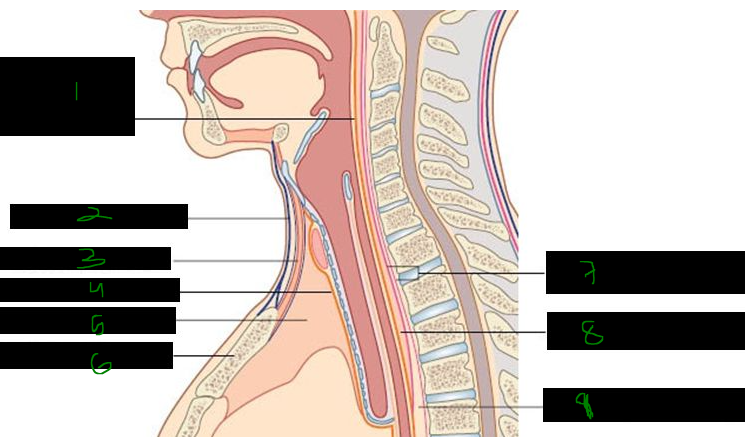 What is 1? | back 55 buccopharyngeal fascia |
front 56 What is 2? | back 56 investing layer |
front 57 What is 3? | back 57 infrahyoid muscles |
front 58 What is 4? | back 58 pretracheal fascia |
front 59 What is 5? | back 59 pretracheal space |
front 60 What is 6? | back 60 manubrium of sternum |
front 61 What is 7? | back 61 prevertebral layer |
front 62 What is 8? | back 62 retropharyngeal spcae |
front 63 What is 9? | back 63 fascial space with prevertebral layer |
front 64 an infection in the pretracheal space can spread where? from ___ to ___ | back 64 from neck to pericardium |
front 65 The retropharyngeal space is located between the ________ and ________ layers of fascia, and infection here can spread to the ________ mediastinum. | back 65 alar, buccopharyngeal, superior |
front 66 The prevertebral space (aka the "danger space") lies between the ________ and ________ fascial layers, and infection here can spread to the ________ mediastinum and down to the ________. | back 66 alar, prevertebral, posterior, diaphragm |
front 67 what are the subdivisions of the anterior triangle? ________/________ ________ ________ ________ ________ ________ ________ (unpaired) ________ ________/________ ________ | back 67 submandibular/digastric triangle superior carotid triangle submental triangle (unpaired) inferior carotid/muscular triangle |
front 68 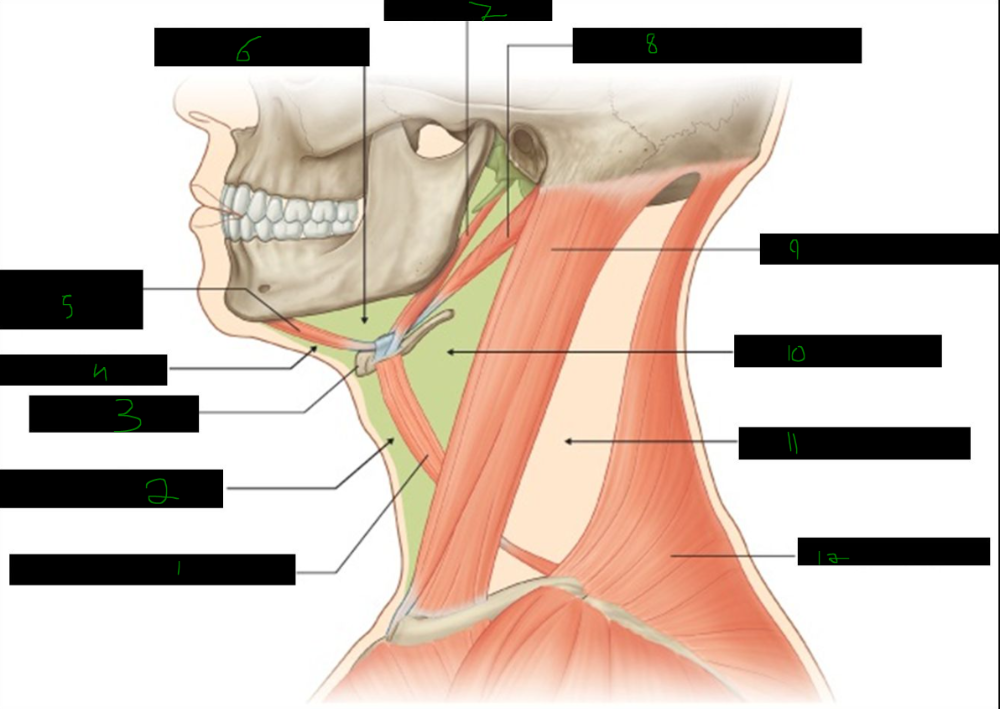 What is 1? | back 68 superior belly of omohyoid muscle |
front 69 What is 2? | back 69 muscular triangle |
front 70 What is 3? | back 70 hyoid bone |
front 71 What is 4? | back 71 submental triangle |
front 72 What is 5? | back 72 anterior belly of digastric muscle |
front 73 What is 6? | back 73 submandibular triangle |
front 74 What is 7? | back 74 stylohyoid muscle |
front 75 What is 8? | back 75 posterior belly of digastric muscle |
front 76 What is 9? | back 76 sternocleidomastoid muscle |
front 77 What is 10? | back 77 carotid triangle |
front 78 What is 11? | back 78 posterior triangle |
front 79 What is 12? | back 79 trapezius muscle |
front 80 what forms the roof & floor of the anterior triangle? roof - ____ ____ & the ____ muscle floor - ____ covering the ____ , ____ , & ____ gland | back 80 roof - superficial fascia & the platysma muscle floor - fascia covering the pharynx, larynx, & thyroid gland |
front 81 The submental triangle is an _______ neck triangle bounded by the _______ symphysis, anterior belly of the _______ muscle, and the body of the _______ bone. | back 81 unpaired, mandibular, digastric, hyoid |
front 82 The contents of the submental triangle include the submental _______ nodes and tributaries forming the anterior _______ vein. | back 82 lymph, jugular |
front 83 The submandibular triangle, also known as the _______ triangle, is a _______ neck triangle bounded by the lower border of the _______, anterior belly of the _______, and posterior belly of the _______. | back 83 digastric, paired, mandible, digastric, digastric |
front 84 The carotid sheath in the superior carotid triangle contains the common _______, internal _______, internal jugular , and vagus (_______) nerve. | back 84 carotid, carotid, vein, X |
front 85 Branches of the external carotid artery in the superior carotid triangle include superior _______, ascending _______, _______, _______, _______, posterior _______, _______, and superficial _______. | back 85 thyroid, pharyngeal, lingual, facial, occipital, auricular, maxillary, temporal |
front 86 Other contents of the superior carotid triangle include tributaries of the internal jugular , hypoglossal () nerve, and roots of the _______ cervicalis (superior and inferior). | back 86 vein, XII, ansa |
front 87 Additional nerves in the superior carotid triangle include the cervical branch of the facial () nerve, accessory () nerve, and transverse cervical _______. | back 87 VII, XI, nerve |
front 88 The superior carotid triangle is a _______ neck triangle bounded by the posterior belly of the _______, superior belly of the _______, and anterior border of the _______. | back 88 paired, digastric, omohyoid, SCM |
front 89 The contents of the superior carotid triangle include the carotid _______, which contains the common _______, internal _______, internal _______, and vagus (_______) nerve. | back 89 sheath, carotid, carotid, vein, jugular, X |
front 90 The inferior carotid triangle, also known as the _______ triangle, is a _______ neck triangle bounded by the midline of the _______, superior belly of the _______, and anterior border of the _______. | back 90 muscular, paired, neck, omohyoid, SCM |
front 91 The contents of the inferior carotid triangle include the _______ muscle, _______ muscle, _______, _______ muscle, thyroid and _______ glands, and the _______. | back 91 sternohyoid, sternothyroid, omohyoid, thyrohyoid, parathyroid, pharynx |
front 92 The _______ muscles are a group that elevate the _______ bone and can lower the _______ when the hyoid is fixed from below. | back 92 suprahyoid, hyoid, mandible |
front 93 The stylohyoid muscle is innervated by the _______ nerve, which is cranial nerve _______. | back 93 facial, VII |
front 94 The digastric muscle has two bellies: the _______ belly is innervated by the facial nerve (VII), while the _______ belly is innervated by the _______ nerve. | back 94 posterior, anterior, mylohyoid |
front 95 The mylohyoid nerve is a _______ of the inferior _______ nerve, which comes from cranial nerve _______. | back 95 branch, alveolar, V3 |
front 96 The _______ muscle is innervated by the mylohyoid nerve, while the _______ muscle is innervated by the C1 anterior ramus via the _______ nerve. | back 96 mylohyoid, geniohyoid, hypoglossal |
front 97 The geniohyoid muscle receives innervation from the _______ anterior ramus that travels via cranial nerve _______, which is the _______ nerve. | back 97 C1, XII, hypoglossal |
front 98 The _______ muscles are a group that _______ the hyoid bone, opposite to the action of the suprahyoid muscles. | back 98 infrahyoid, depress |
front 99 Three infrahyoid muscles - the _______, _______, and _______ - are all innervated by C1-3 anterior rami via the ansa cervicalis. | back 99 sternohyoid, omohyoid, sternothyroid |
front 100 The _______ muscle is the exception among infrahyoid muscles, receiving innervation from the _______ anterior ramus via the _______ nerve. | back 100 thyrohyoid, C1, hypoglossal |
front 101 The ansa _______ carries nerve fibers from spinal segments _______ -_______ to innervate most infrahyoid muscles. | back 101 cervicalis, C1, C3 |
front 102 While most infrahyoid muscles receive innervation via the ansa cervicalis, the thyrohyoid muscle is innervated via cranial nerve _______, which is the _______ nerve. | back 102 XII, hypoglossal |
front 103 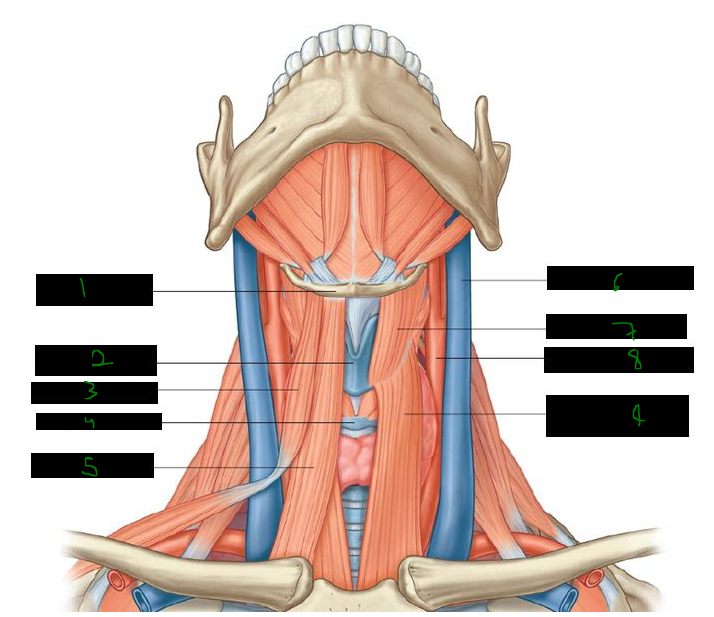 What is 1? | back 103 hyoid bone |
front 104 What is 2? | back 104 thyroid cartilage |
front 105 What is 3? | back 105 omohyoid muscle |
front 106 What is 4? | back 106 cricoid cartilage |
front 107 What is 5? | back 107 sternohyoid muscle |
front 108 What is 6? | back 108 internal jugular vein |
front 109 What is 7? | back 109 thyrohyoid muscle |
front 110 What is 8? | back 110 common carotid artery |
front 111 What is 9? | back 111 sternothyroid muscle |
front 112 what muscles are innervated by C1 ant rami via hypoglossal n (XII)? _____ (_____ group) _____ (_____ group) | back 112 thyrohyoid (infrahyoid group) geniohyoid (suprahyoid group) |
front 113 The branches of the external carotid artery are: _______ _______ (1st branch), _______ pharyngeal, _______, _______, _______, posterior _______, and the two terminal branches _______ and superficial _______. | back 113 superior thyroid, ascending, lingual, facial, occipital, auricular, maxillary, temporal Some Anatomists Like Freaking Out Poor Medical Students |
front 114 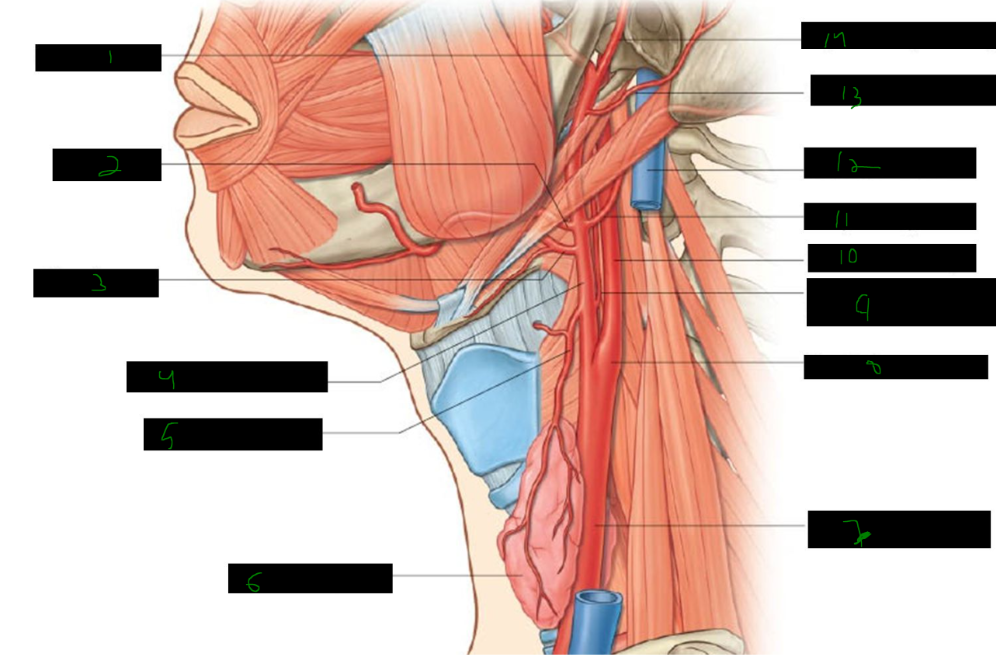 What is 1? | back 114 maxillary artery |
front 115 What is 2? | back 115 facial artery |
front 116 What is 3? | back 116 lingual artery |
front 117 What is 4? | back 117 external carotid artery |
front 118 What is 5? | back 118 superior thyroid artery |
front 119 What is 6? | back 119 thyroid gland |
front 120 What is 7? | back 120 common carotid artery |
front 121 What is 8? | back 121 carotid sinus |
front 122 What is 9? | back 122 ascending pharyngeal artery |
front 123 What is 10? | back 123 internal carotid artery |
front 124 What is 11? | back 124 occipital artery |
front 125 What is 12? | back 125 internal jugular vein |
front 126 What is 13? | back 126 posterior auricular artery |
front 127 What is 14? | back 127 superficial temporal artery |
front 128 The first branch of the external carotid artery is the _______ _______ artery. The terminal branches of the external carotid artery are the _______ _______ artery and the _______ artery. | back 128 superior thyroid superficial temporal, maxillary |
front 129 The common carotid and external carotid pulses can be palpated in the _______ triangle of the neck, with the common carotid felt _______ to the larynx and the external carotid felt immediately _______ to the pharynx midway between the superior margin of the _______ cartilage and below the greater horn of the _______ bone. | back 129 anterior, posterolateral, lateral, thyroid, hyoid |
front 130 The glossopharyngeal nerve emerges deep to the _______ process and passes between the internal and external _______ arteries. | back 130 styloid, carotid |
front 131 The glossopharyngeal nerve sends sensory branches to the carotid _______ and the _______. | back 131 sinus, pharynx |
front 132 The glossopharyngeal nerve passes across the lateral border of the _______ muscle and innervates it. | back 132 stylopharyngeus |
front 133 The glossopharyngeal nerve continues anteriorly, deep to the _______, to reach the base of the _______ and the palatine _______. | back 133 hyoglossus, tongue, tonsil |
front 134 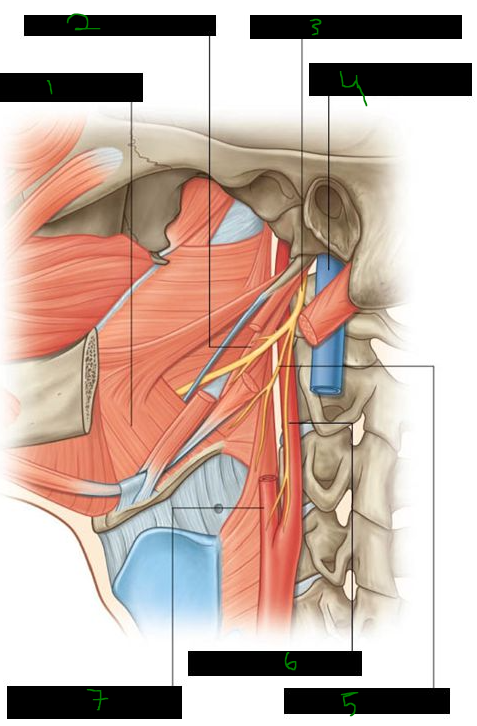 What is 1? | back 134 hyoglossus muscle |
front 135 What is 2? | back 135 stylopharyngeus muscle |
front 136 What is 3? | back 136 glossopharyngeal nerve IX |
front 137 What is 4? | back 137 internal jugular vein |
front 138 What is 5? | back 138 pharyngeal branch |
front 139 What is 6? | back 139 carotid sinus branch |
front 140 What is 7? | back 140 external carotid artery |
front 141 The vagus nerve enters the _______ sheath and descends through the neck medial to the _______ jugular vein and posterior to the _______ arteries. | back 141 carotid, internal, carotid |
front 142 The vagus nerve sends motor branches to the _______, sensory branches to the carotid _______, and gives off the superior _______ nerve and possibly a _______ branch. | back 142 pharynx, body, laryngeal, cardiac |
front 143 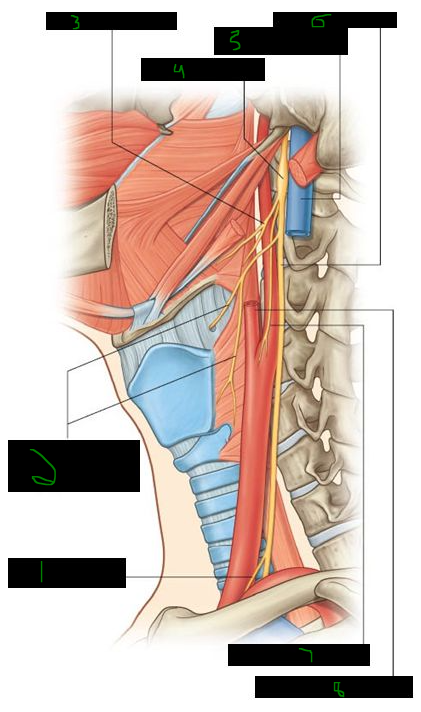 What is 1? | back 143 cardiac branch |
front 144 What is 2? | back 144 internal and external branches of superior laryngeal nerve |
front 145 What is 3? | back 145 pharyngeal branch |
front 146 What is 4? | back 146 inferior ganglion |
front 147 What is 5? | back 147 internal jugular vein |
front 148 What is 6? | back 148 vagus nerve X |
front 149 What is 7? | back 149 carotid body branch |
front 150 What is 8? | back 150 external carotid artery |
front 151 The carotid sinus contains _______ that detect changes in arterial _______ pressure. The carotid sinus is innervated primarily by the _______ nerve (cranial nerve _______) with contributions from the _______ nerve (cranial nerve _______). | back 151 baroreceptors, blood glossopharyngeal, IX, vagus, X |
front 152 The carotid body is located on the _______ side of the carotid bifurcation near the carotid _______, functions as a _______ that monitors _______ levels in blood, and is innervated by the _______ nerve with contributions from the _______ nerve. | back 152 deep, sinus, chemoreceptor, O2, glossopharyngeal, vagus |
front 153 The accessory nerve descends medial to the _______ _______ vein and crosses its lateral surface deep to the _______ muscle. The accessory nerve gives _______ branches in the anterior triangle and innervates the _______ and _______ muscles. | back 153 internal jugular, SCM no, SCM, trapezius |
front 154 The hypoglossal nerve crosses between the _______ _______ vein and _______ _______ artery, hooks around the _______ artery, travels deep to the posterior belly of the _______ and _______ muscles, then travels superficial to the _______ and disappears deep to the _______; it gives _______ branches in the anterior triangle en route to the _______. | back 154 internal jugular, internal carotid, occipital, digastric, stylohyoid, hyoglossus, mylohyoid, no, tongue |
front 155 The transverse cervical nerve is a branch of the _______ plexus from spinal segments _______ and _______, loops around the _______ muscle, and provides _______ innervation to the skin of the _______ triangle. | back 155 cervical, C2, C3, SCM, sensory, anterior |
front 156 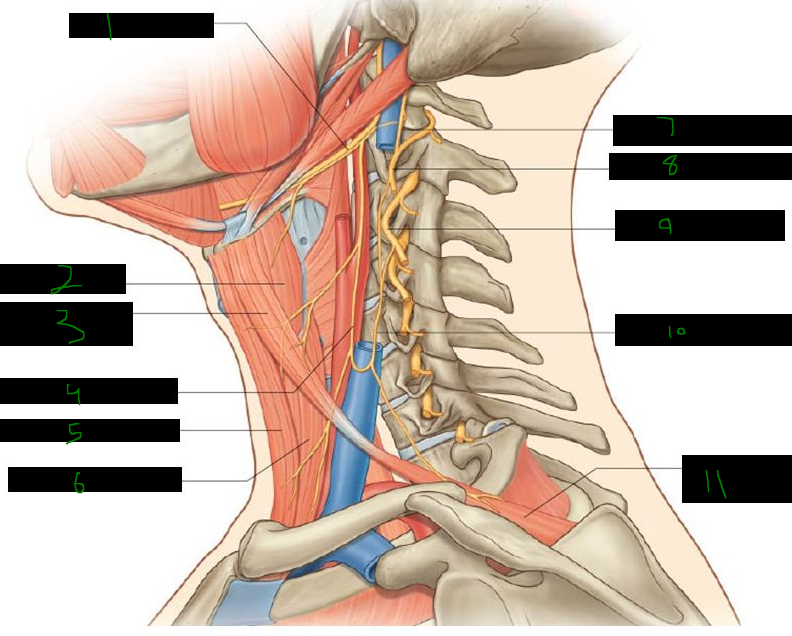 What is 1? | back 156 hypoglossal nerve |
front 157 What is 2? | back 157 thyrohoid muscle |
front 158 What is 3? | back 158 omohyoid muscle (superior belly) |
front 159 What is 4? | back 159 superior root of ansa cervicalis |
front 160 What is 5? | back 160 sternohyoid muscle |
front 161 What is 6? | back 161 sternothyroid muscle |
front 162 What is 7? | back 162 C1 |
front 163 What is 8? | back 163 C2 |
front 164 What is 9? | back 164 C3 |
front 165 What is 10? | back 165 inferior root of ansa cervicalis |
front 166 What is 11? | back 166 omohyoid muscle (inferior belly) |
front 167 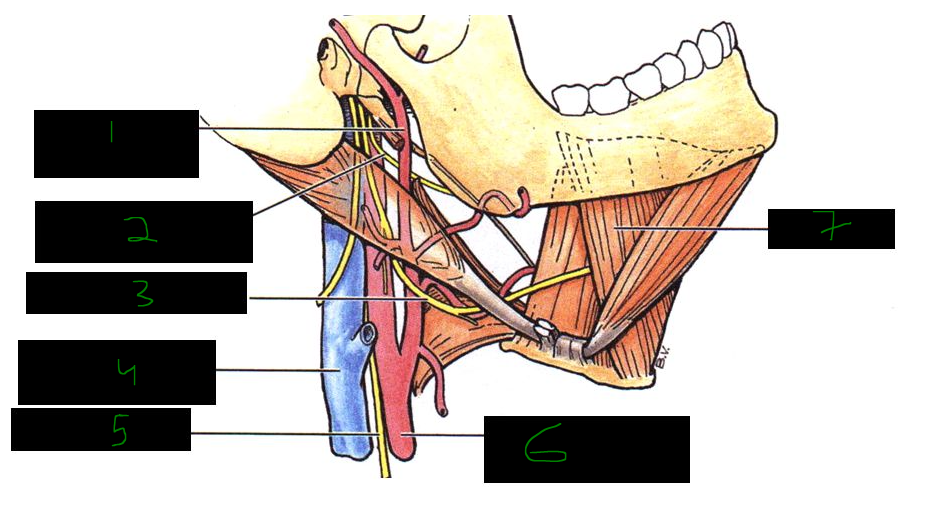 What is 1? | back 167 external carotid artery |
front 168 What is 2? | back 168 glossopharyngeal nerve |
front 169 What is 3? | back 169 hyoglossal nerve |
front 170 What is 4? | back 170 internal jugular vein |
front 171 What is 5? | back 171 vagus nerve |
front 172 What is 6? | back 172 common carotid artery |
front 173 What is 7? | back 173 mylohyoid |
front 174 which cervical nerves form the roots of the ansa cervicalis superior root - branches of ___, ___ inferior root - branches of ___, ___ | back 174 C1, C2 C2, C3 |
front 175 The thyroid gland receives blood from the _______ _______ artery, the first branch of the _______ _______ artery, and the _______ _______ artery, a branch of the _______ trunk. | back 175 superior thyroid, external carotid, inferior thyroid, thyrocervical |
front 176 During a thyroidectomy, care must be taken not to damage the _______ nerves and to retain the _______ _______ glands. | back 176 laryngeal, parathyroid |