GIS test two, satellites
What is an orbit? (think very generally)
the repeating path that one object takes around another
What is an orbit cycle?
The interval of time required for a satellite to pass a point on Earth’s surface directly below the satellite for a second time.
What is revisit time?
The interval of time between observations of the same point on Earth by a satellite
Why can the revisit time of a satellite differ from its orbit cycle?
because satellites can look off-nadir and therefor pass a point twice without imaging it both times.
What is a Geostationary Orbit?
An orbit that matches the speed and direction of
Earth’s
rotation and therefor appears to be stationary over a fixed position
of the earth.
What would be some uses of a satellite in geostationary orbit (2)
Continuous data collection over one location for weather, communication satellites
Decreasing the revisit time of a satellite _____________ the temporal resolution of its images. Geostationary satellites have a ________ temporal resolution.
decreases, high
What is a near-polar orbit?
An orbit path close to the North and South Poles
What is a sun-synchronous orbit? What is the advantage of this?
An orbital path set so the satellite crosses the
same area at
the same local time. Consistent illumination conditions in each
season, reduces the variables between images to provide more accurate comparisons.
What is a satellite swath?
The width of the ground area a satellite images
What is an Across-track scanner? What is the other name it's referred to as?

A scanning method that uses a rotating mirror to collect data by moving back and forth, also referred to as a whiskbroom scanner.
What is an Along-track scanner? What is the other name it's referred to as?

A scanning method that uses a linear array to collect data directly on a satellite’s path, also referred to as a pushbroom scanner.
What is relief displacement?
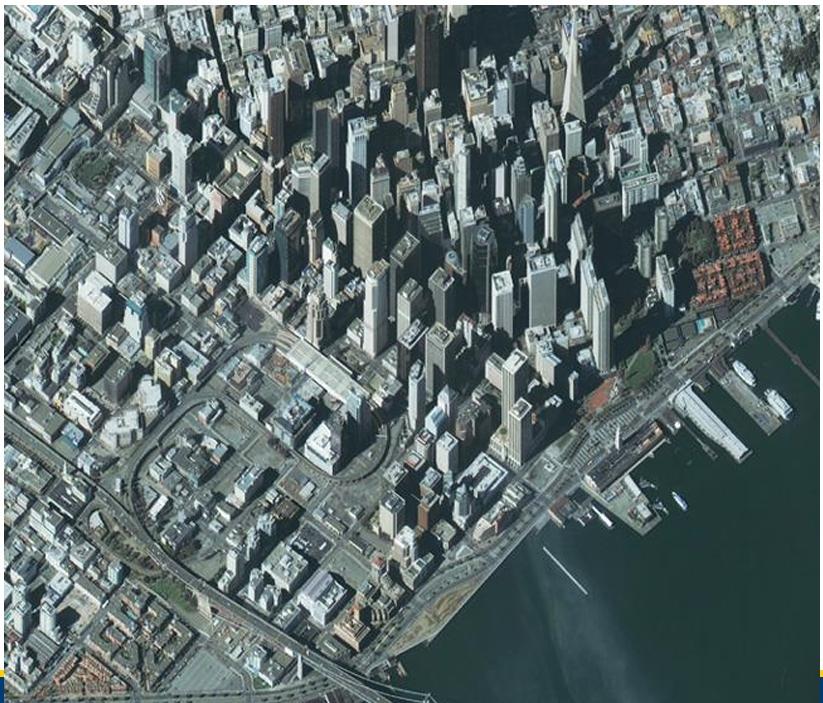
When objects towards the edge of an image appear to lean away from the centre of the image
What is Tangential scale distortion?

The compression of image features located further away from nadir
What is Off-Nadir viewing?
The capability of a centre to look off nadir
What do we use to track satellites?
Receiving stations
The U of L Satellite Receiving Station is owned by which company currently?
Planet labs
What is the spatial resolution of a satellite?
The smallest unit of area the sensor can collect
information about
What is the Radiometric resolution of a satellite?
The sensor’s ability to determine fine
differences in a band of
energy measurements.
What is the Spectral resolution of a satellite?
The number and width of bands measured by a
sensor.
What is the Temporal resolution of a satellite?
The revisit time, or time between images in the
same location.
___________ has over _____ years of continuous monitoring and is considered the gold standard due to its quality data and longevity.
Landsat, 50
When was Landsat 1 launched?
1972
With which satellite did Landsat switch from across track to along track sensors?
Landsat 8
Landsat satellites have progressed from ___ bit with Landsat 1 to ___ bit with Landsat 8 and 9.
6 bit, 12 bit
A _______________ sensor measures one broad range of wavelengths
Panchromatic
What is pansharpening?
The process of merging high-resolution panchromatic and lower resolution multispectral imagery to create a single-coloured image
What does SWIR stand for? What does NIR stand for?
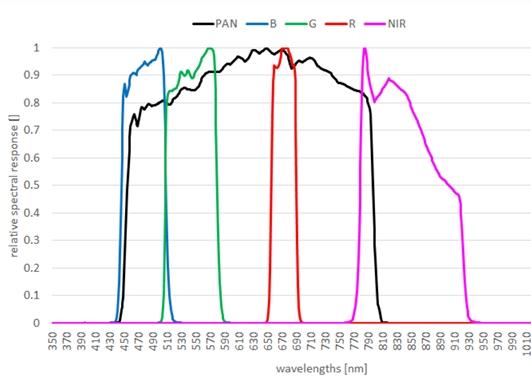
SWIR = short wavelength infrared
NIR = near infrared
What broke on Landsat 7 that corrected for forward motion?

The Scan Line Corrector (SLC)
What are the two new bands added to Landsat 8 and 9? What are they used to detect?
Band 1: ultra-blue- to detect chlorophyl concentrations (ocean
colour) in coastal
regions and for aerosol detection
Band 9: cirrus band- to detect cirrus clouds by measuring reflected NIR energy
________ is the 2nd longest-running Earth Observation mission (37 years) but has a ________________ orientation instead of an experimental one.
SPOT, commercial
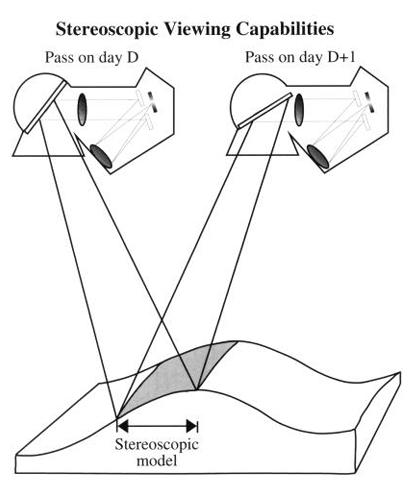
SPOT is capable of off-nadir viewing which
creates image
____________ and allows for the creation of which type of model?
parallax, digital elevation models
SPOT orbits the world from pole to pole and revisits points on earth at the same local time each time it passes over them. Which two terms apply to SPOT's orbits?
Near-polar and sun-synchronous
Sentinel, operated by the European Space Agency (ESA), has three main uses. What are they?
Land Monitoring (information on land cover like vegetation state and the water cycle), Emergency management (information for the management of natural disasters, man-made emergency situations and humanitarian crises), and Security (border and maritime surveillance)
Why was the company Digital Globe revolutionary?
They produced the first public collection of high-resolution imagery that rivalled military technology with the satellite IKONOS-2.
Why was the company WorldView revolutionary?
They produced the world’s first 50 cm resolution commercial satellite.
What is the goal of Maxar’s WorldView Legion?
To support US national security through surveillance and monitoring
Planet labs has three satellite types that make up their constellation. What are they?
• Dove
• RapidEye
• SkySat
Why were Dove satellites so different in a practical sense from the norm of the time? (2)
- Size, 10 X 10 X 30 cm and weigh about 10 lbs
- Many can be launched at the same time
Of the three satellite types that made up the Planet labs constellation which was retired?
RapidEye