ENTO EXAM 2
What order do roaches and termites fall under?
Blattodea
-Most common
-2 stripes on pronotum
-females produce 35,000 offspring in their lives
--carry the egg case to where they think is best to glue them
German cockroach
-yellow band across abdomen
-found in homes, apartments
-like starch, low water needs
-like dry areas
Brown banded cockroach
Insects depend on
external temperature to function and grow (if hot: develop fast; if cold: develop slow)
-males have short wings and females have wings that cover 3/4 of body
-seasonal development (winter=adults, spring=mate, outside for summer and inside in fall)
-like decaying organic matter (drains)
Oriental cockroach
What problems do cockroaches cause in homes?
-Contamination (fecal and salivatory contaminate food)
-carry disease and allergens
Cockroaches are_______ which means they prefer to live outside but like being inside for stability and food
Exophilic
What are problems do cockroaches cause in homes?
-Contamination (fecal and salivatory contaminate food)
-carry disease and allergens
What is a ootheca?
is an egg case from german cockroach
Termites colonize in groups in soil and wood. They cause more than___
$2 billion of damage per year in the US
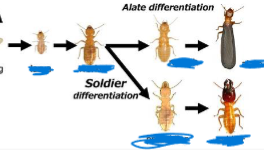
Termite stages:
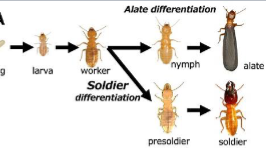
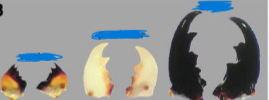
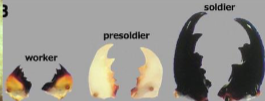
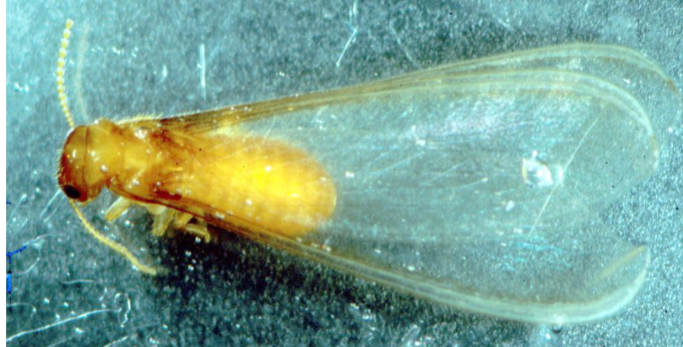
What is their role?
reproductives
Subterranean termites like to build on the ground which causes
more home damage because their homes won't suffer any consequences
What order and family to bed bugs fall in?
-Hemiptera
-Cimicidae
Where do bed bugs dwell?
where hosts live, like mattress/carpet
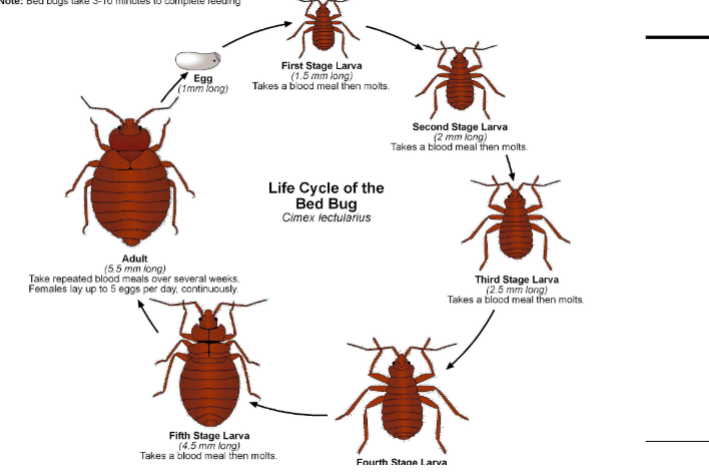
What is the difference between nymphs and adults?
-nymphs take blood meals then mult
- Adults constant feeding on blood
In order to get rid of bed bugs, one must
expose clothes to extremely hot temperatures and throw away mattress
Assassin bugs/ kissing bugs causes Chages disease which causes
serious heart degeneration and other problems
Chages disease can also be contracted from
blood donations
How do you decide which case to take?
-look if it's within your expertise
-consider how emotionally taxing the case will be to you
What is the order name for fleas?
Silphonaptera
What is the scientific name of flea?
Ctenocephalides felils
What is the family and order name of kissing bugs?
- Hemiptera
- Reduviidae
What are tenurial adults?
Adults that just emerged from pupae
Natural or unavoidable damage, foreign substance in foods for human use that isn't harmful to humans
Defect in food
What is the point of having levels of defect in food?
because it is economically impractical to grow, harvest, or process raw products that are free of naturally occurring defects
What is the common name of this insect:
Order: Lepidoptera
Family: Pyralidae
moths and butterflies
What is the common name of this insect:
Order: coleoptera
Family: Ptinidae
Biscuit beetle
What is the common name of this insect:
Order: Coleoptera
Family: dermestidae
Larder beetle
What is the common name of this insect:
Order: Coleoptera
Family: Tenebrionidae
red flour beetle
What is the common name of this insect:
Order: Coleoptera
Family: Silvanidae
Sawtoothed grain beetle
What is the common name of this insect:
Order: Diptera
1. Family: Drosophilidae
2. Family : Tephritidae
-Vinegar flies
-True fruit flies
-infest food
-dried, stored products
-make a silk film on food
-flour, oats, cereal, energy bars, dried fruit, cat & dog food
-Adults have bright copper sheen and fly in a zigzag pattern
Indian Meal moth (plodia interpunctella)
-inhabits herbs, teas, drugs, foodstuffs, pasta
-pearly white eggs
-c-shaped grubs
Drugstore/biscuit beetle (stegobium paniceum)
-inhabits cured meat, cheese, dried dog food, animal by-products, and even dead insects
-eggs are yellowish
-hairy larvae
-bore into wood
Larder beetle (Dermestes lardarius)
-Inhabits wheat flour, dried fruits, breakfast cereals, damaged grains
-like moist environment
-long and armored larvae
-eggs are clear/white
-larvae yellowish and change from yellow to brown
Red flour beetle (tribolium castaneum)
- Inhabited milled grains (damaged), cereals, bread, popcorn, dried fruit, cake mix, crackers, and macaroni
Sawtoothed grain beetle (Oryzaephilus surinamensis)
-attracted to moist organic matter
-larvae feed on organic material(rotting)
"fruit" flies (vinegar flies)
- use fruit as host
-female lay eggs on fruit and larvae develop in fruit
-major pests
True fruit fly (tephritidae)
The best method to get rid of fruit flies and vinegar flies is by
throwing away contaminated product
What method is best to control stored product infestations?
removal of infested product or food source
D. Suzukii is unique because females have a______ that can lay eggs inside healthy fruits
Ovipositor
the study of decomposing or decaying organisms over time, including the process leading to fossilized remains
Taphonomy
Non-living physical and chemical elements in an ecosystem
Abiotic factors
The study of the processes and phenomena of the atmosphere
meteorology
The state of the atmosphere, mainly to its effects upon human activities. Short-term variability of the atmosphere (time scales of minutes to months)
Weather
Long term statistical description of the atmospheric conditions, averaged over a specific period-usually decades
Climate
What abiotic factors affect decomposition and insect behavior?
temperature, wind speed, moisture, wind direction, clouds, shade vs. sunlight
When it comes to temperature, insects depend on
external temperature to function and grow (if hot: develop fast; if cold: develop slow)
How does moisture affect insect development and behavior?
Larvae stay on body for entire lifespan, but if moisture is lost, larvae leave to find new food sources
Fatty tissue breakdown in moist conditions
Adipocere
How does wind speed affect adult insect development and behavior?
Flight and olfactory senses
How does wind speed affect larvae insect development and behavior?
development and survival
How does wind direction affect insect development and behavior?
movement, exposure, location-based
How do clouds affect insect development and behavior?
-development
- activtiy (within and across season)
-Location
T or F: Sunlight vs. shade affects insect development and behavior.
true
What biotic factors affect decomposition?
-Scavengers
-Necrophagous insects
-Microbes
-fungi bacteria
-soil-dwelling microorganism
-Coma and cerebral unresponsiveness
-Dilated pupils
-absent cephalic reflexes
-Apnea
brain death
Body cools to ambient temperature
Algor mortis
-Fibers in muscles stiffen due to calcium build up
-takes 12 hrs to appear fully, lasts 12 hrs, and takes 12 hrs to disappear
-affected by exercise, convulsions, electrocution, heat
-physical conditions where body is found
Rigor mortis
-Purplish-blue discoloration due to settling of blood by gravitational forces
-evident as early as 20 mins after death
-fixed after 8-12 hrs
livor mortis
a postmortem discoloration of the sclera, or white part of the eye, that appears as a brown or black stripe due to exposure and occurs from minutes to hours
tache noir
-Can be localized due to trauma/ stress before death
-occurs in deaths preceded by great excitement or tension
Cadaveric spasm
-Self-dissolution by body enzymes/chemicals (fuels putrefaction)
Autolysis
-Decomposition changes produced by action of bacteria and microorganisms
- gases are produced
Putrefaction
The ______ is an elected official that does not have expertise in medicine
coroner
_____physician/forensic pathologist (autopsy)
Medical examiner
Scientists that uses knowledge of body and body processes to gather information pertaining to death.
forensic pathologist
What are the things to look for in an autopsy?
-Fatty liver
-brain tumor
-enlarged heart
-lung cancer
Bruises
contusions
Scraping damage to skin
Abrasion
Why might both a pathologist and an entomologist be needed?
- determine PMI using state of human remains
- pre-existing wounds and trauma
-burned remains
-drug abuse
What are methods of PMI estimation?
-PMI calculation based on temperature
-ocular changes
-Potassium levels
-livor mortis
-rigor mortis
-Stomach contents
What are the uses of insect evidence?
- ability to rapidly locate and colonize corpse
-Predictable patterns for succession
-time since death (range)
-links suspects and victims
-establish timeline of abuse or neglect
-algor mortis, rigor mortis, blood coagulations
PMI
-identification of flies and age of developmental stage
- base temperature threshold for the species
- temp data from remains recovery scene
- temp data from nearby weather station
- experimental development data at relevant temps for fly of interest
TOC
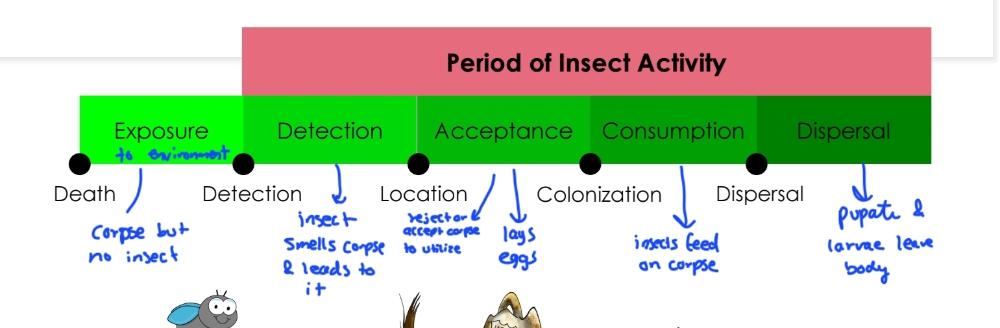
Process of how bugs colonize
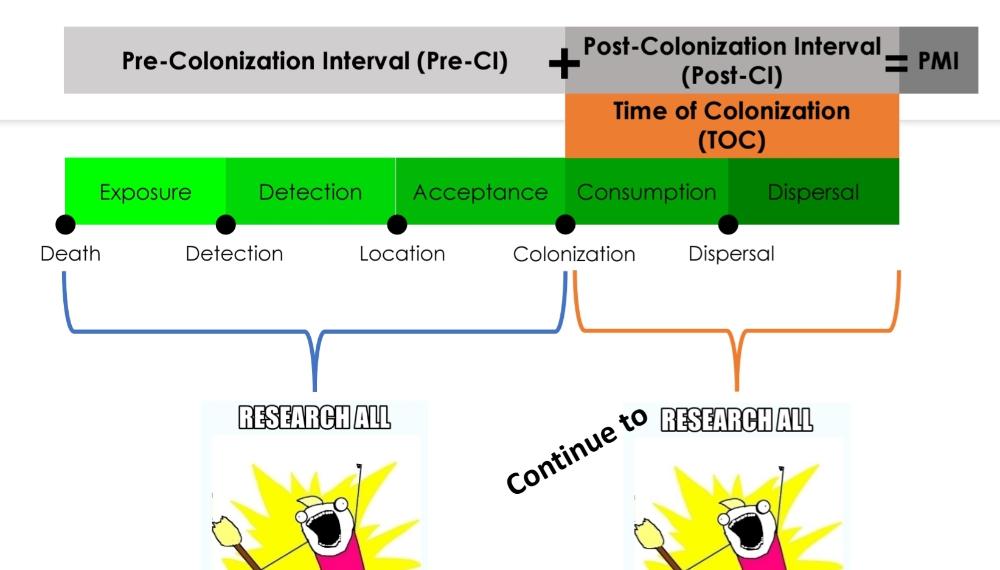
How PMI and TOC can align
ABFE ( American Board of Forensic Entomology) is a
certifying board for forensic entomologists in North America
There are three tiers to the ABFE which are the
members, diplomats, and technicians
Deliberate harm to someone or something
abuse
Failure to meet basic life needs:
-food
-water
-shelter
neglect
What are the types of abuse?
-physical
-sexual
- Emotional
-Trafficking
What are the types of neglect?
neglectful supervision, medical neglect, physical neglect, abandonment and refusal to accept parental responsibility
How can myiasis affect PMI?
because of the parasitic investation of a living animal
-insect colonization before death
Does myiasis always fall under cases of neglect or abuse?
NOOO, it can be due to bad hygiene
What are forms of funeral home negligance?
-embalming errors
-Improper treatment of remains
-cemetery negligence
What can insect evidence tell us?
-Duration
-movement of remains
-Location of crime
-injury
- Ante-mortem drug ingestion (from skin and gut of insect)
- cause or manner of death
What methods can be used to collect adults?
-Sweep net sampling
-kill jar
-sticky traps
What methods can be used to collect immature?
-look at body orficies and body folds
- soil, under body, maggot masses
-representative samples of egg masses, largest and smallest larvae, larvae of diff. species
-Alcohol filled jar
- allow for pupate to emerge (send empty pupal casing)
Preservation of evidence
Olfactory cues
Insects pick up on volatile organic compounds (VOCs)
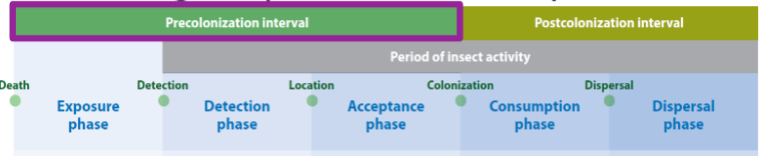
Entomological phases of decomposition:
In postcolonization interval,
lay eggs and move off the body
In exposure, there are no
insects and have microbe activity
Detection results in insects
smelling volatile compounds
In the acceptance step, insects
interact with remains and accept or reject the resource
Consumption step oviposition (laying eggs) occurs and
insects are actively feeding
The dispersal step,
insects complete feeding and leave remains
A repeatable sequence of community changes specific to particular environmental circumstances
seres
What are factors of spatial variability?
urban, rural, forest, field, submerged, buried, europe, South America, Indoors, and outdoors
What is temporal variability?
night, day, winter, and summer
Does size affect the type of insects that colonize the body?
YES
Does being burned or wrapped affect the insect activity?
YES
Catalog of taxa present (kingdom, phylum, order, etc.)
structure
Number of taxa in a given environment (# of taxa)
diversity/biodiversity
Number of different species represented in a given community
Species richness
What abiotic factors affect decomposition and insect behavior?
temperature, wind, moisture, clouds, shade vs. sunlight
Catalog of "what" taxa are doing (roles of taxa)
Function
Insects depend on external temperature to
function and grow (if hot: develop fast; if cold: develop slow)
feed on others present on the carrion
Predator
Live on others that feed on carrion
Parasite
Do it all (wasps, ants)
Omnivorous
How many maggots should be collected from each maggot mass?
2 maggots per maggot mass
Use remains as extensions of environment (springtail)
Adventive
Death is a major event not only for the person who dies but also for the microbes that inhabit their body. Which of the following statements best describes why?
A. Microbial populations grow and spread to different areas of the body after the person dies.
B. All the microbes that were living inside the person’s body die when the person dies.
C. Microbes in the body have fewer resources after the person dies, which increases competition.
A. Microbial populations grow and spread to different areas of the body after the person dies.
Microbes in the body have fewer resources after the person dies, which increases competition. Which of the following statements about cadavers (dead bodies) is most likely to be true?
A. Microbial communities in and around a cadaver change over time.
B. Samples taken from different cadavers always contain the same microbes.
C. The microbial community found in a cadaver is very similar to the one found in a living body.
A. Microbial communities in and around a cadaver change over time.
The microbial community found in a cadaver is very similar to the one found in a living body. After death, gases build up inside the body and cause the skin to rupture (break open). Rupture is a significant event because microbes from outside the body can now access the inside. Which of the following can be a source of the microbes that enter the body after it ruptures? Select all that apply.
A. skin
B. air
C. soil
D. insects
A,B, C, D
In 3-4 complete sentences, describe in your own words (no quotes) how the scientists in the second video are using microbes to create a tool to estimate the time since death.
Scientists collect skin and soil swab samples of cadavers because it was proven that testing for microbes can almost accurately determine the time of death. They can find which microbes should be present based on a microbial clock created that can give a better visual of which microbes show up in different stages of decomposition. The DNA is then sequenced from the microbes on the swab. The results can then be compared to the microbial clock to determine the time of death.
The law of conservation of energy states that the amount of energy in an isolated system stays constant. In other words, energy cannot be created or destroyed; it can only change form. Explain in your own words, no quotes, how the decomposition of a cadaver demonstrates this law.
The decomposition of cadavers demonstrates the law of conservation because when an organism, human or animal, dies, the energy is then consumed by microbes to regenerate and grow. The energy can be transferred or recycled to start a new life for a different organism.
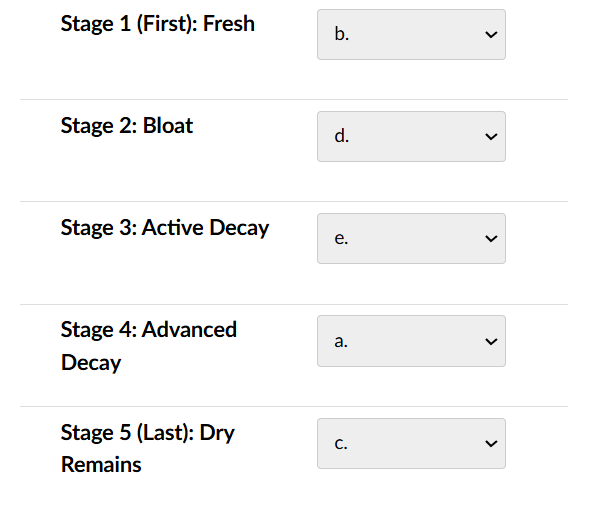
a. Eventually, most of the cadaver’s mass is transferred into the ground or consumed by scavengers. Fungi flourish. Decomposition gradually slows as maggots and scavengers leave. Plants close to the cadaver may die from the overload of nutrients and other components coming from the cadaver.
b. The heart stops beating, so there is less oxygen inside the body. Cells begin to die, and the body no longer maintains a stable temperature. With no immune system regulating microbes that live inside the body, their populations start to shift and grow. Flies lay eggs, which will develop into maggots, in the cadaver’s orifices (such as the mouth and nostrils).
c. Only dried bones, cartilage, and skin remain. Surrounding plant life begins to surge due to the cadaver’s nutrients, which may influence the ecosystem for years to come.
d. With less oxygen inside the cadaver, anaerobic bacteria flourish. These bacteria break down the body’s carbohydrates, fats, and proteins, producing byproducts such as the gases hydrogen sulfide, methane, and ammonia. The accumulation of these gases gives the cadaver a strong odor and causes it to bloat. Maggots start to feed on the cadaver’s tissues.
e. The cadaver breaks open. Fluid spills out of the body’s openings, releasing an abundance of nutrients, such as nitrogen and phosphorus, into the soil. Breaks in the skin allow more microbes, insects, and scavengers to enter the body.
Assign the letters of these descriptions to the stages in Figure 1.
What abiotic factors might affect the kind of scavengers that contribute to a cadaver’s decomposition?
Factors could include temperature or season, as well as the location of the cadaver (above ground or underground, in water or on land, etc.).
Other scavengers include beetles, wasps, dogs, crows, and crustaceans. Explain how these other scavengers could also affect decomposition.
The scavengers may consume the cadaver or spread their own microbes to the cadaver, influencing the microbial community present. Some scavengers, such as insects, may also attract larger scavengers that prey on both the smaller scavengers and the cadaver.